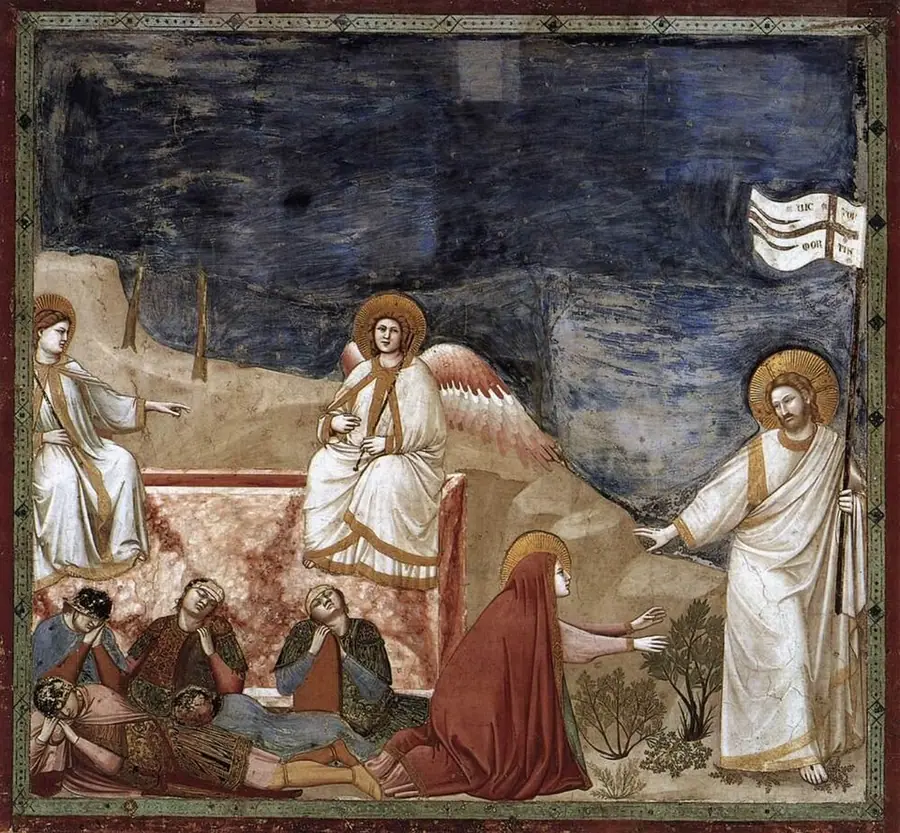
The short version: no. The idea comes from a sermon preached in Rome about five and a half centuries after her lifetime, which combined her with two other women of the Gospels; the image of the repentant prostitute was built on that sermon by medieval art and legend. The Gospels present her as a follower and benefactor of Jesus, a witness of the crucifixion and the empty tomb, and, in John, the first to see the risen Jesus. Consensus
What the Gospels say
The New Testament says these things about Mary Magdalene, and nothing more:
- She had been healed. Luke says that “seven demons had gone out” of her, and that she travelled with Jesus and the Twelve with other women, among them Joanna, the wife of Herod’s steward Chuza, and Susanna, who “provided for them out of their resources”.[1] Seven demons describes an illness or possession, not a sin. Consensus
- She was at the cross. Mark, Matthew and John name her among the women who watched the crucifixion; Luke mentions the women from Galilee there without naming them.[2][3] Consensus
- She found the tomb empty. In Mark she goes with other women to anoint the body and finds the tomb empty; the earliest manuscripts end with the women fleeing in fear (§0).[4] Consensus
- She saw the risen Jesus first. In John she weeps at the tomb, mistakes Jesus for the gardener, recognises him when he calls her name, and is sent to tell the disciples, “I have seen the Lord”.[5] Consensus
Her name means “of Magdala”, a town on the western shore of the Sea of Galilee, where a first-century synagogue was excavated in 2009 (§1).[6] Majority Luke’s mention of women who funded Jesus’ group “out of their resources” suggests she had means of her own. Majority
The two other women
The confusion begins with two anointing stories:
- In Luke 7:36–50, an unnamed “woman in the city, who was a sinner” anoints Jesus’ feet with ointment and her tears in the house of a Pharisee, and Jesus forgives her.[7]
- In John 12:1–8, Mary of Bethany, the sister of Martha and Lazarus, anoints Jesus’ feet in her own home.[8]
Neither is identified with Mary Magdalene in the text. Luke introduces Mary Magdalene in the very next chapter as a new character, with no hint that she is the woman of chapter 7. Consensus Nor does Luke say what the woman’s sin was. Consensus
Gregory’s sermon
In a homily preached in Rome, usually dated to 591, Pope Gregory the Great joined the three into one:
Hanc vero quam Lucas peccatricem mulierem, Iohannes Mariam nominat, illam esse Mariam credimus de qua Marcus septem daemonia eiecta fuisse testatur.
“She whom Luke calls a sinful woman, and John names Mary, we believe to be the Mary from whom, Mark testifies, seven demons were cast out.”[9]
Gregory went on to read her seven demons as all the vices and the ointment as the perfume she had once used on her own body in sin. He does not call her a prostitute; he makes her a sinner whose sins were sexual, and a model of penitence.[9][10] Majority His sermon fixed the identification for the Western church. Majority
From penitent to prostitute
For the medieval West, Mary Magdalene became the great example of repentance: the sinner whose love won forgiveness. Art showed her with long loose hair and an ointment jar, weeping; legends had her preach in Provence and end her life as a hermit, and her supposed relics were venerated at Vézelay from the eleventh century and at Saint-Maximin from 1279.[10][11] Majority The former prostitute is a product of this tradition of art, legend and preaching, not of any single text. Consensus
The older title survived alongside it. Medieval writers called her apostolorum apostola, “apostle of the apostles”, because in John’s Gospel the risen Jesus sends her to the apostles with the news.[11] Majority
The Greek-speaking churches never accepted Gregory’s identification. The Orthodox honour Mary Magdalene as a myrrh-bearer and “equal to the apostles”, with separate days for her, for Mary of Bethany and for the sinful woman.[10] Majority
1969 and 2016
In 1969 the revision of the Roman calendar removed the identification: the feast of 22 July was to commemorate only the Mary Magdalene to whom the risen Christ appeared, and the Gospel reading changed from Luke 7 to John 20.[10] Majority On 3 June 2016 a decree of the Congregation for Divine Worship raised her memorial to a feast, the rank of the apostles’ days.[12] Consensus The popular image changed more slowly. Majority
Was she Jesus’ wife?
A second modern legend makes Mary Magdalene Jesus’ wife. It draws on two second-century texts. The Gospel of Mary shows her teaching the disciples what the Saviour revealed to her privately, and Peter objecting that Jesus would not have preferred a woman; Karen King reads it as evidence of an argument over women’s authority in the second-century churches.[13][14] The Gospel of Philip, a Valentinian text, calls her Jesus’ koinōnos, “companion”, and says he kissed her often, though the papyrus is damaged where it says where; the passage belongs to Valentinian language about spiritual union.[15][14] Majority That either text shows a marriage is not a mainstream scholarly reading (§5).
A papyrus fragment unveiled by King in September 2012, with the words “Jesus said to them, my wife”, was soon challenged; after the journalist Ariel Sabar traced its owner in 2016, King acknowledged that the evidence pointed to forgery.[16][17] Consensus No ancient source says Jesus was married. Consensus
Common misconceptions
- “The Bible calls her a prostitute.” It never does, and never calls her a sinner. Consensus
- “She was the woman caught in adultery.” That story (John 7:53–8:11) names no woman, and it is absent from the earliest manuscripts of John (§0). Consensus
- “The Catholic Church called her a prostitute until 2016.” The official identification with the sinful woman was dropped from the calendar in 1969; 2016 raised her rank. Majority
- “The Gnostic gospels prove she was Jesus’ wife.” They show second-century Christians arguing about her authority; they do not describe a marriage. Majority
Why it matters
Mary Magdalene is the clearest case in the Christian tradition of a figure remade by later interpretation. A woman whom the earliest texts present as a patron, a witness at the cross and at the empty tomb became, through one sermon and a thousand years of art, a reformed sinner. The change says less about her than about how the medieval church preached repentance, and about the narrowing roles of women in the churches that came after the first generation (§4, §8). Majority
References
- ^ Luke 8:1–3 — Gospel of Luke (New Testament). c. 80–90 CE. Greek. Women travel with Jesus and the Twelve and provide for them: Mary Magdalene, Joanna wife of Herod's steward Chuza, Susanna and many others. read the text
- ^ Mark 15:40–41 — Gospel of Mark (New Testament). c. 70 CE. Greek. Women who had followed Jesus in Galilee, including Mary Magdalene, watch the crucifixion. read the text
- ^ John 19:25 — Gospel of John (New Testament). c. 90–110 CE. Greek. Standing near the cross are Jesus' mother, his mother's sister, Mary the wife of Clopas, and Mary Magdalene. read the text
- ^ Mark 16:1–8 — Gospel of Mark (New Testament). c. 70 CE. Greek. Women find the tomb empty; a young man tells them Jesus has been raised. read the text
- ^ John 20:11–18 — Gospel of John (New Testament). c. 90–110 CE. Greek. The risen Jesus appears first to Mary Magdalene and sends her to tell the disciples. read the text
- ^ Magdala synagogue and Magdala stone — Migdal, western shore of the Sea of Galilee. 1st c. CE (before 70). A first-century synagogue found in 2009, with benches, a mosaic floor and a carved stone block showing a menorah. about
- ^ Luke 7:36–50 — Gospel of Luke (New Testament). c. 80–90 CE. Greek. An unnamed 'woman in the city, who was a sinner' anoints Jesus' feet in a Pharisee's house. read the text
- ^ John 12:1–8 — Gospel of John (New Testament). c. 90–110 CE. Greek. Mary of Bethany, sister of Martha and Lazarus, anoints Jesus' feet and wipes them with her hair. read the text
- ^ a b Gregory the Great, Homilies on the Gospels 33 — Homiliae in Evangelia. c. 591 CE. Latin. Gregory identifies the sinful woman of Luke 7 and Mary of Bethany with Mary Magdalene, and reads her seven demons as all the vices. about
- ^ a b c d Susan Haskins Mary Magdalen: Myth and Metaphor. HarperCollins, 1993. The making of the Magdalen from the Gospels to the twentieth century.
- ^ a b Katherine Ludwig Jansen The Making of the Magdalen: Preaching and Popular Devotion in the Later Middle Ages. Princeton University Press, 2000. Mary Magdalene in medieval sermons, including the title apostolorum apostola.
- ^ Congregation for Divine Worship, decree on the feast of Mary Magdalene (3 June 2016), with Arthur Roche's article — Vatican decree and commentary. 3 June 2016. Latin and English. Raises Mary Magdalene's memorial to a feast, citing Rabanus Maurus and Thomas Aquinas for the title 'apostle of the apostles'. read the text
- ^ Gospel of Mary — Berlin Codex (P. Berol. 8502); P.Oxy. 3525; P.Ryl. 463. 2nd c. CE (composition). Coptic and Greek. Mary Magdalene comforts and teaches the disciples, and Peter questions whether the Saviour would speak to a woman privately. about
- ^ a b Karen L. King The Gospel of Mary of Magdala: Jesus and the First Woman Apostle. Polebridge Press, 2003. Translation and study of the Gospel of Mary.
- ^ Gospel of Philip — Nag Hammadi Codex II,3. 2nd–3rd c. CE (composition). Coptic (from Greek). A Valentinian anthology on sacraments; calls Mary Magdalene Jesus' companion (koinōnos) in a damaged passage. about
- ^ Ariel Sabar The Unbelievable Tale of Jesus's Wife. The Atlantic, July/August 2016, 2016. The investigation that traced the owner of the 'Gospel of Jesus' Wife' fragment.
- ^ Ariel Sabar Veritas: A Harvard Professor, a Con Man and the Gospel of Jesus's Wife. Doubleday, 2020. The investigation that traced the 'Gospel of Jesus' Wife' fragment to its owner and showed it to be a modern forgery.