Yahweh’s early history in one paragraph
Yahweh, the god of Israel and Judah, first appears in history as one god among many in the southern Levant. Some of the oldest poems in the Bible have him march out of the deserts of the south, and he was probably brought into the highlands by people with roots there. In Israel he merged with El, the head of the Canaanite pantheon, took over El’s council of lesser gods and many of the storm god Baal’s images, and in some places was worshipped alongside the goddess Asherah. Kings of Israel and Judah built temples to him in more than one place, and their subjects named their children after him. The worship of Yahweh alone, and later the belief that no other god exists, came after this period (§3, §4). Majority
None of this means early Israelite religion was “pagan” in the sense the later Bible condemns, nor that the biblical account is simply wrong. It means that the religion described in the inscriptions and in the oldest layers of the Bible was more varied than the final, edited text suggests. Most of what this chapter reports comes from the biblical text read critically, from inscriptions found since the 1860s, and from the texts of ancient Ugarit, which show the Canaanite religion from which Israel’s grew. Consensus
Timeline of Yahweh’s early history and its evidence
Dates for the biblical poems are disputed and are given as the range most often proposed. Every dated inscription below was found by archaeologists or bought on the antiquities market and later traced to a site.
| Date | Event or evidence | Confidence |
|---|---|---|
| c. 1390–1350 BCE | A temple of Amenhotep III at Soleb, in Nubia, lists a “land of the Shasu of Yhw” among foreign nomad groups[1] | Consensus (text); Contested (meaning) |
| c. 1350–1185 BCE | Texts from Ugarit on the Syrian coast describe El, his consort Athirat (Asherah), Baal and the council of the gods; Yahweh is not securely attested[2] | Consensus |
| c. 1208 BCE | The Merneptah Stele names “Israel” as a people in Canaan[3] | Consensus |
| 12th c. BCE | An open-air hilltop shrine in the northern Samarian hills (the “Bull Site”) with a bronze bull figurine[4] | Majority |
| 12th–10th c. BCE (debated) | The Song of Deborah (Judges 5): Yahweh comes from Seir and Edom[5] | Contested (date) |
| c. 1020–980 BCE | A fortified town at Khirbet Qeiyafa overlooking the Elah Valley; who built it is disputed[6] | Consensus (date); Contested (identity) |
| late 10th–early 9th c. BCE | A temple at Tel Moẓa, a few kilometres west of Jerusalem[7] | Majority |
| c. 925 BCE | Pharaoh Sheshonq I campaigns in the Negev and the north; Jerusalem is not among the sites listed[8] | Majority |
| 853 BCE | “Ahab the Israelite” brings 2,000 chariots to the battle of Qarqar against Assyria[9] | Consensus |
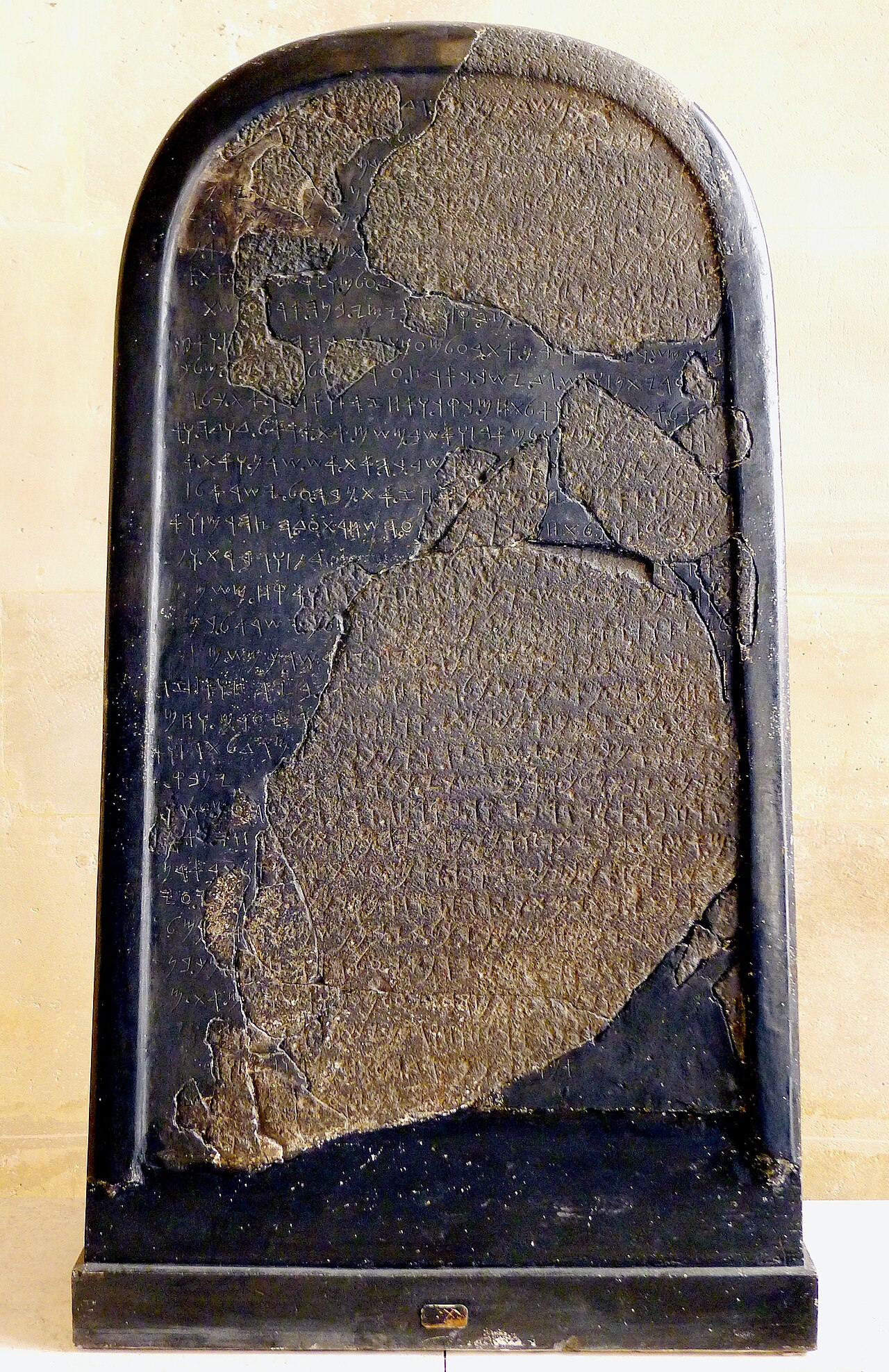
| c. 840 BCE | The Mesha Stele: the king of Moab takes “the vessels of Yahweh” from Nebo, the earliest dated mention of Yahweh as a god[10] | Consensus |
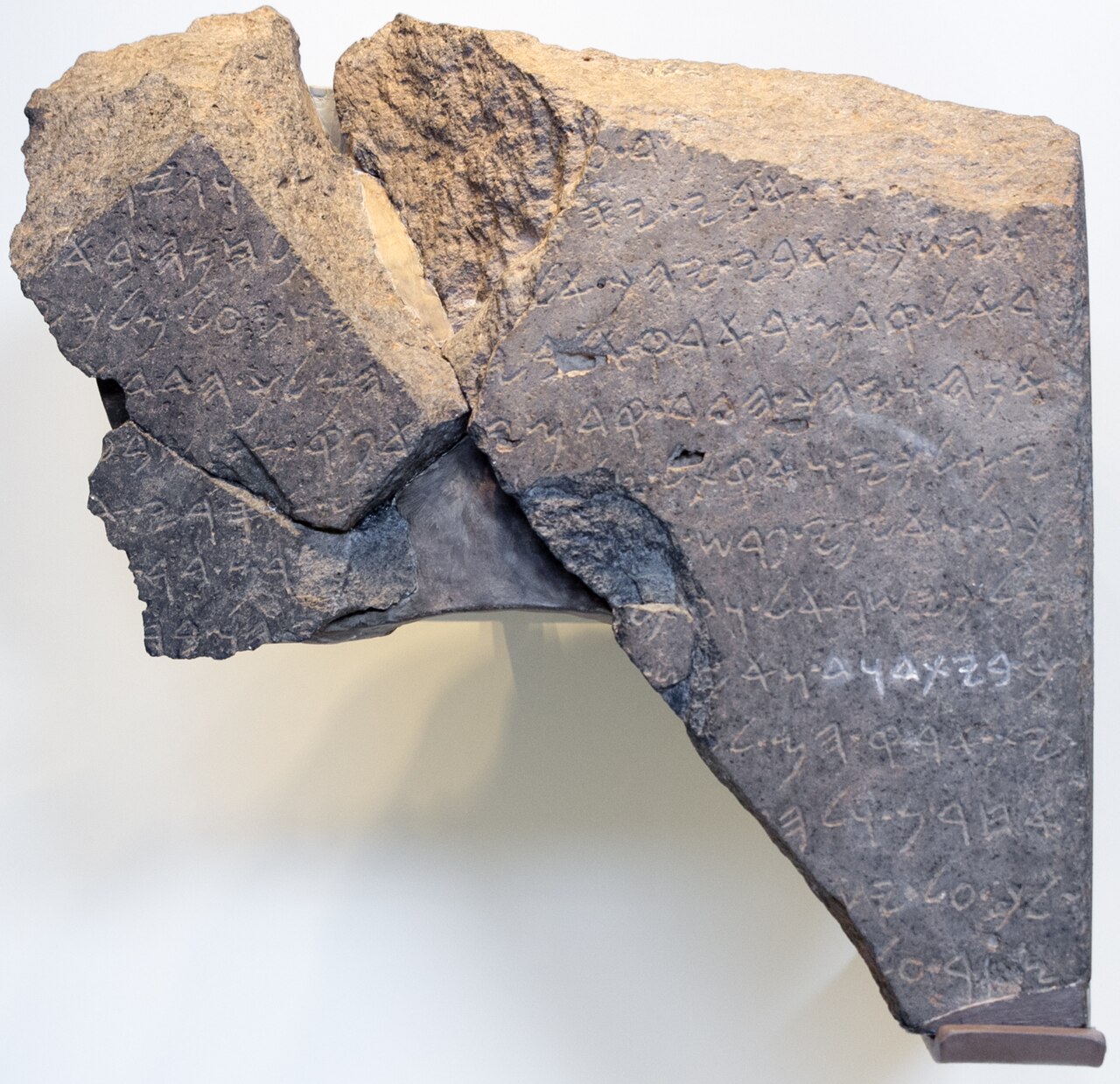
| c. 840–800 BCE | The Tel Dan Stele: an Aramaean king boasts of killing a king of the “House of David”[11] | Majority |
| c. 800 BCE | Kuntillet ʿAjrud: blessings “by Yahweh of Samaria and his asherah” and “by Yahweh of Teman and his asherah”[12][13] | Consensus |
| early 8th c. BCE | The Samaria ostraca: Israelite names built on Yahweh, and a notable minority on Baal[14] | Consensus |
| c. 760–715 BCE | The shrine in the royal Judahite fortress of Arad, with standing stones and two incense altars, is in use[15][16] | Majority |
| 2nd half of the 8th c. BCE | Khirbet el-Qom: Uriyahu is blessed “by Yahweh” and saved “by his asherah”[17] | Majority |
| 8th–early 6th c. BCE | Judean pillar figurines of a woman supporting her breasts are found in hundreds of Judahite homes and tombs[18] | Consensus |
| 722 BCE | Assyria destroys the kingdom of Israel (§3) | Consensus |
Where Yahweh came from: the southern hymns
The god of Israel does not start in Israel, according to several poems that most scholars consider among the oldest material in the Bible. In each of them Yahweh comes from somewhere, as a warrior on the march, and that somewhere lies to the south and southeast of Judah. Majority
- Judges 5:4–5, the Song of Deborah: “Yahweh, when you went out from Seir, when you marched from the field of Edom”.[5]
- Deuteronomy 33:2, the Blessing of Moses: “Yahweh came from Sinai, and dawned from Seir upon them; he shone forth from Mount Paran”.[19]
- Habakkuk 3:3: “God comes from Teman, the Holy One from Mount Paran”.[20]
- Psalm 68:8–9 (verses 7–8 in English Bibles) repeats the Song of Deborah’s image of the earth quaking before “the One of Sinai”.[21]
Seir and Edom are the highlands east of the Arabah valley, in today’s southern Jordan; Teman (“the south”) is a region of Edom; Paran is the wilderness of northern Sinai and the Negev. Mount Sinai’s location is unknown, but these poems pair it with Seir and Paran, not with the southern tip of the Sinai peninsula where later Christian tradition placed it. Majority
The poems are not the only evidence. Around 800 BCE travellers at the desert way-station of Kuntillet ʿAjrud wrote blessings “by Yahweh of Teman”, using the same southern place name as Habakkuk.[13] And the Bible itself links Moses to the south: he marries the daughter of a “priest of Midian” (Exodus 2:16–21), and in Exodus 18 that priest, Jethro, blesses Yahweh, offers sacrifice and advises Moses on how to organise the people. The Kenites, a clan associated with Midian, appear in Judges as friends of Israel.[22] Consensus on what the texts say.
The Midianite–Kenite hypothesis. Since the nineteenth century, many scholars have combined these clues into a theory: Yahweh was first worshipped by pastoral groups of the south, such as Midianites or Kenites, and reached Israel through them, perhaps with a group that later remembered an escape from Egypt (§1).[23][24] It remains the most widely held explanation, but it has always had critics, and the debate is set out at the end of this chapter. Contested
The Shasu of Yhw
The oldest possible trace of the name is Egyptian. A temple built by Amenhotep III at Soleb in Nubia, c. 1390–1350 BCE, has a list of conquered peoples. Among the entries for the Shasu, the Egyptians’ name for the nomadic herders of the Levant, is one written tꜣ šꜣsw yhwꜣ, “the land of the Shasu, Yhw”. A copy appears again in a list of Ramesses II at Amara West.[1][25]
Egyptian writing does not record vowels, and Yhw in these lists is a place or group name. Whether it is connected with the god Yahweh is not known. Many scholars think it is: the spelling fits, and the other Shasu lands mentioned with it include Seir.[26][27] Others think the link is a coincidence of sound, or that a place name and a god’s name could share a root without one producing the other. Contested
What the name means
The Bible explains the name once, when Moses asks who is sending him: “I will be what I will be” (ʾehyeh ʾăšer ʾehyeh, Exodus 3:14), followed by the name YHWH.[28] This is a play on the Hebrew verb “to be”, and many scholars think it is a later theological explanation rather than the original meaning. Frank Moore Cross proposed that the name began as part of a title of El, “he who creates (the hosts)”; others connect it with roots meaning “to blow” or “to fall”, which would suit a storm god.[29][30] None of these proposals has won general agreement. Contested
The pronunciation “Yahweh” is a scholarly reconstruction from Greek transcriptions such as Iaoue and from short forms like Yah and -yahu in personal names. In Jewish practice the name is not pronounced; readers say Adonai, “my Lord”, and Bibles translate it “the LORD”. This series uses “Yahweh” for the god of Iron Age Israel and Judah, as historians do, without any disrespect to that practice (§0).[30] Consensus
El, the god in Israel’s name
Israel’s own name contains a god, and it is not Yahweh. Yiśrāʾēl ends in -ʾēl, “El”, the name of the high god of the Canaanite world. Names of that pattern (Ishmael, Bethel, Penuel) are common in the stories of the patriarchs, which never use names built on Yahweh. Consensus
El at Ugarit. The clay tablets of Ugarit, a port city on the Syrian coast destroyed around 1185 BCE and excavated from 1929, describe El as the aged, wise father of the gods, “Bull El”, “father of humanity” and “creator of creatures”. He presides over the assembly of the gods from his tent on a mountain at the source of the rivers. His consort is Athirat, the Ugaritic form of Asherah, and the gods are “the seventy sons of Athirat”.[2][31] Consensus
El in the Bible. Much of El’s character reappears in the God of the Bible, under El’s own names and titles:
- In Genesis 33:20 Jacob builds an altar and calls it “El, the god of Israel”.[32]
- God appears to the patriarchs as El Shaddai, El Elyon, El Olam and El Bethel. Melchizedek, king of Salem, blesses Abram by “El Elyon, creator of heaven and earth”, a title also known from Phoenician inscriptions.[33]
- The Priestly writer says so outright: God tells Moses, “I appeared to Abraham, Isaac and Jacob as El Shaddai, but by my name Yahweh I did not make myself known to them.”[34]
- El’s traits pass to Yahweh: the white-haired “Ancient of Days” of Daniel 7, the king enthroned among his council, the dwelling in a tent.[35]
Convergence. Mark S. Smith’s influential account explains this as convergence: in early Israel, Yahweh, the warrior god of a particular people, and El, the high god of the wider Canaanite world, were separate figures who merged during the early first millennium BCE. Yahweh took El’s name as a common noun for “god”, El’s titles and El’s place at the head of the council. Later Israel then differentiated itself from Canaan by rejecting features it now saw as foreign, chiefly Baal and Asherah.[36][35] Majority
Some scholars think Yahweh was never distinct from El but began as one of El’s titles (Cross); others think the merger happened much earlier than the monarchy.[29] All agree that by the time the biblical texts were written, Yahweh had taken El’s place. Majority
The sons of God and the divine council
The clearest trace of El’s council is a single verse whose text was changed in transmission. Deuteronomy 32:8–9, in the standard Hebrew (Masoretic) text, says the Most High divided the nations “according to the number of the sons of Israel”. A Hebrew manuscript from Qumran, 4QDeut^j, and the Greek Septuagint read instead “according to the number of the sons of God”. The Qumran reading is older than any surviving Masoretic manuscript, and most textual critics accept it as the earlier text.[37][38] Majority
With that reading, the passage describes the Most High (Elyon) dividing the world among the gods, each nation receiving its own divine patron, and Yahweh receiving Israel. Whether Elyon and Yahweh are two figures here, or the same god described in two roles, is debated, but the verse shows that an assembly of gods was taken for granted.[35][27] Contested
Psalm 82 shows the same council in session: “God stands in the assembly of El; in the midst of the gods he gives judgment.” The God of Israel accuses the other gods of failing to defend the weak, and sentences them: “I said, you are gods, sons of the Most High, all of you; nevertheless you shall die like men.”[39] Many scholars read the psalm as a dramatic scene of the old council being dissolved: the gods of the nations lose their immortality, and Israel’s god inherits all the nations. Majority
Later biblical writers kept the council but demoted its members. They become “the host of heaven” (1 Kings 22:19), “the sons of God” who present themselves before Yahweh (Job 1:6) and, by the time of the book of Daniel in the second century BCE, angels with names (§6).[40][41]
Baal: Yahweh’s rival and model
Baal (“lord”) was the title of Hadad, the storm god of Syria and Canaan, who brings the rain. At Ugarit he defeats Yamm, the sea, is given a palace as king of the gods, and fights Mot, death, to a standstill.[42][2][43] In the Bible he is Yahweh’s great rival: Elijah confronts the prophets of Baal on Mount Carmel in 1 Kings 18, and Jehu massacres Baal’s worshippers in 2 Kings 10.[44] Consensus on the texts.
Yet the Bible also describes Yahweh in Baal’s terms. Yahweh “rides on the clouds”, thunders over the waters, defeats the sea monsters Leviathan and Rahab, and is enthroned as king over the flood. Psalm 29, in which “the voice of Yahweh” thunders, breaks cedars and makes the wilderness shake, is so close to Canaanite storm-god poetry that many scholars think it was adapted from a hymn to Baal.[45][29] Majority
Baal was also a popular element in Israelite names. Saul named a son Ishbaal and Jonathan named a son Meribaal; later scribes changed both names to “-bosheth”, “shame”, in the books of Samuel. A jar inscription from Khirbet Qeiyafa, c. 1000 BCE, bears the name ʾIšbaʿal.[46] The Samaria ostraca of the early eighth century record names built on Baal alongside those built on Yahweh, roughly seven to eleven.[14] And Hosea, in the same century, looks forward to a day when Israel will call Yahweh “my husband” and no longer “my baal”, suggesting that some Israelites used “baal” as a title of Yahweh himself.[47] Majority
The struggle between the two gods was real, but it was not between a native Israelite god and a foreign intruder. Both were at home in the land, and for some Israelites “Baal” may have been another name for Yahweh. The prophetic campaign against Baal was part of the process by which Israel defined Yahweh against his Canaanite background (§3).[36] Majority
Did God have a wife? Asherah
Asherah was the consort of El at Ugarit and the mother of the gods.[2] In the Bible the word asherah refers both to a goddess and to a wooden cult object, a pole or stylised tree set up beside an altar. The Bible condemns both, which shows that both existed in the worship of Yahweh:
- “You shall not plant any tree as an asherah beside the altar of Yahweh your God” (Deuteronomy 16:21). A law forbidding the practice implies that it was practised.[48]
- Queen Maacah makes “an abominable image for Asherah” (1 Kings 15:13), and King Manasseh sets “the carved image of Asherah” in the Temple in Jerusalem (2 Kings 21:7).[49][50]
- During Josiah’s reform of 622 BCE, the king removes from the Temple “all the vessels made for Baal, for Asherah and for all the host of heaven”, burns the asherah from the Temple, and destroys the houses where “women wove coverings for Asherah” (2 Kings 23:4–7).[51]
So, by the Bible’s own account, a symbol of Asherah stood in Yahweh’s Temple in Jerusalem for long periods before the reform. Majority
The inscriptions. In 1975–76 the Israeli archaeologist Ze’ev Meshel excavated a remote way-station at Kuntillet ʿAjrud in northeastern Sinai, on the desert route between Gaza and the Gulf of Aqaba. Radiocarbon dating puts its occupation around 800 BCE. On two large storage jars, travellers had written blessings in ink: “I have blessed you by Yahweh of Samaria and by his asherah” and “by Yahweh of Teman and by his asherah”.[12][13][52] A burial inscription from Khirbet el-Qom, west of Hebron, found in 1967 and dated to the second half of the eighth century BCE, reads in part: “Blessed is Uriyahu by Yahweh; from his enemies, by his asherah, he has saved him.”[17][53] Consensus on the texts.
What “his asherah” meant is the debate. The issue is grammatical: in Hebrew a pronoun suffix such as “his” is not normally attached to a personal name, so “his Asherah” as “Yahweh’s wife Asherah” is irregular. Some scholars therefore read it as Yahweh’s cult object, the sacred pole or tree that stood beside his altar and represented the goddess or her blessing.[54][55] Others, notably William Dever, argue that the distinction would not have mattered to the people who wrote these blessings, and that Asherah was worshipped as Yahweh’s consort in popular religion.[53] Ziony Zevit proposed reading the name as Asherata, with an archaic ending, which would remove the grammatical problem.[56] Contested
On either reading, Asherah, or a symbol bearing her name, was paired with Yahweh in blessings by people who invoked Yahweh as their god. That is not monotheism, and it is not the religion of Deuteronomy. Majority
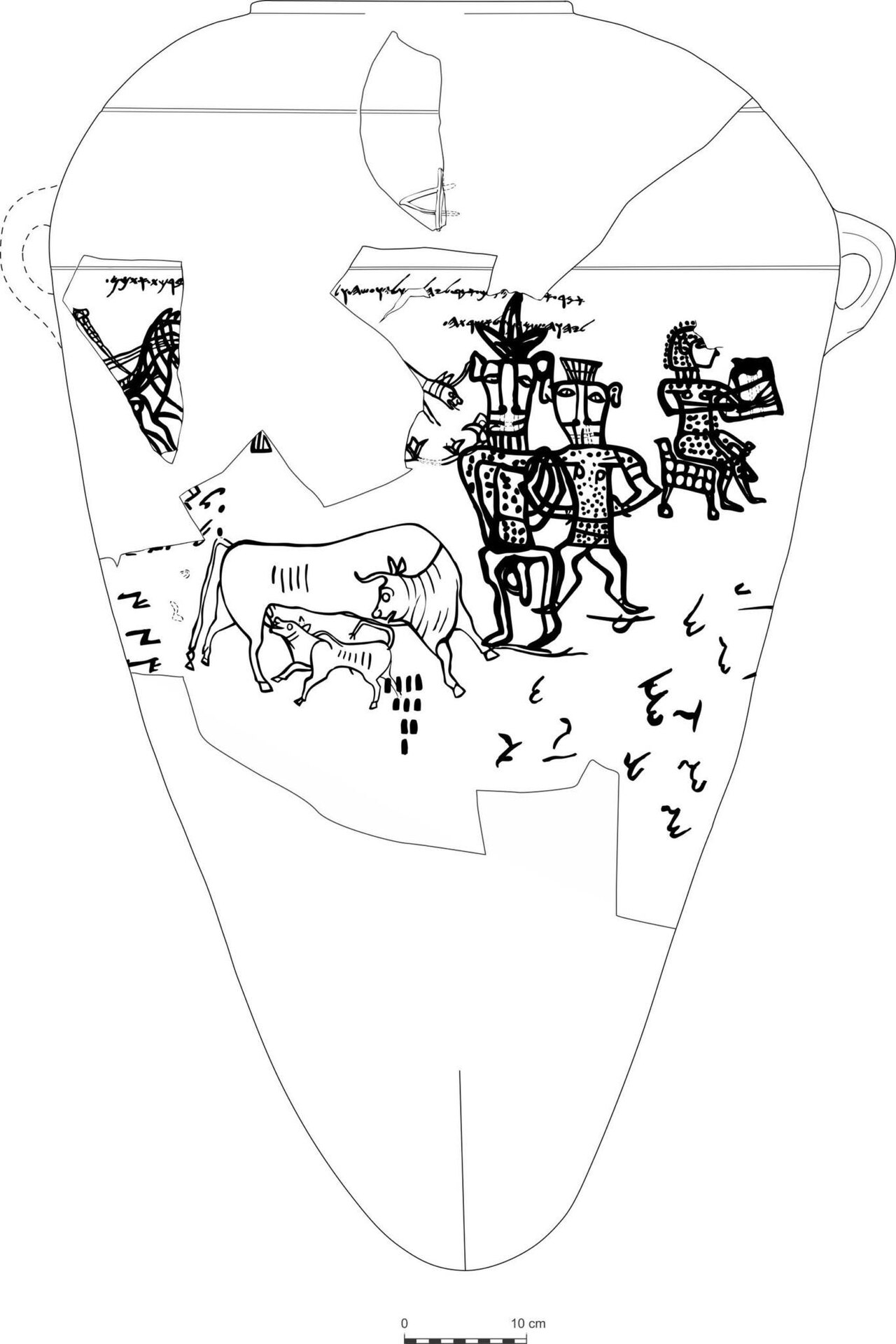
The drawing. Beneath the Samaria blessing on jar A, partly overlapped by it, are two grotesque standing figures and a seated lyre player. From the late 1970s, beginning with Mordechai Gilula, some scholars proposed that they showed Yahweh and Asherah.[57] Most now follow Pirhiya Beck in identifying the standing figures as the Egyptian household god Bes, a popular protective figure, and doubt that the drawing and the inscription were made together.[58][59][52] Majority
The pillar figurines
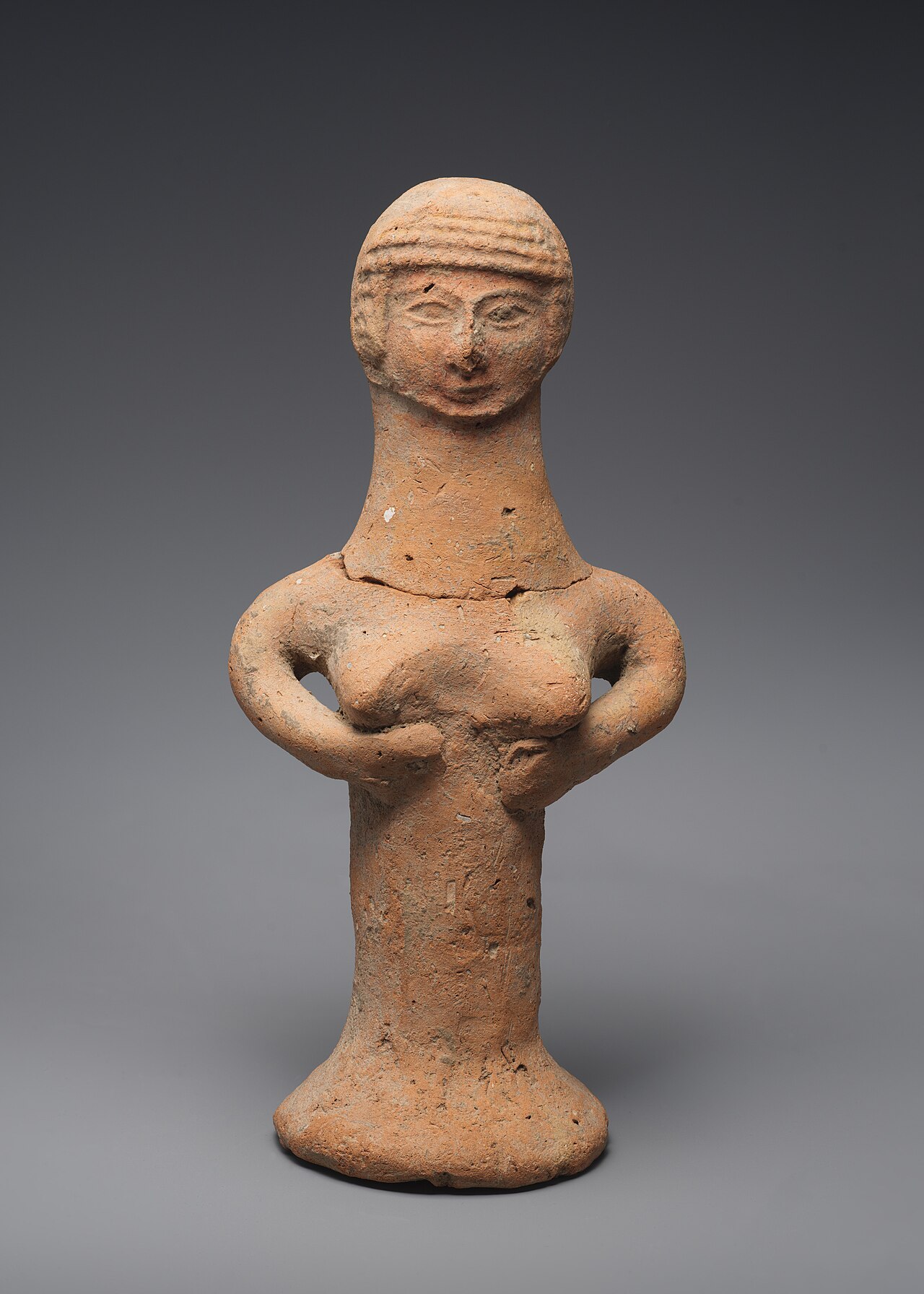
The most common religious objects in eighth- to early-sixth-century Judah are small clay figurines of a woman with a pillar-shaped body, supporting her breasts with her hands. They have been found in hundreds, in houses and tombs across Judah and especially in and around Jerusalem; Raz Kletter’s 1996 catalogue listed more than 800.[18][60] Consensus
Kletter and others identified them with Asherah, as images of the goddess in household worship. In a 2014 study, Erin Darby argued that they were used in household rituals of protection and healing and need not represent any named goddess.[60][61] Either way, they show that ordinary Judahites used female images in religious practice at the same time as the prophets were writing. Contested on what they represent.
Yahweh’s temples: more than one
The Bible’s ideal is a single temple in Jerusalem. That ideal was a demand of Deuteronomy and the reform of Josiah in the late seventh century BCE (§3). Before that, archaeology and the Bible’s own stories show Yahweh being worshipped at many sanctuaries. Consensus
- Tel Moẓa, about 7 km northwest of Jerusalem: a monumental temple of the late tenth or early ninth century BCE, with an altar, a pit of ash and animal bones, and clay figurines of humans and animals. It shows a temple operating near Jerusalem, in the heart of Judah, while the Temple in Jerusalem stood.[7][62] Majority
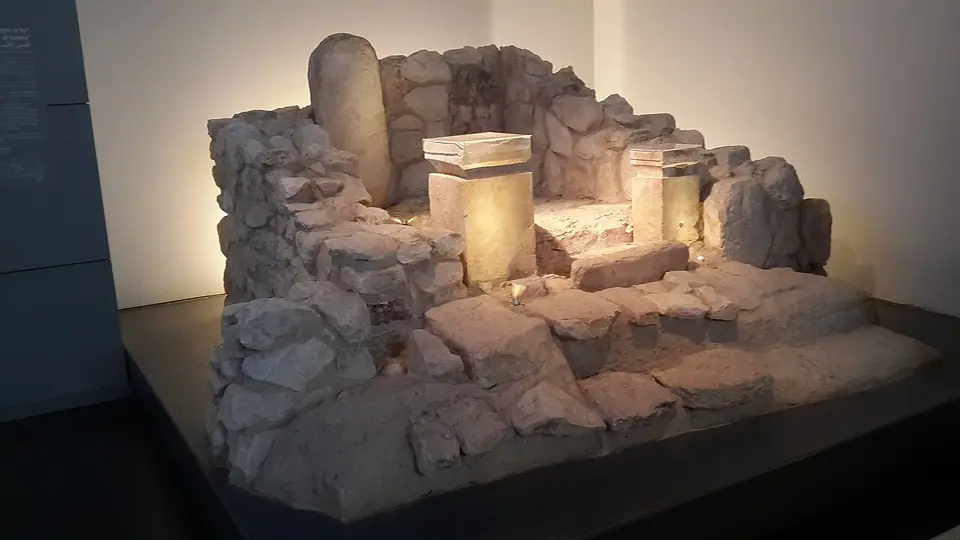
- Arad, in the northeastern Negev: inside a royal Judahite fortress, a small shrine with a courtyard altar of earth and unhewn stones, and an inner niche with one or two standing stones (maṣṣēbôt) and two limestone altars on its steps. A letter from the fortress refers to “the house of Yahweh”.[15][63] In 2020 residue analysis found frankincense on the larger altar and cannabis on the smaller one; the shrine was in use c. 760–715 BCE.[16] Majority
- Bethel and Dan, in the northern kingdom: according to 1 Kings 12, Jeroboam I set up golden calves there and declared, “Here are your gods, O Israel, who brought you up from the land of Egypt.” The calves were probably pedestals or symbols of Yahweh’s presence, not rival gods; the bull was El’s animal. The text is written by Judahite opponents who condemned them.[64] Majority
- The Bull Site, an open-air hilltop shrine of the twelfth century BCE in the northern Samarian hills, produced a bronze figurine of a bull about 18 cm long.[4][65] Who was worshipped there is not known. Majority
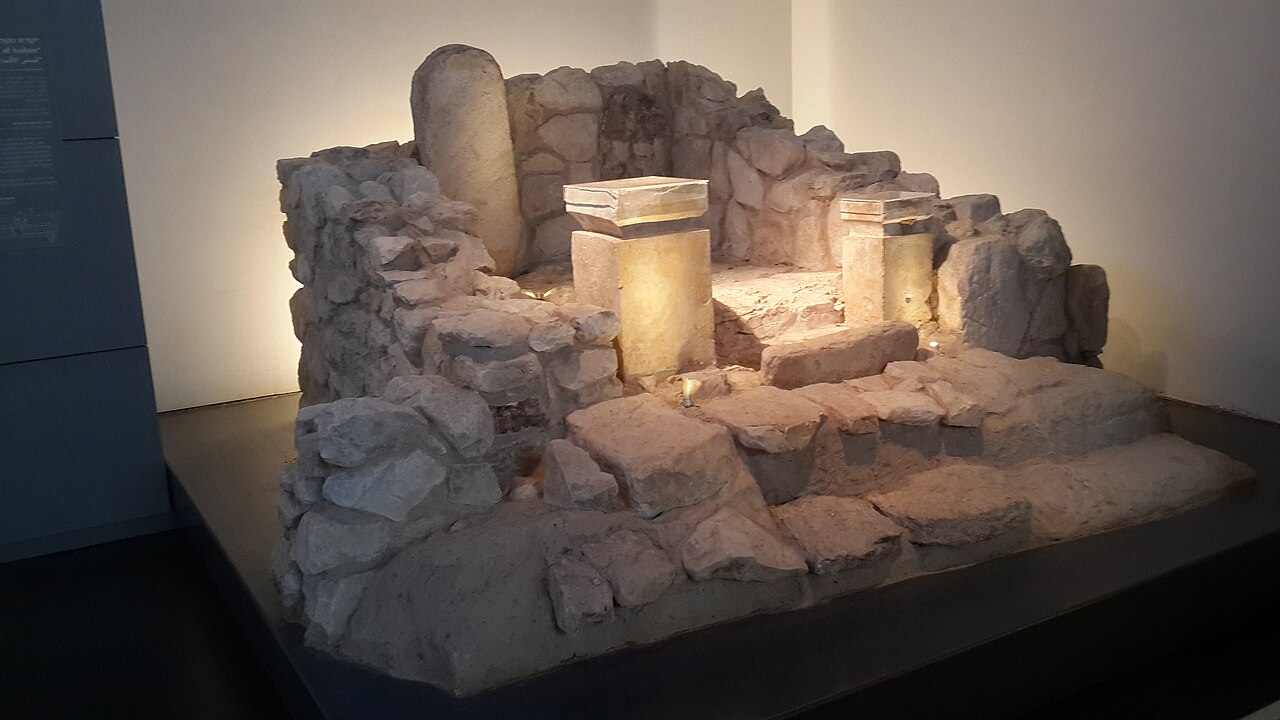
At Arad, the shrine went out of use and was carefully buried, its altars laid on their sides. The excavators connected this with the reform of Hezekiah c. 700 BCE that 2 Kings 18:4 describes. Others date the change differently or doubt that any reform reached the fortress.[66][16] Contested
The evidence ledger for early Yahweh worship
| Question | What the evidence supports | Key evidence | Confidence |
|---|---|---|---|
| First appearance | The god Yahweh is securely attested by c. 840 BCE; the Egyptian Yhw of c. 1370 BCE may be related | Mesha Stele; Soleb list[10][1] | Consensus (840); Contested (1370) |
| Origin | A god connected with the south (Seir, Edom, Teman, Midian) before he was Israel’s | Judges 5, Deuteronomy 33, Habakkuk 3; “Yahweh of Teman”[5][19][20][13] | Majority |
| Relation to El | Originally distinct gods who merged; Yahweh took El’s titles and council | The name Israel; Exodus 6:3; Deuteronomy 32:8–9 in 4QDeut^j[34][37][36] | Majority |
| Divine council | Yahweh was imagined among other gods, later demoted to angels | Psalm 82; Deuteronomy 32:8–9; Ugaritic parallels[39][2] | Consensus |
| Asherah | Paired with Yahweh in blessings c. 800–700 BCE; a symbol of hers stood in the Jerusalem Temple until the reforms | Kuntillet ʿAjrud; Khirbet el-Qom; 2 Kings 21 and 23[12][17][51] | Majority (pairing); Contested (goddess or symbol) |
| Baal | Worshipped by some Israelites; his imagery passed to Yahweh | Baal names; Psalm 29; Hosea 2[14][45][47] | Majority |
| Popular religion | Household cults with female figurines and multiple sanctuaries, alongside royal Yahweh worship | Pillar figurines; Moẓa; Arad[18][7][15] | Consensus |
| Yahweh as the main god | Yahweh dominates personal names in Israel and Judah from the ninth century on | Hebrew inscriptions and seals[67] | Majority |
| The House of David | A Judahite dynasty named after David by c. 840 BCE | Tel Dan Stele[11] | Majority |
| The extent of David’s kingdom | Disputed between a small chiefdom and an early state | Qeiyafa; Jerusalem excavations; radiocarbon[6][68][69] | Contested |
The personal names are the strongest counterweight to the picture of a crowded pantheon. Jeffrey Tigay’s study of Hebrew inscriptions and seals found that names built on Yahweh outnumber names built on any other god by a very wide margin.[67] Whatever other gods Israelites honoured, Yahweh was the one they named their children after. Majority
Primary sources
1. Yahweh marches from the south: Judges 5:4–5
The Song of Deborah celebrates a victory of several Israelite tribes over a Canaanite coalition. Its archaic Hebrew has led many scholars to date it among the oldest passages in the Bible, perhaps the twelfth or eleventh century BCE; others place it in the monarchy or later.[5][29][70]
Hebrew: YHWH bĕṣēʾtĕkā miśśēʿîr, bĕṣaʿdĕkā miśśĕdēh ʾĕdôm, ʾereṣ rāʿāšâ, gam-šāmayim nāṭāpû, gam-ʿābîm nāṭĕpû māyim. hārîm nāzĕlû mippĕnê YHWH zeh sînay, mippĕnê YHWH ʾĕlōhê yiśrāʾēl.
“Yahweh, when you went out from Seir, when you marched from the field of Edom, the earth trembled, the heavens poured, the clouds poured water. The mountains quaked before Yahweh, the One of Sinai, before Yahweh, the god of Israel.”
What it proves. In one of the oldest Israelite poems, Yahweh is a storm god who comes to his people’s aid from Edom, outside the land. Zeh sînay, “the One of Sinai”, is an old title of the kind used for gods of particular places. The poem names the tribes who fought and shames those who did not: Yahweh is the god of a tribal alliance, not yet of a kingdom. Majority
2. “Dawned from Seir”: Deuteronomy 33:2 and Habakkuk 3:3
Deuteronomy 33:2: YHWH missînay bāʾ, wĕzāraḥ miśśēʿîr lāmô, hôpîaʿ mēhar pāʾrān.
“Yahweh came from Sinai, and dawned from Seir upon them; he shone forth from Mount Paran.”[19]
Habakkuk 3:3: ʾĕlôah mittêmān yābôʾ, wĕqādôš mēhar-pāʾrān.
“God comes from Teman, the Holy One from Mount Paran.”[20]
What it proves. Two more poems, independent in wording, set Yahweh’s home in the same southern region: Sinai, Seir, Paran, Teman. Habakkuk’s poem is attached to a late-seventh-century prophet but may use older material. The repeated geography, and the inscriptions naming “Yahweh of Teman” c. 800 BCE, are why most scholars think the tradition of a southern Yahweh is old. Majority Henrik Pfeiffer has argued that all these poems are late and literary; see the debate below.[70]
3. The Shasu of Yhw: Soleb, c. 1390–1350 BCE
In the temple of Amenhotep III at Soleb, a row of bound captives represents conquered lands, each with a name ring. One reads:
Egyptian: tꜣ šꜣsw yhwꜣ
“The land of the Shasu, Yhw.”[1][25]
What it proves. That a nomadic group or region with a name very like Yahweh’s existed in the southern Levant by the fourteenth century BCE, in a list that also includes Seir. It does not prove that anyone worshipped a god of that name then. If the name of the people and the god are linked, this is the earliest trace of Yahweh by five centuries. Contested
4. The sons of God: Deuteronomy 32:8–9
Masoretic Hebrew text: bĕhanḥēl ʿelyôn gôyim, bĕhaprîdô bĕnê ʾādām, yaṣṣēb gĕbulōt ʿammîm lĕmispar bĕnê yiśrāʾēl. kî ḥēleq YHWH ʿammô, yaʿăqōb ḥebel naḥălātô.
“When the Most High gave the nations their inheritance, when he divided humankind, he fixed the boundaries of the peoples according to the number of the sons of Israel. For Yahweh’s portion is his people, Jacob his allotted inheritance.”
Qumran, 4QDeut^j (late Herodian, c. 50 CE): bny ʾlwhym, “the sons of God”, in place of “the sons of Israel”. Most Septuagint manuscripts have “angels of God” (angelōn theou); the oldest Greek papyrus and the critical edition read “sons of God”.[37][71][38]
What it proves. The older reading describes a world divided among divine beings, each people under its own god, with Yahweh’s share being Israel. A later scribe found this theologically troubling and replaced “God” with “Israel”; the change is a textbook example of a theological correction. Whether the poem distinguishes Yahweh from the Most High, or simply describes Yahweh taking his own share, is disputed. Majority on the reading; Contested on the theology.
5. The council in session: Psalm 82
Hebrew (v. 1): ʾĕlōhîm niṣṣāb baʿădat-ʾēl, bĕqereb ʾĕlōhîm yišpōṭ.
“God stands in the assembly of El; in the midst of the gods he gives judgment.”
(vv. 6–8): “I said, ‘You are gods, sons of the Most High, all of you. Nevertheless, you shall die like men, and fall like any prince.’ Arise, O God, judge the earth, for you shall inherit all the nations.”[39]
What it proves. The psalmist assumes a council of gods, “the assembly of El”, the same phrase used of El’s council in Canaanite texts. The psalm does not deny that the other gods exist; it has Israel’s god condemn them to death for injustice. It shows the transition between a council of many gods and a single god ruling all nations. Majority
6. Yahweh and his asherah: Kuntillet ʿAjrud, c. 800 BCE
The inscriptions are written in ink in the Hebrew alphabet, with some Phoenician letter forms, on two large storage jars (pithoi).[52][72]
Pithos A: brkt ʾtkm lyhwh šmrn wlʾšrth
“I have blessed you by Yahweh of Samaria and by his asherah.”[12]
Pithos B: brktk lyhwh tmn wlʾšrth
“I bless you by Yahweh of Teman and by his asherah.”[13]
What it proves. Three things. First, Yahweh was worshipped in local forms named after places, “Yahweh of Samaria” and “Yahweh of Teman”, as Baal and other gods were. Second, the god of the capital of the northern kingdom was invoked together with “his asherah”. Third, the southern title “Yahweh of Teman” was in use c. 800 BCE, matching Habakkuk 3:3. Plaster fragments from the same building mention El and Baal in a poetic text about a divine appearance.[52] Consensus on the readings; Contested on what “his asherah” refers to.
7. Saved by his asherah: Khirbet el-Qom, 8th century BCE
Cut into the wall of a tomb west of Hebron, beside an incised hand. The inscription is crudely made and several readings are uncertain.
Hebrew: ʾryhw hʿšr ktbh / brk ʾryhw lyhwh / wmṣryh lʾšrth hwšʿ lh
“Uriyahu the rich (?) wrote it. Blessed is Uriyahu by Yahweh, and from his enemies, by his asherah, he has saved him.”[17][72]
What it proves. That the pairing of Yahweh and asherah was not confined to a desert way-station with northern connections. It appears in a Judahite burial in the hills of Judah, in a man’s prayer for protection. Majority
8. Taking the vessels of Yahweh: the Mesha Stele, c. 840 BCE
A black basalt monument of King Mesha of Moab, found at Dhiban in Jordan in 1868 and now in the Louvre. Mesha says that Omri, king of Israel, had oppressed Moab, and describes how he took Israelite towns back. At Nebo:
Moabite (lines 14–18, abridged): wyʾmr ly kmš lk ʾḥz ʾt nbh ʿl yśrʾl … wʾqḥ mšm ʾ[t k]ly yhwh wʾsḥb hm lpny kmš
“And Chemosh said to me, ‘Go, take Nebo from Israel.’ … I killed all of them, seven thousand men, boys, women, girls and slave women, for I had devoted it to Ashtar-Chemosh. And I took from there the [vessel]s of Yahweh and dragged them before Chemosh.”[10]
What it proves. This is the earliest securely dated mention of Yahweh as a god, written by an enemy. To the king of Moab, Yahweh was the national god of Israel, as Chemosh was the god of Moab, and his sanctuary objects were war trophies. The Moabite practice of “devoting” a captured town to the god by killing its inhabitants is the same ḥērem described in the book of Joshua. Consensus
9. The House of David: Tel Dan, c. 840–800 BCE
Three fragments of a basalt stele in Aramaic, found in 1993 and 1994 reused in later walls at Tel Dan in northern Israel. The king who set it up, probably Hazael of Damascus, claims to have killed two kings:
Aramaic (lines 7–9, restored): [qtlt ʾyt yhw]rm br [ʾḥʾb] mlk yśrʾl wqtl[t ʾyt ʾḥz]yhw br [yhwrm ml]k bytdwd
“[I killed Jeho]ram son of [Ahab], king of Israel, and I killed [Ahaz]iahu son of [Jehoram, kin]g of the House of David.”[11][73]
What it proves. The restorations of the kings’ names are conjectural, but bytdwd, “House of David”, is clearly legible. In the inscriptions of this period, “House of X” is the normal way of naming a kingdom after the founder of its dynasty: Assyrian texts call Israel the “House of Omri”. So by the mid-ninth century BCE, Judah’s ruling dynasty traced itself to a founder named David. That does not confirm the biblical account of his reign, but it makes it very likely that David was a historical person. Majority
Some scholars once argued that bytdwd, written without a word divider, could be a place name or “house of the beloved”. This view has few defenders now.[73] A separate proposal by André Lemaire to read “House of David” in line 31 of the Mesha Stele is more disputed: in 2019 Israel Finkelstein, Nadav Naʾaman and Thomas Römer argued from new photographs that the name there is Balak; Michael Langlois in 2019, and Lemaire himself with Jean-Philippe Delorme in 2022, have defended the David reading as the most probable from new images.[74][75][76][77] Contested
10. A sanctuary in a royal fortress: Arad
The shrine at Arad was excavated by Yohanan Aharoni between 1962 and 1967 and reinterpreted by Ze’ev Herzog.[15][66] Its plan has a courtyard with an altar of earth and fieldstones, which Aharoni noted matched the five-by-five cubits prescribed in Exodus 27:1 for the altar of the tabernacle, a broad room, and a raised niche at the back with standing stones and two incense altars. An ostracon from the fortress, written c. 600 BCE, mentions “the house of Yahweh”, which may refer to the Temple in Jerusalem.[63]
What it proves. That the kings of Judah maintained a sanctuary of Yahweh inside one of their own fortresses, with standing stones of the kind Deuteronomy later banned (“you shall not set up a standing stone, which Yahweh your God hates”, Deuteronomy 16:22).[48] Worship outside Jerusalem was normal and royal, not a fringe deviation. Whether the two standing stones, if there were two, stood for Yahweh and a consort is speculation. Majority on the function; Speculative on the pair.
David and Solomon: what archaeology says
The Bible describes David uniting the tribes, taking Jerusalem and building an empire from the Euphrates to Egypt, and Solomon building the Temple and governing a wealthy state with fortified cities and international trade. How much of that happened is the most fiercely debated question in the archaeology of the region. It matters for this chapter because a strong early monarchy would mean an early royal cult of Yahweh centred on Jerusalem. Contested
The traditional chronology. From the 1950s, Yigael Yadin and others attributed the monumental six-chambered gates at Hazor, Megiddo and Gezer to Solomon, following 1 Kings 9:15, which names those three cities as his building projects. Pottery found with them defined the archaeology of the tenth century.[78] Majority in the twentieth century; now disputed.
The Low Chronology. In 1996 Israel Finkelstein argued that the pottery used to date those buildings should be moved about 75–100 years later, into the ninth century. The gates and palaces would then belong to the Omride kings of northern Israel, whose power is confirmed by Assyrian and Moabite inscriptions, and tenth-century Jerusalem would be a modest highland village.[68][79] On this view David and Solomon were real, but rulers of a small chiefdom whose kingdom was later remembered through the lens of later kings. Contested
The response. Amihai Mazar proposed a “modified conventional chronology”, in which the archaeological period in question spans both the tenth and ninth centuries, so that some monumental buildings could be Solomonic and others Omride.[69] Radiocarbon dating since the 2000s has narrowed the gap between the camps to a few decades, but not closed it. Eilat Mazar’s excavations in Jerusalem’s City of David uncovered a large stone structure that she identified as David’s palace; others date it later or doubt that it is one building.[80][81] Contested
Khirbet Qeiyafa. Between 2007 and 2013 Yosef Garfinkel and Saar Ganor excavated a small fortified town overlooking the Elah Valley, the setting of the David and Goliath story. Radiocarbon dates on olive pits place it c. 1020–980 BCE. It had a casemate wall, two gates and no pig bones, and Garfinkel argues it was a Judahite town built by a centralised kingdom, evidence for David’s state.[6][82] Finkelstein and Alexander Fantalkin accept the date but argue that the town could belong to a northern Israelite or Gibeonite polity, perhaps that of Saul, rather than to Judah.[83] Contested
The architecture problem. Erez Ben-Yosef, excavating the copper mines of Timna in the Arabah, found evidence of a complex, organised industry in the tenth century run by people who left almost no permanent buildings. He argues that archaeologists have underestimated states built by nomadic or semi-nomadic peoples, and that the absence of monumental architecture does not mean the absence of a kingdom.[84] Contested
What can be said. A dynasty of Judah traced itself to David by c. 840 BCE. The northern kingdom of Israel, under Omri and Ahab in the ninth century, was a significant regional power: Shalmaneser III records Ahab bringing 2,000 chariots to the battle of Qarqar in 853 BCE, more than any other member of the coalition.[9] Judah in the tenth century was smaller and poorer than the Bible’s description of Solomon’s kingdom, and most of its population lived in villages. Between those points, the evidence supports several reconstructions. Majority
What is absent from the earliest record of Yahweh
The religion of the inscriptions and the oldest biblical poems lacks much of what later Judaism and the final form of the Bible take for granted.
- Monotheism. No text of this period says that no other god exists. The question being argued over is which gods Israel should worship, not whether they exist. Consensus
- A single sanctuary. Yahweh is worshipped at Moẓa, Arad, Bethel, Dan and other sites, as well as in Jerusalem. Consensus
- A ban on images. Bull images, standing stones, figurines and an asherah in the Temple are all attested. Whether Yahweh himself was ever represented by a statue is debated (see below). Majority
- A written Torah. There is no evidence for a written law book with the authority Deuteronomy later claims; the earliest Hebrew inscriptions of any length are from the ninth and eighth centuries (§0). Majority
- The patriarchs as one family. Abraham, Isaac and Jacob are not mentioned outside the Bible, and Abraham is barely mentioned in the prophets before the exile. The combined genealogy is probably later. Majority
- Satan, angels with names, resurrection and the Messiah as end-time saviour. All appear later, in the Persian and Hellenistic periods (§5, §6). Consensus
- “Jews” and “Judaism”. The kingdom of Judah exists; “Judaism” as a religion of a dispersed people bound by Torah does not (§5, §7). Consensus
Debates about Yahweh and early Israel
Where did Yahweh come from?
| View | Main argument | Main proponents |
|---|---|---|
| Southern origin (Midianite–Kenite) | The oldest poems place Yahweh in Seir, Edom, Teman and Paran; Moses’ Midianite father-in-law blesses Yahweh and offers sacrifice; “Yahweh of Teman” at Kuntillet ʿAjrud | Blenkinsopp, Römer, van der Toorn[23][24][30] |
| A Shasu people’s god, not borrowed from outsiders | Yhw was a pastoral people of the inland Levant whose name became a god’s name; their descendants were part of Israel, so Israel did not adopt a foreign god | Fleming[26] |
| A storm god of the north | The southern poems are late, literary compositions; Yahweh was a Levantine weather god like Baal-Hadad, worshipped in the north | Pfeiffer[70] |
| An epithet of El | The name began as a title of El, “he who creates (the hosts)”, and became a separate name | Cross[29] |
| Traditional | The one God, already worshipped by the patriarchs, revealed his name and its meaning to Moses at Horeb, the mountain of God (Exodus 3, 6); the southern poems remember that revelation at Sinai, not the borrowing of a foreign god | Jewish and Christian tradition[28][34] |
Most scholars accept some form of the southern origin, with Fleming’s argument that the god’s people were part of Israel’s ancestry as an important refinement.[27] The traditional account and the southern hypothesis share more than might be expected: both place Yahweh’s first revelation in the southern wilderness, outside Canaan, and connect it with Moses and Midian. Contested
Was Israel monotheistic from the start?
The strongest case for an early monotheism was made by Yehezkel Kaufmann in the mid-twentieth century. He argued that Israelite religion was fundamentally different from its neighbours’ from the beginning, that the biblical writers did not even understand how polytheism worked, and that the Bible’s condemnations of idolatry targeted a marginal practice. Tigay’s onomastic evidence gives his position some support: if Israelites had worshipped many gods widely, more of their names would show it.[85][67]
The majority view now is that monotheism developed in stages: from the worship of Yahweh alongside other gods, through the demand to worship Yahweh alone (monolatry), to the claim that no other god exists, first made clearly in the sixth century BCE (§4). The evidence for this is the material in this chapter: the El names, the council of gods, the Asherah blessings and the figurines. The biblical writers themselves present Israel’s history as a long struggle against other gods. Majority
Was Asherah Yahweh’s wife?
The case for: Asherah was El’s consort, Yahweh took El’s place, and inscriptions pair “Yahweh and his asherah”; ordinary people would not have distinguished a goddess from her symbol.[53][56] The case against: Hebrew grammar makes “his Asherah” as a personal name unlikely; the word more probably names the cult object beside Yahweh’s altar, which represented blessing or fertility within Yahweh’s own cult.[54][55] Judith Hadley’s influential view combines both: Asherah was once a goddess worshipped alongside Yahweh, and over time she faded into the cult symbol that bore her name.[55] Contested
Was there a statue of Yahweh?
Tryggve Mettinger argued that Israel’s aniconism was old: Yahweh was represented by standing stones or by an empty space, such as the throne above the cherubim in the Jerusalem Temple, and never by a human-shaped statue.[86] Others, including Christoph Uehlinger, think the Jerusalem Temple may have held an anthropomorphic image of Yahweh before the reforms, as temples of other gods did, and that the ban on images was introduced later.[87] No such statue has been found, and the evidence is indirect on both sides. Contested
Were David and Solomon real?
| View | Position | Main proponents |
|---|---|---|
| Traditional and maximalist | A united kingdom ruled from Jerusalem, broadly as the Bible describes; archaeology confirms monumental building of the tenth century | E. Mazar, Garfinkel[82] |
| Modified conventional | Real kings of a real but modest state; some monuments are tenth-century, others ninth | A. Mazar[69] |
| Low Chronology | Real figures, rulers of a small highland chiefdom; the “united monarchy” is a later idealisation | Finkelstein[68][79] |
| Minimalist | David is a figure of literature; the biblical account was composed centuries later. Held by the “Copenhagen school” in the 1990s, weakened by the Tel Dan Stele | Thompson, Lemche, Davies[88] |
Contested
Further reading
- Mark S. Smith, The Early History of God: Yahweh and the Other Deities in Ancient Israel (2nd ed., Eerdmans, 2002) — the standard account of convergence and differentiation.
- Theodore J. Lewis, The Origin and Character of God (Oxford, 2020) — the fullest recent survey of texts, inscriptions and images.
- Daniel E. Fleming, Yahweh before Israel: Glimpses of History in a Divine Name (Cambridge, 2021).
- Thomas Römer, The Invention of God (Harvard, 2015) — readable, from Yahweh’s southern origins to monotheism.
- William G. Dever, Did God Have a Wife? Archaeology and Folk Religion in Ancient Israel (Eerdmans, 2005).
- Judith M. Hadley, The Cult of Asherah in Ancient Israel and Judah (Cambridge, 2000).
- Othmar Keel and Christoph Uehlinger, Gods, Goddesses, and Images of God in Ancient Israel (Fortress, 1998).
- Israel Finkelstein and Neil Asher Silberman, The Bible Unearthed (Free Press, 2001), with Amihai Mazar’s replies, for the David and Solomon debate.
- Shmuel Aḥituv, Echoes from the Past: Hebrew and Cognate Inscriptions from the Biblical Period (Carta, 2008) — the inscriptions in this chapter with translations.
References
- ^ a b c d Soleb temple list, "Land of the Shasu, Yhw" — Temple of Amenhotep III at Soleb, Nubia. c. 1390–1350 BCE. Egyptian (hieroglyphic). Names a land or group of Shasu nomads as Yhw, possibly the earliest trace of the name Yahweh; repeated in a list of Ramesses II at Amara West. Whether it refers to the god is debated. about
- ^ a b c d e KTU 1.4 (Baal Cycle) — Ugaritic texts, Ras Shamra. c. 1350–1185 BCE. Ugaritic. Part of the Baal Cycle: El as father of the gods, Athirat (Asherah) his consort with her "seventy sons", and Baal's kingship and palace. The Canaanite background of Israel's god. about
- ^ Merneptah Stele — Egyptian Museum, Cairo. c. 1208 BCE. Egyptian (hieroglyphic). A victory hymn of Pharaoh Merneptah naming "Israel" as a people: the earliest mention of Israel outside the Bible. about
- ^ a b The "Bull Site" — Open-air cult site in the northern Samarian hills. 12th c. BCE. A hilltop shrine of the early Iron Age that produced a bronze bull figurine, an animal associated with El and Baal. about
- ^ a b c d Judges 5:4–5 — Song of Deborah (Hebrew Bible). c. 1100–900 BCE (debated). Hebrew. Yahweh marches out from Seir and the field of Edom as a storm god; the mountains quake before "the One of Sinai". Among the oldest poems locating Yahweh in the south. read the text
- ^ a b c Khirbet Qeiyafa — Fortified Iron Age town above the Elah Valley. c. 1020–980 BCE. A casemate-walled town with two gates, radiocarbon-dated to c. 1020–980 BCE; claimed as Judahite and Davidic by its excavators, attributed to a northern or Saulide polity by critics. about
- ^ a b c Tel Moẓa temple — Iron Age temple at Tel Moẓa, west of Jerusalem. late 10th–early 9th c. BCE. A monumental temple with altar, ash pit and figurines a few kilometres from Jerusalem: Yahweh worship at more than one sanctuary in Judah. about
- ^ Sheshonq I campaign list (Bubastite Portal) — Relief of Sheshonq I at Karnak. c. 925 BCE. Egyptian (hieroglyphic). Lists towns in the Negev and northern Israel taken on Sheshonq I's campaign; Jerusalem is not among the legible names. about
- ^ a b Kurkh Monolith — Annals of Shalmaneser III (British Museum). c. 852 BCE. Akkadian. Records "Ahab the Israelite" bringing 2,000 chariots and 10,000 soldiers to the battle of Qarqar in 853 BCE. about
- ^ a b c Mesha Stele — Louvre AO 5066. c. 840 BCE. Moabite. King Mesha of Moab names Omri king of Israel and boasts of taking the vessels of YHWH from Nebo and dragging them before Chemosh: the earliest certain mention of Yahweh outside the Bible. about
- ^ a b c Tel Dan Stele — Israel Museum, Jerusalem. c. 840–800 BCE. Old Aramaic. An Aramean king, probably Hazael, claims to have killed a king of Israel and a king of the 'House of David' (bytdwd): the only certain mention of David outside the Bible from the Iron Age. about
- ^ a b c d Kuntillet ʿAjrud, Pithos A — Kuntillet ʿAjrud inscriptions (Meshel 2012). c. 800 BCE. Hebrew. Blessing written on a storage jar at a Sinai way-station: 'I bless you by Yahweh of Samaria and by his Asherah.' A second jar names 'Yahweh of Teman and his Asherah'. about
- ^ a b c d e Kuntillet ʿAjrud, Pithos B — Ink inscription on a storage jar, Kuntillet ʿAjrud (Ḥorvat Teman), Sinai. c. 800 BCE. Hebrew. "I bless you by Yahweh of Teman and by his asherah": a southern local form of Yahweh, matching Habakkuk 3:3, paired with asherah. about
- ^ a b c Samaria ostraca — Administrative ostraca from the palace at Samaria. early 8th c. BCE. Hebrew. Shipping notes of wine and oil whose personal names are built more often on Yahweh than on Baal (roughly eleven to seven). about
- ^ a b c d Arad sanctuary — Shrine in the Judahite fortress at Tel Arad. c. 760–715 BCE. A sanctuary of Yahweh inside a royal fortress, with a courtyard altar, standing stones and two incense altars (frankincense and cannabis residues); later dismantled and buried. about
- ^ a b c Eran Arie, Baruch Rosen and Dvory Namdar Cannabis and Frankincense at the Judahite Shrine of Arad. Tel Aviv 47, 2020. Residue analysis of the two altars; dates the shrine to c. 760–715 BCE.
- ^ a b c d Khirbet el-Qom, Tomb Inscription 3 — Tomb inscription, Khirbet el-Qom, near Hebron. 2nd half of the 8th c. BCE. Hebrew. "Blessed is Uriyahu by Yahweh; from his enemies, by his asherah, he has saved him": the Yahweh–asherah pairing in a Judahite burial. about
- ^ a b c Judean pillar figurines — Clay figurines from Judahite houses and tombs. 8th–early 6th c. BCE. Hundreds of small clay women supporting their breasts, the most common religious objects of late-monarchic Judah; read as Asherah or as household protective figures. about
- ^ a b c Deuteronomy 33:2 — Blessing of Moses (Hebrew Bible). c. 1000–700 BCE (debated). Hebrew. "Yahweh came from Sinai, and dawned from Seir upon them; he shone forth from Mount Paran": a second poem placing Yahweh's home in the south. read the text
- ^ a b c Habakkuk 3:3 — Prayer of Habakkuk (Hebrew Bible). late 7th c. BCE, possibly older material. Hebrew. "God comes from Teman, the Holy One from Mount Paran": the same southern geography as the Kuntillet Ajrud blessings by "Yahweh of Teman". read the text
- ^ Psalm 68:8–9 (Eng. 68:7–8) — Psalms (Hebrew Bible). debated, 10th–6th c. BCE. Hebrew. When God marched through the wilderness the earth quaked and the heavens poured "before God, the One of Sinai": a reuse of the Song of Deborah's image of Yahweh coming from the south. read the text
- ^ Exodus 18 — Exodus (Hebrew Bible). c. 7th–5th c. BCE. Hebrew. Jethro, priest of Midian and Moses' father-in-law, blesses Yahweh, offers sacrifice and advises Moses: a basis of the Midianite–Kenite hypothesis. read the text
- ^ a b Joseph Blenkinsopp The Midianite–Kenite Hypothesis Revisited and the Origins of Judah. Journal for the Study of the Old Testament 33, 2008. A modern restatement of the theory that Yahweh came to Israel from the south.
- ^ a b Thomas Römer The Invention of God. Harvard University Press (trans. Raymond Geuss), 2015. Readable account from Yahweh's southern origins to biblical monotheism.
- ^ a b Raphael Giveon Les bédouins Shosou des documents égyptiens. Brill, 1971. The Egyptian sources on the Shasu, including the Soleb list.
- ^ a b Daniel E. Fleming Yahweh before Israel: Glimpses of History in a Divine Name. Cambridge University Press, 2021. Yahweh as the god of a Shasu herding people who became part of Israel, not a god borrowed from outsiders.
- ^ a b c Theodore J. Lewis The Origin and Character of God: Ancient Israelite Religion through the Lens of Divinity. Oxford University Press, 2020. The fullest recent survey of the texts, inscriptions and images of Israel's god.
- ^ a b Exodus 3:13–15 — Exodus (Hebrew Bible). c. 7th–5th c. BCE. Hebrew. At the burning bush God answers Moses "I will be what I will be" (ʾehyeh ʾăšer ʾehyeh) and gives the name YHWH: the Bible's own explanation of the name. read the text
- ^ a b c d e Frank Moore Cross Canaanite Myth and Hebrew Epic: Essays in the History of the Religion of Israel. Harvard University Press, 1973. The classic study of El, Baal and Yahweh; argues Yahweh began as a title of El.
- ^ a b c Karel van der Toorn Yahweh. in K. van der Toorn, B. Becking and P. W. van der Horst (eds.), Dictionary of Deities and Demons in the Bible, 2nd ed. (Brill/Eerdmans), pp. 910–919, 1999. Reference survey of the name, its etymologies and pronunciation, and a modified Kenite–Midianite case for Yahweh's origin in Edom and Midian.
- ^ Simon B. Parker, ed. Ugaritic Narrative Poetry. Scholars Press (SBL Writings from the Ancient World 9), 1997. Translations of the Baal Cycle and other Ugaritic myths.
- ^ Genesis 33:20 — Genesis (Hebrew Bible). c. 8th–5th c. BCE. Hebrew. Jacob builds an altar and calls it "El, the god of Israel". read the text
- ^ Genesis 14:19 — Genesis (Hebrew Bible). c. 7th–5th c. BCE. Hebrew. Melchizedek blesses Abram by "El Elyon, creator of heaven and earth", a title of El also found in Phoenician inscriptions. read the text
- ^ a b c Exod 6:2–3 — Exodus (Hebrew Bible). c. 6th–5th c. BCE (Priestly source). Hebrew. God tells Moses he appeared to the patriarchs as El Shaddai but did not make his name YHWH known to them, contradicting Genesis passages where they use the name: a key piece of evidence for separate sources. read the text
- ^ a b c Mark S. Smith The Origins of Biblical Monotheism: Israel's Polytheistic Background and the Ugaritic Texts. Oxford University Press, 2001. How the divine council of Ugarit shrank into the one God of the Bible.
- ^ a b c Mark S. Smith The Early History of God: Yahweh and the Other Deities in Ancient Israel. Eerdmans, 2nd ed., 2002. open library How Israelite religion emerged from its Canaanite setting and became monotheistic.
- ^ a b c Deuteronomy 32:8–9 (MT, 4QDeutj, LXX) — Song of Moses (Hebrew Bible). c. 8th–6th c. BCE (debated). Hebrew. The Most High divides the nations "according to the number of the sons of God" (Qumran, Septuagint) or "the sons of Israel" (Masoretic text); Yahweh's portion is Israel. Trace of the divine council. read the text
- ^ a b Emanuel Tov Textual Criticism of the Hebrew Bible. Fortress Press, 3rd ed., 2012. The standard work on the Masoretic text, Septuagint, Samaritan Pentateuch and Scrolls.
- ^ a b c Psalm 82 — Psalms (Hebrew Bible). c. 8th–6th c. BCE (debated). Hebrew. God stands "in the assembly of El" and judges among the gods, sentencing them to die like mortals: the divine council in session. read the text
- ^ 1 Kings 22:19 — Kings (Hebrew Bible). composed 7th–6th c. BCE. Hebrew. The prophet Micaiah sees Yahweh enthroned "with all the host of heaven standing beside him": the divine council recast as Yahweh's court. read the text
- ^ Job 1:6–12 — Job (Hebrew Bible). probably Persian period (debated). Hebrew. 'The satan' comes among the sons of God before Yahweh and, with Yahweh's permission, tests Job: a member of the divine council, not a rebel. read the text
- ^ KTU 1.2 (Baal Cycle: Baal and Yamm) — Baal Cycle (Ugarit). c. 1350–1185 BCE. Ugaritic. Baal, armed with two clubs made by the craftsman god Kothar-wa-Hasis, defeats Yamm (Sea) and is acclaimed king: the Canaanite storm god's victory over the waters that biblical poetry later gives to Yahweh. about
- ^ KTU 1.5–1.6 (Baal Cycle: Baal and Mot) — Baal Cycle (Ugarit). c. 1350–1185 BCE. Ugaritic. Baal goes down into the realm of Mot (Death) and dies; Anat destroys Mot, Baal returns, and the two gods fight until the sun goddess Shapsh makes Mot yield. about
- ^ 1 Kings 18 — Kings (Hebrew Bible). c. 7th–6th c. BCE. Hebrew. Elijah's contest with the prophets of Baal on Mount Carmel: the Bible's portrait of Yahweh's rivalry with Baal. read the text
- ^ a b Psalm 29 — Psalms (Hebrew Bible). c. 10th–8th c. BCE (debated). Hebrew. "The voice of Yahweh" thunders over the waters and breaks the cedars; so close to Canaanite storm-god poetry that many scholars think it adapts a hymn to Baal. read the text
- ^ Ishbaal inscription — Incised jar from Khirbet Qeiyafa. c. 1020–980 BCE. Hebrew/Canaanite. A jar inscribed with the personal name ʾIšbaʿal, the same name as Saul's son (later altered to Ish-bosheth in Samuel). about
- ^ a b Hosea 2:16–17 (Heb. 2:18–19) — Hosea (Hebrew Bible). 8th c. BCE. Hebrew. Israel will call Yahweh "my husband" and no longer "my baal", and the names of the Baals will be removed from her mouth. read the text
- ^ a b Deuteronomy 16:21–22 — Deuteronomy (Hebrew Bible). c. 7th c. BCE. Hebrew. Forbids planting an asherah beside the altar of Yahweh or setting up a standing stone: a law that implies both were practised. read the text
- ^ 1 Kings 15:13 — Kings (Hebrew Bible). composed 7th–6th c. BCE. Hebrew. King Asa removes the queen mother Maacah because she had made "an abominable image for Asherah", and burns it in the Kidron valley. read the text
- ^ 2 Kings 21:7 — Kings (Hebrew Bible). composed 7th–6th c. BCE. Hebrew. Manasseh sets "the carved image of Asherah" in the house of which Yahweh had said he would put his name there for ever. read the text
- ^ a b 2 Kings 23:4–7 — Kings (Hebrew Bible). c. late 7th–6th c. BCE. Hebrew. Josiah removes from the Temple the vessels made for Baal, Asherah and the host of heaven, burns the asherah, and destroys the houses where women wove for Asherah. read the text
- ^ a b c d Ze'ev Meshel Kuntillet ʿAjrud (Ḥorvat Teman): An Iron Age II Religious Site on the Judah–Sinai Border. Israel Exploration Society, 2012. The final excavation report, with the inscriptions and drawings.
- ^ a b c William G. Dever Did God Have a Wife? Archaeology and Folk Religion in Ancient Israel. Eerdmans, 2005. The case for Asherah as Yahweh's consort in popular religion, from the excavator of Khirbet el-Qom.
- ^ a b J. A. Emerton New Light on Israelite Religion: The Implications of the Inscriptions from Kuntillet ʿAjrud. Zeitschrift für die alttestamentliche Wissenschaft 94, 1982. The grammatical argument that "his asherah" is a cult object, not a goddess's name.
- ^ a b c Judith M. Hadley The Cult of Asherah in Ancient Israel and Judah: Evidence for a Hebrew Goddess. Cambridge University Press, 2000. The inscriptions and biblical texts on asherah, and how a goddess became a cult symbol.
- ^ a b Ziony Zevit The Religions of Ancient Israel: A Synthesis of Parallactic Approaches. Continuum, 2001. A large synthesis of texts and archaeology; proposes reading the goddess's name as Asherata.
- ^ Mordechai Gilula To Yahweh Shomron and His Asherah (Hebrew). Shnaton: An Annual for Biblical and Ancient Near Eastern Studies 3 (1978/79), pp. 129–137, 1979. The first proposal to read the Kuntillet ʿAjrud drawing together with its blessing, as an image of Yahweh and Asherah.
- ^ Pirhiya Beck The Drawings from Ḥorvat Teiman (Kuntillet ʿAjrud). Tel Aviv 9, pp. 3–68, 1982. The iconographic study identifying the two standing figures on jar A as Bes and doubting their link to the inscription.
- ^ Othmar Keel and Christoph Uehlinger Gods, Goddesses, and Images of God in Ancient Israel. Fortress Press, 1998. The history of Israelite religion told through seals, figurines and drawings.
- ^ a b Raz Kletter The Judean Pillar-Figurines and the Archaeology of Asherah. BAR International Series 636, 1996. The catalogue of the figurines and the case for identifying them with Asherah.
- ^ Erin Darby Interpreting Judean Pillar Figurines: Gender and Empire in Judean Apotropaic Ritual. Mohr Siebeck, 2014. Argues the figurines served household rituals of protection and healing.
- ^ Shua Kisilevitz and Oded Lipschits Another Temple in Judah! The Tale of Tel Moẓa. Biblical Archaeology Review 46:1, 2020. The excavators' account of the Iron Age temple near Jerusalem.
- ^ a b Arad Ostracon 18 — Letter from the Arad fortress archive. c. 600 BCE. Hebrew. A letter mentioning "the house of Yahweh", possibly the Temple in Jerusalem. about
- ^ 1 Kings 12:28–29 — Kings (Hebrew Bible). c. 7th–6th c. BCE. Hebrew. Jeroboam sets up golden calves at Bethel and Dan: "Here are your gods, O Israel, who brought you up from the land of Egypt." read the text
- ^ Amihai Mazar The "Bull Site": An Iron Age I Open Cult Place. Bulletin of the American Schools of Oriental Research 247, 1982. Excavation report of the hilltop shrine and its bronze bull.
- ^ a b Ze'ev Herzog The Fortress Mound at Tel Arad: An Interim Report. Tel Aviv 29, 2002. Re-dates the Arad strata and the shrine.
- ^ a b c Jeffrey H. Tigay You Shall Have No Other Gods: Israelite Religion in the Light of Hebrew Inscriptions. Scholars Press, 1986. Personal names in Hebrew inscriptions: Yahweh dominates by a wide margin.
- ^ a b c Israel Finkelstein The Archaeology of the United Monarchy: An Alternative View. Levant 28, 1996. The article that launched the Low Chronology.
- ^ a b c Amihai Mazar The Debate over the Chronology of the Iron Age in the Southern Levant. In T. E. Levy and T. Higham, eds., The Bible and Radiocarbon Dating (Equinox), 2005. The "modified conventional chronology" as a middle way.
- ^ a b c Henrik Pfeiffer Jahwes Kommen von Süden: Jdc 5; Hab 3; Dtn 33 und Ps 68 in ihrem literatur- und theologiegeschichtlichen Umfeld. Vandenhoeck & Ruprecht (FRLANT 211), 2005. Argues the "Yahweh from the south" poems are late literary texts, not early memories.
- ^ Julie A. Duncan 37. 4QDeut^j. in E. Ulrich, F. M. Cross et al., Qumran Cave 4.IX: Deuteronomy, Joshua, Judges, Kings (Discoveries in the Judaean Desert XIV, Clarendon Press, Oxford), pp. 75–91, 1995. The critical edition of 4QDeut^j, dated on palaeographic grounds to the late Herodian period, with the reading "sons of God" at Deuteronomy 32:8.
- ^ a b Shmuel Aḥituv Echoes from the Past: Hebrew and Cognate Inscriptions from the Biblical Period. Carta, 2008. The standard handbook of the inscriptions, with texts, translations and commentary.
- ^ a b Avraham Biran and Joseph Naveh The Tel Dan Inscription: A New Fragment. Israel Exploration Journal 45, 1995. Publication of fragments B1 and B2 and the joined text.
- ^ André Lemaire "House of David" Restored in Moabite Inscription. Biblical Archaeology Review 20:3, 1994. The proposal to read "House of David" in line 31 of the Mesha Stele.
- ^ Israel Finkelstein, Nadav Naʾaman and Thomas Römer Restoring Line 31 in the Mesha Stele: The "House of David" or Biblical Balak?. Tel Aviv 46, 2019. Argues the disputed name in line 31 is Balak, not David.
- ^ Michael Langlois Les rois, la cité et la maison de David sur la stèle de Mésha à la lumière de nouvelles techniques d'imagerie (The Kings, the City and the House of David on the Mesha Stele in Light of New Imaging Techniques). Semitica 61, pp. 23–47, 2019. New RTI images of the stele and its squeeze; concludes that "house of David" in line 31 remains hypothetical but is the most probable reading.
- ^ André Lemaire and Jean-Philippe Delorme Mesha's Stele and the House of David. Biblical Archaeology Review 48:4 (Winter 2022), 2022. open library Lemaire's defence, with new photographs of the squeeze, of reading bytdwd, "House of David", in line 31 against the Balak proposal.
- ^ Yigael Yadin Solomon's City Wall and Gate at Gezer. Israel Exploration Journal 8:2, pp. 80–86, 1958. Identifies the six-chambered gate at Gezer with those of Hazor and Megiddo as Solomon's work, after 1 Kings 9:15.
- ^ a b Israel Finkelstein and Neil Asher Silberman The Bible Unearthed. Free Press, 2001. The low chronology and a sceptical reading of early Israel, for general readers.
- ^ Eilat Mazar Did I Find King David's Palace?. Biblical Archaeology Review 32:1, 2006. The excavator's case for identifying the Large Stone Structure in the City of David as David's palace.
- ^ Israel Finkelstein, Ze'ev Herzog, Lily Singer-Avitz and David Ussishkin Has King David's Palace in Jerusalem Been Found?. Tel Aviv 34:2, pp. 142–164, 2007. Argues that the Large Stone Structure combines walls of different periods and is not a tenth-century palace.
- ^ a b Yosef Garfinkel, Igor Kreimerman and Peter Zilberg Debating Khirbet Qeiyafa: A Fortified City in Judah from the Time of King David. Israel Exploration Society, 2016. The excavators' case for Qeiyafa as a Judahite town of David's kingdom.
- ^ Israel Finkelstein and Alexander Fantalkin Khirbet Qeiyafa: An Unsensational Archaeological and Historical Interpretation. Tel Aviv 39, 2012. Accepts the early date but attributes Qeiyafa to a northern or Saulide polity.
- ^ Erez Ben-Yosef The Architectural Bias in Current Biblical Archaeology. Vetus Testamentum 69, 2019. Timna's copper industry and the argument that nomadic kingdoms leave little architecture.
- ^ Yehezkel Kaufmann The Religion of Israel: From Its Beginnings to the Babylonian Exile. University of Chicago Press (trans. Moshe Greenberg), 1960. The classic argument that Israelite religion was monotheistic from the start.
- ^ Tryggve N. D. Mettinger No Graven Image? Israelite Aniconism in Its Ancient Near Eastern Context. Almqvist & Wiksell, 1995. Standing stones and empty thrones: the case for an early ban on images of Yahweh.
- ^ Christoph Uehlinger Anthropomorphic Cult Statuary in Iron Age Palestine and the Search for Yahweh's Cult Images. in Karel van der Toorn (ed.), The Image and the Book: Iconic Cults, Aniconism, and the Rise of Book Religion in Israel and the Ancient Near East (Peeters, Leuven), pp. 97–155, 1997. The case that Iron Age temples of Yahweh, including Jerusalem, may have held a human-shaped cult statue before the later ban on images.
- ^ Philip R. Davies In Search of 'Ancient Israel'. JSOT Press, Sheffield, 1992. The minimalist manifesto: the Bible's Israel as a late literary construct.