Judaism since 1967 in one paragraph
Judaism in the twenty-first century is the religion of about 15.7 million people, almost all of them in two countries. In Israel it is entangled with the state: a rabbinate holds a monopoly over Jewish marriage, and the fastest-growing group is the ultra-Orthodox. In the United States it is a voluntary religion divided into movements, most of them liberal, with a large and growing share of Jews who say they have no religion at all. Between the 1960s and today, women became rabbis in every movement except Orthodoxy, a Hasidic group from Brooklyn built a global network, Jews from Ethiopia and the former Soviet Union reshaped Israeli Jewry, and the old question “who is a Jew?” acquired three different legal answers. The divisions are mostly not about God; they are about how far Jewish law binds and who belongs. Majority
None of these forms is the religion of Iron Age Israel described in §2. The God of today’s Judaism is the one God of the exile (§4), approached through the Torah as the rabbis read it (§7), in synagogues, homes and study halls rather than at an altar. The closing section of this chapter sets the two side by side. Consensus
Timeline of Judaism since 1967 and its evidence
| Date | Event | Confidence |
|---|---|---|
| 1950; amended 1970 | Israel’s Law of Return gives every Jew the right to immigrate; the 1970 amendment defines a Jew and extends the right to children and grandchildren of Jews[1] | Consensus |
| 1962 | Israel’s Supreme Court rules that Oswald Rufeisen, born Jewish but a Catholic monk, is not a Jew under the Law of Return[2] | Consensus |
| 1963 | Sherwin Wine founds the first congregation of Humanistic Judaism near Detroit, with services that omit God[3] | Consensus |
| 1968 | Havurat Shalom in Somerville, Massachusetts, starts the havurah movement of small, lay-led communities[4] | Consensus |
| 1970s | The baʿal teshuvah (“returnee”) movement: yeshivot for newly observant Jews open in Jerusalem (Ohr Somayach, early 1970s; Aish HaTorah 1974)[5] | Consensus |
| 3 June 1972 | Sally Priesand is ordained by Hebrew Union College, the first woman ordained by a rabbinical seminary[6] | Consensus |
| 1973 | Conservative law committee allows women to be counted in a prayer quorum;[6] Sephardi Chief Rabbi Ovadia Yosef rules that the Beta Israel of Ethiopia are Jews[7] | Consensus |
| 15 March 1983 | American Reform rabbis accept the child of a Jewish father as presumptively Jewish[8] | Consensus |
| 1984 | Shas, a party of ultra-Orthodox Mizrahi Jews led spiritually by Ovadia Yosef, enters the Knesset[9] | Consensus |
| 1984–85; 24–25 May 1991 | Operations Moses and Solomon bring Ethiopian Jews to Israel; in Solomon, 14,325 people in 36 hours[10] | Consensus |
| 12 May 1985 | Amy Eilberg is the first woman ordained by the Conservative Jewish Theological Seminary[6] | Consensus |
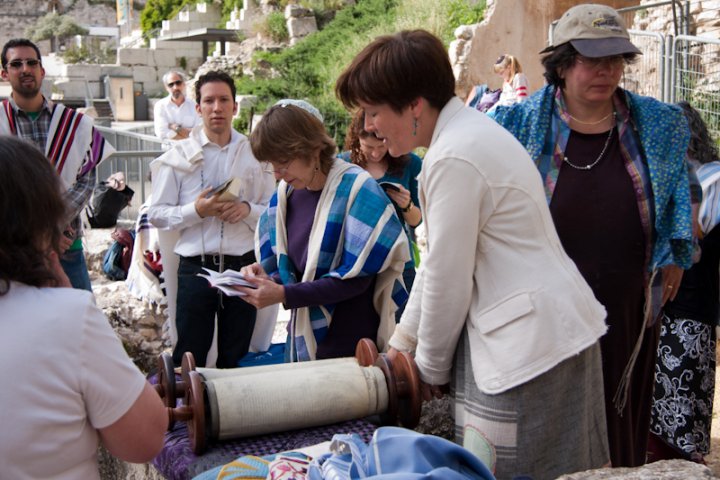
| 1 Dec 1988 | Women of the Wall first pray with a Torah scroll at the Western Wall[11] | Consensus |
| 1989–2000 | About a million Jews and their relatives from the former Soviet Union immigrate to Israel[12] | Consensus |
| 12 June 1994 | Death of Menachem Mendel Schneerson, the Lubavitcher Rebbe; part of Chabad proclaims him Messiah[13] | Consensus |
| 1999 | Reform rabbis’ Pittsburgh Statement of Principles calls for study of “the whole array of mitzvot”[14] | Consensus |
| 6 Dec 2006 | Conservative law committee permits gay and lesbian rabbis and same-sex ceremonies[15] | Consensus |
| 2009–10 | Sara Hurwitz ordained by Avi Weiss as the first openly ordained Orthodox woman clergy, later titled rabba[16] | Consensus |
| Jan 2016; June 2017 | Israeli government approves, then freezes, a plan for a state-recognised egalitarian prayer area at the Western Wall[17] | Consensus |
| 1 Feb 2017 | The Orthodox Union bars women from clergy positions in its synagogues[18] | Consensus |
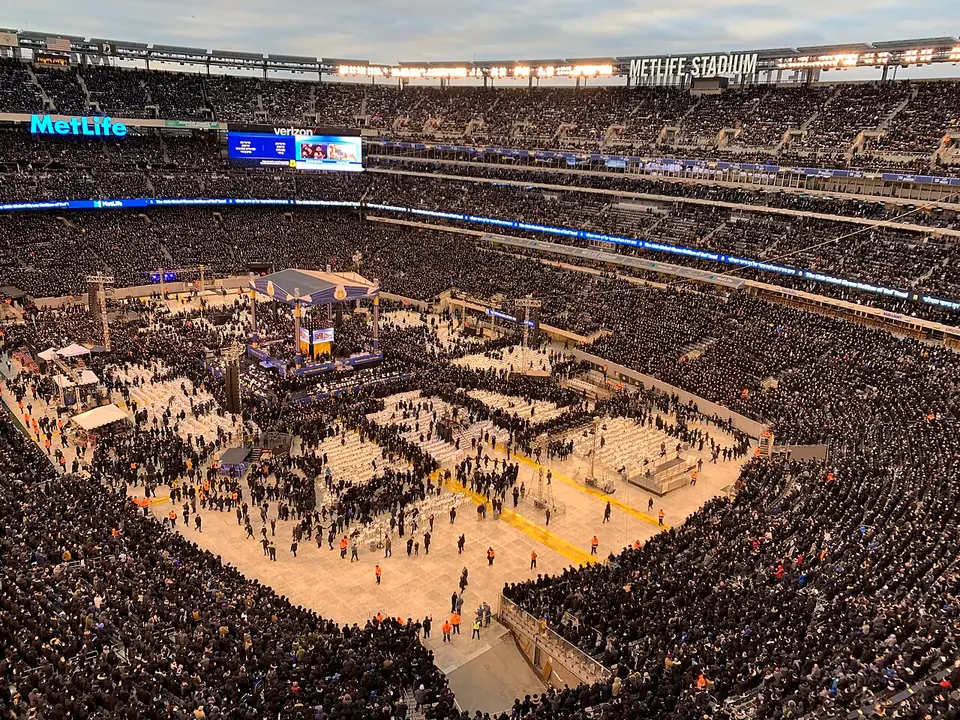
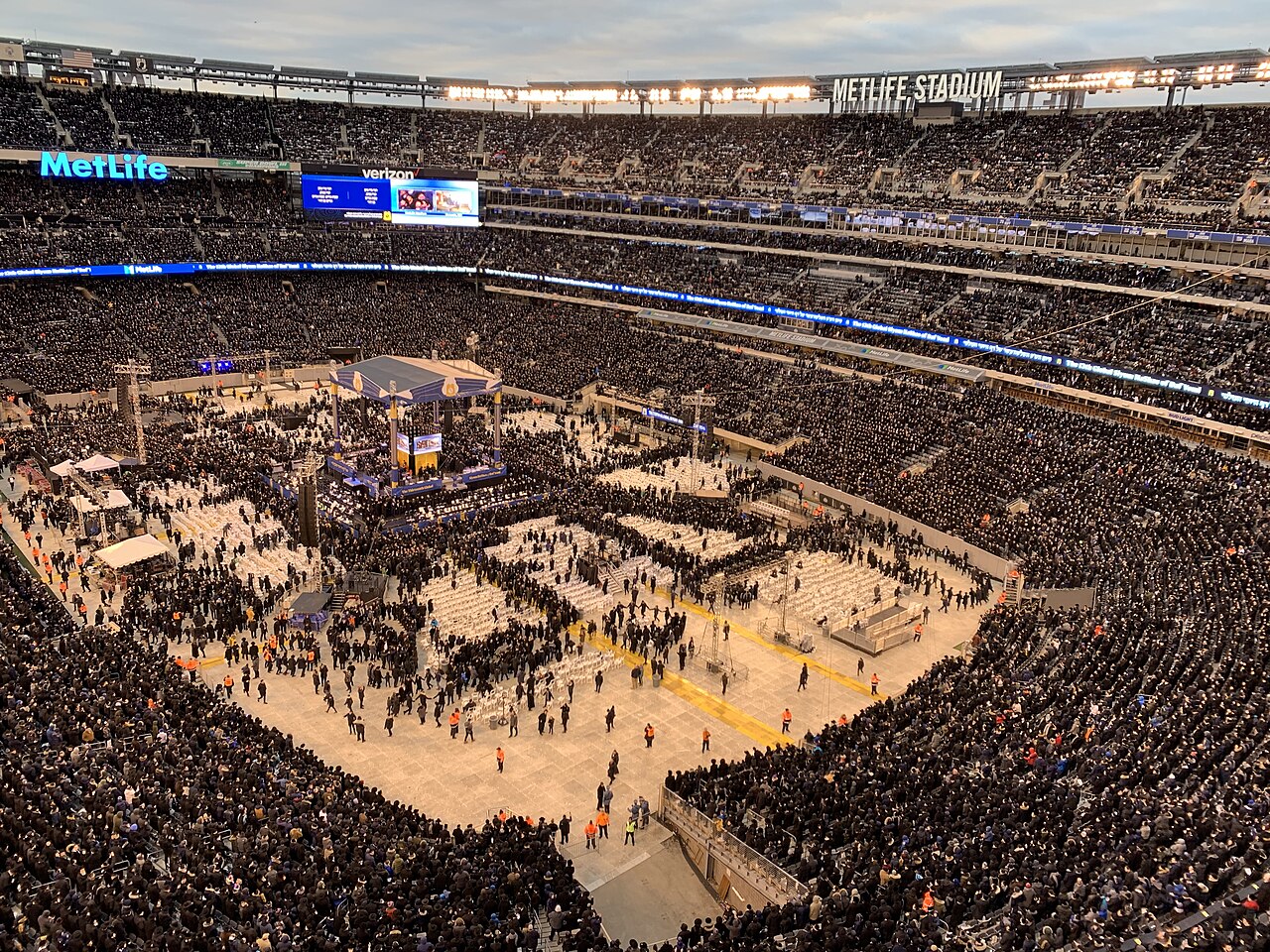
| 1 Jan 2020 | Over 90,000 people fill MetLife Stadium for the 13th completion of the Daf Yomi Talmud cycle[19] | Consensus |
| 2020–21 | Pew finds 27% of US Jewish adults have no religion; 17% of those aged 18–29 are Orthodox[20] | Consensus |
| 1 Jan 2024 | World core Jewish population about 15.74 million: Israel 7.15 million, US 6.3 million[21] | Majority |
How many Jews, and where
The basic fact of Jewish life today is concentration. Of about 15.7 million Jews counted in 2024, roughly 7.15 million lived in Israel and 6.3 million in the United States. France (about 440,000), Canada (400,000) and the United Kingdom (about 310,000) came next; no other country had more than 200,000.[21] Before the Second World War, the largest Jewish communities were in Poland, the Soviet Union and the United States; the Holocaust, emigration to Israel and the end of the Soviet Union removed Eastern Europe from the map (§12). Consensus
The numbers depend on definitions, and the definitions are the subject of this chapter. DellaPergola’s “core” population counts people who identify as Jews and do not profess another religion. Counting everyone with a Jewish parent gives a larger number; counting only those Jewish under traditional law gives a smaller one. In the United States, the 2020 Pew survey estimated 7.5 million Jews of all ages, including 5.8 million adults; the difference from DellaPergola’s figure is mostly a matter of who is counted.[20][21] Majority
Nearly all recent growth is in Israel, because Israeli Jews have more children than diaspora Jews and because the ultra-Orthodox there have very large families. DellaPergola projects that, at current rates, Israel could hold a majority of the world’s Jews as early as the mid-2030s.[22] Majority on the trend.
Two Judaisms: America and Israel
The same religion has taken different shapes in its two centres, because the two societies treat religion differently.
The United States: a voluntary religion of movements
American Judaism is organised the way American Protestantism is: as denominations that people join by choice, each with its own seminary, rabbinical association and synagogue union.[3] The 2020 Pew survey found that 37 percent of Jewish adults identified with Reform Judaism, 17 percent with Conservative, 9 percent with Orthodoxy and 4 percent with smaller movements, while 32 percent identified with no denomination.[20] Consensus
The trends run in two directions at once. Across the generations, Conservative Judaism, the largest movement in the 1950s, has shrunk; Reform and “no denomination” have grown. Among the young, both ends are expanding: 40 percent of Jewish adults aged 18–29 describe themselves as Jews of no religion, but 17 percent are Orthodox, including about one in ten who are ultra-Orthodox. Among non-Orthodox Jews who married between 2010 and 2020, 72 percent married someone who is not Jewish.[20] The American middle is thinning. Consensus on the figures; Contested on what they mean (see the debates).
Israel: a religious spectrum without denominations
Israeli Jews rarely describe themselves by movement. Pew’s survey of 2014–15 asked them instead to place themselves on a scale: 49 percent said they were hiloni (secular), 29 percent masorti (traditional), 13 percent dati (religious, roughly Modern or Religious-Zionist Orthodox) and 9 percent haredi (ultra-Orthodox).[23] The categories are social as much as theological: 95 percent of married Haredim and 93 percent of secular Jews with a spouse or partner had partners from their own group.[23] Consensus
The religious structure of the state goes back to arrangements of the British Mandate and of 1948. There is no civil marriage for Jews in Israel: Jewish weddings and divorces are performed under the authority of the Orthodox Chief Rabbinate, so couples who cannot or will not marry under it marry abroad, often in Cyprus, and register on return.[23] Reform and Conservative (Masorti) Judaism exist in Israel but have few state-funded rabbis and limited recognition. Consensus
The ultra-Orthodox share of Israel’s population has grown from a few percent at independence to roughly one in seven Israelis by the mid-2020s, with a median age under twenty. The Haredi exemption from military service, granted in 1948 to a few hundred yeshiva students, became one of the country’s most divisive issues as their numbers grew.[24] Consensus on the numbers; Political on the exemption.
The movements and what divides them
Most of the movements were born in nineteenth-century Germany and America (§11). What changed after 1967 was their practice, above all on gender, and the emergence of new groups.
Orthodoxy holds that both the written Torah and the oral Torah, the tradition later written in the Mishnah and Talmud, were given by God to Moses at Sinai, and that Jewish law is binding and develops only by traditional legal reasoning. It includes the ultra-Orthodox (Haredi) world, itself divided into Hasidic groups loyal to dynastic rebbes and “Lithuanian” groups centred on yeshivot, and Modern or Centrist Orthodoxy, which combines strict observance with secular education and, in its Israeli Religious-Zionist form, with Zionism. Consensus
Conservative (Masorti) Judaism also treats Jewish law as binding, but holds that it has always developed historically and can be changed by its rabbinic law committee. That position allowed it to count women in the prayer quorum (1973), ordain women (1985) and ordain gay and lesbian rabbis (2006), each time by legal argument rather than by abandoning law.[6][15] Consensus
Reform Judaism treats Jewish law as a resource, not an obligation. It originally discarded much ritual; since the 1970s it has moved back towards it, a shift written into its 1999 Pittsburgh principles.[14] Consensus
Reconstructionist Judaism, founded on the ideas of Mordecai Kaplan, defines Judaism as the “evolving religious civilization of the Jewish people” rather than as a revealed law. Kaplan held a bat mitzvah for his daughter Judith on 18 March 1922, the first public one in America, and is remembered for the principle, often attributed to him, that the past has “a vote but not a veto”.[25][26][27][28] Consensus
Newer currents include Humanistic Judaism (Sherwin Wine, 1963), which removes God from the liturgy; the havurah movement (from 1968), whose do-it-yourself Jewish Catalog of 1973 became a bestseller; and Jewish Renewal, led by Zalman Schachter-Shalomi, which brought Hasidic spiritual practice into egalitarian, countercultural communities.[4][3] Consensus
Women and the rabbinate
The ordination of women is one of the largest changes in Jewish religious leadership since the rise of the rabbis (§7). Rabbinic law did not admit women as witnesses, judges or members of the prayer quorum, and no woman had been a rabbi.[6] Consensus
Regina Jonas studied at the liberal Hochschule für die Wissenschaft des Judentums in Berlin and wrote her thesis on whether a woman could be a rabbi according to the sources of Jewish law, concluding that she could.[29] The Hochschule would not ordain her; on 27 December 1935 the liberal rabbi Max Dienemann ordained her privately in Offenbach. She preached and served as a chaplain in Berlin, was deported to Theresienstadt in November 1942, worked there as a rabbi, and was murdered at Auschwitz in October or December 1944. Her papers were rediscovered in an East Berlin archive in 1991.[30] Consensus
The movements follow. Sally Priesand was ordained by Reform’s Hebrew Union College on 3 June 1972; Sandy Eisenberg Sasso by the Reconstructionist Rabbinical College on 19 May 1974; Amy Eilberg by the Conservative Jewish Theological Seminary on 12 May 1985, after a faculty vote in 1983.[6] Today women make up a large share of new Reform and Conservative rabbis. Consensus
Orthodoxy divides. In 2009 Rabbi Avi Weiss ordained Sara Hurwitz with the newly coined title maharat, a Hebrew acronym for a female leader in law, spirituality and Torah, and in 2010 announced the title rabba.[16] Yeshivat Maharat in New York has trained women for Orthodox clergy roles since. On 1 February 2017 the Orthodox Union, the main synagogue body of American Modern Orthodoxy, ruled that “a woman should not be appointed to serve in a clergy position” in its member synagogues.[18] Women’s advanced Talmud study, unknown a century ago, has meanwhile become ordinary in Modern Orthodoxy and Religious-Zionist Israel. Consensus on the events; Contested inside Orthodoxy.
The Western Wall. On 1 December 1988 a group of women attending a Jewish feminist conference in Jerusalem prayed with a Torah scroll at the Western Wall; other worshippers shouted, cursed and threatened them, and a later service that month ended in violence. Women of the Wall has met there on each new moon since.[11] In January 2016 the Israeli government approved a compromise creating a state-recognised egalitarian prayer area at the southern end of the Wall; under pressure from ultra-Orthodox coalition partners it froze the plan on 25 June 2017.[17] Political
Who is a Jew?
The question that the Iron Age did not need to ask, because Israel was a people in its land, became the most practical question in modern Judaism. There are now three main answers, and they disagree. Consensus
Jewish law. A Jew is a person born to a Jewish mother or converted according to halakhah. The matrilineal rule is rabbinic; the Bible traces descent through fathers, and the change probably came in the early rabbinic period (§7). Conversion requires acceptance of the commandments, immersion and, for men, circumcision, before a rabbinic court.[31] Majority on the history.
American Reform Judaism. On 15 March 1983 the Central Conference of American Rabbis declared that “the child of one Jewish parent is under the presumption of Jewish descent”, to be confirmed by “appropriate and timely public and formal acts of identification with the Jewish faith and people”.[8] The Reconstructionist movement had taken the same position in 1968.[28] Orthodox and Conservative Judaism reject it, so a person can be a Jew in one American synagogue and not in another. Consensus
The State of Israel. The Law of Return of 1950 gave every Jew the right to immigrate. In 1962 the Supreme Court ruled that Oswald Rufeisen, a Jew by birth who had saved Jews in the war and become a Carmelite monk, was not a Jew for this purpose: halakhically he was, but in ordinary Jewish understanding a Jew who adopts another religion is not.[2] The 1970 amendment wrote a definition into law and, at the same time, extended the right of return to the children and grandchildren of Jews and their spouses.[1] The result is that hundreds of thousands of immigrants from the former Soviet Union are Israeli citizens of Jewish descent but not Jews under the rabbinate’s rules, and cannot marry as Jews in Israel. On 1 March 2021 the Supreme Court ruled that people converted in Israel by Reform or Conservative rabbis qualify under the Law of Return.[32] Political
The Beta Israel
The Jews of Ethiopia, the Beta Israel, had a religion based on the Bible in Geʿez, with priests and monks and without the Talmud: in some ways closer to Second Temple Judaism than to rabbinic Judaism (§6). Their origins are debated: their own traditions trace them to Israelites who came to Ethiopia with Menelik, son of Solomon and the Queen of Sheba, and rabbinic tradition to the tribe of Dan, while many historians, notably Steven Kaplan, see them as forming in Ethiopia between the fourteenth and sixteenth centuries from local groups who adopted biblical law; James Quirin gives more weight to an older Jewish element.[33][34] Contested
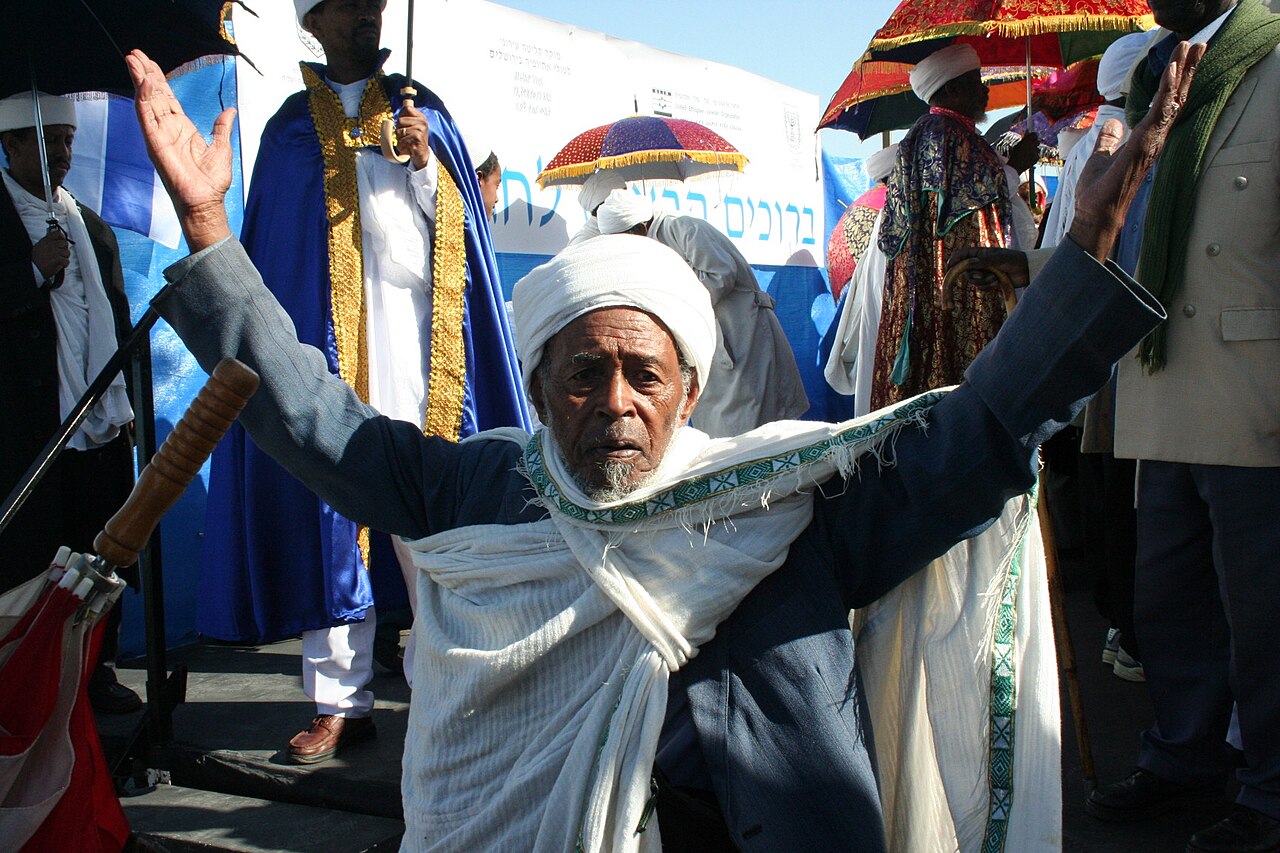
In 1973 Sephardi Chief Rabbi Ovadia Yosef ruled, following a sixteenth-century responsum of David ibn Zimra, that they were Jews descended from the tribe of Dan; the Law of Return was applied to them in 1975.[7] Operation Moses (1984–85) and Operation Solomon, which flew 14,325 people from Addis Ababa in 36 hours on 24–25 May 1991, brought most of the community to Israel.[10] From the late 1970s the rabbinate required many Ethiopian immigrants to undergo a symbolic conversion, a demand later dropped after protests; a Chief Rabbinate ruling made public in January 2020 formally confirmed the community’s Jewish status.[35] Their pilgrimage festival, Sigd, became an Israeli national holiday by law in 2008.[36] Consensus
The Mizrahi revival
Jews from the Middle East and North Africa, who arrived in Israel in large numbers in the 1950s (§12), were absorbed into institutions run largely by Ashkenazi Jews. Shas, founded in 1984 with Ovadia Yosef as its spiritual leader, made religion the vehicle of Mizrahi pride under Yosef’s slogan le-haḥzir ʿatarah le-yoshnah, “to restore the crown to its former glory”, and built its own network of schools. Yosef’s legal rulings, which aimed to make the codes of the Sephardi authority Joseph Karo binding in the Land of Israel, are widely regarded as the most influential body of Jewish law produced in Israel.[9] Majority
The Orthodox revival
In the 1950s many sociologists expected Orthodoxy to disappear in America. It did not. Three changes reversed the expectation.
The yeshiva world rebuilt. The Lithuanian yeshivot and Hasidic courts destroyed in the Holocaust were re-established in Israel and in Brooklyn, Lakewood and other centres, and grew through high birth rates and full-time Torah study for men. The Daf Yomi programme, proposed by Rabbi Meir Shapiro at the first world congress of Agudat Israel in Vienna in 1923 and begun that Rosh Hashanah, in which participants study one folio of the Babylonian Talmud a day and finish the whole in seven and a half years, became a mass practice;[37] its thirteenth completion, on 1 January 2020, filled MetLife Stadium in New Jersey with over 90,000 people.[19] Consensus
The returnees. From the late 1960s, yeshivot in Jerusalem such as Ohr Somayach (early 1970s) and Aish HaTorah (1974) taught young Jews with little background, many of them American students travelling in Israel. The baʿal teshuvah movement made Orthodoxy something people chose, not only something they were born into.[5] Consensus
From custom to text. Haym Soloveitchik argued in 1994 that the Orthodoxy that emerged after the war was itself new. In Eastern Europe, religious practice had been learned by imitation in the home and the street; after the destruction of that world, it was rebuilt from books, so that observance became stricter, more uniform and more dependent on written rulings.[38] Majority
Chabad
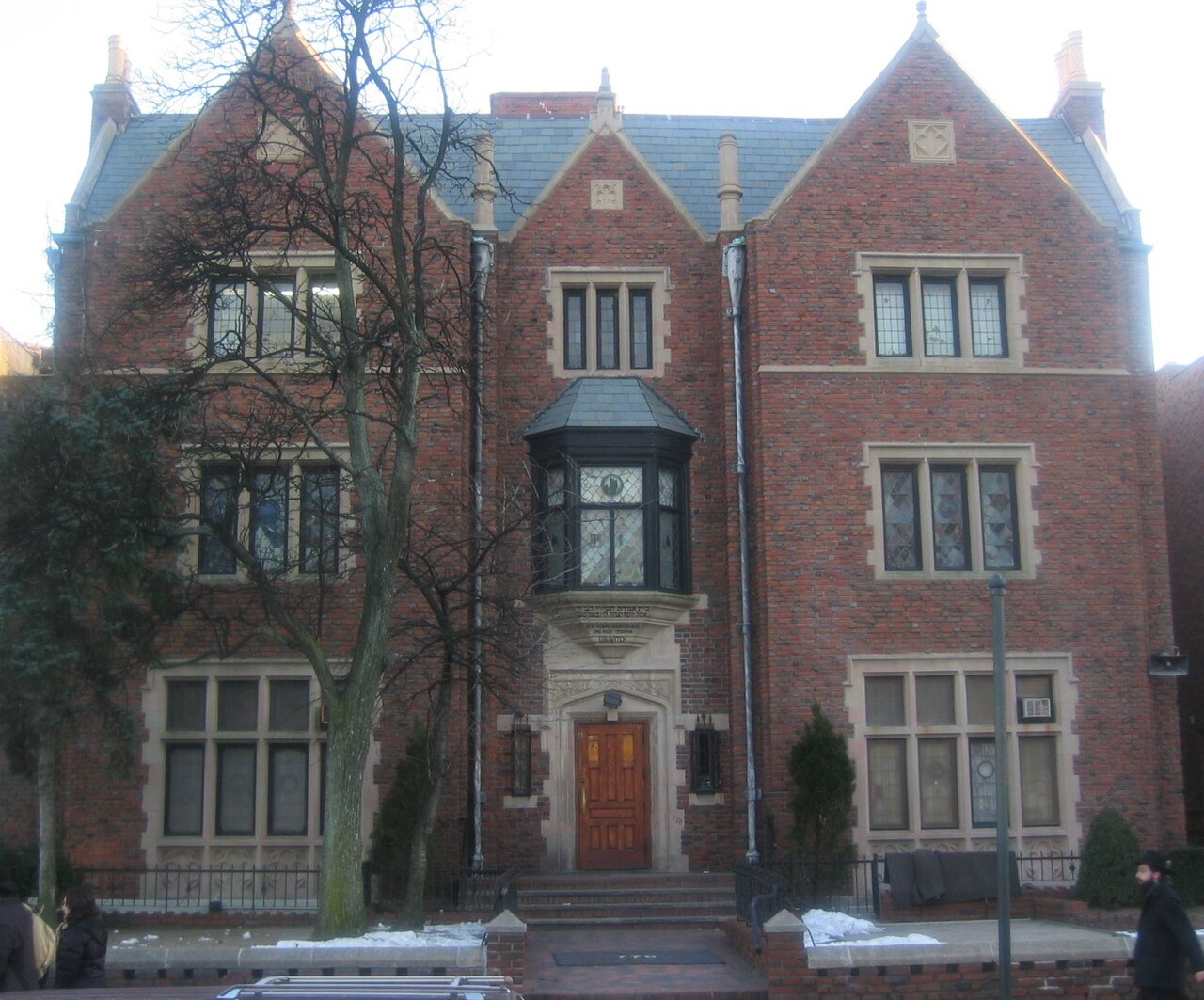
Chabad-Lubavitch, a Hasidic movement founded by Shneur Zalman of Liadi in the late eighteenth century (§10), was led from 1951 by Menachem Mendel Schneerson, the seventh Lubavitcher Rebbe, from 770 Eastern Parkway in Brooklyn. He turned it into a movement of outreach to all Jews, sending married couples as permanent emissaries (shluchim) to cities and campuses around the world. By the mid-2020s the movement counted more than 6,000 emissary families, about 2,500 of them in the United States.[13][39] Consensus
In his last years, many followers came to believe that Schneerson was the Messiah. After his stroke of 1992 and his death on 12 June 1994, a messianist wing continued to proclaim him as such, some believing he would return, some that he had not truly died. The movement’s official bodies avoid the claim; others in the Orthodox world, notably the historian David Berger, argued that a messiah who died without completing the redemption is a belief Judaism had rejected since the early Christians (§6) and Sabbatai Zevi (§10).[40][13] Contested
The evidence ledger for Judaism today
| Question | What the evidence supports | Key evidence | Confidence |
|---|---|---|---|
| Size | About 15.7 million core Jews (2024), over 85% in Israel and the US | DellaPergola’s annual estimates[21] | Majority |
| US denominations | Reform 37%, Conservative 17%, Orthodox 9%, none 32% of adults | Pew 2020[20] | Consensus |
| Israeli self-identification | Secular 49%, traditional 29%, religious 13%, ultra-Orthodox 9% of Jewish adults (2014–15) | Pew 2016[23] | Consensus |
| Haredi growth | Roughly one Israeli in seven by the mid-2020s, with very young age structure | Israel Democracy Institute reports[24] | Consensus |
| Jews of no religion | 27% of US Jewish adults; 40% of those aged 18–29 | Pew 2020[20] | Consensus |
| Women rabbis | Ordained in Reform (1972), Reconstructionist (1974), Conservative (1985); contested in Orthodoxy | Movement records; OU 2017[6][18] | Consensus |
| Who is a Jew | Three operative definitions: halakhic, Reform, Israeli civil | CCAR 1983; Law of Return; Rufeisen[8][1][2] | Consensus |
| Orthodox change | Post-war Orthodoxy is text-based and stricter than pre-war custom | Soloveitchik’s analysis; returnee studies[38][5] | Majority |
| Liberal return to ritual | Reform has moved towards Hebrew, Shabbat and mitzvot since the 1970s | 1999 Pittsburgh principles[14] | Consensus |
Primary sources
1. The Law of Return, 1950 and 1970
Hebrew (§1, 1950): kol yehudi zakkai laʿalot artzah.
“Every Jew has the right to come to this country as an oleh [immigrant].”
Hebrew (§4B, 1970): le-ʿinyan ḥoq zeh, “yehudi” – mi she-nolad le-em yehudiyyah o she-nitgayyer, ve-hu eino ben dat aḥeret.
“For the purposes of this Law, ‘Jew’ means a person who was born of a Jewish mother or has become converted to Judaism and who is not a member of another religion.”[1]
What it proves. A secular state wrote a religious definition into law, and immediately qualified it. The definition takes the halakhic rule of maternal descent, adds the Rufeisen principle that a Jew who adopts another religion is excluded, and leaves undefined how one converts, which is why the recognition of non-Orthodox conversions has been fought over in the courts ever since. The same amendment extended the right of return to non-Jewish children, grandchildren and spouses of Jews. Consensus
2. Can a woman hold rabbinic office? Regina Jonas, 1930
The thesis Jonas submitted at the Berlin Hochschule was titled Kann die Frau das rabbinische Amt bekleiden?, “Can a woman hold rabbinic office?” She argued from biblical, talmudic and later sources that almost nothing in Jewish law stood against it except prejudice and unfamiliarity.[29][30]
What it proves. The first case for women rabbis was argued not by rejecting Jewish law but from within it, by a woman trained in it. The same method, a legal argument that the tradition permits what custom forbade, was used by the Conservative movement in 1983 and by the Orthodox advocates of women clergy after 2009. Majority
3. One Jewish parent: the Reform resolution of 1983
English (CCAR, 15 March 1983): “The Central Conference of American Rabbis declares that the child of one Jewish parent is under the presumption of Jewish descent. This presumption of the Jewish status of the offspring of any mixed marriage is to be established through appropriate and timely public and formal acts of identification with the Jewish faith and people.”[8]
The resolution lists the acts it has in mind: “entry into the covenant, acquisition of a Hebrew name, Torah study, Bar/Bat Mitzvah, and Kabbalat Torah (Confirmation).”
What it proves. Two things often missed. First, the resolution did not simply add fathers to mothers: it made the status of every child of a mixed marriage, through either parent, depend on being raised as a Jew. Second, it was a response to intermarriage, which by the 1980s was common in American Jewish life. It is the largest formal divergence between the movements on membership in the people. Consensus
4. “Great is human dignity”: Berakhot 19b and the Conservative ruling of 2006
Hebrew/Aramaic (b. Berakhot 19b, citing a baraita): gadol kevod ha-beriyyot she-doḥeh et lo taʿaseh she-ba-Torah.
“Great is human dignity, as it overrides a prohibition in the Torah.” (William Davidson translation)[41]
The Talmud immediately limits the principle: the prohibition it overrides is the general command to obey the sages, so human dignity can set aside rabbinic rules, not explicit biblical ones.
In December 2006 the Conservative movement’s law committee accepted a responsum by Elliot Dorff, Daniel Nevins and Avram Reisner that used this principle to set aside the rabbinic prohibitions on homosexual relations, while keeping the one act the authors read as biblically forbidden, and on that basis permitted the ordination of gay and lesbian rabbis and same-sex commitment ceremonies.[15]
What it proves. That Conservative Judaism changes by legal reasoning from classical sources, and that the Talmud’s own limits on that reasoning shape the result. The committee also accepted a responsum upholding the traditional prohibitions, so congregations and rabbis could follow either: pluralism inside a single legal system. Consensus
5. No women clergy: the Orthodox Union, 2017
English (OU statement, 1 February 2017): “a woman should not be appointed to serve in a clergy position.”[18]
The statement adopted the responses of a panel of seven Orthodox rabbis, most of them senior Yeshiva University faculty. It listed roles it encouraged women to take, such as teaching Torah at advanced levels, advising on the laws of family purity and pastoral counselling, and barred not only the title of rabbi but the functions of clergy, even without a title: ruling on Jewish law, officiating at life-cycle events and preaching from the pulpit.
What it proves. Orthodoxy’s line on women’s leadership is drawn by function and by tradition (mesorah), not by explicit text, since no text addresses women rabbis. It also shows that the debate over women clergy is now inside Orthodoxy: the statement was needed because Orthodox synagogues had begun to hire women. Consensus
6. Long live the King Messiah: the Chabad proclamation
Hebrew: yeḥi adonenu morenu ve-rabbenu melekh ha-mashiaḥ le-ʿolam vaʿed.
“Long live our master, our teacher and our rabbi, the King Messiah, for ever and ever.”[42]
Chanted by Chabad messianists in Schneerson’s presence from the early 1990s, and still sung at 770 Eastern Parkway and in some Chabad houses, it names no one; everyone present knows who is meant.
What it proves. That messianism, a belief that entered Judaism in the Second Temple period (§6) and erupted under Sabbatai Zevi (§10), remains a living force in modern Judaism, and that the movement most successful at reaching non-observant Jews also produced the strongest messianic movement in centuries. Consensus
7. Reform returns to mitzvot: Pittsburgh 1885 and 1999
1885: “We hold that all such Mosaic and rabbinical laws as regulate diet, priestly purity, and dress originated in ages and under the influence of ideas entirely foreign to our present mental and spiritual state.”[43]
1999: “We are committed to the ongoing study of the whole array of mitzvot and to the fulfillment of those that address us as individuals and as a community.” And: “We affirm the importance of studying Hebrew, the language of Torah and Jewish liturgy, that we may draw closer to our people’s sacred texts.”[14]
What it proves. The movement that most completely rejected ritual law in the nineteenth century invited its members back to it at the end of the twentieth, in the same city. The 1999 text still leaves the choice to the individual, which is the line that separates Reform from the law-bound movements. Consensus
What is absent from Judaism today
Judaism today is often called “the religion of the Bible”. Measured against the evidence of §2, most of what Iron Age worshippers of Yahweh did has gone.
- Sacrifice and the Temple. No Jewish community has offered animal sacrifice since 70 CE. Daily prayer stands in for it; Orthodox liturgy prays for its restoration, while Reform and Conservative prayer books have dropped or reinterpreted those prayers. Consensus
- A ruling priesthood. Descendants of priests (kohanim) keep a few roles, such as blessing the congregation, but authority belongs to rabbis, a role that did not exist in biblical Israel (§7). Consensus
- Other gods and a goddess. No living form of Judaism worships any god but one; Asherah survives only as a word in the Bible (§2). Consensus
- A single centre of authority. There is no Sanhedrin, no universally recognised chief rabbi and no agreed definition of who belongs. Consensus
- Agreement on revelation. Orthodoxy holds that the Torah was given at Sinai; most non-Orthodox theologies accept the historical-critical account of its composition (§0) in some form. Majority
Debates about Judaism today
Is Orthodoxy “traditional Judaism”?
| View | Main argument | Main proponents |
|---|---|---|
| Continuity | Orthodoxy preserves the law and beliefs of rabbinic Judaism unchanged in principle and changes only by the tradition’s own legal methods, as every generation has; its stringency is fidelity to the codes, not novelty; the other movements departed from the system itself | Orthodox self-understanding |
| A modern movement too | “Orthodoxy” was a nineteenth-century label (§11); post-war Orthodoxy rebuilt itself from texts and became stricter and more uniform than the pre-war world it claims to continue | Soloveitchik; historians of modern Judaism[38][3] |
Both can be true. Orthodoxy keeps the legal system and the theology of revelation that the other movements gave up or reinterpreted, and in that sense it is the direct heir of rabbinic Judaism. But the way it is practised, from printed codes and with a vocabulary of stringency, is modern. Majority
Is non-Orthodox Judaism declining or transforming?
The pessimistic reading of the Pew data: high intermarriage, low birth rates and the rise of “Jews of no religion” mean that liberal Judaism in America is shrinking and that the Jewish future belongs to Orthodoxy and Israel.[44] The optimistic reading: American Judaism has been declared dying in every generation and has repeatedly renewed itself; many intermarried families raise Jewish children; the growth of “no denomination” is a change in how Jews belong, not a decision to stop belonging.[3][45] Contested
Who should decide who is a Jew?
The halakhic position, held by Orthodox and Conservative Judaism and by Israel’s rabbinate: status is fixed by Jewish law, and a people with differing definitions will split, because its members will not be able to marry each other. The liberal position: Jewish identity in a voluntary society rests on commitment, and a definition that excludes the children of Jewish fathers who are raised as Jews, and the hundreds of thousands of Israelis of Jewish descent, defines out people who are living Jewish lives. Israel’s Law of Return stands between them, taking a near-halakhic definition of a Jew but a broader one for the right to immigrate. Political
Was the Rebbe the Messiah?
Messianists in Chabad hold that Schneerson’s own words about the imminence of redemption, and his role as the leader of the generation, identify him as the Messiah, whose mission his death does not cancel. Most of Chabad’s institutions do not make that claim publicly, and see the Rebbe’s legacy in the emissary network. David Berger argued that Orthodox bodies’ failure to reject the belief that a dead man will return as Messiah was an abandonment of a principle that had separated Judaism from Christianity.[40][13] Contested
What changed and what didn’t: Judaism today against the baseline of §2
The religion of Iron Age Israel described in §2 is the starting point of this series. Setting it beside the Judaism of today shows how much the history in between has done. Majority
| Iron Age Israel and Judah (§2) | Judaism today | |
|---|---|---|
| God | Yahweh, one god among others, merged with El, sometimes paired with Asherah | One God, creator of all, without consort or rival; in some modern theologies a symbol or a process |
| Divine name | Yahweh, spoken freely and built into personal names | Not pronounced; read as Adonai or ha-Shem, “the Name” |
| Worship | Animal sacrifice at many shrines, then at one Temple | Prayer, Torah reading and study, at home and in synagogues |
| Sacred text | Oral traditions, a few written scrolls, no fixed scripture | A closed Bible, the Talmud and two millennia of commentary and law |
| Religious leaders | Kings, priests and prophets | Rabbis, including, in most movements, women |
| Membership | Belonging to a people in its land | A people dispersed across the world, joined by birth or conversion, with competing definitions |
| Afterlife | Sheol, a shadowy underworld for all | Resurrection, the world to come and immortality of the soul, held with varying literalness |
| Images | Bulls, standing stones, figurines | No images of God in any form of Judaism |
| Centre | Jerusalem and the kingdoms of Israel and Judah | Israel and the United States |
What didn’t change is shorter, and more important. The name Israel, borne by a people in the Merneptah Stele of c. 1208 BCE, is borne by a people and a state today. The god of that people is still the god invoked in their prayers, even if he is now understood as the only one. And the books that began as the writings of the Iron Age kingdoms, re-read by exiles, priests, sages and modern critics, are still read aloud each week in the same cycle. Judaism’s continuity is not of belief or practice, both of which have changed beyond recognition, but of a people reading its own texts and arguing about them. Majority
Further reading
- Jonathan D. Sarna, American Judaism: A History (Yale, 2004; 2nd ed. 2019) — the standard history, ending in the present.
- Pew Research Center, Jewish Americans in 2020 (2021), and Israel’s Religiously Divided Society (2016) — the survey data, free online.
- Haym Soloveitchik, “Rupture and Reconstruction: The Transformation of Contemporary Orthodoxy”, Tradition 28:4 (1994).
- Samuel Heilman and Menachem Friedman, The Rebbe: The Life and Afterlife of Menachem Mendel Schneerson (Princeton, 2010).
- Pamela S. Nadell, Women Who Would Be Rabbis: A History of Women’s Ordination, 1889–1985 (Beacon, 1998), and Elisa Klapheck, Fräulein Rabbiner Jonas (Jossey-Bass, 2004).
- Jack Wertheimer, The New American Judaism: How Jews Practice Their Religion Today (Princeton, 2018).
- Steven Kaplan, The Beta Israel (Falasha) in Ethiopia (NYU, 1992).
- Mordecai M. Kaplan, Judaism as a Civilization (1934).
References
- ^ a b c d Law of Return 5710–1950, §1; §4B (1970) — Law of Return (Israel). 1950; amended 1970. Hebrew. Grants every Jew the right to immigrate to Israel; the 1970 amendment defines a Jew as one born of a Jewish mother or converted and not a member of another religion, and extends the right to children, grandchildren and spouses of Jews. about
- ^ a b c Rufeisen v. Minister of the Interior, HCJ 72/62 (1962) — Supreme Court of Israel. December 1962. Hebrew. By four to one, the court held that Oswald Rufeisen (Brother Daniel), born Jewish but a Carmelite monk, was not a Jew for the purposes of the Law of Return: a Jew who adopts another religion is not a Jew in ordinary Jewish understanding. about
- ^ a b c d e Jonathan D. Sarna American Judaism: A History. Yale University Press, 2004. The standard history, from colonial congregations to the present.
- ^ a b Riv-Ellen Prell Prayer and Community: The Havurah in American Judaism. Wayne State University Press, 1989. Ethnography and history of the havurah movement from Havurat Shalom (1968) onward, including the counterculture roots of Jewish Renewal.
- ^ a b c M. Herbert Danzger Returning to Tradition: The Contemporary Revival of Orthodox Judaism. Yale University Press, 1989. Sociological study of the baal teshuvah movement in the US and Israel.
- ^ a b c d e f g Pamela S. Nadell Women Who Would Be Rabbis: A History of Women's Ordination, 1889–1985. Beacon Press, 1998. The history of the debate over women rabbis from the first proposals to Amy Eilberg's ordination.
- ^ a b Ovadia Yosef, ruling on the Beta Israel (1973) — Sephardi Chief Rabbinate of Israel. 1973. Hebrew. Following the sixteenth-century responsum of David ibn Zimra, rules that the Beta Israel of Ethiopia are Jews descended from the tribe of Dan, opening the way to their immigration under the Law of Return in 1975. about
- ^ a b c d CCAR resolution, 15 March 1983 — Status of Children of Mixed Marriages (Central Conference of American Rabbis). 1983. English. Declares the child of one Jewish parent, mother or father, presumptively Jewish, the status to be established by public acts of Jewish identification such as a Hebrew name, Torah study and bar/bat mitzvah. read the text
- ^ a b David Lehmann and Batia Siebzehner Remaking Israeli Judaism: The Challenge of Shas. Hurst / Oxford University Press, 2006. Sociological study of Shas, its school network and Ovadia Yosef's programme to 'restore the crown to its former glory'.
- ^ a b Stephen Spector Operation Solomon: The Daring Rescue of the Ethiopian Jews. Oxford University Press, 2005. Narrative history of the Ethiopian aliyah and the 1991 airlift of 14,325 people in 36 hours.
- ^ a b Phyllis Chesler and Rivka Haut, eds. Women of the Wall: Claiming Sacred Ground at Judaism's Holy Site. Jewish Lights, 2003. Participants' accounts of the women's prayer group at the Western Wall from 1988.
- ^ Larissa Remennick Russian Jews on Three Continents: Identity, Integration, and Conflict. Transaction Publishers, 2007. Comparative study of the post-1989 Soviet Jewish emigration to Israel, the US, Canada and Germany.
- ^ a b c d Samuel Heilman and Menachem Friedman The Rebbe: The Life and Afterlife of Menachem Mendel Schneerson. Princeton University Press, 2010. Critical biography of the seventh Lubavitcher Rebbe and of Chabad messianism; contested by Chabad.
- ^ a b c d A Statement of Principles for Reform Judaism (Pittsburgh, 1999) — Central Conference of American Rabbis. May 1999. English. Affirms Torah as the foundation of Jewish life and commits Reform Jews to 'the ongoing study of the whole array of mitzvot' and to Hebrew study: a return towards ritual after the 1885 platform. about
- ^ a b c Dorff, Nevins and Reisner, responsum accepted 6 December 2006 — Homosexuality, Human Dignity, and Halakhah (Committee on Jewish Law and Standards, Rabbinical Assembly). 2006. English. Uses the principle of human dignity to set aside rabbinic prohibitions on homosexual relations, permitting gay and lesbian rabbis and same-sex ceremonies in Conservative Judaism while retaining the biblical prohibition as the authors read it. about
- ^ a b Jewish Telegraphic Agency New title for Orthodox female rabbi. J. The Jewish News of Northern California, 5 February 2010, 2010. open library News report of Avi Weiss replacing Sara Hurwitz's 2009 title maharat with rabba.
- ^ a b Israeli government decision on the Western Wall, January 2016; frozen 25 June 2017 — Government of Israel. 2016–2017. Hebrew. Approved a state-recognised egalitarian prayer area at the southern end of the Western Wall under a council including the non-Orthodox movements; frozen under ultra-Orthodox pressure seventeen months later. about
- ^ a b c d Orthodox Union statement, 1 February 2017 — Statement on halakhically valid roles for women in synagogue leadership. 2017. English. Adopting the responses of a seven-member rabbinic panel, rules that 'a woman should not be appointed to serve in a clergy position' in OU synagogues, barring clergy functions (ruling on law, officiating, preaching) with or without title, while encouraging other roles such as advanced Torah teaching, family-purity advising and pastoral counselling. about
- ^ a b Marc Liverman Over 90,000 Jewish people unite at religious event in New Jersey after violent attacks. CBS News, 1 January 2020, 2020. open library News report of the 13th Siyum HaShas at MetLife Stadium and its attendance.
- ^ a b c d e f Pew Research Center Jewish Americans in 2020. Pew Research Center, Washington DC, 2021. open library The largest recent survey of American Jews: denominations, Jews of no religion, intermarriage, Orthodox growth.
- ^ a b c d Sergio DellaPergola World Jewish Population, 2024. In A. Dashefsky and I. Sheskin, eds., American Jewish Year Book 2024 (Springer), 2025. The standard annual estimate of the core Jewish population by country.
- ^ Sergio DellaPergola The Jewish People in 2126: Demography, Identity and the Future of a Global Minority. Institute for Jewish Policy Research, London, 2026. open library Long-range projection of world Jewish population; expects Israel to hold a majority of the world's Jews within decades, possibly by the mid-2030s.
- ^ a b c d Pew Research Center Israel's Religiously Divided Society. Pew Research Center, Washington DC, 2016. open library Survey of 5,601 Israeli adults (2014–15): the secular–traditional–religious–Haredi spectrum and views on religion and state.
- ^ a b Gilad Malach and Lee Cahaner Statistical Report on Ultra-Orthodox Society in Israel 2024. Israel Democracy Institute, 2024. Annual figures on Haredi population, age structure, education, employment and military service.
- ^ Mordecai M. Kaplan Judaism as a Civilization: Toward a Reconstruction of American-Jewish Life. Macmillan, 1934. The founding text of Reconstructionism: Judaism as the evolving religious civilization of the Jewish people.
- ^ Mel Scult Judaism Faces the Twentieth Century: A Biography of Mordecai M. Kaplan. Wayne State University Press, 1993. The standard biography of Kaplan, covering the Society for the Advancement of Judaism and his daughter Judith's bat mitzvah of 1922.
- ^ Robert M. Seltzer Jewish People, Jewish Thought: The Jewish Experience in History. Macmillan, 1980. Survey history of Jewish thought; summarises Kaplan's view of Judaism as an evolving religious civilization in which law has 'a vote and not a veto'.
- ^ a b David Teutsch et al. Reconstructionist Judaism, Past, Present and Future: A Symposium. The Reconstructionist (Fall 2005), pp. 93–101, 2005. full text Movement leaders' reflections; states the Reconstructionist commitment to giving the past 'a vote but not a veto' and dates the movement's adoption of descent through either parent to 1968.
- ^ a b Regina Jonas, Kann die Frau das rabbinische Amt bekleiden? — Thesis, Hochschule für die Wissenschaft des Judentums, Berlin. 1930. German. The first halakhic argument for women's ordination, concluding from biblical, talmudic and later sources that almost nothing but prejudice and unfamiliarity stands against a woman holding rabbinic office; its author was ordained privately in 1935. about
- ^ a b Elisa Klapheck Fräulein Rabbiner Jonas: The Story of the First Woman Rabbi. Jossey-Bass, 2004. Biography of Regina Jonas with an English translation of her thesis.
- ^ Shaye J. D. Cohen The Beginnings of Jewishness: Boundaries, Varieties, Uncertainties. University of California Press, 1999. When Ioudaios came to mean a religious identity, and how conversion and matrilineal descent arose.
- ^ Globes correspondent High Court: Israel must recognize Reform conversions. Globes, 1 March 2021, 2021. open library Reports the 8–1 ruling of a nine-justice panel that Reform and Conservative conversions performed in Israel count under the Law of Return.
- ^ Steven Kaplan The Beta Israel (Falasha) in Ethiopia: From Earliest Times to the Twentieth Century. New York University Press, 1992. Argues that the Beta Israel formed as a distinct group in Ethiopia from the fourteenth century.
- ^ James Quirin The Evolution of the Ethiopian Jews: A History of the Beta Israel (Falasha) to 1920. University of Pennsylvania Press, 1992. History of the Beta Israel as an Ethiopian community shaped by local politics and religion.
- ^ Marcy Oster Israel's Chief Rabbinate officially recognizes Ethiopian Beta Israel community as Jewish. Jewish Telegraphic Agency (via J. The Jewish News of Northern California), 21 January 2020, 2020. open library Reports the Chief Rabbinate ruling of November 2019, made public in January 2020, and the earlier symbolic-conversion requirement.
- ^ Sigd Law, 5768–2008 — Knesset of Israel. 30 June 2008. Hebrew. Makes Sigd, the Beta Israel festival held on 29 Heshvan, a national holiday with a state ceremony in Jerusalem. about
- ^ Chaim Simons Who Originated the Idea of the Daf Yomi Learning Schedule?. Orthodox Union (ou.org), 24 December 2019, 2019. open library Describes Meir Shapiro's 1923 proposal at the first Knessia Gedolah of Agudat Israel and earlier precedents for a daily Talmud page.
- ^ a b c Haym Soloveitchik Rupture and Reconstruction: The Transformation of Contemporary Orthodoxy. Tradition 28:4, 1994. The classic argument that post-war Orthodoxy shifted from mimetic custom to a text-based, stricter religiosity.
- ^ Chabad-Lubavitch Media Center About Chabad-Lubavitch. Chabad.org, 2026. open library The movement's self-description, giving more than 6,000 emissary families (2,500 in the US); figures as accessed in 2026.
- ^ a b David Berger The Rebbe, the Messiah, and the Scandal of Orthodox Indifference. Littman Library of Jewish Civilization, 2001. An Orthodox historian's case that belief in a returning dead Messiah breaches a core Jewish principle.
- ^ b. Berakhot 19b — Babylonian Talmud. c. 500–600 CE. Hebrew and Aramaic. 'Great is human dignity, for it overrides a prohibition of the Torah', limited by the Talmud itself to rabbinic rules; the principle later used by the Conservative movement in 2006. read the text
- ^ Yechi Adoneinu — Chabad messianist proclamation. early 1990s–present. Hebrew. 'Long live our master, our teacher and our rabbi, the King Messiah, for ever and ever': the refrain of Chabad messianists identifying Menachem Mendel Schneerson as the Messiah. about
- ^ Pittsburgh Platform — Conference of Reform rabbis, Pittsburgh. 16–19 November 1885. English. Classical Reform's charter: only the moral law binding; dietary and purity laws obsolete; Jews 'no longer a nation, but a religious community' expecting no return to Palestine. about
- ^ Jack Wertheimer The New American Judaism: How Jews Practice Their Religion Today. Princeton University Press, 2018. Survey of American Jewish practice across the movements, cautious about the non-Orthodox future.
- ^ Steven M. Cohen and Arnold M. Eisen The Jew Within: Self, Family, and Community in America. Indiana University Press, 2000. Interviews showing American Jews constructing personal, voluntary forms of Jewish identity.