The prophets and Josiah’s reform in one paragraph
In the second half of the eighth century BCE a handful of prophets in Israel and Judah began to say things that were remembered, collected and eventually written down: that Yahweh was angry with his own people, that sacrifice without justice was worthless, and that Israel must have nothing to do with Baal and the other gods. Within a few decades Assyria destroyed the northern kingdom and devastated Judah, and the prophets’ warnings looked like fulfilled predictions. In Jerusalem, a movement of priests, scribes and officials turned the prophetic demand into law. Its programme, preserved in the book of Deuteronomy, was put into force by King Josiah in 622 BCE: Yahweh alone was to be worshipped, at one place only, in one way, and according to a written book. This is not yet monotheism. The prophets and Deuteronomy argue about which god Israel should worship, not whether other gods exist. Majority
The story told in the books of Kings presents this as a return to an original faith from which Israel had strayed. Historians mostly read it the other way round: as the moment when a minority position, the worship of Yahweh alone, gained royal backing and began to define what Israel’s religion should be. Both readings agree on the main events. They disagree about whether the “Yahweh-alone” demand was new or old. Majority
Timeline of the prophets and the reforms, with the evidence
Royal dates follow the most widely used chronology; individual dates can vary by a year or two between systems.
| Date | Event or evidence | Confidence |
|---|---|---|
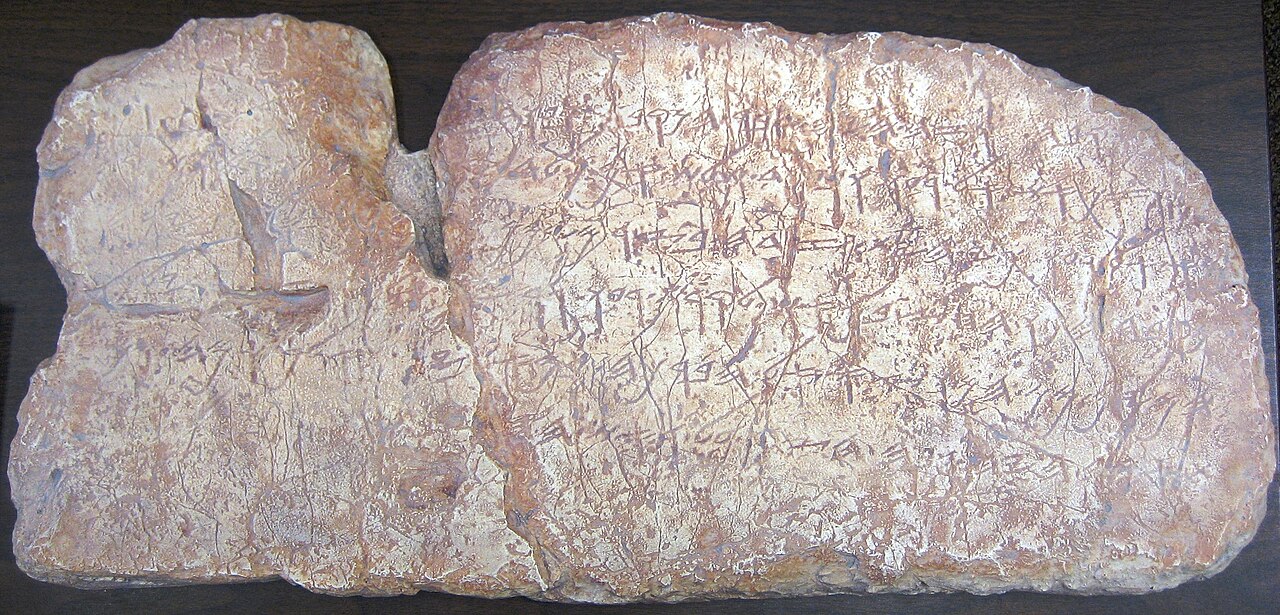
| c. 800 BCE | The Deir ʿAlla plaster text in Jordan records the visions of “Balaam son of Beor, a seer of the gods”: a non-Israelite prophet known also from Numbers 22–24[1] | Consensus |
| c. 760–750 BCE | Amos, a herdsman from Tekoa in Judah, prophesies in the northern kingdom under Jeroboam II[2] | Majority |
| c. 750–725 BCE | Hosea prophesies in Israel against Baal and the calf of Samaria[3] | Majority |
| c. 740 BCE | Isaiah’s vision in the Temple “in the year that King Uzziah died”[4] | Majority |
| 734–732 BCE | Israel and Damascus attack Judah; Ahaz appeals to Assyria, against Isaiah’s advice[5] | Majority |
| 722–720 BCE | Samaria falls to Assyria under Shalmaneser V and Sargon II; Sargon claims to have deported 27,280 people[6] | Consensus |
| late 8th c. BCE | Jerusalem expands to several times its earlier size; the Broad Wall and new western quarter[7][8][9] | Consensus (growth); Contested (cause) |
| c. 715–700 BCE | Hezekiah’s reform: high places removed, the bronze serpent Nehushtan broken (2 Kings 18:4); shrines at Arad, Beersheba and Lachish go out of use[10][11] | Contested |
| c. 701 BCE | The Siloam tunnel inscription records workers meeting underground[12] | Majority (date) |
| 701 BCE | Sennacherib invades Judah, destroys Lachish and besieges Jerusalem; Hezekiah pays tribute[13][14] | Consensus |
| c. 698–642 BCE | Manasseh rules as a loyal Assyrian vassal; Esarhaddon’s annals list him among 22 western kings[15] | Consensus |
| 672 BCE | Esarhaddon’s succession treaty imposed on vassals; a copy found at Tell Tayinat in 2009[16] | Consensus |
| 622 BCE | “The book of the law” found in the Temple; Josiah’s reform[17][18] | Majority (event); Contested (scope) |
| 609 BCE | Josiah killed at Megiddo by Pharaoh Necho II[19] | Consensus |
| c. 627–586 BCE | Jeremiah’s career; his scribe Baruch writes his words on a scroll (Jeremiah 36)[20][21] | Majority |
| 597 BCE | Nebuchadnezzar takes Jerusalem and deports King Jehoiachin; the Babylonian Chronicle gives the date[22] | Consensus |
| c. 588–586 BCE | Lachish Letter 4: “we cannot see Azeqah”[23] | Consensus |
| 587/586 BCE | Jerusalem and the Temple destroyed (§4) | Consensus |
Prophets before the prophetic books
Prophets were not an Israelite invention. Across the ancient Near East, kings and temples consulted people who claimed to speak for a god. Letters from Mari on the Euphrates, in the eighteenth century BCE, report messages from prophets and prophetesses of several gods to the king. Oracles to the Assyrian kings Esarhaddon and Ashurbanipal in the seventh century BCE, many from prophetesses of Ishtar of Arbela, were copied onto tablets and kept in the royal archives.[24] Consensus
The closest parallel to the Bible comes from Deir ʿAlla in the Jordan Valley. In 1967 a Dutch expedition led by Henk Franken found fragments of an inscription written in ink on a plastered wall, from about 800 BCE. Its heading names “Balaam son of Beor”, a man who was “a seer of the gods”. The gods come to Balaam at night, he weeps, and he tells his people of a vision of disaster decreed by a council of gods called the šaddayin.[1][25] The same Balaam is the foreign seer of Numbers 22–24, who is hired to curse Israel and blesses it instead. Consensus
The Bible’s own earlier prophets fit this pattern. Samuel, Nathan, Elijah and Elisha appear in stories, not in collections of their words. They advise and oppose kings, work wonders and belong to groups of “sons of the prophets”. The books of Kings also mention hundreds of prophets of Baal and Asherah (1 Kings 18:19) and four hundred prophets of Yahweh who tell King Ahab what he wants to hear (1 Kings 22).[26] Prophecy was a profession, and most prophets supported their kings. Majority
What changed in the eighth century was not prophecy itself but the survival of a particular kind of prophecy: words that opposed the king and the people, and that were kept because events seemed to prove them right. Majority
The eighth-century prophets
Amos: justice before sacrifice
Amos, according to his book (1:1; 7:14), was a herdsman and tender of sycamore figs from Tekoa, south of Bethlehem, who went north to prophesy at Bethel in the reign of Jeroboam II (c. 790–750 BCE), “two years before the earthquake”. The northern kingdom was prosperous, and Amos attacked its prosperity: the rich “lie on beds of ivory”, “sell the righteous for silver and the needy for a pair of sandals”, and crowd the sanctuaries with offerings.[27][2] Majority
His central claim was new in its sharpness: Yahweh does not want sacrifice from people who practise injustice. “I hate, I despise your festivals … let justice roll down like waters, and righteousness like an ever-flowing stream.” Amos also turns the idea of a chosen people against itself: “You only have I known of all the families of the earth; therefore I will punish you for all your iniquities” (3:2). And he denies Israel any special status: Yahweh brought the Philistines and Aramaeans from their homelands just as he brought Israel out of Egypt (9:7).[28] Majority on the core sayings.
Amos does not denounce other gods by name in the oracles most scholars attribute to him. His god is already the god of other nations, judging them for their crimes (Amos 1–2), but the issue is justice, not exclusive worship. Majority
Hosea: Yahweh’s jealous marriage
Hosea, a northerner active in the last decades of the kingdom of Israel, introduced the image that defined the Yahweh-alone movement: Israel as Yahweh’s unfaithful wife, who runs after “lovers”, the Baals, and credits them with the grain, wine and oil that Yahweh gave her (Hosea 2). He attacks the calf of Samaria (“a workman made it; it is not God”, 8:6) and the sacrifices on hilltops “under oak, poplar and terebinth” (4:13).[29] Majority
Hosea gives the clearest early statement of exclusive worship: “I am Yahweh your God from the land of Egypt; you know no god but me, and besides me there is no saviour” (13:4).[3] This is monolatry. Other gods are real enough to be lovers; Israel simply may not have them. Hosea also connects Yahweh exclusively with the Exodus and the wilderness, which suggests that the Exodus tradition was a northern possession before it became all Israel’s.[30] Majority
Isaiah of Jerusalem: the Holy One of Israel
Isaiah son of Amoz worked in Jerusalem from about 740 to 700 BCE, under Ahaz and Hezekiah. Only part of the book that carries his name is his: most scholars attribute much of chapters 1–39 to him, chapters 40–55 to an anonymous prophet of the exile (§4), and chapters 56–66 to the Persian period (§5).[31] Consensus on the division.
In his call vision (Isaiah 6) Yahweh sits enthroned in the Temple, surrounded by seraphim who call, “Holy, holy, holy is Yahweh of hosts; the whole earth is full of his glory.”[4] Isaiah’s god is the king of Jerusalem’s Temple and master of the nations. Assyria is “the rod of my anger” (10:5), a tool Yahweh uses and will then break. Isaiah also gave Jerusalem its royal hope: a child of the house of David who will rule with justice (Isaiah 9 and 11). These passages became central to later messianic expectation, but in their setting they describe an ideal king of Judah, not an end-time saviour (§6).[31] Majority
Micah: Zion ploughed like a field
Micah of Moresheth, a town in the Judahite lowlands, attacked Jerusalem’s rulers, priests and prophets for corruption, and predicted the unthinkable: “Zion shall be ploughed as a field; Jerusalem shall become a heap of ruins” (3:12).[32] A century later, when Jeremiah was put on trial for predicting the Temple’s destruction, elders defended him by quoting Micah’s words and naming Hezekiah’s reign as their date (Jeremiah 26:18).[33] It is the only place in the Bible where one prophet’s words are quoted by name as precedent, and it shows that a collection of Micah’s sayings was known in Jerusalem around 600 BCE. Majority
What the eighth-century prophets did not say
They did not say that no other god exists. They did not demand a single sanctuary; Isaiah’s vision takes place in the Jerusalem Temple, but neither Amos nor Hosea objects to sacrifice as such, only to sacrifice offered by the unjust or to the wrong gods. They did not appeal to a written law of Moses as such. Hosea once mentions Yahweh writing “my many laws” (8:12), but none of them quotes a law code. Majority
Assyria and the end of the northern kingdom
From the 740s BCE, the Assyrian empire under Tiglath-pileser III turned the states of the Levant into vassals and then provinces. Israel rebelled, and in 722–720 BCE Samaria fell. The Bible attributes the siege to Shalmaneser V; Sargon II claimed the conquest in his own inscriptions and boasted of deporting 27,280 people and resettling the region with foreigners.[6][34] The most likely reconstruction is that Shalmaneser took the city shortly before his death and that Sargon reconquered it after a revolt.[35] Majority
For the history of religion, the fall of Samaria mattered in three ways. Majority
- It seemed to vindicate Amos and Hosea. Their words had predicted disaster for Israel; the disaster came. That is one reason their sayings were preserved.
- Northern traditions moved south. Refugees, scribes and priests from Israel brought to Judah traditions such as the Exodus, the Jacob stories, Hosea’s oracles and probably early forms of Deuteronomic law. Much of the Bible’s northern material was preserved by Judahite editors.[36][37]
- Judah became “Israel”. After 720 BCE the only surviving kingdom of Yahweh’s people was Judah, and its writers took over the name Israel for themselves.
Jerusalem’s sudden growth
Archaeology shows Jerusalem growing in the late eighth century from a small hilltop town on the City of David ridge to a city that also covered the Western Hill. Nahman Avigad uncovered part of a seven-metre-thick fortification, the “Broad Wall”, in the Jewish Quarter in the 1970s. Magen Broshi argued in 1974 that the city grew three- or fourfold in a few decades, and that two waves of refugees explained the growth: Israelites fleeing the fall of Samaria, then Judahites fleeing Sennacherib’s devastation of the lowlands in 701; Finkelstein and Silberman developed the theory.[9][7][38] Consensus on the growth.
Nadav Naʾaman disputed the northern-refugee explanation. He argued that the growth was more gradual, began before 720, and was fed by people from Judah’s own countryside, especially after Sennacherib’s campaign of 701 devastated the lowlands; in 2014 he added that northern personal names do not increase in Judah after 720.[8][39] Finkelstein replied in 2015 that the demographic evidence still required substantial migration from the north.[40] A radiocarbon study published in 2024 adds that Jerusalem’s westward expansion had already begun in the ninth century BCE, which makes the growth look more gradual than the refugee model assumed.[41] Contested
Hezekiah, Sennacherib and the first reform
Hezekiah (c. 715–687 BCE; some chronologies begin his reign c. 727) is the first king of Judah whose reign is well documented outside the Bible. He prepared to rebel against Assyria: he fortified Jerusalem, secured its water supply with a tunnel from the Gihon spring, and stored provisions in jars stamped lmlk, “belonging to the king”.[42][43] A clay seal impression found in 2009 in the Ophel excavations below the Temple Mount and published in 2015 reads “Belonging to Hezekiah [son of] Ahaz, king of Judah”, beside a winged sun flanked by two Egyptian ankh signs of life.[44] A king later remembered as a reformer used the royal sun emblem common across the region. Consensus
The reform. 2 Kings 18:4 says that Hezekiah “removed the high places, broke the standing stones and cut down the asherah. He broke in pieces the bronze serpent that Moses had made, for until those days the people of Israel had made offerings to it; it was called Nehushtan.”[10] The detail about Nehushtan is striking: an object attributed to Moses had been worshipped in Jerusalem until Hezekiah’s day. Majority that the verse preserves a real tradition about Nehushtan; Contested on the reform as a whole.
Archaeology. Three sites have been connected with the reform.
- Arad. The shrine in the royal fortress was dismantled and buried in the late eighth century, its altars laid on their sides (§2).[45][46]
- Beersheba. In 1973 Yohanan Aharoni’s team found the dismantled stones of a large horned altar reused in the walls of a storehouse of the late eighth century.[47]
- Lachish. In 2016 excavators announced a shrine in the city gate whose altar horns had been trimmed off and beside whose altar a stone toilet seat had been placed, apparently as a deliberate desecration. Tests suggested it was never used. The shrine was sealed before Sennacherib destroyed the city in 701.[11][48]
Supporters of a historical reform see these as a pattern. Critics point out that the dating of each site is debated, that a dismantled altar could be explained by rebuilding or by Assyrian destruction, and that Kings’ account of Hezekiah may be modelled on its account of Josiah. Naʾaman argued in 1995 that no religious reform by Hezekiah can be shown to have happened.[49] Contested
701 BCE: the Assyrian invasion
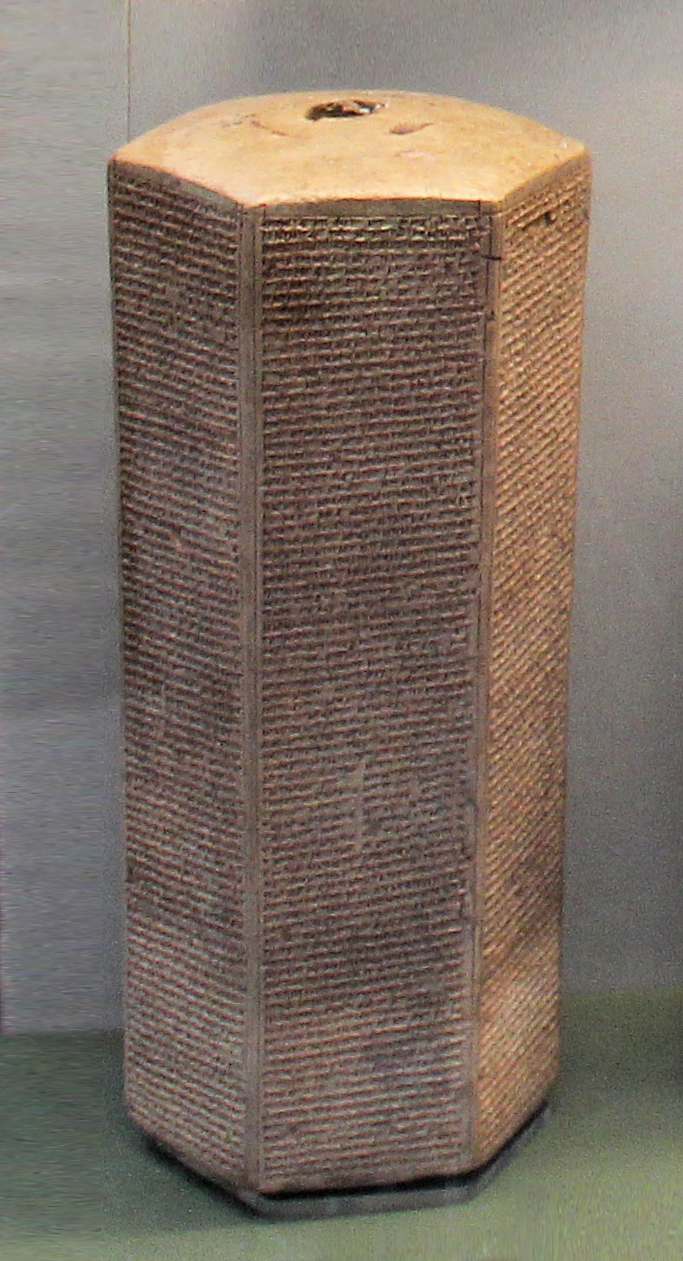
In 701 BCE Sennacherib marched west to crush the rebellion. His annals, first composed in 700 BCE and recopied on clay prisms of c. 691–689 BCE, give the Assyrian version (translation from the Royal Inscriptions of the Neo-Assyrian Period edition):
“Moreover, (as for) Hezekiah of the land Judah, who had not submitted to my yoke, I surrounded (and) conquered forty-six of his fortified cities, fortresses, and small(er) settlements in their environs, which were without number … I brought out of them 200,150 people, young (and) old, male and female … As for him (Hezekiah), I confined him inside the city Jerusalem, his royal city, like a bird in a cage.”[13]
The annals then say that, after Sennacherib’s departure, Hezekiah sent to Nineveh 30 talents of gold, 800 talents of silver, precious goods and his own daughters. The Bible (2 Kings 18:14) gives 30 talents of gold and 300 of silver.[14] The two accounts agree on the essentials: Judah was devastated, Lachish was taken, Jerusalem was besieged but not captured, and Hezekiah paid. Consensus
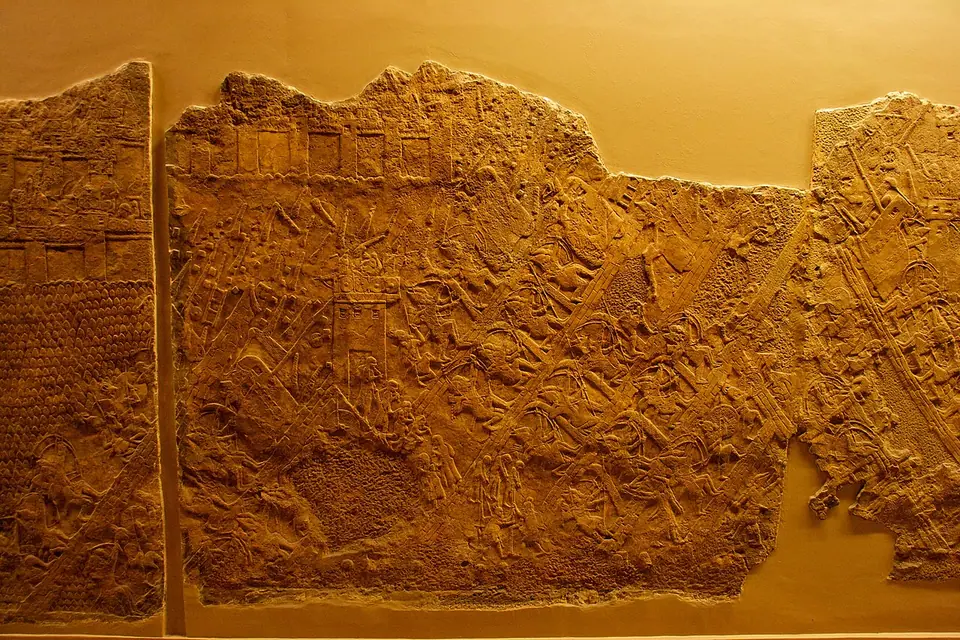
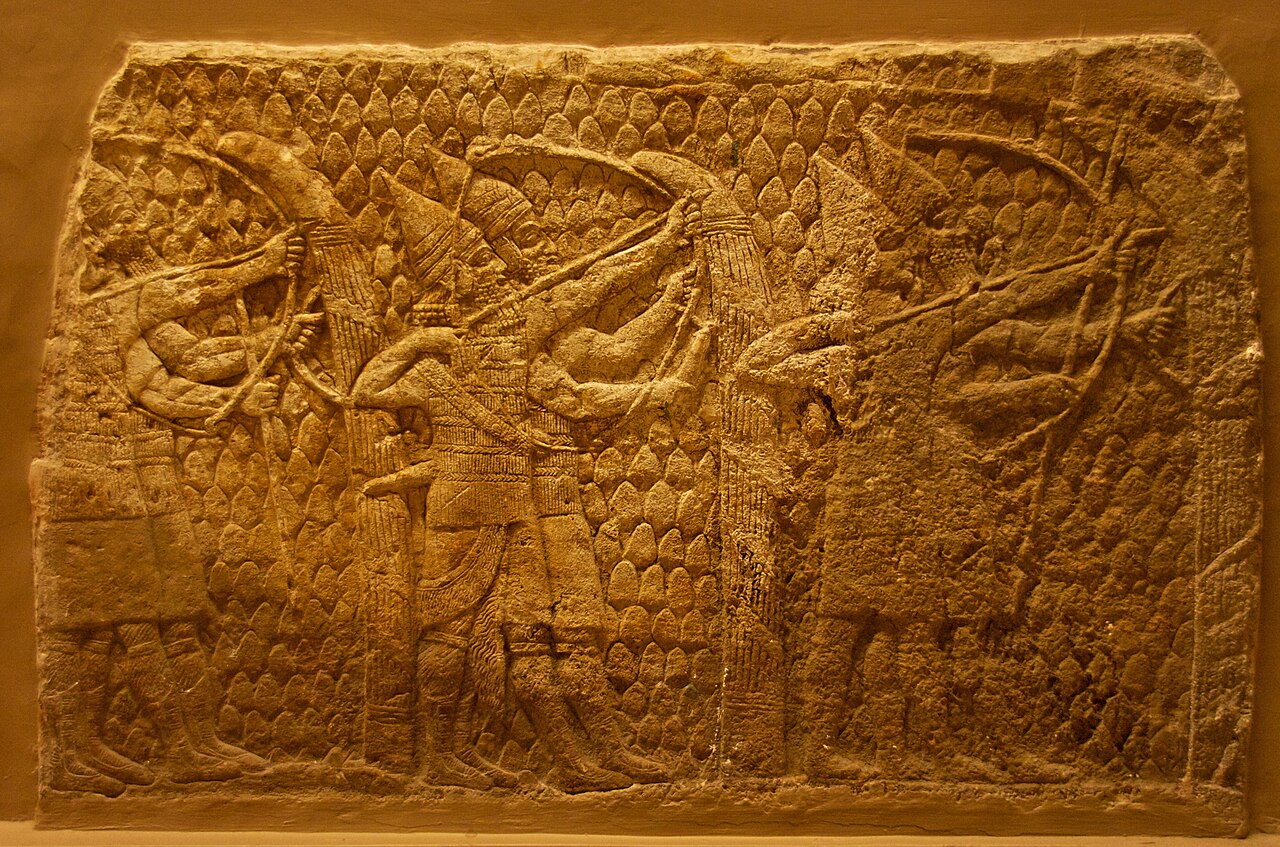
Sennacherib celebrated the fall of Lachish, not Jerusalem, on the walls of his palace at Nineveh. The carved reliefs, excavated by Austen Henry Layard between 1847 and 1851 and now in the British Museum, show the siege ramp, the defenders on the walls, the impaled prisoners and the families leaving with their goods. Archaeologists have found the Assyrian siege ramp itself at Lachish, the only Assyrian siege ramp yet excavated and the oldest known anywhere.[50][51] Consensus
Why Jerusalem survived became a theological question. The Bible says that “the angel of Yahweh” struck down 185,000 Assyrians in a night (2 Kings 19:35).[52] Herodotus, writing in the fifth century BCE, tells a story from Egyptian priests of mice gnawing the bowstrings of Sennacherib’s army on the border of Egypt.[53] Historians usually explain the withdrawal by Hezekiah’s submission and tribute, which gave Sennacherib what he wanted, perhaps helped by disease in the camp or the approach of an Egyptian army.[54] Majority
The survival of Jerusalem, when Samaria and Lachish had fallen, fed a belief that Yahweh would never let his city and Temple be taken. Jeremiah would have to fight that belief a century later. Majority
Manasseh: the villain of Kings
Hezekiah’s son Manasseh reigned for about fifty-five years, longer than any other king of Judah, as a loyal vassal of Assyria. Esarhaddon lists “Manasseh, king of Judah” among twenty-two western kings who sent building materials for his palace at Nineveh, and Ashurbanipal lists him among the kings who supported his campaign against Egypt.[15] Consensus
The books of Kings make Manasseh the worst king in Judah’s history. He rebuilt the high places, set up altars for Baal and an image of Asherah in the Temple, worshipped “all the host of heaven”, practised divination and “made his son pass through the fire” (2 Kings 21).[55] Kings blames him for the destruction of Jerusalem, which came more than fifty years after his death. Majority on the texts.
Historians read this verdict as the judgment of his opponents. What Kings calls apostasy was largely the ordinary religion of Judah, described in §2, together with Assyrian astral cults that came with imperial power. Manasseh’s long, stable reign was probably prosperous; the Judahite economy recovered from 701 and expanded in the Negev and the Judaean desert. Kings needed a villain to explain why Josiah’s reform did not save Judah.[38] Majority
One change visible in this period points the other way. Othmar Keel and Christoph Uehlinger noted that after a phase in the eighth and early seventh centuries when astral symbols were popular on Judahite seals, the seals of the late monarchy increasingly carry only names and no images. The shift can be connected with the growing prestige of writing and, more debatably, with a reserve about divine images among the scribal elite; Uehlinger himself cautions that it cannot be tied directly to Josiah’s reform.[56][57] Majority on the trend; Contested on its meaning.
Josiah and the book of the law
Josiah came to the throne at eight, in 640 BCE, after the assassination of his father Amon. In his eighteenth year, 622 BCE, according to 2 Kings 22, the high priest Hilkiah found “the book of the law” in the Temple during repairs and gave it to the scribe Shaphan, who read it to the king. Josiah tore his clothes, consulted the prophetess Huldah, assembled the people, and made a covenant “to follow Yahweh and keep his commandments … with all his heart and soul”.[17] Majority on the core narrative.
What followed, in 2 Kings 23, was the most radical religious reform described in the Bible:
- The vessels for Baal, Asherah and the host of heaven were taken out of the Temple and burned; the asherah was burned and ground to dust; the houses where women wove for Asherah were destroyed.[18]
- The priests who had sacrificed at the high places throughout Judah were brought to Jerusalem, and the high places were defiled “from Geba to Beersheba”.
- The horses and chariots dedicated to the sun were removed; the Tophet, where children were “passed through the fire”, was defiled.
- The altar at Bethel, in the old northern kingdom, was destroyed.
- A Passover was celebrated in Jerusalem “as had not been kept since the days of the judges”.[58]
Why the book is Deuteronomy
In 1805 Wilhelm de Wette argued that the book found in the Temple was Deuteronomy, or an early form of it, and most scholars still accept the identification.[59][60] Majority The reasons:
- Centralisation. The heart of Deuteronomy’s law code is the demand that sacrifice be offered only “at the place that Yahweh your God will choose” (Deuteronomy 12). No other book of the Torah makes this demand, and it is exactly what Josiah enforced.[61]
- The other gods. Deuteronomy bans standing stones, asherahs and the worship of the sun, moon and “all the host of heaven” (16:21–22; 17:3), the objects Josiah removed.[62]
- Passover. Deuteronomy 16 turns Passover from a family meal into a pilgrimage feast at the central sanctuary, as in Josiah’s Passover.
- Language. The style of Deuteronomy matches the speeches and verdicts in the books of Kings, which judge every king by whether he removed the high places.[63]
The Assyrian model
The strongest evidence for a seventh-century date came from Assyria. In 672 BCE Esarhaddon made his vassals swear an oath to support the succession of his son Ashurbanipal. Copies of the treaty were found at Nimrud in 1955 and, in 2009, at Tell Tayinat in southern Turkey, where it had been displayed in a temple.[16][64] Consensus
Deuteronomy uses the same form for Israel’s relationship with Yahweh. Deuteronomy 13 demands that anyone who urges disloyalty to Yahweh, even “your brother, your son or daughter, the wife you embrace”, be reported and killed; the treaty demands the same of anyone who speaks against Ashurbanipal. The curses of Deuteronomy 28 follow the treaty closely, sometimes in the same order: “The heavens over your head shall be bronze, and the earth under you iron” (28:23) echoes the treaty’s curse that the gods will make the ground like iron and the sky like bronze. Hans Ulrich Steymans (on chapter 28) and Bernard Levinson with Jeffrey Stackert (on chapter 13) argued that Deuteronomy’s authors adapted the Assyrian text directly, transferring to Yahweh the total loyalty that vassals owed the Assyrian king.[65][66] Others, notably C. L. Crouch, argue that the shared material is not specific or frequent enough to show that Deuteronomy was adapting this treaty, or Assyrian sources at all, because loyalty oaths and curses of this kind were common across the ancient Near East.[67] Conservative scholars such as Kenneth Kitchen argue that Deuteronomy’s covenant form is closer to Hittite treaties of the second millennium BCE and that its curses draw on a much older and wider tradition.[68] Majority on the Assyrian background; Contested on direct borrowing.
If they are right, Deuteronomy’s demand to “love Yahweh your God with all your heart” (6:5) uses the language of political loyalty, in which “love” meant faithful service to an overlord.[69] The Yahweh-alone covenant was written in the vocabulary of the empire it implicitly rejected. Majority
The Shema: one god or the only god?
The best-known verse of Deuteronomy, later the central declaration of Jewish prayer, is 6:4: šĕmaʿ yiśrāʾēl YHWH ʾĕlōhênû YHWH ʾeḥād.[70] It can be translated “Hear, O Israel: Yahweh our God, Yahweh is one”, or “Hear, O Israel: Yahweh is our God, Yahweh alone”. The Jewish Publication Society’s translation (1985) takes the second. In its seventh-century setting the verse probably meant that Israel’s god was Yahweh alone, not Baal or the Yahweh of some other place, and not that no other god existed. Later Jewish tradition read it as a statement of the unity and uniqueness of God, and in that sense it became the centre of Jewish faith. Majority
How far did the reform reach?
The reform is told in the books of Kings by writers who admired Josiah, and there is no account of it outside the Bible. Archaeology gives mixed signals. The Judean pillar figurines, which many scholars associate with Asherah, continue in Judahite households into the sixth century BCE. On the other hand, seals and seal impressions of officials named in the Bible from Josiah’s time onwards, such as Gemaryahu son of Shaphan, carry names built on Yahweh and almost no divine images.[71][21][72] Contested
Jeremiah gives the clearest evidence that the reform did not win everyone over. In Egypt after 586, Judahite refugees, led by women, tell him that they will go on making offerings to “the queen of heaven”, because things went well when they did and badly when they stopped.[73] The reform, in their view, had caused the disaster. Majority
Josiah himself was killed at Megiddo in 609 BCE by Pharaoh Necho II.[19] Within twenty-five years Jerusalem was destroyed. The reformers’ own theology now had to explain why the most faithful king in Judah’s history had died in battle and his kingdom had fallen. Consensus
The Yahweh-alone movement
In 1971 Morton Smith proposed that the Hebrew Bible was largely the work of a “Yahweh-alone party”, a minority of prophets, priests and laymen who insisted on the exclusive worship of Yahweh against a majority who worshipped Yahweh alongside other gods. Bernhard Lang developed the idea in 1983 as the “prophetic minority” that eventually won.[74][75] Majority on the basic picture.
The movement’s ideas can be followed through the sources: Elijah’s contest with Baal (told later but set in the ninth century), Hosea’s marriage metaphor, Hezekiah’s reform, Deuteronomy, Josiah, and Jeremiah. Its success was not certain. Under Manasseh it seems to have lost royal support entirely, and the refugees of Jeremiah 44 show that many Judahites rejected it to the end. Majority
The movement’s greatest influence came through writing. The books of Deuteronomy, Joshua, Judges, Samuel and Kings, which Martin Noth in 1943 called the “Deuteronomistic History”, tell Israel’s story from Moses to the fall of Jerusalem as a test of exactly one thing: whether Israel worshipped Yahweh alone at his chosen place.[76] Frank Moore Cross argued that a first edition was written under Josiah, celebrating him as the king who fulfilled the law, and a second edition after 586, explaining the disaster.[77] Majority
The evidence ledger for the prophets and the reforms
| Question | What the evidence supports | Key evidence | Confidence |
|---|---|---|---|
| Prophecy | A widespread ancient Near Eastern institution, not unique to Israel | Mari letters; Assyrian oracles; Deir ʿAlla[24][1] | Consensus |
| The eighth-century prophets | Amos, Hosea, Isaiah and Micah were real figures whose core sayings survive in later edited books | Jeremiah 26:18 quoting Micah; historical settings matching Assyrian records[32][31] | Majority |
| Exclusive worship | Demanded by Hosea and Deuteronomy as monolatry, not monotheism | Hosea 13:4; Deuteronomy 6:4[3][70] | Majority |
| Fall of Samaria | 722–720 BCE, with deportations and resettlement | Sargon’s inscriptions; 2 Kings 17[6][34] | Consensus |
| Jerusalem’s growth | Large late-eighth-century expansion; cause debated | Broad Wall; surveys[7][8][40] | Consensus (growth); Contested (refugees) |
| 701 BCE | Judah devastated, Lachish destroyed, Jerusalem besieged but not taken, tribute paid | Sennacherib’s annals; Lachish reliefs; 2 Kings 18–19[13][50][14] | Consensus |
| Hezekiah’s reform | Possible; several shrines went out of use in his time | Arad, Beersheba, Lachish gate shrine[45][47][11] | Contested |
| Josiah’s reform | A real programme of centralisation and purge, of uncertain reach | 2 Kings 22–23; seals; continuing figurines[18][71] | Majority (event); Contested (scope) |
| Deuteronomy’s date | Core composed in the seventh century | Parallels with Esarhaddon’s treaty of 672[16][65] | Majority |
| Opposition | Popular worship of other deities continued to 586 and beyond | Jeremiah 7 and 44[73] | Majority |
Primary sources
1. Justice, not sacrifice: Amos 5:21–24
Hebrew (vv. 21, 24): śānēʾtî māʾastî ḥaggêkem, wĕlōʾ ʾārîaḥ bĕʿaṣṣĕrōtêkem … wĕyiggal kammayim mišpāṭ, ûṣĕdāqâ kĕnaḥal ʾêtān.
“I hate, I despise your festivals, and I take no delight in your solemn assemblies. Even though you offer me burnt offerings and grain offerings, I will not accept them … Take away from me the noise of your songs … But let justice roll down like waters, and righteousness like an ever-flowing stream.”[2]
What it proves. That by the mid-eighth century a prophet could claim that Yahweh rejected the worship offered at his own sanctuaries, because of the worshippers’ conduct. Sacrifice is not condemned as such; it is made conditional on justice. This principle runs through the later prophets and into rabbinic Judaism, which survived the loss of sacrifice altogether (§7). Majority
2. “Are you not like the Cushites to me?”: Amos 9:7
Hebrew: hălôʾ kibnê kušîyîm ʾattem lî bĕnê yiśrāʾēl, nĕʾum-YHWH; hălôʾ ʾet-yiśrāʾēl heʿĕlêtî mēʾereṣ miṣrayim, ûpĕlištiyyîm mikkaptôr, waʾărām miqqîr.
“Are you not like the Cushites to me, O people of Israel? says Yahweh. Did I not bring up Israel from the land of Egypt, and the Philistines from Caphtor, and the Aramaeans from Kir?”[28]
What it proves. In this oracle Yahweh directs the migrations of other peoples as well as Israel’s. The god of Israel is already imagined as the lord of history for the whole region, although not yet as the only god. The Exodus is not unique; it is one of Yahweh’s acts among many. Some scholars think the verse is a later addition; most keep it with Amos. Majority
3. “You know no god but me”: Hosea 13:4
Hebrew: wĕʾānōkî YHWH ʾĕlōhêkā mēʾereṣ miṣrāyim, wēʾlōhîm zûlātî lōʾ tēdāʿ, ûmôšîaʿ ʾayin biltî.
“I am Yahweh your God from the land of Egypt; you know no god but me, and besides me there is no saviour.”[3]
What it proves. The demand for exclusive worship, tied to the Exodus, in the eighth century. “Know” here is the language of relationship: Israel is to acknowledge no other god as its own. The verse does not say other gods do not exist, which is why historians call Hosea’s position monolatry. The opening, “I am Yahweh your God from the land of Egypt”, is close to the formula that introduces the Ten Commandments (Exodus 20:2). Majority
4. Holy, holy, holy: Isaiah 6:1–5
Hebrew (v. 3): qādôš qādôš qādôš YHWH ṣĕbāʾôt, mĕlōʾ kol-hāʾāreṣ kĕbôdô.
“In the year that King Uzziah died I saw the Lord sitting on a throne, high and lofty, and the hem of his robe filled the temple. Seraphim stood above him … And one called to another and said: ‘Holy, holy, holy is Yahweh of hosts; the whole earth is full of his glory.’”[4]
What it proves. The Jerusalem theology of Isaiah’s time: Yahweh as a king enthroned in his Temple, attended by a court of divine beings (the seraphim are the council of §2 in a new form), whose glory fills the whole earth. The verse later entered Jewish liturgy as the Qedushah, recited in the synagogue service. Majority
5. Zion ploughed like a field: Micah 3:12 and Jeremiah 26:18
Hebrew (Micah 3:12): lākēn biglalkem ṣiyyôn śādeh tēḥārēš, wîrûšālaim ʿiyyîn tihyeh, wĕhar habbayit lĕbāmôt yāʿar.
“Therefore because of you Zion shall be ploughed as a field; Jerusalem shall become a heap of ruins, and the mountain of the house a wooded height.”[32]
Jeremiah 26:18: “Micah of Moresheth prophesied in the days of King Hezekiah of Judah, and said to all the people of Judah: ‘Thus says Yahweh of hosts: Zion shall be ploughed as a field …’”[33]
What it proves. That Micah’s oracle was remembered, in the same words, about a century after it was spoken, and dated to Hezekiah’s reign. It is the earliest evidence that the sayings of an eighth-century prophet circulated as a recognised collection. The elders cite it to argue that Hezekiah listened to an unwelcome prophet and that Jehoiakim should do the same. Majority
6. The Assyrian account of 701: Sennacherib’s annals
The annals survive on three nearly identical clay prisms of c. 691–689 BCE: the Taylor Prism (found at Nineveh in 1830, British Museum), the Oriental Institute Prism (Chicago) and the Jerusalem Prism (Israel Museum).
Akkadian (extract): u Ḫazaqiau Iaudāya ša lā iknušu ana nīrīya … šâšu kīma iṣṣur quppi qereb Ursalimmu āl šarrūtišu ēsiršu.
“Moreover, (as for) Hezekiah of the land Judah, who had not submitted to my yoke … As for him (Hezekiah), I confined him inside the city Jerusalem, his royal city, like a bird in a cage.”[13]
What it proves. That the biblical account of 701 rests on real events: the names, the devastation of Judah, the siege of Jerusalem and the tribute all match. It also shows what the Bible leaves out. Kings has Hezekiah pay tribute before the siege and Yahweh rescue the city; the Assyrian account has Hezekiah pay after it, in submission. Each side presents the outcome as a victory. Consensus
7. The tunnel: the Siloam inscription, c. 700 BCE
Carved into the wall of the tunnel near its southern end and discovered in 1880 by a boy wading through it. The inscription was cut out of the rock in 1890 and is now in Istanbul.
Hebrew (opening): […] hnqbh. wzh hyh dbr hnqbh …
”… [when the tunnel] was driven through. And this was the way in which it was cut through: While [the quarrymen were] still […] axes, each man toward his fellow, and while there were still three cubits to be cut through, [there was heard] the voice of a man calling to his fellow … And when the tunnel was driven through, the quarrymen hewed [the rock], each man towards his fellow, axe against axe; and the water flowed from the spring toward the reservoir for 1,200 cubits.” (trans. W. F. Albright)[12]
What it proves. That Jerusalem carried out a major engineering project around 700 BCE, matching 2 Kings 20:20 and 2 Chronicles 32:30, which credit Hezekiah with bringing water into the city.[42] The inscription does not name a king, and the date rests on the letter forms; a few scholars have proposed a later date, but most accept Hezekiah.[78] It is also one of the longest Hebrew inscriptions of the monarchy, written in fluent prose by someone used to writing. Majority
8. The loyalty oath: Esarhaddon’s succession treaty and Deuteronomy
Deuteronomy 13:7–10 (English 13:6–9, abridged): “If your brother, your mother’s son, or your son or your daughter, or the wife you embrace, or your friend who is as your own soul, entices you secretly, saying, ‘Let us go and serve other gods’ … you shall not yield … your hand shall be first against him to put him to death.”[79]
Deuteronomy 28:23: “The heavens over your head shall be bronze, and the earth under you shall be iron.”[80]
Esarhaddon’s succession treaty (672 BCE, §§63–64, trans. Parpola and Watanabe): “May they make your ground like iron (so that) nothing can sprout from it. Just as rain does not fall from a brazen heaven so may rain and dew not come upon your fields and your meadows.”[16][64]
What it proves. That Deuteronomy’s authors knew Assyrian treaty language well, probably from the oath that Judah, as a vassal, had to swear to in 672 BCE, though no Judahite copy has been found and critics such as Crouch doubt that its contents were widely known in Jerusalem.[67] They turned it into a covenant with Yahweh: the jealous overlord who demands exclusive loyalty is now Israel’s god, not the king of Assyria. This is strong evidence that Deuteronomy’s core was composed in the seventh century. Majority
9. “We will burn incense to the queen of heaven”: Jeremiah 44:15–19
After the destruction of Jerusalem, Judahite refugees in Egypt answer Jeremiah:
Hebrew (v. 17, part): lĕqaṭṭēr limleket haššāmayim wĕhassēk lāh nĕsākîm
“We will do everything we have vowed: burn incense to the queen of heaven and pour out drink offerings to her, as we did, we and our ancestors, our kings and our officials, in the cities of Judah and in the streets of Jerusalem. We used to have plenty of food, and prospered, and saw no misfortune. But from the time we stopped burning incense to the queen of heaven … we have lacked everything and have perished by the sword and by famine.”[73]
What it proves. That the worship of a goddess was a long-standing, royal and popular practice in Judah, not a foreign novelty, and that some Judahites blamed the reform, not idolatry, for the catastrophe. The book of Jeremiah preserves the argument because it rejects it, but it records the opponents’ case in their own words. The goddess is unnamed; most scholars identify her with a form of Ishtar or Astarte, some with Asherah. Majority on the practice; Contested on the identity.
What is absent from the record of this period
- Monotheism. Not one text of this period that most scholars date before the exile states that no other god exists. The argument is about loyalty. Majority
- A complete Torah. Deuteronomy’s core existed by the late seventh century; the Torah in its final form, with the Priestly material, did not (§4, §5). Majority
- A sacred canon. The prophets’ sayings were preserved and quoted, but no list of authoritative books existed. Consensus
- Synagogues. Worship centred on sacrifice at sanctuaries, and after Josiah, in theory, on the Jerusalem Temple alone. Consensus
- The Sabbath and circumcision as marks of identity. The Sabbath is mentioned as a holy day (Amos 8:5) and circumcision was practised, but neither yet served as the badge separating Israel from others (§4). Majority
- An end-time Messiah. Isaiah’s ideal Davidic king is a ruler of Judah, not a figure of the end of history (§6). Majority
Debates about the prophets and the reforms
Was the book of the law found or written?
| View | Main argument | Main proponents |
|---|---|---|
| Traditional | A copy of the Torah of Moses, or of Deuteronomy, neglected during Manasseh’s reign and rediscovered; Josiah restored an ancient covenant. Deuteronomy’s covenant form resembles Hittite treaties of the late second millennium as much as Assyrian ones | Jewish and Christian tradition; conservative scholars such as Kenneth Kitchen[68] |
| Composed for the reform (majority) | Deuteronomy’s core was written in the seventh century by Jerusalem scribes, perhaps building on northern traditions, and “found” to give it authority | de Wette; most critical scholars[59][81] |
| Older northern law | The code goes back to northern Israel in the eighth century, brought south after 720 and revised in Jerusalem | Nicholson and others; supported by links with Hosea[37] |
| Little or no reform | The narrative of 2 Kings 22–23 is largely an exilic or later construction; centralisation was an ideal, not a policy | Pakkala, Davies[82][83] |
The majority view combines the second and third: a seventh-century composition drawing on older northern material, whose “discovery” was the way a new programme was presented. The traditional reading and the critical one agree that the book’s demands were felt as new by Josiah and his court. Contested
Did Hezekiah carry out a reform?
For: Arad, Beersheba and the Lachish gate shrine all went out of use or were deliberately destroyed in the late eighth century, and 2 Kings 18:4 records a detail, the destruction of Nehushtan, that a later writer had no reason to invent.[46][48][47] Against: the dating of the archaeological evidence is disputed, the Kings account is brief and may be modelled on Josiah’s, and a king preparing to rebel against Assyria had political reasons to centralise that need not be religious.[49] Contested
Did the eighth-century prophets write their books?
The traditional view is that the books record the prophets’ own words, written by them or their disciples. Most critical scholars accept that core sayings go back to the eighth century but think the books were expanded over centuries, so that each book is a layered collection; Isaiah is the clearest case. A minority, influential in recent European scholarship, argues that the prophetic books are mostly literary creations of the exile and Persian period, built around a small or unrecoverable core.[31][83] The quotation of Micah in Jeremiah 26, the close fit between oracles and Assyrian events, and the Deir ʿAlla evidence that prophetic texts were being written in the region around 800 BCE support the majority. Contested
Was the Yahweh-alone movement a minority?
Morton Smith and Bernhard Lang argued that exclusive Yahweh worship was a minority view that became dominant only after the exile.[74][75] Yehezkel Kaufmann and, more cautiously, Jeffrey Tigay argued that most Israelites were already devoted mainly to Yahweh, as personal names show, and that the polytheism the Bible condemns was a marginal deviation.[84][85] The two positions are closer than they seem: Yahweh was clearly the main god of Israel and Judah, and the question is how many people also honoured other deities, and how much that mattered to them. The evidence from Kuntillet ʿAjrud, the figurines and Jeremiah 44 suggests that many did. Contested
Further reading
- Joseph Blenkinsopp, A History of Prophecy in Israel (rev. ed., Westminster John Knox, 1996).
- Martti Nissinen, Prophets and Prophecy in the Ancient Near East (Society of Biblical Literature, 2003) — the Mari, Assyrian and other non-biblical prophetic texts in translation.
- Morton Smith, Palestinian Parties and Politics That Shaped the Old Testament (Columbia, 1971).
- Bernhard Lang, Monotheism and the Prophetic Minority (Almond Press, 1983).
- Israel Finkelstein and Neil Asher Silberman, The Bible Unearthed (Free Press, 2001), chapters on Hezekiah and Josiah.
- Jacob Lauinger, “Esarhaddon’s Succession Treaty at Tell Tayinat: Text and Commentary”, Journal of Cuneiform Studies 64 (2012).
- Mordechai Cogan and Hayim Tadmor, II Kings (Anchor Bible, Doubleday, 1988) — the Assyrian sources alongside the biblical text.
- Thomas Römer, The So-Called Deuteronomistic History (T&T Clark, 2005).
References
- ^ a b c Deir ʿAlla plaster inscription (Combination I) — Ink text on plaster, Tell Deir ʿAlla, Jordan. c. 800 BCE. Aramaic or Canaanite dialect (debated). Its heading names "Balaam son of Beor", "a seer of the gods": a non-Israelite prophet, known also from Numbers 22–24, receives a night vision of disaster decreed by a council of gods (the šaddayin). Found in 1967 by a Dutch expedition led by H. J. Franken. about
- ^ a b c Amos 5:21–24 — Amos (Hebrew Bible). core c. 760–750 BCE; edited later. Hebrew. "I hate, I despise your festivals ... let justice roll down like waters": Yahweh rejects the sacrifices of people who practise injustice. read the text
- ^ a b c d Hosea 13:4 — Hosea (Hebrew Bible). c. 750–725 BCE. Hebrew. "You know no god but me, and besides me there is no saviour": the demand for exclusive worship, tied to the Exodus. Monolatry, not a denial that other gods exist. read the text
- ^ a b c Isaiah 6:1–5 — Isaiah (Hebrew Bible). c. 740 BCE (core). Hebrew. Isaiah's vision of Yahweh enthroned in the Temple among the seraphim: "Holy, holy, holy is Yahweh of hosts; the whole earth is full of his glory." read the text
- ^ 2 Kings 16:5–9 — Kings (Hebrew Bible). composed 7th–6th c. BCE. Hebrew. Rezin of Aram and Pekah of Israel besiege Ahaz in Jerusalem; Ahaz sends the Temple's silver and gold to Tiglath-pileser of Assyria, who takes Damascus. Isaiah 7 gives the prophet's opposing counsel. read the text
- ^ a b c Sargon II, annals and Nimrud Prism (Samaria) — Inscriptions of Sargon II. c. 720–706 BCE. Akkadian. Sargon claims the conquest of Samaria, the deportation of 27,280 of its people and the resettlement of the region with captives from elsewhere. about
- ^ a b c Magen Broshi The Expansion of Jerusalem in the Reigns of Hezekiah and Manasseh. Israel Exploration Journal 24, 1974. Jerusalem's late-eighth-century growth, explained by refugees from the north.
- ^ a b c Nadav Naʾaman When and How Did Jerusalem Become a Great City? The Rise of Jerusalem as Judah's Premier City in the Eighth–Seventh Centuries B.C.E.. Bulletin of the American Schools of Oriental Research 347, 2007. Against the refugee theory: Jerusalem grew gradually and from Judah's own countryside.
- ^ a b Nahman Avigad Discovering Jerusalem. Thomas Nelson, Nashville (also Blackwell, Oxford), 1983. open library The excavator's own account of the Jewish Quarter digs of 1969–1982, including the Broad Wall and the Iron Age expansion onto the Western Hill.
- ^ a b 2 Kings 18:4 — Kings (Hebrew Bible). composed 7th–6th c. BCE. Hebrew. Hezekiah removes the high places, breaks the standing stones, cuts down the asherah and breaks the bronze serpent Nehushtan "that Moses had made", to which Israelites had been making offerings. read the text
- ^ a b c Lachish gate shrine (Level III) — Shrine in the inner city gate of Tel Lachish. late 8th c. BCE. A shrine in the city gate whose altar horns were trimmed and beside whose altar a stone toilet seat was placed, apparently a deliberate desecration before Sennacherib destroyed the gate in 701 BCE; linked by its excavators with Hezekiah's reform. Final report: Ganor and Kreimerman, 'Atiqot 111. about
- ^ a b Siloam inscription — Hebrew inscription from the Siloam tunnel, Jerusalem (Istanbul Archaeology Museum). c. 700 BCE (palaeography). Hebrew. Records the moment two teams of tunnellers met "axe against axe" and the water flowed from the spring to the pool, 1,200 cubits; matches the Bible's credit to Hezekiah for bringing water into Jerusalem. about
- ^ a b c d Sennacherib's annals (Taylor, Chicago and Jerusalem prisms) — Annals of Sennacherib. 700 BCE (first edition); prisms c. 691–689 BCE. Akkadian. Sennacherib conquers 46 fortified cities of Judah, brings out 200,150 people and confines Hezekiah inside Jerusalem "like a bird in a cage"; after the king's departure Hezekiah sends 30 talents of gold and 800 of silver to Nineveh. No claim that Jerusalem fell. read the text
- ^ a b c 2 Kings 18:13–16 — Kings (Hebrew Bible). composed 7th–6th c. BCE. Hebrew. Sennacherib takes the fortified cities of Judah; Hezekiah submits at Lachish and pays 300 talents of silver and 30 of gold, stripping the Temple doors. Close to the Assyrian account. read the text
- ^ a b Esarhaddon, Prism Nineveh A (list of 22 kings) — Annals of Esarhaddon. c. 673–672 BCE. Akkadian. Lists "Manasseh, king of Judah" among 22 kings of the west who delivered timber and stone for Esarhaddon's palace: Manasseh as a loyal Assyrian vassal. read the text
- ^ a b c d Esarhaddon's succession treaty (SAA 2 6; Tell Tayinat copy) — Succession oath of Esarhaddon for Ashurbanipal. 672 BCE. Akkadian. Vassals swear total loyalty to Ashurbanipal, must report anyone urging disloyalty, and are threatened with curses (ground of iron, sky of bronze) closely paralleled in Deuteronomy 13 and 28. read the text
- ^ a b 2 Kgs 22:8 — 2 Kings (Hebrew Bible). c. 6th c. BCE. Hebrew. The high priest Hilkiah 'finds the book of the law' in the Temple in Josiah's reign (622 BCE); since de Wette (1805) identified with an early form of Deuteronomy. read the text
- ^ a b c 2 Kings 23:4–7 — Kings (Hebrew Bible). c. late 7th–6th c. BCE. Hebrew. Josiah removes from the Temple the vessels made for Baal, Asherah and the host of heaven, burns the asherah, and destroys the houses where women wove for Asherah. read the text
- ^ a b 2 Kings 23:29 — Kings (Hebrew Bible). composed 6th c. BCE. Hebrew. Pharaoh Necho goes up to the Euphrates and kills Josiah at Megiddo. read the text
- ^ Jeremiah 36:9–12 — Jeremiah (Hebrew Bible). set 604 BCE; composed 6th c. BCE. Hebrew. Baruch reads Jeremiah's scroll in the Temple from the chamber of Gemariah son of Shaphan the scribe, and the officials then hear it in the palace. read the text
- ^ a b Bulla of Gemaryahu son of Shaphan — Clay seal impression from the "House of the Bullae", City of David. early 6th c. BCE. Hebrew. One of 51 bullae found in 1982 in a building burned in 586 BCE; names Gemaryahu son of Shaphan, the official in whose chamber Baruch read Jeremiah's scroll (Jeremiah 36:10).
- ^ Babylonian Chronicle ABC 5 (BM 21946) — Chronicle of the early years of Nebuchadnezzar II. 6th c. BCE. Akkadian. Nebuchadnezzar besieges "the city of Judah" and captures it on the second day of Adar in his seventh year (March 597 BCE), seizes its king and appoints a king of his own choice. about
- ^ Lachish Letter 4 — Lachish ostraca. c. 588 BCE. Hebrew. An officer reports that he is watching for the fire-signals of Lachish 'for we cannot see Azekah', matching Jer 34:7 on the last fortified cities of Judah before Babylon. about
- ^ a b Martti Nissinen Prophets and Prophecy in the Ancient Near East. Society of Biblical Literature (Writings from the Ancient World 12), 2003. Prophetic texts from Mari, Assyria and elsewhere in translation: the context for Israel's prophets.
- ^ J. Hoftijzer and G. van der Kooij Aramaic Texts from Deir ʿAlla. Brill, Leiden (Documenta et Monumenta Orientis Antiqui 19), 1976. The first edition of the Balaam inscription.
- ^ 1 Kings 18 — Kings (Hebrew Bible). c. 7th–6th c. BCE. Hebrew. Elijah's contest with the prophets of Baal on Mount Carmel: the Bible's portrait of Yahweh's rivalry with Baal. read the text
- ^ Amos 1:1; 7:14–15 — Amos (Hebrew Bible). superscription added by editors; setting c. 760–750 BCE. Hebrew. Amos, "among the shepherds of Tekoa", saw his words "in the days of Jeroboam son of Joash, king of Israel, two years before the earthquake"; at Bethel he says he was a herdsman and dresser of sycamore figs, not a prophet's son. read the text
- ^ a b Amos 9:7 — Amos (Hebrew Bible). c. 760–750 BCE (some argue later). Hebrew. Yahweh brought the Philistines from Caphtor and the Aramaeans from Kir as he brought Israel from Egypt: Israel's god directs the history of other peoples. read the text
- ^ Hosea 2:16–17 (Heb. 2:18–19) — Hosea (Hebrew Bible). 8th c. BCE. Hebrew. Israel will call Yahweh "my husband" and no longer "my baal", and the names of the Baals will be removed from her mouth. read the text
- ^ Yair Hoffman A North Israelite Typological Myth and a Judaean Historical Tradition: The Exodus in Hosea and Amos. Vetus Testamentum 39, pp. 169–182, 1989. doi Argues that the Exodus served as a foundational myth in the northern kingdom, as in Hosea, before it became a Judahite historical tradition.
- ^ a b c d John J. Collins Introduction to the Hebrew Bible. Fortress Press, 3rd ed., 2018. The standard critical introduction.
- ^ a b c Micah 3:12 (cf. Jeremiah 26:18) — Micah (Hebrew Bible). c. 725–700 BCE. Hebrew. "Zion shall be ploughed as a field": quoted word for word in Jeremiah 26:18 a century later and dated to Hezekiah's reign, the earliest evidence that a prophet's sayings circulated as a collection. read the text
- ^ a b Jeremiah 26:17–19 — Jeremiah (Hebrew Bible). set c. 609–608 BCE; composed 6th c. BCE. Hebrew. Elders defend Jeremiah by quoting Micah of Moresheth's oracle that "Zion shall be ploughed as a field", dated to Hezekiah's reign, and noting that Hezekiah did not kill him. read the text
- ^ a b 2 Kings 17:6 — Kings (Hebrew Bible). composed 7th–6th c. BCE. Hebrew. The king of Assyria captures Samaria and deports Israel to Assyria, Halah, the Habor and the cities of the Medes. read the text
- ^ Hayim Tadmor The Campaigns of Sargon II of Assur: A Chronological-Historical Study. Journal of Cuneiform Studies 12, pp. 22–40, 77–100, 1958. doi The classic reconstruction in which Shalmaneser V took Samaria in 722 and Sargon II reconquered and resettled it after a revolt in 720.
- ^ William M. Schniedewind How the Bible Became a Book: The Textualization of Ancient Israel. Cambridge University Press, 2004. Argues for the late eighth and seventh centuries as the first great period of biblical writing.
- ^ a b E. W. Nicholson Deuteronomy and Tradition. Blackwell, Oxford / Fortress Press, Philadelphia, 1967. open library The classic case that Deuteronomy's traditions originated in northern Israel, among prophetic circles, and were brought to Judah after 720 BCE.
- ^ a b Israel Finkelstein and Neil Asher Silberman The Bible Unearthed. Free Press, 2001. The low chronology and a sceptical reading of early Israel, for general readers.
- ^ Nadav Naʾaman Dismissing the Myth of a Flood of Israelite Refugees in the Late Eighth Century BCE. Zeitschrift für die alttestamentliche Wissenschaft 126, 2014. No rise in northern personal names in Judah after 720; the case against mass northern migration, answered by Finkelstein 2015.
- ^ a b Israel Finkelstein Migration of Israelites into Judah after 720 BCE: An Answer and an Update. Zeitschrift für die alttestamentliche Wissenschaft 127, 2015. The case for northern migration restated against Naʾaman.
- ^ Johanna Regev, Yuval Gadot, Joe Uziel et al. Radiocarbon Chronology of Iron Age Jerusalem Reveals Calibration Offsets and Architectural Developments. Proceedings of the National Academy of Sciences 121, e2321024121, 2024. doi 103 radiocarbon dates from Jerusalem; argues that the westward expansion of the city had already begun in the ninth century BCE.
- ^ a b 2 Kings 20:20; 2 Chronicles 32:30 — Kings and Chronicles (Hebrew Bible). composed 7th–4th c. BCE. Hebrew. Hezekiah "made the pool and the conduit and brought water into the city"; Chronicles adds that he directed the upper Gihon waters down to the west side of the City of David. read the text
- ^ David Ussishkin The Destruction of Lachish by Sennacherib and the Dating of the Royal Judean Storage Jars. Tel Aviv 4, pp. 28–60, 1977. doi Shows that the lmlk-stamped jars belong to Lachish Level III, destroyed in 701, and so to Hezekiah's preparations for revolt.
- ^ Eilat Mazar The Ophel Excavations to the South of the Temple Mount 2009–2013: Final Reports, Volume I. Shoham Academic Research and Publication, Jerusalem, 2015. open library Includes the bulla of Hezekiah son of Ahaz.
- ^ a b Arad sanctuary — Shrine in the Judahite fortress at Tel Arad. c. 760–715 BCE. A sanctuary of Yahweh inside a royal fortress, with a courtyard altar, standing stones and two incense altars (frankincense and cannabis residues); later dismantled and buried. about
- ^ a b Ze'ev Herzog The Fortress Mound at Tel Arad: An Interim Report. Tel Aviv 29, 2002. Re-dates the Arad strata and the shrine.
- ^ a b c Yohanan Aharoni The Horned Altar of Beer-sheba. Biblical Archaeologist 37, 1974. The dismantled altar found reused in a storehouse wall.
- ^ a b Saar Ganor and Igor Kreimerman An Eighth-Century B.C.E. Gate Shrine at Tel Lachish, Israel. Bulletin of the American Schools of Oriental Research 381, pp. 211–236, 2019. doi The desecrated gate shrine and its link to Hezekiah's reform.
- ^ a b Nadav Naʾaman The Debated Historicity of Hezekiah's Reform in the Light of Historical and Archaeological Research. Zeitschrift für die alttestamentliche Wissenschaft 107, 1995. Argues that Hezekiah's reform cannot be shown to have happened.
- ^ a b Lachish reliefs — Wall reliefs from Sennacherib's Southwest Palace, Nineveh (British Museum). c. 700–690 BCE. Sennacherib's palace shows the siege and capture of Lachish in 701 BCE, the deportation of its people and the king receiving the spoil: the victory he chose to display instead of Jerusalem. about
- ^ David Ussishkin Sennacherib's Campaign to Judah: The Archaeological Perspective with an Emphasis on Lachish and Jerusalem. in Isaac Kalimi and Seth Richardson (eds), Sennacherib at the Gates of Jerusalem (Brill, Leiden), pp. 75–103, 2014. doi The Lachish excavator's summary of the siege ramp, the counter-ramp and the destruction of 701, compared with Jerusalem.
- ^ 2 Kings 19:35–36 — Kings (Hebrew Bible). composed 7th–6th c. BCE. Hebrew. The angel of Yahweh strikes down 185,000 in the Assyrian camp in one night, and Sennacherib returns to Nineveh. read the text
- ^ Herodotus, Histories 2.141 — Histories. c. 430 BCE. Greek. An Egyptian priests' tale: field mice gnaw the quivers, bows and shield handles of Sennacherib's army at Pelusium, forcing its retreat. A separate tradition of a disaster to the Assyrian army. read the text
- ^ Mordechai Cogan and Hayim Tadmor II Kings: A New Translation with Introduction and Commentary. Doubleday (Anchor Bible 11), New York, 1988. open library Standard commentary setting the Kings narratives beside the Assyrian and Babylonian sources, including the events of 701 BCE.
- ^ 2 Kings 21:3–6 — Kings (Hebrew Bible). composed 7th–6th c. BCE. Hebrew. Manasseh rebuilds the high places, sets up altars for Baal and an asherah, worships all the host of heaven, makes his son pass through the fire and practises divination: the case Kings makes against him. read the text
- ^ Othmar Keel and Christoph Uehlinger Gods, Goddesses, and Images of God in Ancient Israel. Fortress Press, 1998. The history of Israelite religion told through seals, figurines and drawings.
- ^ Christoph Uehlinger Was There a Cult Reform under King Josiah? The Case for a Well-Grounded Minimum. in Lester L. Grabbe (ed.), Good Kings and Bad Kings (T&T Clark, London); reprinted in Grabbe (ed.), The Hebrew Bible and History (T&T Clark, 2019), pp. 425–464, 2005. doi Weighs the archaeological evidence, especially seals and iconography, for a minimal but real Josianic reform.
- ^ 2 Kings 23:8–23 — Kings (Hebrew Bible). composed 7th–6th c. BCE. Hebrew. Josiah brings the priests of the high places to Jerusalem and defiles the high places from Geba to Beersheba, defiles the Tophet, removes the horses dedicated to the sun, destroys the altar at Bethel and keeps a Passover in Jerusalem such as had not been kept since the days of the judges. read the text
- ^ a b Wilhelm Martin Leberecht de Wette Dissertatio critica qua Deuteronomium a prioribus Pentateuchi libris diversum, alius cuiusdam recentioris auctoris opus esse monstratur. Jena, 1805. The doctoral dissertation that identified Josiah's book of the law with Deuteronomy, a later work than the rest of the Torah.
- ^ Julius Wellhausen Geschichte Israels I (from 1883: Prolegomena zur Geschichte Israels). Reimer, Berlin, 1878. full text The classic Documentary Hypothesis, and the argument that the Priestly law came after the prophets. Its view of post-exilic Judaism as decline is long discarded.
- ^ Deuteronomy 12:13–14 — Deuteronomy (Hebrew Bible). core 7th c. BCE. Hebrew. Burnt offerings may be offered only "at the place that Yahweh will choose": the centralisation law that Josiah enforced and no other book of the Torah contains. read the text
- ^ Deuteronomy 16:21–22 — Deuteronomy (Hebrew Bible). c. 7th c. BCE. Hebrew. Forbids planting an asherah beside the altar of Yahweh or setting up a standing stone: a law that implies both were practised. read the text
- ^ Moshe Weinfeld Deuteronomy and the Deuteronomic School. Clarendon Press, Oxford, 1972. open library Standard study of Deuteronomy's scribal origins, its treaty background and the Deuteronomic phraseology shared with Joshua–Kings (appendix of phrases).
- ^ a b Jacob Lauinger Esarhaddon's Succession Treaty at Tell Tayinat: Text and Commentary. Journal of Cuneiform Studies 64, 2012. The copy found in a temple at Tayinat in 2009.
- ^ a b Hans Ulrich Steymans Deuteronomium 28 und die adê zur Thronfolgeregelung Asarhaddons: Segen und Fluch im Alten Orient und in Israel. Universitätsverlag Freiburg / Vandenhoeck & Ruprecht (OBO 145), 1995. The detailed case that Deuteronomy 28 adapts Esarhaddon's treaty curses.
- ^ Bernard M. Levinson and Jeffrey Stackert Between the Covenant Code and Esarhaddon's Succession Treaty: Deuteronomy 13 and the Composition of Deuteronomy. Journal of Ancient Judaism 3, 2012. Argues that Deuteronomy 13 adapts the loyalty clauses of Esarhaddon's succession treaty.
- ^ a b C. L. Crouch Israel and the Assyrians: Deuteronomy, the Succession Treaty of Esarhaddon, and the Nature of Subversion. SBL Press (Ancient Near East Monographs 8), Atlanta, 2014. open library Argues that the parallels between Deuteronomy 13 and 28 and Esarhaddon's treaty are not specific or frequent enough to show deliberate adaptation, since loyalty demands and curses were common ancient Near Eastern property (conclusions, pp. 179–183).
- ^ a b K. A. Kitchen On the Reliability of the Old Testament. Eerdmans, 2003. A maximalist Egyptologist's defence of the biblical narratives.
- ^ William L. Moran The Ancient Near Eastern Background of the Love of God in Deuteronomy. Catholic Biblical Quarterly 25, pp. 77–87, 1963. The classic demonstration that 'love' in Deuteronomy draws on the treaty language of a vassal's loyalty to his overlord.
- ^ a b Deuteronomy 6:4–5 — Deuteronomy (Hebrew Bible). core 7th c. BCE. Hebrew. The Shema: "Hear, O Israel: Yahweh is our God, Yahweh alone" (or "Yahweh is one"), with the command to love Yahweh with all the heart: exclusive loyalty in the language of treaty. read the text
- ^ a b Raz Kletter The Judean Pillar-Figurines and the Archaeology of Asherah. BAR International Series 636, 1996. The catalogue of the figurines and the case for identifying them with Asherah.
- ^ Yigal Shiloh and David Tarler Bullae from the City of David: A Hoard of Seal Impressions from the Israelite Period. Biblical Archaeologist 49, pp. 196–209, 1986. doi The excavators' report of the 51 bullae from the burned House of the Bullae, including that of Gemaryahu son of Shaphan.
- ^ a b c Jeremiah 44:15–19 — Jeremiah (Hebrew Bible). after 586 BCE. Hebrew. Judahite refugees in Egypt, led by women, refuse to stop offering to "the queen of heaven": things went well while they did, and badly after they stopped. The reform's opponents in their own words. read the text
- ^ a b Morton Smith Palestinian Parties and Politics That Shaped the Old Testament. Columbia University Press, 1971. The 'Yahweh-alone party' as the minority whose writings became the Bible.
- ^ a b Bernhard Lang Monotheism and the Prophetic Minority: An Essay in Biblical History and Sociology. Almond Press, Sheffield, 1983. How a minority of prophets turned the worship of Yahweh alone into Israel's religion.
- ^ Martin Noth Überlieferungsgeschichtliche Studien. Niemeyer, Halle, 1943. The theory of a single 'Deuteronomistic History' from Deuteronomy to Kings; English translation The Deuteronomistic History (1981).
- ^ Frank Moore Cross Canaanite Myth and Hebrew Epic: Essays in the History of the Religion of Israel. Harvard University Press, 1973. The classic study of El, Baal and Yahweh; argues Yahweh began as a title of El.
- ^ John Rogerson and Philip R. Davies Was the Siloam Tunnel Built by Hezekiah?. Biblical Archaeologist 59, pp. 138–149, 1996. doi The minority case for dating the Siloam tunnel and inscription to the Hasmonean period.
- ^ Deuteronomy 13:7–10 (Eng. 13:6–9) — Deuteronomy (Hebrew Bible). core 7th c. BCE. Hebrew. Anyone, even a brother, child, wife or friend, who secretly urges "Let us go and serve other gods" must be denounced and put to death: the loyalty clause compared with Esarhaddon's succession treaty. read the text
- ^ Deuteronomy 28:23 — Deuteronomy (Hebrew Bible). core 7th c. BCE. Hebrew. "The heavens over your head shall be bronze, and the earth under you iron": the curse that parallels §§63–64 of Esarhaddon's succession treaty. read the text
- ^ Thomas Römer The Invention of God. Harvard University Press (trans. Raymond Geuss), 2015. Readable account from Yahweh's southern origins to biblical monotheism.
- ^ Juha Pakkala Why the Cult Reforms in Judah Probably Did Not Happen. in Reinhard G. Kratz and Hermann Spieckermann (eds), One God – One Cult – One Nation: Archaeological and Biblical Perspectives (BZAW 405, de Gruyter, Berlin), pp. 201–236, 2010. doi The sceptical case against the historicity of Josiah's reform.
- ^ a b Philip R. Davies In Search of 'Ancient Israel'. JSOT Press, Sheffield, 1992. The minimalist manifesto: the Bible's Israel as a late literary construct.
- ^ Yehezkel Kaufmann The Religion of Israel: From Its Beginnings to the Babylonian Exile. University of Chicago Press (trans. Moshe Greenberg), 1960. The classic argument that Israelite religion was monotheistic from the start.
- ^ Jeffrey H. Tigay You Shall Have No Other Gods: Israelite Religion in the Light of Hebrew Inscriptions. Scholars Press, 1986. Personal names in Hebrew inscriptions: Yahweh dominates by a wide margin.