The short version: in the religion of the Bible’s final editors, no. In the religion of many Israelites before them, probably yes, in some sense. The question gave its title to William Dever’s book of 2005, Did God Have a Wife?, and it rests on a small number of inscriptions found since 1967 and on what the Bible itself says it had to stamp out.[1] What is not in doubt is that Asherah, or something bearing her name, was paired with Yahweh in blessings and stood in his Temple. What is in doubt is whether the people who did this thought of her as his wife.
Who Asherah was
In the texts of Ugarit, the Canaanite port city destroyed around 1185 BCE, Athirat (the local form of Asherah) is the consort of El, the aged father of the gods, and the gods are “the seventy sons of Athirat”.[2] In Israel, Yahweh took over El’s name, titles and position at the head of the gods.[3] If he took over El’s place, the argument runs, he could have taken over El’s wife. Majority on the Ugaritic evidence and the merger of Yahweh and El.
The inscriptions
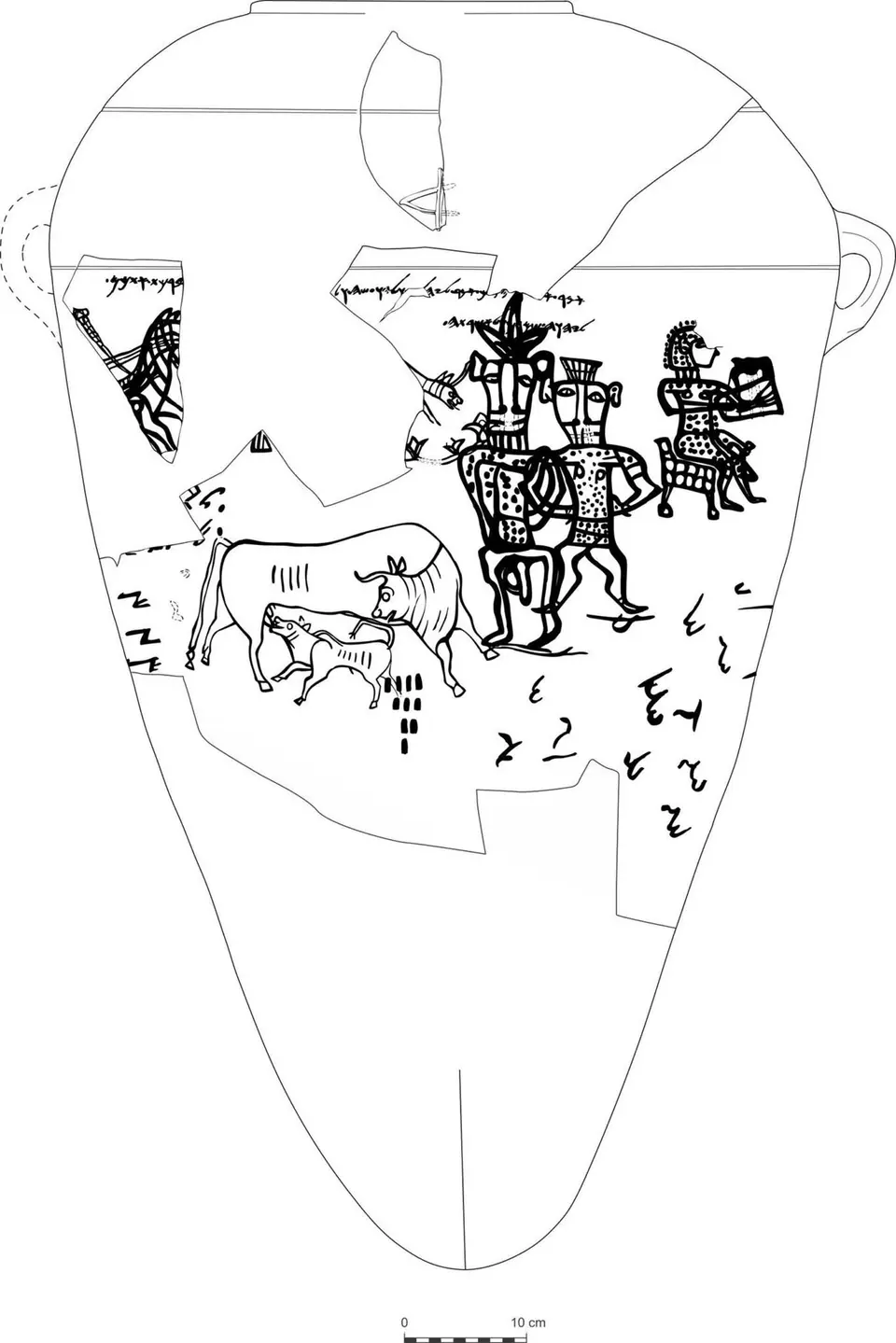
In 1975–76 Ze’ev Meshel excavated a remote way-station at Kuntillet ʿAjrud in northeastern Sinai, occupied around 800 BCE.[4] On two large storage jars, travellers had written blessings in ink:
brkt ʾtkm lyhwh šmrn wlʾšrth
“I have blessed you by Yahweh of Samaria and by his asherah.”[5]
brktk lyhwh tmn wlʾšrth
“I bless you by Yahweh of Teman and by his asherah.”[6][4]
A tomb inscription from Khirbet el-Qom, west of Hebron, found in 1967 and dated to the second half of the eighth century BCE, says: “Blessed is Uriyahu by Yahweh; from his enemies, by his asherah, he has saved him.”[7]
What it proves. The pairing was not a single oddity. It appears in the north (“Yahweh of Samaria”), the south (“Yahweh of Teman”), and in a Judahite family tomb in the hills of Judah, in a man’s prayer for protection. People who invoked Yahweh as their god invoked “his asherah” alongside him. Consensus on the readings.
What the Bible says
The Bible’s later writers condemn both a goddess Asherah and wooden cult objects called asherahs, poles or stylised trees set beside an altar. The condemnations show that both existed in the worship of Yahweh:
- “You shall not plant any tree as an asherah beside the altar of Yahweh your God” (Deuteronomy 16:21). A law forbidding the practice implies that it was practised.[8]
- King Manasseh set “the carved image of Asherah” in the Temple in Jerusalem (2 Kings 21:7).[9]
- In 622 BCE King Josiah removed from the Temple “all the vessels made for Baal, for Asherah and for all the host of heaven”, burned the asherah, and destroyed the houses where “women wove coverings for Asherah” (2 Kings 23:4–7).[10]
What it proves. By the Bible’s own account, a symbol of Asherah stood in Yahweh’s Temple for long periods before Josiah’s reform, and women performed rituals for her in the Temple precinct. The reform was a break with existing practice in Jerusalem, not a defence of it. Majority
The household figurines
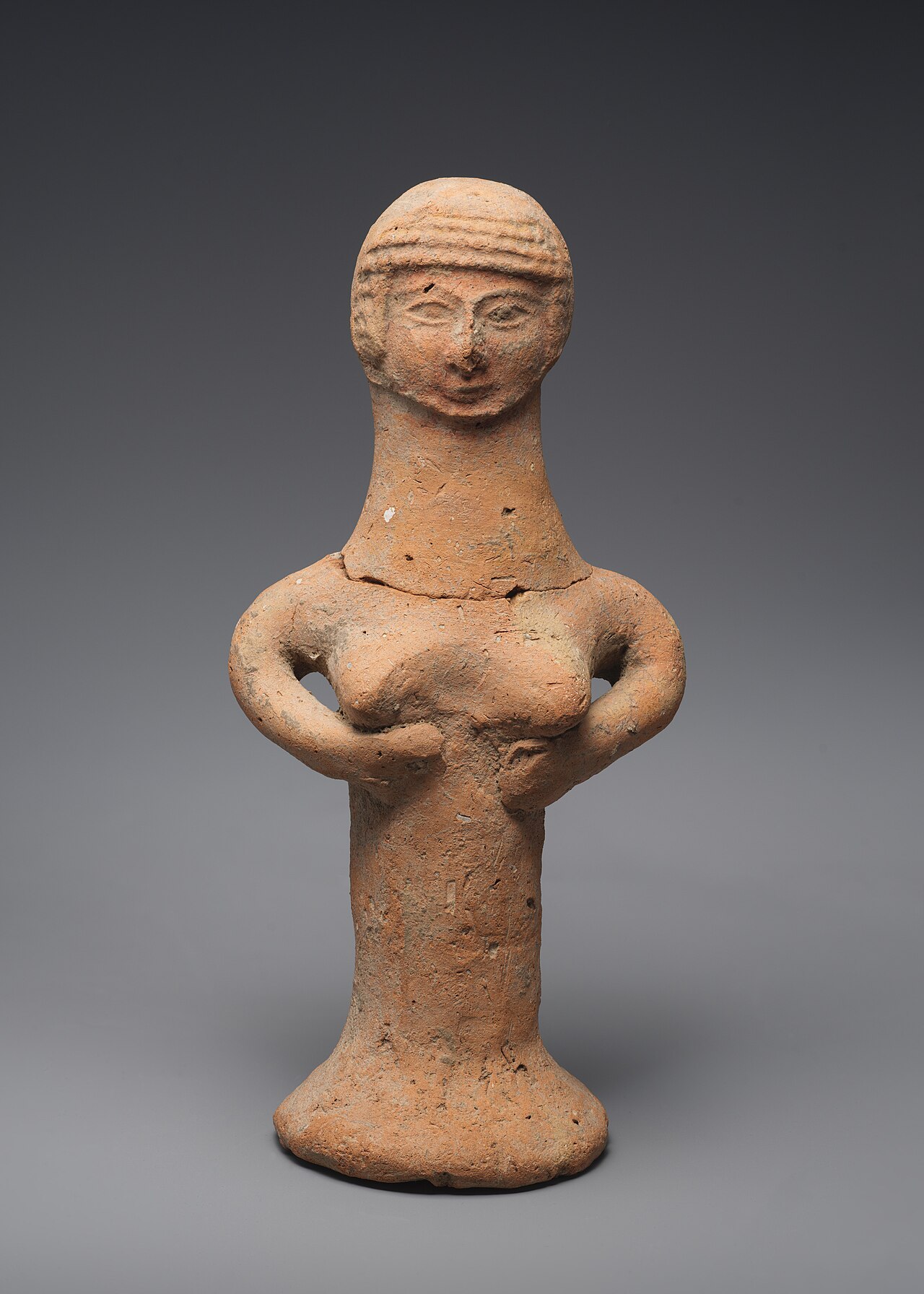
The most common religious objects in eighth- to early-sixth-century Judah are small clay figurines of a woman with a pillar-shaped body, supporting her breasts with her hands. Raz Kletter’s 1996 catalogue listed more than 800.[11][12] Kletter and others identified them with Asherah. Erin Darby argued in 2014 that they were used in household rituals of protection and healing and need not represent any named goddess.[13] Either way, ordinary Judahites used female images in religious practice in the same centuries that the prophets were writing. Contested on what they represent.
The case on each side
Goddess and consort. Asherah was El’s wife; Yahweh took El’s place; inscriptions pair “Yahweh and his asherah”; the Bible describes rituals for Asherah in the Temple. William Dever argues that the grammatical distinction between a goddess and her symbol would not have mattered to the people who wrote these blessings, and that in popular religion Asherah was Yahweh’s consort. Ziony Zevit proposed reading the name with an archaic ending, Asherata, which removes the grammatical objection.[1][14] Contested
A cult object, not a wife. In Hebrew a pronoun suffix such as “his” is not normally attached to a personal name, so “his Asherah”, meaning Yahweh’s wife, would be irregular. J. A. Emerton and others therefore read “his asherah” as Yahweh’s own cult object, the sacred pole or tree beside his altar, which stood for blessing within Yahweh’s worship.[15] Contested
A goddess who faded into a symbol. Judith Hadley’s influential synthesis combines the two: Asherah was once a goddess worshipped alongside Yahweh, and over time she was reduced to the cult object that bore her name, until the reformers removed even that.[16] Contested
The traditional reading. In Jewish tradition the God of Israel has no consort, and the Bible’s condemnations show what Israel was forbidden to do, not what its faith ever taught. The asherahs and the “queen of heaven” were the idolatry the prophets fought; their presence in the record is evidence of Israel’s failures, which the Bible itself narrates at length, not of the original religion. On this view Kuntillet ʿAjrud and Khirbet el-Qom show what some Israelites practised, which is exactly what the prophets said.[10][17] Consensus that this is the traditional view.
The positions are closer than they seem. All agree that Asherah, or her symbol, was attached to Yahweh’s worship in some circles until the late seventh century, and that the biblical writers condemned it. They differ on how widespread it was and what the people who did it believed.
What the evidence does not show
- A marriage myth. No text from Israel or Judah tells a story of Yahweh and Asherah as a couple, as the Ugaritic texts do for El and Athirat. Consensus
- A statue of the pair. The drawing beneath the blessing on jar A at Kuntillet ʿAjrud was once read as Yahweh and Asherah. Most scholars now identify the standing figures as the Egyptian protective god Bes and doubt that drawing and inscription were made together.[18][4] Majority
- That Asherah was the “queen of heaven”. Jeremiah’s Judahite refugees in Egypt, after 586 BCE, insisted on making offerings to “the queen of heaven” (Jeremiah 44). Whether she was Asherah, Astarte or a form of the Mesopotamian Ishtar is debated.[17] Contested
Common misconceptions
- “Archaeologists found a statue of God’s wife.” No statue of Asherah with Yahweh has been found. The evidence is a handful of inscriptions, biblical condemnations and female figurines whose meaning is disputed.
- “The Bible never mentions Asherah.” It mentions her, or the cult object named after her, about forty times, almost always to condemn.[16]
- “This proves Israel was polytheistic from the start.” It shows that some Israelites worshipped Yahweh with Asherah in the ninth to seventh centuries. Personal names of the same period are built overwhelmingly on Yahweh, so Yahweh was clearly the main god (§2).[19]
Why it matters
Asherah is the clearest case of the gap between the religion of the Bible’s final editors and the religion of the people the Bible describes. Her removal from the Temple under Josiah was a step on the road from the worship of Yahweh among other divine beings to the worship of Yahweh alone, and later to the claim that no other god exists (§3, §4).
For the full evidence on Asherah, El and Baal, see Chapter 2: Yahweh Among the Gods. For Josiah’s reform, see Chapter 3: The Prophets and the Yahweh-Alone Movement.
References
- ^ a b William G. Dever Did God Have a Wife? Archaeology and Folk Religion in Ancient Israel. Eerdmans, 2005. The case for Asherah as Yahweh's consort in popular religion, from the excavator of Khirbet el-Qom.
- ^ KTU 1.4 (Baal Cycle) — Ugaritic texts, Ras Shamra. c. 1350–1185 BCE. Ugaritic. Part of the Baal Cycle: El as father of the gods, Athirat (Asherah) his consort with her "seventy sons", and Baal's kingship and palace. The Canaanite background of Israel's god. about
- ^ Mark S. Smith The Early History of God: Yahweh and the Other Deities in Ancient Israel. Eerdmans, 2nd ed., 2002. open library How Israelite religion emerged from its Canaanite setting and became monotheistic.
- ^ a b c Ze'ev Meshel Kuntillet ʿAjrud (Ḥorvat Teman): An Iron Age II Religious Site on the Judah–Sinai Border. Israel Exploration Society, 2012. The final excavation report, with the inscriptions and drawings.
- ^ Kuntillet ʿAjrud, Pithos A — Kuntillet ʿAjrud inscriptions (Meshel 2012). c. 800 BCE. Hebrew. Blessing written on a storage jar at a Sinai way-station: 'I bless you by Yahweh of Samaria and by his Asherah.' A second jar names 'Yahweh of Teman and his Asherah'. about
- ^ Kuntillet ʿAjrud, Pithos B — Ink inscription on a storage jar, Kuntillet ʿAjrud (Ḥorvat Teman), Sinai. c. 800 BCE. Hebrew. "I bless you by Yahweh of Teman and by his asherah": a southern local form of Yahweh, matching Habakkuk 3:3, paired with asherah. about
- ^ Khirbet el-Qom, Tomb Inscription 3 — Tomb inscription, Khirbet el-Qom, near Hebron. 2nd half of the 8th c. BCE. Hebrew. "Blessed is Uriyahu by Yahweh; from his enemies, by his asherah, he has saved him": the Yahweh–asherah pairing in a Judahite burial. about
- ^ Deuteronomy 16:21–22 — Deuteronomy (Hebrew Bible). c. 7th c. BCE. Hebrew. Forbids planting an asherah beside the altar of Yahweh or setting up a standing stone: a law that implies both were practised. read the text
- ^ 2 Kings 21:7 — Kings (Hebrew Bible). composed 7th–6th c. BCE. Hebrew. Manasseh sets "the carved image of Asherah" in the house of which Yahweh had said he would put his name there for ever. read the text
- ^ a b 2 Kings 23:4–7 — Kings (Hebrew Bible). c. late 7th–6th c. BCE. Hebrew. Josiah removes from the Temple the vessels made for Baal, Asherah and the host of heaven, burns the asherah, and destroys the houses where women wove for Asherah. read the text
- ^ Judean pillar figurines — Clay figurines from Judahite houses and tombs. 8th–early 6th c. BCE. Hundreds of small clay women supporting their breasts, the most common religious objects of late-monarchic Judah; read as Asherah or as household protective figures. about
- ^ Raz Kletter The Judean Pillar-Figurines and the Archaeology of Asherah. BAR International Series 636, 1996. The catalogue of the figurines and the case for identifying them with Asherah.
- ^ Erin Darby Interpreting Judean Pillar Figurines: Gender and Empire in Judean Apotropaic Ritual. Mohr Siebeck, 2014. Argues the figurines served household rituals of protection and healing.
- ^ Ziony Zevit The Religions of Ancient Israel: A Synthesis of Parallactic Approaches. Continuum, 2001. A large synthesis of texts and archaeology; proposes reading the goddess's name as Asherata.
- ^ J. A. Emerton New Light on Israelite Religion: The Implications of the Inscriptions from Kuntillet ʿAjrud. Zeitschrift für die alttestamentliche Wissenschaft 94, 1982. The grammatical argument that "his asherah" is a cult object, not a goddess's name.
- ^ a b Judith M. Hadley The Cult of Asherah in Ancient Israel and Judah: Evidence for a Hebrew Goddess. Cambridge University Press, 2000. The inscriptions and biblical texts on asherah, and how a goddess became a cult symbol.
- ^ a b Jeremiah 44:15–19 — Jeremiah (Hebrew Bible). after 586 BCE. Hebrew. Judahite refugees in Egypt, led by women, refuse to stop offering to "the queen of heaven": things went well while they did, and badly after they stopped. The reform's opponents in their own words. read the text
- ^ Othmar Keel and Christoph Uehlinger Gods, Goddesses, and Images of God in Ancient Israel. Fortress Press, 1998. The history of Israelite religion told through seals, figurines and drawings.
- ^ Jeffrey H. Tigay You Shall Have No Other Gods: Israelite Religion in the Light of Hebrew Inscriptions. Scholars Press, 1986. Personal names in Hebrew inscriptions: Yahweh dominates by a wide margin.