The short version: of the traditions compared here, Hinduism and Buddhism teach rebirth, and so does Jainism, which grew up beside them; so, two thousand years later, does Sikhism. Judaism and Christianity teach resurrection. The Indian idea has a datable arrival. It is absent from the Rigveda and first appears in the Upaniṣads around 700–500 BCE, where a teacher refuses to explain it in public (Hinduism §5).[1][2] Majority The biblical idea is younger: the first clear promise that the dead will rise is Daniel 12:2, written around 165 BCE (Judaism §6).[3][4] Majority This page sets the traditions side by side and dates the evidence; it does not judge which belief is true.
Three words that are often confused
- Reincarnation, in ordinary English, means a soul or self that leaves one body at death and enters another. That fits the Upaniṣads, which speak of the ātman, the self, and the Jains, who speak of the jīva, the soul.
- Rebirth is the word scholars prefer for Buddhism, because the Buddha taught that nothing in experience is a permanent self (anattā). Lives follow one another, but no unchanging soul travels between them.[5] Consensus
- Resurrection is a different idea altogether: the dead are raised once, at the end of time, to be judged. It is not a cycle, and nobody comes back as an animal or a different person.
Hinduism: from the world of the fathers to saṃsāra
Before rebirth. The Rigveda, composed mostly c. 1500–1000 BCE, has no karma, no rebirth and no liberation. In its hymns karman simply means a deed, especially a ritual act; the dead go to the world of the fathers, and the aim of life is cattle, sons and a full span of years (Hinduism §3).[6] Consensus The ritual manuals of c. 1000–800 BCE, the Brāhmaṇas, worry instead about punarmṛtyu, “re-death”: dying again in the next world. Their remedy is the sacrifice. This is the seed of the later idea, but it is not rebirth on earth, and it is not ethical (Hinduism §4).[7][8] Consensus
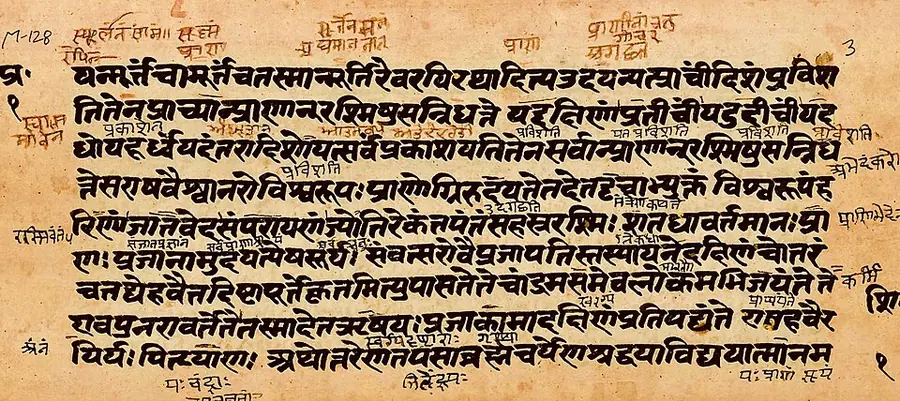
The arrival. In the Bṛhadāraṇyaka Upaniṣad, at a public debate at King Janaka’s court, the sage Yājñavalkya is asked what remains of a person after death. He takes the questioner aside: “We two only will know of this.” What they discussed, the text says, was karma: “one becomes good by good action, bad by bad action.”[1][9] That this is the earliest clear attestation is Consensus; that the secrecy shows the idea was new is the Majority reading. Later in the same text it is stated openly: “According as one acts, according as one conducts himself, so does he become.”[10][9]
The first theory. In the Chāndogya Upaniṣad a king, Pravāhaṇa Jaivali, teaches two brahmins the paths of the dead and says this knowledge has never before belonged to brahmins. Some of the dead take the path of the gods and do not return; others take the path of the fathers, go to the moon, become rain, then food, and are born again; and conduct decides the next womb, pleasant or foul.[11] Together these passages set out the ideas that define later Indian religion: that action carries consequences across lifetimes (karma), that beings are reborn in an endless chain (saṃsāra), and that the highest goal is release from it (mokṣa), through knowing the self (ātman) as one with the ground of all reality (brahman).[2] Majority
Living with karma. The Bhagavad Gītā, composed c. 200 BCE–200 CE, answers a problem the renunciants had raised: if action binds you to rebirth, should you stop acting? Its reply is that attachment, not action, binds, so a soldier, a farmer or a householder can still seek release (Hinduism §7).[12][13] Consensus
Jainism, the Ājīvikas and the doubters
Within two centuries of the first Upanishadic statements, karma and rebirth were common ground for renunciant movements, the śramaṇas, that agreed on little else and rejected the Veda, the sacrifice and the authority of brahmins (Hinduism §6).[14][15] Majority They argued over how karma works:
- The Jains, led in the fifth century BCE by Mahāvīra, treated karma as a fine physical substance that action, even unintended action, binds to the soul. Austerity burns it off.[15]
- The Ājīvikas under Makkhali Gosāla held a strict determinism: effort changes nothing, and liberation comes when the soul’s allotted cycles run out.[16]
- The materialists denied rebirth outright. Ajita Kesakambalī taught that a person is four elements and nothing survives death.[14] A Buddhist text even has a sceptical chieftain try to disprove rebirth by experiment, sealing a criminal in a jar to catch the escaping soul.[17]
So “India believed in reincarnation” needs a qualification: from the start there were Indians who argued against it, and they remained a standard opponent in Indian philosophy for well over a millennium.
Buddhism: rebirth without a soul
The Buddha accepted rebirth in many realms as the problem to be solved, and liberation from it, nibbāna, as the goal (Buddhism §1). Consensus He changed two things. First, he made karma a matter of the mind: “It is intention that I call deeds. For after making a choice one acts by way of body, speech, and mind.”[18] Against the Jains, he held mental action the most blameworthy.[19] Majority Second, he rejected the permanent self. Experience is analysed into processes, none of which is a lasting self, which was a direct challenge to the Upanishadic ātman (Buddhism §2).[5] Consensus Even the gods are inside the cycle: their lives are long and pleasant, but they die and are reborn when their good karma runs out.[20]
Two later developments show how far the idea could travel:
- Reincarnate lamas. In thirteenth-century Tibet the Kagyu lama Karma Pakshi was recognised as the rebirth of the first Karmapa, the first line of reincarnate lamas (tulku). It solved a problem for celibate orders, how to pass on authority and property without heirs (Buddhism §9).[21][22] Majority In July 2025 the 14th Dalai Lama said his office alone may recognise his successor, and Beijing said the choice needs its approval (Buddhism §13).[23][24] Political
- Reinterpretation. B. R. Ambedkar’s Buddhism, set out in The Buddha and His Dhamma (1957), reinterpreted karma and rebirth in social and ethical terms (Buddhism §12).[25] Majority
Sikhism: rebirth ended by grace
Guru Nānak (1469–1539), the first of the Sikh Gurus, taught in Punjab within the Indian picture of rebirth. In his hymns the obstacle is haumai, “I-me”, the self-centredness that keeps a person from God and binds them to rebirth. Release comes by nadar, grace, through remembering the divine Name (nām simaran), not through ritual, pilgrimage, caste or asceticism (Sikhism §2).[26][27][28] Consensus Two points set the hymns apart from the positions above:
- No incarnations of God. The God of the hymns is formless, beyond birth and death, and takes no incarnations, though the Guru uses Hindu and Muslim names for God, Rām, Hari, Khudā, Allāh, freely.[26][29] Consensus
- Release inside the world. Against the Nāth yogīs, the most visible ascetics of Punjab, Guru Nānak set the working householder above the renouncer. In the Siddh Goshṭ one crosses “the ocean of existence” by fixing the mind on the Word and repeating the Name, like a lotus that stays untouched in the water.[30][26] Consensus on the text. W. H. McLeod counted liberation in this life among the teachings Guru Nānak shared with the Sant poets.[26] Majority that this is his argument. Many Sikh scholars rejected that thesis as reducing the founder of a revelation to one voice among many (Sikhism §1).[31] Contested; Political
What passes from life to life is not defined in a system (Sikhism §2). The hymns speak of the jīu (the living self), the ātmā and, above all, the man, which W. H. McLeod found to be mind, heart and soul at once: the part of a person “which does not perish with physical death”, and which at release merges with God like light in light.[26][32] Majority Deeds decide the birth. The Japjī says “by karam comes the robe; by grace, the door of release”, and McLeod and the standard English translations take karam there as action, so that past deeds bring the body and only grace frees; but karam is also an Arabic word for grace, and Sahib Singh’s commentary reads the line as grace twice.[33][26][32][34] Contested on the reading. Release need not wait for death: the term jīvan mukti, liberation while living, is older than the Sikh scripture, and Guru Nānak gives it to the one “from within whom haumai goes”.[35][32] Consensus The round itself is counted in the Indian way, as eighty-four lakh (8.4 million) forms of life. Guru Nānak uses the figure, and Guru Arjan (1581–1606) tells the hearer that after wandering through them, as worm, moth, elephant, fish and deer, “you have obtained this birth so hard to gain”.[36][37][38] Consensus on the texts.
The count of births survived in Sikh devotion. At Goindvāl Guru Amar Dās, the third Guru, had a step-well (bāolī) dug; tradition counts eighty-four steps and says that a pilgrim who recites the Japjī on each of them is freed from the round of eighty-four lakh births. It became the first Sikh tīrath, at a time when Guru Nānak’s hymns had denied that bathing at the tīraths brings liberation (Sikhism §3).[39][32] Consensus on the step-well; Majority on the tradition.
Judaism: Sheol, then resurrection
For most of the Hebrew Bible there is nothing after death but Sheol, a dark, silent underworld where good and wicked alike go, with no judgment and no return: “The dead do not praise Yah.”[40] Consensus Ezekiel’s valley of dry bones, from the sixth century BCE, is about the exiled nation returning to its land, not about individuals.[41] Consensus
The first clear promise of individual resurrection is Daniel 12:2, written during the persecution of Antiochus IV around 165 BCE: “many of those who sleep in the dust of the earth shall awake, some to everlasting life, and some to shame and everlasting contempt.”[3][4] Majority In the first century CE the Pharisees held that souls survive and are rewarded or punished, while the Sadducees denied any afterlife.[42] Consensus The rabbis made resurrection a boundary of the faith in the Mishnah, around 200 CE, and Maimonides made it the last of his Thirteen Principles (Judaism §7).[43][44] Consensus In 1885 Classical Reform Judaism kept the immortal soul and rejected bodily resurrection.[45] None of these is reincarnation. Later Jewish mysticism lies outside what the Judaism series covers, and so outside this page. The full story is in Where did the idea of resurrection come from?
Christianity: one resurrection
Christianity began inside the Judaism of the late Second Temple period, where resurrection was a live and disputed belief; the Gospels show Sadducees challenging Jesus over it.[46] Consensus The central Christian claim is about one resurrection. Paul’s first letter to the Corinthians, written about 54 CE, quotes an earlier formula: that Christ died, was buried, “was raised on the third day” and appeared to Cephas, then to the twelve. Most scholars date the formula to within about five years of the crucifixion (Christianity §2).[47][48][49] Majority The hope it grounds is also one-off: Paul tells the Thessalonians that at the Lord’s coming “the dead in Christ will rise”, and most Christians, from the early church on, have expected Christ to return once, at the end of history, to judge the living and the dead (Christianity §12).[50] Consensus
The closest the early church came to the Indian idea, in this series, is a speculation of the third-century theologian Origen that souls existed before birth. It was condemned in the sixth century, long after his death (Christianity §5). Consensus Existing before birth is not the same as being born again.
A rough timeline
| Date | Evidence | Confidence |
|---|---|---|
| c. 1500–1000 BCE | Rigveda: no karma, rebirth or liberation[6] | Consensus |
| c. 1000–800 BCE | Brāhmaṇas: fear of “re-death” in the next world, solved by ritual[7] | Consensus |
| c. 700–500 BCE | Upaniṣads: karma taught in private; the paths of the dead[1][11] | Majority |
| 5th c. BCE | Mahāvīra, the Ājīvikas and the materialists[15][14] | Majority |
| c. 480–400 BCE | The Buddha: rebirth without a permanent self[18][51] | Contested (dates) |
| c. 200 BCE–200 CE | Bhagavad Gītā: attachment, not action, binds[12] | Majority |
| c. 165 BCE | Daniel 12:2: the dead will rise to be judged[3] | Majority |
| 1st c. CE | Pharisees affirm and Sadducees deny life after death[42] | Consensus |
| c. 30s CE | The formula that Christ “was raised on the third day”[47] | Majority |
| c. 200 CE | Mishnah: denying resurrection costs one’s share in the world to come[43] | Consensus |
| 13th c. | The first line of reincarnate lamas in Tibet[21] | Majority |
| Early 16th c. | Guru Nānak’s hymns: the ego binds to rebirth; release by grace and the Name[26][27] | Consensus |
| 2025 | Dalai Lama and Beijing both claim the right to recognise his rebirth[23][24] | Political |
What scholars disagree about
Where karma and rebirth came from. Four answers are argued, and they are not exclusive: that the idea grew out of Vedic ritual thought about re-death;[52] that it came from the warrior class, as the Upaniṣads themselves say; that it belonged to an older, non-Vedic ascetic culture in the eastern Ganga plain, Johannes Bronkhorst’s “Greater Magadha”;[53] or that Vedic, Buddhist and Jain thinkers arrived at it together in a new urban society. Bronkhorst’s later work argues that the real puzzle is why rebirth became ethical, not rebirth itself.[54] Contested See Where does the idea of karma come from?
Whether the Upaniṣads are older than the Buddha. The majority dates the oldest Upaniṣads before him; Bronkhorst argues that the passages introducing rebirth may be as late as the Buddha, and Michael Witzel’s rebuttal is the central reply.[2][55] Contested
Whether Isaiah 26:19 is about individuals. “Your dead shall live” may promise the revival of the nation, as in Ezekiel, or of individuals; its date is also uncertain.[56] Contested
Common misconceptions
- “Reincarnation is in the Vedas.” The word karman is; the doctrine is not. Rebirth is absent from all four Vedas and the Brāhmaṇas.[6] Consensus
- “Buddhists believe a soul is reincarnated.” The Buddha denied a permanent self; what continues is a chain of conditions, not a soul.[5] Consensus
- “Buddhism took rebirth from Hinduism.” On the majority dating the first Upanishadic statements are older, but the Upanishadic and śramaṇa movements are best seen as strands of one ferment, not one copying the other.[2][55] Majority
- “Karma means fate.” Its first statement says the reverse: you become what you do. Strict fatalism was the Ājīvika position, which the other schools attacked.[10][16] Majority
- “The Hebrew Bible teaches resurrection throughout.” Most of it sends the dead to Sheol; the clear statement comes only in Daniel.[40][3] Majority
Why it matters
Rebirth and resurrection are often treated as timeless features of “Eastern” and “Western” religion. The evidence shows two ideas with histories. Rebirth enters Indian thought around 700 BCE and changes everything after it: once fate depends on action and knowledge rather than correct sacrifice, renunciation becomes a rational choice and the priest’s monopoly weakens.[57] Resurrection enters Jewish thought about five centuries later, as an answer to martyrdom. Both are younger than the traditions that now hold them. For the dates of other ideas across five traditions, see When did the big religious ideas first appear?, and for how far back the traditions themselves go, What is the oldest religion in the world?
References
- ^ a b c BU 3.2.13 — Bṛhadāraṇyaka Upaniṣad. c. 700 BCE. Sanskrit. The single most important passage on this site: karma is taught in private, away from the assembly — which is how we know the idea was new. read the text
- ^ a b c d Patrick Olivelle, trans. The Early Upaniṣads: Annotated Text and Translation. Oxford University Press, 1998. full text The scholarly standard. Its introduction is the best short account of the period.
- ^ a b c d Daniel 12:1–3 — Book of Daniel (Hebrew Bible). c. 165 BCE. Hebrew. Michael the great prince arises; 'many of those who sleep in the dust of the earth shall awake, some to everlasting life, and some to shame and everlasting contempt': the first clear biblical statement of resurrection and judgment. read the text
- ^ a b John J. Collins The Apocalyptic Imagination: An Introduction to Jewish Apocalyptic Literature. Eerdmans, 3rd ed., 2016. Daniel, Enoch and the rise of ideas about judgment, resurrection and the end.
- ^ a b c Rupert Gethin The Foundations of Buddhism. Oxford University Press, 1998. The clearest introduction to early Buddhist thought and to what the canon is.
- ^ a b c Michael Witzel "Tracing the Vedic Dialects". in Dialectes dans les littératures indo-aryennes, 1989. The foundational work on Rigvedic internal chronology and geography.
- ^ a b ŚB 2.3.3.9 — Śatapatha Brāhmaṇa. c. 900–600 BCE. Vedic Sanskrit. Whoever goes to the next world without escaping Death "dies again and again there" — punarmṛtyu, the fear of re-death, which is the conceptual seed of saṃsāra but is solved by ritual, not knowledge. read the text
- ^ ŚB 10.1.4.14 — Śatapatha Brāhmaṇa. c. 900–600 BCE. Vedic Sanskrit. "Whereby the Sacrificer conquers recurring death" — punarmṛtyu, the anxiety that ritual is meant to solve and that saṃsāra later replaces. read the text
- ^ a b Robert Ernest Hume, trans. The Thirteen Principal Upanishads. Oxford University Press, 1921. full text The older complete English translation, out of copyright; quoted where a named public-domain rendering is needed.
- ^ a b BU 4.4.5 — Bṛhadāraṇyaka Upaniṣad. c. 700 BCE. Sanskrit. "As one acts, so one becomes." Karma now stated openly as settled doctrine — inside the same text that whispered it. read the text
- ^ a b CU 5.3–10 — Chāndogya Upaniṣad. c. 700 BCE. Sanskrit. Pañcāgni-vidyā. A kṣatriya king teaches rebirth to two brahmins who cannot answer his questions — the texts crediting the doctrine outside the priesthood. read the text
- ^ a b BhG 2.47 — Bhagavad Gītā. c. 200 BCE – 200 CE. Sanskrit. Action without attachment to fruits — the answer to renunciation that rescues ordinary life. read the text
- ^ Angelika Malinar The Bhagavadgītā: Doctrines and Contexts. Cambridge University Press, 2007. The standard study of the Gītā's doctrines and its place in the epic and in post-Mauryan debates.
- ^ a b c DN 2 — Sāmaññaphala Sutta (Dīgha Nikāya). c. 400–300 BCE. Pali. The six heterodox teachers — determinism, materialism, scepticism, atomism — the best map we have of the intellectual landscape, written by a rival. read the text
- ^ a b c Paul Dundas The Jains. Routledge, 2nd ed., 2002. open library The standard survey.
- ^ a b Bhagavatī Sūtra 15 — Viyāhapannatti. c. 300 BCE. Ardhamāgadhī Prakrit. The Jain account of Makkhali Gosāla and his rupture with Mahāvīra — the fullest Ājīvika narrative anywhere, hostile but detailed. read the text
- ^ DN 23 — Pāyāsi Sutta (Dīgha Nikāya). c. 300 BCE. Pali. A sceptical prince argues against rebirth by experiment — weighing a man before and after death, sealing a criminal in a jar to catch the escaping soul. Preserved by opponents in order to refute it. read the text
- ^ a b AN 6.63 — Nibbedhika Sutta (Aṅguttara Nikāya). c. 400–200 BCE. Pali. "It is intention that I call deeds. For after making a choice one acts by way of body, speech, and mind" (trans. Sujato). The Buddhist redefinition of karma as intention. read the text
- ^ MN 56 — Upāli Sutta (Majjhima Nikāya). c. 400–200 BCE. Pali. A Jain monk says Mahāvīra holds bodily action the most blameworthy; the Buddha says he holds mental action the most blameworthy. The karma debate between the two traditions, staged. read the text
- ^ AN 4.33 — Sīha Sutta (Aṅguttara Nikāya). c. 400–200 BCE. Pali. Long-lived gods who hear the Buddha's teaching realise with dismay that they too are impermanent: the gods are inside saṃsāra. read the text
- ^ a b Matthew T. Kapstein The Tibetans. Blackwell, 2006. The best single-volume history of Tibetan civilisation, careful on the gap between imperial evidence and later tradition.
- ^ Peter Schwieger The Dalai Lama and the Emperor of China: A Political History of the Tibetan Institution of Reincarnation. Columbia University Press, 2015. How reincarnation became a political institution between the Mongols, the Qing and the Dalai Lamas.
- ^ a b Statement of 2 July 2025 — Office of the 14th Dalai Lama. 2025. English (also Tibetan). The Dalai Lama affirms that the institution of the Dalai Lama will continue and that the Gaden Phodrang Trust has sole authority to recognise his reincarnation. about
- ^ a b Foreign Ministry press conference, 2 July 2025 — Ministry of Foreign Affairs of the PRC. 2025. Chinese. Spokesperson Mao Ning: the Dalai Lama's reincarnation must follow domestic recognition, the golden urn and approval by the central government.
- ^ The Buddha and His Dhamma, introduction — B. R. Ambedkar. 1956; published 1957. English. Ambedkar's "four problems" with the inherited tradition: the renunciation story, the four noble truths, karma and rebirth, and the purpose of the monk. He replaces the four sights with a dispute over the Rohiṇī river. read the text
- ^ a b c d e f g W. H. McLeod Guru Nanak and the Sikh Religion. Clarendon Press, Oxford, 1968. The critical study of Nānak's life and theology, separating the janamsākhī tradition from the hymns.
- ^ a b Christopher Shackle and Arvind-pal Singh Mandair, trans. Teachings of the Sikh Gurus: Selections from the Sikh Scriptures. Routledge, 2005.
- ^ Eleanor Nesbitt Sikhism: A Very Short Introduction. Oxford University Press, 2nd ed., 2016.
- ^ Pashaura Singh The Guru Granth Sahib: Canon, Meaning and Authority. Oxford University Press, 2000. doi The formation of the Sikh canon, from the 1604 Ādi Granth to its installation as Guru.
- ^ Guru Granth Sāhib, ang 938 — Guru Nānak, Rāmkalī, Siddh Goshṭ. before 1539 CE (composed); 1604 CE (compiled). Punjabi in Gurmukhi. The opening of the discourse with the Siddhs: Charpaṭ asks how the world-ocean is crossed; the lotus untouched in the water. read the text
- ^ Kharak Singh, G. S. Mansukhani and Jasbir Singh Mann, eds. Fundamental Issues in Sikh Studies. Institute of Sikh Studies, Chandigarh, 1992. Essays against McLeod's school, from its Sikh critics.
- ^ a b c d Harbans Singh, ed. The Encyclopaedia of Sikhism. Punjabi University, Patiala, 4 vols, 1992. open access Published 1992–1998; the standard reference, with signed entries reporting both tradition and sources.
- ^ Guru Granth Sāhib, ang 2 — Guru Nānak, Japu (Japjī), pauṛī 4. before 1539 CE (composed); 1604 CE (compiled). Punjabi in Gurmukhi. "By karam comes the robe; by grace, the door of release" (karamī āvai kapaṛā nadarī mokhu duāru): read as action and grace by McLeod and the Khalsa and Manmohan Singh translations, as grace twice by Sahib Singh. read the text
- ^ Sahib Singh Srī Gurū Granth Sāhib Darpaṇ. Raj Publishers, Jalandhar, 10 vols, 1962–64, 1962. open access The standard Punjabi line-by-line commentary on the scripture; read here in its Punjabi text as given by BaniDB and in the Hindi version on srigranth.org.
- ^ Guru Granth Sāhib, ang 1009 — Guru Nānak, Rāg Mārū. before 1539 CE (composed); 1604 CE (compiled). Punjabi in Gurmukhi. "He is called liberated while alive from within whom haumai goes" (jīvan mukatu so ākhīai jisu vichahu haumai jāi): the term jīvan mukti in Guru Nānak's own hymns. read the text
- ^ Guru Granth Sāhib, ang 434 — Guru Nānak, Paṭṭī Likhī, Rāg Āsā. before 1539 CE (composed); 1604 CE (compiled). Punjabi in Gurmukhi. Pauṛī 27 of the acrostic: "the self-willed fools wander and do not remember; they fall into the round of eighty-four lakh" (lakh chaurāsīh pheru paiā). read the text
- ^ Guru Granth Sāhib, ang 176 — Guru Arjan, Gauṛī Guārerī. 1581–1606 CE. Punjabi in Gurmukhi. "In many births you were worm and moth, elephant, fish and deer… meet the Lord of the world: now is the time": the births before the human one. read the text
- ^ Guru Granth Sāhib, ang 50 — Guru Arjan, Sirī Rāg. 1581–1606 CE. Punjabi in Gurmukhi. "Wandering through eighty-four lakh, you have obtained this birth so hard to gain" (lakh chaurāsīh bhramatiā dulabh janamu pāioi). read the text
- ^ J. S. Grewal The Sikhs of the Punjab. The New Cambridge History of India II.3, Cambridge University Press, 1990. The standard narrative history; revised edition 1998.
- ^ a b Psalm 115:17 — Psalms (Hebrew Bible). uncertain; probably Persian period. Hebrew. 'The dead do not praise Yah, nor any who go down into silence': the older biblical view of the dead in Sheol. read the text
- ^ Ezekiel 37:1–14 — Ezekiel (Hebrew Bible). 6th c. BCE. Hebrew. The valley of dry bones: bones that rise and live are explained as 'the whole house of Israel', the nation restored from exile, not individuals raised from death. read the text
- ^ a b Josephus, Jewish War 2.119–166 — The Jewish War. c. 75–79 CE. Greek. The three Jewish 'philosophies': a long idealised account of the Essenes, and the Pharisees' belief in the survival of the soul and reward and punishment against the Sadducees' denial. read the text
- ^ a b m. Sanhedrin 10:1 — Mishnah. c. 200 CE. Hebrew. Abba Saul adds to those with no share in the world to come 'one who pronounces the name according to its letters'. read the text
- ^ Maimonides, Commentary on Mishnah Sanhedrin 10 (Introduction to Perek Ḥeleq) — Commentary on the Mishnah. c. 1168 CE. Judeo-Arabic. The Thirteen Principles of faith; the eighth holds that the whole Torah now in our hands was given to Moses from heaven. about
- ^ Pittsburgh Platform — Conference of Reform rabbis, Pittsburgh. 16–19 November 1885. English. Classical Reform's charter: only the moral law binding; dietary and purity laws obsolete; Jews 'no longer a nation, but a religious community' expecting no return to Palestine. about
- ^ Mark 12:18–27 — Gospel of Mark (New Testament). c. 70 CE. Greek. Sadducees, 'who say there is no resurrection', test Jesus with the case of a woman married in turn to seven brothers; he answers from the Torah's 'God of Abraham, Isaac and Jacob'. read the text
- ^ a b 1 Corinthians 15:3–8 — Paul, First Letter to the Corinthians. c. 54 CE. Greek. A creed Paul 'received': Christ died, was buried, was raised on the third day, and appeared to Cephas, the Twelve, five hundred, James, all the apostles and Paul. read the text
- ^ James D. G. Dunn Jesus Remembered. Eerdmans, 2003. Jesus as remembered by his first followers, with a full treatment of the resurrection traditions.
- ^ Bart D. Ehrman How Jesus Became God: The Exaltation of a Jewish Preacher from Galilee. HarperOne, 2014. A developmental account of early Christology and the resurrection visions.
- ^ 1 Thessalonians 4:15–17 — Paul, First Letter to the Thessalonians. c. 50 CE. Greek. Paul expects that 'we who are alive, who are left until the coming of the Lord' will meet him in the air. read the text
- ^ L. S. Cousins "The Dating of the Historical Buddha: A Review Article". Journal of the Royal Asiatic Society 6, 1996. doi Where the c. 400 BCE working default comes from.
- ^ Herman W. Tull The Vedic Origins of Karma: Cosmos as Man in Ancient Indian Myth and Ritual. SUNY Press, 1989. full text The case that karma develops from within Vedic ritual thought.
- ^ Johannes Bronkhorst Greater Magadha: Studies in the Culture of Early India. Brill, 2007. full text The strongest case for an eastern, non-Vedic origin for karma and rebirth. Influential and contested.
- ^ Johannes Bronkhorst "Whence Karma?". Contributions to Indian Sociology 56, 2022. doi His revised position: the thing to explain is ethicization, not rebirth. Rejects both Obeyesekere and Seaford.
- ^ a b Michael Witzel "Moving Targets? Texts, Language, Archaeology and History in the Late Vedic and Early Buddhist Periods". Indo-Iranian Journal 52: 287–310, 2009. doi The central chronological rebuttal to Bronkhorst.
- ^ Isaiah 26:19 — Isaiah (Hebrew Bible). debated; Persian or Hellenistic period. Hebrew. 'Your dead shall live, their corpses shall rise': in the late 'Isaiah Apocalypse'; whether it means individual resurrection or national revival is debated. read the text
- ^ Patrick Olivelle The Āśrama System: The History and Hermeneutics of a Religious Institution. Oxford University Press, 1993. Establishes that the āśramas began as alternatives, not stages.