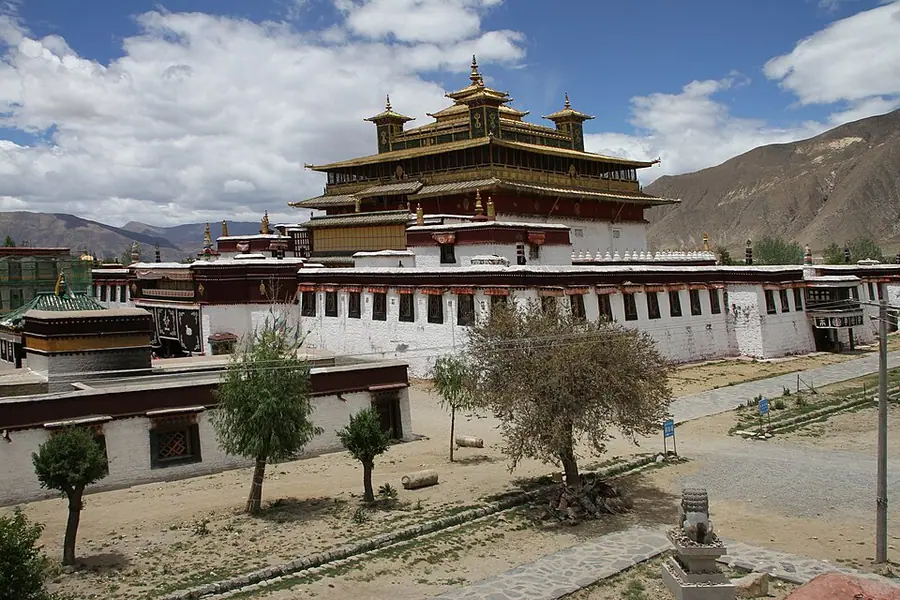
Tibetan Buddhism in one paragraph
Buddhism came to Tibet twice. The first time, in the seventh and eighth centuries, it arrived as the religion of an expanding empire: the emperors built temples, invited monks from India and China, founded the monastery of Samye around 779 and sponsored a great translation project. When the empire broke apart in 842, royal support ended. The second time, from the late tenth century, local rulers and returning translators brought new teachers and texts from India just as Indian Buddhism entered its last, tantric phase (§8). Out of that “later spread” came the monastic schools, the reincarnated lamas and, through alliances with Mongol rulers, the government of the Dalai Lamas. Tibet became the place where Indian Buddhism’s final form was preserved most completely, with its monastic universities, its philosophy and its tantra. Majority
Much of what Tibetans tell about the first arrival was written down in the twelfth century and later, when the schools were looking back on a golden age. The inscriptions and manuscripts of the imperial period show a smaller and less dramatic story, and the gap between the two is one of the main subjects of this chapter. Consensus
Timeline of Buddhism in Tibet
| Date | Event | Confidence |
|---|---|---|
| c. 618–649 | Songtsen Gampo unifies the plateau; a Tang princess, Wencheng, is sent to the Tibetan court in 641; a temple is built at Lhasa[1][2] | Majority |
| 650 onward | The Old Tibetan Annals begin: the first dated Tibetan records[3] | Consensus |
| 755/756–c. 797 | Reign of Trisong Detsen; Buddhism declared the religion of the realm[4] | Consensus |
| c. 779 | Samye consecrated; first Tibetan monks ordained under Śāntarakṣita[4][5] | Majority |
| c. 786–848 | Tibet rules Dunhuang; Tibetan and Chinese Buddhism meet there[6] | Consensus |
| c. 792–794 | The Samye debate between Kamalaśīla and Moheyan[5][7] | Contested |
| 814 | Imperial decree standardising translation terms (the Madhyavyutpatti)[8] | Consensus |
| 821–823 | Peace treaty with the Tang; bilingual pillar set up at Lhasa[9] | Consensus |
| 842 | Assassination of the emperor Langdarma; the empire fragments[10] | Majority |
| c. 1000 | The Dunhuang Library Cave is sealed[6] | Majority |
| 958–1055 | Rinchen Zangpo, translator of western Tibet[11] | Consensus |
| 1042 | Atiśa arrives in western Tibet[12] | Consensus |
| 1073 | Sakya monastery founded[11] | Consensus |
| 13th c. | Karma Pakshi recognised as the rebirth of Düsum Khyenpa: the first reincarnation line[2] | Majority |
| 1247 | Sakya Pandita meets the Mongol prince Köden; Sakya lamas become agents of Mongol rule[13][14] | Consensus |
| early 14th c. | Kangyur and Tengyur compiled; Butön (1290–1364) edits the Tengyur[15][16] | Majority |
| 1409 | Tsongkhapa founds Ganden monastery: the start of the Geluk school[17] | Consensus |
| 1578 | Altan Khan gives Sonam Gyatso the title Dalai Lama[18][19] | Consensus |
| 1642 | The Fifth Dalai Lama becomes ruler of Tibet with Güshi Khan’s army[20] | Consensus |
| 1720 | Qing troops enter Lhasa; imperial representatives (ambans) from 1728[21][18] | Consensus |
| 1793 | Qing ordinance introduces the Golden Urn for selecting reincarnations[22][23] | Consensus (decree); Political (meaning) |
| 1913 | The Thirteenth Dalai Lama’s proclamation after the fall of the Qing[24] | Consensus (text); Political (meaning) |
| 1950 | The People’s Liberation Army enters eastern Tibet (§13)[25] | Consensus |
Where: an empire on the plateau
The Tibetan empire of the seventh to ninth centuries was one of the great powers of Asia. At its height it controlled the Tarim Basin and the Silk Road oases, raided as far as the Tang capital Chang’an, which its army briefly occupied in 763, and ruled Dunhuang for about sixty years. Its heartland was the Yarlung valley and the Lhasa region of central Tibet, and the early Buddhist foundations, the Jokhang and Ramoche temples at Lhasa and Samye on the Tsangpo, lie there.[2][14]
Buddhism reached this empire from three directions: from India and Nepal across the Himalaya, from China, and from the Buddhist kingdoms of Central Asia such as Khotan. Tibetan Buddhism was not simply Indian Buddhism carried north; in the imperial period it was a meeting point, and only later did Tibetans decide to trace everything to India. Majority
The second spread had different centres: the kingdom of Gugé in western Tibet, where Rinchen Zangpo built temples such as Tabo and Tholing; and the valleys of central and southern Tibet, where clans founded monasteries that became the seats of the schools. From the thirteenth century Mongolia joined the Tibetan Buddhist world, and from the seventeenth century the Tibetan form of Buddhism was the religion of the Mongols and of many peoples of Inner Asia, as far as the Kalmyks on the Volga.
The evidence ledger for Tibetan Buddhism
| Dimension | What we can say | Evidence | Confidence |
|---|---|---|---|
| First contact | Buddhist temples at Lhasa under Songtsen Gampo; little sign of wider practice | Karchung inscription, early 9th c.; the Annals’ silence on religion[1][3] | Majority |
| State religion | Buddhism established by royal decree and oath under Trisong Detsen | The Samye pillar; later Karchung pillar renewing the oath[4][1] | Consensus |
| Translation | A state-run project with fixed terminology | The Madhyavyutpatti decree of 814; imperial catalogues[8] | Consensus |
| Sources of Buddhism | Indian, Chinese and Central Asian teachers all active in the imperial period | Dunhuang manuscripts; the Chinese Chan texts in Tibetan[7][6] | Consensus |
| After 842 | Monastic institutions in central Tibet decline; lay and tantric practice continues | Dunhuang tantric manuscripts of the 10th c.[6][26] | Majority |
| The revival | New translations and new lineages from India, 10th–12th c. | Rinchen Zangpo; Atiśa; the founding dates of the great monasteries[11][12] | Consensus |
| Politics | Lamas become rulers through alliances with Mongol princes | Sakya under the Yuan; the Dalai Lamas from 1642[14][18] | Consensus |
| Succession | Leadership by recognised reincarnation, a Tibetan invention | The Karmapa line from the 13th c.; the Dalai Lamas[2] | Consensus |
Primary sources
1. A temple remembered in stone: the Karchung pillar
The imperial inscriptions are the best evidence for early Tibetan Buddhism, because they were cut while the empire still existed. The pillar at Karchung, near Lhasa, was set up by the emperor Tride Songtsen (r. c. 800–815) to renew his father’s oath to protect Buddhism. Looking back over his ancestors, it recalls that in the time of Songtsen Gampo the religion of the Buddha began to be practised with the building of the temple at Rasa, the old name of Lhasa (paraphrasing Richardson’s edition and translation).[1][27][28]
What it proves. That by about 800 the court remembered Songtsen Gampo as the founder of the first Buddhist temple in Lhasa. It does not say that he was a devout Buddhist or that Buddhism spread beyond the court. The Old Tibetan Annals, a year-by-year record of the empire from 650, say almost nothing about religion at all.[3] Majority
2. The queens who brought the Buddha: a later legend
Tibetan tradition says Songtsen Gampo married two Buddhist princesses, Wencheng from China and Bhṛkutī from Nepal, who brought the two most sacred images of the Buddha to Lhasa, and that the king was an emanation of the bodhisattva Avalokiteśvara. The fullest version is in the Maṇi bka’ ‘bum, a collection put together between the twelfth and thirteenth centuries.[29]
What it proves. That Tibetans of the later spread saw the empire as a Buddhist golden age and its first great king as a bodhisattva who had chosen to tame Tibet. A Tang princess named Wencheng was sent to the Tibetan court in 641; Chinese records confirm it. The Nepali queen is not attested in any contemporary source, and many historians regard her as legendary, though some Nepali scholars argue for her historicity. Neither princess is credited with any religious role in the imperial sources.[2][14] Majority
3. The oath at Samye
Trisong Detsen had his decision to make Buddhism the religion of the realm engraved on a pillar at Samye. It records that the shrines of the Three Jewels at Lhasa, Samye and elsewhere were founded, and that the emperor and his ministers swore never to abandon or destroy them.[4][28] A longer edict, preserved in a later history, lists the ministers who took the oath.
What it proves. That the adoption of Buddhism was a state act, sealed by an oath of the kind the Tibetan court used for treaties and alliances. Buddhism was fitted into the political forms of the empire, and the endowments of the monasteries were guaranteed by the aristocracy. That also explains why the monasteries were vulnerable when the dynasty fell. Consensus
4. Padmasambhava in the Dunhuang manuscripts
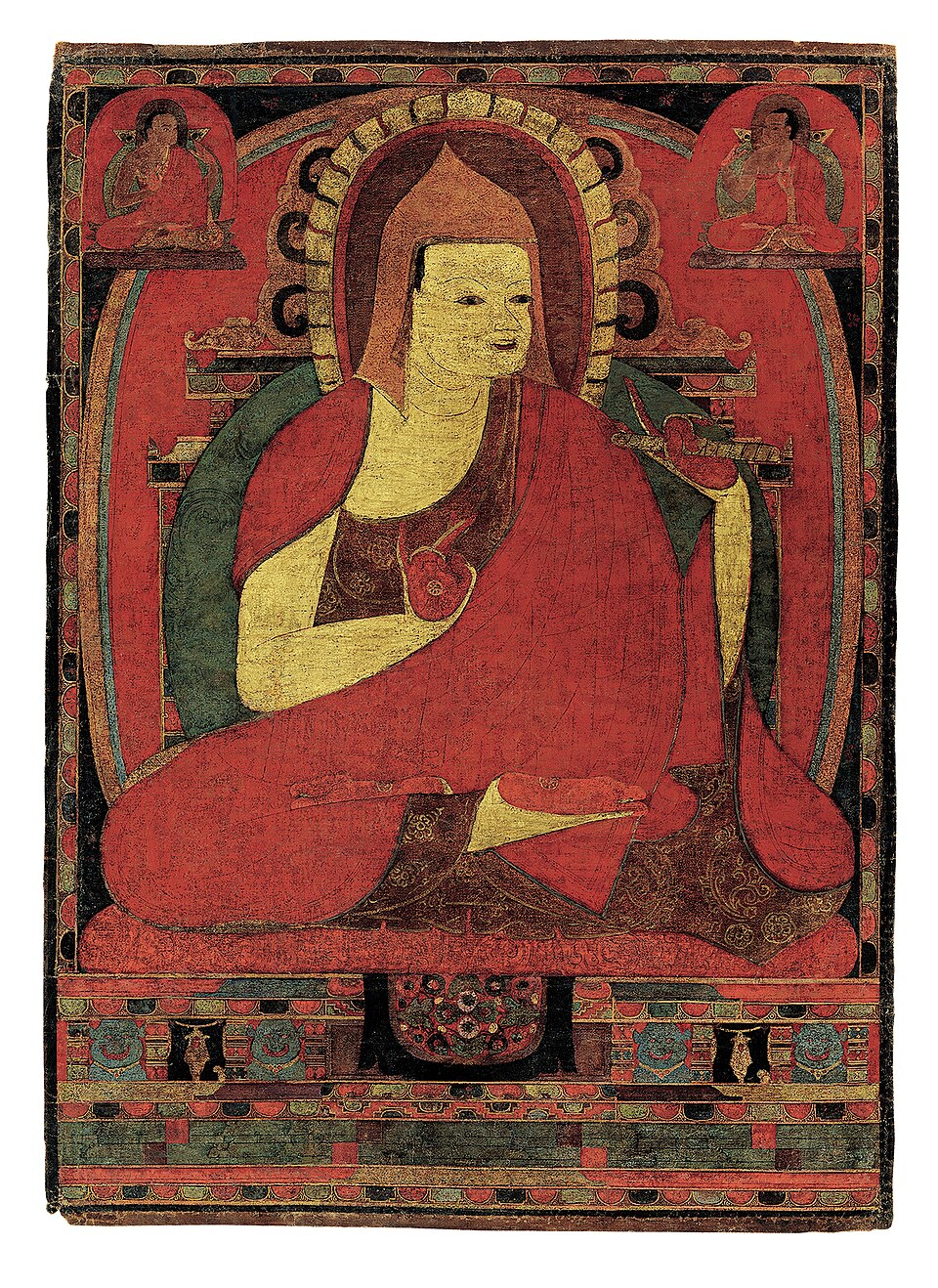
Padmasambhava, “the Lotus-born,” known to Tibetans as Guru Rinpoche, is the most beloved figure of Tibetan Buddhism. Later biographies make him the tantric master who subdued the hostile gods of Tibet so that Samye could be built, hid teachings in the landscape for later discovery, and left Tibet only after making it Buddhist. The most influential of these, the Padma bka’ thang, was revealed as a treasure text in the fourteenth century.[30]
The earliest evidence is much more modest. Tenth-century manuscripts from the Dunhuang Library Cave, such as IOL Tib J 321 and Pelliot tibétain 44, present Padmasambhava as a tantric teacher associated with the ritual dagger (phur pa) and with commentaries on tantras.[26][31][6] Jacob Dalton has read two further Dunhuang texts, IOL Tib J 644 and Pelliot tibétain 307, as evidence that the Padmasambhava legend was already developing in this period.[32] The Testament of Ba (dBa’ bzhed), the main narrative of the founding of Samye, gives him a role, but a shorter one, and describes him being sent away from court.[5][33]
What it proves. That Padmasambhava was probably a real tantric teacher at the court of Trisong Detsen, remembered within two centuries, and that his status as the second Buddha of Tibet grew afterwards, above all in the Nyingma school, which made him its founder; the twelfth-century treasure revealer Nyangral Nyima Özer did most to shape that picture.[30] Majority
5. The treaty pillar at Lhasa
In 821–822 the emperor Ralpacan and the Tang emperor Muzong concluded a peace treaty. A bilingual pillar recording it was set up in front of the Jokhang in Lhasa in 823, and still stands. In Richardson’s translation of the Tibetan text, “Both Tibet and China shall keep the country and frontiers of which they are now in possession”; the land to the east of the agreed line belongs to Great China and that to the west to Great Tibet, and “from either side of that frontier there shall be no warfare, no hostile invasions, and no seizure of territory.”[9][34][28]
What it proves. That ninth-century Tibet negotiated with Tang China as a separate power with its own frontier, at a time when its court was officially Buddhist. The treaty calls the two rulers “nephew and uncle”; Western historians usually read this as a marriage-alliance formula between powers treating each other as equals.[34][2] The PRC’s 1992 white paper on Tibet reads the same monument differently, quoting it as saying that the two sovereigns had agreed “that their territories be united as one.”[35] That is why the pillar is quoted in modern political arguments about Tibet’s status, which it can only illuminate for its own century (see Debates). Majority
6. The Samye debate, from both sides
Two kinds of source describe a dispute at the Tibetan court around 792–794 between Indian and Chinese Buddhists.
- The Tibetan account. The Testament of Ba and later histories say that the Chinese Chan master Moheyan taught that awakening comes suddenly, by ceasing all thought and action, while the Indian scholar Kamalaśīla argued that it comes gradually, through ethics, study, analysis and meditation. The emperor judged for Kamalaśīla, and Tibet was to follow Indian Buddhism.[5][33] Kamalaśīla’s three Bhāvanākrama, “Stages of Meditation,” are traditionally linked to the dispute.[36]
- The Chinese account. A Chinese manuscript from Dunhuang, the Dunwu dacheng zhengli jue, with a preface by a man named Wangxi, records Moheyan’s answers to questions put by Indian monks and says that Moheyan prevailed and that the emperor endorsed his teaching.[7][37]
What it proves. That Chinese Chan and Indian scholastic Buddhism were both present at the Tibetan court and that their differences were argued out there. Whether there was a single, formal debate is doubtful: the exchanges may have been written questions and answers over some years. What is certain is that later Tibetans made “the victory of the Indian side” a founding story, and used Moheyan as a symbol of quietist error for centuries. Chan teachings in fact continued to circulate in Tibetan, and some were absorbed into the Nyingma Great Perfection (rdzogs chen) literature, which later critics held against it.[14][38] Contested
7. The Lamp for the Path
Atiśa Dīpaṃkaraśrījñāna (982–1054), a senior monk of the Vikramaśīla monastery in eastern India (modern Bihar), born in Bengal, was invited to western Tibet by its rulers and arrived in 1042. There he wrote a short verse text, the Bodhipathapradīpa, “Lamp for the Path to Awakening,” at the request of the king. It sorts practitioners into three kinds, those who seek a good rebirth, those who seek their own liberation and those who seek awakening for the sake of all beings, and arranges the whole of Buddhist practice, including tantra, into a single graduated path.[12]
What it proves. That the Tibetan revival wanted order: a way to fit together the monastic rules, the Mahāyāna path and the tantras, which had reached Tibet piecemeal and were being practised in ways the rulers of western Tibet found alarming. Atiśa’s scheme became the model for the “stages of the path” (lam rim) literature, including Tsongkhapa’s Great Treatise of 1402.[17] Consensus
8. A ruler who is a reincarnation
In 1643, a year after he became ruler of Tibet, the Fifth Dalai Lama wrote a history of Tibet, often called the Song of the Spring Queen. It presents the Tibetan emperors as emanations of Avalokiteśvara, and so, by implication, the Dalai Lama himself, who was identified with the same bodhisattva, as their successor.[20]
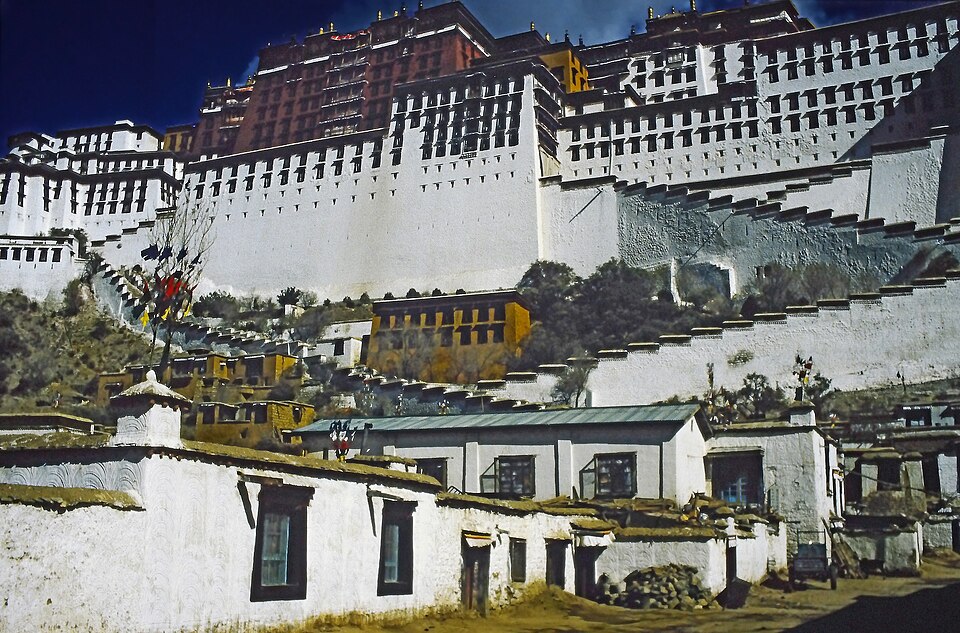
What it proves. That the government of the Dalai Lamas legitimised itself by joining the imperial past, the Maṇi bka’ ‘bum’s picture of Songtsen Gampo as Avalokiteśvara, and the institution of reincarnation. The Potala Palace, begun in 1645 on the hill where Songtsen Gampo was said to have had a palace, made the same claim in stone. Consensus
The collapse and the later spread
The empire’s end did not end Tibetan Buddhism, but it changed what Tibetan Buddhism would be.
The Langdarma story. Later Tibetan histories say the emperor Langdarma (r. c. 838–842) persecuted Buddhism, closed the monasteries and forced monks to marry or hunt, until he was assassinated by a monk, Lhalung Palgyi Dorje, who shot him with an arrow hidden in his sleeve. The persecution is not recorded in contemporary sources. A Dunhuang prayer for the king at his accession (Pelliot tibétain 134) addresses him as a Buddhist ruler: Yamaguchi Zuihō read it as proof that he was a devout Buddhist, while Sam van Schaik reads it as a reminder of the duties expected of a Buddhist king rather than a record of his piety.[39][10][14] Many historians now think state support for the monasteries ended because the empire broke apart, and that the persecution story came later, as a way of explaining the collapse.[10][6] Majority
The age of fragmentation, 842 to the late 900s. Later histories call it a dark age. Jacob Dalton’s work on the Dunhuang manuscripts shows a different picture: monks were fewer, but tantric ritual, including rites of violent “liberation,” was being practised, adapted and written down by lay specialists and local lords. Much of what would later be called Nyingma took shape in this period.[6] Majority
The later spread (phyi dar) began from two directions around the end of the tenth century. In the east, monks who had preserved the ordination lineage in Amdo returned to central Tibet. In the west, the kings of Gugé sent young men to Kashmir and India to study, of whom Rinchen Zangpo (958–1055) became the most famous translator, and invited Indian teachers, above all Atiśa.[11] Ronald Davidson’s account of this “Tibetan renaissance” shows the revival as a project of aristocratic clans, who used the prestige of new Indian texts and lineages to build religious and political power.[11] Majority
The schools grew out of this period:
| School | Origin | Key figures | Distinctive emphasis |
|---|---|---|---|
| Nyingma (“old”) | Traces itself to the imperial period; organised as a school from the 11th–12th c. | Padmasambhava (as founder); Nyangral Nyima Özer (1124–1192) | The old tantras; the Great Perfection; treasure (gter ma) revelation |
| Kadam | Atiśa’s disciple Dromtön founds Reting, 1056/7[11] | Atiśa; Dromtön | Monastic discipline, the graduated path; absorbed into Geluk |
| Sakya | Sakya monastery, 1073, by the Khön clan[11] | Sakya Pandita (1182–1251); Phagpa (1235–1280) | Scholarship; the “path and result” tantric system; Mongol alliance |
| Kagyu | The translator Marpa (1012–1097) and the yogin Milarepa | Gampopa; the Karmapas | Mahāmudrā meditation; reincarnate lamas |
| Geluk | Tsongkhapa (1357–1419) founds Ganden, 1409[2] | Tsongkhapa; the Dalai and Panchen Lamas | Monastic discipline, logic and debate; the great monasteries of Lhasa |
Treasure texts. The Nyingma claimed that Padmasambhava and his consort Yeshe Tsogyal had hidden teachings in caves, lakes and the minds of disciples, to be revealed by “treasure finders” (gter ston) when needed. Treasure revelation allowed the old school to answer critics who said its tantras had no Indian original, and kept the canon open: new treasures are still revealed.[30] Consensus
The canon. The translations were gathered in the early fourteenth century into two great collections: the Kangyur, “translated words” of the Buddha, about a hundred volumes, and the Tengyur, “translated treatises” by Indian masters, over two hundred. The scholar Butön Rinchen Drub (1290–1364) edited and catalogued the Tengyur at Shalu, and his history of Buddhism set the standard for what counted as authentic.[15][16][2] Many of the old Nyingma tantras were left out, because no Indian original could be found, and were later gathered in a separate collection of their own.[15] Majority
Lamas and Mongols: how monks came to rule
Tibetan lamas gained political power through a relationship that Tibetans call mchod yon, “offering and patron”: the lama gives religious teaching and protection; the patron gives wealth and military force. Whether that made the patron a protector or a sovereign is the root of the modern dispute.
- Sakya and the Yuan. In 1247 Sakya Pandita met the Mongol prince Köden at Liangzhou and arranged Tibet’s submission to the Mongols. His nephew Phagpa became the imperial preceptor of Kublai Khan, invented the square “Phagpa script” for the empire (1269), and with his successors governed Tibet on the Mongols’ behalf until the Yuan declined in the mid-fourteenth century.[13][14] Consensus
- Reincarnation. The Kagyu lama Karma Pakshi (1204/6–1283) was recognised as the rebirth of Düsum Khyenpa (1110–1193), the first Karmapa. It was the first line of reincarnate lamas (sprul sku, tulku), and it solved a problem for celibate orders: how to pass on authority and property without heirs. Hundreds of lines followed.[2][18] Majority
- The Dalai Lamas. In 1578 the Tümed Mongol ruler Altan Khan met Sonam Gyatso, abbot of the Geluk monastery of Drepung, at Lake Kokonor, and gave him the Mongolian title Dalai, “ocean.” Sonam Gyatso was counted as the Third Dalai Lama; the title was given retroactively to his two predecessors. The Fourth Dalai Lama was found among Altan Khan’s own descendants. In 1642 Güshi Khan of the Khoshut Mongols defeated the kings of Tsang, patrons of the Karmapa, and handed rule over central Tibet to the Fifth Dalai Lama, Ngawang Lobsang Gyatso (1617–1682).[18][19][20] Consensus
- Mongolia’s second conversion. Altan Khan’s alliance also began the conversion of the Mongols to Tibetan Buddhism, which had faded after the Yuan. The Khalkha monastery of Erdene Zuu was founded in 1585, and Zanabazar (1635–1723) became the first of the Jebtsundamba Khutughtus, the reincarnate heads of Mongolian Buddhism.[19][40] Consensus
The Qing. The Manchu Qing dynasty took a strong interest in Tibetan Buddhism, which held the loyalty of the Mongols. After Dzungar Mongols invaded Tibet, Qing troops entered Lhasa in 1720, and from 1728 two imperial representatives, the ambans, resided there. After a war with the Gurkhas of Nepal, the Qing issued a 29-article ordinance in 1793 that among other things required high reincarnations, including the Dalai and Panchen Lamas, to be selected by drawing lots from a Golden Urn.[22][21][18] How often the urn was actually used, and whether the lot or the Tibetan search decided the outcome, is disputed.[23][41] Political
What is absent
- A Buddhist Tibet before the late eighth century. The imperial sources show Buddhism at court, not a Buddhist country. Monasteries, ordained Tibetans and an organised translation programme begin with Trisong Detsen. Consensus
- Reincarnate lamas before the thirteenth century. The institution most associated with Tibet is a later development.[18] Consensus
- The Dalai Lama before 1578, and rule by a Dalai Lama before 1642.[18] Consensus
- The “four schools” as a fixed scheme. Many lineages existed; the list of four is a modern simplification, used especially in exile. Majority
- Bon as an organised religion before the tenth and eleventh centuries. See Debates. Contested
- “Lamaism” as Tibetans’ own word. The term, used by Western and Chinese writers to suggest a religion distinct from Buddhism, was never Tibetan self-description.[42] Consensus
Debates about Tibetan Buddhism
Is Bon the pre-Buddhist religion of Tibet?
Bon followers (Bonpo) hold that their religion was taught by the enlightened teacher Tönpa Shenrab in a land called Olmo Lungring, west of Tibet, long before the Buddha, and was Tibet’s original religion until Buddhists suppressed it. Some Tibetan scholars, notably Samten Karmay, take these traditions seriously as historical memory.[43]
Most Western historians, following Per Kværne, distinguish the ritual specialists called bon who appear in the Dunhuang documents, often in connection with funerals, from Bon as an organised religion with monasteries, a canon and a doctrine of liberation, which appears in the tenth and eleventh centuries alongside the Buddhist revival and is in structure very close to it.[44] Some go further and call later Bon an unorthodox form of Buddhism. The Bonpo reply that similarity reflects common origins or Buddhist borrowing from them. Contested
Who won the Samye debate, and did it happen?
The Tibetan sources say Kamalaśīla won; the Chinese Dunhuang source says Moheyan did. Paul Demiéville first published the Chinese account in 1952, and later scholars have questioned whether there was one debate rather than a series of exchanges.[37][38] Most now think the “debate” narrative condenses a longer process in which the Tibetan court chose to follow Indian scholastic models, partly for political reasons, as relations with China were hostile. Contested
Was Langdarma a persecutor?
Probably not in the way the histories describe; see above. Yamaguchi Zuihō called the persecution a “fiction,” and the Dunhuang evidence supports a more complex picture of the end of the empire.[10][6] Majority
Was Tibet part of China or an independent state?
Political, and the evidence has to be stated without taking sides on the present.
The position of the People’s Republic of China. In the words of Beijing’s 1992 white paper, “In the mid-13th century, Tibet was officially incorporated into the territory of China’s Yuan Dynasty,” when Mongol emperors ruled China and governed Tibet through the Sakya lamas; “for more than 700 years the central government of China has continuously exercised sovereignty over Tibet, and Tibet has never been an independent state.” The Qing stationed ambans in Lhasa, controlled the selection of reincarnations through the Golden Urn and issued seals and titles to the Dalai Lamas. The Republic of China claimed Tibet after 1912, and the 1951 agreement with the Tibetan government recognised Chinese sovereignty. The white paper presents the 1913 declaration as British-instigated, calls “Tibetan independence” a “fiction of the imperialists,” and stresses that “no government of any country in the world has ever recognized Tibet as an independent state.”[35][45]
The position of the Tibetan government in exile. The Yuan and Qing were Mongol and Manchu empires, not “China,” and their relations with the lamas were those of priest and patron, not sovereign and subject. The exile government’s own history calls the Golden Urn an “imperialist imposition” that “was not adhered to by the Tibetans,” and holds that despite Qing interference “Tibet never lost her sovereignty.”[46] After the Qing fell, the Thirteenth Dalai Lama expelled the remaining Chinese troops and in 1913 issued a proclamation. In W. D. Shakabpa’s English translation, the one usually cited (the Tibetan wording and its force are themselves debated), it says that the relationship with China “had been that of patron and priest and had not been based on the subordination of one to the other,” and that “We are a small, religious, and independent nation.”[24][47] From 1913 to 1950 Tibet ran its own government, army, currency and foreign relations. The 1951 Seventeen-Point Agreement was signed under military pressure after the invasion of 1950, and the Dalai Lama repudiated it in 1959, after his flight to India.[25][41]
What historians can say. Tibet was subordinate in various ways to the Mongol and Manchu empires, whose rulers did not consider themselves Chinese in the modern national sense, and whose arrangements do not map neatly onto modern ideas of sovereignty. From 1913 to 1950 Tibet was self-governing in practice, while no major power formally recognised it as independent. Elliot Sperling’s study of the polemics on both sides is a good guide to how selectively the documents are used.[45][25] Melvyn Goldstein’s history of the period describes both Lhasa’s de facto independence and its failure to secure recognition. The events of 1950 and after belong to §13.
Further reading
- Matthew T. Kapstein, The Tibetans (Blackwell, 2006) — the best single-volume history.
- Sam van Schaik, Tibet: A History (Yale, 2011) — readable and current, strong on the empire.
- Ronald M. Davidson, Tibetan Renaissance: Tantric Buddhism in the Rebirth of Tibetan Culture (Columbia, 2005).
- Jacob P. Dalton, The Taming of the Demons: Violence and Liberation in Tibetan Buddhism (Yale, 2011).
- Hugh E. Richardson, A Corpus of Early Tibetan Inscriptions (Royal Asiatic Society, 1985).
- Per Kværne, The Bon Religion of Tibet (Serindia, 1995).
- Peter Schwieger, The Dalai Lama and the Emperor of China (Columbia, 2015).
- Melvyn C. Goldstein, A History of Modern Tibet, 1913–1951 (University of California Press, 1989).
- Elliot Sperling, The Tibet–China Conflict: History and Polemics (East-West Center, 2004).
References
- ^ a b c d Karchung pillar — Karchung (Skar-cung), near Lhasa. c. 800–815. Old Tibetan. Tride Songtsen renews his father's oath to protect Buddhism and recalls that in Songtsen Gampo's time the religion of the Buddha was practised by building the temple at Rasa (Lhasa). about
- ^ a b c d e f g h i Matthew T. Kapstein The Tibetans. Blackwell, 2006. The best single-volume history of Tibetan civilisation, careful on the gap between imperial evidence and later tradition.
- ^ a b c Old Tibetan Annals — Dunhuang manuscripts (IOL Tib J 750; PT 1288). 650–764. Old Tibetan. A year-by-year record of the Tibetan empire's councils, campaigns and hunts. The first dated Tibetan writing, and almost silent about religion. about
- ^ a b c d Samye pillar — Samye monastery. c. 779–800. Old Tibetan. Trisong Detsen's edict on stone: the shrines of the Three Jewels at Lhasa, Samye and elsewhere are founded, and the ruler and ministers swear never to abandon or destroy them. about
- ^ a b c d dBa' bzhed (Testament of Ba) — Account of the founding of Samye. versions from the 11th c. onward; core possibly older. Classical Tibetan. The main narrative of how Buddhism was established under Trisong Detsen: Śāntarakṣita, Padmasambhava's short stay, the building of Samye and the debate with the Chinese party. about
- ^ a b c d e f g h Jacob P. Dalton The Taming of the Demons: Violence and Liberation in Tibetan Buddhism. Yale University Press, 2011. open library Uses Dunhuang manuscripts to show the so-called dark age after 842 as a creative period for Tibetan tantra.
- ^ a b c Dunwu dacheng zhengli jue (Pelliot chinois 4646) — Dunhuang manuscript. late 8th–9th c.. Classical Chinese. Moheyan's answers to the Indian party's questions, with a preface by Wangxi saying that the Chinese master prevailed and was endorsed by the Tibetan ruler. about
- ^ a b Madhyavyutpatti (sGra sbyor bam po gnyis pa) — Imperial translation decree. 814. Classical Tibetan and Sanskrit. The court's ruling on how Sanskrit Buddhist terms must be translated, with explanations of the choices. Translation in Tibet was a state project with fixed rules.
- ^ a b Lhasa treaty pillar — Tang–Tibet treaty of 821–822. 823. Old Tibetan and Chinese. Bilingual pillar before the Jokhang recording the peace between Ralpacan and the Tang: each side keeps the frontiers it holds, east to Great China and west to Great Tibet. about
- ^ a b c d Yamaguchi Zuihō "The Fiction of King Dar-ma's Persecution of Buddhism". In Du Dunhuang au Japon, ed. J.-P. Drège, Droz, 1996. Argues that the persecution story was a later construction.
- ^ a b c d e f g Ronald M. Davidson Tibetan Renaissance: Tantric Buddhism in the Rebirth of Tibetan Culture. Columbia University Press, 2005. The later spread as a project of clans and translators, 10th–12th centuries.
- ^ a b c Bodhipathapradīpa (Tōh. 3947) — Atiśa. c. 1042. Sanskrit (surviving in Tibetan). Atiśa's Lamp for the Path to Awakening, written in western Tibet: three kinds of practitioners and one graduated path that includes tantra. about
- ^ a b Luciano Petech Central Tibet and the Mongols: The Yüan–Sa-skya Period of Tibetan History. Istituto Italiano per il Medio ed Estremo Oriente (Serie Orientale Roma 65), 1990. The detailed scholarly history of Sakya rule in Tibet under the Mongol Yuan.
- ^ a b c d e f g Sam van Schaik Tibet: A History. Yale University Press, 2011. Readable narrative history from the empire to the present, by a specialist in the Dunhuang manuscripts.
- ^ a b c Paul Harrison "A Brief History of the Tibetan bKa' 'gyur". In Tibetan Literature: Studies in Genre, ed. José Ignacio Cabezón and Roger R. Jackson, Snow Lion, 1996. The standard short account of how the Kangyur and Tengyur were compiled from the early fourteenth century and how the editions branch.
- ^ a b Kurtis R. Schaeffer and Leonard W. J. van der Kuijp An Early Tibetan Survey of Buddhist Literature: The Bstan pa rgyas pa rgyan gyi nyi 'od of Bcom ldan ral gri. Harvard University Press (Harvard Oriental Series 64), 2009. Edition and study of the Narthang scholar Chomden Raldri's catalogue, the immediate background to the first Kangyur and Tengyur.
- ^ a b Lam rim chen mo — Tsongkhapa. 1402. Classical Tibetan. Tsongkhapa's Great Treatise on the Stages of the Path, building on Atiśa's scheme; the foundation text of the Geluk school.
- ^ a b c d e f g h Peter Schwieger The Dalai Lama and the Emperor of China: A Political History of the Tibetan Institution of Reincarnation. Columbia University Press, 2015. How reincarnation became a political institution between the Mongols, the Qing and the Dalai Lamas.
- ^ a b c Johan Elverskog The Jewel Translucent Sūtra: Altan Khan and the Mongols in the Sixteenth Century. Brill, 2003. doi Translation and study of the Mongolian biography of Altan Khan, the main source for the 1578 meeting and the Mongols' second conversion.
- ^ a b c History of Tibet (Song of the Spring Queen) — The Fifth Dalai Lama. 1643. Classical Tibetan. Written a year after he took power: the Tibetan emperors as emanations of Avalokiteśvara, the bodhisattva with whom the Dalai Lamas were identified.
- ^ a b Luciano Petech China and Tibet in the Early XVIIIth Century: History of the Establishment of Chinese Protectorate in Tibet. Brill (2nd rev. ed.; first published 1950), 1972. doi The standard study of the Dzungar invasion, the Qing entry into Lhasa in 1720 and the institution of the ambans.
- ^ a b Twenty-nine-article ordinance — Qing government. 1793. Tibetan, Chinese and Manchu. Qing regulations for Tibet after the Gurkha war, including the rule that high reincarnations be chosen by lot from a Golden Urn. about
- ^ a b Max Oidtmann Forging the Golden Urn: The Qing Empire and the Politics of Reincarnation in Tibet. Columbia University Press, 2018. doi Archival study of how the 1792–93 lottery was introduced and actually used, showing both Qing officials and Tibetan elites shaping it.
- ^ a b Proclamation of the Thirteenth Dalai Lama — Lhasa. 1913. Classical Tibetan. Issued on the Dalai Lama's return from exile: in Shakabpa's translation, relations with the Mongol, Ming and Manchu rulers had been 'that of patron and priest and had not been based on the subordination of one to the other', and 'We are a small, religious, and independent nation.' Read by Tibetans as a declaration of independence and by the PRC as no such thing. about
- ^ a b c Melvyn C. Goldstein A History of Modern Tibet, 1913–1951: The Demise of the Lamaist State. University of California Press, 1989. open library Detailed history of Tibet's de facto independence and its end, critical of both sides.
- ^ a b IOL Tib J 321 — Dunhuang manuscript. 10th c.. Old Tibetan. A commentary on a tantra connected with Padmasambhava, among the earliest evidence for him: a tantric master, not yet the tamer of all Tibet. about
- ^ Hugh E. Richardson "The sKar-cung Inscription". Journal of the Royal Asiatic Society 1973.1, pp. 12–20, 1973. doi Edition and translation of Tride Songtsen's Karchung pillar.
- ^ a b c Hugh E. Richardson A Corpus of Early Tibetan Inscriptions. Royal Asiatic Society, 1985. Texts and translations of the imperial pillars at Samye, Karchung, Lhasa and elsewhere.
- ^ Maṇi bka' 'bum — Treasure compilation. 12th–13th c.. Classical Tibetan. The fullest telling of Songtsen Gampo as an emanation of Avalokiteśvara and of his Chinese and Nepali queens bringing the sacred images to Lhasa. about
- ^ a b c Daniel A. Hirshberg Remembering the Lotus-Born: Padmasambhava in the History of Tibet's Golden Age. Wisdom Publications, 2016. How the treasure revealer Nyangral Nyima Özer shaped the later image of Padmasambhava and the imperial golden age.
- ^ Cathy Cantwell and Robert Mayer Early Tibetan Documents on Phur pa from Dunhuang. Verlag der Österreichischen Akademie der Wissenschaften, 2008. doi Edition and study of the Dunhuang ritual-dagger texts, including the early material linking Padmasambhava to the phur pa.
- ^ Jacob P. Dalton "The Early Development of the Padmasambhava Legend in Tibet: A Study of IOL Tib J 644 and Pelliot tibétain 307". Journal of the American Oriental Society 124.4, pp. 759–772, 2004. doi Uses two Dunhuang manuscripts to trace the Padmasambhava legend before the later histories.
- ^ a b Pasang Wangdu and Hildegard Diemberger dBa' bzhed: The Royal Narrative Concerning the Bringing of the Buddha's Doctrine to Tibet. Verlag der Österreichischen Akademie der Wissenschaften, 2000. doi Facsimile, edition and translation of the oldest known version of the Testament of Ba, the main account of Samye's founding and the debate.
- ^ a b Hugh E. Richardson "The Sino-Tibetan Treaty Inscription of A.D. 821/823 at Lhasa". Journal of the Royal Asiatic Society 110.2, pp. 137–162, 1978. doi Edition and translation of the Lhasa treaty pillar, the source of the translation quoted here.
- ^ a b Tibet: Its Ownership and Human Rights Situation (white paper, September 1992) — Information Office of the State Council of the People's Republic of China. 1992. Chinese (official English version). The PRC's official historical case: Tibet incorporated into the Yuan in the mid-13th century, continuous Chinese sovereignty for over 700 years, the Golden Urn and imperial titles as proof of central authority, and 'Tibetan independence' as a British-instigated fiction that no government ever recognised. about
- ^ Bhāvanākrama I–III (Tōh. 3915–3917) — Kamalaśīla. late 8th c.. Sanskrit (and Tibetan). Three treatises on the stages of meditation, combining calm and analytical insight, traditionally linked to Kamalaśīla's dispute with Moheyan. about
- ^ a b Paul Demiéville Le concile de Lhasa. Imprimerie nationale, 1952. The first edition and study of the Chinese Dunhuang account of the Samye debate.
- ^ a b David Seyfort Ruegg Buddha-nature, Mind and the Problem of Gradualism in a Comparative Perspective. School of Oriental and African Studies, 1989. The sudden-versus-gradual controversy in India, China and Tibet, and the afterlife of the Samye debate.
- ^ Pelliot tibétain 134 — Dunhuang manuscript. 9th c.. Old Tibetan. An aspiration prayer for the emperor 'U'i dum brtan (Langdarma) at his accession, addressing him as a Buddhist ruler; Yamaguchi read it as proof of his piety, van Schaik as a reminder of a Buddhist king's duties. about
- ^ Agata Bareja-Starzyńska "Jebtsundamba Khutugtus of Mongolia". Oxford Research Encyclopedia of Religion, Oxford University Press, 2018. doi Reference survey of the Khalkha reincarnation line from Zanabazar (1635–1723) to the present.
- ^ a b Melvyn C. Goldstein The Snow Lion and the Dragon: China, Tibet, and the Dalai Lama. University of California Press, 1997. The clearest short history of the Tibet question, including the golden urn and the Panchen Lama dispute.
- ^ Donald S. Lopez Jr. Prisoners of Shangri-La: Tibetan Buddhism and the West. University of Chicago Press, 1998. doi Opens with the history of the term 'Lamaism' and how outsiders used it to set Tibetan religion apart from Buddhism.
- ^ Samten G. Karmay The Arrow and the Spindle: Studies in History, Myths, Rituals and Beliefs in Tibet. Mandala Book Point, 1998. Essays by a Bonpo scholar who takes Bon accounts of its own past seriously.
- ^ Per Kværne The Bon Religion of Tibet: The Iconography of a Living Tradition. Serindia, 1995. The standard Western account of Bon, dating organised Bon to the 10th–11th centuries.
- ^ a b Elliot Sperling The Tibet–China Conflict: History and Polemics. East-West Center (Policy Studies 7), 2004. A short, sharp analysis of how both sides use the historical record.
- ^ Glimpses on History of Tibet — Central Tibetan Administration (Tibetan government in exile), tibet.net. current website text. English. The exile government's historical case: a priest-patron relationship with the Mongol and Manchu emperors, the Golden Urn as an 'imperialist imposition' not adhered to by Tibetans, Tibetan sovereignty never lost, and the 1913 declaration of independence. about
- ^ Tsepon W. D. Shakabpa Tibet: A Political History. Yale University Press, 1967. History by a former Tibetan finance minister, written from the exile standpoint; its translation of the 1913 proclamation (pp. 246–248) is the one usually quoted.