Between about 130 and 312 CE, Christianity spread through the cities of the Roman Empire without a New Testament, without a creed agreed by all, and without any power to enforce one. Groups that all called themselves Christian disagreed about whether the God of the Jewish scriptures was the Father of Jesus, whether the world was good, and which books to read in church. Out of those arguments came three things that would define later Christianity: a network of bishops who claimed succession from the apostles, a “rule of faith” used to test teachers, and a slowly forming list of authoritative books that by the late fourth century became the New Testament. All of this happened while Christians were an illegal, sometimes persecuted minority, which they remained until 311. Majority
What this chapter does not say is that one “true” Christianity was corrupted by heretics, or that a diverse Christianity was crushed by a power-hungry orthodoxy. Both pictures are older than the evidence. What the evidence shows is a movement arguing with itself in public, in many places at once, and the side that prevailed writing most of the sources that survive. Majority
Timeline
| Date | Event or evidence | Confidence |
|---|---|---|
| c. 110–117 CE | Ignatius of Antioch, on his way to execution in Rome, writes seven letters stressing one bishop in each city (§4)[1] | Majority |
| c. 120–140 | Basilides teaches in Alexandria[2] | Majority |
| c. 136–160 | Valentinus teaches in Rome[3] | Majority |
| c. 144 | Marcion breaks with the Roman church; his churches spread across the empire[4] | Majority |
| c. 150–155 | Justin Martyr’s First Apology, with the first description of a Sunday service[5] | Majority |
| c. 155–167 | Polycarp, bishop of Smyrna, is burned; the Martyrdom of Polycarp is the earliest surviving martyr account[6] | Majority |
| c. 157–172 | Montanus, Priscilla and Maximilla prophesy in Phrygia[7] | Majority |
| 177 | Martyrs of Lyon and Vienne, among them the enslaved woman Blandina[8] | Consensus |
| c. 180 | Irenaeus’ Against Heresies: four Gospels only; Theophilus of Antioch first calls God a trias[9][10] | Consensus |
| c. 190 | Bishop Serapion of Antioch first allows, then forbids, the Gospel of Peter at Rhossus[11] | Majority |
| late 2nd c. (disputed) | The Muratorian list of New Testament books[12] | Contested |
| 7 March 203 | Perpetua and Felicity are executed in Carthage[13] | Consensus |
| c. 213 | Tertullian, Against Praxeas: trinitas, “three persons, one substance”[14] | Majority |
| 249–251 | Decius orders everyone in the empire to sacrifice; certificates (libelli) survive from Egypt[15] | Consensus |
| 257–258 | Valerian’s edicts target clergy and church property; Cyprian of Carthage and Sixtus II of Rome are executed[16] | Consensus |
| 260 | Gallienus restores church property: forty years of peace follow[17] | Consensus |
| 303–311 | The Great Persecution under Diocletian and Galerius[18] | Consensus |
| 30 April 311 | Galerius’ edict of toleration[19] | Consensus |
| 318/319 | A Greek inscription at Lebaba in Syria names a “synagogue of the Marcionites”[20] | Consensus |
| 367 | Athanasius’ 39th Festal Letter: the first list of exactly the 27 books (§6)[21] | Consensus |
Where: a religion of cities
Christianity in this period was mostly urban: Rome, Alexandria, Antioch, Carthage, the cities of western Asia Minor and, by 177, Lyon in Gaul. Its literature was in Greek, even in Rome, until Latin Christian writing began in North Africa in the late second century (the Acts of the Scillitan Martyrs, 180), above all with Tertullian.[22][23] Consensus A Syriac-speaking Christianity grew independently around Edessa, east of the Euphrates, and a Coptic one in Egypt in the third century (§7). Majority
The house church at Dura-Europos (§0) and the catacombs of Rome are the main physical remains. The catacombs were burial grounds, not hiding places; Christians buried their dead there, as Jews and pagans did in their own underground cemeteries. The Roman church managed a cemetery on the Appian Way from the early third century, now called the Catacomb of Callixtus after the deacon put in charge of it.[24][25] Consensus
Marcion: the first New Testament
Marcion was a wealthy shipowner from Sinope on the Black Sea who came to Rome and joined its church, reportedly giving it a large donation, which was returned when he was expelled around 144.[4][26] Majority His teaching is known only from his opponents, above all Tertullian’s five books Against Marcion, written some sixty years later.
Marcion taught that the God of the Jewish scriptures, a just but harsh creator, was not the Father whom Jesus revealed, a previously unknown God of pure goodness. He set the two side by side in a work called the Antitheses.[4][27] Consensus Logically, he rejected the Jewish scriptures as Christian scripture, and he compiled a fixed collection of his own:
- The Gospel, a version of Luke without the birth stories;
- The Apostle (Apostolikon): ten letters of Paul, without the Pastoral letters (1–2 Timothy, Titus), which may not yet have been in circulation or which he rejected.[28][29]
This is the first known closed list of Christian scriptures. Consensus Adolf von Harnack argued in 1921 that the church’s own New Testament was largely a response to Marcion’s; most scholars now think the use of the Gospels and Paul’s letters was already established, and that Marcion accelerated a process rather than starting it.[27][29][30] Contested A minority, notably Matthias Klinghardt and Markus Vinzent, argue that Marcion’s Gospel was earlier than canonical Luke, which expanded it; most specialists still see Marcion’s as an edited Luke.[31][32] Contested
Marcion’s church was not a small sect. Justin wrote against it in the 150s as a living threat, and a Greek inscription from Lebaba, south of Damascus, dated 318/319, records the building of a “synagogue of the Marcionites” in a village there.[33][20] Consensus Theodoret, bishop of Cyrrhus in Syria, claimed around 448 to have brought “eight villages of Marcionists” in his diocese, more than a thousand people, back to the church.[34][35] Majority
The Gnostics, and the problem with the word
What was taught
In the second century several groups taught that salvation came through gnōsis, knowledge: an inner recognition that the true self belongs to a hidden, transcendent God and is trapped in a world made by a lesser power. Two clusters stand out.
- The Valentinians. Valentinus, an Alexandrian educated Christian, taught in Rome from about 136 to 160. His followers developed an elaborate account of how spiritual beings, the aeons, emanated from the Father, how one of them, Wisdom (Sophia), fell, and how the world’s maker, the Demiurge, arose ignorant of the Father above him.[36][3][37] Majority Valentinians belonged to ordinary congregations and saw themselves as the church’s spiritual elite, not a separate church. Ptolemy’s Letter to Flora, preserved by the fourth-century heresy-hunter Epiphanius, explains to a Christian woman that the Jewish law was given by an intermediate god, neither perfect nor evil.[38] Majority
- The “Sethians”. A group of texts, including the Apocryphon (Secret Book) of John, tell a myth in which the creator of the material world, Yaldabaoth, is an arrogant, ignorant being, and the race of Seth, Adam’s third son, carries the divine spark. Irenaeus summarised a version of this myth around 180, which shows it existed by then.[39][40][41] The category “Sethian” was defined by Hans-Martin Schenke in the 1970s from shared themes in the Nag Hammadi texts. Majority
Basilides in Alexandria (c. 120–140) and others are often counted with them. What is known of most of these teachers comes from Irenaeus, Hippolytus and Epiphanius, who wrote to refute them.[2] Consensus
“Gnosticism” as a label
The word Gnosticism is modern. It was first used by the English philosopher Henry More in 1669, and became a scholarly category in the nineteenth century for every ancient group that seemed to fit the pattern.[42][43] Majority In 1996 Michael Williams argued that the category should be dismantled: the groups it lumped together did not share a single set of beliefs, were not all world-hating or ascetic, and were described as a unity mainly by their opponents.[44] Karen King’s What Is Gnosticism? (2003) traced how the category was built, first by the church fathers and then by modern scholars looking for a “pre-Christian Gnosticism”.[43]
Others, notably Bentley Layton and David Brakke, keep a narrower term: Irenaeus says some groups called themselves gnōstikoi (he uses it of the Carpocratians), and Brakke argues that the name belongs properly to the “Gnostic school” whose myth Irenaeus summarises, the Sethians.[45][46][47][42][48] Contested This series uses “Gnostic” in that narrower sense or in quotation marks, and names the groups where possible.
Their gospels
The best-known “lost gospels” are a mixed collection, not a single alternative Bible. §0 describes how they were found; here is what they say.
-
The Gospel of Thomas has 114 sayings and no story of Jesus’ death or resurrection. About half have parallels in the Synoptic Gospels. It is not clearly Sethian or Valentinian, and is often called “Gnostic” only loosely.[49][50][51] Majority Its last saying shows how its world looked from the inside:
“Simon Peter said to them, ‘Let Mary leave us, for women are not worthy of life.’ Jesus said, ‘I myself shall lead her in order to make her male, so that she too may become a living spirit…’” (Gospel of Thomas 114, trans. Thomas O. Lambdin)[52][53]
-
The Gospel of Mary has Mary Magdalene comfort the disciples after the resurrection and teach them what the Saviour revealed to her privately. Peter objects that Jesus would not have spoken to a woman in secret in preference to them; Levi rebukes him. Karen King reads it as evidence of an argument over women’s authority in second-century churches.[54][55] Majority (Mary Magdalene’s later reputation is a story for §8.)
-
The Gospel of Philip, a Valentinian collection of meditations, calls Mary Magdalene Jesus’ koinōnos, “companion”, and says he kissed her often; the papyrus is damaged at the point where it says where.[56] Consensus on the text. That it shows Jesus was married is not a mainstream scholarly reading; the passage is about spiritual union in Valentinian sacramental language.[55] Majority
-
The Gospel of Judas was presented in 2006 as rehabilitating Judas as Jesus’ most trusted disciple. April DeConick and others soon argued that the first translation had misread key passages and that the text in fact mocks Judas as a demon serving the creator god.[57][58] Contested It is probably the work Irenaeus knew by that name around 180 Majority; either way it is a second-century text and says nothing reliable about the historical Judas.[59] Consensus
Orthodoxy and heresy: who was first?
The church fathers told the story one way: Jesus taught the apostles the truth, the apostles passed it to the bishops, and heresy was a later deviation, inspired by the devil or by Greek philosophy. Irenaeus’ list of Roman bishops from Peter to his own day, around 180, is the classic statement of that succession.[60] Consensus on what Irenaeus claimed.
In 1934 Walter Bauer turned the story round. In Orthodoxy and Heresy in Earliest Christianity, he argued that in several regions, Edessa and Egypt above all, forms of Christianity later called heretical were the first and dominant ones, and that “orthodoxy” was the version of Rome, which spread its influence by money, letters and organisation.[61] Bauer’s book shaped the field for two generations. Its critics, from H. E. W. Turner in 1954 to Andreas Köstenberger and Michael Kruger in 2010, have shown that the evidence for some of his regions is thin and that much of what became orthodoxy (the Jewish scriptures, the four Gospels, the apostolic creed) was widely shared early.[62][63] Bart Ehrman and others defend a modified Bauer: early Christianity was very diverse, and the winners rewrote its history.[64] Contested
What most historians now accept is a middle position: diversity was real from the start; what later counted as orthodox was one strand among several in many places, but a strong and widespread one; and the categories “orthodox” and “heretic” are themselves products of the second-century arguments. Majority
The tools of the winners
Three instruments gave the proto-orthodox churches their coherence:
- Bishops. By the mid-second century most churches had one bishop at their head, a pattern Ignatius had argued for around 110. Bishops corresponded, met in local synods and excommunicated.[1][65] Majority
- The rule of faith. Irenaeus and Tertullian appeal to a short summary of belief, received at baptism: one God, maker of heaven and earth, who sent his Son, born of the virgin, crucified, risen, who will return to judge. It is the ancestor of the later creeds, and its first article (one God, the creator) excluded both Marcion and the Valentinians.[66][67] Consensus
- The Jewish scriptures. Keeping the Old Testament, read as prophecy of Christ, against Marcion, bound the proto-orthodox to a creator God who had made a good world. Majority
Defenders and teachers: Justin, Irenaeus, Tertullian, Origen
Justin Martyr
Justin, a philosopher from Samaria, taught in Rome and addressed two Apologies, to the emperor and his sons and to the Senate, in the 150s, before being beheaded around 165. He presented Christianity as the true philosophy: Christ was the divine Logos, the reason through which God made the world, of which philosophers had glimpsed fragments.[68][69] Consensus He also gives the first description of Christian worship:
“On the day called Sunday, all who live in cities or in the country gather together to one place, and the memoirs of the apostles or the writings of the prophets are read, as long as time permits.” (First Apology 67, trans. Marcus Dods and George Reith)[5]
What it proves. By about 150, Roman Christians met weekly on Sunday and read the Gospels, which Justin calls “memoirs of the apostles”, alongside the Jewish prophets, as scripture in worship. Consensus Justin never names the Gospels’ authors.
Irenaeus
Irenaeus, from Smyrna in Asia Minor, was bishop of Lyon after the persecution of 177. His Against Heresies (c. 180), five books written in Greek and preserved mainly in Latin, is the fullest account of the second-century groups, the first argument for exactly four Gospels, and the first to treat the apostles’ writings alongside the Jewish scriptures as a single body of authoritative texts.[9][70][71] Majority
Tertullian
Tertullian of Carthage (c. 160–c. 225) was the first major Christian writer in Latin, and much of the Western church’s theological vocabulary begins with him. In Against Praxeas, around 213, he argued against a teacher who said Father and Son were one person, and used trinitas for God’s threeness, describing three persons (personae) of one substance (substantia).[14] Majority He also coined the most quoted line about martyrdom:
plures efficimur quotiens metimur a vobis: semen est sanguis Christianorum.
“We grow more numerous every time we are mown down by you: the blood of Christians is seed.” (Apology 50, trans. this site)[72]
Later in life Tertullian sympathised with the New Prophecy (below). Majority That a founder of Latin orthodoxy ended up among the prophets shows how unsettled the boundaries still were.
Origen
Origen of Alexandria (c. 185–c. 253) was the greatest scholar of the early church. He compiled the Hexapla, the Hebrew Bible in six parallel columns (the Hebrew, a Greek transliteration and four Greek translations), wrote commentaries on most of scripture, and in On First Principles produced the first systematic Christian theology. He was tortured in the persecution of Decius and died a few years later.[73][74] Consensus Some of his speculations, such as the pre-existence of souls, were condemned long after his death, in the sixth century. Consensus
The New Prophecy: Montanus, Priscilla and Maximilla
In Phrygia, in the 160s or 170s, Montanus and two women, Priscilla (or Prisca) and Maximilla, prophesied in ecstasy, speaking in the first person as the Spirit. They taught strict fasting, discouraged remarriage, and expected the heavenly Jerusalem to descend at Pepuza in Phrygia.[7][75] Majority Their opponents called the movement “Montanism”; its followers called it the New Prophecy. A team led by William Tabbernee found the site of Pepuza in 2000; Tabbernee and Peter Lampe have explored it since 2001.[76] Majority
The issue was authority: could new revelation through prophets, and through women prophets, stand beside the bishops and the apostles’ writings? The answer the churches gave, slowly, was no, and the New Prophecy’s defeat pushed the churches toward a closed body of scripture.[77] Majority The movement survived in Phrygia into the sixth century. Majority
The making of the New Testament
What there was before a canon
The first Christians had scripture: the Jewish scriptures, mostly read in Greek. By the early second century, Gospels and collections of Paul’s letters circulated and were read in worship, alongside other texts: the Shepherd of Hermas, the Didache, the Epistle of Barnabas, 1 Clement.[29][78] Consensus Kanōn, “measuring rule”, came to mean a closed list of authoritative books only in the fourth century. Consensus
How a book was judged, when anyone explained it, came down to three questions: was it apostolic (written by an apostle or a companion of one)? Was it used widely and from early on? Did it agree with the rule of faith?[78][30] Majority A revealing case comes from Antioch around 190. Bishop Serapion, visiting the church at Rhossus, allowed a congregation to read the Gospel of Peter, assuming it was harmless; when he later read it himself and found teaching he judged docetic (that Christ only seemed to suffer), he wrote to withdraw his permission.[11] Majority Local use, a bishop’s judgment, and content: all three are visible at once.
The four Gospels
By about 180, Irenaeus insisted that there were exactly four Gospels, no more and no fewer.[9] Around the same time Tatian, a pupil of Justin, wove the four into one continuous narrative, the Diatessaron (“through four”), which was the standard Gospel text of the Syriac churches until the fifth century.[79] Consensus That someone made a harmony of exactly these four suggests they already stood apart; C. E. Hill has argued that the fourfold Gospel was recognised earlier than Irenaeus.[80] Majority on the four by 180; Contested on how much earlier.
The Muratorian list
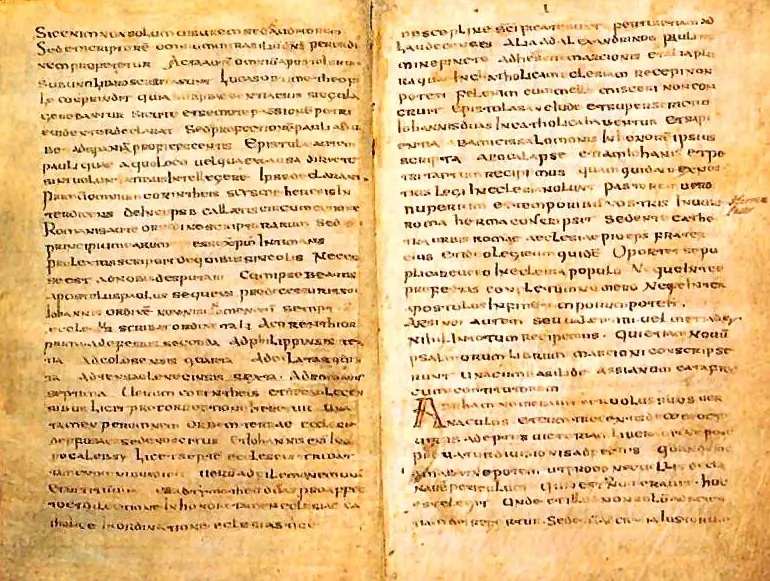
The oldest surviving list of New Testament books may be the Muratorian fragment, a Latin text copied badly in an eighth-century manuscript in Milan’s Ambrosian Library and published by Ludovico Antonio Muratori in 1740. Its beginning is lost; it accepts four Gospels (Luke “third”, John “fourth”), Acts, thirteen letters of Paul, Jude, two letters of John and the Wisdom of Solomon, and it accepts the Revelation of John and of Peter, “though some of us are not willing” to have Peter’s read in church. It rejects letters to the Laodiceans and Alexandrians “forged in Paul’s name to further the heresy of Marcion”.[12][78] Consensus on the content.
Its date is the problem. It says:
“But Hermas wrote the Shepherd very recently, in our times, in the city of Rome, while bishop Pius, his brother, was occupying the chair of the church of the city of Rome.” (trans. Bruce Metzger)[12][78]
Pius was bishop around 140–155, which would put the list around 170–200. In 1973 Albert Sundberg, and in 1992 Geoffrey Hahneman, argued that the list is a fourth-century Eastern one, and that “in our times” means the Christian era generally; others, including Everett Ferguson and Joseph Verheyden, have defended the traditional date.[81][82][83][84] Contested
Origen and Eusebius: accepted, disputed, rejected
Origen in the third century, and Eusebius of Caesarea around 325, both sorted the books into categories, and their lists show which ones were still in doubt.[85][86]
| Eusebius’ category (HE 3.25, c. 325) | Books |
|---|---|
| Recognised (homologoumena) | Four Gospels, Acts, Paul’s letters (including Hebrews), 1 John, 1 Peter; Revelation “if it seems right” |
| Disputed (antilegomena), “but known to most” | James, Jude, 2 Peter, 2 and 3 John |
| Spurious (notha) | Acts of Paul, the Shepherd of Hermas, the Apocalypse of Peter, the Epistle of Barnabas, the Didache; Revelation, “if it seems right” |
| Heretical, “not even to be ranked among the spurious” | Gospels of Peter, Thomas and Matthias; Acts of Andrew and of John |
Consensus on the list. Eusebius puts Revelation in two categories at once, a sign of how divided the Greek-speaking churches were about it.[86] Hebrews had the opposite problem: accepted in the East as Paul’s, it was doubted in the West, where Paul’s authorship was denied, until the later fourth century.[78] Majority
The first list of the 27
In his Easter letter of 367, Athanasius, bishop of Alexandria, listed the books of both Testaments. His New Testament has exactly the 27 books of today’s, in a slightly different order:
“These are fountains of salvation, that they who thirst may be satisfied with the living words they contain. In these alone is proclaimed the doctrine of godliness. Let no man add to these, neither let him take ought from these.” (Festal Letter 39, NPNF translation)[21]
He added that the Didache and the Shepherd were useful for instructing new converts but were not “canonised”. This is the first known list of exactly the 27 books. Consensus (§6 picks up the fourth-century story.)
It did not end the matter. Synods at Hippo (393) and Carthage (397) adopted the same list for North Africa. The Syriac Peshitta, the Bible of the Syriac churches from the fifth century, lacked 2 Peter, 2 and 3 John, Jude and Revelation; Revelation stayed out of Greek lectionaries; the Ethiopian church kept a larger collection.[78][30] Consensus Codex Sinaiticus, from a little before Athanasius’ letter, includes the Epistle of Barnabas and the Shepherd of Hermas after Revelation.[87] Consensus No council of the whole church in the West listed the books until the Council of Florence in 1442, and the Council of Trent made the list a dogma in 1546 (§9). Consensus
The first words for the Trinity
The New Testament speaks of Father, Son and Spirit together, most clearly in the baptismal formula of Matthew 28:19, but has no word for their unity and no account of how they relate.[88] Consensus The vocabulary came in the late second and early third centuries:
- Theophilus of Antioch, c. 180, explaining the six days of creation, says that “the three days which were before the luminaries are types of the Trinity (trias), of God, and his Word, and his Wisdom” (To Autolycus 2.15, ANF translation). This is the first use of trias for God.[10] Consensus His triad is God, Word and Wisdom, not Father, Son and Spirit.
- Tertullian, c. 213, uses trinitas, persona and substantia (above).[14] Majority
The arguments that drove the vocabulary were about how to hold one God and a divine Christ together. Monarchians (from monarchia, “single rule”) such as Noetus of Smyrna, and Praxeas and Sabellius in Rome, early in the third century, taught that Father, Son and Spirit were modes or names of one God, so that the Father himself suffered on the cross (“Patripassianism”, as opponents called it). Adoptionists, such as Theodotus the leather-worker, excommunicated in Rome around 190, held that Jesus was a man whom God adopted at his baptism.[24][89] Majority Paul of Samosata, bishop of Antioch, was deposed by a synod in 268 for a related view.[90] Consensus The definitions that settled these questions, for most churches, belong to the fourth century (§6).
Persecution
The legal position
Christians were not formally outlawed by any surviving law before 250. Trajan’s reply to Pliny around 112 (§0) set the pattern for a century: Christians were not to be sought out; if accused by name and found guilty, they were to be punished unless they renounced Christianity by sacrificing; anonymous accusations were to be ignored.[91][92] Consensus Persecution therefore depended on local accusers, local crowds and the attitude of each governor.
Martyrs of the second century
- Polycarp, the aged bishop of Smyrna, was burned in the stadium sometime between about 155 and 167. The letter describing his death is the earliest surviving martyr account, already shaped by the Gospel passion narratives.[6][93] Majority
- Lyon and Vienne, 177. A letter preserved by Eusebius describes a pogrom in which Christians were arrested, tortured and killed in the amphitheatre, among them the bishop Pothinus and the enslaved woman Blandina.[8] Consensus
- Perpetua and Felicity, Carthage, 203. Vibia Perpetua, a well-born married woman of about 22 nursing an infant son, and the enslaved Felicity, who gave birth in prison, were killed in the arena with three men on 7 March 203. The Passion of Perpetua and Felicity contains a prison diary presented as Perpetua’s own (chapters 3–10), which most scholars accept as substantially hers, making it one of the earliest surviving texts by a Christian woman.[13][94] Majority In it her father begs her to recant, and she answers by pointing to a water jug: as the jug cannot be called by any other name than what it is, she cannot call herself anything but a Christian.[13]
The empire-wide persecutions
| Emperor | Dates | What happened | Confidence |
|---|---|---|---|
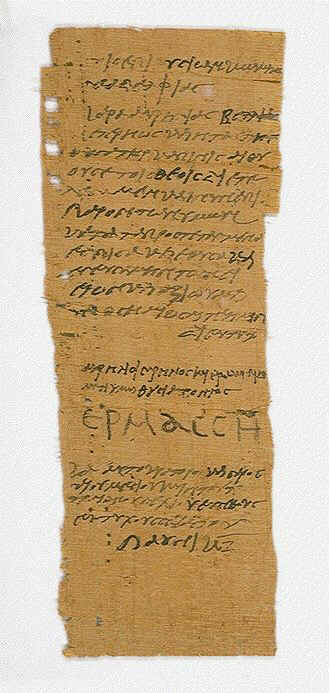
| Decius | 249–251 | An edict ordered every inhabitant of the empire to sacrifice to the gods and obtain a certificate (libellus); more than forty such certificates survive from Egypt. Many Christians complied; others bought false certificates or fled; Fabian of Rome was executed and Origen tortured[15][95] | Consensus |
| Valerian | 257–258 | Edicts aimed at clergy and church property: Cyprian of Carthage was beheaded on 14 September 258, Sixtus II of Rome in August 258[16] | Consensus |
| Gallienus | 260 | Restored church property; about forty years of peace followed[17] | Consensus |
| Diocletian and Galerius | 303–311 | Four edicts, from February 303: churches destroyed, scriptures surrendered, clergy arrested, finally everyone ordered to sacrifice; most severe in the East; ended by Galerius’ edict of 30 April 311 (and in Maximinus’ territory only in 313)[18][19] | Consensus |
James Rives has argued that Decius’ edict was not aimed at Christians as such, but was a general act of religious unity at the start of a reign; its effect on Christians was nonetheless devastating.[95] Contested The crisis it caused inside the church was as important as the deaths. What should happen to the lapsi, the many who had sacrificed? Cyprian’s On the Lapsed (251) argued for re-admission after penance; Novatian in Rome refused, and founded a rigorist church that lasted for centuries.[96][97] Consensus A generation later the Great Persecution produced the same quarrel in North Africa, where the Donatists refused bishops who had handed over scriptures (§6).
Galerius’ edict ended the persecution with a grudging permission:
“…that Christians may exist again and set up their meeting places, provided they do nothing contrary to public order.” (Lactantius, On the Deaths of the Persecutors 34, trans. this site)[19]
How many died?
The martyr literature gives few numbers, and the ones it gives are rhetorical. Eusebius, an eyewitness in Palestine, names fewer than a hundred executions there over eight years of the Great Persecution.[98] Majority Modern estimates for the whole empire in 303–311 run to the low thousands; W. H. C. Frend suggested 3,000–3,500.[99][100] Contested Candida Moss’s The Myth of Persecution (2013) argued that targeted, empire-wide persecution lasted only about a decade in total, that most martyr stories were embellished or invented later, and that the image of a church of martyrs was a fourth-century construction. Critics replied that she understated the real violence and the fear it caused.[93] Contested What is not disputed is that being a Christian could, at any time before 311, cost a person everything. Consensus
How fast did Christianity grow?
There are no census figures. Rodney Stark’s The Rise of Christianity (1996) began from about 1,000 believers in 40 CE and showed that steady growth of about 40 percent per decade, like that of the Mormons in the twentieth century, would produce about 6 million Christians, roughly a tenth of the empire, by 300. Keith Hopkins reached similar orders of magnitude.[101][102] Contested The model fits the few fixed points (a church in Rome with about 150 clergy and 1,500 widows and needy people in 251, according to Bishop Cornelius), but every input is an assumption.[103] Majority on the order of magnitude; Contested on the figures.
Stark also argued that women were over-represented among converts, that Christian care for the sick during epidemics improved survival, and that Christian rejection of infanticide and abortion raised the birth rate.[101] Contested The pagan critic Celsus, around 175, said Christians wanted to convince only “the foolish, dishonourable and stupid, and only slaves, women, and little children” (as quoted by Origen, trans. Henry Chadwick), which at least shows what outsiders saw.[104] Majority
The evidence
| Question | What the evidence supports | Key evidence | Confidence |
|---|---|---|---|
| First fixed canon | Marcion’s Gospel and Apostle, c. 144 | Tertullian, Against Marcion[28] | Consensus |
| “Gnosticism” | Several distinct groups (Valentinians, Sethians, others); some called themselves “Gnostics” | Irenaeus; Nag Hammadi[47][40][44] | Majority (diversity); Contested (the category) |
| Four Gospels | Established in the main churches by c. 180 | Irenaeus; Tatian’s Diatessaron[9][79] | Consensus |
| Muratorian list | An early list; date late 2nd or 4th century | The Hermas remark[12][82] | Contested |
| The 27 books | First listed together in 367; disputed books (Revelation, Hebrews, 2 Peter, Jude, 2–3 John, James) resolved slowly and regionally | Eusebius; Athanasius[86][21] | Consensus |
| Trinity vocabulary | Trias c. 180; trinitas c. 213 | Theophilus; Tertullian[10][14] | Consensus / Majority |
| Sunday worship | Weekly Sunday gatherings with readings by c. 150 | Justin[5] | Consensus |
| Persecution before 250 | Local and sporadic, on accusation | Pliny and Trajan; martyr acts[91][6] | Consensus |
| Empire-wide persecution | Decius 250, Valerian 257–258, Diocletian 303–311 | Libelli; Lactantius; Cyprian[15][18][16] | Consensus |
| Number of martyrs | Probably low thousands in 303–311 | Eusebius; modern estimates[98][99] | Contested |
| Size by 300 | Perhaps 5–10% of the empire | Growth models[101][102] | Contested |
Primary sources
Show the 10 primary sources
1. Marcion’s two Gods: Tertullian, Against Marcion 1.19
Tertullian dates Marcion’s break with the church “about 115 years and six and a half months” after Christ, and describes the Antitheses as a work setting Law against Gospel, to prove two Gods.[4]
What it proves. Marcion’s teaching is known only through hostile sources writing two or three generations later; but the outline (two Gods, no Jewish scriptures, a fixed collection of Luke and Paul) is consistent across Irenaeus, Tertullian and later writers, and is accepted by historians. Majority
2. The first Sunday service: Justin, First Apology 67, c. 150
Quoted above. What it proves. Weekly Sunday worship with readings from Gospels and prophets, a sermon, prayers, and a meal of bread and wine mixed with water, existed in Rome by the mid-second century. Consensus
3. Four Gospels, like four winds: Irenaeus, Against Heresies 3.11.8, c. 180
Irenaeus argues that there cannot be more or fewer than four Gospels, since there are four regions of the world and four principal winds, and the church, spread throughout the world, rests on four pillars.[9]
What it proves. By 180 a leading bishop treated the fourfold Gospel as fixed, and needed to defend it against those who used fewer (Marcion) or more (the Valentinians’ Gospel of Truth). Consensus
4. The Gospel of Peter at Rhossus: Eusebius, Ecclesiastical History 6.12
Eusebius preserves part of a letter by Serapion, bishop of Antioch around 190, who had allowed the church at Rhossus to read a Gospel under Peter’s name, then withdrew permission after borrowing a copy and finding additions he judged docetic.[11]
What it proves. Around 190 there was still no closed list; a bishop decided case by case, on content and on whether a book’s attribution to an apostle was believable. A fragment of a Gospel of Peter was found at Akhmim in Egypt in 1886–87. Majority
5. The Muratorian list on Hermas
Quoted above. What it proves. Someone, either in the late second century or the fourth, drew a line between books read publicly in church and books that could be read privately, and judged the Shepherd too recent to be apostolic. The date of the list decides whether that line was drawn early or late. Contested
6. “Triad”: Theophilus, To Autolycus 2.15, c. 180
Quoted above. What it proves. The word that became “Trinity” first appears in a passing allegory of the creation days, applied to God, his Word and his Wisdom. It is a word, not yet a doctrine. Consensus
7. Seed: Tertullian, Apology 50, c. 197
Quoted above. What it proves. By the end of the second century Christians in Carthage presented martyrdom as a source of growth; the boast is rhetorical, but it shows that persecution was public, known and expected. Majority
8. A prisoner’s diary: the Passion of Perpetua and Felicity 3–10, 203
Paraphrased above. What it proves. A young, well-born Christian woman in Carthage wrote, or dictated, an account of her imprisonment, her father’s appeals and her visions. It is among the earliest surviving writing by a Christian woman, and shows both the social cost of conversion and the authority women could hold as confessors and visionaries. Majority
9. A certificate of sacrifice: Decian libelli, 250
The certificates follow a fixed form: the applicant declares that he or she has always sacrificed to the gods, has now sacrificed, poured a libation and tasted the offerings in the presence of the commissioners, and asks them to certify it; one or two officials sign.[15]
What it proves. Decius’ order was carried out house by house, in villages as well as cities, and was recorded on papyrus; among the surviving certificates is one for a priestess of the god Petesouchos, which supports Rives’ view that the edict targeted everyone, not only Christians. Majority
10. A Marcionite church: the Lebaba inscription, 318/319
A Greek lintel inscription from Lebaba (Deir Ali), south of Damascus, records that “the synagogue of the Marcionites of the village of Lebaba” was built under the presbyter Paul in the year 630 of the Seleucid era, 318/319 CE.[20]
What it proves. More than a century and a half after Marcion’s expulsion, his followers had their own church buildings in Syrian villages, called themselves openly by his name. It is among the oldest dated church inscriptions anywhere. Majority
What is absent
- A New Testament. There was no agreed list until the late fourth century, and churches read books that did not make it, such as Hermas and Barnabas. Consensus
- A universal creed. Local rules of faith and baptismal questions existed; the Nicene Creed did not (§6). Consensus
- The Trinity as a doctrine. The words trias and trinitas existed; the definition of three persons of one being, co-equal and co-eternal, did not. Consensus
- A pope. Bishops of Rome were prominent and claimed Peter’s succession; Irenaeus gives a list of them. But there was no jurisdiction over other churches, and Cyprian of Carthage publicly disagreed with Stephen of Rome over baptism in the 250s. Majority
- Church buildings of a recognisable kind. Christians met mostly in houses and converted houses, with a few purpose-built halls before 303; the first basilicas came under Constantine (§6). Majority
- Christmas. Easter was the great festival; the date of Easter itself was a dispute (the “Quartodeciman” controversy of the 190s). No feast of the Nativity on 25 December is attested securely before 336 (§6). Majority
- Legal recognition. Christians had none until 311. Consensus
Debates
Was “orthodoxy” first, or “heresy”?
| View | Main argument | Main proponents |
|---|---|---|
| Traditional | The apostles’ teaching passed through the bishops; heresies were later deviations | Irenaeus, Eusebius; modern defenders such as Köstenberger and Kruger[60][63] |
| Bauer thesis | In many regions heresy was first; orthodoxy was the Roman version that won | Bauer; in modified form Ehrman[61][64] |
| Middle view | Diversity from the start; proto-orthodoxy was early and widespread but not the only form; both categories were made in the arguments | Most current scholars; Turner (in part)[62][22] |
Contested
Is “Gnosticism” a useful category?
| View | Position | Main proponents |
|---|---|---|
| Dismantle it | The groups shared no single doctrine; the category is a polemical and modern construct | Williams, King[44][43] |
| Keep a narrow sense | Use “Gnostic” for the self-named school, the Sethians, and name the others | Layton, Brakke[42][48] |
| Keep a broad type | A recognisable family of myths and ideas, however varied | Older consensus (the Messina colloquium, 1966) |
Contested
Did Marcion cause the New Testament?
Harnack and Hans von Campenhausen thought Marcion’s canon forced the church to make its own. Later scholars, including Harry Gamble and Lee McDonald, see the churches’ use of Gospels and Pauline letters as already established, and the canon as a long process of use, not a reaction to one man.[27][29][30] Contested
How large was persecution?
| View | Position | Main proponents |
|---|---|---|
| Severe and formative | Persecution, even when sporadic, was constant in its threat and shaped Christian identity | Frend[99] |
| Limited and later magnified | Systematic persecution was brief; much of the martyr literature is later invention | Moss[93] |
| Legal and local | Persecution was governed by Roman legal practice and local initiative; deaths were real but few until 250 | de Ste. Croix[92][100] |
Contested
Further reading
Show further reading (10 works)
- Bruce M. Metzger, The Canon of the New Testament: Its Origin, Development, and Significance (Oxford, 1987): the standard account.
- Harry Y. Gamble, The New Testament Canon: Its Making and Meaning (Fortress, 1985): short and clear.
- Walter Bauer, Orthodoxy and Heresy in Earliest Christianity (1934; English translation 1971).
- Bart D. Ehrman, Lost Christianities (Oxford, 2003): the modified Bauer thesis for general readers.
- Michael A. Williams, Rethinking “Gnosticism” (Princeton, 1996); Karen L. King, What Is Gnosticism? (Harvard, 2003); David Brakke, The Gnostics (Harvard, 2010).
- Bentley Layton, The Gnostic Scriptures (Doubleday, 1987): translations with introductions.
- Christine Trevett, Montanism: Gender, Authority and the New Prophecy (Cambridge, 1996).
- W. H. C. Frend, Martyrdom and Persecution in the Early Church (Blackwell, 1965), and Candida Moss, The Myth of Persecution (HarperOne, 2013), read together.
- Rodney Stark, The Rise of Christianity (Princeton, 1996).
- Andrew McGowan, Ancient Christian Worship (Baker, 2014).
References
- ^ a b Ignatius, To the Smyrnaeans 8 — Letters of Ignatius of Antioch. c. 110 CE (date disputed). Greek. Follow the bishop as Jesus Christ the Father; 'wherever Jesus Christ is, there is the catholic church', the first known use of the phrase. read the text
- ^ a b Irenaeus, Against Heresies 1.24.3–7 — Against Heresies. c. 180 CE. Greek (Latin translation). Irenaeus on the teaching of Basilides in Alexandria. read the text
- ^ a b Irenaeus, Against Heresies 3.4.3 — Against Heresies. c. 180 CE. Greek (Latin translation). Valentinus came to Rome under Hyginus, flourished under Pius and remained until Anicetus; Marcion flourished under Anicetus. read the text
- ^ a b c d Tertullian, Against Marcion 1.19 — Against Marcion. c. 207–208 CE. Latin. Dates Marcion's break with the church and describes his Antitheses, setting Law against Gospel. read the text
- ^ a b c Justin, First Apology 67 — First Apology. c. 150–155 CE. Greek. Sunday worship: readings from the memoirs of the apostles or the prophets, a homily, prayers and the Eucharist. read the text
- ^ a b c Martyrdom of Polycarp — Letter of the church of Smyrna. c. 155–167 CE (event); text soon after. Greek. The earliest surviving account of a Christian martyrdom, modelled on the passion of Jesus. read the text
- ^ a b Eusebius, Ecclesiastical History 5.16 — Ecclesiastical History. c. 325 CE (quoting 2nd-c. sources). Greek. An anonymous anti-Montanist writer on Montanus, Priscilla and Maximilla and their ecstatic prophecy in Phrygia. read the text
- ^ a b Eusebius, Ecclesiastical History 5.1 — Ecclesiastical History. c. 325 CE (quoting a letter of 177). Greek. The letter of the churches of Vienne and Lyon on the martyrs of 177, including Blandina. read the text
- ^ a b c d e Irenaeus, Against Heresies 3.11.8 — Against Heresies. c. 180 CE. Greek (Latin translation). There can be neither more nor fewer than four Gospels, as there are four zones of the world and four principal winds. read the text
- ^ a b c Theophilus of Antioch, To Autolycus 2.15 — Ad Autolycum. c. 180 CE. Greek. The three days before the luminaries are 'types of the Trinity (trias), of God, and His Word, and His wisdom'. read the text
- ^ a b c Eusebius, Ecclesiastical History 6.12 — Ecclesiastical History. c. 325 CE (quoting Serapion, c. 190). Greek. Serapion of Antioch first allows, then forbids, the Gospel of Peter at Rhossus after finding docetic additions. read the text
- ^ a b c d Muratorian fragment — Biblioteca Ambrosiana, Milan, Cod. J 101 sup.. 8th-c. copy of a list of the late 2nd or 4th c.. Latin. A list of New Testament books, incomplete at the start; rejects the Shepherd as written 'very recently, in our times'. about
- ^ a b c Passion of Perpetua and Felicity — Passio sanctarum Perpetuae et Felicitatis. 203 CE (with Perpetua's prison account, ch. 3–10). Latin. The arrest, imprisonment, visions and execution of Perpetua, Felicity and companions at Carthage on 7 March 203. read the text
- ^ a b c d Tertullian, Against Praxeas 2 — Adversus Praxean. c. 213 CE. Latin. Against monarchianism: the Trinity (trinitas), three persons of one substance. read the text
- ^ a b c d Decian libelli — Certificates of sacrifice from Egypt (papyri). 250 CE. Greek. More than forty papyrus certificates in a fixed form, attesting that the holder sacrificed before the commissioners, as Decius' edict required. about
- ^ a b c Acts of Cyprian (Acta Proconsularia) — Acta Proconsularia Sancti Cypriani. 258 CE. Latin. Cyprian's trial before the proconsul under Valerian's edict and his execution on 14 September 258. about
- ^ a b Eusebius, Ecclesiastical History 7.13 — Ecclesiastical History. c. 325 CE. Greek. Gallienus' rescript returning places of worship to the bishops. read the text
- ^ a b c Lactantius, On the Deaths of the Persecutors 12–13 — De mortibus persecutorum. c. 315 CE. Latin. The destruction of the church at Nicomedia and the first edict of the Great Persecution, February 303. read the text
- ^ a b c Lactantius, On the Deaths of the Persecutors 34 — De mortibus persecutorum. c. 314–315 CE (edict of 311). Latin. Galerius' edict of toleration: Christians may exist again and rebuild their meeting places. read the text
- ^ a b c Lebaba inscription (Le Bas–Waddington 2558) — Lintel inscription from Deir Ali (Lebaba), Syria. 318/319 CE. Greek. 'The synagogue of the Marcionites of the village of Lebaba', built under the presbyter Paul in year 630 of the Seleucid era. about
- ^ a b c Athanasius, Festal Letter 39 — Festal (Easter) Letters. 367 CE. Greek. The first list of exactly the 27 books of the New Testament: 'Let no man add to these, neither let him take ought from these.' read the text
- ^ a b Andrew B. McGowan Ancient Christian Worship. Baker Academic, 2014. Meals, readings, music and prayer in the early churches.
- ^ Bart D. Ehrman The New Testament: A Historical Introduction to the Early Christian Writings. Oxford University Press, 7th ed., 2020. The standard critical introduction.
- ^ a b Hippolytus, Refutation of All Heresies 9.12 — Refutation of All Heresies. c. 225–235 CE. Greek. A hostile life of Callixtus: put in charge of the cemetery by Zephyrinus, later bishop of Rome; Roman monarchian controversies. read the text
- ^ Leonard V. Rutgers Subterranean Rome: In Search of the Roots of Christianity in the Catacombs of the Eternal City. Peeters, 2000. The catacombs as cemeteries, not hiding places.
- ^ Tertullian, Prescription Against Heretics 30 — De praescriptione haereticorum. c. 200 CE. Latin. Marcion and Valentinus were members of the Roman church until expelled; Marcion's donation of 200,000 sesterces was returned. read the text
- ^ a b c Adolf von Harnack Marcion: Das Evangelium vom fremden Gott. J. C. Hinrichs, 1921. The classic study, arguing that Marcion prompted the church's canon.
- ^ a b Tertullian, Against Marcion 4.2 — Against Marcion. c. 207–208 CE. Latin. Marcion's Gospel carries no author's name; Tertullian identifies it as a mutilated Luke. read the text
- ^ a b c d Harry Y. Gamble The New Testament Canon: Its Making and Meaning. Fortress Press, 1985. A short, clear account of canon formation.
- ^ a b c d Lee Martin McDonald The Formation of the Biblical Canon. Bloomsbury T&T Clark, 2 vols., 2017. The fullest recent survey of both Testaments' canons.
- ^ Markus Vinzent Marcion and the Dating of the Synoptic Gospels. Peeters, 2014. Argues Marcion's Gospel preceded and prompted the canonical Synoptics.
- ^ Dieter T. Roth The Text of Marcion's Gospel. Brill, 2015. A critical reconstruction of Marcion's Gospel.
- ^ Justin, First Apology 26 — First Apology. c. 150–155 CE. Greek. Marcion of Pontus 'is even at this day alive', teaching another god than the creator, with followers 'in every nation'. read the text
- ^ Theodoret, Letter 81 — Letters. c. 448 CE. Greek. To the consul Nomus: Theodoret says he 'led eight villages of Marcionists with their neighbourhood into the way of truth' in the diocese of Cyrrhus. read the text
- ^ Theodoret, Letter 113 — Letters. c. 449 CE. Greek. To Leo of Rome: 'more than a thousand souls did I rescue from the plague of Marcion'. read the text
- ^ Irenaeus, Against Heresies 1.1.1 — Against Heresies. c. 180 CE. Greek (Latin translation). Irenaeus' summary of the Valentinian myth of the aeons. read the text
- ^ Einar Thomassen The Spiritual Seed: The Church of the 'Valentinians'. Brill, 2006. The fullest study of Valentinian thought.
- ^ Ptolemy, Letter to Flora — Preserved in Epiphanius, Panarion 33.3–7. mid-2nd c. CE. Greek. A Valentinian teacher explains that the Jewish law came from an intermediate god, neither the perfect Father nor the devil. read the text
- ^ Irenaeus, Against Heresies 1.29 — Against Heresies. c. 180 CE. Greek (Latin translation). A myth of Barbelo and the ignorant creator, closely parallel to the Apocryphon of John. read the text
- ^ a b Nag Hammadi codices — Thirteen papyrus codices (Coptic Museum, Cairo). mid-4th c. CE (cartonnage dated 340s). Coptic. Fifty-two texts found buried in a jar in December 1945, including the Gospel of Thomas, the Gospel of Philip and the Apocryphon of John. about
- ^ Bentley Layton The Gnostic Scriptures. Doubleday, 1987. Translations with introductions, grouped by school.
- ^ a b c Bentley Layton Prolegomena to the Study of Ancient Gnosticism. in L. Michael White and O. Larry Yarbrough, eds., The Social World of the First Christians (Fortress), 334–350, 1995. On the self-designation 'Gnostic' and the history of the term.
- ^ a b c Karen L. King What Is Gnosticism?. Belknap Press of Harvard University Press, 2003. How the category was constructed by ancient polemicists and modern scholars.
- ^ a b c Michael A. Williams Rethinking "Gnosticism": An Argument for Dismantling a Dubious Category. Princeton University Press, 1996. The case for abandoning the category.
- ^ Irenaeus, Against Heresies 1.25.6 — Against Heresies. c. 180 CE. Greek (Latin translation). Irenaeus says the Carpocratians 'style themselves Gnostics' and keep images of Christ alongside those of philosophers. read the text
- ^ Irenaeus, Against Heresies 1.11.1 — Against Heresies. c. 180 CE. Greek (Latin translation). Valentinus adapted the principles of 'the so-called Gnostic school' (haeresis) to his own teaching. read the text
- ^ a b Irenaeus, Against Heresies 1.29.1 — Against Heresies. c. 180 CE. Greek (Latin translation). Irenaeus summarises the myth of Barbelo taught by a multitude of Gnostics, the account scholars connect with the Sethian Apocryphon of John. read the text
- ^ a b David Brakke The Gnostics: Myth, Ritual, and Diversity in Early Christianity. Harvard University Press, 2010. Keeps 'Gnostic' for the self-named Sethian school.
- ^ Gospel of Thomas — Nag Hammadi Codex II,2. 2nd c. CE (composition; date disputed). Coptic (from Greek). One hundred and fourteen sayings of Jesus with almost no narrative. about
- ^ Mark Goodacre Thomas and the Gospels: The Case for Thomas's Familiarity with the Synoptics. Eerdmans, 2012. Argues that the Gospel of Thomas knew Matthew and Luke and is therefore second-century.
- ^ April D. DeConick Recovering the Original Gospel of Thomas: A History of the Gospel and Its Growth. T&T Clark, 2005. Argues for an early 'kernel' of Thomas from before 50 CE, expanded into the present text by about 120.
- ^ Gospel of Thomas, saying 114 — Nag Hammadi Codex II,2. 2nd c. CE (composition; date disputed). Coptic (from Greek). Peter: 'Let Mary leave us, for women are not worthy of life'; Jesus: 'I myself shall lead her in order to make her male'. read the text
- ^ James M. Robinson, ed. The Nag Hammadi Library in English. Harper & Row, 1977. The first complete English translation of the codices.
- ^ Gospel of Mary — Berlin Codex (P. Berol. 8502); P.Oxy. 3525; P.Ryl. 463. 2nd c. CE (composition). Coptic and Greek. Mary Magdalene comforts and teaches the disciples, and Peter questions whether the Saviour would speak to a woman privately. about
- ^ a b Karen L. King The Gospel of Mary of Magdala: Jesus and the First Woman Apostle. Polebridge Press, 2003. Translation and study of the Gospel of Mary.
- ^ Gospel of Philip — Nag Hammadi Codex II,3. 2nd–3rd c. CE (composition). Coptic (from Greek). A Valentinian anthology on sacraments; calls Mary Magdalene Jesus' companion (koinōnos) in a damaged passage. about
- ^ Gospel of Judas — Codex Tchacos. codex c. 220–340 CE (radiocarbon); composition 2nd c.. Coptic. A dialogue in which Jesus singles out Judas; the codex was found in the 1970s and published in 2006. about
- ^ April D. DeConick The Thirteenth Apostle: What the Gospel of Judas Really Says. Continuum, 2007. Argues the first translation misread the text and that it portrays Judas as a demon.
- ^ Irenaeus, Against Heresies 1.31.1 — Against Heresies. c. 180 CE. Greek (Latin translation). Irenaeus mentions 'a fictitious history' called the Gospel of Judas, used by a group later called Cainites. read the text
- ^ a b Irenaeus, Against Heresies 3.3.3 — Against Heresies. c. 180 CE. Greek (Latin translation). The list of bishops of Rome from Linus to Eleutherus, as a succession from the apostles. read the text
- ^ a b Walter Bauer Rechtgläubigkeit und Ketzerei im ältesten Christentum (Orthodoxy and Heresy in Earliest Christianity). Mohr Siebeck (English trans. Fortress, 1971), 1934. Argues that forms later called heretical were original in several regions and that orthodoxy was Rome's version.
- ^ a b H. E. W. Turner The Pattern of Christian Truth. Mowbray, 1954. The first major reply to Bauer.
- ^ a b Andreas J. Köstenberger and Michael J. Kruger The Heresy of Orthodoxy. Crossway, 2010. An evangelical critique of the Bauer thesis.
- ^ a b Bart D. Ehrman Lost Christianities: The Battles for Scripture and the Faiths We Never Knew. Oxford University Press, 2003. A modified Bauer thesis for general readers.
- ^ Alistair C. Stewart The Original Bishops: Office and Order in the First Christian Communities. Baker Academic, 2014. How the single bishop emerged.
- ^ Irenaeus, Against Heresies 1.10.1 — Against Heresies. c. 180 CE. Greek (Latin translation). The church's faith received from the apostles: one God, Creator, his Son incarnate, the Spirit, and the coming judgment. read the text
- ^ Tertullian, Prescription Against Heretics 13 — De praescriptione haereticorum. c. 200 CE. Latin. The rule of faith: one God, the Creator, his Word born of the virgin, crucified, risen, who will come to judge. read the text
- ^ Justin, Second Apology 13 — Second Apology. c. 150–160 CE. Greek. Each philosopher spoke well 'according to the share he had of the seminal divine Word (logos spermatikos)'. read the text
- ^ Sara Parvis and Paul Foster, eds. Justin Martyr and His Worlds. Fortress Press, 2007. Essays on Justin's life, writings and context.
- ^ Irenaeus, Against Heresies 3.1.1 — Against Heresies. c. 180 CE. Greek (Latin translation). The earliest list naming Matthew, Mark, Luke and John as authors of the four Gospels. read the text
- ^ John Behr Irenaeus of Lyons: Identifying Christianity. Oxford University Press, 2013. Irenaeus' theology and his role in defining the church's scripture and faith.
- ^ Tertullian, Apology 50 — Apologeticum. c. 197 CE. Latin. 'We grow more numerous every time we are mown down by you: the blood of Christians is seed.' read the text
- ^ Eusebius, Ecclesiastical History 6.39 — Ecclesiastical History. c. 325 CE. Greek. Under Decius, Fabian of Rome is executed and Origen is tortured in prison. read the text
- ^ Ronald E. Heine Origen: Scholarship in the Service of the Church. Oxford University Press, 2010. Origen's life and work.
- ^ William Tabbernee Fake Prophecy and Polluted Sacraments: Ecclesiastical and Imperial Reactions to Montanism. Brill, 2007. The suppression of the New Prophecy.
- ^ William Tabbernee and Peter Lampe Pepouza and Tymion: The Discovery and Archaeological Exploration of a Lost Ancient City and an Imperial Estate. De Gruyter, 2008. The identification of the Montanist holy city.
- ^ Christine Trevett Montanism: Gender, Authority and the New Prophecy. Cambridge University Press, 1996. The New Prophecy and its women prophets.
- ^ a b c d e f Bruce M. Metzger The Canon of the New Testament: Its Origin, Development, and Significance. Clarendon Press, 1987. The standard account, with translations of the early lists.
- ^ a b William L. Petersen Tatian's Diatessaron: Its Creation, Dissemination, Significance, and History in Scholarship. Brill, 1994. The standard study of the Gospel harmony.
- ^ Charles E. Hill Who Chose the Gospels? Probing the Great Gospel Conspiracy. Oxford University Press, 2010. Argues the fourfold Gospel was recognised before Irenaeus.
- ^ Albert C. Sundberg Jr. Canon Muratori: A Fourth-Century List. Harvard Theological Review 66: 1–41, 1973. Argues the list is fourth-century and Eastern.
- ^ a b Geoffrey Mark Hahneman The Muratorian Fragment and the Development of the Canon. Clarendon Press, 1992. Argues for a fourth-century Eastern date.
- ^ Everett Ferguson Canon Muratori: Date and Provenance. Studia Patristica 17: 677–683, 1982. Defends a late-second-century Roman date against Sundberg.
- ^ Joseph Verheyden The Canon Muratori: A Matter of Dispute. in J.-M. Auwers and H. J. de Jonge, eds., The Biblical Canons (BETL 163, Peeters), 487–556, 2003. Defends the traditional second-century date.
- ^ Eusebius, Ecclesiastical History 6.25 — Ecclesiastical History. c. 325 CE (quoting Origen). Greek. Origen's views on the Hebrew canon, the four Gospels and the disputed epistles. read the text
- ^ a b c Eusebius, Ecclesiastical History 3.25 — Ecclesiastical History. c. 325 CE. Greek. Eusebius sorts Christian books into recognised, disputed, spurious and heretical. read the text
- ^ Codex Sinaiticus — British Library (most leaves); Leipzig, St Catherine's Monastery and St Petersburg. c. 325–360 CE. Greek. About half of the Greek Old Testament survives, with the oldest complete copy of the New Testament. read the text
- ^ Matthew 28:16–20 — Gospel of Matthew (New Testament). c. 80–90 CE. Greek. The risen Jesus meets the eleven on a mountain in Galilee and sends them to baptise 'in the name of the Father and of the Son and of the Holy Spirit'. read the text
- ^ Eusebius, Ecclesiastical History 5.28 — Ecclesiastical History. c. 325 CE (quoting an early 3rd-c. source). Greek. Theodotus the leather-worker, who called Christ a mere man, excommunicated by Victor of Rome. read the text
- ^ Eusebius, Ecclesiastical History 7.30 — Ecclesiastical History. c. 325 CE (quoting the synod's letter). Greek. The synod of Antioch's letter deposing Paul of Samosata (268). read the text
- ^ a b Trajan to Pliny, Letters 10.97 — Pliny the Younger, Letters. c. 112 CE. Latin. Trajan's reply: Christians are not to be sought out; if accused and convicted they are to be punished, but pardoned if they sacrifice; anonymous accusations are not to be admitted. about
- ^ a b G. E. M. de Ste. Croix Why Were the Early Christians Persecuted?. Past & Present 26: 6–38, 1963. The classic analysis of the legal basis and local character of persecution.
- ^ a b c Candida Moss The Myth of Persecution: How Early Christians Invented a Story of Martyrdom. HarperOne, 2013. Argues imperial persecution was brief and the martyr literature largely later.
- ^ Thomas J. Heffernan The Passion of Perpetua and Felicity. Oxford University Press, 2012. Edition, translation and commentary.
- ^ a b J. B. Rives The Decree of Decius and the Religion of Empire. Journal of Roman Studies 89: 135–154, 1999. Argues the decree was a general religious measure, not aimed at Christians.
- ^ Cyprian, On the Lapsed — De lapsis. 251 CE. Latin. Cyprian on Christians who sacrificed under Decius, arguing for readmission after penance. read the text
- ^ Allen Brent Cyprian and Roman Carthage. Cambridge University Press, 2010. Cyprian, the lapsed and the persecutions of Decius and Valerian.
- ^ a b Eusebius, The Martyrs of Palestine — The Martyrs of Palestine. c. 311–313 CE. Greek. An eyewitness account of the executions in Palestine during the Great Persecution, by name and date. read the text
- ^ a b c W. H. C. Frend Martyrdom and Persecution in the Early Church. Blackwell, 1965. The persecutions from the Maccabees to Donatus.
- ^ a b G. E. M. de Ste. Croix Christian Persecution, Martyrdom, and Orthodoxy. Oxford University Press, 2006. Collected studies, including on the Great Persecution.
- ^ a b c Rodney Stark The Rise of Christianity: A Sociologist Reconsiders History. Princeton University Press, 1996. The 40-percent-per-decade growth model.
- ^ a b Keith Hopkins Christian Number and Its Implications. Journal of Early Christian Studies 6: 185–226, 1998. A demographic model of early Christian growth.
- ^ Eusebius, Ecclesiastical History 6.43 — Ecclesiastical History. c. 325 CE (quoting Cornelius, 251). Greek. Bishop Cornelius lists the Roman church's 46 presbyters and other clergy and more than 1,500 widows and needy people. read the text
- ^ Origen, Against Celsus 3.44 — Against Celsus. c. 248 CE (quoting Celsus, c. 175–180). Greek. Celsus: Christians wish to persuade 'only the foolish, dishonourable and stupid, and only slaves, women, and little children'. read the text