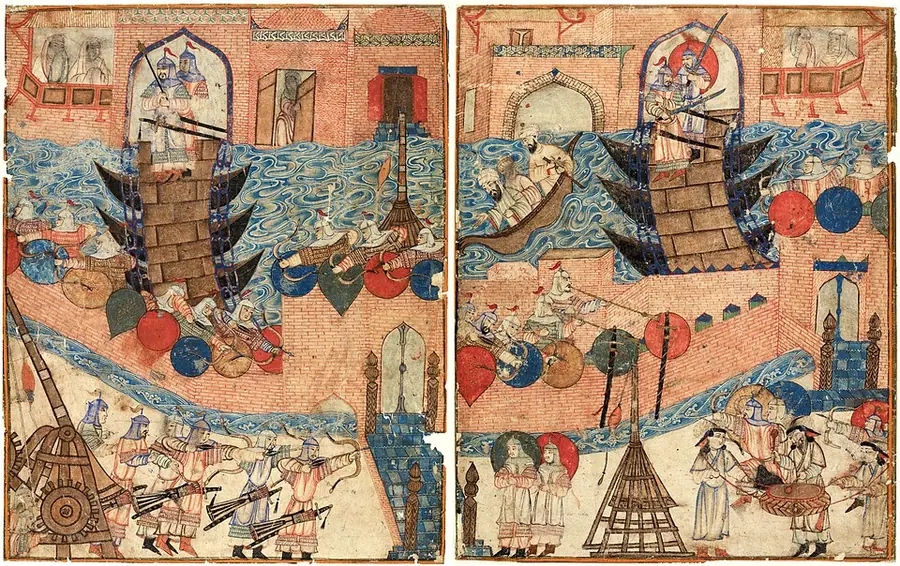
Between about 1000 and 1400 the Islamic world was ruled more and more by soldiers from outside it. Turkish dynasties took power in Iran, Iraq, Syria and Anatolia; from 1055 a Seljuk sultan ruled in Baghdad beside an Abbasid caliph who kept his title and lost his power. Their ministers endowed madrasas, colleges of law, which spread a Sunni scholarly culture across the region. From 1096 the Franks of western Europe invaded the Syrian coast and held parts of it for two centuries; Muslim rulers were slow to unite against them, and the Mamluk sultans of Egypt took the last of their cities in 1291. A larger catastrophe came from the east: the Mongols destroyed the cities of Central Asia in 1219–1221 and sacked Baghdad in 1258, ending the Abbasid caliphate there. Yet within forty years the Mongol rulers of Iran had become Muslim. Meanwhile Islam was losing ground in Spain and gaining it in north India, West Africa and the islands of Southeast Asia, where it arrived with armies in some places and with traders and scholars in others. Majority
This chapter follows those changes. The scholars and law of the earlier centuries are in §6; the Sufis, whose orders took shape in these same centuries and did much to carry Islam to the new frontiers, are in §7. The view from the other side is told in Christianity §8 for the Crusades, Judaism §8 and Judaism §9 for the Jews of al-Andalus and the Crusader lands, and Hinduism §10 for India.
Timeline
| Date | Event or evidence | Confidence |
|---|---|---|
| 1000–1027 | Maḥmūd of Ghazni (r. 998–1030) raids north India; Somnath, 1026[1][2] | Consensus |
| c. 1030 | Al-Bīrūnī completes his book on India[3] | Consensus |
| 1031 | The caliphate of Córdoba breaks up into the “taifa” kingdoms[4] | Consensus |
| 1055 | The Seljuk Tughril enters Baghdad; Buyid rule in Iraq ends[5] | Consensus |
| 1065–1067 | The Niẓāmiyya madrasa of Baghdad is built and opened[6] | Majority |
| 1071 | Alp Arslan defeats the Byzantine emperor at Manzikert[5] | Consensus |
| 1086 | The Almoravids cross to Spain and defeat Alfonso VI at Sagrajas[4] | Consensus |
| 1099 | The First Crusade takes Jerusalem; its Muslims and Jews are massacred[7][8] | Consensus |
| 1105 | Al-Sulamī preaches his Book of Jihad in Damascus[9] | Consensus |
| 1144 | Zengi takes Edessa[8] | Consensus |
| 1168–1169 | Nūr al-Dīn commissions a pulpit for al-Aqṣā[10] | Consensus |
| 1171 | Saladin ends the Fatimid caliphate in Cairo[8] | Consensus |
| 1187 | Hattin (4 July); Jerusalem surrenders (2 October)[8][11] | Consensus |
| 1198 | Death of Ibn Rushd (Averroes) in Marrakesh[4] | Consensus |
| 1206 | The Delhi Sultanate begins[12] | Consensus |
| 1219–1221 | The Mongols destroy the cities of Khwārazm and Khurāsān[13][14] | Consensus |
| 1250 | Mamluk officers take power in Egypt[15] | Consensus |
| 1258 | The Mongols sack Baghdad; the caliph is executed (20 February)[14][16] | Consensus |
| 1260 | The Mamluks defeat the Mongols at ʿAyn Jālūt (3 September)[15] | Consensus |
| 1261 | An Abbasid is proclaimed caliph in Cairo[15] | Consensus |
| 1291 | The Mamluks take Acre[11] | Consensus |
| 1295 | The Ilkhan Ghazan converts to Islam[14] | Consensus |
| 1297 | Gravestone of Malik al-Ṣāliḥ of Samudra-Pasai, Sumatra[17][18] | Consensus |
| 1303 or later | The Terengganu stone proclaims Islam in Malay[19] | Contested (date) |
| 1324–1325 | Mansa Mūsā of Mali makes the pilgrimage; his visit to Cairo[20][21] | Consensus |
| 1328 | Ibn Taymiyya dies in prison in Damascus[22] | Consensus |
The Seljuks: a sultan beside the caliph
Turks in Baghdad
By the year 1000 the Abbasid caliph in Baghdad ruled almost nothing. Since 945 the Buyids, a Shia family from the mountains of northern Iran, had governed Iraq in his name, and since 969 a rival, Ismāʿīlī caliphate, the Fatimids, had ruled Egypt and claimed the allegiance of every Muslim (§6). The power that changed this came from Central Asia. The Seljuks, a family of Oghuz Turkish chiefs recently converted to Sunni Islam, took Khurāsān in the 1030s; their leader Tughril called himself sultan, “authority”, after taking Nīshāpūr in 1037.[5] Consensus
Tughril entered Baghdad in 1055, at the caliph al-Qāʾim’s invitation, and ended Buyid rule there. Three years later a Turkish commander, al-Basāsīrī, seized Baghdad with Fatimid backing and had the Friday sermon said in the name of the Fatimid caliph, before Tughril retook the city. In 1058 the caliph gave Tughril the title “King of the East and the West”.[5] Consensus The pattern held for the next two centuries: a caliph who embodied the legitimacy of the Sunni community and appointed no one to anything that mattered, and a sultan who held the armies and the revenues and needed the caliph’s blessing. Muslim jurists, al-Ghazālī among them (§7), worked out a theory that justified the arrangement after the fact. Majority
In 1071 Tughril’s nephew Alp Arslan defeated and captured the Byzantine emperor Romanos IV at Manzikert, in eastern Anatolia. The battle opened Anatolia to Turkish migration; a branch of the dynasty, the Seljuks of Rūm, ruled it from Konya until the Mongols reduced it to a vassal state in 1243. Over the next three centuries Anatolia, which had been Greek-speaking and Christian, became mostly Turkish-speaking and Muslim, the process studied by Speros Vryonis.[5][23] Consensus on the outcome; Contested on how much of it came by conversion, migration or flight. The Persian poet Rūmī taught in Konya under these sultans (§7).
The madrasa
The Seljuks’ greatest minister, the Persian Niẓām al-Mulk, vizier from 1064 until he was murdered in 1092 (by an assassin the sources attribute to the Ismāʿīlī Nizārīs), founded a network of madrasas, colleges of law, in Baghdad, Nīshāpūr, Iṣfahān and other cities.[5][6] Consensus The Niẓāmiyya of Baghdad, built from 1065 and opened in 1067, became the most famous: an endowed building with salaried teachers, stipends for students, a library and a mosque. Its deed required its teachers, preachers and librarians to be Shāfiʿī in law and Ashʿarī in theology. Al-Ghazālī taught there from 1091 until he left in 1095–96 (§7).[6] Consensus
The madrasa was not new. Teaching circles in mosques were centuries old, and endowed colleges are recorded in Khurāsān before Niẓām al-Mulk; George Makdisi showed that the form rested on the waqf, the charitable endowment, which gave a founder legal control of the institution and its appointments.[6] Majority What the Seljuk era did was multiply it. Within two centuries madrasas were founded by sultans, princes, officers and their wives from Anatolia to Cairo, and a madrasa education became the normal path to a career as a judge, preacher or teacher. Consensus
A “Sunni revival”?
Historians long called this period the “Sunni revival”: Sunni Turkish rulers, having freed the caliph from the Shia Buyids, used madrasas to train scholars against Shiism and the Fatimids. The picture has been questioned. Jonathan Berkey argues that Sunni learning had not been in eclipse under the Buyids, that the Fatimid threat was waning by the 1070s, and that what happened is better called a “recentring” of religious authority around the scholars, the ʿulamāʾ, and the institutions that supported them.[24] Daphna Ephrat, studying the scholars of eleventh-century Baghdad, finds that the madrasas changed less than was claimed: learning still passed from teacher to student, in mosques and homes as well as colleges, and the madrasas served their founders’ prestige and the scholars’ careers as much as any doctrinal campaign.[25] Contested on how far the madrasas were instruments of policy; Consensus that Sunni scholarly culture became more uniform and more institutional in these centuries.
The Crusades from the Muslim side
The Franks arrive
The armies that reached Syria in 1097 found a divided region. The Seljuk sultanate had splintered after the deaths of Malikshāh and Niẓām al-Mulk in 1092; rival Turkish princes held Aleppo and Damascus, and the Fatimids had retaken Jerusalem from them in 1098. The crusaders took Antioch in 1098 and Jerusalem on 15 July 1099, and killed thousands of the city’s Muslims and Jews. Arabic sources later gave 70,000 or more; modern estimates, from a city of perhaps 30,000, are far lower, in the thousands.[7][8] Consensus that a massacre took place; Contested on its scale.
Muslim writers called the invaders al-Ifranj, the Franks, and their wars the wars of the Franks. There was no Arabic word for “crusade”: the phrase now used, al-ḥurūb al-ṣalībiyya, “the wars of the cross”, was introduced much later by Arabic-speaking Christians.[8] Majority Many of their contemporaries saw the invasion as one more incursion by Byzantium’s western mercenaries, not as a religious war. An exception was the Damascus jurist ʿAlī ibn Ṭāhir al-Sulamī, who in 1105 preached a Book of Jihad in the city’s Great Mosque. He read the Franks’ conquest as part of a single Christian offensive that had already taken Sicily and much of Spain, blamed Muslims’ neglect of their religion and of jihad, and called on rulers to unite and fight. His call found little response at the time.[9][8] Consensus
Zengi, Nūr al-Dīn and holy war
The counter-attack was led by Turkish princes from the Jazīra and Syria. Zengi, the ruler of Mosul and Aleppo, took the crusader city of Edessa in December 1144, which provoked the Second Crusade; its attack on Damascus in 1148 failed.[8] Consensus His son Nūr al-Dīn (d. 1174) united Muslim Syria and made jihad a programme of government. He founded madrasas and Sufi lodges, built “houses of hadith”, sponsored preachers and poets, and promoted the merits of Jerusalem as a holy city to be recovered. Around 1168–69 he had a carved wooden pulpit made in Aleppo for the al-Aqṣā mosque, a city he did not hold; Saladin installed it there after 1187, and it stood until an arsonist burned it in 1969.[10][8] Consensus Carole Hillenbrand describes this as a sustained propaganda of jihad, joining the war against the Franks to a programme of religious revival at home.[8] Majority
Saladin and Jerusalem
Nūr al-Dīn’s Kurdish officer Ṣalāḥ al-Dīn, Saladin, became vizier of Fatimid Egypt in 1169 and in 1171 ended the Fatimid caliphate, restoring the Friday prayer in the name of the Abbasid caliph in Cairo after two centuries.[8] Consensus After Nūr al-Dīn’s death he spent a decade bringing Syria under his rule as well. On 4 July 1187 he destroyed the army of the Kingdom of Jerusalem at Hattin, and on 2 October Jerusalem surrendered. The city’s defenders were allowed to ransom themselves at a fixed price, ten dinars a man, five a woman and two a child; thousands who could not pay were enslaved. There was no massacre. The cross was taken down from the Dome of the Rock, and Muslim worship restored in al-Aqṣā.[8][11] Consensus The Third Crusade retook Acre but not Jerusalem; the Treaty of Jaffa (1192) left the coast to the Franks and gave Christian pilgrims access to the holy places. Saladin died in Damascus in March 1193. Consensus
Living beside the Franks
Most of the two centuries were not spent in battle. Truces were frequent, trade went on, and Muslim peasants lived under Frankish lords. The best-known Muslim witness is Usāma ibn Munqidh (1095–1188), a Syrian emir, poet and diplomat who knew the Franks in war and peace. His Book of Contemplation, written around 1183 as a book of lessons and anecdotes for Saladin’s circle, mocks Frankish medicine and law and admires some Frankish knights, and survives in a single manuscript found in the Escorial in 1880.[26][27] Paul Cobb, its modern translator, warns that its stories were shaped to entertain and instruct, not to report. Majority
The Mamluks and the end of the Franks
In 1250 the slave soldiers, mamlūks, of the last Ayyubid sultan of Egypt killed his heir and took power. The Mamluk sultanate they founded, ruled by a self-renewing elite of soldiers bought as boys from the Black Sea steppes, would last until the Ottoman conquest of 1517.[15] Consensus Its sultans, above all Baybars (r. 1260–1277), destroyed the crusader fortresses one by one. On 18 May 1291 al-Ashraf Khalīl stormed Acre, the last great Frankish city on the mainland; the remaining coastal towns were abandoned within months.[11] Consensus
How the Crusades are remembered
For Muslim historians of the following centuries the Franks were one episode among many. Hillenbrand argues that the crusades were a marginal matter to most Muslims compared with the Mongol invasions and the fall of the caliphate.[8] Majority Interest revived in the nineteenth century, in the age of European empire. The Ottoman writer Namık Kemal published the first modern biography of Saladin in 1872; after the German emperor Wilhelm II visited Saladin’s tomb in Damascus in 1898, Arab nationalists recast Saladin as a hero of resistance to the West.[11] Majority In the twentieth century “Crusaders” became a term for Western powers in nationalist and later Islamist rhetoric, and Western writers in turn spoke of a crusade against enemies in the Middle East. Both uses read the present into the Middle Ages. Political
The Mongols
The first storm, 1219–1221
In 1218 a governor of the Khwārazm-Shāh, the Muslim ruler of Central Asia and Iran, killed the members of a Mongol trading caravan at Otrār, and his master killed an envoy sent to demand redress. Chinggis Khan’s armies destroyed Bukhārā, Samarqand, Urgench, Merv and Nīshāpūr between 1219 and 1221.[14] Consensus The historian Ibn al-Athīr of Mosul, writing a few years later, confessed that for years he had been unable to bring himself to record it, “deeming it so horrible”, and called it “the greatest catastrophe and the most dire calamity” ever to befall mankind, and the Muslims in particular.[13] Consensus on the text. His figure of 700,000 dead at Merv, and a later Persian historian’s 1.3 million, are not credible; that the destruction was a demographic catastrophe is not in doubt.[14] Majority
Baghdad, 1258
A generation later Chinggis’s grandson Hülegü led a second army west. It destroyed the Ismāʿīlī Nizārī fortresses of Iran in 1256 and reached Baghdad in January 1258. The caliph al-Mustaʿṣim surrendered on 10 February; the city was sacked from 13 February, and on 20 February the caliph was executed, by the usual account rolled in a carpet and trampled by horses, since the Mongols avoided spilling royal blood.[14] Majority on the manner of death. Hülegü himself claimed about 200,000 dead; some Muslim sources give 800,000 or two million. Peter Jackson calls Hülegü’s figure “obviously inflated”, and recent work asks how far epidemic disease after the siege swelled the later totals.[14][28] Contested on numbers.
The image of Baghdad’s libraries thrown into the Tigris until its water ran black is a later literary flourish. Michal Biran has shown that large libraries were working again within two years of the conquest, and that Baghdad remained a centre of learning under Mongol rule; the astronomer Naṣīr al-Dīn al-Ṭūsī, who served Hülegü, built the observatory of Marāgha with his patronage.[16] Majority What did end was the caliphate in Baghdad, after five centuries. For the first time since 632 the Sunni world had no caliph at all. Consensus
ʿAyn Jālūt and a caliph in Cairo
The Mongol advance into Syria was stopped by the Mamluks at ʿAyn Jālūt, in the Jezreel valley in Palestine, on 3 September 1260; the Mongol general Kitbuqa was killed. The Mamluk officer Baybars murdered his sultan on the way home and took the throne.[15] Consensus In June 1261 Baybars proclaimed an Abbasid survivor caliph in Cairo; when that caliph was killed later the same year leading a small force against the Mongols in Iraq, another was installed. His descendants remained in Cairo as figureheads, lending legitimacy to Mamluk sultans, until the Ottoman conquest of 1517 (§9).[15] Consensus The war between the Mamluks and the Mongols of Iran, the Ilkhans, went on for sixty years, with Mongol invasions of Syria in 1260, 1271, 1281, 1299–1300, 1303 and 1312, until a peace was ratified in 1322–23. Consensus
The Mongols become Muslim
The Mongols ruled Iran as Buddhists, shamanists and patrons of every religion; their armies included Christians. On 16 June 1295 the Ilkhan Ghazan converted to Sunni Islam at the urging of his general Nawrūz, who made it a condition of his support in a struggle for the throne. Buddhist temples and churches were destroyed in the persecution that followed, and Buddhism did not recover in Iran.[14] Consensus Ghazan’s vizier Rashīd al-Dīn, a convert from Judaism, compiled the Compendium of Chronicles, a history of the world in Persian, whose illustrated copies include some of the earliest surviving paintings of Muhammad (§0).[29] Consensus
Ghazan’s conversion did not end the war with Egypt: his armies invaded Mamluk Syria three times, winning at Wādī al-Khaznadār in December 1299 and losing at Marj al-Ṣuffar in April 1303.[15][14] Consensus That Muslims were now fighting Muslims who had converted only yesterday posed a question of law, and one Damascus scholar answered it.
Ibn Taymiyya
Taqī al-Dīn Aḥmad ibn Taymiyya was born in Ḥarrān, in upper Mesopotamia, in 1263; his family fled the Mongols to Damascus when he was a child, and he became a Ḥanbalī jurist and theologian of great learning and combativeness.[22] Consensus When the Ilkhans invaded Syria he issued fatwas that they must be fought despite their profession of Islam: on his account they ruled by the yāsā, the law of Chinggis Khan, rather than sharia, and so stood outside Islam however often they said the creed.[30][22] Majority on his argument. He took part in the campaign of 1303 and issued a ruling that soldiers could break the Ramadan fast to fight; how far he fought in person is disputed.[22] Contested
He spent much of his later life in prison. He was held in Cairo in 1306–1307 on charges of describing God in bodily terms, in Damascus in 1320–21 over a ruling on divorce, and from 1326 until his death in the citadel of Damascus on 26 September 1328 for a treatise condemning journeys made to visit the tombs of prophets and saints, including the Prophet’s own.[22] Consensus He held that such journeys, and the requests for intercession made at shrines, were innovations that compromised the worship owed to God alone; most scholars of his time, and the Mamluk courts, held that he had gone too far. Majority
His reputation has had two lives. His student Ibn Qayyim al-Jawziyya (d. 1350) spread his ideas, and he was respected as a scholar, but historians note that he had little influence on mainstream Sunni Islam until the nineteenth century.[22] Majority Then the Arabian reformer Muḥammad ibn ʿAbd al-Wahhāb (§10), and later Salafis and some modern militants, took up his writings on shrines and on rulers who do not apply sharia. The essays edited by Yossef Rapoport and Shahab Ahmed (2010) argue for reading him in his Mamluk context rather than through his modern admirers and enemies.[22] Political on the modern use of his anti-Mongol fatwas.
Al-Andalus: from caliphate to Granada
The Umayyad emirate founded in Spain in 756 (§5) became a caliphate in 929, when ʿAbd al-Raḥmān III took the title for himself. Córdoba was then among the largest cities of Europe, with a royal library said to hold hundreds of thousands of volumes and Jewish courtiers such as Ḥasdai ibn Shaprūṭ.[4] Majority After civil war from 1009 the caliphate dissolved in 1031 into a dozen or more “taifa” kingdoms, rich and culturally brilliant but militarily weak, which paid tribute to the Christian kings of the north.[4] Consensus
When Alfonso VI of Castile took Toledo in 1085, the taifa kings called in the Almoravids, a movement of Ṣanhāja Berbers from the western Sahara founded on a strict Mālikī reformism, whose leader Yūsuf ibn Tāshfīn defeated Alfonso at Sagrajas in 1086 and then took the taifas for himself. They in turn were overthrown, in North Africa by 1147 and in Spain soon after, by the Almohads, al-muwaḥḥidūn, “those who affirm God’s oneness”, a movement founded by Ibn Tūmart (d. 1130), who claimed to be the Mahdī.[4] Consensus The Almohads abandoned the old protections for Jews and Christians and pressed them to convert; many emigrated, among them the family of Maimonides (Judaism §8).[4][31] Majority
The same dynasty patronised philosophy. Its caliph Abū Yaʿqūb Yūsuf asked the Córdoban judge and physician Ibn Rushd (1126–1198), known in Latin as Averroes, to explain Aristotle, and his commentaries became in Latin translation the standard guide to Aristotle in the universities of Europe, where he was called “the Commentator”. He also defended philosophy against al-Ghazālī’s attack on it (§7) and wrote a major work comparing the schools of law. He fell from favour in 1195 and was restored before his death in Marrakesh in 1198. His influence in the Islamic world was modest until modern times.[4] Majority
The Almohads’ defeat at Las Navas de Tolosa in 1212 opened the south to Castile and Aragon: Córdoba fell in 1236 and Seville in 1248. The Naṣrid kingdom of Granada survived as a tributary state until it surrendered on 2 January 1492. The treaty promised Muslims their religion; within a decade, after a revolt in 1499–1501, they were forced to convert or leave, and their converted descendants, the Moriscos, were expelled in 1609–1614. In the same year as Granada fell, Spain’s Jews were ordered to convert or leave.[4] Consensus
How tolerant al-Andalus had been is itself contested. María Rosa Menocal’s Ornament of the World (2002) presented a culture of coexistence, convivencia; others stress the hierarchy of the dhimma (§5), periodic violence and the Almohad persecutions.[32] Contested; Political on modern uses of either picture.
The new frontiers
North India
Maḥmūd of Ghazni (r. 998–1030), a Turkish ruler of eastern Afghanistan, raided north India repeatedly for its temple treasures, and in 1026 sacked the temple of Somnath in Gujarat.[1][2] Consensus A scholar of his court, al-Bīrūnī, travelled in India in these years and completed, around 1030, a long and careful account of Indian religion, philosophy and science, written, he said, to set out Hindu teachings as the Hindus themselves held them.[3] Consensus Romila Thapar has traced how the raid on Somnath was told and retold over the following centuries, in Persian chronicles, Sanskrit inscriptions and colonial histories.[2] Majority
Conquest and rule came later. The Ghurid Muḥammad of Ghūr defeated a Rajput coalition at Tarāʾin in 1192; after his death in 1206 his slave general Quṭb al-Dīn Aybak ruled from Delhi, and the Delhi Sultanate, under five successive dynasties, lasted until the Mughal conquest of 1526.[12] Consensus It repelled repeated Mongol invasions in the thirteenth and fourteenth centuries and at its widest, under Muḥammad ibn Tughluq (r. 1325–1351), reached most of the subcontinent. Around 1200 a Khalji commander’s troops sacked a Buddhist monastery in Bihar, an event that later tradition attached to Nālandā (see Was Nalanda destroyed by Bakhtiyar Khilji?).[33] Contested on what was destroyed.
Richard Eaton’s survey of temple desecration finds eighty reasonably certain cases between 1192 and 1729, mostly of royal temples in newly conquered or rebellious territory, which he reads as political acts as well as religious ones; and his study of Bengal finds that conversion to Islam was heaviest not near the centres of Muslim power but on the agrarian frontier, centuries later.[34][35] Majority; Political on the modern argument over both, set out in Hinduism §10.
West Africa
Muslim traders had crossed the Sahara since the eighth century, and the Almoravid movement of the eleventh began among the desert Berbers on its southern edge. Whether the Almoravids conquered the empire of Ghana around 1076 or only converted its rulers is debated.[21] Contested By the thirteenth century the rulers of the empire of Mali were Muslim. In 1324–1325 its king Mansa Mūsā (r. c. 1312–1337) made the pilgrimage to Mecca with a vast retinue. The Cairo administrator al-ʿUmarī, writing within a generation and drawing on an official who had befriended the king, records that before his visit a mithqāl of gold was worth twenty-five silver dirhams in Cairo, and that his spending pushed it below twenty-two for at least twelve years.[20][36] Majority Modern claims that he was the richest man in history cannot be measured. Consensus The Moroccan traveller Ibn Baṭṭūṭa visited Mali in the early 1350s and left the fullest description of Muslim life at its court, in the account of his travels he dictated to Ibn Juzayy at the court of the Marinid sultan in Fez.[36] Consensus
Southeast Asia
Islam reached the islands of Southeast Asia with merchants, not armies. The earliest legible Muslim gravestone in the region, that of a woman at Leran in eastern Java, is dated 1082, but it may have been brought there later. Marco Polo reported a Muslim town on the north coast of Sumatra in 1292, and the gravestone of Sultan Malik al-Ṣāliḥ of Samudra-Pasai, on the same coast, is dated 1297: the first dated Muslim ruler in the region.[17][18] Consensus When Ibn Baṭṭūṭa called there in 1345–46 he found a pious sultan of the Shāfiʿī school. Majority
The Terengganu stone, found in 1887 on the Malay peninsula, is the oldest known text in Malay written in Arabic script. It proclaims the religion of the Prophet in the land, sets out rules of sharia for its ruler’s subjects, and is dated on a Friday in the month of Rajab; the year is damaged and has been read as anything from 702 to 789 AH, that is from 1303 to 1387. Syed Muhammad Naquib al-Attas argued for 1303.[19] Contested on the date. M. C. Ricklefs’s account of how the region became Muslim, gradually and from the coasts and courts inward, through traders, intermarriage and later Sufi teachers, is the standard one; it was mostly peaceful.[18] Majority Indonesia, now the largest Muslim country in the world, took its religion from these centuries and the next (§9).
The evidence
| Question | What the evidence supports | Key evidence | Confidence |
|---|---|---|---|
| Sultan and caliph | From 1055 Seljuk sultans ruled; the Abbasid caliph conferred legitimacy | Chronicles; titles conferred in 1058[5] | Consensus |
| The madrasa | An endowed college of law, older than the Seljuks but multiplied by them | Endowment deeds; the Niẓāmiyya’s conditions[6] | Majority |
| “Sunni revival” | Sunni learning became more institutional; a campaign against Shiism is overstated | Berkey; Ephrat[24][25] | Contested |
| The Crusades | A slow response, then a jihad organised from the 1140s; Jerusalem retaken 1187, Acre 1291 | Al-Sulamī; the al-Aqṣā pulpit; Usāma[9][10][26][8] | Consensus |
| The Mongols | Catastrophic destruction; the Baghdad caliphate ended; learning survived; the Ilkhans converted | Ibn al-Athīr; Biran; Ghazan’s conversion[13][16][14] | Consensus (events); Contested (numbers) |
| Ibn Taymiyya | A contested scholar in his time; a major authority only from the nineteenth century | His fatwas; his imprisonments[30][22] | Majority |
| New frontiers | Islam rooted in north India by conquest and later conversion, in Africa and Southeast Asia by trade | Delhi Sultanate; al-ʿUmarī; Sumatran gravestones; Terengganu[12][20][17][19] | Majority |
Primary sources
Show the 7 primary sources
1. “The greatest catastrophe”: Ibn al-Athīr on the Mongols, written in the 1220s
“For some years I continued averse from mentioning this event, deeming it so horrible that I shrank from recording it… O would that my mother had not borne me, or that I had died and become a forgotten thing ere this befell! … This thing involves the description of the greatest catastrophe and the most dire calamity (of the like of which days and nights are innocent) which befell all men generally, and the Muslims in particular.” (al-Kāmil fī l-taʾrīkh, trans. E. G. Browne, 1902)[13]
What it proves. How a learned Muslim historian of Mosul, writing within a few years of the Mongol destruction of Central Asia, understood it: as a catastrophe for Islam without parallel, worse than the Franks. His numbers are rhetorical; his horror is evidence of the shock. The Arabic is in the standard editions of the Kāmil; this is Browne’s translation. Consensus
2. “Mysterious are the works of the Creator”: Usāma ibn Munqidh on the Franks, c. 1183
“Mysterious are the works of the Creator, the author of all things! When one comes to recount cases regarding the Franks, he cannot but glorify Allah (exalted is he!) and sanctify him, for he sees them as animals possessing the virtues of courage and fighting, but nothing else; just as animals have only the virtues of strength and carrying loads.” (trans. P. K. Hitti, 1929)[26]
What it proves. The tone in which a Syrian aristocrat could write about the Franks for a Muslim audience at Saladin’s court: contempt for their learning and customs, respect for their courage. The anecdotes that follow, of Frankish doctors who killed their patients, are told as entertainment as much as report. Consensus on the text; Majority on how it should be read.
3. “The theories of the Hindus exactly as they are”: al-Bīrūnī, India, c. 1030
“I shall place before the reader the theories of the Hindus exactly as they are.” (preface, trans. E. C. Sachau, 1888)[3]
What it proves. That a Muslim scholar attached to the court of the raider of Somnath set out to describe another religion from its own texts, in Sanskrit, rather than to refute it. The same book records the destruction of Somnath’s image (Hinduism §10). Consensus
4. A pulpit for a city not yet won: Nūr al-Dīn’s minbar, 1168–1169
The carved wooden pulpit commissioned by Nūr al-Dīn in Aleppo carried Qur’anic verses, an inscription naming him and the date of its making, and the signatures of its craftsmen. It waited in Aleppo until Saladin installed it in al-Aqṣā after 1187, and was destroyed by an arsonist on 21 August 1969; a replica was installed in 2007.[10]
What it proves. That recovering Jerusalem was a stated aim of Syrian Muslim rulers two decades before it happened, and that they made it visible in a sacred object. Consensus
5. Gold in Cairo: al-ʿUmarī on Mansa Mūsā, c. 1340
Al-ʿUmarī reports that Mansa Mūsā and his followers spent and gave away so much gold in Cairo in 1324 that its value fell from twenty-five silver dirhams a mithqāl to under twenty-two, and had not recovered twelve years later; his informant was a Cairene official, Ibn Amīr Ḥājib, who had befriended the king.[20][36] Summarized here.
What it proves. That a West African Muslim king could make the pilgrimage on a scale noticed by the bureaucracy of the Mamluk capital, and that Mali was known in Cairo as a Muslim kingdom. The figures are an official’s recollection, not an account book. Majority
6. “On this land the religion of the Prophet shall prevail”: the Terengganu stone
”… Praise the God Almighty for giving us Islam. With Islam, truth revealed to all Thy creatures. On this land the religion of the Holy Prophet shall prevail.” (English rendering of the Malay)[19]
What it proves. That by the fourteenth century, and perhaps by 1303, a ruler on the Malay peninsula proclaimed Islam and its laws in his own language, written in Arabic letters. Its damaged date keeps it from settling when. Consensus on the text; Contested on the date.
7. The Mongols as rebels against the law: Ibn Taymiyya’s fatwas, 1299–1303
Summarized here. Asked whether the invading Mongols, who professed Islam, could be fought, Ibn Taymiyya answered that any group that refuses to observe the law of Islam must be fought until it does, whatever it professes; and that the Mongols, who judged by the yāsā of Chinggis Khan and fought Muslims alongside unbelievers, were such a group.[30]
What it proves. How a jurist of the period applied the old law of rebellion and apostasy to a new case, converted conquerors. The fatwas became, much later, a source for modern militants, which is a fact about their reception, not about their author’s world. Majority on the argument; Political on the modern use.
What is absent
- A Muslim word for “crusade”. Contemporaries wrote of the Franks and their wars. Majority
- A count of the dead. Medieval figures for Jerusalem in 1099, Merv in 1221 and Baghdad in 1258 are rhetorical; none comes from a census or a list. Consensus
- A ruling caliph after 1258. The Abbasids in Cairo were appointed and controlled by the Mamluk sultans. Consensus
- A single Sunni curriculum. Madrasas taught different schools of law, and much teaching went on outside them. Majority
- A date for the conversion of Southeast Asia. Gravestones date individuals and rulers, not populations. Consensus
Debates
Was there a “Sunni revival”?
The older view: Seljuk sultans and their viziers used madrasas to defeat Shiism and the Fatimids. The revision: Sunni learning was not in eclipse, the Fatimids were declining anyway, and the madrasas reorganised scholarly authority more than they fought a campaign.[24][25][6] Contested
How much did the Crusades matter to Muslims?
To western Europe they were a defining enterprise. To most Muslims of the time, Hillenbrand argues, they were a regional war on the Syrian coast, less important than the Mongols; their central place in modern Muslim memory dates from the nineteenth century.[8][11] Majority; Political on modern uses.
How tolerant was al-Andalus?
Convivencia as a golden age of coexistence, or a hierarchy that was tolerable in good times and oppressive in bad ones, as under the Almohads.[32][4] Contested; Political
How did Islam spread on the new frontiers?
By conquest and state patronage in north India; by trade, intermarriage and teachers in West Africa and Southeast Asia; and in Bengal and elsewhere, Eaton argues, by the slow spread of agrarian settlement long after conquest.[35][18][21] Majority on the general pattern; Political on the argument in India.
Further reading
Show further reading (11 works)
- Carole Hillenbrand, The Crusades: Islamic Perspectives (Edinburgh, 1999).
- Paul M. Cobb, The Race for Paradise: An Islamic History of the Crusades (Oxford, 2014), and his translation of Usāma ibn Munqidh, The Book of Contemplation (Penguin, 2008).
- A. C. S. Peacock, The Great Seljuk Empire (Edinburgh, 2015).
- Jonathan P. Berkey, The Formation of Islam: Religion and Society in the Near East, 600–1800 (Cambridge, 2003).
- George Makdisi, The Rise of Colleges: Institutions of Learning in Islam and the West (Edinburgh, 1981).
- Peter Jackson, The Mongols and the Islamic World: From Conquest to Conversion (Yale, 2017), and The Delhi Sultanate (Cambridge, 1999).
- Reuven Amitai-Preiss, Mongols and Mamluks: The Mamluk–Īlkhānid War, 1260–1281 (Cambridge, 1995).
- Yossef Rapoport and Shahab Ahmed (eds), Ibn Taymiyya and His Times (Oxford University Press, Karachi, 2010).
- Hugh Kennedy, Muslim Spain and Portugal: A Political History of al-Andalus (Longman, 1996).
- Nehemia Levtzion, Ancient Ghana and Mali (Methuen, 1973).
- M. C. Ricklefs, A History of Modern Indonesia since c. 1200 (4th ed., Palgrave Macmillan, 2008).
References
- ^ a b al-Bīrūnī, Kitāb al-Hind, ch. 58 — Alberuni's India, tr. Edward C. Sachau (London: Trübner, 1888), vol. 2, p. 103. c. 1030 CE. Arabic. "The image was destroyed by the Prince Mahmūd … A.H. 416." A scholar at Maḥmūd's own court records the destruction of the Somanātha liṅga in 1026 matter-of-factly. read the text
- ^ a b c Romila Thapar Somanatha: The Many Voices of a History. Viking/Penguin, New Delhi (Verso, London, 2005), 2004. How Maḥmūd's 1026 raid was told and retold in Persian, Sanskrit, Jain and colonial sources.
- ^ a b c al-Bīrūnī, Taḥqīq mā li-l-Hind, preface (trans. E. C. Sachau, Alberuni's India, 1888) — Taḥqīq mā li-l-Hind (Kitāb al-Hind). c. 1030 CE. Arabic. 'I shall place before the reader the theories of the Hindus exactly as they are': a scholar of Maḥmūd of Ghazni's court sets out to describe Indian religion from its own texts. about
- ^ a b c d e f g h i j Hugh Kennedy Muslim Spain and Portugal: A Political History of al-Andalus. Longman, 1996. Standard political history from the conquest of 711 to the fall of Granada.
- ^ a b c d e f g A. C. S. Peacock The Great Seljuk Empire. Edinburgh University Press, 2015. The standard history of the Seljuk sultanate, its relationship with the caliph and its institutions.
- ^ a b c d e f George Makdisi The Rise of Colleges: Institutions of Learning in Islam and the West. Edinburgh University Press, 1981. The madrasa as an endowed college of law founded on the waqf.
- ^ a b Benjamin Z. Kedar The Jerusalem Massacre of July 1099 in the Western Historiography of the Crusades. Crusades 3: 15–75, 2004. Weighs the sources for the 1099 massacre.
- ^ a b c d e f g h i j k l m n o Carole Hillenbrand The Crusades: Islamic Perspectives. Edinburgh University Press, 1999. The Crusades as Muslim sources saw them: the slow response, the jihad propaganda of Zengi and Nūr al-Dīn, and their marginality beside the Mongols.
- ^ a b c ʿAlī ibn Ṭāhir al-Sulamī, Kitāb al-jihād — Kitāb al-jihād (The Book of Jihad). 1105 CE. Arabic. Preached in the Great Mosque of Damascus: the Franks' conquest as part of a Christian offensive that had taken Sicily and Spain, and a call to unite and fight. Survives in two incomplete Damascus manuscripts. about
- ^ a b c d Minbar of Nūr al-Dīn (al-Aqṣā mosque, Jerusalem) — Carved wooden pulpit commissioned in Aleppo. 1168–1169 CE. Arabic. Commissioned by Nūr al-Dīn for al-Aqṣā before Jerusalem was retaken; installed by Saladin after 1187; destroyed by arson on 21 August 1969; replica installed 2007. about
- ^ a b c d e f Paul M. Cobb The Race for Paradise: An Islamic History of the Crusades. Oxford University Press, 2014. The Crusades from Arabic sources, set in a Mediterranean-wide frame, with the modern memory.
- ^ a b c Peter Jackson The Delhi Sultanate: A Political and Military History. Cambridge University Press, 1999. The standard political history of the Sultanate from its Ghurid origins.
- ^ a b c d Ibn al-Athīr, al-Kāmil fī l-taʾrīkh, year 617 AH (trans. E. G. Browne, A Literary History of Persia II, 1902, pp. 427–431) — al-Kāmil fī l-taʾrīkh (The Complete History). 1220s CE. Arabic. The Mosul historian's lament on the Mongol invasion of Central Asia: 'the greatest catastrophe and the most dire calamity… which befell all men generally, and the Muslims in particular.' about
- ^ a b c d e f g h i j Peter Jackson The Mongols and the Islamic World: From Conquest to Conversion. Yale University Press, 2017. The Mongol conquests and the Ilkhans' conversion; calls Hülegü's Baghdad death toll 'obviously inflated' (p. 172).
- ^ a b c d e f g Reuven Amitai-Preiss Mongols and Mamluks: The Mamluk–Īlkhānid War, 1260–1281. Cambridge University Press, 1995. ʿAyn Jālūt and the war between the Mamluks and the Mongols of Iran.
- ^ a b c Michal Biran Libraries, Books, and Transmission of Knowledge in Ilkhanid Baghdad. Journal of the Economic and Social History of the Orient 62 (2–3): 464–502, 2019. Shows that large libraries reopened within two years of the 1258 conquest.
- ^ a b c Gravestone of Sultan Malik al-Ṣāliḥ, Samudra-Pasai (Aceh) — Funerary inscription. 696 AH / 1297 CE. Arabic. The earliest dated grave of a Muslim ruler in Southeast Asia, founder of the Samudra-Pasai sultanate on the north coast of Sumatra. about
- ^ a b c d M. C. Ricklefs A History of Modern Indonesia since c. 1200. Palgrave Macmillan, 4th ed., 2008. Opens with the evidence for the Islamisation of the archipelago: gravestones, travellers and courts.
- ^ a b c d Terengganu Inscription Stone (Terengganu State Museum) — Malay inscription in Jawi script. 702–789 AH (1303–1387 CE), date damaged. Malay (Jawi script). Proclaims the religion of the Prophet in the land and sets out rules of sharia; the oldest known Malay text in Arabic script; found 1887 at Kuala Berang. UNESCO Memory of the World, 2009. about
- ^ a b c d Ibn Faḍl Allāh al-ʿUmarī, Masālik al-abṣār, on Mali (in Levtzion and Hopkins, Corpus of Early Arabic Sources, 1981) — Masālik al-abṣār fī mamālik al-amṣār. c. 1340 CE. Arabic. Mansa Mūsā's spending in Cairo in 1324 lowered gold from 25 to under 22 dirhams a mithqāl for at least twelve years; information from the Cairene official Ibn Amīr Ḥājib. about
- ^ a b c Nehemia Levtzion Ancient Ghana and Mali. Methuen, 1973. The West African empires and the coming of Islam to the Sahel.
- ^ a b c d e f g h Yossef Rapoport and Shahab Ahmed (eds) Ibn Taymiyya and His Times. Oxford University Press, Karachi, 2010. Essays reading Ibn Taymiyya in his Mamluk context rather than through his modern reception.
- ^ Speros Vryonis Jr. The Decline of Medieval Hellenism in Asia Minor and the Process of Islamization from the Eleventh through the Fifteenth Century. University of California Press, 1971. How Anatolia became Turkish-speaking and Muslim after Manzikert.
- ^ a b c Jonathan P. Berkey The Formation of Islam: Religion and Society in the Near East, 600–1800. Cambridge University Press, 2003. Questions the 'Sunni revival' and proposes a 'recentring' of religious authority around the ulama.
- ^ a b c Daphna Ephrat A Learned Society in a Period of Transition: The Sunni ʿUlamaʾ of Eleventh-Century Baghdad. State University of New York Press, 2000. How Baghdad's scholars taught and built careers in and outside the new madrasas.
- ^ a b c Usāma ibn Munqidh, Kitāb al-iʿtibār (trans. P. K. Hitti, 1929) — Kitāb al-iʿtibār (The Book of Contemplation). c. 1183 CE. Arabic. A Syrian emir's anecdotes of the Franks, from their medicine to their courage, written for Saladin's circle; survives in a single Escorial manuscript. about
- ^ Paul M. Cobb (trans.) Usama ibn Munqidh, The Book of Contemplation: Islam and the Crusades. Penguin Classics, 2008. The modern translation of Usāma's memoir, with an introduction on how to read its anecdotes.
- ^ Jonathan Brack, Michal Biran and Reuven Amitai Plague and the Mongol Conquest of Baghdad (1258)? A Reevaluation of the Sources. Medical History 68 (4): 392–410, 2024. Asks how far epidemic disease after the siege lies behind the inflated death tolls.
- ^ Rashīd al-Dīn, Jāmiʿ al-tawārīkh (Edinburgh University Library, Or. MS 20) — Compendium of Chronicles. early 14th c. CE. Arabic. Illustrated copy from Rashīd al-Dīn's scriptorium in Tabriz with a cycle of paintings of Muhammad, among the earliest surviving. about
- ^ a b c Ibn Taymiyya, fatwas on the Mongols (Majmūʿ al-fatāwā, vol. 28) — Fatwas on fighting the Mongols. 1299–1303 CE. Arabic. The converted Ilkhanid Mongols, who judged by the yāsā rather than sharia, are to be fought as a group refusing the law of Islam, whatever they profess. about
- ^ Joel L. Kraemer Maimonides: The Life and World of One of Civilization's Greatest Minds. Doubleday, 2008. Biography drawing heavily on the Geniza; discusses the evidence that his family outwardly converted under the Almohads.
- ^ a b María Rosa Menocal The Ornament of the World: How Muslims, Jews, and Christians Created a Culture of Tolerance in Medieval Spain. Little, Brown, 2002. The best-known modern statement of the convivencia view.
- ^ Ṭabaqāt-i Nāṣirī (Raverty, vol. 1, p. 552) — Minhāj al-Sirāj Jūzjānī. c. 1260 CE. Persian. Muhammad Bakhtiyār Khalji's troops take a fortified 'Bihar', kill its shaven-headed inhabitants and find it full of books: a Buddhist monastery, probably Odantapurī, sacked around 1200. about
- ^ Richard M. Eaton "Temple Desecration and Indo-Muslim States". Journal of Islamic Studies 11, 2000. doi The survey behind the ~80 documented cases and the political-target pattern.
- ^ a b Richard M. Eaton The Rise of Islam and the Bengal Frontier, 1204–1760. University of California Press, 1993. doi Why conversion was heaviest far from the centres of Muslim power.
- ^ a b c N. Levtzion and J. F. P. Hopkins (eds and trans.) Corpus of Early Arabic Sources for West African History. Cambridge University Press, 1981. The Arabic sources on West Africa in translation, including al-ʿUmarī and Ibn Baṭṭūṭa.