Islam · Timeline · Free to reuse
A timeline of Islam, from late antique Arabia to today
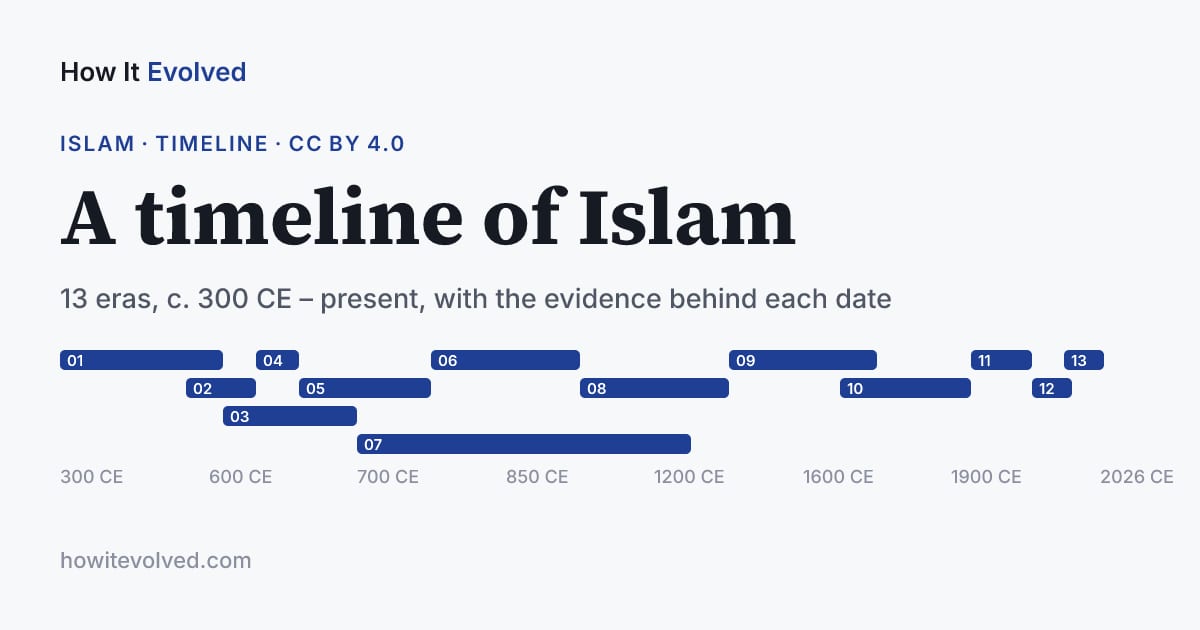
Islam's history in 13 eras, from the Arabia of Ḥimyar and the two empires to the two billion Muslims of today. Each era is one chapter of the series, shown with its date range, its key takeaways and the 39 dated firsts it argues, from the first dated Arabic papyrus and the first coin to name Muhammad to the four schools of law, the abolition of the caliphate and the Amman Message. Every date is the first datable attestation in the surviving record, and each era links to the chapter that cites the evidence.
Free to embed or reuse under CC BY 4.0. Get the embed code
The whole span
Time axis compressed: each labelled interval gets equal width
Bars overlap where periods do: §3 follows the Qur'an from the first revelation to the settled text around 700, alongside §2, §4 and §5, and §7 traces Sufism across six centuries beside §6 and §8. That overlap is the actual history, not a rendering artefact.
Era by era
-
c. 300 – 610 CE Chapter 1 Majority view
Late Antique Arabia
Empires, kings, gods and monotheists: the world in which Islam began
Ḥimyar (Yemen), the Ḥijāz, and the Roman and Persian frontiers in Syria and Iraq
- Arabia before Islam was not isolated. Rome and Persia fought over its edges through Arab allies, the Ghassanids and the Lakhmids, and their last great war, from 602 to 628, exhausted both empires in Muhammad's lifetime.
- From about 380 the kings of Ḥimyar in Yemen gave up the old gods for one god, later called Raḥmānān, 'the Merciful', in a monotheism close to Judaism; around 523 a Jewish king killed the Christians of Najrān, and Christian Aksum conquered Ḥimyar soon after.
- The Christian ruler Abraha left inscriptions in the 540s and 550s invoking 'Raḥmānān and his Messiah' and recording raids deep into Arabia. Muslim tradition links his failed march on Mecca to the 'Year of the Elephant' and the birth of Muhammad; the dates do not fit easily.
- The goddesses al-Lāt, al-ʿUzzā and Manāt are attested in inscriptions centuries before Islam, but most of what is said about the gods of Mecca comes from Ibn al-Kalbī's Book of Idols, written about two hundred years after Muhammad.
- Arabic was written in Nabataean letters by 267 CE, and the script that became the Arabic alphabet appears in Christian inscriptions in Syria in 512, 528 and 568. Mecca itself is not securely named in any surviving source before Islam.
-
c. 570 – 632 CE Chapter 2 Majority view
Muhammad
From Mecca to Medina: what the Qur'an, the documents and the biographies can and cannot tell us about the prophet
Mecca and Medina (Yathrib), western Arabia
- 622–627 A community of believers bound by pact. Pacts organising Medina's clans, Muhammad's followers and its Jews into one community (umma); most scholars accept the document as early. The "Constitution of Medina", preserved in the sīra
- That Muhammad existed, preached in Mecca, led a community in Medina from 622, took Mecca in 630 and died in 632 is accepted by almost all historians. Christian writers name him by about 640, and the outline is confirmed by the Qur'an and the earliest documents.
- Nearly everything else, from his birth in the 'Year of the Elephant' to the order of his campaigns and the words of his speeches, comes from biographies written a century and more after his death; historians weigh those reports one by one.
- The 'Constitution of Medina', a set of pacts between Muhammad, the emigrants, the Medinan Arabs and their Jewish allies, is accepted by most scholars as an early document, the solidest piece of evidence for the Medinan community.
- The biographies report that two Jewish tribes of Medina were expelled and the men of a third, the Qurayẓa, executed in 627. The outline is widely accepted; the numbers and details come only from sources written over a century later and are debated.
- The report that ʿĀʾisha was six at marriage and nine at its consummation is in al-Bukhārī and Muslim and was accepted by classical scholars. Its chains run mostly through Hishām ibn ʿUrwa, who taught in Iraq in the 750s; whether it records her real age is now argued from the transmission evidence.
-
c. 610 – 700 CE Chapter 3 Majority view
The Qur'an
From recitation to book: the collection, the oldest manuscripts, the readings, and the text's late-antique world
Mecca and Medina; then Damascus, Kufa, Basra, Fusṭāṭ and Ṣanʿāʾ
- 643 Arabic written with dots to tell letters apart. The oldest dated Arabic papyrus already uses the dots that early Qur'an copies use only sparingly. PERF 558
- c. 650 (r. 644–656) A standard written Qur'an. Tradition credits ʿUthmān with a standard codex; one written archetype behind the early copies supports a date around his reign. Collection reports in al-Bukhārī; the shared spelling of early manuscripts
- before 936 Seven canonical readings of the Qur'an. Seven readers chosen as authoritative; others became "irregular". Ibn Mujāhid, Kitāb al-Sabʿa
- 1924 A printed standard Qur'an. The reading of Ḥafṣ ʿan ʿĀṣim becomes the world standard. The Cairo edition
- The Qur'an began as recitation: its own verses speak of being recited and memorized, and Muslim tradition says no single written copy of the whole existed when Muhammad died in 632.
- Tradition credits a first collection to Abū Bakr (c. 633) and a standard text to the caliph ʿUthmān (c. 650), who sent copies to the provinces and had other copies burned; companions such as Ibn Masʿūd and Ubayy ibn Kaʿb kept codices that differed in wording and in the order of the suras.
- The oldest manuscripts are radiocarbon-dated to the seventh century: the Birmingham leaves to 568–645, a Ṣanʿāʾ leaf to 578–669, the Tübingen fragment to 649–675. Shared spelling quirks across early copies point to a single written archetype, which most scholars place under ʿUthmān.
- Early copies wrote only the consonantal skeleton, without vowels and with few dots, so one written text allowed several recitations; Ibn Mujāhid (d. 936) canonized seven readings, and the Cairo edition of 1924 made one of them, Ḥafṣ ʿan ʿĀṣim, the world's most printed text.
- The Qur'an speaks to listeners who knew biblical and Christian stories, such as Mary, the Sleepers of the Cave and Alexander, and retells them in its own argument; how it came to know them, and how far its text was still growing after 650, are the field's live debates.
-
c. 632 – 661 CE Chapter 4 Majority view
The Conquests and the First Caliphs
Twenty years of conquest, a new ruling class, and the civil war that divided the community
Arabia, Syria and Palestine, Iraq, Egypt and Iran; Medina, then Kufa and Damascus
- Within twenty years of Muhammad's death in 632, Arab armies took Syria, Palestine, Iraq, Egypt and most of Iran from two empires that had just fought each other to exhaustion in the war of 602–628.
- The conquests are confirmed by contemporaries: a Christian sermon of December 634 says the Saracens blocked the road to Bethlehem, and a Coptic bishop writing c. 690 describes the surrender of Egypt and the taxes that followed.
- Conquest was not conversion. The conquered stayed mostly Christian, Jewish and Zoroastrian, paying tax as protected subjects; Muslim majorities came over the following three centuries or more, by a pace historians still dispute.
- Of the first four caliphs, three were killed: ʿUmar by a Persian slave in 644, ʿUthmān by Muslim rebels in 656, and ʿAlī by a Khārijite in 661. The civil war of 656–661 left the parties that later became Sunni, Shia and Khārijite.
- Early documents call the ruler 'commander of the believers'. What the title 'caliph' meant, successor of God's messenger or God's own deputy, was itself part of the struggle over authority.
-
c. 661 – 750 CE Chapter 5 Majority view
The Umayyads
An Islamic state: Damascus, Karbalāʾ, the Dome of the Rock, the coins, and the empire from Spain to Sindh
Syria, Iraq and the Ḥijāz; Egypt, Iran and Central Asia; North Africa and Spain; Sindh
- 662–663; 677–678 Leaders called "commander of the believers". The caliph's title in public inscriptions, a generation after the conquests; neither names Muhammad. Hammat Gader and Ṭāʾif dam inscriptions of Muʿāwiya
- 691–692 "Islām" proclaimed on a public monument. Qur'anic verses in public, including "the religion with God is islām" and a rejection of the Trinity. Dome of the Rock inscriptions
- 693–697 (74–77 AH) The caliph as "God's deputy" on coins. Coins with the caliph's standing figure and the title khalīfat Allāh, before the aniconic reform. "Standing caliph" gold coins
- 696–697 (77 AH) Coins without images. Figures removed; the creed and Qur'anic verses fill both faces. ʿAbd al-Malik's reformed dinar
- c. 697–700 Arabic as the language of government. Arabic replaces Persian and Greek in the administration. Umayyad registers of Iraq and Syria
- Muʿāwiya made Damascus the capital in 661 and named his son Yazīd as heir, turning the caliphate into a dynasty; a Greek inscription of 662–663 already calls him 'the servant of God, commander of the believers'.
- At Karbalāʾ in October 680 Umayyad troops killed Muhammad's grandson al-Ḥusayn and most of his small company. The penitents and al-Mukhtār's revolt that followed were the first movements of the Shia, the 'party' of ʿAlī's family.
- ʿAbd al-Malik (685–705) won the second civil war and gave the state an Islamic face: the Dome of the Rock in Jerusalem (691–692), coins proclaiming Muhammad, then coins with no images at all (696–697), and Arabic as the language of government.
- Why he built the Dome is debated. A ninth-century report that he meant it to replace the pilgrimage to Mecca, held by his rival Ibn al-Zubayr, is doubted by most historians; its inscriptions are clearly addressed to Christians about Jesus.
- Conquest was not conversion: most subjects stayed Christian, Jewish or Zoroastrian, and Arab rule over non-Arab converts, the mawālī, became a grievance that helped the Abbasids overthrow the dynasty in 750.
-
c. 750 – 1000 CE Chapter 6 Majority view
The Abbasids: Law, Hadith and Theology
Baghdad, the schools of law, the hadith canon, the created Qur'an, and how Sunni and Shia became separate communities
Iraq (Baghdad, Kufa, Basra, Samarra), Iran and Khurāsān, Egypt, North Africa and Arabia
- before 820 Hadith of the Prophet as the second source of law. Al-Shāfiʿī's theory makes reports from the Prophet, beside the Qur'an, binding in law. al-Shāfiʿī, Risāla
- 833–c. 848 The created Qur'an as state doctrine. Judges and scholars had to affirm that the Qur'an was created; Ibn Ḥanbal refused. The miḥna of al-Maʾmūn and his successors
- c. 846 A collection of only "sound" hadith. Later revered by Sunnis as the most authoritative book after the Qur'an. al-Bukhārī, al-Ṣaḥīḥ
- 874; complete occultation 941 The hidden twelfth imam. The eleventh imam dies and his son's occultation begins; after 941 no agent speaks for him. Twelver tradition
- c. 900–950 Organized schools of law. The Ḥanafī, Mālikī, Shāfiʿī and Ḥanbalī traditions become self-reproducing schools. Biographical and legal literature
- 963 Public mourning for al-Ḥusayn on ʿĀshūrāʾ. The first public ʿĀshūrāʾ mourning in Baghdad, under a Shia dynasty. Reports from Buyid Baghdad
- The Abbasids took the caliphate in 750 and founded Baghdad in 762, but by the mid-tenth century real power had passed to provincial dynasties, and in 945 a Shia dynasty, the Buyids, ruled Baghdad in the caliph's name.
- Islamic law was built by scholars, not issued by caliphs. The schools named after Abū Ḥanīfa, Mālik, al-Shāfiʿī and Ibn Ḥanbal, all of whom died between 767 and 855, became organized schools only around 900–950.
- The hadith collections of al-Bukhārī and Muslim were compiled in the ninth century and recognized as Sunni Islam's most authoritative books after the Qur'an over the tenth and eleventh; the 'six books' were first grouped about 1100.
- From 833 to the late 840s the caliphs required scholars to affirm that the Qur'an was created. Aḥmad ibn Ḥanbal's refusal, and the policy's collapse, left doctrine to the scholars rather than the caliph.
- Sunni and Shia became separate communities in this period: the Twelver line of imams ended in the occultation of the twelfth imam (874; complete in 941), Ismāʿīlīs founded the Fatimid caliphate (909–910), and in 963 Baghdad saw the first public Shia mourning for Karbalāʾ.
-
c. 700 – 1300 CE Chapter 7 Majority view
The Mystics: Sufism
From the renunciants of Basra to the Sufi orders: Rābiʿa, Junayd, al-Ḥallāj, al-Ghazālī, Rūmī and Ibn ʿArabī
Iraq (Basra, Baghdad), Khurāsān and Central Asia, Anatolia, Syria, Egypt, North Africa, al-Andalus and northern India
- 9th c. "Ṣūfī" as the name of a circle. The word names a recognizable group in ninth-century Baghdad. Baghdad's mystics
- 1045–1046 A Sufi handbook for Sunni readers. The most widely read Sufi manual, arguing the path fits Sunni law and theology. al-Qushayrī, Risāla
- 12th–13th c. Sufi orders with founders and chains of masters. Organized orders take shape around named masters, lodges and initiation. Qādiriyya, Suhrawardiyya, Chishtiyya, Shādhiliyya, Mevleviyya
- Sufism grew out of the renunciants (zuhhād) of eighth-century Iraq, such as al-Ḥasan al-Baṣrī (d. 728); the word ṣūfī, most likely from ṣūf, 'wool', named a recognisable group in Baghdad only in the ninth century.
- Rābiʿa of Basra (d. c. 801) is real but thinly documented: no writing can be securely tied to her, and the famous stories and prayers about her pure love of God come mostly from sources written centuries later.
- Al-Ḥallāj was executed in Baghdad in March 922 after years in prison. His saying 'I am the Real' (anā l-ḥaqq) became the emblem of ecstatic mysticism, but historians see politics at court as at least as decisive as doctrine.
- From the late tenth century Sufis wrote manuals arguing that their path fitted Sunni law and theology; al-Ghazālī (d. 1111), after a crisis in 1095 that left him unable to teach, made that case the most influential.
- Organized orders (ṭarīqas) with founders, lodges, rules and chains of masters took shape in the twelfth and thirteenth centuries (the Qādiriyya, Suhrawardiyya, Chishtiyya, Kubrawiyya, Shādhiliyya and Rūmī's Mevleviyya), often named after a master who had not founded an institution himself.
-
c. 1000 – 1400 CE Chapter 8 Majority view
Turks, Crusaders and Mongols
Seljuk sultans and the madrasa, the Crusades from the Muslim side, the Mongol conquest, Ibn Taymiyya, and Islam's new frontiers
Iraq, Iran, Syria, Egypt and Anatolia; al-Andalus and North Africa; north India; West Africa; Sumatra and the Malay coast
- 1065–1067 The state-endowed madrasa. Niẓām al-Mulk's college, endowed for Shāfiʿī law and Ashʿarī theology. The Niẓāmiyya of Baghdad
- 1105 Preaching jihad against the Crusaders. Preached in Damascus six years after the fall of Jerusalem. al-Sulamī, Book of Jihad
- 1261 A caliph without power, in Cairo. After Baghdad's fall, an Abbasid is proclaimed caliph under Mamluk protection. The Mamluk court
- From 1055 Turkish sultans ruled in Baghdad beside the Abbasid caliph, who kept his title and lost his power. Their viziers founded madrasas, endowed colleges of law, the most famous of them the Niẓāmiyya of Baghdad (1065–67).
- Muslim writers called the crusaders 'Franks' and had no word for 'crusade'. The response was slow at first; holy war against the Franks was preached from 1105, organised under Zengi and Nūr al-Dīn, and won Jerusalem back for Saladin in 1187. The last Frankish city on the mainland, Acre, fell to the Mamluks in 1291.
- The Mongols sacked Baghdad in February 1258 and executed the last caliph there; the Abbasid line survived only as figureheads in Mamluk Cairo. Within forty years the Mongol rulers of Iran had themselves become Muslim (Ghazan, 1295).
- Ibn Taymiyya (1263–1328) declared the converted Mongols unbelievers and attacked pilgrimage to graves; he died in prison and had little influence on mainstream Sunni Islam until the nineteenth century.
- In these centuries Islam became a religion of India, West Africa and Southeast Asia: the Delhi Sultanate from 1206, Mansa Mūsā of Mali's pilgrimage in 1324, and Muslim rulers' gravestones on Sumatra from 1297.
-
c. 1400 – 1800 CE Chapter 9 Majority view
The Great Empires: Ottomans, Safavids, Mughals
Ottoman law and the caliphate claim, Iran made Shia, Akbar and Aurangzeb, and Islam's spread across Southeast Asia
Anatolia and the Balkans, the Arab lands, Iran, North India and the Deccan, the Malay world and Java
- 1501 Twelver Shiism as a state religion. The Safavids make Iran Shia within about a century. Shah Ismāʿīl's proclamation in Tabriz
- c. 1582 Akbar's Dīn-i Ilāhī. A circle of discipleship around the emperor; whether it was a religion is debated. Mughal court sources
- 1774 The Ottoman sultan recognised as caliph by treaty. Russia recognises the sultan's religious authority over the Crimean Tatars as caliph. Treaty of Küçük Kaynarca
- Between 1450 and 1600 three dynasties, the Ottomans, the Safavids and the Mughals, came to rule most of the Muslim world from the Balkans to Bengal, and each built a different relationship between the ruler, the scholars and the law.
- The Ottomans made the Ḥanafī school an arm of the state, with a hierarchy of salaried scholars under the şeyhülislam. Their claim to the caliphate grew mostly later: the story that the last Abbasid caliph handed it to Selim I in 1517 is first recorded in the late eighteenth century.
- Shah Ismāʿīl declared Twelver Shiism the religion of his new state in 1501, in a country that was then mostly Sunni. With scholars brought from Arab lands, the Safavids made Iran Shia within about a century.
- Akbar abolished the jizya in 1564 and promoted 'universal peace'; his Dīn-i Ilāhī of 1582 had about nineteen known adherents. Aurangzeb reimposed the jizya in 1679, and how to read his reign is one of the most contested questions in South Asian history.
- Islam spread across Southeast Asia mostly through trade, port courts and Sufi teachers, from a sultan's gravestone of 1297 in Sumatra to the conversion of Javanese courts in the fifteenth and sixteenth centuries; Indonesia is now home to more Muslims than any other country.
-
c. 1700 – 1920 CE Chapter 10 Majority view
Reform, Revival and Empire
Ibn ʿAbd al-Wahhāb and the Saudis, the West African jihads, India after 1857, the Egyptian reformers, the Tanzimat, and the new movements of the nineteenth century
Arabia (Najd, the Ḥijāz), Ottoman Iraq, Syria and Istanbul, Egypt, India, West Africa, Libya and Iran
- 1744 A pact of preacher and prince. Ibn ʿAbd al-Wahhāb and Muḥammad ibn Saʿūd join religious reform to a state. Pact of Dirʿiyya
- 1839 Guarantees for all subjects, of whatever religion. Gülhane promises every subject security of life, honour and property; the edict of 1856 promises non-Muslims legal equality. Edict of Gülhane
- 1844 A messiah after Muhammad: the Bāb. The beginning of the Bābī movement, from which the Bahāʾī faith grew. The Bāb's announcement in Shiraz
- 1869–1876 Islamic law written as a civil code. Ḥanafī civil law codified in articles. The Ottoman Mecelle
- 1889 The Ahmadiyya. A movement whose Muslim status other Muslims came to dispute. Mirza Ghulam Ahmad's first oath of allegiance, Ludhiana
- 20th c. "Salafiyya" as a movement's name. The label for ʿAbduh and al-Afghānī is largely a later construction. History of the term (Lauzière)
- In 1744 the Najdi scholar Muḥammad ibn ʿAbd al-Wahhāb and the ruler of Dirʿiyya, Muḥammad ibn Saʿūd, made a pact: the scholar would lead in religion, the ruler in war and politics. Their first state took Mecca in 1803 and was destroyed by an Ottoman–Egyptian army in 1818.
- 'Wahhabi' is an outsiders' label: the movement called itself al-muwaḥḥidūn, those who affirm God's oneness, and many adherents today prefer 'Salafi'. Who is entitled to name it is part of the modern argument.
- Reform movements arose across the Muslim world in the same century, without a single centre: Shāh Walī Allāh in Delhi, the jihad of Usman dan Fodio that founded the Sokoto caliphate in West Africa (1804), and the Sanūsī order in Libya.
- Colonial rule produced rival answers in India after 1857: the seminary at Deoband (1866), the Anglo-Oriental College at Aligarh (1875) and the Barelwī defence of devotion to the Prophet and the saints. In Egypt, Muḥammad ʿAbduh argued that reason and revelation could not conflict.
- The century also produced movements that most Muslims came to regard as outside Islam: the Bābīs (1844), from whom the Bahāʾī faith emerged, and the Ahmadiyya (1889), whose founder's claims touch the doctrine that Muhammad is the last prophet.
-
c. 1920 – 1979 CE Chapter 11 Majority view
The Twentieth Century
The end of the caliphate, new states and their religions, the birth of Islamism, Pakistan, the Nation of Islam, and the veil
Turkey, Egypt, Arabia, Iran, British India and Pakistan, the United States
- 3 March 1924 No caliph at all. The Ottoman caliphate abolished. Turkey's Law No. 431
- 1925 Islam without a caliphate. An al-Azhar scholar argues Islam requires no caliphate; he is stripped of his rank. ʿAlī ʿAbd al-Rāziq, Islam and the Foundations of Governance
- 1928 Islamism: a movement for an Islamic state. Followed by Mawdūdī's Jamāʿat-i Islāmī (1941) and Quṭb's Milestones (1964). Ḥasan al-Bannā's Muslim Brotherhood
- 7 September 1974 A state defines who is a Muslim. A parliament declares the Ahmadiyya non-Muslim. Pakistan's Second Amendment
- On 3 March 1924 the Turkish Grand National Assembly abolished the caliphate, an office claimed by Ottoman sultans and held in some form since 632. Attempts to revive it, by Sharif Hussein of Mecca in 1924 and at congresses in Cairo (1926) and Jerusalem (1931), failed.
- New states took over religion. Atatürk's Turkey closed the Sufi lodges, replaced Islamic law with a Swiss-based civil code and put mosques under a state directorate; Reza Shah's Iran banned the veil in 1936; Ibn Saud's Saudi Arabia, proclaimed in 1932, made a Wahhabi reading of Islam the creed of a state that struck oil in 1938.
- Islamism, the movement for a state governed by Islamic law, was born in these decades: the Muslim Brotherhood in Egypt (1928), Mawdūdī's Jamāʿat-i Islāmī in India (1941) and Sayyid Quṭb's Milestones (1964), which declared every existing society, including those calling themselves Muslim, to be in a state of jāhiliyya, pagan ignorance.
- Pakistan was founded in 1947 as a homeland for India's Muslims; whether it was meant to be an Islamic state is still argued. Its 1949 Objectives Resolution declared sovereignty to belong to God, and its 1974 constitutional amendment declared the Ahmadiyya non-Muslim.
- In the United States the Nation of Islam (1930) taught doctrines far from Sunni Islam. Malcolm X left it for Sunni Islam in 1964, and after 1975 most of its members followed W. D. Mohammed into Sunni practice.
-
c. 1979 – 2001 CE Chapter 12 Majority view
Revolution and Revival
Iran's clerical state, the siege of Mecca, the Afghan jihad, Saudi Salafism, the Rushdie affair and al-Qaeda, 1979–2001
Iran, Saudi Arabia, Afghanistan and Pakistan; Algeria, Lebanon and Palestine; Britain
- 1970 lectures; 1979 constitution Rule by the jurist. A Shia clerical state, new in Shia history. Khomeini's lectures in Najaf; Iran's constitution
- 1992 Women reading the Qur'an for equality. A reading of the Qur'an's verses on gender from the text, not later law. Amina Wadud, Qur'an and Woman
- The Iranian revolution of 1979 created something new in Shia history: a state ruled by a senior jurist. Khomeini set out the idea in lectures at Najaf in 1970, and the constitution approved in December 1979 wrote it into law; most of the senior ayatollahs of the day did not accept it.
- In the same year a Saudi preacher's followers seized the Grand Mosque of Mecca for two weeks, proclaiming a Mahdi; the Soviet Union invaded Afghanistan; and Pakistan's military ruler introduced Qur'anic punishments into criminal law.
- Saudi money built mosques, schools and universities abroad from the 1960s, and much more after the oil boom of the 1970s. The headline figures for its spending are large and poorly sourced; that it spread a Salafi reading of Islam is not in doubt.
- Salafis share a creed but divide over method: Quintan Wiktorowicz's typology separates purists who avoid politics, politicos who engage in it, and jihadis who take up arms. Most Salafis have been in the first group.
- Khomeini's call of 14 February 1989 to kill Salman Rushdie had no precedent as a ruling issued across borders by a head of state, and was criticised by Sunni scholars on legal grounds. Al-Qaeda, founded in Peshawar in 1988, declared in 1998 that killing Americans was every Muslim's individual duty; Muslim religious authorities overwhelmingly rejected that claim.
-
c. 2001 – 2026 CE Chapter 13 Majority view
Islam Today
How many Muslims there are, where they live, and the movements, laws and arguments that have shaped Islam since 2001
Worldwide, with most Muslims in Asia and Africa
- 2004–2005 Mutual recognition of the schools. Eight schools of law recognised as Muslim, and declaring their followers apostates forbidden. The Amman Message
- 2014 Scholars answer a self-declared caliph. More than 120 scholars reject the "Islamic State" on classical grounds. Open Letter to al-Baghdadi
- The Pew Research Center counted about 2 billion Muslims in 2020, 25.6 per cent of the world, the fastest-growing major religious group of the decade, mainly because Muslims are younger and have more children on average.
- Most Muslims live in Asia: Indonesia, Pakistan, India and Bangladesh have the largest populations. Shia Muslims are about 10–13 per cent of the total (Pew, 2009).
- The 'Islamic State' declared a caliphate on 29 June 2014 and lost its last territory in March 2019; a public letter of September 2014 signed by more than 120 Muslim scholars rejected its caliphate, its killings and its revival of slavery point by point.
- Some states now define who counts as a Muslim: Pakistan declared Ahmadis non-Muslim in 1974 and made it a crime for them to call themselves Muslims in 1984; France banned conspicuous religious symbols in state schools in 2004 and face coverings in public in 2010.
- Against the institutions of the first centuries, much has changed: authority is spread among states, movements, scholars and the internet. The Qur'an's text, the five pillars, the schools of law and the Sunni–Shia division have not.
How to read the dates
Era boundaries are the chapters' own ranges, and they are approximate; several overlap because the changes did. A date beside an idea is its first datable appearance, which is not the same as the date it began: the biographies of Muhammad and the hadith collections were written down a century or more after the events they report. The confidence tag on each era says how settled its evidence is. The dating methods are set out in How we know.
Embed or reuse this timeline
Teachers, students, writers and site owners may copy, adapt and republish this timeline, including commercially, under the Creative Commons Attribution 4.0 licence. The only condition is credit: name How It Evolved (howitevolved.com) and link back to this page. Photographs elsewhere on the site keep their own licences.
Embed code
<iframe src="https://howitevolved.com/embed/islam-timeline/" title="Timeline of Islam, c. 300 CE to the present" width="100%" height="720" style="border:1px solid #dce1e8;border-radius:8px;max-width:760px" loading="lazy"></iframe>
<p style="font-size:13px">Timeline: <a href="https://howitevolved.com/islam/timeline/">A timeline of Islam</a> by <a href="https://howitevolved.com/">How It Evolved</a>, licensed <a href="https://creativecommons.org/licenses/by/4.0/">CC BY 4.0</a>.</p>The embedded version is a plain page with no ads and no tracking, and it updates when the chapters do. Preview it.
All five traditions
How religions evolved, on one chart: this series beside the other four, as a family tree with every dated first and branch, free to print.
Image version
1200 × 630 JPEG. Credit: How It Evolved (howitevolved.com), CC BY 4.0.