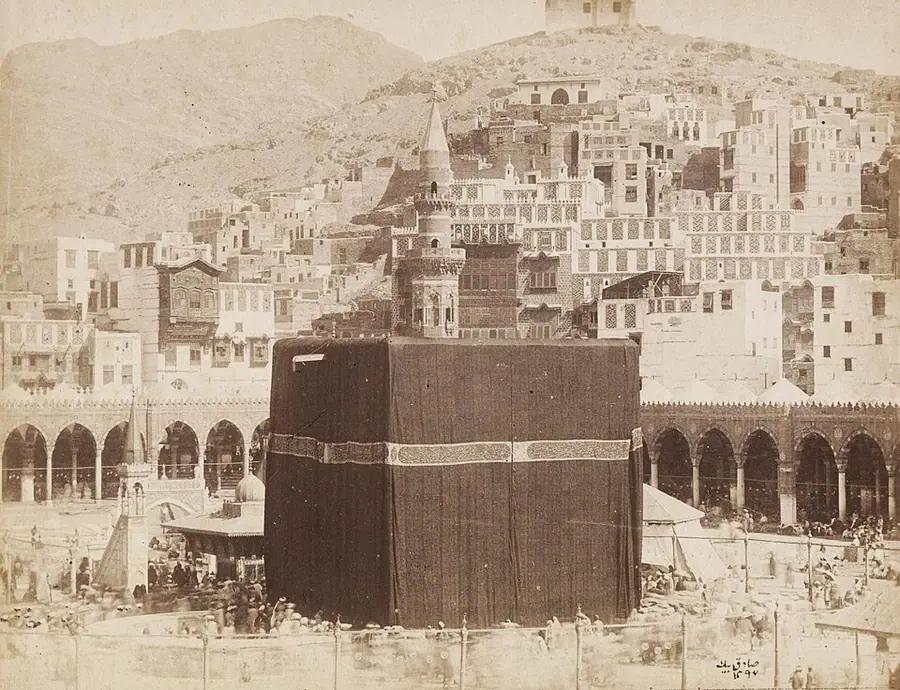
Muhammad ibn ʿAbd Allāh was born in Mecca, a sanctuary town of western Arabia, into the clan of Hāshim of the tribe of Quraysh, probably in the third quarter of the sixth century. He was orphaned young, married a widowed merchant, Khadīja, and from about 610 began to recite words he understood as revelation from the one God, calling his townspeople to abandon their gods and prepare for judgment. Opposition in Mecca drove him and his followers in 622 to the oasis of Yathrib, later Medina, where he became leader of a community bound by written pacts. Over eight years of war with Mecca, and conflict with Medina’s Jewish tribes, his following grew until he took Mecca in 630 and received the allegiance of much of Arabia. He died in Medina in 632. That outline is accepted by almost all historians. Nearly everything inside it, the dates, the speeches, the stories of each battle and each marriage, comes from biographies written a century and more after his death, and is weighed report by report. Majority
This chapter separates the layers. The Qur’an, a text of his lifetime or very near it (§3), shows his message and his opponents but almost no narrative. The documents and outside witnesses of §0 confirm the outline. The sīra, the biography tradition that begins with ʿUrwa ibn al-Zubayr (d. c. 712) and Ibn Isḥāq (d. 767), supplies the story. Each claim below says which layer it rests on. Whether Muhammad received revelation is outside what historical method can test (§0).
Timeline
| Date | Event | Main evidence | Confidence |
|---|---|---|---|
| c. 552 | Abraha, ruler of Ḥimyar, campaigns in central Arabia (inscription Ry 506)[1] | South Arabian inscription | Consensus (inscription) |
| c. 570 (tradition) | Birth in Mecca in the “Year of the Elephant”[2][1] | Sīra | Contested (date) |
| c. 595 (tradition) | Marriage to Khadīja[2] | Sīra | Majority |
| c. 610 (tradition) | First revelation, at about forty[2][3] | Sīra; Qur’an | Majority (that preaching began in Mecca); Contested (date) |
| c. 613–619 | Public preaching; opposition from Quraysh; emigration of some followers to Ethiopia[2] | Qur’an; sīra | Majority |
| c. 619 | Deaths of Khadīja and of his uncle and protector Abū Ṭālib[2][4] | Sīra; hadith | Majority |
| 622 | The hijra to Yathrib (Medina); later year 1 of the Muslim era[5] | Sīra; Hijri dating from 643 | Consensus |
| 622–627 | Pacts later called the “Constitution of Medina”[6][7] | Document preserved in the sīra | Majority |
| 624 | Battle of Badr; expulsion of the Qaynuqāʿ[8][2] | Qur’an names Badr; sīra | Consensus (Badr); Majority (date) |
| 625 | Battle of Uḥud; expulsion of the Naḍīr[2][9] | Sīra; Qur’an alludes | Majority |
| 627 | Siege of Medina (“the Trench”); fate of the Qurayẓa[10][2] | Qur’an alludes; sīra | Majority (events); Contested (numbers) |
| 628 | Treaty of al-Ḥudaybiyya with Mecca; conquest of Khaybar[11][2] | Sīra; Qur’an alludes | Majority |
| 630 | Conquest of Mecca[2] | Sīra | Majority |
| 632 | Death in Medina[2][12] | Sīra; hadith | Majority (year); Contested (Shoemaker) |
| c. 640 | Thomas the Presbyter names “the Arabs of Muhammad”[13] | Syriac chronicle | Consensus |
| 685–686 | First dated Muslim document to name him, a coin of Bīshāpūr[14] | Coin | Consensus |
What can be known, and from what
The outline, and why historians accept it
Four independent kinds of evidence converge on the outline of Muhammad’s career.[15][16]
- Outside witnesses. A Syriac chronicle by Thomas the Presbyter, written about 640, records a battle near Gaza in February 634 fought by “the Arabs of Muhammad”.[13] The Armenian history attributed to Sebeos, finished in the 660s, describes him as a merchant of the sons of Ishmael who taught the Arabs the God of Abraham.[17] Neither writer was a Muslim or depended on Muslim books (§0). Consensus
- The Qur’an. It names Muhammad four times (3:144, 33:40, 47:2, 48:29), calls him “God’s Messenger and the seal of the prophets”, and addresses a prophet in conflict with his own people, then leading believers in war.[18][19] Consensus on what the text says.
- Documents. The Hijri era is in use on an Egyptian papyrus of 643, twenty-one years after the emigration it counts from, and a coin of 685–686 proclaims “Muhammad is the messenger of God”.[5][14] Consensus
- The Muslim tradition itself, unanimous on the outline across rival schools, sects and regions, from the earliest reports onward.[20] Majority
Did Muhammad exist?
The question is asked often online and almost never by specialists. A few writers, among them some associated with the Inārah research group in Germany, have argued that muḥammad (“praised”) began as an epithet, perhaps of Jesus, and was later read as a name. The idea has found almost no support among specialists. The Syriac text of about 640 that names “the Arabs of Muhammad” as a living leader’s followers, the Armenian account of the 660s, and the tradition’s unanimous memory are hard to explain without a historical person, and easy to explain with one.[21][16] The historian Joshua Little, reviewing the evidence in 2025, concluded that “there can be no reasonable doubt that the founding prophet of Islam existed in history”.[21] Consensus
The biographies, and their distance
The full story of Muhammad’s life comes from the sīra. Its earliest surviving full form is Ibn Isḥāq’s biography, written in the 750s or 760s and known mainly through the edition of Ibn Hishām (d. 833); al-Wāqidī (d. 823), Ibn Saʿd (d. 845) and al-Ṭabarī (d. 923) add more.[2][22][23] Behind them lie collectors of the previous generation, above all ʿUrwa ibn al-Zubayr, whose accounts Andreas Görke and Gregor Schoeler have traced from later quotations.[24][20] Majority that a core of reports reaches the late seventh century.
The tradition’s narrative is coherent and vivid, and much of it may be accurate. But it was told by people who knew the outcome, who needed stories to explain Qur’anic verses and to ground law, and whose families, factions and sects had stakes in who did what. Patricia Crone, the most influential sceptic, nonetheless singled out one document preserved in it, the Constitution of Medina (below), as unusually solid evidence.[25] Michael Cook’s short life of Muhammad (1983) put the problem plainly: the sources are abundant, but the further one moves from the outline, the less securely they can be checked.[26] Majority
Mecca and the early life
Quraysh and the House
The Qur’an addresses a people it calls Quraysh by name once, in a short sura that ties their prosperity to the sanctuary:
li-īlāfi quraysh; īlāfihim riḥlata l-shitāʾi wa-l-ṣayf; fa-l-yaʿbudū rabba hādhā l-bayt; alladhī aṭʿamahum min jūʿin wa-āmanahum min khawf
“[He did this] to make the Quraysh feel secure, secure in their winter and summer journeys. So let them worship the Lord of this House: who provides them with food to ward off hunger, safety to ward off fear.” (Q 106, trans. Abdel Haleem)[27][28]
The House is the Kaʿba; the journeys are, in the tradition, trading caravans. How large Mecca’s trade was is debated: Patricia Crone argued in 1987 that the picture of a great international entrepôt is not supported by outside evidence, and others have replied that local and regional trade, and the sanctuary’s pilgrimage fairs, were enough to make Quraysh prosperous (§1).[29] Contested Translations of the Qur’an in this chapter are Abdel Haleem’s (2004).
Birth, the Elephant and round numbers
The tradition places Muhammad’s birth in the “Year of the Elephant”, when an army from South Arabia with an elephant marched on Mecca and was miraculously turned back, the event alluded to in sura 105 (“Do you not see how your Lord dealt with the army of the elephant?”).[30] Later scholars equated that year with about 570. Majority as the tradition’s date.
Lawrence Conrad showed in 1987 that the date is less secure than it looks. The early reports disagree about how many years separated the Elephant from the birth, from none to several decades; South Arabian inscriptions show the king Abraha campaigning in central Arabia around 552, and he seems to have died by about 570; and the tradition’s ages for Muhammad (forty at his call, sixty-three at his death) fit literary patterns for prophets and sages as much as calendars.[1] Majority that the traditional chronology before 622 is approximate. Most historians give his birth as “about 570” or a range in the third quarter of the sixth century. Majority
Orphan, merchant, husband
The tradition says his father, ʿAbd Allāh, died before he was born and his mother, Āmina, when he was six; he was raised by his grandfather ʿAbd al-Muṭṭalib and then by his uncle Abū Ṭālib, chief of the clan of Hāshim.[2] A Qur’anic passage addressed to the prophet agrees with the outline: “Did He not find you an orphan and shelter you? Did He not find you lost and guide you? Did He not find you in need and make you self-sufficient?” (Q 93:6–8).[31] Majority
As a young man he worked in the caravan trade, and at about twenty-five, the tradition says, he married Khadīja bint Khuwaylid, a widowed merchant who had employed him and who was some years older; she is said to have been forty, though some reports make her younger.[2][22] She bore him his children who lived to adulthood, among them Fāṭima, and he took no other wife while she lived. Majority on the outline; Contested on the ages.
The Meccan preaching
The call
The tradition says that at about forty, while in retreat in a cave on Mount Ḥirāʾ above Mecca, he was seized by the angel Gabriel and commanded “Read!” or “Recite!”, the opening of sura 96; that he returned shaken to Khadīja, who comforted him and became the first believer; and that a second early revelation, “You, wrapped in your cloak, arise and give warning!” (Q 74:1–2), sent him to preach.[2][3][32] That these were the first revelations is the tradition’s account, not something the text says (§3). Majority as tradition.
The message, as the Qur’an gives it
What the early, short suras say is clearer than when they were first recited. They call on their hearers to recognise one God, creator and sustainer, in the signs of nature; to prepare for a day of judgment when the dead will be raised and deeds weighed; to care for orphans and the poor instead of hoarding wealth; and to see in the punished peoples of the past, ʿĀd, Thamūd, the people of Noah and of Lot, a warning.[33][34] Consensus on the themes. The opponents the text answers deny resurrection, demand a sign or an angel, and ask “What sort of messenger is this? He eats food and walks about in the marketplaces!” (Q 25:7).[35] Consensus
The Qur’an’s titles for Muhammad belong to this argument: rasūl Allāh, “the messenger of God”; al-nabī, “the prophet”; nadhīr and bashīr, “warner” and “bearer of good news”; khātam al-nabiyyīn, “the seal of the prophets” (33:40); and al-nabī al-ummī (7:157), “the unlettered prophet” in Abdel Haleem’s translation, though some scholars read ummī as “of the gentiles”, a prophet to a people without scripture.[18][36][33] Contested on ummī. One verse has Jesus foretell a messenger “whose name will be Aḥmad” (61:6), a form of the same root as Muhammad.[37] Consensus on the text.
Opposition and emigration to Ethiopia
The tradition describes years of mounting hostility from the leaders of Quraysh, whose gods and pilgrimage trade the preaching threatened: ridicule, pressure on converts of low status, a boycott of Muhammad’s clan, and the emigration of a group of his followers to the Christian kingdom of Aksum, across the Red Sea, around 615.[2] Majority on the pattern. The episode of the “Satanic verses”, in which some early reports say Muhammad briefly praised the goddesses of Mecca, is discussed with its sources in §3.
About 619, by the tradition’s count, Khadīja and Abū Ṭālib both died, and Muhammad lost his wife and his clan’s protection.[2][4] He sought support at the town of al-Ṭāʾif and was rebuffed, and then reached agreements, at two meetings at al-ʿAqaba near Mecca, with pilgrims from the oasis of Yathrib, whose Arab clans were divided by feuds and who undertook to protect him.[2] Majority
Medina
The hijra and the new era
In 622 Muhammad and his Meccan followers, the muhājirūn (“emigrants”), moved to Yathrib, which the tradition soon called al-madīna, “the city”, or madīnat al-nabī, “the city of the prophet”. The Medinan converts became the anṣār, “helpers”. Consensus on the move and the names.
The hijra became the start of the Muslim calendar. The reckoning, adopted under the caliph ʿUmar about 638 according to the tradition, counts from the first day of the lunar year in which the emigration took place, 16 July 622; Muhammad’s own arrival came some weeks later. The Egyptian papyrus PERF 558, dated “year twenty-two”, shows the era in official use by 643, and the Greek half of the same document calls the Arab troops magaritai, probably the muhājirūn.[5] Consensus
The Constitution of Medina
Ibn Isḥāq’s biography, and independently the jurist Abū ʿUbayd (d. 838) in his book on public finance, preserve a long document of pacts between “Muhammad the prophet” and the believers of Quraysh and Yathrib “and those who followed them”.[6][2] It declares that they “are one community (umma) to the exclusion of other people”, regulates blood-money and the ransom of captives clan by clan, names God and Muhammad as the final authority in disputes, and includes Jewish groups allied to the Medinan clans:
wa-inna yahūda banī ʿawfin ummatun maʿa l-muʾminīn; li-l-yahūdi dīnuhum wa-li-l-muslimīna dīnuhum
“The Jews of Banū ʿAwf are a community along with the believers; to the Jews their religion and to the Muslims theirs.”[6][7]
Its age is unusually well supported for a text preserved in the sīra. It lacks a chain of transmitters, uses archaic language, organises the community by clans and alliances, and gives the Jews a place inside the umma that no later author would have invented after the tribes’ expulsion.[38][7][25] Most scholars accept it as early. W. Montgomery Watt dated it to the first years after 622;[39] R. B. Serjeant argued in 1978 that it combines eight separate documents issued over Muhammad’s first seven years in Medina;[38] Michael Lecker’s edition of 2004 treats it as “Muḥammad’s first legal document”.[7] Majority on authenticity; Contested on whether it is one document or several.
What the Constitution shows is a community defined first by alliance and religion together, with Muhammad as arbiter, and with Jewish clans as members of the umma while keeping their own religion. Fred Donner reads it as evidence that the early community was open to monotheists of other confessions; others think the clauses on the Jews are terms of alliance rather than of religious fellowship.[15] Contested
The wars with Mecca
The Medinan community lived by raids on Meccan caravans, which brought on war. The Qur’an names one battle by place: “God helped you at Badr when you were very weak” (Q 3:123).[8] The tradition dates Badr to 624, a victory of some three hundred Muslims over a larger Meccan force; Uḥud, outside Medina, to 625, a defeat; and the siege of Medina in 627, when a Meccan-led coalition failed to break a trench dug across the open approach to the oasis.[2][39] Majority on the sequence and dates; the Qur’an alludes to all three but gives no numbers or dates.
In 628 Muhammad led his followers to perform the pilgrimage at Mecca and, turned back at al-Ḥudaybiyya, agreed a ten-year truce with Quraysh. The tradition reads the opening of sura 48, “Truly We have opened up a path to clear triumph for you”, as referring to it.[11][2] In the same year his forces took the Jewish oasis of Khaybar, north of Medina, leaving its farmers on the land in return for half the harvest. When the truce broke down in 629–630, Muhammad marched on Mecca, which surrendered almost without fighting in January 630; the idols of the Kaʿba were destroyed, and most of Quraysh accepted Islam.[2] Majority
The Jewish tribes of Medina
Medina’s oasis was home to Arab clans and to Jewish tribes, among them the Qaynuqāʿ, the Naḍīr and the Qurayẓa, who lived from farming, crafts and trade. What happened to them is told in detail only in the Muslim biographies, and its modern use is fought over. Political on the modern framing.
According to Ibn Isḥāq and al-Wāqidī:[2][39]
- The Qaynuqāʿ were besieged after a quarrel in their market in 624, soon after Badr, and expelled with their movable goods.
- The Naḍīr were accused of plotting to kill Muhammad and, after a siege in 625, left for Khaybar. The Qur’an’s sura 59 is traditionally read as referring to them: “It was He who drove those of the People of the Book who broke faith out from their homes at the first gathering of forces” (59:2).[9]
- The Qurayẓa were accused of negotiating with the coalition during the siege of 627. When they surrendered, Muhammad left their fate to Saʿd ibn Muʿādh, chief of the Aws, their former allies, who ruled that the men should be killed, the property divided and the women and children taken captive. Ibn Isḥāq gives the number of men as six or seven hundred, and notes that some put it at eight or nine hundred.[2] The Qur’an alludes to the episode: “He brought those People of the Book who supported them down from their strongholds… Some of them you killed and some you took captive. He passed on to you their land, their houses, their possessions” (33:26–27).[10]
Historians accept the outline: Medina’s Jewish tribes were expelled or destroyed within five years of the hijra, and the Qur’an alludes to both the expulsions and the killing.[39][40][41] Majority The numbers, the accusations and the details come only from Muslim sources written more than a century later, and are debated. W. N. Arafat argued in 1976 that the execution of hundreds is unlikely: it conflicts with Islamic legal principle, is unknown to the Qur’an’s own account in that form, and reached Ibn Isḥāq partly from descendants of the Qurayẓa and from informants the jurist Mālik distrusted; he thought only the leaders were executed.[40] M. J. Kister replied in 1986, from a wide range of early reports, that the tradition’s core account of a mass execution is early and consistent.[41] Contested on the numbers.
Both the polemical use of this episode, as proof that Islam was hostile to Jews from the start, and the apologetic denial that anything of the kind happened, outrun the evidence. What can be dated is the tradition’s account, from the mid-eighth century, and the Qur’an’s briefer allusions. For the Jewish side of the story and the later history of Jews under Islam, see Judaism §8. Political
The last years
After the conquest of Mecca, the tradition describes a victory over the Hawāzin tribe at Ḥunayn, an expedition north to Tabūk on the Byzantine frontier, and a stream of delegations from across Arabia pledging allegiance. In early 632 Muhammad led the pilgrimage to Mecca, the “farewell pilgrimage”, and returned to Medina, where he fell ill and died in Rabīʿ I of year 11, June 632, in the room of his wife ʿĀʾisha; most reports give his age as sixty-three.[2][23] Majority
He left no son and, in the Sunni account, no designated successor; the community chose Abū Bakr. Shia Muslims hold that he had designated his cousin and son-in-law ʿAlī, above all at the pool of Ghadīr Khumm on the way back from the pilgrimage. How the succession was settled, and how that dispute became two communities, is the subject of §4 and §6. Consensus that the question was disputed.
Several early Christian, Jewish and Samaritan texts seem to place the prophet alive at the start of the invasion of Palestine in 634. Stephen Shoemaker argues that they preserve an early tradition later revised; most historians read them as second-hand and keep 632 (§0).[42][16] Contested
Muhammad’s marriages
The wives
While Khadīja lived, Muhammad was married to her alone. After her death, by the tradition’s count, he married about a dozen women over the following thirteen years, most of them in Medina: among them Sawda, a widow of an early convert; ʿĀʾisha, daughter of Abū Bakr; Ḥafṣa, daughter of ʿUmar; Zaynab bint Jaḥsh, previously the wife of his adopted son Zayd (a marriage the Qur’an discusses, 33:37); Umm Salama; and Ṣafiyya, a woman of the Jewish Naḍīr captured at Khaybar.[22][43] Majority on the list. Historians from Watt onward have read many of these marriages as alliances, with the families of his closest companions, with tribes, and with the widows of men killed in his wars.[39][44] Majority
ʿĀʾisha’s age: the reports
The marriage that has drawn most modern attention is to ʿĀʾisha. The evidence is a group of hadith in the two most authoritative Sunni collections, mostly in her own voice. In al-Bukhārī’s version:
anna l-nabiyya ṣallā llāhu ʿalayhi wa-sallam tazawwajahā wa-hiya bintu sitti sinīn, wa-udkhilat ʿalayhi wa-hiya bintu tisʿ, wa-makathat ʿindahu tisʿā
“That the Prophet married her when she was six years old and he consummated his marriage when she was nine years old, and then she remained with him for nine years.” (al-Bukhārī 5133)[45]
Other reports in al-Bukhārī tell the same story at length, with ʿĀʾisha recalling that she was playing on a swing with her friends when her mother came to prepare her (3894), and date the marriage contract to about three years before the hijra, after Khadīja’s death (3896).[46][4] Muslim’s Ṣaḥīḥ gives four versions under one number (1422): she was six, or in one version seven, at the contract, nine when she moved to his house “and her dolls were with her”, and eighteen when he died.[47] Ibn Saʿd’s biographical dictionary (before 845) and al-Ṭabarī give the same ages.[22][23] Consensus on what the sources say.
The transmitters
The chains of transmission matter, because they are the only way to date the reports. Most run through Hishām ibn ʿUrwa (d. c. 763), son of ʿUrwa ibn al-Zubayr, ʿĀʾisha’s nephew; Hishām taught in Medina and, late in life, in Iraq, and the students who carried his version were largely Iraqi.[45][47][48] Muslim also preserves two chains that do not pass through Hishām: one from al-Zuhrī through ʿUrwa (the version that says seven), and one from the Kufan al-Aswad ibn Yazīd, a student of ʿĀʾisha, through Ibrāhīm al-Nakhaʿī and al-Aʿmash.[47] Consensus on the chains as recorded.
Classical Muslim scholarship accepted the report without difficulty. The great hadith critics placed it in their sound collections, the jurists cited it in discussing guardianship and marriage, and the biographers repeated it; the historian Denise Spellberg and the scholar of religion Kecia Ali note that premodern writers stressed it chiefly as proof that ʿĀʾisha was Muhammad’s only virgin bride, a mark of honour in debates over her status.[44][49] Majority
The modern debate
From the twentieth century, as marriage ages changed and polemicists made the report a charge against Muhammad, some Muslim writers, among them the Egyptian ʿAbbās Maḥmūd al-ʿAqqād, recalculated ʿĀʾisha’s age upwards.[49] The arguments most often made rest on other reports: that her sister Asmāʾ was ten years older than she and died in 73 AH aged a hundred, which would make ʿĀʾisha about seventeen to nineteen at the marriage; that she was said to have been promised earlier to another man; and that Hishām’s memory and his Iraqi transmissions were criticised by some early authorities. Jonathan A. C. Brown notes that traditional scholars rejected such recalculations, because they set reports of weaker standing against reports the hadith sciences ranked as the soundest.[50] Contested; Political on the motives ascribed by each side.
A different kind of argument came from source criticism. In a 2022 Oxford doctoral thesis, Joshua Little applied the methods of isnād and text comparison (§0) to all the versions and concluded that the report originated with Hishām ibn ʿUrwa in Iraq in the mid-eighth century, in a period when proto-Sunni and proto-Shia factions were arguing over ʿĀʾisha’s standing; he judged the other chains to be later borrowings, and concluded that there is no longer “any solid basis” for thinking the marriage took place in her childhood.[48] That conclusion is about the report’s origin; it does not establish another age. Contested
What a historian can say is limited. The report is old: it is attested by the mid-eighth century, in several collections, through more than one chain, and it was accepted by classical scholars across schools. Whether it preserves ʿĀʾisha’s actual age, a later memory, or a figure shaped by sectarian argument cannot be settled from the evidence available. The early sources show no unease about the age they report. How modern readers judge it is a separate question from what the evidence can establish, and this chapter does not try to answer it. Political on the modern use; Contested on the age.
The evidence
| Question | What the evidence supports | Key evidence | Confidence |
|---|---|---|---|
| Existence | A historical prophet named Muhammad led the Arabs who invaded Palestine | Thomas the Presbyter; Sebeos; the Qur’an; the coins[13][17][14] | Consensus |
| Mecca and Quraysh | A Meccan of Quraysh preaching against his town’s gods | The Qur’an; sīra[27][2] | Majority |
| The message | One God, judgment, resurrection, care for the poor, warnings from past peoples | The Qur’an[33] | Consensus |
| Hijra, 622 | Emigration to Yathrib, the base of the Muslim calendar | Hijri dating from 643[5] | Consensus |
| Medinan community | A community of pacts including Jewish allies | Constitution of Medina[6][7] | Majority |
| Wars with Mecca | Badr, Uḥud, the siege, Ḥudaybiyya, the conquest of 630 | Qur’an names Badr; sīra[8][2] | Majority |
| Jewish tribes | Two expelled, the men of the third killed; numbers debated | Sīra; Qur’an 33:26, 59:2[2][40][41] | Majority (outline); Contested (numbers) |
| Chronology before 622 | Approximate; the round numbers are partly literary | Conrad[1] | Majority |
| ʿĀʾisha’s age | Reported as six or seven and nine by the mid-eighth century; origin debated | al-Bukhārī; Muslim; Little[45][47][48] | Contested |
| Death, 632 | Tradition unanimous; some outside texts place him alive in 634 | Sīra; Shoemaker[2][42] | Majority |
Primary sources
Show the 8 primary sources
1. “Seal of the prophets”: Q 33:40
mā kāna muḥammadun abā aḥadin min rijālikum wa-lākin rasūla llāhi wa-khātama l-nabiyyīn; wa-kāna llāhu bi-kulli shayʾin ʿalīmā
“Muhammad is not the father of any one of you men; he is God’s Messenger and the seal of the prophets: God knows everything.”[18]
What it proves. The Qur’an names Muhammad and gives him the titles later central to Muslim belief, “God’s Messenger” and “seal of the prophets”. The context, in a sura about his household, ties the verse to the Medinan years. The meaning of “seal”, whether last or confirming, was later settled as “last”. Consensus on the text.
2. “The Lord of this House”: Q 106
Quoted above. What it proves. The Qur’an addresses Quraysh by name and links their welfare to a sanctuary and to seasonal journeys, fixing the preaching in a Meccan setting. Consensus on the text; Contested on what the journeys were.
3. “God helped you at Badr”: Q 3:123
wa-la-qad naṣarakumu llāhu bi-badrin wa-antum adhillatun fa-ttaqū llāha laʿallakum tashkurūn
“God helped you at Badr when you were very weak. Be mindful of God, so that you may be grateful.”[8]
What it proves. The only battle of Muhammad’s lifetime the Qur’an names. It confirms that his community fought, and remembered as divinely aided, a battle at Badr, which the tradition dates to 624. Consensus
4. The Constitution of Medina, on the Jews of Banū ʿAwf
Quoted above. What it proves. An early document, preserved without isnād in Ibn Isḥāq and Abū ʿUbayd, in which Jewish clans are part of the Medinan umma while keeping their religion. Its inclusion of the Jews is the strongest internal sign that it predates their expulsion. Majority on date; Contested on whether it is one document.
5. The Qurayẓa: Q 33:26–27
wa-anzala lladhīna ẓāharūhum min ahli l-kitābi min ṣayāṣīhim wa-qadhafa fī qulūbihimu l-ruʿba farīqan taqtulūna wa-taʾsirūna farīqā
“He brought those People of the Book who supported them down from their strongholds and put panic into their hearts. Some of them you [believers] killed and some you took captive.”[10]
What it proves. The Qur’an’s own allusion to the defeat of a Jewish group allied with the besiegers of Medina, with killing and captivity. It confirms the event’s outline and gives no number, name or procedure; those come from the sīra. Consensus on the text; Contested on the numbers.
6. ʿĀʾisha’s age: al-Bukhārī 5133
Quoted above. What it proves. That by the time al-Bukhārī compiled his collection (before 870), and by the chain it gives, Hishām ibn ʿUrwa’s generation, the report of ages six and nine was transmitted as ʿĀʾisha’s own and accepted as sound. Whether it reaches ʿĀʾisha is what the modern debate is about. Consensus on the text; Contested on its origin.
7. “Seven years… and her dolls with her”: Muslim 1422
anna l-nabiyya ṣallā llāhu ʿalayhi wa-sallam tazawwajahā wa-hiya bintu sabʿi sinīn, wa-zuffat ilayhi wa-hiya bintu tisʿi sinīn wa-luʿabuhā maʿahā, wa-māta ʿanhā wa-hiya bintu thamāna ʿashra
“That the Prophet married her when she was seven years old, and she was brought to him as a bride when she was nine, and her dolls were with her; and when he died she was eighteen.”[47]
What it proves. The version transmitted by al-Zuhrī from ʿUrwa, outside Hishām’s line, differs in one detail (seven, not six). With the Kufan chain through al-Aswad, it is the evidence classical scholars cited for multiple transmission, and that Little argues was borrowed from Hishām’s report. Consensus on the text; Contested on its independence.
8. “The Arabs of Muhammad”: Thomas the Presbyter, c. 640
Quoted in §0. What it proves. A Syriac Christian, writing within about eight years of Muhammad’s death, names him as the leader whose Arabs fought near Gaza in February 634. It is the earliest text to name him and the strongest single answer to the claim that he did not exist. Consensus
What is absent
- A contemporary biography. Nothing about his life was written down, as far as is known, in his lifetime or for decades after; the earliest narratives are of the generation after his companions. Consensus
- Muhammad’s name on a dated Muslim document before 685–686. The early documents name God and the caliphs; outside writers name him from about 640 (§0). Consensus
- Exact dates before 622. The year of his birth, his age at his marriage and at his call come only from the tradition and are partly schematic. Majority
- An outside source on the Jewish tribes of Medina. No Jewish or Christian text of the seventh century describes their expulsion or the Qurayẓa’s fate; the account is the Muslim tradition’s. Majority
- A designated successor recognised by all. The tradition records rival claims, which became the Sunni–Shia division (§4, §6). Consensus
- Images from his lifetime or the following centuries. The earliest surviving paintings of Muhammad are from the early fourteenth century (§0). Consensus
Debates
How much of the sīra is history?
| View | Position | Main proponents |
|---|---|---|
| Broadly reliable | The tradition preserves a substantial core of accurate memory, checkable against the Qur’an and the Constitution | Watt; Rodinson; many Muslim historians[51][39] |
| Core and accretion | A datable core reaches ʿUrwa in the late seventh century; later layers added detail and miracle | Görke and Schoeler; Motzki[24][20] |
| Deeply sceptical | Much of the narrative is exegesis and later politics; only the outline is safe | Crone; Cook[29][26] |
| Revised early chronology | Non-Muslim sources preserve elements the tradition later changed, such as the date of death | Shoemaker; Anthony on the making of the biography[42][52] |
Majority for the middle positions; Contested overall.
What happened to the Qurayẓa?
The tradition’s account of a mass execution, with numbers from 600 to 900, against Arafat’s argument that only the leaders died and Kister’s reply that the core account is early and consistent.[2][40][41] Contested on numbers; Political on the modern use.
ʿĀʾisha’s age
The classical acceptance of six and nine; modern Muslim recalculations to her later teens, from reports about her sister and her engagement; and Little’s transmission-critical case that the report began with Hishām ibn ʿUrwa in Iraq.[45][47][50][48] Contested; Political.
When was Muhammad born, and when did he die?
The traditional birth in the Year of the Elephant, about 570, against Conrad’s demonstration that the early chronology is schematic; the unanimous Muslim date of death in 632, against Shoemaker’s reading of the non-Muslim sources.[1][42] Majority for an approximate birth and 632; Contested on the precise dates.
Further reading
Show further reading (10 works)
- Fred M. Donner, Muhammad and the Believers: At the Origins of Islam (Harvard, 2010): the life and the early community, with a revised reading of the Constitution.
- W. Montgomery Watt, Muhammad at Mecca (Oxford, 1953) and Muhammad at Medina (Oxford, 1956): the classic Western biography.
- Michael Cook, Muhammad (Oxford, 1983): a short, sceptical introduction to the sources.
- Jonathan E. Brockopp, ed., The Cambridge Companion to Muhammad (Cambridge, 2010).
- Gregor Schoeler, The Biography of Muhammad: Nature and Authenticity (Routledge, 2011).
- Sean W. Anthony, Muhammad and the Empires of Faith: The Making of the Prophet of Islam (California, 2020).
- Michael Lecker, The “Constitution of Medina”: Muḥammad’s First Legal Document (Darwin, 2004).
- Denise A. Spellberg, Politics, Gender, and the Islamic Past: The Legacy of ʿAʾisha bint Abi Bakr (Columbia, 1994).
- Kecia Ali, The Lives of Muhammad (Harvard, 2014): how Muslim and Western biographers have told the life, including the modern debates.
- Stephen J. Shoemaker, The Death of a Prophet (Pennsylvania, 2012).
References
- ^ a b c d e Lawrence I. Conrad Abraha and Muḥammad: Some Observations apropos of Chronology and Literary Topoi in the Early Arabic Historical Tradition. Bulletin of the School of Oriental and African Studies 50, 1987. The Year of the Elephant as a chronological topos rather than a remembered date.
- ^ a b c d e f g h i j k l m n o p q r s t u v w x y z { | } ~ Ibn Isḥāq, Sīrat Rasūl Allāh — The Life of Muhammad (recension of Ibn Hishām). mid-8th c. CE (Ibn Hishām's recension, early 9th c.). Arabic. The earliest surviving Muslim biography of Muhammad; source for his alliance and conflicts with the Jewish tribes of Medina (Qaynuqāʿ, Naḍīr, Qurayẓa) and the conquest of Khaybar. about
- ^ a b Qur'an 96:1 — The Qur'an. 610–632 CE (recited); standard text c. 650. Arabic. 'Read! In the name of your Lord who created', traditionally the first revelation. read the text
- ^ a b c al-Bukhārī, Ṣaḥīḥ 3896 — al-Bukhārī, al-Jāmiʿ al-ṣaḥīḥ, Merits of the Anṣār. compiled before 870 CE. Arabic. ʿUrwa (via Hishām) dates Khadīja's death three years before the hijra and the contract with ʿĀʾisha after it. read the text
- ^ a b c d PERF 558 (Austrian National Library, Papyrus Erzherzog Rainer) — Greek–Arabic receipt from Herakleopolis. Jumādā I 22 AH / 25 April 643 CE. Arabic and Greek. Receipt by the commander ʿAbd Allāh ibn Jābir for 65 sheep; the earliest dated Arabic papyrus, dated by the Hijri era, with dotted letters; the Greek calls the Arabs magaritai. about
- ^ a b c d The 'Constitution of Medina' (Ibn Isḥāq via Ibn Hishām; Abū ʿUbayd, Kitāb al-Amwāl) — Pacts between Muhammad, the believers of Quraysh and Yathrib, and their Jewish allies. c. 622–627 CE (preserved in 8th–9th c. works). Arabic. Declares the believers 'one community to the exclusion of other people', regulates blood-money by clan, and makes the Jews of Banū ʿAwf 'a community along with the believers; to the Jews their religion and to the Muslims theirs'. about
- ^ a b c d e Michael Lecker The "Constitution of Medina": Muḥammad's First Legal Document. Darwin Press, 2004. Edition, translation and commentary; the standard modern study.
- ^ a b c d Qur'an 3:123 — The Qur'an. 610–632 CE (recited); standard text c. 650. Arabic. 'God helped you at Badr': the only battle of Muhammad's lifetime the Qur'an names. read the text
- ^ a b Qur'an 59:2 — The Qur'an. 610–632 CE (recited); standard text c. 650. Arabic. Those of the People of the Book who broke faith are driven from their homes 'at the first gathering of forces'; traditionally the Naḍīr. read the text
- ^ a b c Qur'an 33:26-27 — The Qur'an. 610–632 CE (recited); standard text c. 650. Arabic. People of the Book who supported the besiegers are brought down from their strongholds; some killed, some taken captive; their land and goods passed on. read the text
- ^ a b Qur'an 48:1 — The Qur'an. 610–632 CE (recited); standard text c. 650. Arabic. 'We have opened up a path to clear triumph for you', traditionally read as referring to the truce of al-Ḥudaybiyya, 628. read the text
- ^ Qurʾan 3:144 — Qurʾan, Sūrat Āl ʿImrān. 7th c. CE. Arabic. 'Muhammad is only a messenger; messengers have passed away before him': one of four places the Qur'an names Muhammad. read the text
- ^ a b c Thomas the Presbyter, Chronicle (British Library Add. MS 14,643) — Syriac Chronicle of 640. c. 640 CE (manuscript copied 724). Syriac. Records a battle on 4 February 634 between the Romans and 'the Arabs of Muhammad' twelve miles east of Gaza: the earliest datable text to name Muhammad. about
- ^ a b c Arab-Sasanian drachm of ʿAbd al-Malik ibn ʿAbd Allāh, Bīshāpūr (British Museum) — Silver coin. 66 AH / 685–686 CE. Arabic and Middle Persian. Margin legend 'bism Allāh Muḥammad rasūl Allāh': the earliest dated Muslim text to name Muhammad, struck for a Zubayrid governor. about
- ^ a b Fred M. Donner Muhammad and the Believers: At the Origins of Islam. Belknap Press of Harvard University Press, 2010. Islam's origins in the early seventh-century preaching of Muhammad.
- ^ a b c Robert G. Hoyland Seeing Islam as Others Saw It: A Survey and Evaluation of Christian, Jewish and Zoroastrian Writings on Early Islam. Darwin Press, 1997. The non-Muslim sources of the first Islamic century and a half, translated and discussed.
- ^ a b History attributed to Sebeos (trans. R. W. Thomson and J. Howard-Johnston, 1999) — Armenian History. soon after 661 CE. Armenian. Describes Mahmet, a merchant of the sons of Ishmael, who taught the Arabs the God of Abraham, followed by an account of the conquests. about
- ^ a b c Qur'an 33:40 — The Qur'an. 610–632 CE (recited); standard text c. 650. Arabic. Muhammad is 'God's Messenger and the seal of the prophets'; one of the four places the Qur'an names him. read the text
- ^ Qur'an 48:29 — The Qur'an. 610–632 CE (recited); standard text c. 650. Arabic. 'Muhammad is the Messenger of God': the Qur'an names him and describes his followers. read the text
- ^ a b c Gregor Schoeler The Biography of Muhammad: Nature and Authenticity. Routledge, 2011. How the sīra was transmitted and what can be traced early.
- ^ a b Joshua J. Little Did Muhammad Exist? An Academic Response to a Popular Question. Islamic Origins (blog), 2025. Reviews the evidence and concludes there is no reasonable doubt that Muhammad existed.
- ^ a b c d Ibn Saʿd, al-Ṭabaqāt al-kabīr — Ibn Saʿd, The Great Book of Generations. before 845 CE. Arabic. The earliest large biographical dictionary of the Prophet, his family and companions; vol. 1 on Muhammad, vol. 8 on the women, including his wives. about
- ^ a b c al-Ṭabarī, Taʾrīkh al-rusul wa-l-mulūk — al-Ṭabarī, The History of Prophets and Kings. early 10th c. CE. Arabic. The great annalistic history, preserving extracts of Ibn Isḥāq and other early narrators on Muhammad's life and death. about
- ^ a b Andreas Görke and Gregor Schoeler Die ältesten Berichte über das Leben Muḥammads: Das Korpus ʿUrwa ibn az-Zubair. Darwin Press, 2008. Reconstructs the reports attributed to ʿUrwa ibn al-Zubayr.
- ^ a b Patricia Crone What do we actually know about Mohammed?. openDemocracy, 2008. A short assessment by the leading sceptic; singles out the Constitution of Medina as unusually solid evidence.
- ^ a b Michael Cook Muhammad. Oxford University Press, 1983. A short, sceptical introduction to Muhammad and the sources.
- ^ a b Qur'an 106:1-4 — The Qur'an. 610–632 CE (recited); standard text c. 650. Arabic. The Qur'an names Quraysh and ties their security and journeys to 'the Lord of this House'. read the text
- ^ M. A. S. Abdel Haleem The Qur'an: A New Translation. Oxford University Press (Oxford World's Classics), 2004. The translation quoted in the Islam series unless stated.
- ^ a b Patricia Crone Meccan Trade and the Rise of Islam. Princeton University Press, 1987. Questions Mecca's trade and the reliability of the sīra's detail.
- ^ Qur'an 105:1 — The Qur'an. 610–632 CE (recited); standard text c. 650. Arabic. 'How your Lord dealt with the army of the elephant': the event the tradition links with Muhammad's birth year. read the text
- ^ Qur'an 93:6-8 — The Qur'an. 610–632 CE (recited); standard text c. 650. Arabic. 'Did He not find you an orphan and shelter you?' Consistent with the tradition's account of Muhammad's childhood. read the text
- ^ Qur'an 74:1-2 — The Qur'an. 610–632 CE (recited); standard text c. 650. Arabic. 'You, wrapped in your cloak, arise and give warning!', placed by the tradition among the first revelations. read the text
- ^ a b c Nicolai Sinai The Qur'an: A Historical-Critical Introduction. Edinburgh University Press, 2017. The Qur'an as a historical text, from the current mainstream.
- ^ Angelika Neuwirth The Qur'an and Late Antiquity: A Shared Heritage. Oxford University Press (trans. Samuel Wilder; German ed. 2010), 2019. Reads the Qur'an as a liturgical text in dialogue with the traditions of late antiquity.
- ^ Qur'an 25:7 — The Qur'an. 610–632 CE (recited); standard text c. 650. Arabic. Opponents ask: 'What sort of messenger is this? He eats food and walks about in the marketplaces!' read the text
- ^ Qur'an 7:157 — The Qur'an. 610–632 CE (recited); standard text c. 650. Arabic. 'The unlettered prophet' (al-nabī al-ummī), described in the Torah and the Gospel. read the text
- ^ Qur'an 61:6 — The Qur'an. 610–632 CE (recited); standard text c. 650. Arabic. Jesus announces 'a messenger to follow me whose name will be Aḥmad'. read the text
- ^ a b R. B. Serjeant The Sunnah Jāmiʿah, Pacts with the Yathrib Jews, and the Taḥrīm of Yathrib: Analysis and Translation of the Documents Comprised in the So-Called 'Constitution of Medina'. Bulletin of the School of Oriental and African Studies 41.1, 1978. Argues that the Constitution combines eight documents issued over Muhammad's first seven years in Medina.
- ^ a b c d e f W. Montgomery Watt Muhammad at Medina. Clarendon Press, 1956. The Medinan years, the Constitution, the wars and the Jewish tribes.
- ^ a b c d W. N. Arafat New Light on the Story of Banū Qurayẓa and the Jews of Medina. Journal of the Royal Asiatic Society of Great Britain & Ireland 108.2, pp. 100–107, 1976. doi Argues that the traditional account of the execution of the Qurayẓa men was inflated in later tradition.
- ^ a b c d M. J. Kister The Massacre of the Banū Qurayẓa: A Re-examination of a Tradition. Jerusalem Studies in Arabic and Islam 8, 1986. Defends the early date and consistency of the tradition of the Qurayẓa's execution against Arafat.
- ^ a b c d Stephen J. Shoemaker The Death of a Prophet: The End of Muhammad's Life and the Beginnings of Islam. University of Pennsylvania Press, 2012. The non-Muslim reports of the prophet alive at the conquest of Palestine.
- ^ Qur'an 33:37 — The Qur'an. 610–632 CE (recited); standard text c. 650. Arabic. The marriage of the prophet to the former wife of his adopted son Zayd (Zaynab bint Jaḥsh). read the text
- ^ a b Denise A. Spellberg Politics, Gender, and the Islamic Past: The Legacy of ʿAʾisha bint Abi Bakr. Columbia University Press, 1994. How Sunni and Shia writers shaped ʿĀʾisha's memory, including the emphasis on her virginity.
- ^ a b c d al-Bukhārī, Ṣaḥīḥ 5133 — al-Bukhārī, al-Jāmiʿ al-ṣaḥīḥ, Book of Marriage. compiled before 870 CE. Arabic. ʿĀʾisha reports (via Hishām ibn ʿUrwa from his father) that the Prophet married her at six and consummated the marriage at nine, and that she was with him nine years. read the text
- ^ al-Bukhārī, Ṣaḥīḥ 3894 — al-Bukhārī, al-Jāmiʿ al-ṣaḥīḥ, Merits of the Anṣār. compiled before 870 CE. Arabic. ʿĀʾisha's longer account, via Hishām ibn ʿUrwa: engaged at six, playing on a swing when her mother prepared her for the marriage in Medina. read the text
- ^ a b c d e f Muslim, Ṣaḥīḥ 1422 (four reports) — Muslim ibn al-Ḥajjāj, al-Musnad al-ṣaḥīḥ, Book of Marriage. compiled before 875 CE. Arabic. Four versions of ʿĀʾisha's age: two via Hishām ibn ʿUrwa; one via al-Zuhrī from ʿUrwa (seven at the contract, nine with her dolls, eighteen at his death); one via al-Aʿmash, Ibrāhīm and al-Aswad. read the text
- ^ a b c d Joshua J. Little The Hadith of ʿĀʾišah's Marital Age: A Study in the Evolution of Early Islamic Historical Memory. DPhil thesis, University of Oxford, 2022. Isnād-cum-matn study concluding that the report originated with Hishām ibn ʿUrwa in Iraq in the mid-eighth century.
- ^ a b Kecia Ali The Lives of Muhammad. Harvard University Press, 2014. How Muslim and non-Muslim biographers have told Muhammad's life, including modern debates over ʿĀʾisha's age.
- ^ a b Jonathan A. C. Brown Misquoting Muhammad: The Challenge and Choices of Interpreting the Prophet's Legacy. Oneworld, 2014. Hadith interpretation in classical and modern Islam, including modernist recalculations and their rejection.
- ^ W. Montgomery Watt Muhammad at Mecca. Clarendon Press, 1953. The classic Western account of the Meccan years.
- ^ Sean W. Anthony Muhammad and the Empires of Faith: The Making of the Prophet of Islam. University of California Press, 2020. How the earliest biography of Muhammad was made, read against the late antique empires.