The short version: Wahhabism is an eighteenth-century reform movement from central Arabia that became the religious establishment of Saudi Arabia. It is Sunni, rooted in the Ḥanbalī school of law, and centred on a strict reading of God’s oneness that condemns the veneration of saints and tombs. Its followers reject the name “Wahhabi”, which opponents gave them; historians still use it, with that caution, because the alternative, “Salafi”, now covers much more.[1] Political on the label. This page sets out what the founder taught, how the movement became a state, and why its modern reputation is argued over.
The founder and his teaching
Muḥammad ibn ʿAbd al-Wahhāb was born in 1703 at ʿUyayna in Najd, into a family of Ḥanbalī judges. He studied in Medina and Basra and began preaching in Najd in the 1740s (§10).[1][2] Consensus
His teaching turned on tawḥīd, God’s oneness, which he understood to exclude any act of worship directed at anyone but God. Calling on dead saints for help, vowing offerings at tombs, revering trees and stones believed to bring blessing: all of these, he argued, were shirk, associating partners with God, even when the people who did them called themselves Muslims. His main work, Kitāb al-Tawḥīd, is a short book of chapters built from Qur’anic verses and hadith.[3][2] Consensus on the teaching.
His debts were to the Ḥanbalī tradition and above all to Ibn Taymiyya (d. 1328), whose treatise against journeys to visit tombs had cost him his freedom in Mamluk Damascus (§8), and to Ibn Taymiyya’s student Ibn Qayyim al-Jawziyya.[1][4][5] Majority Ibn Taymiyya had had little influence on mainstream Sunni Islam until then; the Arabian reformer revived him.[5] Majority
What made the teaching unusual was its consequence. If the practices he condemned were shirk, then those who practised them and refused correction were not truly Muslims, and fighting them could be a duty. How far he drew that conclusion himself, and how far his heirs did, is the central question about him.[2][1] Contested
The pact of 1744 and the first Saudi state
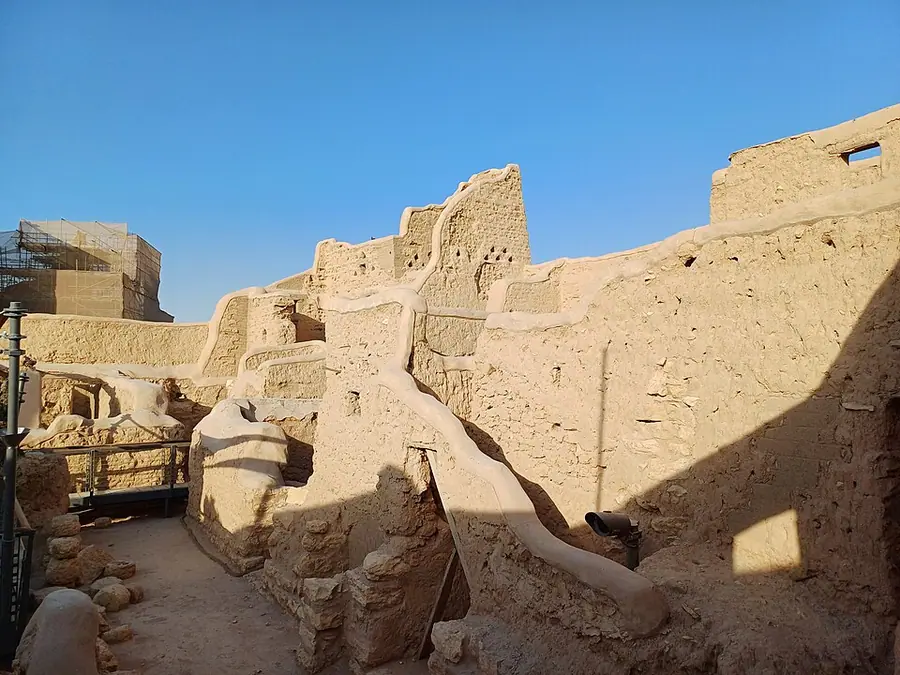
Expelled from ʿUyayna, he went in 1744 to Dirʿiyya, a small town ruled by Muḥammad ibn Saʿūd, and the two men exchanged oaths. As Saudi tradition remembers it, the ruler would govern and wage war, the scholar would direct religion, and each would support the other.[1][2] Consensus The Saudi state now dates its own beginning to 1727, when Muḥammad ibn Saʿūd came to power, but historians treat the pact as the founding of the alliance that has lasted, through three Saudi states, to the present.[1] Majority
The alliance took Riyadh in 1773 or 1774, and in 1801–1802 its forces sacked Karbalāʾ in Ottoman Iraq, killed thousands of its people and plundered the shrine of al-Ḥusayn. To Shia Muslims it is remembered as a massacre; in the movement’s own terms it was a war on shirk.[1] Consensus on the event; Political on its memory. From 1803 to 1805 they took Ṭāʾif, Mecca and Medina and destroyed domed tombs there, including those over the graves of the Prophet’s companions and family. The Ottoman sultan had Egypt’s governor send armies, and in 1818 Dirʿiyya fell and its emir was executed in Istanbul.[1] Consensus
The kingdom
A second Saudi state followed (1824–1891), and in January 1902 ʿAbd al-ʿAzīz ibn Saʿūd, Ibn Saud, retook Riyadh. He settled Bedouin warriors, the Ikhwan, in colonies where Wahhabi preachers taught them a strict monotheism; they were his shock troops in the conquest of Mecca in 1924. When they turned on him for religious laxity and raided into British-protected Iraq and Kuwait, he defeated them at Sabilla in 1929, and in 1932 proclaimed the Kingdom of Saudi Arabia (§11).[6][1] Consensus The settlement gave the Wahhabi scholars authority over worship, education, public morals and law, and the monarchy authority over everything else.[1][6] Majority
From the 1960s the state built an international religious apparatus, the Islamic University of Medina (1961) and the Muslim World League (1962), and after the oil boom of the 1970s and the shocks of 1979 it funded mosques, schools, textbooks and preachers abroad (§12). Consensus Figures of $75 billion to “upwards of $100 billion” circulate widely without published accounts behind them; Peter Mandaville warns against them and finds the effects real but uneven.[7] Contested on the scale; Majority that it spread a Salafi reading of Islam.
Since 2016 the government has changed course in some respects: the religious police lost their powers of arrest, cinemas and concerts opened, and women were allowed to drive from June 2018, while clerics, critics and activists were detained (§13).[8][9] Consensus on the measures; Political on what they amount to.
Wahhabi, Salafi: what is the difference?
The two overlap but are not the same. Salafiyya comes from al-salaf al-ṣāliḥ, “the pious predecessors”, the first generations of Muslims. Salafis aim to follow them directly from the Qur’an and hadith and reject later practices they consider innovations. Wahhabism is one source of modern Salafism; the hadith teaching of al-Albānī and other modern currents are others.[10] Majority
The word itself has a confusing history. Western scholars long called the Egyptian modernists al-Afghānī, ʿAbduh and Riḍā “the Salafiyya”; Henri Lauzière showed that this was largely a later construction, and that “Salafism” as a purist movement opposed to their modernism took shape in the twentieth century.[11] Majority
Salafis also differ among themselves. Quintan Wiktorowicz divided them into purists, the majority, who teach and avoid politics; politicos, who criticise governments; and jihadis, who take up arms.[10] Majority Most Salafis are not jihadis, and the jihadis’ sharpest critics have often been other Salafis. Majority
“Wahhabi” as a word of abuse
The name has always been used by opponents, and in South Asia it became an accusation in a quarrel among Sunnis. The Barelwī movement founded by Aḥmad Riḍā Khān (1856–1921) defended the celebration of the Prophet’s birthday and the visiting of saints’ tombs, and calls itself the defender of the Sunni mainstream against what it calls Wahhabi innovations; its opponents at Deoband and elsewhere reject the label for themselves (§10).[12] Majority In that quarrel “Wahhabi” means less a follower of the Najdi scholar than anyone who condemns practices the speaker considers devout. Political
When the movement turned on itself
The Saudi establishment has also faced challenges from within its own tradition. In November 1979 a group led by Juhayman al-ʿUtaybī seized the Grand Mosque in Mecca and proclaimed a Mahdī. Thomas Hegghammer and Stéphane Lacroix showed that it was a millenarian offshoot of Saudi Salafism, which denounced the royal family and the official scholars; the senior scholars, led by ʿAbd al-ʿAzīz ibn Bāz, gave the ruling that allowed troops to retake the mosque (§12).[13][14] Majority In the following decade the Ṣaḥwa, the “Awakening”, a movement of preachers and teachers, combined the Wahhabi creed with the political activism of the Muslim Brotherhood, and turned against the government after it invited American troops into the kingdom in 1990.[15] Majority It is the “politico” strand in Wiktorowicz’s terms.[10] Majority
What scholars disagree about
Reformer or militant? Natana DeLong-Bas argued in 2004 that the founder was a moderate whose teaching had little to do with later jihadism. Reviewers, among them Khaled Abou El Fadl, called the book apologetic for rarely quoting him directly; David Commins and Michael Crawford see a rigorous doctrinal reformer whose idea of shirk made fighting other Muslims a duty his state carried out.[16][1][2] Contested; Political on its modern use.
Wahhabism and the jihadis. Cole Bunzel traced the theology of the “Islamic State” to the most uncompromising strand of Wahhabi doctrine.[17] Majority That is a claim about one strand, not about the Saudi religious establishment or Salafis in general; no major religious institution recognised the group’s caliphate (§13). Political
Common misconceptions
- “Wahhabism is a separate sect.” It is a Sunni reform movement within the Ḥanbalī tradition; the sect-like name was its opponents’ choice.[1] Consensus
- “All Salafis are Wahhabis, and all are militants.” Salafism has several roots, and most Salafis are quietist purists.[10] Majority
- “Wahhabism is as old as Islam.” It dates from the 1740s; its debt to Ibn Taymiyya reaches back to the fourteenth century, not the seventh.[1][5] Consensus
The full story is in Reform, revival and empire and Revolution and revival.
References
- ^ a b c d e f g h i j k l m David Commins The Wahhabi Mission and Saudi Arabia. I.B. Tauris, 2006. The history of the Najdi movement from Ibn ʿAbd al-Wahhāb to the modern kingdom.
- ^ a b c d e Michael Crawford Ibn ʿAbd al-Wahhab. Oneworld, 2014. A critical life of the founder, his doctrine and his alliance with the Saudis.
- ^ Muḥammad ibn ʿAbd al-Wahhāb, Kitāb al-Tawḥīd — The Book of God's Oneness. mid-18th c. CE. Arabic. Short chapters of Qur'an verses and hadith defining worship and condemning practices the author judged to be shirk. about
- ^ Bernard Haykel On the Nature of Salafi Thought and Action. in R. Meijer, ed., Global Salafism (Hurst/Columbia), 2009. Salafism's doctrine and its debts to Ibn Taymiyya and Ibn ʿAbd al-Wahhāb.
- ^ a b c Yossef Rapoport and Shahab Ahmed (eds) Ibn Taymiyya and His Times. Oxford University Press, Karachi, 2010. Essays reading Ibn Taymiyya in his Mamluk context rather than through his modern reception.
- ^ a b Madawi Al-Rasheed A History of Saudi Arabia. Cambridge University Press, 2002. The making of the Saudi state, the Ikhwan, and oil.
- ^ Peter Mandaville (ed.) Wahhabism and the World: Understanding Saudi Arabia's Global Influence on Islam. Oxford University Press, 2022. Case studies of Saudi religious influence abroad, sceptical of the large headline spending figures.
- ^ Saudi royal decree curtailing the Committee for the Promotion of Virtue and the Prevention of Vice (April 2016) — Saudi religious police reform. April 2016. Arabic. Removes the religious police's powers to pursue, question and detain suspects. about
- ^ Lifting of the ban on women driving in Saudi Arabia (24 June 2018) — Saudi Arabia, women driving. 24 June 2018. English. Women licensed to drive while several campaigners remained in detention. about
- ^ a b c d Quintan Wiktorowicz Anatomy of the Salafi Movement. Studies in Conflict & Terrorism 29.3, 207–239, 2006. Divides Salafis by method into purists, politicos and jihadis, who share a creed but disagree on how to apply it.
- ^ Henri Lauzière The Making of Salafism: Islamic Reform in the Twentieth Century. Columbia University Press, 2016. Shows 'salafiyya' as a movement name is a twentieth-century construction projected back onto the modernists.
- ^ Usha Sanyal Devotional Islam and Politics in British India: Ahmad Riza Khan Barelwi and His Movement, 1870–1920. Oxford University Press, 1996. The Barelwī movement and its defence of devotion to the Prophet and the saints.
- ^ Thomas Hegghammer and Stéphane Lacroix Rejectionist Islamism in Saudi Arabia: The Story of Juhayman al-ʿUtaybi Revisited. International Journal of Middle East Studies 39.1, 2007. The religious background of Juhayman's movement, from interviews and his own writings.
- ^ Yaroslav Trofimov The Siege of Mecca: The Forgotten Uprising in Islam's Holiest Shrine. Doubleday, 2007. A narrative history of the 1979 seizure of the Grand Mosque.
- ^ Stéphane Lacroix Awakening Islam: The Politics of Religious Dissent in Contemporary Saudi Arabia. Harvard University Press, 2011. The Saudi religious field and the Ṣaḥwa movement of the 1980s and 1990s.
- ^ Natana J. DeLong-Bas Wahhabi Islam: From Revival and Reform to Global Jihad. Oxford University Press, 2004. Argues the founder was a moderate reformer; criticised as apologetic.
- ^ Cole Bunzel From Paper State to Caliphate: The Ideology of the Islamic State. Brookings Institution, 2015. Traces the Islamic State's theology and its roots in an uncompromising strand of Wahhabi doctrine.