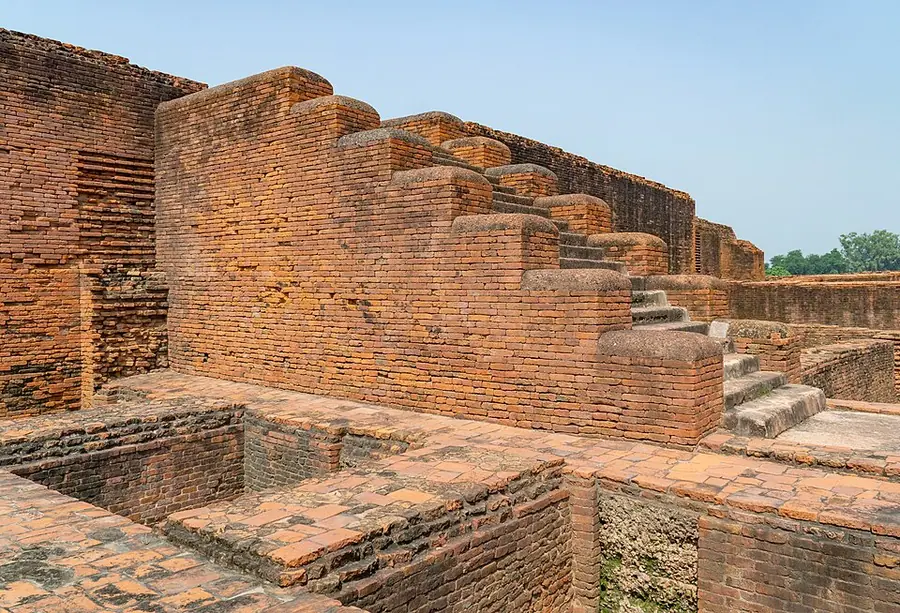
The short version: Bakhtiyār Khalji’s campaigns of around 1200 did destroy the great Buddhist monasteries of Bihar as working institutions, and Nālandā was among the casualties. But the story most people know, of a single raid on Nālandā and a library that burned for months, is not what the medieval sources say. The one Persian account of a monastery being sacked does not name Nālandā and does not mention a fire.[1] A Tibetan monk who stayed at Nālandā in the 1230s found it battered, mostly empty and still teaching.[2] The burning-library tale comes from a Tibetan history written more than five centuries later, and that version blames non-Buddhist arsonists, not Turkic soldiers.[3]
The evidence for what happened to Nālandā
What the Persian chronicle says
The Persian historian Minhāj al-Sirāj Jūzjānī wrote his Ṭabaqāt-i Nāṣirī in Delhi around 1260, a couple of generations after the conquest of Bihar. He describes Muhammad Bakhtiyār Khalji’s men storming a fortified place, killing its inhabitants, the “Brahmans” with “heads shaven,” and finding it full of books:
”… it was found that the whole of that fortress and city was a college, and in the Hindūī tongue, they call a college Bihār.”[1][4]
What it proves. That a large Buddhist monastery was stormed and its monks massacred around 1200. The shaven-headed “Brahmans” are almost certainly monks, and bihār is vihāra, monastery. The passage does not name the place, and it says nothing about burning. Martin Delhey, who has examined the sources closely, thinks Odantapurī at modern Bihar Sharif, about a dozen kilometres from Nālandā, the most likely target, while noting that identifications vary.[5] Majority on the event; Contested on the place
A Tibetan eyewitness, a generation later
The Tibetan translator Chag Lotsāwa Chöjé Pel, known as Dharmasvāmin, travelled in Bihar in 1234–36 and stayed at Nālandā. His biography reports that Vikramaśīla had been razed by “Turushka” soldiers and its foundation stones thrown into the Ganges, and that at Nālandā most buildings were damaged and deserted. Two were still in use, and the ninety-year-old abbot Rāhulaśrībhadra was teaching about seventy monks, who hid when raiding parties came through.[2][6]
What it proves. Two things at once. Contemporaries did blame Turkic troops for destroying the monasteries of Bihar, so the military conquest is not a modern invention. And Nālandā was not wiped out in a single raid: a generation after the conquest it was a damaged, impoverished place still trying to function. It faded without patrons rather than vanishing overnight.[5] Consensus
A later Tibetan historian tells the same story in more detail. Tāranātha’s History of Buddhism in India, written in Tibet in 1608, says the petty Turuṣka rulers “ran over the whole of Magadha and massacred many ordained monks in Odantapuri. They destroyed this and also Vikramaśīla,” and later “the Persians at last built a fort on the ruins of the Odanta-vihara.” He adds that some monks had acted as messengers for the Turkic king, and that the surviving scholars scattered to Odisha, Nepal, Tibet, the south of India and Southeast Asia. At Nālandā, he says, the paṇḍita Rāhulaśrībhadra later had “about seventy listeners,” the same figure Dharmasvāmin gives.[7][8] The account is late and partly legendary, but it remembers Odantapurī and Vikramaśīla, not Nālandā, as the monasteries the Turkic troops destroyed, and Nālandā as a place that survived on a small scale.[5] Majority
Where the burning library comes from
An eighteenth-century Tibetan history tells a different story. Sumpa Khenpo’s Pag Sam Jon Zang of 1748 says that young monks insulted two non-Buddhist mendicants, who performed a long fire ritual and then set Nālandā’s library alight; Tibetan tradition names the library complex Dharmagañja, with three great buildings.[3] The story is legendary, written more than five hundred years after the events, and it does not involve Bakhtiyār at all. The phrase that the library “burned for months” is not found in any medieval source; it appears in modern retellings. Majority
What the ground shows
Francis Buchanan-Hamilton described the ruins at Bargaon early in the nineteenth century, and Alexander Cunningham identified them with Nālandā in the 1860s from the distances and directions the Chinese pilgrims give.[9] The Archaeological Survey of India excavated the site in 1915–37 and again in 1974–82, exposing eleven monasteries and six large brick temples.[10] The excavators found burnt beams, doors, images and grain across the buildings; the Survey’s own guide reads them as evidence of “a general outbreak of fire at Nalanda at least once,” after which the site was reoccupied rather than abandoned.[9] Fire is evidence of destruction, but it cannot by itself say who set it or when, and in a site occupied for seven centuries fires could have many causes. Majority
One inscription found at Nālandā shows that Buddhist monasteries could also suffer from Indian armies. A twelfth-century eulogy of the monk Vipulaśrīmitra records that his spiritual ancestor Karuṇāśrīmitra died when his house at the great monastery of Somapura, in Bengal, was set on fire by an army of Vaṅgāla.[11] Monasteries were rich, walled and exposed in every war of the period, not only in the last one. Majority
A short timeline
| Date | What happens | Confidence |
|---|---|---|
| 5th c. CE | Nālandā founded under the Guptas; Xuanzang names a king Śakrāditya (§8)[12] | Majority |
| 630s | Xuanzang studies at Nālandā (§7)[12] | Consensus |
| 8th–12th c. | Pāla kings endow Nālandā; grant of five villages under Devapāla[13] | Consensus |
| 11th c. | A Vaṅgāla army burns part of Somapura monastery, recorded at Nālandā[11] | Majority |
| c. 1200 | Bakhtiyār Khalji’s troops sack a monastery called “Bihar”; Vikramaśīla destroyed[1][2] | Majority |
| 1234–36 | Dharmasvāmin finds Nālandā damaged, with about seventy monks[2] | Consensus |
| 1608 | Tāranātha names Odantapurī and Vikramaśīla as the monasteries the Turuṣkas destroyed[7] | Consensus |
| 1748 | Sumpa Khenpo’s history tells the library-burning legend[3] | Consensus |
| 1915–37, 1974–82 | Archaeological Survey of India excavates the site[9][10] | Consensus |
| 2010–2024 | Nalanda University Act (2010); first classes (2014); new campus at Rajgir opened (2024)[14] | Consensus |
What scholars disagree about
Which monastery Minhāj describes. Odantapurī is the most common identification, but Nālandā and Vikramaśīla have both been proposed. The text gives no name, and the “Bihar” it mentions may be the city of Bihar Sharif, named after its monastery.[5] Tāranātha’s much later history also places the massacre of monks at Odantapurī.[7] Contested
How much the conquest mattered. Historians agree that Indian Buddhism had been contracting for centuries before 1200, as royal and landed patronage moved to temples and brahmins, and that its last great base was in Bihar and Bengal (§8). They disagree about weight. The majority view is that the Turkic conquest destroyed institutions that were already weakened and removed the patrons who might have rebuilt them.[15] That view matches the Hinduism series’ account of how Buddhism disappeared from India. Majority
Single-cause stories. Two opposite stories circulate. One makes Bakhtiyār the sole destroyer of Indian Buddhism and Nālandā its symbol. The other, argued most fully by Giovanni Verardi, holds that Brahmanical hostility did most of the damage and that the Turkic raids finished off what was left; Delhey and others find that reading extreme.[16][5] Both are used in present-day arguments about Islam and Hinduism in India. The sources support neither in its strong form: they show a long decline ended by military conquest. Political
Earlier destructions. Popular accounts often say Nālandā was “destroyed three times,” first by the Huns under Mihirakula in the fifth or sixth century and then by a Gauḍa king of Bengal. No contemporary source records either attack on Nālandā. Xuanzang does accuse the seventh-century Gauḍa king Śaśāṅka of persecuting Buddhists, but the outrages he describes are at Bodh Gaya, where he says Śaśāṅka cut down the Bodhi tree, not at Nālandā, where Xuanzang himself studied a generation later.[17] Majority
Common misconceptions
- “Khilji burned Nālandā’s library and it smouldered for months.” No medieval source says this. The Persian chronicle does not mention fire; the Tibetan fire legend blames non-Buddhist arsonists.[1][3]
- “Nālandā was destroyed in 1193.” The precise year of Bakhtiyār’s raids is uncertain, and dates from 1193 to about 1205 circulate. Nālandā itself was still occupied in 1235.[2]
- “Nālandā was the world’s first university, founded in the Buddha’s time.” It was founded in the fifth century CE, about nine hundred years after the Buddha; the village of Nālandā is older than the monastery (§8).[12]
- “Its fall ended Buddhism in India overnight.” Buddhism lingered in Bengal, Odisha and the Himalaya for centuries, and Indian monks carried learning and manuscripts to Tibet and Nepal (§8, §9).[5][7]
Why it matters
Nālandā has become a symbol in modern India, of ancient Indian learning, of what conquest destroyed, and of what can be rebuilt; the new Nalanda University, founded by an act of Parliament in 2010, opened its campus at Rajgir in 2024.[14] The real history is more interesting than the symbol. It shows a Gupta foundation that grew into a great international monastery over seven centuries, drew students from China and Tibet, was weakened as its patrons changed, was overrun in a war of conquest, and was finally abandoned by the few monks who had stayed.
For the whole story of the monastic universities and the end of Indian Buddhism, see Chapter 8: Tantra and the Last Age of Indian Buddhism.
References
- ^ a b c d Ṭabaqāt-i Nāṣirī (Raverty, vol. 1, p. 552) — Minhāj al-Sirāj Jūzjānī. c. 1260 CE. Persian. Muhammad Bakhtiyār Khalji's troops take a fortified 'Bihar', kill its shaven-headed inhabitants and find it full of books: a Buddhist monastery, probably Odantapurī, sacked around 1200. about
- ^ a b c d e Biography of Dharmasvāmin — Chos dpal dar dpyang. 13th c. CE. Classical Tibetan. Eyewitness of Bihar in 1234–36: Vikramaśīla razed by Turkic troops and its stones thrown into the Ganges; Nālandā damaged but still teaching about seventy monks under its aged abbot. about
- ^ a b c d Pag Sam Jon Zang — Sumpa Khenpo Yeshe Paljor. 1748. Tibetan. A Tibetan history of Buddhism in India that tells how two non-Buddhist mendicants, insulted by young monks, set Nālandā's library on fire. Legendary, and written five centuries after the events. about
- ^ H. G. Raverty, trans. Ṭabakāt-i-Nāṣirī: A General History of the Muhammadan Dynasties of Asia. Bibliotheca Indica, 2 vols., 1881. full text The standard English translation of Minhāj al-Sirāj's chronicle.
- ^ a b c d e f Martin Delhey "The Library at the East Indian Buddhist Monastery of Vikramaśīla: An Attempt to Identify Its Himalayan Remains". manuscript cultures 8, 2015. open access A careful, open-access account of the eastern monasteries' end, with the key Persian and Tibetan sources quoted.
- ^ George Roerich, trans. Biography of Dharmasvāmin (Chag lo-tsa-ba Chos-rje-dpal), a Tibetan Monk Pilgrim. K. P. Jayaswal Research Institute, Patna, 1959. full text The Tibetan text and translation of the most important eyewitness of Bihar after the conquest.
- ^ a b c d Tāranātha, History of Buddhism in India (Chimpa & Chattopadhyaya, pp. 318–320) — Tāranātha. 1608 CE. Tibetan. The petty Turuṣka rulers overrun Magadha, massacre monks at Odantapurī and destroy it and Vikramaśīla; the Persians later build a fort on Odantapurī's ruins, and scholars flee to Odisha, Nepal, Tibet, south India and Southeast Asia. At Nālandā Rāhulaśrībhadra still has about seventy listeners. read the text
- ^ Lama Chimpa and Alaka Chattopadhyaya, trans.; Debiprasad Chattopadhyaya, ed. Tāranātha's History of Buddhism in India. Indian Institute of Advanced Study, Simla, 1970. full text The standard English translation of Tāranātha's 1608 history, with notes; the source for the Tibetan picture of Vikramaśīla.
- ^ a b c A. Ghosh A Guide to Nalanda. Archaeological Survey of India / Manager of Publications, Delhi, 2nd ed., 1946. full text The Survey's own site guide: the history of identification and excavation, and the evidence of at least one general fire after which the site was reoccupied.
- ^ a b Nālandā Mahāvihāra (archaeological site) — Bihar. 5th–12th c. CE; excavated 1915–37 and 1974–82. The excavated monastery at Bargaon: eleven monasteries and six large brick temples exposed by the Archaeological Survey of India in 1915–37 and 1974–82; a UNESCO World Heritage Site since 2016. about
- ^ a b Nālandā inscription of Vipulaśrīmitra — Nālandā, Monastery 7. c. 12th c. CE. Sanskrit. Found at Nālandā: a eulogy of the monk Vipulaśrīmitra recording that his predecessor Karuṇāśrīmitra died when his house at Somapura monastery was set on fire by an army of Vaṅgāla.
- ^ a b c Xuanzang, Record of the Western Regions 9 — Da Tang Xiyu ji. 646 CE. Classical Chinese. Xuanzang's account of Nālandā, where he studied in the 630s: the line of kings from Śakrāditya who built its monasteries one after another, and its reputation for learning and debate. about
- ^ Nālandā copper plate of Devapāla — Nālandā. mid-9th c. CE. Sanskrit. Records that Bālaputradeva, Śailendra king of Suvarṇadvīpa, built a monastery at Nālandā and that the Pāla king Devapāla granted five villages for its upkeep. about
- ^ a b Nalanda University Act, 2010 — Parliament of India. 2010. English. Act founding the modern Nalanda University near Rajgir; first classes 2014, new campus inaugurated in June 2024. about
- ^ Romila Thapar Early India: From the Origins to AD 1300. Penguin, 2002. full text The best single-volume political and social history for this whole span.
- ^ Giovanni Verardi Hardships and Downfall of Buddhism in India. Manohar, 2011. Argues that Brahmanical hostility, not Islam, was the main force against Indian Buddhism. Provocative and widely disputed.
- ^ T 2087 (Da Tang Xiyu ji) — Xuanzang, Record of the Western Regions. 646 CE. Classical Chinese. Xuanzang's account of the lands and monasteries he saw between 629 and 645, from the Tarim basin to south India; still a guide for archaeologists. read the text