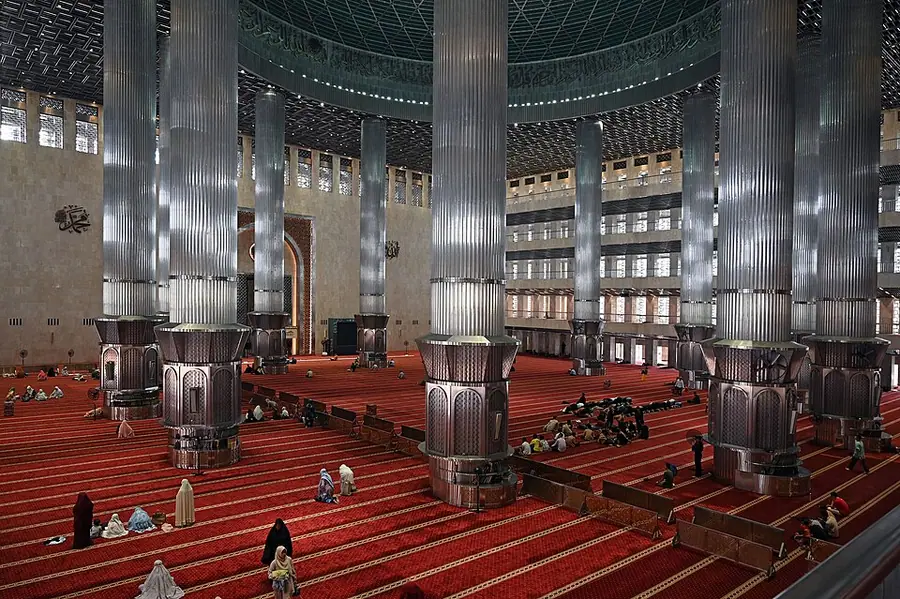
In 2020 there were about 2 billion Muslims, a quarter of the people in the world, and their number was growing faster than that of any other major religious group, mainly because Muslims are young. Most of them live in Asia, and the largest Muslim populations are in Indonesia, Pakistan, India and Bangladesh, not in the Arab world. The quarter-century since 2001 has been dominated in the news by violence carried out in Islam’s name, from the attacks of 11 September 2001 to the “Islamic State” of 2014–2019, and by the public rejection of that violence by Muslim scholars. Less visible changes have reshaped the religion as much: states that decide who counts as a Muslim; Muslim minorities in Europe and North America, and the laws written about them; women reading the Qur’an for themselves and leading its interpretation; Islamic banking grown into a multi-trillion-dollar industry; and an internet on which anyone can issue a ruling. Against the institutions traced in §3–§6, much has changed; the Qur’an’s text, the five pillars, the schools of law and the Sunni–Shia division have not. Majority
Every number in this chapter comes from a named source with a date, because the numbers are contested and some governments do not allow religion to be counted freely. As in the companion chapters on Christianity today and Judaism today, surveys measure how people describe themselves, which is not the same as belief or practice. Consensus on the difference in method.
Timeline
| Date | Event or evidence | Confidence |
|---|---|---|
| 23 February 1998 | The “World Islamic Front” statement of bin Laden and others declares killing Americans and their allies an individual duty[1] | Consensus |
| 11 September 2001 | Al-Qaeda’s attacks on New York and Washington kill 2,977 people[2] | Consensus |
| 15 March 2004 | France bans conspicuous religious symbols in state schools[3] | Consensus |
| November 2004 – July 2005 | The Amman Message, then its “three points”, agreed by about 200 scholars in Amman[4] | Consensus |
| 18 March 2005 | Amina Wadud leads Friday prayer for a mixed congregation in New York[5] | Consensus |
| 11 October 2010 | France bans face coverings in public, in force from 11 April 2011[6] | Consensus |
| May 2011 | Osama bin Laden killed in Abbottabad, Pakistan[2] | Consensus |
| 29 June 2014 | The “Islamic State” proclaims a caliphate; al-Baghdadi preaches in Mosul on 4 July[7][8] | Consensus |
| 19 September 2014 | Open letter of more than 120 scholars to al-Baghdadi[9] | Consensus |
| April 2016 | Saudi Arabia strips its religious police of powers of arrest[10] | Consensus |
| 2017–2019 | IS loses Mosul (July 2017), Raqqa (October 2017) and Baghuz (23 March 2019); al-Baghdadi dies on 27 October 2019[11] | Consensus |
| 24 June 2018 | Women in Saudi Arabia drive legally for the first time[12] | Consensus |
| 2018–19 and 2021–22 | Arab Barometer finds a rise, then a fall, in Arabs calling themselves not religious[13][14] | Majority |
| 10 March 2023 | Saudi Arabia and Iran agree to restore relations, broken since 2016[15] | Consensus |
| 9 June 2025 | Pew reports about 2 billion Muslims in 2020, 25.6 per cent of the world[16] | Consensus |
How many Muslims, and where
The count
The Pew Research Center’s report of June 2025, How the Global Religious Landscape Changed From 2010 to 2020, counted about 2 billion Muslims in 2020, 25.6 per cent of the world’s population, second only to Christians (about 2.3 billion, 28.8 per cent).[16][17] Consensus Muslims were the fastest-growing major religious group of the decade. The reason Pew gives is demographic, not missionary: Muslims are on average younger than other groups and have more children, while conversion into and out of Islam roughly balances worldwide.[16] Majority
Projections depend on those assumptions continuing. Pew’s earlier study, The Future of World Religions (2015), projected Muslims at about 29.7 per cent of the world by 2050, close to parity with Christians.[18] Fertility in many Muslim-majority countries, from Iran to Turkey to Bangladesh, has fallen faster than such projections assumed, and a projection is not a forecast. Majority on the direction; Contested on the numbers.
Where Muslims live
The picture most Western readers have of Islam, as an Arab and Middle Eastern religion, is out of date by several centuries (§8–§9). In the 2020 estimates the largest Muslim populations were, in descending order, Indonesia, Pakistan, India, Bangladesh, Nigeria, Egypt, Iran and Turkey. About 12 per cent of all Muslims live in Indonesia, 31 per cent in South Asia, 20 per cent in the Middle East and North Africa, and 15 per cent in sub-Saharan Africa.[16] Consensus India, where Muslims are a minority of about 14 per cent, has more Muslims than any country except Indonesia and Pakistan. The Arabs, among whom Islam began, are a minority of the world’s Muslims. Consensus
Sunni, Shia and others
Pew’s 2009 study Mapping the Global Muslim Population, still the standard estimate, put Shia Muslims at 10–13 per cent of all Muslims, about 154–200 million people at the time, and Sunnis at 87–90 per cent.[19] Majority Shia Muslims are majorities in Iran, Iraq, Azerbaijan and Bahrain, and large minorities in Lebanon, Pakistan, India and Yemen. The Ibāḍīs of Oman, heirs of a branch of the early Khārijites (§4), number a few million. The Ahmadiyya, founded in nineteenth-century India (§10), number perhaps 10–20 million on independent estimates; whether they are Muslims is itself disputed (below). Majority
Many Muslims do not identify with either main branch. Pew’s 2012 survey of Muslims in 39 countries found that those describing themselves as “just a Muslim” were a majority in eight of them, among them Kazakhstan, Albania, Kyrgyzstan, Kosovo and Indonesia, most often in Central Asia and South-Eastern Europe.[20] Majority
Violence in Islam’s name, and its rejection
Al-Qaeda and 11 September
On 23 February 1998, Osama bin Laden, Ayman al-Ẓawāhirī and others issued a statement in the name of a “World Islamic Front” declaring that to kill Americans and their allies, civilians and soldiers, was an individual duty for every Muslim able to do it.[1] Consensus On 11 September 2001 nineteen al-Qaeda hijackers flew aircraft into the World Trade Center and the Pentagon; a fourth aircraft crashed in Pennsylvania. The attacks killed 2,977 people.[2] Consensus Bin Laden was killed by US forces in Abbottabad, Pakistan, in May 2011.[2] Consensus
Al-Qaeda’s ideas came from the strand of Islamist thought traced in §11 and §12: Sayyid Quṭb’s judgement that existing Muslim societies had fallen into jāhiliyya, the Afghan jihad of the 1980s, and a militant reading of Salafism. Historians stress how small and recent this strand is against the history of Islamic law, which developed detailed rules restricting war and protecting non-combatants (§6). Majority What the attacks changed was the way Islam was discussed in public: for many non-Muslims after 2001, terrorism became the first association with the religion, and Muslims in the West found themselves asked to answer for it. Political
The “Islamic State”
The group that called itself the Islamic State grew out of al-Qaeda’s branch in Iraq. On 29 June 2014, the first day of Ramadan, its spokesman announced the restoration of the caliphate, with Abū Bakr al-Baghdādī as caliph; on 4 July al-Baghdādī preached in the Great Mosque of al-Nūrī in Mosul and called on Muslims everywhere to support him.[7][8] Consensus At its height, at the end of 2015, the group ruled an area in Iraq and Syria with a population of about 12 million.[11] Majority
It claimed the institutions of §4–§6: the caliphate, the Prophet’s law, the jizya on Christians. It also revived things those institutions had long abandoned or never allowed in the form it practised them, above all the enslavement of Yazidi women. Cole Bunzel, studying its texts, traced its theology to the most uncompromising strand of Wahhabi doctrine (§10).[8] Majority It lost Mosul in July 2017 and its capital, Raqqa, in October 2017; its last territory, at Baghuz on the Euphrates, fell on 23 March 2019, and al-Baghdādī died during a US raid in north-western Syria on 27 October 2019.[11] Consensus Its branches survive in parts of Africa and Asia.
The scholars’ reply
On 19 September 2014 a group of Muslim scholars published an Open Letter to al-Baghdadi, initially signed by more than 120 scholars from many countries and schools, and later by more. It was written in Arabic and English and argued from the Qur’an, the hadith and classical law, in the scholars’ own idiom, not in the language of Western policy.[9] Consensus Its summary runs to twenty-four points: among them, that it is forbidden “to kill the innocent”, that “jihad in Islam is defensive war”, that it is forbidden “to force people to convert”, that “the re-introduction of slavery is forbidden in Islam”, and that “it is forbidden in Islam to declare a caliphate without consensus from all Muslims”.[9] Consensus on the text.
No state recognised the Islamic State, and its claim to the caliphate was rejected by the vast majority of Muslims. Consensus How representative violent groups are of Islam remains one of the most argued questions of the period: critics of Islam point to the texts these groups quote, and most Muslim scholars and most historians point to the interpretive tradition those groups discarded. The evidence of this chapter is that the overwhelming majority of Muslim religious authorities rejected them, publicly and on religious grounds. Political
The Amman Message
A different kind of reply came from Jordan. In November 2004 King Abdullah II issued the Amman Message, and in July 2005 he convened about 200 scholars from more than fifty countries, who agreed “three points”.[4] The first recognised as Muslims the followers of eight schools of law: the four Sunni schools of §6, the Shia Jaʿfarī and Zaydī schools, the Ibāḍī and the Ẓāhirī; it forbade declaring any of them apostates (takfīr), and extended the protection to Ashʿarī theology, “real” Sufism and “true” Salafi thought. The second said the schools agree on the fundamentals and differ only on details; the third restricted the right to issue fatwas to the qualified.[4] Consensus By July 2006 the three points had 552 signatures from 84 countries, Sunni and Shia.[4] Consensus
The Amman Message is the clearest modern statement of the classical settlement traced in §6: several schools, mutually recognised, with disagreement on the “branches” of law treated as legitimate. Its force depends on the institutions that signed it; groups that reject those institutions are not bound by it. Majority
Sunni and Shia as geopolitics
The division between Sunni and Shia goes back to the disputes over the succession (§4) and took shape as two communities in the Abbasid centuries (§6); Iran became a Shia state under the Safavids (§9) and a Shia revolutionary state in 1979 (§12). Since 2003 it has also become a line of conflict between states and their allies, above all between Saudi Arabia and Iran, through the wars in Iraq, Syria and Yemen. Political Diplomatic relations between Saudi Arabia and Iran were broken in 2016, after Saudi Arabia executed the Shia cleric Nimr al-Nimr and protesters attacked Saudi missions in Iran, and were restored by an agreement brokered by China on 10 March 2023.[15] Consensus
Historians caution against reading these conflicts as a fourteen-century religious war. For most of the history traced in this series, Sunnis and Shia lived side by side, often intermarried, and their rivalries were driven as much by states as by doctrine. Majority The Amman Message’s mutual recognition of the schools was one answer from religious authorities; the conflicts of the period were another. This chapter describes the religious dimension and stops there. Political
Who counts as a Muslim? The Ahmadiyya
The Ahmadiyya movement, founded by Mirzā Ghulām Aḥmad in the Punjab in 1889 (§10), regards itself as Muslim. Most other Muslims reject it, because Ghulām Aḥmad was held by his followers to be a prophet of some kind, which they consider incompatible with the belief that Muhammad was the last prophet (khatm al-nubuwwa). Consensus on the disagreement.
What is new in the modern period is that a state settles the question by law. On 7 September 1974, Pakistan’s Second Amendment to its constitution declared that for legal purposes a person who does not believe that Muhammad was the last prophet is not a Muslim, and that “non-Muslim” includes a person “of the Quadiani Group or the Lahori Group (who call themselves Ahmadis or by any other name)”.[21] Consensus On 26 April 1984, under General Zia-ul-Haq, Ordinance XX added section 298-C to the penal code, punishing with up to three years in prison any Ahmadi who “poses himself as a Muslim, or calls, or refers to, his faith as Islam”, or preaches it.[22] Consensus Azad Jammu and Kashmir’s legislative assembly approved a similar amendment on 6 February 2018. Consensus
The episode is a modern one. In the classical tradition the question “who is a Muslim?” was argued by scholars and settled, if at all, in their writings; here it is decided by a parliament and enforced by the police. Ahmadis and human rights organisations describe the laws as persecution; their defenders describe them as the protection of a core doctrine. Political
Muslims in the West
Numbers
Muslim communities in Western Europe and North America are mostly the result of migration since the 1950s (§11). The Pew Research Center estimated in 2017 that Muslims were 4.9 per cent of the population of Europe (the European Union, Norway and Switzerland) in 2016, and projected that by 2050 the share would be between 7.4 per cent, if all migration stopped, and 14 per cent, with high migration.[23] Majority In south-eastern Europe and Russia, by contrast, Muslim communities are centuries old (§9). In the United States Pew estimated 3.45 million Muslims in 2017, about 1.1 per cent of the population.[24] Majority
The headscarf and the law
Dress became the most visible point of argument. In France, after fifteen years of disputes over schoolgirls’ headscarves, the law of 15 March 2004 banned, in public primary and secondary schools, “the wearing of signs or dress by which pupils conspicuously show a religious affiliation”. The law names no religion; it was widely understood to be aimed at the Muslim headscarf, and also covers the kippa and large crosses.[3] Consensus The law of 11 October 2010, in force from 11 April 2011, banned clothing “designed to conceal the face” in public places, in effect the full-face veil.[6] The European Court of Human Rights upheld it on 1 July 2014, accepting the French government’s argument from “living together”; the UN Human Rights Committee found in October 2018 that it disproportionately harmed the right of two women prosecuted under it to manifest their religion.[25] Consensus on the rulings.
Supporters of such laws present them as defending secularism (laïcité) and women’s equality; opponents, including many Muslim women who wear the headscarf by choice, present them as restricting religious freedom and singling out Muslims. Political The history of the veil itself, from the unveiling campaigns of the 1920s–30s to the new veiling of the 1970s and the compulsory veil in Iran after 1979, is traced in §11 and in When did Muslim women start wearing the hijab?
Saudi Arabia after 2016
For most of the twentieth century Saudi Arabia was the state most closely identified with the Wahhabi tradition (§10), and from the 1980s it funded the spread of Salafi teaching abroad (§12). From 2016 its government changed course in some respects. In April 2016 a royal decree removed the religious police’s powers to pursue, question and detain suspects.[10] Consensus The crown prince, Muḥammad ibn Salmān, said in October 2017 that he aimed to return the country to “what we were before — a country of moderate Islam that is open to all religions and to the world”, presenting the strictness of the decades after 1979 as a reaction to the Iranian revolution.[26] Public concerts, cinemas and mixed public entertainment followed, and women were allowed to drive from 24 June 2018.[12] Consensus on the measures.
The same years saw the detention of clerics, critics and several of the women’s rights activists who had campaigned for the right to drive. Whether the changes are a religious reform, a change of religious policy by an authoritarian state, or both, is argued. Political
New voices and new authorities
Women reading the Qur’an
Since the 1990s a body of scholarship has argued that the Qur’an’s text supports the equality of women and that the patriarchal rulings of classical law came from its interpreters, all of them men. The American scholar Amina Wadud’s Qur’an and Woman (1992; Oxford edition 1999) read the text’s statements on creation and gender as egalitarian.[27] Asma Barlas, in “Believing Women” in Islam (2002), argued for “unreading” patriarchal interpretations of the Qur’an.[28] Kecia Ali’s Sexual Ethics and Islam (2006) turned the same questions on the classical law of marriage and slavery.[29] Majority on the content of their arguments.
On 18 March 2005 Wadud led Friday prayer in New York for a congregation of about sixty women and forty men seated together, an act most Sunni and Shia scholars regard as invalid; she described the reaction in Inside the Gender Jihad (2006).[5] Consensus on the event; Contested on its legitimacy. Barlas herself rejects the label “Islamic feminism” unless it is defined as a discourse of equality grounded in the Qur’an. Whether such readings will reshape mainstream interpretation, or remain the work of scholars largely in Western universities, is open. Contested
The roles of women in the earlier history, from Khadīja to the women transmitters of hadith, are traced in the women thread of this series and compared across religions on How has the role of women changed?
Money: Islamic finance
The prohibition of interest (ribā) in classical law (§6) became, from the 1970s, the basis of a modern industry of Islamic banks, bonds (ṣukūk) and funds. By 2024 its size was estimated at US$3.88 trillion by the Islamic Financial Services Board, and at US$5.98 trillion on the broader definition of the ICD–LSEG Islamic Finance Development Report; the Gulf states held just over half of the assets the IFSB measured.[30][31] Majority Whether Islamic finance differs from conventional finance in substance or mainly in its contracts and terminology is argued by its own scholars as well as its critics. Contested
Authority online
The classical scholars of §6 drew their authority from years of study with teachers and from recognition by their peers. In the twentieth century print, mass education and Islamist movements had already let people without that training speak for Islam (§11). The internet extended the process: fatwas, sermons and Qur’an commentaries are now available instantly, from anyone, in every language. Gary Bunt has traced this “cyber-Islamic” world since the 1990s.[32] Olivier Roy argued that migration and globalisation produced a “deterritorialised” Islam, cut off from any particular culture and reconstructed by individuals, which suits both liberal and Salafi forms.[33] Majority
Others argue that the scholars have adapted rather than declined. Muhammad Qasim Zaman showed that the ulama of the twentieth century used print, mass education and political engagement to extend their reach, and remain central in many countries.[34] Large institutions such as al-Azhar in Cairo and the seminaries of Qom and Najaf are well established online. Contested on how far traditional authority has weakened.
Are Muslims becoming less religious?
Survey evidence from the Arab world, the one region where repeated independent surveys exist, is mixed. The Arab Barometer research network, interviewing more than 25,000 people in ten countries and the Palestinian territories for BBC News Arabic between late 2018 and spring 2019, reported a rise since 2013 in the share of Arabs describing themselves as “not religious”, especially among the young.[13] Majority The next wave, in 2021–22, found the reverse in most countries. In Tunisia the share calling themselves not religious fell from 31 to 27 per cent, and among people aged 18–29 it fell by 15 points in Tunisia and 12 in Morocco and Egypt; reading of religious texts rose. Lebanon, in economic collapse, went the other way.[14] Majority
Three cautions apply. The surveys measure how people describe themselves to an interviewer, which moves with politics and economics; they cover only part of the Muslim world, and few Gulf states; and in many countries leaving Islam carries legal or social risk, so non-belief is likely under-reported. Consensus on the limits. There is no evidence of a decline in Muslim religious identity worldwide comparable to the fall of Christian identity in Western Europe described in Christianity today. Majority
The evidence
| Question | What the evidence supports | Key evidence | Confidence |
|---|---|---|---|
| How many Muslims? | About 2 billion in 2020, 25.6 per cent of the world | Pew 2025[16] | Consensus |
| Why the growth? | Youth and fertility, not conversion | Pew 2025; Pew 2015 projections[16][18] | Majority |
| Sunni and Shia | Shia about 10–13 per cent of all Muslims | Pew 2009[19] | Majority |
| Rejection of IS | Public, detailed and on religious grounds | Open Letter, 2014[9] | Consensus |
| Mutual recognition | Eight schools recognised by 552 signatories | Amman Message[4] | Consensus |
| State definitions of Muslim | Pakistan’s laws of 1974 and 1984 | Constitution; penal code[21][22] | Consensus |
| Western laws | French bans of 2004 and 2010 | Statutes; ECHR 2014[3][6][25] | Consensus |
| Religiosity | No clear trend; rise then fall in self-described non-religion | Arab Barometer[13][14] | Majority |
Primary sources
Show the 9 primary sources
1. Eight schools, one community: the Amman Message, first point, 2005
inna kulla man yattabiʿu aḥada l-madhāhibi l-arbaʿati min ahli l-sunnati wa-l-jamāʿa (al-ḥanafī wa-l-mālikī wa-l-shāfiʿī wa-l-ḥanbalī) wa-l-madhhaba l-jaʿfarī wa-l-madhhaba l-zaydī wa-l-madhhaba l-ibāḍī wa-l-madhhaba l-ẓāhirī fa-huwa muslim, wa-lā yajūzu takfīruh, wa-yaḥrumu damuhu wa-ʿirḍuhu wa-māluh
“Whosoever is an adherent to one of the four Sunni schools (Mathahib) of Islamic jurisprudence (Hanafi, Maliki, Shafi
i and Hanbali), the two Shi'i schools of Islamic jurisprudence (Jafari and Zaydi), the Ibadi school of Islamic jurisprudence and the Thahiri school of Islamic jurisprudence, is a Muslim. Declaring that person an apostate is impossible and impermissible. Verily his (or her) blood, honour, and property are inviolable.” (official English version)[4]
What it proves. That in 2005 several hundred Sunni and Shia authorities formally recognised each other’s schools of law as Islamic, restating the classical pluralism of §6 against the practice of declaring other Muslims unbelievers. It binds only those who accept the signatories’ authority. Consensus
2. “Without consensus from all Muslims”: the Open Letter to al-Baghdadi, 2014
“It is forbidden in Islam to kill the innocent… Jihad in Islam is defensive war… It is forbidden in Islam to force people to convert… The re-introduction of slavery is forbidden in Islam. It was abolished by universal consensus… It is forbidden in Islam to declare a caliphate without consensus from all Muslims.” (Executive summary, signatories’ English version, 24 Dhū l-Qaʿda 1435 / 19 September 2014)[9]
What it proves. That Muslim scholars answered the Islamic State within three months of its declaration, in the language of Islamic law, and on the specific points of its practice: killing, coercion, slavery and the caliphate. Consensus
3. The caliph’s sermon, as the scholars quoted it, 4 July 2014
“If you find what I say and do to be true, then assist me, and if you find what I say and do to be false, then advise me and set me straight.”[9]
What it proves. The letter opens by quoting al-Baghdādī’s sermon in Mosul, in which he paraphrased Abū Bakr’s accession speech (§4), and takes him at his word by offering “advice”. The exchange shows both sides arguing from the same early history, the caliphate of §4, for opposite conclusions. Consensus on the quotation.
4. Pakistan defines a Muslim: the Second Amendment, 1974
“…a person of the Quadiani Group or the Lahori Group (who call themselves Ahmadis or by any other name)…” (Constitution of Pakistan, Article 260(3)(b), among those it defines as “non-Muslim”)[21]
What it proves. That from 1974 a modern state’s constitution, not a body of scholars, decided that the Ahmadiyya are not Muslims. Consensus on the text; Political on its justice.
5. “Poses himself as a Muslim”: Pakistan Penal Code 298-C, 1984
“Any person of the Qadiani group or the Lahori group (who call themselves ‘Ahmadis’ or by any other name), who directly or indirectly, poses himself as a Muslim, or calls, or refers to, his faith as Islam, or preaches or propagates his faith… shall be punished with imprisonment of either description for a term which may extend to three years and shall also be liable to fine.”[22]
What it proves. That the 1984 ordinance moved from definition to criminal law, making it an offence for Ahmadis to describe their own religion as Islam. Consensus on the text.
6. The French school law, 2004
« Dans les écoles, les collèges et les lycées publics, le port de signes ou tenues par lesquels les élèves manifestent ostensiblement une appartenance religieuse est interdit. »
“In public primary schools, middle schools and high schools, the wearing of signs or dress by which pupils conspicuously show a religious affiliation is forbidden.” (Code de l’éducation, art. L141-5-1, inserted by the law of 15 March 2004)[3]
What it proves. That the law is written in general terms, naming no religion; its application to the Muslim headscarf came from the debate that produced it and from the circular that interpreted it. Consensus
7. The French face-covering law, 2010
« Nul ne peut, dans l’espace public, porter une tenue destinée à dissimuler son visage. »
“No one may, in public space, wear clothing designed to conceal the face.” (Law no. 2010-1192 of 11 October 2010, article 1)[6]
What it proves. That the 2010 ban, like the 2004 law, is framed without reference to religion, although in practice it applies chiefly to the niqab and burqa. Consensus
8. “No compulsion in religion”: Q 2:256
lā ikrāha fī l-dīni qad tabayyana l-rushdu mina l-ghayy
“There is no compulsion in religion: true guidance has become distinct from error.” (trans. Abdel Haleem)[35]
What it proves. The verse most often cited by Muslims against coercion in religion, and the ground of the Open Letter’s point that forced conversion is forbidden. How it relates to other verses has been argued since the commentators of §6. Consensus on the text.
9. “A country of moderate Islam”: the Saudi crown prince, 2017
“…returning to what we were before — a country of moderate Islam that is open to all religions and to the world.”[26]
What it proves. That Saudi Arabia’s ruler presented the religious strictness of the decades after 1979 as a departure to be reversed. It is a statement of policy, not a scholarly argument. Political
What changed and what didn’t
Set against the first Islamic centuries traced in §2–§6, the Islam of the 2020s has changed in some respects beyond recognition, and in others very little.
What has not changed:
- The Qur’an’s text. The consonantal text fixed in the seventh century (§3), in the reading printed at Cairo in 1924, is recited from Indonesia to Morocco. No Muslim community of any size uses another. Consensus
- The five pillars. The profession of faith, prayer, alms, the Ramadan fast and the pilgrimage are practised by the great majority of Muslims; the Amman Message lists them as common ground of all eight schools. Consensus
- The schools of law. The four Sunni schools and the Shia Jaʿfarī school, which crystallised in the ninth and tenth centuries (§6), remain the frameworks within which most Muslim scholars reason. Majority
- Sunni and Shia. The division that grew out of the succession disputes of §4 and took shape in §6 still defines the two largest communities, in roughly the proportions of the Middle Ages. Majority
What has changed:
- Who speaks for Islam. Authority once held by scholars trained in a chain of teachers is now shared with states, movements, preachers with no formal training and the internet. Majority
- The caliphate. An institution that lasted, in name at least, from 632 to 1924 (§11) has no holder recognised by any significant part of the Muslim world; the one attempt to revive it as a state, in 2014, was rejected by Muslim scholars almost unanimously. Consensus
- Where Muslims live. A religion of Arabia became a religion mainly of South and South-East Asia and Africa, with growing minorities in Europe and the Americas. Consensus
- The state. Modern states now define who is a Muslim (Pakistan), what Muslims may wear (France, and differently Iran and Saudi Arabia), and what is taught in mosques, to a degree no medieval ruler attempted. Majority
- Women’s interpretation. Women scholars now publish commentary on the Qur’an and the law, a role with few precedents in the written tradition, though not none. Majority
The direction of change is not settled. The same decades produced the Islamic State and the Open Letter against it, compulsory veiling and campaigns against it, Salafi literalism and feminist reading. The historian’s conclusion is that, as at every stage of this series, Islam is what Muslims make of their inheritance, and they are making several different things at once. Majority
What is absent
- A single count everyone accepts. Censuses in many Muslim-majority countries do not ask about religion freely, and Sunni–Shia figures in particular are estimates. Consensus
- A recognised caliph or central authority. No person or institution speaks for all Muslims. Consensus
- Reliable data on leaving Islam. Where apostasy carries legal or social penalties, surveys undercount it. Consensus
- Comparable surveys for the whole Muslim world. Repeated surveys of religiosity exist for some Arab countries, Turkey, Indonesia and Western minorities, but not for most of Africa or Central Asia. Majority
Debates
Is political violence a product of Islam or of modern politics?
| View | Position | Representative arguments |
|---|---|---|
| Textual | Violent groups draw on texts and precedents genuinely in the tradition | Bunzel on IS’s Wahhabi sources[8]; polemicists extend the argument to Islam as a whole |
| Modern | Jihadism is a modern ideology that breaks with the classical tradition | The Open Letter’s signatories; most historians of Islamic law[9] |
| Political | The causes are wars, states and the uprooting of individuals more than religion | Roy, on a “deterritorialised” Islam[33] |
Political The positions are not exclusive, and the strongest forms of each concede part of the others.
Has traditional religious authority declined?
Roy and Bunt describe an individualised, online Islam without stable authorities; Zaman shows the ulama adapting and extending their reach.[33][32][34] Contested
Will Muslims outnumber Christians?
Pew’s 2015 projections put the two near parity by 2050 and Muslims ahead later in the century, if current fertility trends continue. Falling fertility in many Muslim-majority countries makes the date uncertain.[18][16] Contested
Further reading
Show further reading (9 works)
- Pew Research Center, How the Global Religious Landscape Changed From 2010 to 2020 (2025), and Mapping the Global Muslim Population (2009).
- Olivier Roy, Globalised Islam: The Search for a New Ummah (Hurst, 2004).
- Muhammad Qasim Zaman, The Ulama in Contemporary Islam: Custodians of Change (Princeton, 2002).
- Gary R. Bunt, iMuslims: Rewiring the House of Islam (North Carolina, 2009).
- Amina Wadud, Qur’an and Woman (Oxford, 1999), and Inside the Gender Jihad (Oneworld, 2006).
- Asma Barlas, “Believing Women” in Islam (Texas, 2002).
- Kecia Ali, Sexual Ethics and Islam (Oneworld, 2006).
- Cole Bunzel, From Paper State to Caliphate: The Ideology of the Islamic State (Brookings, 2015).
- The Amman Message and its three points, ammanmessage.com.
References
- ^ a b World Islamic Front, statement on jihad against Jews and Crusaders, al-Quds al-ʿArabī, 23 February 1998 — Statement of the World Islamic Front. 23 February 1998. Arabic. Signed by Osama bin Laden, Ayman al-Ẓawāhirī and three others: declares killing Americans and their allies, civilian and military, an individual duty. about
- ^ a b c d The attacks of 11 September 2001 — September 11 attacks. 11 September 2001. English. Al-Qaeda attacks killing 2,977 people; bin Laden killed in Abbottabad in May 2011. about
- ^ a b c d Loi n° 2004-228 du 15 mars 2004 (Code de l'éducation, art. L141-5-1) — French law on religious symbols in schools. 15 March 2004. French. Bans signs or dress by which pupils conspicuously show a religious affiliation in public schools. about
- ^ a b c d e f The Amman Message and its Three Points (November 2004; July 2005) — Amman Message. 2004–2005. Arabic and English. Recognises followers of eight schools of law as Muslims and forbids declaring them apostates; 552 signatures from 84 countries by July 2006. about
- ^ a b Amina Wadud Inside the Gender Jihad: Women's Reform in Islam. Oneworld, 2006. Includes her account of leading a mixed Friday prayer in New York on 18 March 2005.
- ^ a b c d Loi n° 2010-1192 du 11 octobre 2010 interdisant la dissimulation du visage dans l'espace public — French face-covering law. 11 October 2010. French. "No one may, in public space, wear clothing designed to conceal the face"; in force 11 April 2011. about
- ^ a b Islamic State proclamation of a caliphate (29 June 2014) and al-Baghdadi's sermon in Mosul (4 July 2014) — Islamic State statements. 29 June – 4 July 2014. Arabic. The group renames itself the Islamic State and names al-Baghdadi caliph; he preaches at the Great Mosque of al-Nuri in Mosul. about
- ^ a b c d Cole Bunzel From Paper State to Caliphate: The Ideology of the Islamic State. Brookings Institution, 2015. Traces the Islamic State's theology and its roots in an uncompromising strand of Wahhabi doctrine.
- ^ a b c d e f g Open Letter to Dr. Ibrahim Awwad Al-Badri, alias Abu Bakr Al-Baghdadi (19 September 2014) — Open Letter to al-Baghdadi. 19 September 2014. Arabic and English. More than 120 Muslim scholars refute the Islamic State in 24 points, including the killing of innocents, forced conversion, slavery and the declaration of a caliphate without consensus. about
- ^ a b Saudi royal decree curtailing the Committee for the Promotion of Virtue and the Prevention of Vice (April 2016) — Saudi religious police reform. April 2016. Arabic. Removes the religious police's powers to pursue, question and detain suspects. about
- ^ a b c The territorial collapse of the Islamic State, 2017–2019 — Islamic State. 2017–2019. English. Mosul retaken July 2017, Raqqa 17 October 2017, Baghuz 23 March 2019; al-Baghdadi killed 27 October 2019; about 12 million under IS rule at the end of 2015. about
- ^ a b Lifting of the ban on women driving in Saudi Arabia (24 June 2018) — Saudi Arabia, women driving. 24 June 2018. English. Women licensed to drive while several campaigners remained in detention. about
- ^ a b c Arab Barometer, Wave V survey for BBC News Arabic (2018–19), published 23 June 2019 — Arab Barometer / BBC News Arabic. 2018–2019. Arabic. More than 25,000 interviews in ten countries and the Palestinian territories find a rise since 2013 in people calling themselves not religious. about
- ^ a b c Michael Robbins MENA Youth Lead Return to Religion. Arab Barometer, 2023. open library Wave VII (2021–22) finds fewer people calling themselves not religious than in 2018–19, especially among those aged 18–29; Lebanon the exception.
- ^ a b Joint trilateral statement of Saudi Arabia, Iran and China (10 March 2023) — Iran–Saudi Arabia agreement. 10 March 2023. English. The two states agree to restore relations broken in 2016 after the execution of Nimr al-Nimr. about
- ^ a b c d e f g Pew Research Center, How the Global Religious Landscape Changed From 2010 to 2020: Muslim population change (9 June 2025) — Pew Research Center report. 2025. English. About 2 billion Muslims in 2020, 25.6% of the world's population, the fastest-growing major religious group of 2010–2020, mainly through youth and fertility. about
- ^ Pew Research Center How the Global Religious Landscape Changed From 2010 to 2020. Pew Research Center, 2025. open access The source of the 343 and 324 million estimates and the explanation of the decline.
- ^ a b c Pew Research Center The Future of World Religions: Population Growth Projections, 2010–2050. Pew Research Center, 2015. open library Projects Muslims at about 29.7 per cent of the world by 2050, on current fertility and age structure.
- ^ a b Pew Research Center Mapping the Global Muslim Population. Pew Research Center, 2009. open library Estimates Shia Muslims at 10–13 per cent of all Muslims (154–200 million) and Sunnis at 87–90 per cent.
- ^ Pew Research Center The World's Muslims: Unity and Diversity. Pew Research Center, 2012. Surveys in 39 countries; about one in five Muslims in 22 Muslim-majority countries identify as "just a Muslim".
- ^ a b c Constitution (Second Amendment) Act, 1974, Pakistan — Second Amendment to the Constitution of Pakistan. 7 September 1974. English. Defines as non-Muslim, for constitutional and legal purposes, anyone who does not believe in the absolute finality of Muhammad's prophethood, naming the Ahmadi groups. about
- ^ a b c Ordinance XX (26 April 1984), Pakistan Penal Code ss. 298-B and 298-C — Anti-Islamic Activities of the Quadiani Group, Lahori Group and Ahmadis (Prohibition and Punishment) Ordinance. 26 April 1984. English. Makes it an offence, punishable by up to three years, for Ahmadis to call themselves Muslims or their faith Islam, or to preach it. about
- ^ Pew Research Center Europe's Growing Muslim Population. Pew Research Center, 2017. open library Muslims 4.9 per cent of Europe (EU, Norway, Switzerland) in 2016; 7.4–14 per cent projected for 2050 depending on migration.
- ^ Pew Research Center U.S. Muslims Concerned About Their Place in Society, but Continue to Believe in the American Dream. Pew Research Center, 2017. Estimates 3.45 million Muslims in the United States in 2017, about 1.1 per cent of the population.
- ^ a b S.A.S. v. France (ECtHR, 1 July 2014) and UN Human Rights Committee views (October 2018) — Rulings on the French face-covering ban. 2014–2018. English and French. The European Court upholds the ban on grounds of "living together"; the UN Human Rights Committee finds it disproportionately harmed two women's right to manifest their religion. about
- ^ a b Muhammad ibn Salman, remarks of 24 October 2017, reported in The Guardian — "I will return Saudi Arabia to moderate Islam, says crown prince". 24 October 2017. English. The crown prince speaks of "returning to what we were before — a country of moderate Islam that is open to all religions and to the world". about
- ^ Amina Wadud Qur'an and Woman: Rereading the Sacred Text from a Woman's Perspective. Oxford University Press (first published Kuala Lumpur, 1992), 1999. A gender-inclusive reading of the Qur'an by a Muslim scholar of exegesis.
- ^ Asma Barlas "Believing Women" in Islam: Unreading Patriarchal Interpretations of the Qur'an. University of Texas Press, 2002. Argues that patriarchal readings come from the Qur'an's interpreters, not its text.
- ^ Kecia Ali Sexual Ethics and Islam: Feminist Reflections on Qur'an, Hadith, and Jurisprudence. Oneworld, 2006. Examines classical marriage law and slavery from a feminist perspective.
- ^ Islamic Financial Services Board Islamic Financial Services Industry Stability Report 2025. IFSB, 2025. Estimates Islamic finance assets at US$3.88 trillion in 2024, just over half in the Gulf states.
- ^ ICD and LSEG Islamic Finance Development Report 2025. Islamic Corporation for the Development of the Private Sector and LSEG, 2025. Estimates US$5.98 trillion on a broader definition of the Islamic economy.
- ^ a b Gary R. Bunt iMuslims: Rewiring the House of Islam. University of North Carolina Press, 2009. Studies online religious authority and "cyber-Islamic environments".
- ^ a b c Olivier Roy Globalised Islam: The Search for a New Ummah. Hurst, 2004. Argues that migration and globalisation produce a deterritorialised, individualised Islam.
- ^ a b Muhammad Qasim Zaman The Ulama in Contemporary Islam: Custodians of Change. Princeton University Press, 2002. How the ulama adapted to modern states, including al-Azhar after 1961.
- ^ Qur'an 2:256 — The Qur'an. 610–632 CE. Arabic. 'There is no compulsion in religion: true guidance has become distinct from error.' read the text