Muslim tradition gives a detailed account of how Islam began: the life of Muhammad year by year, the occasion of each revelation, the sayings and deeds of the Prophet and his companions, the first battles and the first caliphs. Almost all of it comes from books written in Iraq, Syria and Egypt in the eighth, ninth and tenth centuries. Since the nineteenth century historians have also read those books as evidence: texts written by particular people at particular times, which can be dated, compared with one another, and set beside the Qur’an, the earliest manuscripts, the writings of Christian and Jewish neighbours, and the inscriptions, coins and papyri of the first Islamic century. Every later chapter of this series depends on that second kind of reading. This one explains how it works and where it stops.
The short answer: the Qur’an is a text of the early seventh century, fixed in writing within a generation of Muhammad’s death; the stories about his life are later and must be weighed one by one; the outside sources and the documents confirm the outline of the tradition and sometimes disagree with its details. No single kind of evidence is decisive. Where they agree, this series says so; where they do not, it says that too. Majority
The problem: a scripture, and a biography written a century later
The historian of early Islam has two very different kinds of source, and the gap between them is the central problem of the field.[1][2] Consensus
- The Qur’an is early, but it is not a narrative. It speaks to its hearers about God, judgment, the prophets of the past and the conduct of the believers. It names Muhammad only four times, says little about his life and almost nothing about dates or places in a way that could be checked (below).[3]
- The narratives are late. The story of Muhammad’s life, the sīra, survives in its earliest full form in the work of Ibn Isḥāq (d. 767), written in the 750s or 760s, about 120 years after the death it describes, and preserved only in later editions.[4][5] The great collections of the Prophet’s sayings, the hadith, were compiled in the ninth century.[6]
- The outside evidence is thin but early. A handful of Christian writers mention the Arab conquests and their prophet from 634 onward. Inscriptions, coins and papyri from the first Islamic century are short and practical, but each one carries a date.[7]
The difficulty is not that there is too little evidence. For a seventh-century Arabian figure there is a great deal. It is that most of the detailed evidence was written down several generations after the events, in a world that had changed beyond recognition, by scholars who were also settling the law and theology of their own day.[2] Consensus How much those later books preserve of the first decades is the question on which historians divide (see Revisionism and after, below).
The Qur’an as a historical source
The Qur’an is about 6,200 verses, arranged in 114 sūras (“chapters”) roughly from longest to shortest after the short opening prayer. It is not arranged in the order in which the tradition says it was revealed, and it rarely says who is speaking to whom, where, or when. Muslim scholarship sorts the sūras into “Meccan” and “Medinan” by style, content and the reports about their occasions; Western scholarship from Theodor Nöldeke (1860) onward has refined that division into phases.[8] Majority
What the text does show:
- A prophet called Muhammad. He is named four times (3:144, 33:40, 47:2, 48:29), and once as Aḥmad (61:6). The text calls him “the messenger of God” and “the seal of the prophets”, and says he is “only a messenger; messengers have passed away before him”.[3] Consensus
- A setting. Its hearers know traders’ journeys, the sanctuary and the “House”, Jews, Christians and the stories of the Bible, angels and jinn, and disputes over idols and daughters of God. The world it presupposes is that of late antique Arabia, which §1 describes from outside evidence.[8][9] Majority
- One datable reference. Sūra 30 opens: “The Romans have been defeated in the nearest land, and after their defeat they will be victorious within a few years.” Most readers, Muslim and Western, connect it with the Persian conquest of Syria and Palestine in 613–614 and the Byzantine recovery of the 620s.[10][8] Majority It is the only passage that ties the text to an event known from other sources.
The Qur’an’s own language also changes. Short, rhymed early sūras give way to long, legislative ones; the opponents shift from Meccan polytheists to Jews and “hypocrites” in Medina. The tradition’s outline of a Meccan and a Medinan phase is visible in the text itself, even where the stories explaining individual verses are later.[8] Majority §3 takes up the Qur’an in full.
Manuscripts: how old is the written Qur’an?
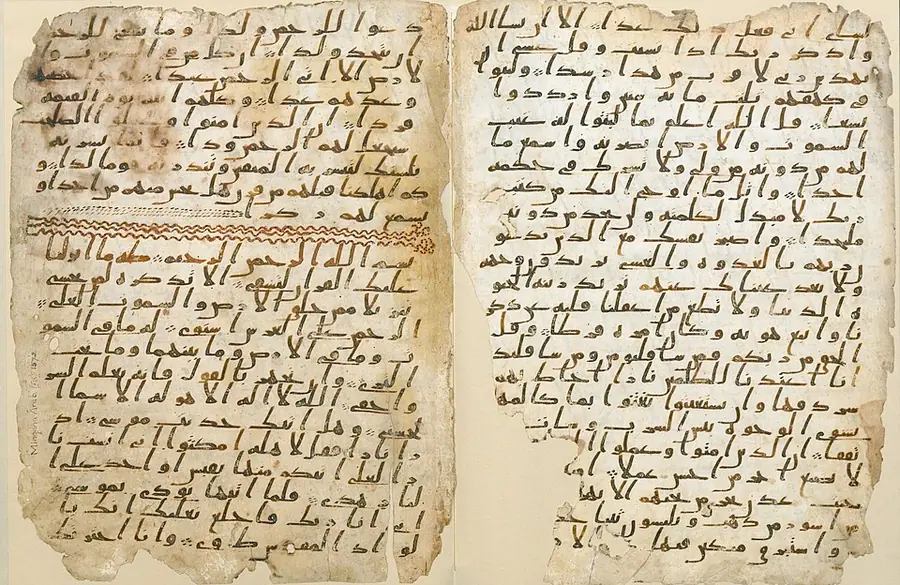
Until the 1970s the oldest Qur’an manuscripts were dated by the style of their script, a method with wide margins of error. Two developments changed that: the systematic study of the early fragments, many of them scattered among libraries in Europe, Russia and the Middle East, and radiocarbon testing of their parchment.[11]
The earliest copies share three features. They are written in a slanting script called ḥijāzī or in early kufic; they mark few or none of the dots that distinguish Arabic letters of the same shape, and no short vowels; and they divide verses with clusters of strokes rather than numbers. The text they record is therefore the consonantal skeleton (rasm), which the reader had to voice from memory or teaching.[11][12] Consensus
Birmingham and Paris
In 2015 the University of Birmingham announced that two leaves in its Mingana collection had been radiocarbon dated by the Oxford Radiocarbon Accelerator Unit to 568–645 CE, with 95.4% probability. They are written in ḥijāzī script and contain parts of sūras 18–20.[13] Consensus on the result. The leaves had been noticed by a doctoral researcher, Alba Fedeli, and were soon recognised as part of the same manuscript as sixteen leaves in the Bibliothèque nationale de France, catalogued as Arabe 328(c) and bound with the larger Codex Parisino-petropolitanus, which François Déroche studied in 2009.[13][12] Consensus
The Ṣanʿāʾ palimpsest
In 1972, workers restoring the Great Mosque of Ṣanʿāʾ in Yemen found a loft packed with damaged parchment and paper: the remains of thousands of Qur’an manuscripts. Among them is a palimpsest, a manuscript whose first text was washed off and written over. The upper text is the standard Qur’an. The lower text, recovered with ultraviolet imaging, is a Qur’an too, but a different one: it orders some sūras differently and has many variant words and phrases.[14][15][16] Consensus
A leaf of it sold at auction and later tested gave a date of 578–669 CE (95%).[17] Behnam Sadeghi and Mohsen Goudarzi argue that the lower text is the only surviving manuscript of a non-ʿUthmānic text type, comparable to the codices the tradition attributes to companions of the Prophet such as Ibn Masʿūd, and that its variants are mostly the kind that arise in oral transmission.[17][15] Majority Asma Hilali, editing both layers, reads the lower text as a teaching or practice copy rather than a rival codex.[16] Contested on what the lower text was.
Tübingen and others
In 2014 the University of Tübingen announced that a fragment in its library, Ma VI 165, in kufic script, had been dated by a laboratory in Zürich to 649–675 CE (above 95%).[18] Consensus on the result. Other early leaves have since been tested in Berlin, Leiden, Paris and elsewhere, many in connection with the project Corpus Coranicum of the Berlin-Brandenburg Academy of Sciences, which since 2007 has been photographing and transcribing the early manuscripts.[11]
What carbon dating can and cannot show
Radiocarbon tests the death of the animal whose skin became the parchment. It does not date the ink. Parchment could be stored for some years before use, and the statistical ranges are wide: a result of 568–645 means the animal most likely died somewhere in those 77 years, not that the leaf was written in 568.[13] Déroche has warned that radiocarbon results for Qur’an manuscripts have sometimes come out earlier than other evidence allows, and prefers to combine them with the study of script and orthography.[11] Majority The careful conclusion is the cumulative one: several independent leaves from different manuscripts fall in the first half-century of Islam. Consensus
One written archetype
Marijn van Putten showed in 2019 that the early manuscripts share not only their words but their spelling quirks. The phrase “the grace of God” (niʿmat Allāh), for example, is spelled in two different ways in different places, and the manuscripts agree on which way in which place. Scribes copying independently, or writing from memory, would not reproduce such arbitrary choices; scribes copying a single written exemplar would.[19] Majority All the early manuscripts except the Ṣanʿāʾ lower text therefore descend from one written copy, most plausibly the standard text the tradition credits to ʿUthmān (r. 644–656). The Birmingham leaves already belong to that family.[19]
What the manuscripts do not show is the reading of the text in full. The vowels, and many of the dots, were supplied by readers, and the tradition preserves several accepted ways of reciting the same consonants (qirāʾāt), standardised as seven by Ibn Mujāhid in the tenth century (§3). Consensus
The biographies: sīra and maghāzī
The first Muslims to collect stories about Muhammad’s life were scholars of the generation after the companions. ʿUrwa ibn al-Zubayr (d. c. 712), a nephew of ʿĀʾisha, is credited with accounts of the Prophet’s campaigns (maghāzī), known only from quotations in later books; Ibn Shihāb al-Zuhrī (d. 742) collected more.[20][5] Majority
The first full biography was written by Muḥammad ibn Isḥāq (d. 767) for the early Abbasid court. It does not survive as he wrote it. It is known mainly through the abridged and edited version of Ibn Hishām (d. 833), who says he left out material he thought unsuitable, and through extracts quoted by al-Ṭabarī (d. 923) and others.[4][5] Consensus Other early works followed: al-Wāqidī’s Campaigns (d. 823) and the biographical dictionary of his secretary Ibn Saʿd (d. 845).
The historian’s questions about these books are of three kinds:
- Distance. Ibn Isḥāq wrote about 120 years after Muhammad’s death, roughly as far from him as a writer today is from the First World War, but without written sources from the period except the Qur’an and a few documents. Consensus
- Purpose. Stories explaining when and why a verse was revealed (asbāb al-nuzūl) were needed by commentators, and some appear to have been built from the verse itself. Patricia Crone and others argued that much of the sīra is exegesis presented as history.[21] Contested
- Development. Comparing versions of the same story across generations shows them gaining detail, names and miracles over time. Andreas Görke and Gregor Schoeler, working back from the later compilations, argue that a core of reports can be traced to ʿUrwa in the late seventh century, a generation after Muhammad.[20] Majority
The result is a broad but not universal agreement: the outline of Muhammad’s life (Mecca, the emigration to Medina in 622, the wars with Mecca, the return in 630, death in 632) is accepted by most historians, while individual episodes, speeches and dates are judged case by case (§2).[22][5] Majority
The hadith and the isnād
A hadith (ḥadīth, “report”) is an account of something the Prophet said, did or approved, introduced by a chain of transmitters, the isnād: “A told me that B told him that C said, I heard the Messenger of God say…”. Hadith became, after the Qur’an, the second source of Islamic law and belief (§6).[6] Consensus
The Muslim science of hadith
Muslim scholars knew early that reports were being invented, for political, sectarian or pious reasons. From the eighth century they developed a science of hadith criticism: biographical dictionaries assessing each transmitter’s reliability, rules for continuous chains, and grades from ṣaḥīḥ (“sound”) through ḥasan (“good”) to ḍaʿīf (“weak”) and mawḍūʿ (“fabricated”).[6] Consensus The great collections, above all those of al-Bukhārī (d. 870) and Muslim (d. 875), were made with these tools, and Sunni Muslims came to regard them as the most authoritative books after the Qur’an. Shia Muslims rely on their own collections, transmitted through the imams.[23][6] Consensus
The sceptical turn
Western scholarship took a different view. Ignaz Goldziher, a Hungarian Jewish scholar who had studied at al-Azhar, argued in 1890 that most hadith reflected the legal, political and theological debates of the eighth and ninth centuries rather than the time of the Prophet.[24] Joseph Schacht went further in 1950: tracing legal hadith, he concluded that isnāds “grew backwards”, attributing opinions first to later scholars, then to companions, and finally to the Prophet himself, and that few if any legal hadith were authentic.[25] Majority that this was the dominant Western view for a generation.
Dating traditions
Later scholars tried to date reports rather than accept or reject them wholesale. G. H. A. Juynboll noticed that the chains of many hadith converge on a single transmitter, the common link, and argued that this person was probably the one who put the report into circulation.[26] Harald Motzki, analysing an early collection compiled by ʿAbd al-Razzāq of Ṣanʿāʾ (d. 827), showed that its material had been transmitted, not invented, by identifiable teachers in Mecca in the late seventh and early eighth century. His method, comparing both chains and wording (isnād-cum-matn analysis), has traced some reports to the generation after the companions.[27] Majority
Where this leaves the field: almost no historian now holds either that the canonical collections preserve the Prophet’s words as a whole, or that they preserve nothing. Each report is a separate question of dating, and many can be placed no earlier than the late seventh or early eighth century. Majority Muslim scholars such as Jonathan A. C. Brown, writing from inside the tradition and in dialogue with this scholarship, argue that the classical critics anticipated many of the sceptics’ methods.[6] Contested
Outside witnesses: what Christians and Jews wrote
The conquests of the 630s fell on societies with long traditions of writing. Robert Hoyland’s collection Seeing Islam as Others Saw It (1997) gathers more than a hundred Christian, Jewish and Zoroastrian texts from the first Islamic century and a half. They are hostile or puzzled more often than not, and they were rarely interested in Arab religion; but they are early, and they did not depend on the Muslim tradition.[7] Consensus
The Teaching of Jacob, 634
The Doctrina Jacobi, a Greek dialogue between Jews and a converted Jew in Carthage, is set in the summer of 634. In it a Jew of Palestine reports a letter from his brother: the Romans’ commander has been killed by the Saracens, and “a prophet has appeared, coming with the Saracens”, who proclaims the coming of the anointed one. An old man learned in the scriptures tells the brother that the prophet is false, “for the prophets do not come armed with a sword”.[28] Most scholars date the text to 634 or very soon after. Majority It is the earliest surviving reference to a prophet among the Arab conquerors, from within two years of the traditional date of Muhammad’s death.[7][29]
Thomas the Presbyter, c. 640
A Syriac chronicle by a priest named Thomas, written about 640 and preserved in a manuscript copied in 724, records:
“On Friday 4 February [634] at the ninth hour, there was a battle between the Romans and the Arabs of Muhammad (ṭayyāyē d-Mḥmṭ) in Palestine twelve miles east of Gaza.”[30]
It is the earliest datable text to name Muhammad. Consensus
Sebeos, 660s
The Armenian history attributed to Sebeos, finished soon after 661, describes a man of the sons of Ishmael called Mahmet, a merchant, who preached to the Arabs and taught them to know the God of Abraham, drawing on the story of Moses; it then tells of the conquests.[31][7] Majority on the date and reading.
Why they matter, and where they differ
The outside witnesses confirm the outline of the tradition: an Arab prophet, a monotheist preaching in Abraham’s name, conquests launched in his name in the 630s. Consensus They also differ from it in places. The Doctrina and several later Christian, Jewish and Samaritan texts appear to place the prophet alive at the start of the invasion of Palestine, in 634, two years after the Muslim date of his death; Stephen Shoemaker argues that this may preserve an early tradition later revised.[29] Most historians keep the date of 632 and read the outside reports as loose or second-hand. Contested
Inscriptions, coins and papyri
Documents are the one kind of evidence from the first Islamic century that carry their own dates. They are short and practical, but they show when particular words, names and beliefs entered public use.[7][32]
| Date | Document | What it shows |
|---|---|---|
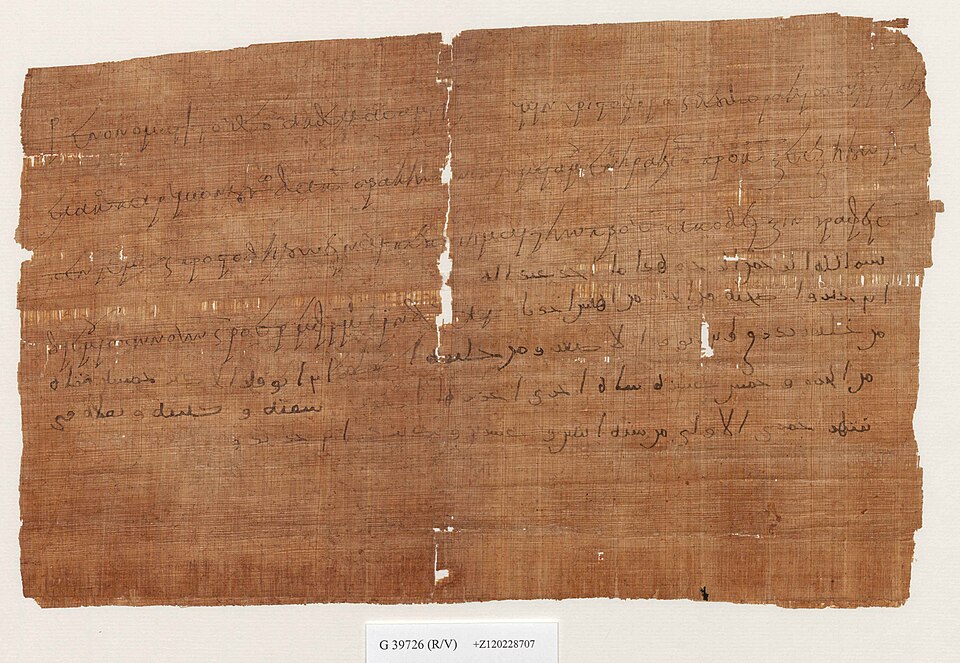
| 22 AH / 643 CE | PERF 558, a Greek–Arabic receipt for 65 sheep, Herakleopolis, Egypt[33] | The Hijri calendar in use; dotted Arabic letters; Arab troops called magaritai in Greek |
| 24 AH / 644–645 | The Zuhayr inscription, near al-ʿUlā, Arabia[34] | The earliest dated Islamic inscription; records “the time ʿUmar died” |
| 58 AH / 677–678 | The Ṭāʾif dam, built for “the servant of God Muʿāwiya, commander of the believers”[35] | The caliph’s titles; no mention of Muhammad |
| 66 AH / 685–686 | A silver drachm of Bīshāpūr, Iran, struck for a governor loyal to Ibn al-Zubayr[36] | The earliest dated Muslim text to name Muhammad: “In the name of God, Muhammad is the messenger of God” |
| 72 AH / 691–692 | The Dome of the Rock, Jerusalem[37] | Long Qur’anic passages in public; the name islām; an argument against the Trinity |
| 77 AH / 696–697 | ʿAbd al-Malik’s reformed gold coinage[38] | Images removed from coins; the creed, Qur’an 9:33 and sūra 112 on every coin |
Two patterns stand out. First, the dating system and the community’s leaders are visible from the 640s: a Hijri year on an Egyptian receipt within twenty-one years of the emigration to Medina, and a caliph’s death recorded on an Arabian rock. Consensus Second, Muhammad’s name enters official documents only in the 680s, in the civil war between ʿAbd al-Malik and Ibn al-Zubayr, and then everywhere: on coins, milestones and the Dome of the Rock.[7][22] Consensus on the dates; Contested on what the earlier silence means. Some read it as the sign of a religion still defining itself; most think it reflects the kind of document that happens to survive from a small, newly conquering elite (§5).
Revisionism and after
In 1977 two books appeared that set the agenda for a generation.
- John Wansbrough, Quranic Studies, applied the methods of biblical form criticism to the Qur’an and argued that it was assembled from separate traditions in Iraq over a long period, and did not reach its canonical form until about 800.[39]
- Patricia Crone and Michael Cook, Hagarism, set the Muslim sources aside and tried to rebuild the origins of Islam from non-Muslim texts, proposing a messianic movement allied with Jews, centred on Jerusalem rather than Mecca.[40]
Crone’s Meccan Trade and the Rise of Islam (1987) then questioned the traditional picture of Mecca as a great caravan city (§1).[21] The “revisionists” did not agree with one another, and Hagarism’s specific reconstruction found few followers; but they established that the traditional account had to be tested rather than assumed.[2] Consensus
The evidence since has moved the field in two directions at once. The radiocarbon results and the analysis of manuscripts make Wansbrough’s late canon untenable: the Qur’an was a written text within a few decades of Muhammad, not two centuries.[19][8] Majority At the same time, the source criticism of the sīra and hadith has largely held: the stories about Muhammad’s life are treated as later layers, valuable but not transparent.[5][22] Majority
| View | Main argument | Representative scholars |
|---|---|---|
| Traditional | The sīra and the sound hadith preserve the Prophet’s life and words, checked by the science of transmitters | Classical Muslim scholarship; Jonathan Brown on its methods[6] |
| Sceptical (1970s–80s) | The narrative sources are late reconstructions; only external evidence is reliable; the canon formed late | Wansbrough, Crone and Cook[39][40] |
| Current mainstream | The Qur’an is early and the best guide to Muhammad’s message; the biographies preserve a core that can be partly dated; external sources confirm the outline | Donner, Sinai, Neuwirth, Schoeler, Motzki[22][8][9][5][27] |
| Revised chronology | Early Islam was more open, apocalyptic or ecumenical than the tradition remembers, and its boundaries hardened under ʿAbd al-Malik | Donner’s “Believers”, Shoemaker[22][29] |
The evidence ledger
| Date | Evidence | Confidence |
|---|---|---|
| 568–645 | Birmingham Qur’an leaves (radiocarbon, 95.4%)[13] | Consensus (test result) |
| 578–669 | A leaf of the Ṣanʿāʾ palimpsest (radiocarbon, 95%)[17] | Consensus (test result) |
| 634 | Doctrina Jacobi: “a prophet has appeared, coming with the Saracens”[28] | Majority (date) |
| c. 640 | Thomas the Presbyter: “the Arabs of Muhammad”[30] | Consensus |
| 643 | PERF 558, the earliest dated Arabic papyrus[33] | Consensus |
| 644–645 | The Zuhayr inscription, on ʿUmar’s death[34] | Consensus |
| 649–675 | Tübingen fragment Ma VI 165 (radiocarbon)[18] | Consensus (test result) |
| soon after 661 | Sebeos: Mahmet the merchant teaches the God of Abraham[31] | Majority |
| 685–686 | First dated Muslim text naming Muhammad, a coin of Bīshāpūr[36] | Consensus |
| 691–692 | Dome of the Rock inscriptions[37] | Consensus |
| 750s–760s | Ibn Isḥāq’s biography, surviving through Ibn Hishām (d. 833)[4] | Consensus |
| 9th c. | The hadith collections of al-Bukhārī (d. 870) and Muslim (d. 875)[23] | Consensus |
| early 14th c. | Rashīd al-Dīn’s Jāmiʿ al-tawārīkh, Edinburgh: among the earliest surviving paintings of Muhammad[41] | Consensus |
Faith and history: what historians can and cannot say
Historians can say when a text was written down, by what kind of people, out of what earlier material, and for what purpose. They can say what the first Muslims believed and when a belief is first attested. They cannot say whether the Qur’an is the word of God, or whether Muhammad received revelation. Those questions are outside the reach of historical method, in either direction.
The clearest case is the Qur’an itself. That a recited text attributed to Muhammad was fixed in writing within a generation of his death is among the best-supported conclusions in the field.[8][19] Majority For Muslims that agrees with the belief that the text was preserved from the moment of revelation; for others it shows only that the text is early. Both readings are compatible with the evidence, and this series does not choose between them.
Three further points of method:
- Muslim and non-Muslim scholars do the same history. Many of the scholars cited in this series are Muslims; many are not; their conclusions do not divide neatly along that line. Where a view is held mainly by believers or mainly by sceptics, the series says so.
- Tradition is evidence too. The Muslim tradition’s memory, from ʿUrwa to al-Ṭabarī, is reported as what it says, with its date, and weighed like any other source. It is often confirmed, and sometimes contradicted, by earlier evidence.
- Silence is weak evidence. Most of seventh-century Arabia left no written trace at all. That a person or event is missing from the few surviving documents is what would be expected, not proof that it did not exist (§2).
Images of Muhammad in this series
Islamic tradition has long discouraged images of living beings in religious settings, and most Muslims today regard depicting Muhammad as forbidden. The tradition was never uniform. From the early fourteenth century, painters in Persian, Turkic and later Mughal courts illustrated histories and biographies that showed the Prophet, first with his face visible, as in Rashīd al-Dīn’s Compendium of Chronicles (Jāmiʿ al-tawārīkh), copied in Tabriz in the early fourteenth century, in Rashīd al-Dīn’s lifetime; later, as in the Ottoman Siyer-i Nebi completed in 1595, with his face veiled.[41][42] Consensus
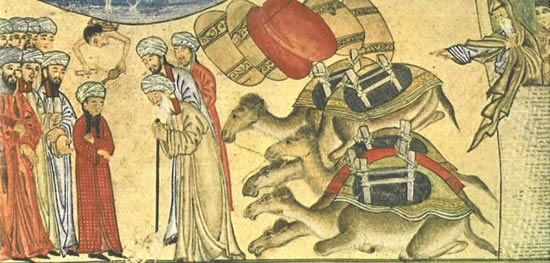
This series shows such historical paintings only inside chapters, as works of art history, with their date, workshop and collection, and never as a page’s main image or social card. It uses no modern depictions.
What “Islam” means in this series
The Arabic islām means “submission” or “surrender” to God, and muslim one who submits. Both words are in the Qur’an, which also calls its hearers “the believers” (al-muʾminūn) far more often.[22] Consensus The Dome of the Rock in 691–692 quotes the verse “the religion with God is islām” (3:19) in public, and from the reign of ʿAbd al-Malik onward the name and the boundaries of the community are clear.[37][43] Consensus Whether the earliest community already saw itself as a separate religion, or as an open movement of believers that included pious Jews and Christians, is debated (§5).[22] Contested The series says “Muslims” and “Islam” from the beginning, as the sources do, and marks where the question matters.
Reading conventions used throughout
- Dates are CE, with the Hijri year (AH, “after the hijra”) added for documents dated that way and for a few anchor events. The Hijri year 1 began in 622 CE. Ranges are given where dates are uncertain, with a confidence tag.
- Arabic appears in italic transliteration with macrons and the marks ʿ (ʿayn) and ʾ (hamza), then translation, then what the passage is used to prove. Familiar words keep their usual English spelling in running prose: Qur’an, hadith, Shia, Sunni, caliph, Mecca, Medina.
- The Qur’an is cited by sūra and verse in the standard Cairo numbering (e.g. 30:2–4). Each chapter names the translation it quotes, usually M. A. S. Abdel Haleem’s (Oxford, 2004); where none is named, as in this chapter, the translation is the site’s own, close to standard English versions.
- God and Allah. Translations say “God”. “Allah” is used only where the Arabic word itself is the subject.
- Honorifics. Muslims follow Muhammad’s name with ṣallā llāhu ʿalayhi wa-sallam, “may God bless him and grant him peace” (ﷺ; in English often “pbuh”). As in academic writing, the narrative leaves them out; quotations keep them where the original has them.
- Islamist is used for political movements that seek a state governed by Islamic law, never for Muslims in general.
- Confidence tags: Consensus Majority Contested Speculative Political
Primary sources
Show the 8 primary sources
1. The prophet with the Saracens: Doctrina Jacobi V.16, set in 634
(Greek; standard edition by Gilbert Dagron and Vincent Déroche, 1991)
“And they were saying that the prophet had appeared, coming with the Saracens, and that he was proclaiming the advent of the anointed one who was to come… [The old man said:] ‘He is false, for the prophets do not come armed with a sword… He says also that he has the keys of paradise, which is incredible.’”[28]
What it proves. That within two years of 632, Jews and Christians in Palestine knew of a prophet associated with the Arab invaders and believed he preached a coming judgment or messiah. It is a Christian polemic, written to convert Jews, so its description is second-hand and hostile. It is also the main text behind the argument that the prophet was thought to be alive in 634 (see Debates). Majority on the date; Contested on what it implies about Muhammad’s death.
2. “The Arabs of Muhammad”: Thomas the Presbyter, c. 640
ṭayyāyē d-Mḥmṭ
“In the year 945, indiction 7, on Friday 4 February at the ninth hour, there was a battle between the Romans and the Arabs of Muhammad in Palestine twelve miles east of Gaza. The Romans fled, leaving behind the patrician, whom the Arabs killed. Some 4,000 poor villagers of Palestine were killed there, Christians, Jews and Samaritans.”[30]
What it proves. That a Syrian Christian about 640 knew the invaders as the followers of a man named Muhammad, and could date one of their first battles to the day (4 February 634 in the Julian calendar). It confirms the name and the timing of the conquest of Palestine. Consensus
3. The first dated Arabic papyrus: PERF 558, 22 AH / 643 CE
“In the name of God, the Merciful, the Compassionate. This is what ʿAbd Allāh ibn Jābir and his companions took as slaughter sheep from Herakleopolis… fifty sheep as slaughter sheep and fifteen other sheep… for his vessels, his cavalry and his breastplated infantry… in Jumādā the first of the year twenty-two.”[33]
What it proves. That twenty-one years after the hijra, Arab commanders in Egypt dated official documents by the Hijri era, opened them with the basmala, and wrote Arabic with diacritical dots. The Greek half calls the Arab troops magaritai, probably from muhājirūn, “emigrants”. Consensus on the text; Majority on the meaning of magaritai.
4. “The time ʿUmar died”: the Zuhayr inscription, 24 AH / 644–645
bism Allāh / anā Zuhayr katabtu zamān / tuwuffiya ʿUmar sanat arbaʿ / wa-ʿishrīn
“In the name of God. I, Zuhayr, wrote [this] at the time ʿUmar died, in the year four and twenty.”[34][32]
What it proves. That the second caliph, ʿUmar, died in or about 24 AH, the year the tradition gives, and that the Hijri era was in private as well as official use in Arabia by then. Its letters already carry some dots. Consensus
5. Muhammad named on a coin: Bīshāpūr, 66 AH / 685–686
bism Allāh / Muḥammad rasūl / Allāh
“In the name of God, Muhammad is the messenger of God.”[36]
What it proves. The earliest dated Muslim document to name Muhammad. It was struck in Iran on a Sasanian-style coin, with a Persian king’s bust and a fire altar, for a governor of ʿAbd Allāh ibn al-Zubayr, ʿAbd al-Malik’s rival in the second civil war. Proclaiming the Prophet became a way of claiming legitimacy (§5). Consensus
6. The Dome of the Rock, 72 AH / 691–692
bism Allāh al-raḥmān al-raḥīm / lā ilāha illā llāh waḥdahu lā sharīka lahu…
“In the name of God, the Merciful, the Compassionate. There is no god but God alone; He has no partner… O People of the Book, do not go beyond the bounds in your religion, and say nothing but the truth about God. The Messiah, Jesus son of Mary, was only a messenger of God and His word… Do not say ‘Three’. Refrain; it is better for you. God is only one God.”[37][44]
What it proves. That by 691–692 long passages of the Qur’an, in the form known today, were displayed in public, in a building raised in Christian Jerusalem, addressed to Christians about the nature of Jesus. The founder’s name was later replaced by that of the Abbasid caliph al-Maʾmūn (r. 813–833), who left the date unchanged. Consensus
7. “Only a messenger”: Qur’an 3:144
wa-mā Muḥammadun illā rasūlun qad khalat min qablihi l-rusul…
“Muhammad is only a messenger; messengers have passed away before him. If he dies or is killed, will you turn back on your heels?”[3]
What it proves. One of the four places the Qur’an names Muhammad, and typical of how it speaks of him: as a messenger in a line of messengers, mortal, not as the subject of a narrative. The tradition says Abū Bakr recited this verse to the believers on the day Muhammad died; that story is later. Consensus on the text.
8. “The Romans have been defeated”: Qur’an 30:2–4
ghulibati l-rūmu fī adnā l-arḍi wa-hum min baʿdi ghalabihim sa-yaghlibūna fī biḍʿi sinīn
“The Romans have been defeated in the nearest land, and after their defeat they will be victorious within a few years.”[10]
What it proves. The Qur’an’s only explicit reference to a contemporary event that can be checked: the Persian conquest of Byzantine Syria and Palestine in 613–614, with a prediction of recovery that came in the 620s. It places the passage, on any reading, in the years of the last great war between Rome and Persia (§1). An old variant reading reverses the verbs (“have conquered… will be defeated”), which shows how the unvoweled text could be read in more than one way. Majority
What is absent
- A seventh-century biography. No account of Muhammad’s life written in his century survives; the earliest are quotations from ʿUrwa (d. c. 712) and the edited text of Ibn Isḥāq (d. 767). Consensus
- A dated Qur’an manuscript. No Qur’an of the first Islamic century carries a date or a colophon. The early copies are dated by radiocarbon, script and spelling. Consensus
- Muhammad’s name on a dated Muslim document before 685–686. Outside writers name him from about 640; Muslim documents of the 640s–670s name God and the caliph, not the Prophet. Consensus on the fact; Contested on its meaning.
- Mecca in a datable outside source before the conquests. Mecca is named in the Qur’an (48:24) and in later Muslim sources; no pre-Islamic inscription or Greek or Syriac text securely names it (§1). Majority
- The hadith collections and the schools of law. These are products of the eighth and ninth centuries (§6), even where they preserve older material. Consensus
Debates
How early was the Qur’an fixed?
| View | Main argument | Main proponents |
|---|---|---|
| Under ʿUthmān, c. 650 (the tradition, and the current majority) | Radiocarbon dates; one written archetype; the Ṣanʿāʾ lower text shows that other codices circulated beside it | Sinai, Sadeghi, van Putten[8][15][19] |
| Under ʿAbd al-Malik, c. 690–700 | Muhammad’s name and the Qur’an’s words appear in public only then; reports that al-Ḥajjāj revised the text | Some revisionists; Shoemaker sees a longer process[29] |
| Much later, c. 800 | Form-critical analysis of the text’s composition | Wansbrough[39] |
The manuscript evidence has made the latest view untenable and the middle one a minority position. Majority
How much of the sīra is history?
Most historians accept the outline and the major events; some argue that much of the detail grew out of Qur’an commentary and later politics.[21][5][20] Contested on how much detail survives.
Did Muhammad die in 632?
The Muslim tradition is unanimous for 632. Several early non-Muslim texts appear to describe the prophet as alive and leading the invasion of Palestine in 634–635. Shoemaker argues that this preserves an early belief; most historians think the outside writers simply conflated the prophet with the movement he founded.[29][7] Contested
Further reading
Show further reading (9 works)
- Fred M. Donner, Narratives of Islamic Origins: The Beginnings of Islamic Historical Writing (Darwin, 1998): how the Muslim historical tradition was formed.
- Robert G. Hoyland, Seeing Islam as Others Saw It (Darwin, 1997): the non-Muslim sources, translated and discussed.
- Chase F. Robinson, Islamic Historiography (Cambridge, 2003): a short guide to the historical sources.
- Nicolai Sinai, The Qur’an: A Historical-Critical Introduction (Edinburgh, 2017): the Qur’an as a historical text, from the current mainstream.
- François Déroche, Qur’ans of the Umayyads (Brill, 2014): the early manuscripts.
- Jonathan A. C. Brown, Hadith: Muhammad’s Legacy in the Medieval and Modern World (Oneworld, 2009): the hadith and their critics, Muslim and Western.
- Gregor Schoeler, The Biography of Muhammad: Nature and Authenticity (Routledge, 2011).
- Patricia Crone and Michael Cook, Hagarism (Cambridge, 1977), and John Wansbrough, Quranic Studies (Oxford, 1977): the revisionist challenge, to be read with the replies above.
- Stephen J. Shoemaker, The Death of a Prophet (Pennsylvania, 2012): the case from the non-Muslim sources.
References
- ^ Chase F. Robinson Islamic Historiography. Cambridge University Press, 2003. A short guide to the Arabic historical tradition and how it was made.
- ^ a b c Fred M. Donner Narratives of Islamic Origins: The Beginnings of Islamic Historical Writing. Darwin Press, 1998. How the Muslim historical tradition formed, and a survey of the sceptical approaches.
- ^ a b c Qurʾan 3:144 — Qurʾan, Sūrat Āl ʿImrān. 7th c. CE. Arabic. 'Muhammad is only a messenger; messengers have passed away before him': one of four places the Qur'an names Muhammad. read the text
- ^ a b c Ibn Isḥāq, Sīrat Rasūl Allāh — The Life of Muhammad (recension of Ibn Hishām). mid-8th c. CE (Ibn Hishām's recension, early 9th c.). Arabic. The earliest surviving Muslim biography of Muhammad; source for his alliance and conflicts with the Jewish tribes of Medina (Qaynuqāʿ, Naḍīr, Qurayẓa) and the conquest of Khaybar. about
- ^ a b c d e f g Gregor Schoeler The Biography of Muhammad: Nature and Authenticity. Routledge, 2011. How the sīra was transmitted and what can be traced early.
- ^ a b c d e f Jonathan A. C. Brown Hadith: Muhammad's Legacy in the Medieval and Modern World. Oneworld, 2009. The hadith and their critics, Muslim and Western.
- ^ a b c d e f g Robert G. Hoyland Seeing Islam as Others Saw It: A Survey and Evaluation of Christian, Jewish and Zoroastrian Writings on Early Islam. Darwin Press, 1997. The non-Muslim sources of the first Islamic century and a half, translated and discussed.
- ^ a b c d e f g h Nicolai Sinai The Qur'an: A Historical-Critical Introduction. Edinburgh University Press, 2017. The Qur'an as a historical text, from the current mainstream.
- ^ a b Angelika Neuwirth Der Koran als Text der Spätantike: Ein europäischer Zugang. Verlag der Weltreligionen, 2010. The Qur'an read in its late antique setting.
- ^ a b Qurʾan 30:2–4 — Qurʾan, Sūrat al-Rūm. 7th c. CE. Arabic. 'The Romans have been defeated in the nearest land…': the Qur'an's one checkable reference to a contemporary event, the Persian conquest of 613–614. read the text
- ^ a b c d François Déroche Qur'ans of the Umayyads: A First Overview. Brill, 2014. The early manuscripts and how they are dated.
- ^ a b François Déroche La transmission écrite du Coran dans les débuts de l'islam: le codex Parisino-petropolitanus. Brill, 2009. The largest early Qur'an codex, studied leaf by leaf.
- ^ a b c d Birmingham Qur'an manuscript (Cadbury Research Library, Mingana Islamic Arabic 1572a) — Two parchment leaves of the Qur'an, suras 18–20. parchment radiocarbon 568–645 CE. Arabic. Two ḥijāzī-script leaves radiocarbon dated by the Oxford Radiocarbon Accelerator Unit to 568–645 CE (95.4%); part of the same codex as Paris BnF Arabe 328(c). about
- ^ Ṣanʿāʾ 1 palimpsest (Dār al-Makhṭūṭāt, DAM 01-27.1) — Qur'an palimpsest from the Great Mosque of Ṣanʿāʾ. 7th c. CE (lower text). Arabic. Found in 1972; the erased lower text is a non-ʿUthmānic Qur'an with variant wording and sura order, overwritten with the standard text. about
- ^ a b c Behnam Sadeghi and Mohsen Goudarzi Ṣanʿāʾ 1 and the Origins of the Qurʾān. Der Islam 87, 2012. Transcription of the lower text and the case that it is a non-ʿUthmānic companion codex.
- ^ a b Asma Hilali The Sanaa Palimpsest: The Transmission of the Qur'an in the First Centuries AH. Oxford University Press, 2017. Edition of both layers, reading the lower text as a teaching copy.
- ^ a b c Behnam Sadeghi and Uwe Bergmann The Codex of a Companion of the Prophet and the Qurʾān of the Prophet. Arabica 57, 2010. Radiocarbon date and analysis of a leaf of the Ṣanʿāʾ palimpsest.
- ^ a b Tübingen University Library, Ma VI 165 — Kufic Qur'an fragment. parchment radiocarbon 649–675 CE. Arabic. Fragment acquired from the Wetzstein collection in 1864, radiocarbon dated in Zürich to 649–675 CE (above 95%), announced 2014. about
- ^ a b c d e Marijn van Putten 'The Grace of God' as Evidence for a Written Uthmanic Archetype: The Importance of Shared Orthographic Idiosyncrasies. Bulletin of the School of Oriental and African Studies 82, 2019. Shared spelling quirks show the early manuscripts descend from one written copy.
- ^ a b c Andreas Görke and Gregor Schoeler Die ältesten Berichte über das Leben Muḥammads: Das Korpus ʿUrwa ibn az-Zubair. Darwin Press, 2008. Reconstructs the reports attributed to ʿUrwa ibn al-Zubayr.
- ^ a b c Patricia Crone Meccan Trade and the Rise of Islam. Princeton University Press, 1987. Questions Mecca's trade and the reliability of the sīra's detail.
- ^ a b c d e f g Fred M. Donner Muhammad and the Believers: At the Origins of Islam. Belknap Press of Harvard University Press, 2010. Islam's origins in the early seventh-century preaching of Muhammad.
- ^ a b al-Bukhārī, al-Jāmiʿ al-ṣaḥīḥ — Ṣaḥīḥ al-Bukhārī. compiled before 870 CE. Arabic. The most authoritative Sunni hadith collection, made with the classical tools of isnād criticism. read the text
- ^ Ignaz Goldziher Muhammedanische Studien, vol. 2. Max Niemeyer, 1890. The founding critique of the hadith as evidence for the first century.
- ^ Joseph Schacht The Origins of Muhammadan Jurisprudence. Clarendon Press, 1950. Legal hadith and the argument that isnāds 'grew backwards'.
- ^ G. H. A. Juynboll Muslim Tradition: Studies in Chronology, Provenance and Authorship of Early Ḥadīth. Cambridge University Press, 1983. The common-link method for dating hadith.
- ^ a b Harald Motzki The Origins of Islamic Jurisprudence: Meccan Fiqh before the Classical Schools. Brill, 2002. Isnād-cum-matn analysis tracing material in ʿAbd al-Razzāq's collection to the late seventh century (German original 1991).
- ^ a b c Doctrina Jacobi nuper baptizati V.16 — Teaching of Jacob, Newly Baptised. set in 634 CE; written c. 634. Greek. A Jew reports that 'a prophet has appeared, coming with the Saracens', who claims the keys of paradise; the earliest reference to the prophet of the conquerors. about
- ^ a b c d e Stephen J. Shoemaker The Death of a Prophet: The End of Muhammad's Life and the Beginnings of Islam. University of Pennsylvania Press, 2012. The non-Muslim reports of the prophet alive at the conquest of Palestine.
- ^ a b c Thomas the Presbyter, Chronicle (British Library Add. MS 14,643) — Syriac Chronicle of 640. c. 640 CE (manuscript copied 724). Syriac. Records a battle on 4 February 634 between the Romans and 'the Arabs of Muhammad' twelve miles east of Gaza: the earliest datable text to name Muhammad. about
- ^ a b History attributed to Sebeos (trans. R. W. Thomson and J. Howard-Johnston, 1999) — Armenian History. soon after 661 CE. Armenian. Describes Mahmet, a merchant of the sons of Ishmael, who taught the Arabs the God of Abraham, followed by an account of the conquests. about
- ^ a b ʿAli Ibrahim Ghabban, trans. Robert G. Hoyland The inscription of Zuhayr, the oldest Islamic inscription (24 AH/AD 644–645). Arabian Archaeology and Epigraphy 19, 2008. Edition and discussion of the earliest dated Islamic inscription.
- ^ a b c PERF 558 (Austrian National Library, Papyrus Erzherzog Rainer) — Greek–Arabic receipt from Herakleopolis. Jumādā I 22 AH / 25 April 643 CE. Arabic and Greek. Receipt by the commander ʿAbd Allāh ibn Jābir for 65 sheep; the earliest dated Arabic papyrus, dated by the Hijri era, with dotted letters; the Greek calls the Arabs magaritai. about
- ^ a b c Inscription of Zuhayr, Qāʿ al-Muʿtadil near al-ʿUlā — Rock graffito. 24 AH / 644–645 CE. Arabic. 'I, Zuhayr, wrote [this] at the time ʿUmar died in the year four and twenty': the earliest dated Islamic inscription, with dotted letters. about
- ^ Dam inscription of Muʿāwiya near al-Ṭāʾif — Building inscription. 58 AH / 677–678 CE. Arabic. Records the dam built for 'the servant of God Muʿāwiya, commander of the believers' in the year fifty-eight; names God and the caliph, not Muhammad. about
- ^ a b c Arab-Sasanian drachm of ʿAbd al-Malik ibn ʿAbd Allāh, Bīshāpūr (British Museum) — Silver coin. 66 AH / 685–686 CE. Arabic and Middle Persian. Margin legend 'bism Allāh Muḥammad rasūl Allāh': the earliest dated Muslim text to name Muhammad, struck for a Zubayrid governor. about
- ^ a b c d Dome of the Rock, inner arcade inscription — Foundation inscription of ʿAbd al-Malik. 72 AH / 691–692 CE. Arabic. Monumental kufic band of Qur'anic passages on God's oneness and Jesus as messenger (4:171, 3:18–19, 19:33–36), dated 72; the founder's name was later replaced by al-Maʾmūn's. about
- ^ Reformed gold dinar of ʿAbd al-Malik — Aniconic Umayyad coinage. 77 AH / 696–697 CE. Arabic. The first purely epigraphic coins: the shahāda and Qur'an 9:33 on the obverse, sura 112 on the reverse, the date and no images. about
- ^ a b c John Wansbrough Quranic Studies: Sources and Methods of Scriptural Interpretation. Oxford University Press, 1977. The form-critical case for a late, composite canon.
- ^ a b Patricia Crone and Michael Cook Hagarism: The Making of the Islamic World. Cambridge University Press, 1977. Origins reconstructed from non-Muslim sources alone.
- ^ a b Rashīd al-Dīn, Jāmiʿ al-tawārīkh (Edinburgh University Library, Or. MS 20) — Compendium of Chronicles. early 14th c. CE. Arabic. Illustrated copy from Rashīd al-Dīn's scriptorium in Tabriz with a cycle of paintings of Muhammad, among the earliest surviving. about
- ^ Siyer-i Nebi, Ottoman illustrated manuscript for Murad III — Life of the Prophet. completed 1595 CE. Ottoman Turkish. Six-volume illustrated life of Muhammad completed in 1595, with 814 miniatures in which the Prophet's face is veiled. about
- ^ Qurʾan 3:18–19 — Qurʾan, Sūrat Āl ʿImrān. 7th c. CE. Arabic. 'The religion with God is islām': quoted on the Dome of the Rock in 691–692. read the text
- ^ Qurʾan 4:171 — Qurʾan, Sūrat al-Nisāʾ. 7th c. CE. Arabic. 'Do not say "Three"… God is only one God': the verse on Jesus quoted on the Dome of the Rock. read the text