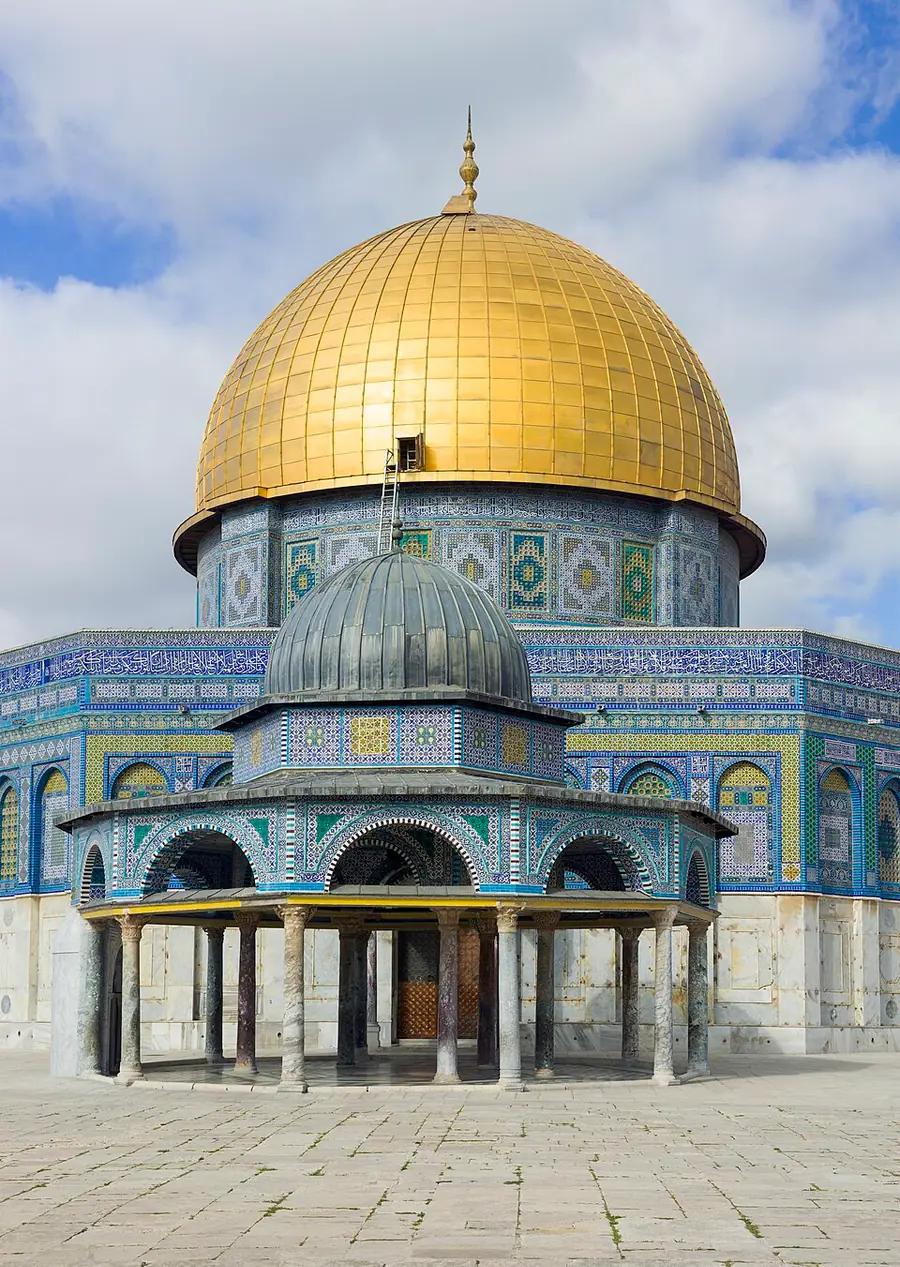
In 661, after the murder of ʿAlī ended the first civil war (§4), the governor of Syria, Muʿāwiya, became caliph and ruled from Damascus. He made the office hereditary, and his clan, the Umayyads, held it for ninety years. The dynasty’s first test was Karbalāʾ in 680, where its troops killed Muhammad’s grandson al-Ḥusayn, an event that created the Shia as a movement. Its second was a long civil war, which ended in 692 with the death of the rival caliph Ibn al-Zubayr in Mecca. The winner, ʿAbd al-Malik, made the empire look Islamic for the first time: the Dome of the Rock in Jerusalem, coins that named Muhammad and then carried only scripture, Arabic as the language of government, roads marked with Arabic milestones. His sons extended the empire to Spain and Sindh and built the great mosques of Damascus and Medina. Most of their subjects remained Christian, Jewish or Zoroastrian, and the status of non-Arab converts became one of the grievances that brought the dynasty down in 750. Majority
Almost all the narrative of this century comes from Arabic histories written under the Abbasids, the dynasty that overthrew the Umayyads and had every reason to paint them as worldly kings rather than pious caliphs (§0). The documents of the period, its inscriptions, coins, buildings and papyri, carry their own dates and are the main check on those histories.[1][2] Consensus This chapter leans on them wherever it can.
Timeline
| Date | Event or evidence | Confidence |
|---|---|---|
| 661 | ʿAlī murdered in Kufa; Muʿāwiya recognised as caliph and rules from Damascus[1] | Consensus |
| 662–663 | A Greek inscription at Hammat Gader names “the servant of God Muʿāwiya, commander of the believers”[3] | Consensus |
| 677–678 | The Ṭāʾif dam inscription, in Arabic, for “Muʿāwiya, commander of the believers” (§0)[4] | Consensus |
| 680 | Muʿāwiya dies; Yazīd succeeds; al-Ḥusayn killed at Karbalāʾ, 10 October[5] | Consensus |
| 683 | Umayyad army besieges Ibn al-Zubayr in Mecca; the Kaʿba burns; Yazīd dies[1] | Majority |
| 685 | The penitents (tawwābūn) are destroyed at ʿAyn al-Warda; al-Mukhtār takes Kufa[1] | Consensus |
| 685–686 | First dated Muslim coin naming Muhammad, struck in Iran for a Zubayrid governor (§0)[6] | Consensus |
| 691–692 | The Dome of the Rock completed, dated 72 AH[7] | Consensus |
| 692 | ʿAqaba road inscription of ʿAbd al-Malik; Mecca falls and Ibn al-Zubayr is killed[8][1] | Consensus |
| 693–697 | “Standing caliph” gold coins, 74–77 AH[9][10] | Consensus |
| 696–697 | Reformed dinar, 77 AH: no images, only creed and Qur’an[11] | Consensus |
| c. 697–700 | Arabic replaces Persian and Greek in the registers of Iraq and Syria[12] | Majority |
| 706–715 | al-Walīd I builds the Great Mosque of Damascus[13] | Consensus |
| 711–712 | Conquest of Spain begins; Muḥammad ibn al-Qāsim takes Sindh[14] | Consensus |
| 717–720 | ʿUmar II; his rulings on converts and taxes[15] | Majority |
| 732 | A raiding army defeated near Poitiers by Charles Martel[14] | Consensus |
| 747–750 | The Abbasid revolution, from Khurasan to the battle of the Zab[14] | Consensus |
Muʿāwiya and the making of a dynasty
A caliph in Syria
Muʿāwiya ibn Abī Sufyān belonged to the Umayya clan of Quraysh, the Meccan tribe that had opposed Muhammad until the conquest of Mecca. He had governed Syria for some twenty years when ʿAlī was murdered in 661, and he had fought him to a standstill at Ṣiffīn (§4). Syria became the centre of the empire, with an army loyal to him and an administration of Greek-speaking Christian officials, such as Sarjūn ibn Manṣūr, the father of John of Damascus.[1][14] Consensus
The outside sources see him as a ruler, not yet as the head of a new religion. A Syriac chronicle written by a Maronite Christian records that Muʿāwiya received the allegiance of the Arab chiefs at Jerusalem around 660, prayed at Christian holy places there, and “did not wear a crown like other kings”.[16][17] Majority A Greek inscription in the hot baths of Hammat Gader, near the Sea of Galilee, carved for a restoration in December 662 by a Christian official with a cross at its head, dates itself “in the days of the servant of God Muʿāwiya, the commander of the believers” and “according to the Arabs, the forty-second year”.[3] Consensus His Arabic dam inscription near al-Ṭāʾif, of 677–678, uses the same titles: “servant of God” and “commander of the believers” (§0).[4] Neither names Muhammad. Consensus
The hereditary principle
Muʿāwiya’s most consequential act was to have the leading men swear allegiance to his son Yazīd as his successor. The first four caliphs had not been followed by their sons. Later Muslim historians, writing under the Abbasids, made this the moment when the caliphate became mulk, mere kingship.[1] Majority that the designation was new; Contested on how much it was resented at the time.
Karbalāʾ and the first Shia movements
The death of al-Ḥusayn, 680
When Muʿāwiya died in April 680, al-Ḥusayn, the son of ʿAlī and of Muhammad’s daughter Fāṭima, refused to swear allegiance to Yazīd. Men of Kufa, ʿAlī’s old capital, wrote inviting him to lead them. He set out from Mecca with his family and a few dozen companions. The governor of Iraq, ʿUbayd Allāh ibn Ziyād, cut off Kufa and sent an army to stop him. At Karbalāʾ, on the Euphrates, the small company was surrounded, denied water and, on 10 Muḥarram 61 AH, 10 October 680, killed almost to a man. Al-Ḥusayn’s head was sent to Kufa and then to Damascus; the women and his surviving son ʿAlī were taken as captives.[5][1] Consensus on the event and its date.
The detailed story is known mainly from the Kufan historian Abū Mikhnaf (d. 774), whose account al-Ṭabarī preserved two centuries after the battle. It already has the shape of a martyrdom narrative, with dialogues, omens and the thirst of the children.[5][2] Majority that the outline is reliable and the detail shaped by later devotion.
The penitents and al-Mukhtār
Karbalāʾ turned a political loyalty into a religious one. In 684–685 several thousand Kufans who had failed to come to al-Ḥusayn’s aid called themselves the tawwābūn, “the penitents”, and marched out to die for their failure. Most of them did, at ʿAyn al-Warda in January 685.[1] Consensus Later that year al-Mukhtār ibn Abī ʿUbayd seized Kufa in the name of another son of ʿAlī, Muḥammad ibn al-Ḥanafiyya, whom he called al-mahdī, “the rightly guided one”, one of the earliest uses of the title for a redeemer. He hunted down the killers of Karbalāʾ and drew support from non-Arab converts, before being killed in 687.[1][14] Majority Some of his followers held that Ibn al-Ḥanafiyya had not died but was hidden and would return, an early form of the idea of the hidden imam that later Shia communities developed (§6). Majority
What Karbalāʾ became
Shīʿa means “party”: at first the party of ʿAlī and his descendants, as rightful leaders of the community. In this century it was a set of loyalties and revolts, not yet a separate community with its own law and theology; that came later (§6).[1] Majority The commemoration of al-Ḥusayn on ʿĀshūrāʾ, the tenth of Muḥarram, grew over centuries. Public processions of mourners in black are first recorded in Baghdad in 963, under the Buyid emirs, and the Persian passion plays, taʿziya, developed under the Safavids and Qajars.[18] Majority
The second civil war and Ibn al-Zubayr
After Karbalāʾ the more serious challenge came from Mecca. ʿAbd Allāh ibn al-Zubayr, son of one of Muhammad’s companions and nephew of ʿĀʾisha, refused allegiance to Yazīd and made the sanctuary his base. In 683 a Syrian army besieged Mecca, and the Kaʿba caught fire. Yazīd’s death that November broke off the siege, and for a decade Ibn al-Zubayr was recognised as caliph across most of the empire: the Ḥijāz, Iraq, Egypt and much of Iran.[1] Consensus Tradition says he rebuilt the Kaʿba on a larger plan, which his enemies later reversed. Majority
In Syria the Umayyads survived only by a narrow victory at Marj Rāhiṭ in 684, which put the older Umayyad Marwān ibn al-Ḥakam on the throne; on his death in 685 his son ʿAbd al-Malik succeeded.[1] Consensus ʿAbd al-Malik defeated al-Mukhtār’s successors, retook Iraq through his general al-Ḥajjāj ibn Yūsuf, and in 692 al-Ḥajjāj besieged Mecca. Ibn al-Zubayr was killed that autumn, and the civil war ended.[1][12] Consensus
The war matters for the history of the religion as well as the state. It was on a Zubayrid coin of 685–686, struck in Iran, that Muhammad’s name first appears on a dated Muslim object (§0).[6] Both sides now claimed the Prophet. When ʿAbd al-Malik won, he did the same, on a much larger scale. Majority
ʿAbd al-Malik: an empire that looked Islamic
ʿAbd al-Malik (r. 685–705) is the caliph whose works survive. In the decade after 691 the empire’s public face changed: its buildings, coins, roads and registers began to speak Arabic and to proclaim God, his oneness and his Prophet.[12][19] Consensus Jeremy Johns, surveying the archaeological and documentary evidence, concluded that Islam as a public, state religion becomes visible in the 690s, and that before then the evidence shows a Muslim elite whose religion was largely private.[19] Majority What that change means is the subject of a live debate (below).
The Dome of the Rock
The Dome of the Rock stands on the platform in Jerusalem that Jews call the Temple Mount and Muslims the Ḥaram al-Sharīf, over an outcrop of bedrock. It is an octagon with a gilded dome, built in the manner of Byzantine churches and martyria, and decorated inside with mosaics of jewels, crowns and trees but no human or animal figures.[20] Consensus A band of mosaic inscription in gold on blue, about 240 metres long, runs round both faces of the octagonal arcade inside it, and gives its date: the year 72, 691–692.[7][21] Consensus The caliph who built it was later erased: under the Abbasid caliph al-Maʾmūn (r. 813–833) his name was replaced, but the date was left as it was (§0).[7] Consensus
The inscription is the longest Arabic text surviving from the first Islamic century. On the outer face, it repeats the creed, “there is no god but God, alone, he has no partner”, and “Muhammad is the messenger of God”, with sūra 112 (“He is God, One… He begets not, nor was he begotten”) and other verses on God’s oneness and on blessing the Prophet. On the inner face it turns to Christians: it quotes Qur’an 4:171–172, “the Messiah, Jesus son of Mary, was only a messenger of God and his word… do not say ‘Three’”, a version of 19:33–36 on Jesus as a mortal servant of God, and 3:18–19, “the religion with God is islām”.[7][21][22][23] Consensus on the passages; Estelle Whelan argued that its departures from the standard text are the adaptations of an inscription, not evidence of a different Qur’an (§3).[21] Majority
Why was it built?
No source of ʿAbd al-Malik’s time says, and the answers turn on which later source is trusted.
- To replace the pilgrimage to Mecca. The historian al-Yaʿqūbī, writing in the late ninth century, says that because Ibn al-Zubayr used the pilgrimage season to make Syrians swear allegiance to him, ʿAbd al-Malik forbade them to go to Mecca, declared the Rock “in the place of the Kaʿba”, and had people walk round it as pilgrims walked round the Kaʿba.[24] Ignaz Goldziher accepted the report in 1890.[25] S. D. Goitein rejected it in 1950: al-Yaʿqūbī was hostile to the Umayyads, other early historians do not mention so dramatic a step, and ʿAbd al-Malik could not have hoped to win Muslims by abolishing a duty laid down in the Qur’an.[26] Amikam Elad, re-examining the Arabic sources in 1992, argued that the report is also found in sources without al-Yaʿqūbī’s bias and cannot simply be dismissed as propaganda.[27] Most historians still doubt it; the inscription, completed in the year Ibn al-Zubayr fell, says nothing about Mecca. Contested
- To answer the Christians. A tenth-century geographer of Jerusalem, al-Muqaddasī, reports his uncle’s view that ʿAbd al-Malik, seeing “the greatness of the Dome” of the Holy Sepulchre, “was moved lest it should dazzle the minds of the Muslims”, and so built a dome over the Rock.[13] Goitein took this line, and Oleg Grabar, reading the inscriptions and the decoration together, argued in 1959 that the building announced the arrival of Islam in a Christian city: its form borrowed from Christian architecture and its texts corrected Christian belief.[26][20] Majority
- To claim the Temple. The Rock was already associated with the Jewish Temple and with Abraham, and later Muslim tradition linked it with Muhammad’s night journey and ascent to heaven. Several historians read the building as claiming Jerusalem’s sacred history for the new faith; the association with the ascent is not in the inscription and is probably later.[20][12] Contested on what ʿAbd al-Malik intended.
These readings are not exclusive. The building stood in a Christian city, during a civil war over the caliphate, in the decade when the dynasty first proclaimed the Prophet in public. Each of those contexts can be read in it.[12] Majority
The coins
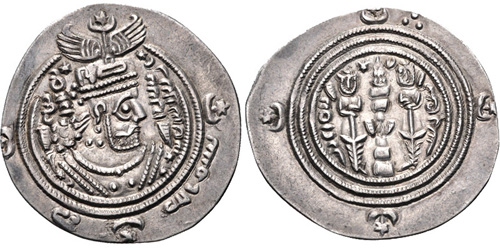
The conquerors kept the money they found. In the former Sasanian lands they struck silver drachms of the Persian type, with the king’s bust and a fire altar, adding short Arabic phrases in the margin; in Syria they struck copper coins on Byzantine models, often with crosses and emperors.[10] Consensus Muhammad’s name entered this coinage in Iran in 685–686, in the civil war (§0).
ʿAbd al-Malik then tried a new image. From 74 to 77 AH (693–697) the Damascus mint struck gold dinars and copper coins showing a standing figure in Arab dress, with a sword: the caliph himself. Their legends proclaim the creed, “Muhammad is the messenger of God”, and on some types call the ruler “commander of the believers” and khalīfat Allāh, “deputy of God”. On the reverse, the Byzantine cross on steps became a pole or globe on steps.[9][10] Consensus Stefan Heidemann calls the type the first representation of the new empire’s power in the manner of the Byzantine emperor or the Persian king of kings.[10] Majority
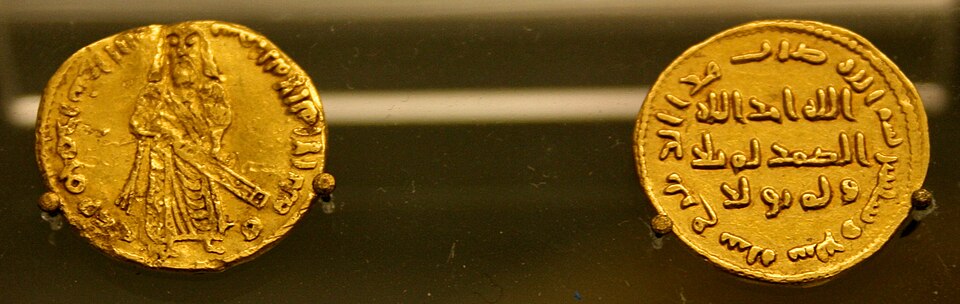
In 77 AH, 696–697, the images went. The new gold dinar carried only Arabic: on one side “There is no god but God, alone, he has no partner” and, round it, “Muhammad is the messenger of God, whom he sent with guidance and the religion of truth to make it prevail over every religion” (Qur’an 9:33); on the other, the opening of sūra 112, “God is One, God the eternal; he did not beget and was not begotten”, and the date.[11] Consensus A new silver dirham followed within two years. The design, words instead of a ruler’s portrait, became the model of Islamic coinage for centuries.[10] Consensus Both sūra 112 and verse 9:33 answer Christian claims about God’s son, and the coins circulated among a population that was still largely Christian.[12] Majority
Arabic government
Until the 690s the registers of the empire (dīwān) were kept in the languages of the old empires: Greek in Syria and Egypt, Persian in Iraq and Iran. Arabic histories report that al-Ḥajjāj had the Iraqi registers translated into Arabic around 697, and that ʿAbd al-Malik’s secretary Sulaymān ibn Saʿd did the same for Syria around 700; Egypt followed.[12][14] Majority on the dates. The officials often stayed in post, and Greek papyri continued in Egypt for decades: the change was of the language of record, not of the men who kept it. Majority
Roads and milestones
ʿAbd al-Malik also marked the land. An inscription found near Fīq, on the steep ascent (ʿaqaba) from the Sea of Galilee to the Golan, records that he ordered the pass levelled in Muḥarram of the year 73 (692), the oldest Islamic inscription about road building.[8] Milestones on the road from Damascus to Jerusalem give the distance in Arabic miles, invoke God and name “the servant of God ʿAbd al-Malik, commander of the believers”.[8][12] Consensus The Qur’an’s text in this decade, and al-Ḥajjāj’s reported part in copying and distributing it, are discussed in §3.
Islam as a name and a boundary
When did the community of Muhammad’s followers come to see itself as a religion distinct from Judaism and Christianity? The documents give a pattern: the caliph’s titles and the Hijri era from the 640s, the Prophet’s name only from the 680s, and the word islām in public only on the Dome of the Rock, with its argument against Christian doctrine (§0).[17][19] Consensus on the pattern.
- The traditional view. Islam was a distinct religion from Muhammad’s lifetime, with the Qur’an, the prayer and the pilgrimage; ʿAbd al-Malik made public and imperial what already existed. Silence in the early documents reflects how few survive. Majority
- Donner’s “Believers”. Fred Donner argues that the first community called itself al-muʾminūn, “the believers”, far more often than muslimūn, and was open to pious Jews and Christians who accepted God’s oneness and the coming judgment; only under the Marwanids, ʿAbd al-Malik and his sons, did it define itself by the Qur’an and the Prophet as a separate religion called Islam.[28] Critics answer that the Qur’an already distinguishes believers from Jews and Christians, and that the shift in the documents may record a change of public language rather than of belief.[17] Contested
What is not in doubt is that the empire’s public religion was defined, visibly and in Arabic, in ʿAbd al-Malik’s reign, and that its first great statement was addressed to Christians. Majority Christian writers of the time noticed. John of Damascus, whose family had served the caliphs, wrote in the 740s the first Christian treatment of Islam as a heresy, “the heresy of the Ishmaelites” (Christianity §7).[29] Consensus
Christians, Jews and Zoroastrians under Umayyad rule
Conquest did not make the conquered Muslim. Under the surrender treaties of the 630s and 640s Christians, Jews and Zoroastrians kept their religions and their places of worship in return for paying tribute, and most of them remained in their faiths throughout the Umayyad century.[30][31] Consensus Richard Bulliet, counting converts’ names in later biographical dictionaries, estimated that Muslims were still a small minority in Iran and Iraq in 750 and a majority only in the ninth or tenth century.[31] Majority on the shape of the curve; Contested on its numbers.
Protected non-Muslims came to be called ahl al-dhimma, “people of the pact”, and paid a poll tax, the jizya, named in the Qur’an (9:29). The rules that later defined dhimmī status are best known from the Pact of ʿUmar, a document in which Christians promise the caliph not to build new churches, not to display crosses in public, to dress differently from Muslims and not to ride on saddles or bear arms.[32] Tradition ascribes it to ʿUmar I or ʿUmar II. Milka Levy-Rubin traces it to the surrender agreements of the conquest and to Byzantine and Sasanian models, and dates its known form to the ninth century.[30] Majority It was enforced unevenly, more often in moments of tension than as daily practice (Judaism §8). Majority How it should be characterised, as toleration by the standards of its age or as institutionalised inferiority, is fought over in modern polemic on both sides. Political
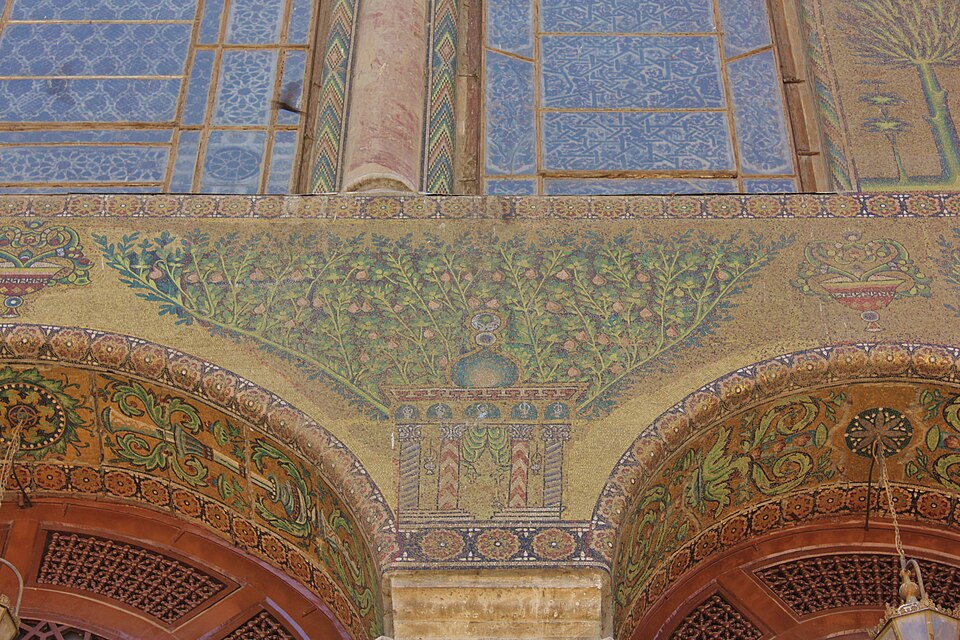
ʿAbd al-Malik’s son al-Walīd I (r. 705–715) took the cathedral of St John in Damascus for the new Great Mosque, built between 706 and 715 with mosaics of trees, rivers and buildings, and had the Prophet’s mosque in Medina rebuilt on a grand scale.[13][14] Consensus Al-Muqaddasī’s uncle explained the Damascus mosque, like the Dome, as an answer to “the beautiful churches” of Syria, built so that Muslims would not be dazzled by them.[13] That is a tenth-century explanation, not a record of al-Walīd’s own words. Majority
From Spain to Sindh
The conquests resumed after the civil war. Arab armies took Carthage in 698 and reached the Atlantic. In 711 an army under Ṭāriq ibn Ziyād crossed to Spain and defeated the Visigothic king Roderic; within a few years most of the peninsula was under Muslim rule, the province the Arabs called al-Andalus (Judaism §8).[14] Consensus In the same years Muḥammad ibn al-Qāsim, a young relative of al-Ḥajjāj, conquered Sindh in the lower Indus valley (711–712), and Arab armies crossed the Oxus into Central Asia.[14] Consensus The fullest account of Sindh, the Persian Chachnāma, was written in the thirteenth century, and historians use it with caution. Majority
In 732 a raiding army from Spain under the governor ʿAbd al-Raḥmān al-Ghāfiqī was defeated between Tours and Poitiers by Charles Martel, and its commander killed.[14] Consensus European historians long made the battle the moment Europe was saved for Christianity. Most now see it as the defeat of a raid at the far edge of an empire that was already overstretched, important for the rise of the Carolingians more than for the history of Islam. Majority
ʿUmar II, converts and the mawālī
Conversion created a problem the conquerors had not planned for. A non-Arab who became Muslim had to attach himself to an Arab tribe as its client, mawlā (plural mawālī). Converts expected to stop paying the poll tax and to share in the stipends of the Arab army; governors short of revenue sometimes kept taxing them, and in places sent converts back to their villages.[33][14] Majority
ʿUmar ibn ʿAbd al-ʿAzīz, ʿUmar II (r. 717–720), remembered in later sources as the one pious Umayyad, ruled that converts were to be treated as Muslims and freed from the poll tax, while land that had paid the land tax (kharāj) continued to pay it whoever owned it. H. A. R. Gibb studied the “fiscal rescript” attributed to him.[15] Majority that the policy is his; Contested on the authenticity of the documents. Measures to mark Christians and Jews off from Muslims are also attributed to him. Majority
The grievances of the mawālī, unequal status within a religion that claimed equality before God, fed the revolts of the dynasty’s last decades.[33] Majority
The fall of the Umayyads, 747–750
The dynasty’s last decades brought feuds between Arab tribal factions in the army, revolts in Iraq and North Africa, and a third civil war after 744. The decisive movement came from Khurasan, in the far east of the empire, where Arab settlers and Iranian converts lived side by side. Agents of a family descended from Muhammad’s uncle al-ʿAbbās had organised there for years, calling for rule by al-riḍā min āl Muḥammad, “one chosen from the family of Muhammad”, a slogan that let supporters of ʿAlī’s family believe the revolt was theirs.[14] Majority
In June 747 Abū Muslim raised black banners near Merv. His armies took Kufa in September 749, where Abū l-ʿAbbās was proclaimed caliph, and in January 750 they defeated the last Umayyad caliph, Marwān II, at the river Zab. Marwān was killed in Egypt that August, and most of his family were massacred.[14] Consensus One grandson of Hishām, ʿAbd al-Raḥmān, escaped to Spain and founded the Umayyad emirate of Córdoba in 756. The new dynasty moved the centre of the empire east, to Iraq (§6). Consensus
The evidence
| Question | What the evidence supports | Key evidence | Confidence |
|---|---|---|---|
| The first caliph-kings | Muʿāwiya ruled as “servant of God, commander of the believers” from Syria | Hammat Gader, Ṭāʾif dam[3][4] | Consensus |
| Karbalāʾ | al-Ḥusayn killed on 10 October 680; the narrative shaped by later devotion | Abū Mikhnaf in al-Ṭabarī[5] | Consensus (event); Majority (detail) |
| The Prophet in public | Muhammad named on coins from 685–686, then everywhere from the 690s | Coins, Dome of the Rock[6][7] | Consensus |
| The Dome’s purpose | A statement to Christians in their own city; the Mecca-replacement report doubtful | Inscriptions; al-Yaʿqūbī; al-Muqaddasī[7][24][13] | Contested |
| The coinage reform | Images, then words only, 693–697 | Standing caliph and reform dinars[9][11] | Consensus |
| Islam as a boundary | Publicly defined under ʿAbd al-Malik; how distinct before is debated | Documents of the 640s–690s; Donner[19][28] | Contested |
| Dhimmī rules | Surrender treaties early; the Pact of ʿUmar in its known form later | Levy-Rubin[30][32] | Majority |
| Conversion | Slow; Muslims a minority of subjects in 750 | Bulliet’s name counts[31] | Majority |
Primary sources
Show the 9 primary sources
1. The commander of the believers at Hammat Gader, 42 AH / 662–663
“In the days of the servant of God Muʿāwiya (abdalla Maavia), the commander of the faithful (amēra almoumenēn), the hot baths of the people there were saved and rebuilt by ʿAbd Allāh son of Abū Hāshim, the governor, on the fifth of the month of December, on the second day (of the week), in the 6th year of the indiction, in the year 726 of the colony, according to the Arabs (kata Arabas) the 42nd year, for the healing of the sick, under the care of Ioannes, the official of Gadara.”[3]
What it proves. That within a year of becoming caliph, Muʿāwiya was named in public, in Greek, by the Arabic titles ʿabd Allāh and amīr al-muʾminīn, transliterated; that the Hijri era was used alongside the old local eras; and that Christian officials served the new rulers and carved a cross on the stone. It does not name the Prophet or the religion. Consensus
2. “He did not wear a crown”: the Maronite Chronicle, c. 660
The Syriac chronicle reports that the Arab chiefs gathered in Jerusalem and gave their allegiance to Muʿāwiya, that he prayed at Christian holy places there, and that he “did not wear a crown like other kings”.[16][17]
What it proves. That a contemporary or near-contemporary Christian saw Muʿāwiya’s accession as that of a ruler who respected Jerusalem’s Christian sites and did not adopt the regalia of a Byzantine emperor. Its author reports the scene at second hand. Majority
3. “The religion with God is islām”: the Dome of the Rock, 72 AH / 691–692
inna l-dīna ʿinda llāhi l-islām…
“The religion with God is islām. Those who were given the Book did not differ except after knowledge had come to them, out of envy among themselves.”[7][23]
What it proves. That by 691–692 the word islām was displayed in Jerusalem as the name of the true religion, at the end of a long passage addressed to Christians about Jesus (4:171–172 and 19:33–36). The building, its date and the Abbasid substitution of the founder’s name are discussed above and in §0. Consensus
4. The standing caliph: a dinar of 76 AH / 695–696
bism Allāh lā ilāha illā llāh wa / ḥdahu Muḥammad rasūl Allāh — bism Allāh ḍuriba hādhā l-dīnār fī sanat sitt wa-sabʿīn
“In the name of God. There is no god but God alone. Muhammad is the messenger of God.” — “In the name of God, this dinar was struck in the year seventy-six.”[9]
What it proves. That for three or four years ʿAbd al-Malik’s gold coinage showed the caliph himself, standing with a sword, beside the creed and the name of Muhammad. Islam’s public imagery was still being worked out in the 690s; the image-free coinage was a decision, not a starting point. Consensus
5. Words without images: the reformed dinar of 77 AH / 696–697
lā ilāha illā llāh waḥdahu lā sharīka lahu — Muḥammad rasūl Allāh arsalahu bi-l-hudā wa-dīn al-ḥaqq li-yuẓhirahu ʿalā l-dīn kullih — Allāhu aḥad Allāhu l-ṣamad lam yalid wa-lam yūlad — bism Allāh ḍuriba hādhā l-dīnār fī sanat sabʿ wa-sabʿīn
“There is no god but God alone, he has no partner.” — “Muhammad is the messenger of God, whom he sent with guidance and the religion of truth to make it prevail over every religion.” — “God is One, God the eternal; he did not beget and was not begotten.” — “In the name of God, this dinar was struck in the year seventy-seven.”[11]
What it proves. The new coinage replaced every image with the creed and the Qur’an (9:33; 112:1–3). Its texts deny that God has a son and proclaim the supremacy of the Prophet’s religion over all others, on the coin that every subject, Christian or Muslim, now handled. Consensus
6. “In the place of the Kaʿba”: al-Yaʿqūbī, late ninth century
“Then ʿAbd al-Malik forbade the people of Syria to make the pilgrimage (to Mecca); and this by reason that ʿAbd Allāh ibn al-Zubayr was wont to seize on them during the time of the pilgrimage, and force them to pay him allegiance… And this Rock… shall be unto you in the place of the Kaʿba.” (trans. Guy Le Strange, 1890)[24]
What it proves. That by the late ninth century a historian could explain the Dome as a rival to the Kaʿba built during the civil war. It is two centuries after the event, from an author unsympathetic to the Umayyads, and its claim is not reflected in the inscription. It proves the report, not the motive. Contested
7. “Lest it should dazzle the minds of the Muslims”: al-Muqaddasī, 985
“For he beheld Syria to be a country that had long been occupied by the Christians, and he noted herein the beautiful churches still belonging to them… So he sought to build for the Muslims a mosque that should prevent their regarding these… And in like manner is it not evident how the Caliph ʿAbd al-Malik, noting the greatness of the Dome of (the Holy Sepulchre)… was moved lest it should dazzle the minds of the Muslims, and hence erected above the Rock the Dome which now is seen there?” (trans. Guy Le Strange, 1890)[13]
What it proves. That a learned native of Jerusalem in the tenth century explained both great Umayyad buildings as answers to Christian architecture. It is an interpretation three centuries after the event, but one that fits the Dome’s form and its inscription. Majority
8. The road through the pass: ʿAqaba, Muḥarram 73 AH / 692
The inscription records that “the servant of God ʿAbd al-Malik, commander of the believers” ordered the levelling of the pass, and that the work was carried out by Yaḥyā ibn al-Ḥakam in Muḥarram of the year seventy-three.[8]
What it proves. That even before the civil war ended, ʿAbd al-Malik was marking public works on the road between Damascus and Jerusalem in Arabic with his caliphal titles, alongside the milestones on the same road. Consensus
9. The conditions on non-Muslims: the Pact of ʿUmar
The Christians of a city write to the caliph that they will not build new churches or repair those in Muslim quarters, will not display crosses or books in Muslim streets, will rise for Muslims, will not dress like them, ride on saddles or bear arms, in return for protection.[32]
What it proves. The classic statement of dhimmī status as later jurists understood it. Its attribution to ʿUmar I is not accepted by most historians; its known form is of about the ninth century, and it tells us more about the Abbasid period than about Umayyad practice.[30] Majority
What is absent
- An Umayyad history of the Umayyads. The dynasty’s own court chronicles, if they existed, are lost; the narrative was written under its enemies, the Abbasids. Consensus
- A contemporary statement of why the Dome of the Rock was built. The inscription gives a date and a creed, not a reason. Consensus
- A contemporary account of Karbalāʾ. The earliest detailed narrative is Abū Mikhnaf’s, preserved two centuries later. Consensus
- Separate Sunni and Shia communities. There were partisans of ʿAlī’s family and revolts in their name, but not yet two bodies of law and theology (§6). Majority
- The schools of law and the hadith canon. Scholars in Medina, Kufa and Basra were debating law and collecting reports, but the schools and the great collections are later (§6). Consensus
- A Muslim majority. Most of the caliphate’s subjects in 750 were not Muslims. Majority
Debates
Why was the Dome of the Rock built?
| View | Main argument | Main proponents |
|---|---|---|
| To replace the pilgrimage to Mecca during the civil war | al-Yaʿqūbī’s report; Ibn al-Zubayr held Mecca | Goldziher; Elad on the report’s sources[25][27] |
| To answer Christianity in its holy city | The inscriptions on Jesus; the building’s Christian form; al-Muqaddasī | Goitein; Grabar[26][20] |
| To proclaim an imperial, Islamic order | The same decade’s coins, roads and Arabic registers | Johns; Robinson[19][12] |
Contested; the second and third are compatible and together are the majority view.
When did Islam become a distinct religion?
Donner’s ecumenical community of Believers, defined as Islam only under ʿAbd al-Malik, against the traditional view of a distinct religion from the start, with the 690s as the moment it became the state’s public face.[28][19] Contested
How were the Umayyads seen?
The Abbasid-era histories present them as kings who turned the caliphate into a monarchy, killed the Prophet’s grandson and taxed converts. Their buildings, coins and titles show rulers who presented themselves as God’s deputies and the champions of his religion. Historians from Gerald Hawting to Chase Robinson read both as partial.[1][12] Majority
Further reading
Show further reading (10 works)
- G. R. Hawting, The First Dynasty of Islam: The Umayyad Caliphate AD 661–750 (2nd ed., Routledge, 2000).
- Chase F. Robinson, ʿAbd al-Malik (Oneworld, 2005).
- Hugh Kennedy, The Prophet and the Age of the Caliphates (2nd ed., Longman, 2004).
- Oleg Grabar, “The Umayyad Dome of the Rock in Jerusalem”, Ars Orientalis 3 (1959).
- Estelle Whelan, “Forgotten Witness: Evidence for the Early Codification of the Qurʾān”, Journal of the American Oriental Society 118 (1998).
- Jeremy Johns, “Archaeology and the History of Early Islam: The First Seventy Years”, Journal of the Economic and Social History of the Orient 46 (2003).
- Fred M. Donner, Muhammad and the Believers (Harvard, 2010).
- Patricia Crone, Slaves on Horses: The Evolution of the Islamic Polity (Cambridge, 1980).
- Milka Levy-Rubin, Non-Muslims in the Early Islamic Empire (Cambridge, 2011).
- Robert G. Hoyland, Seeing Islam as Others Saw It (Darwin, 1997).
References
- ^ a b c d e f g h i j k l m n o G. R. Hawting The First Dynasty of Islam: The Umayyad Caliphate AD 661–750. Routledge, 2nd ed., 2000. The standard short history of the Umayyads and of the sources' bias against them.
- ^ a b Chase F. Robinson Islamic Historiography. Cambridge University Press, 2003. A short guide to the Arabic historical tradition and how it was made.
- ^ a b c d Greek inscription in the baths of Hammat Gader — Building inscription of the governor ʿAbd Allāh ibn Abī Hāshim. 5 December 662 CE (42 AH). Greek. Dates a restoration 'in the days of the servant of God Muʿāwiya, the commander of the faithful' and 'according to the Arabs, the 42nd year'; carved with a cross. read the text
- ^ a b c Dam inscription of Muʿāwiya near al-Ṭāʾif — Building inscription. 58 AH / 677–678 CE. Arabic. Records the dam built for 'the servant of God Muʿāwiya, commander of the believers' in the year fifty-eight; names God and the caliph, not Muhammad. about
- ^ a b c d al-Ṭabarī, Taʾrīkh al-rusul wa-l-mulūk, on Karbalāʾ (after Abū Mikhnaf) — al-Ṭabarī, History of the Prophets and Kings. early 10th c. CE, from Abū Mikhnaf (d. 774). Arabic. The fullest account of al-Ḥusayn's journey and death at Karbalāʾ on 10 Muḥarram 61 AH, preserved from the Kufan historian Abū Mikhnaf. about
- ^ a b c Arab-Sasanian drachm of ʿAbd al-Malik ibn ʿAbd Allāh, Bīshāpūr (British Museum) — Silver coin. 66 AH / 685–686 CE. Arabic and Middle Persian. Margin legend 'bism Allāh Muḥammad rasūl Allāh': the earliest dated Muslim text to name Muhammad, struck for a Zubayrid governor. about
- ^ a b c d e f g Dome of the Rock, inner arcade inscription — Foundation inscription of ʿAbd al-Malik. 72 AH / 691–692 CE. Arabic. Monumental kufic band of Qur'anic passages on God's oneness and Jesus as messenger (4:171, 3:18–19, 19:33–36), dated 72; the founder's name was later replaced by al-Maʾmūn's. about
- ^ a b c d Road inscription of ʿAbd al-Malik near Fīq (ʿAqabat Fīq), Golan — Arabic road-building inscription. Muḥarram 73 AH / May–June 692 CE. Arabic. ʿAbd al-Malik, commander of the believers, orders a difficult pass levelled; the work done by Yaḥyā ibn al-Ḥakam. The oldest Islamic inscription on road building. read the text
- ^ a b c d 'Standing caliph' dinar of ʿAbd al-Malik, Damascus — Arab-Byzantine gold dinar. 76 AH / 695–696 CE. Arabic. A standing caliph with sword; 'In the name of God. There is no god but God alone. Muhammad is the messenger of God'; 'this dinar was struck in the year 76'. read the text
- ^ a b c d e Stefan Heidemann The Standing Caliph-Type: The Object on the Reverse. in A. Oddy (ed.), Coinage and History in the Seventh Century Near East 2, Archetype, 2010. The standing caliph coinage of 74–77 AH and its place between Byzantine imagery and the epigraphic reform.
- ^ a b c d Reformed gold dinar of ʿAbd al-Malik — Aniconic Umayyad coinage. 77 AH / 696–697 CE. Arabic. The first purely epigraphic coins: the shahāda and Qur'an 9:33 on the obverse, sura 112 on the reverse, the date and no images. about
- ^ a b c d e f g h i j Chase F. Robinson ʿAbd al-Malik. Oneworld, 2005. The caliph's reign and the making of a public Islamic state in the 690s.
- ^ a b c d e f al-Muqaddasī, Aḥsan al-taqāsīm, on the mosque of Damascus and the Dome of the Rock — al-Muqaddasī, The Best Divisions for Knowledge of the Regions (trans. Guy Le Strange, Palestine under the Moslems, 1890). 985 CE. Arabic. His uncle explains al-Walīd's mosque and ʿAbd al-Malik's Dome as answers to Syria's churches and the Holy Sepulchre, 'lest it should dazzle the minds of the Muslims'. about
- ^ a b c d e f g h i j k l m Hugh Kennedy The Prophet and the Age of the Caliphates. Longman, 1986. Standard political history of the Near East from Muhammad to the eleventh century.
- ^ a b H. A. R. Gibb The Fiscal Rescript of ʿUmar II. Arabica 2, 1955. ʿUmar II's rulings on converts and taxation.
- ^ a b Maronite Chronicle, on Muʿāwiya's accession — Maronite Chronicle (Syriac). c. 660s CE. Syriac. The Arab chiefs give allegiance to Muʿāwiya in Jerusalem; he prays at Christian holy places and 'did not wear a crown like other kings'. about
- ^ a b c d Robert G. Hoyland Seeing Islam as Others Saw It: A Survey and Evaluation of Christian, Jewish and Zoroastrian Writings on Early Islam. Darwin Press, 1997. The non-Muslim sources of the first Islamic century and a half, translated and discussed.
- ^ Heinz Halm Shiʿa Islam: From Religion to Revolution. Markus Wiener, 1997. The commemoration of Karbalāʾ from the first mourners to the passion plays.
- ^ a b c d e f Jeremy Johns Archaeology and the History of Early Islam: The First Seventy Years. Journal of the Economic and Social History of the Orient 46, 2003. Islam as a public state religion becomes visible in the documents of the 690s.
- ^ a b c d Oleg Grabar The Umayyad Dome of the Rock in Jerusalem. Ars Orientalis 3, 1959. Reads the building and its inscriptions as a statement of Islam's arrival in a Christian city.
- ^ a b c Estelle Whelan Forgotten Witness: Evidence for the Early Codification of the Qurʾān. Journal of the American Oriental Society 118, 1998. Reads the Dome of the Rock and Medina inscriptions as presupposing a codified text.
- ^ Qurʾan 4:171 — Qurʾan, Sūrat al-Nisāʾ. 7th c. CE. Arabic. 'Do not say "Three"… God is only one God': the verse on Jesus quoted on the Dome of the Rock. read the text
- ^ a b Qurʾan 3:18–19 — Qurʾan, Sūrat Āl ʿImrān. 7th c. CE. Arabic. 'The religion with God is islām': quoted on the Dome of the Rock in 691–692. read the text
- ^ a b c al-Yaʿqūbī, Taʾrīkh, on the building of the Dome of the Rock — al-Yaʿqūbī, History (trans. Guy Le Strange, Palestine under the Moslems, 1890). late 9th c. CE. Arabic. ʿAbd al-Malik forbids Syrians the pilgrimage while Ibn al-Zubayr holds Mecca and declares the Rock 'in the place of the Kaʿba'. about
- ^ a b Ignaz Goldziher Muhammedanische Studien, vol. 2. Max Niemeyer, 1890. The founding critique of the hadith as evidence for the first century.
- ^ a b c S. D. Goitein The Historical Background of the Erection of the Dome of the Rock. Journal of the American Oriental Society 70, 1950. Rejects the report that the Dome was meant to replace the pilgrimage to Mecca.
- ^ a b Amikam Elad Why Did ʿAbd al-Malik Build the Dome of the Rock? A Re-examination of the Muslim Sources. in J. Raby and J. Johns (eds), Bayt al-Maqdis: ʿAbd al-Malik's Jerusalem, Part One, Oxford University Press, 1992. Argues the pilgrimage-diversion report is not confined to al-Yaʿqūbī and cannot simply be dismissed.
- ^ a b c Fred M. Donner Muhammad and the Believers: At the Origins of Islam. Belknap Press of Harvard University Press, 2010. Islam's origins in the early seventh-century preaching of Muhammad.
- ^ John of Damascus, On Heresies 100 — Fount of Knowledge, part 2. c. 740s CE. Greek. The chapter on 'the heresy of the Ishmaelites', an early Christian polemic against Islam. about
- ^ a b c d Milka Levy-Rubin Non-Muslims in the Early Islamic Empire: From Surrender to Coexistence. Cambridge University Press, 2011. Traces the Pact of Umar to conquest-era surrender treaties and Byzantine and Sasanian models.
- ^ a b c Richard W. Bulliet Conversion to Islam in the Medieval Period: An Essay in Quantitative History. Harvard University Press, 1979. The onomastic S-curve of conversion.
- ^ a b c Pact of Umar (al-Ṭurṭūshī, Sirāj al-Mulūk) — Pact of Umar (Shurūṭ ʿUmar). 9th c. CE (form); attributed to Umar I, 634–644. Arabic. Conditions on non-Muslim subjects, framed as a letter from Christians to the caliph Umar: no new churches or synagogues, distinctive dress, no riding on saddles or bearing arms. Surviving versions are later than Umar; a legal ideal, enforced unevenly. about
- ^ a b Patricia Crone Slaves on Horses: The Evolution of the Islamic Polity. Cambridge University Press, 1980. The Umayyad polity, its tribal armies and the place of the mawālī.