Judaism under Islam in one paragraph
Within a century of the Prophet Muhammad’s death in 632, Arab armies had conquered the two empires that ruled almost all the world’s Jews, Byzantium in the west and Sasanian Persia in the east. For the next five centuries most Jews lived under Muslim rulers, as a protected and subordinate community (dhimmīs) that paid a poll tax. In that world the Babylonian academies made the Talmud (§7) the law of Jews everywhere; a rival movement, the Karaites, rejected it; Jews adopted Arabic and, with it, Greek philosophy, Arabic grammar and Arabic poetry; and the great synthesisers, Saadia Gaon and Moses Maimonides, gave rabbinic Judaism a theology, a code and a creed. Much of what later Jews regarded as “traditional” Judaism, from the order of the prayer book to the Thirteen Principles, was formed in Arabic-speaking lands between the eighth and twelfth centuries. Majority
The period has been described both as a golden age of tolerance and as a long story of humiliation. Neither picture fits the evidence well. Jews under Islam were legally inferior and occasionally persecuted, but they were rarely expelled or massacred, they took part in the economy and culture of their neighbours, and their institutions flourished. The best guide to their lives is not legal theory but the hundreds of thousands of documents from the Cairo Geniza, which show ordinary Jews trading, marrying, quarrelling and writing to their rabbis.[1][2] Majority
Timeline of Judaism under Islam and its evidence
| Date | Event or evidence | Confidence |
|---|---|---|
| c. 380s–525 | Kings of Ḥimyar in southern Arabia adopt Judaism or a monotheism close to it; the last, Yūsuf (Dhū Nuwās), is defeated by Christian Aksum c. 525[3] | Majority (event); Contested (how Jewish) |
| 589 | Traditional start of the geonic period, by the chronology of Sherira Gaon[4][5] | Majority |
| 622–628 | In Medina, Muhammad expels two Jewish tribes and, according to the Muslim biographical tradition, has the men of a third, the Qurayẓa, executed; Khaybar is conquered[6][7] | Majority (events); Contested (numbers and details) |
| 634–711 | Arab conquests of Syria, Palestine, Iraq, Egypt, North Africa and Spain[1] | Consensus |
| c. 760s | Anan ben David breaks with the rabbinic leadership in Baghdad; his Aramaic Book of Commandments[8][9] | Majority (event); Contested (story) |
| 9th c. | The Pact of Umar takes the form in which it is later known[10][11] | Majority |
| c. 860–875 | Seder Rav Amram, the first complete order of Jewish prayer, is sent from Babylonia to Spain[12][5] | Majority |
| c. 930 | The Aleppo Codex is written and vocalised by the Ben Asher school of Masoretes in Tiberias[13] | Consensus |
| 921–922 | Calendar dispute between Aaron ben Meir in Palestine and the Babylonian academies, with Saadia leading the Babylonian side[14] | Consensus |
| 933 | Saadia Gaon completes the Book of Beliefs and Opinions[15][16] | Consensus |
| c. 950s–970 | Hasdai ibn Shaprut serves the caliphs of Córdoba; Dunash ben Labrat introduces Arabic metre into Hebrew poetry[17] | Majority |
| 987 | Sherira Gaon’s Epistle to the community of Kairouan, the first history of the rabbinic tradition[4] | Consensus |
| 1009–1014 | The Fatimid caliph al-Ḥākim orders the destruction of churches and synagogues, a rare general persecution, later reversed[1] | Majority |
| 1038 | Death of Hai Gaon, conventionally the end of the geonic period[5] | Consensus |
| 1066 | Massacre of Jews in Granada after the killing of the vizier Joseph ibn Naghrela[18] | Consensus (event); Contested (numbers) |
| 1140 | Judah Halevi leaves Spain for the Land of Israel; he dies in 1141[19][2] | Majority |
| 1148 onward | Almohad conquests in al-Andalus and North Africa; Jews and Christians are pressed to convert[1][20] | Consensus |
| 1165–1168 | Maimonides leaves Morocco, visits Palestine and settles in Egypt; completes his Commentary on the Mishnah with the Thirteen Principles[21][20] | Consensus |
| c. 1170–1180 | The Mishneh Torah, Maimonides’ code of all Jewish law[22][23] | Consensus |
| c. 1185–1190 | The Guide of the Perplexed, in Arabic[24] | Consensus |
| 1204 | Maimonides dies in Fustat[20] | Consensus |
| 1230s | The Maimonidean controversy in Provence and Spain; copies of his philosophical works are burned in Montpellier (1232 or 1233)[25] | Majority |
Before Islam: Jews in Arabia
Judaism was in Arabia before Islam. Jewish tribes lived in the oases of the Hejaz, including Yathrib (later Medina), Khaybar and Fadak; Hebrew and Aramaic inscriptions and later Arabic tradition both attest them. In the south, inscriptions of the kingdom of Ḥimyar, in today’s Yemen, show its rulers abandoning the old gods for a single god called Raḥmānān, “the Merciful”, from the 380s, and some inscriptions use explicitly Jewish language. The last Ḥimyarite king, Yūsuf Asʾar Yathʾar, known in Arabic tradition as Dhū Nuwās, persecuted the Christians of Najrān c. 523 and was overthrown by the Christian kingdom of Aksum soon after.[3] Whether Ḥimyar’s official religion was Judaism or a “Judaising” monotheism of its own is debated. Majority on the monotheism; Contested on how Jewish it was.
Muhammad’s relations with the Jews of Medina, as told by the Muslim biographical tradition of the eighth and ninth centuries, began with an alliance and ended in conflict. Two Jewish tribes, the Qaynuqāʿ and the Naḍīr, were expelled; after the siege of Medina in 627 the third, the Qurayẓa, whom the Muslim sources accuse of negotiating with the besieging Meccan coalition in breach of their pact, surrendered, and Muhammad left their fate to Saʿd ibn Muʿādh, chief of the Aws, their former allies; in Ibn Isḥāq’s account Saʿd ruled that the men should be killed, the property divided and the women and children taken captive. The oasis of Khaybar was conquered in 628 and left to its Jewish farmers in return for half its harvest.[6][7] Historians accept the broad outline; the numbers and many details, which come only from Muslim sources written more than a century later, are debated: Ibn Isḥāq gives 600 or 700 men and notes that some put the figure as high as 800 or 900,[6] while some scholars, including the Arabist W. N. Arafat, have argued that the later tradition greatly inflated the executions.[26] Majority on the outline; Contested on the details. This series leaves the Islamic side of the story to a future series on Islam.
The conquests and the dhimmī
The Arab conquests were fast: Syria and Palestine in the 630s, Iraq and Egypt by 642, North Africa by the 690s, Spain from 711. For most Jews they replaced Christian rulers who had legislated against them with Muslim rulers who, at first, cared little about them. Under the Byzantine emperor Heraclius, Jews had been ordered to be baptised; under the Visigothic kings of Spain, Judaism had been outlawed outright in the seventh century.[1] Consensus
Under Islamic law Jews and Christians, as “People of the Book”, became dhimmīs, protected subjects. They could practise their religion and run their own courts in exchange for paying a poll tax, the jizya (Qurʾān 9:29), and accepting a subordinate status. The details were set out in a document called the Pact of Umar, presented as a letter from the Christians of Syria to the caliph Umar I (634–644). It forbids new churches and synagogues, requires distinctive dress, forbids non-Muslims to ride on saddles or bear arms; later jurists added a ban on non-Muslims holding authority over Muslims.[10]
Historians do not think Umar I wrote it. Its surviving versions are known from texts of the tenth century and later. Milka Levy-Rubin has argued that it grew out of the surrender agreements of the conquest period, drew on Byzantine and Sasanian traditions for ordering subject populations, and was formalised as a canonical text under the early Abbasids, in the first half of the ninth century.[11][1] Majority
Enforcement varied enormously. Many rules were ignored for long periods: Jewish physicians, tax farmers and viziers served Muslim rulers in Baghdad, Cairo and Córdoba, in plain breach of the rule against non-Muslims holding authority. They were applied harshly in occasional campaigns, most notably under the Fatimid caliph al-Ḥākim between 1009 and 1014, who ordered churches and synagogues destroyed, and under the Almohads in the twelfth century, who did not recognise dhimmī status at all.[1][18] Majority
Where the Jews lived. The conquests brought the great Jewish population of Iraq, which had lived under the Sasanians, into the same empire as the Jews of Palestine, Egypt, North Africa and Spain. For the first time since antiquity most of the world’s Jews lived in a single political and linguistic world, and the Abbasid capital Baghdad, founded in 762, became its centre. Most of world Jewry, by many estimates the great majority, lived under Islam between the eighth and twelfth centuries.[1][2] Majority
The geonim: how the Talmud became the law
When the Arab armies arrived, the Babylonian Talmud (§7) was a body of learning studied in two Babylonian academies, Sura and Pumbedita, and largely unknown elsewhere. By 1038 it was the recognised law of Jews from Spain to Yemen. The people who achieved that were the geonim.[5] Consensus
The office. Gaon (plural geonim) is short for rosh yeshivat geʾon Yaʿaqov, “head of the academy of the pride of Jacob” (after Psalm 47:5). Sherira Gaon dates the beginning of the line to 589, and the period is conventionally ended with the death of Hai Gaon of Pumbedita in 1038. In the ninth and tenth centuries both academies moved to Baghdad. Alongside them stood the exilarch (rēsh galūtā), a hereditary leader who claimed descent from King David and represented the Jews to the caliph.[4][5] Majority
Responsa. The geonim governed by letter. Communities sent questions, often with donations, and the academies answered in writing. Thousands of these teshuvot (responsa) survive, many of them from the Cairo Geniza. A Jew in Kairouan or Córdoba who wanted to know how to write a marriage contract, observe a festival or settle a commercial dispute asked Baghdad, and the answer came back in the language of the Babylonian Talmud.[5] Consensus
Codes and prayer books. The geonim also produced the first post-Talmudic legal codes, such as the Halakhot Pesuqot attributed to Yehudai Gaon (8th century) and the Halakhot Gedolot (9th century), and the first complete order of prayer. Amram Gaon wrote his Seder c. 860–875 in reply to a request from Spain. It is the oldest surviving Jewish prayer book, though later copyists expanded and altered its text, and its order is the basis of the Sephardi and Ashkenazi rites.[12][5] Majority
Babylonia against Palestine. The victory of the Babylonian Talmud was not inevitable. The Palestinian academy, based in Tiberias and later Jerusalem, had its own Talmud, its own customs and its own claim to authority, including the right to fix the calendar. In 921–922 its head, Aaron ben Meir, announced a calendar that would have placed Passover two days earlier than the Babylonian reckoning. The Babylonian academies, led by the young Saadia, won the dispute, and Babylonian practice prevailed in most communities.[14][5] Consensus
History as authority. In 987 the community of Kairouan in Tunisia asked Sherira, gaon of Pumbedita, how the Mishnah and the Talmud had been written. His reply, the Epistle of Sherira Gaon, is the first history of the rabbinic tradition, with a list of the sages and geonim from the Mishnah to his own day. It is the main source for the chronology of the period, and it is also an argument: that the Babylonian academies were the unbroken heirs of the sages.[4][5] Majority
The Karaites: scripture alone
In the same years another group of Jews rejected the whole structure. The Karaites (Hebrew Qaraʾim, from miqra, “scripture”) held that the Hebrew Bible is the only authority and that the Oral Torah of the rabbis was a human invention. Each believer was to read the Bible for himself. They calculated the calendar by observing the new moon and the ripening of barley, as the Bible describes, rather than by the rabbis’ fixed calculation; they did not light lamps for the Sabbath or eat meat with milk in the rabbinic sense; and they disputed many marriage laws.[27][9] Consensus
Anan ben David. Later Karaites called Anan ben David, of the exilarch’s family in Baghdad in the 760s, their founder. The story told by their Rabbanite opponents is that Anan was passed over for the office of exilarch in favour of his younger brother, declared himself exilarch, was imprisoned by the caliph and saved himself by claiming to found a new religion. Historians treat the story as polemic: it is first cited, as a Rabbanite tradition, by the twelfth-century Karaite author Elijah ben Abraham, some four centuries after the event.[28][9][27] Majority
Anan’s Book of Commandments, written in Aramaic and surviving only in fragments, set out a strict and ascetic law, stricter than the rabbis’ on the Sabbath and on diet. It is not literalist: Anan used rabbinic methods of interpretation and reached his own conclusions. Early Karaite writers such as Jacob al-Qirqisānī (10th century) treated him as one authority among many and often disagreed with him.[8][9] Majority
Origins. Most historians now think Karaism was not founded by one man. Several non-rabbinic groups existed in the early Islamic period, some perhaps continuing older Jewish dissent, and they merged into a movement in the ninth century, around figures such as Benjamin al-Nahāwandī and Daniel al-Qūmisī; Anan became its founder in retrospect.[27][29] Majority
The Mourners of Zion. In the tenth and eleventh centuries Karaite scholars settled in Jerusalem as Avelei Ṣiyyon, “Mourners of Zion”, praying for the restoration of the city. They produced major works of Hebrew grammar and some of the finest medieval Bible commentary, such as that of Japheth ben Eli. The Crusader capture of Jerusalem in 1099 ended the community; Karaism survived in Egypt, Byzantium, the Crimea and later Lithuania.[27] Majority
Why it matters. The Karaite challenge forced the rabbis to defend the Oral Torah explicitly, and in doing so to define rabbinic Judaism as one position in a debate. Much of Saadia’s work, and some of Maimonides’, is an answer to it. Karaites call their opponents Rabbanites, and the word “Rabbanite” itself is a product of the split. Karaites today number a few tens of thousands, most of them in Israel, many of Egyptian origin.[29] Majority
Saadia Gaon: Judaism in Arabic
Saʿadya ben Yosef, known as Saadia Gaon, was born in the Fayyum in Egypt, probably in 882 (some sources give 892), and moved to Palestine and then to Baghdad. In 928 the exilarch David ben Zakkai appointed him gaon of Sura, the first foreigner to hold the post. Within two years they had quarrelled and excommunicated each other; they were reconciled around 937, and Saadia died in office in 942.[14][5] Consensus
His achievements made him the model of the medieval Jewish scholar:
- Translation. His Tafsīr, an Arabic translation of the Torah with commentary, written in Hebrew letters, became the standard Bible of Arabic-speaking Jews; Yemenite Jews still read it.
- Prayer. His Siddur, with instructions in Arabic, is the second oldest surviving prayer book.
- Language. He wrote the first Hebrew dictionary, the Agron, and the first Hebrew grammar, both modelled on Arabic philology.
- Polemic. He attacked the Karaites in a series of works from about 905 on, arguing that the Bible cannot be understood or obeyed without the oral tradition.
- Theology. His Book of Beliefs and Opinions (Kitāb al-Amānāt wa-l-Iʿtiqādāt), completed in 933, was the first systematic Jewish theology.[15][16][14]
Consensus
The Book of Beliefs and Opinions adopted the method of the Muslim rationalist theologians, the Muʿtazila: reason and revelation cannot conflict, and the existence of a single, incorporeal creator can be proved by argument as well as accepted from scripture. That approach, borrowed from Islamic kalām, set the agenda for Jewish philosophy for three centuries. It also shows how deeply Jews were part of Arabic intellectual life: their questions, methods and vocabulary were the questions, methods and vocabulary of their Muslim and Christian neighbours.[15][16] Majority
Judeo-Arabic. Saadia’s books, like those of Judah Halevi and Maimonides after him, were written in Arabic but usually in Hebrew script. This “Judeo-Arabic” was the language of everyday Jewish life from Iraq to Spain: letters, contracts, commentaries and philosophy. Hebrew was reserved for prayer, poetry and, increasingly, law. Most of the major works of medieval Jewish thought that readers now know in Hebrew are translations, many made in twelfth- and thirteenth-century Provence by the Ibn Tibbon family.[2][1] Consensus
The Masoretes: the vowels of the Bible
The Hebrew Bible had been copied for more than a thousand years without vowel signs. Between the seventh and tenth centuries scholars in Tiberias, the Masoretes (“transmitters”), devised a system of vowel points and cantillation marks to fix the reading, and compiled marginal notes counting letters and listing unusual forms. Their most authoritative family, the Ben Asher, produced the Aleppo Codex c. 930, the manuscript that Maimonides later declared the model for copying Torah scrolls.[13][30] Consensus
The work belongs to its Islamic setting. Geoffrey Khan links the writing down of the vowels to the general shift from oral to written transmission of knowledge in the early Islamic period, when Muslim scholars were also fixing the reading traditions of the Qurʾān. Karaites, who depended on the Bible alone, became deeply involved with the Tiberian tradition from the later tenth century, and some notes in the Aleppo Codex seem to reflect Karaite theology; whether the Ben Asher family were Karaites has been debated since the nineteenth century, but Khan points out that the family’s tradition began before Karaism existed and that there is no evidence of a Karaite community in Tiberias in the Masoretic period.[31] Contested on the family; Majority on the setting.
The Cairo Geniza: everyday life
Jewish custom forbids destroying a text that might contain the name of God. Worn-out books and documents were stored in a genizah and periodically buried. At the Ben Ezra synagogue in Fustat, Old Cairo, the storeroom was not emptied for about nine centuries, from the eleventh century to the nineteenth, and Jews put into it almost anything written in Hebrew letters: Bible fragments, poems, letters, bills, marriage contracts, court records, children’s exercises and magic spells.[32] Consensus
In 1896 the Cambridge scholar Solomon Schechter identified a leaf brought from Cairo as part of the lost Hebrew original of the book of Ben Sira. He travelled to Cairo and in 1896–97 brought back some 193,000 fragments, now the Taylor-Schechter collection at Cambridge. Other fragments went to Oxford, Manchester, New York, St Petersburg, Paris and elsewhere; estimates of the total run to several hundred thousand.[32][33] Consensus
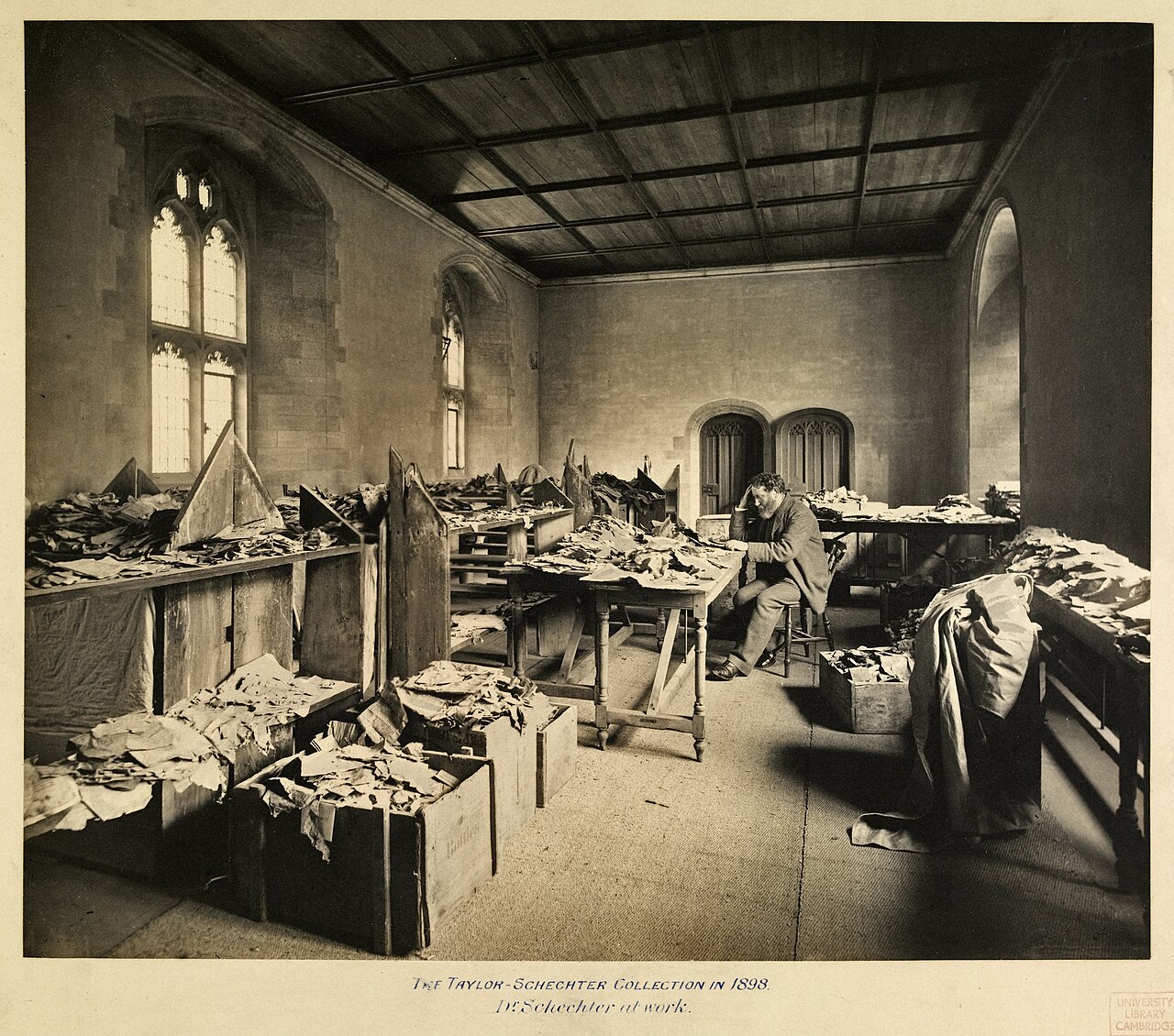
The historian S. D. Goitein spent four decades on the documentary fragments and published the results as A Mediterranean Society (six volumes, 1967–1993). The Geniza shows a Jewish community fully at home in the Mediterranean economy: merchants trading textiles, spices and books between Spain, Sicily, Egypt, Aden and India; women buying and selling property and suing in court; families writing in Arabic about health, prices and marriages; and communities corresponding with the geonim in Baghdad and the academy in Jerusalem.[2] Consensus
The Geniza also preserves texts that would otherwise be lost, including Hebrew Ben Sira, the Damascus Document later found at Qumran (§6), early piyyuṭ (liturgical poetry), Palestinian prayer rites quite different from the Babylonian ones, and letters and drafts in Maimonides’ own hand.[32] It is the main reason the Jews of medieval Egypt are better documented than almost any other medieval community. Consensus
Al-Andalus: courtiers and poets
Spain was conquered in 711, and under the Umayyad caliphs of Córdoba in the tenth century it became the richest society in western Europe. Jews, who had been persecuted under the Visigoths, became part of its elite.[1][17] Consensus
Courtiers. Ḥasdai ibn Shaprūṭ (c. 915–c. 970), a physician, served the caliph ʿAbd al-Raḥmān III as a diplomat and customs chief, and used his wealth to patronise Hebrew scholarship in Córdoba. Samuel ibn Naghrela (993–1056), known as Samuel ha-Nagid, became vizier of the Berber kingdom of Granada, commanded its armies in the field, wrote a Talmudic code and composed some of the finest Hebrew poetry of the Middle Ages, including poems written on campaign.[17][1] Consensus
A new Hebrew poetry. Around the 950s Dunash ben Labrat, a student of Saadia, introduced into Hebrew the quantitative metres of Arabic poetry, and Andalusian poets adopted Arabic genres too: wine songs, love poems, garden poems, panegyrics and laments. Solomon ibn Gabirol (c. 1021–c. 1058) wrote both secular verse and the philosophical hymn Keter Malkhut, and a Neoplatonic treatise in Arabic that survived in Latin as Fons Vitae, whose author Christian scholastics took to be a Muslim or Christian “Avicebron”. Grammarians such as Judah Ḥayyūj worked out the three-letter root system of Hebrew from the Arabic model.[17] Consensus
The limits. The golden age had violent edges. In 1066 Samuel’s son Joseph, who had succeeded him as vizier, was killed by a mob in Granada, and the city’s Jews were massacred, after an Arabic poem by Abū Isḥāq of Elvira attacked Jewish power. Later accounts speak of 1,500 families, and the often-repeated figure of about 4,000 dead is unverified.[18] The Almoravid conquest of the 1090s brought harsher rule, and the Almohads, a reformist movement from Morocco that took al-Andalus from 1147–48, did not tolerate dhimmīs: Jews and Christians were pressed to convert, leave or die. Many Jews fled north to the Christian kingdoms of Spain or east to Egypt; others converted outwardly.[1][20] Consensus
Judah Halevi. The most famous poet of the age, Judah Halevi (c. 1075–1141), spent his life among the courtiers of Muslim and Christian Spain and ended it rejecting them. His Arabic dialogue, the Kuzari, finished around 1140, imagines the king of the Khazars choosing Judaism after hearing a philosopher, a Christian, a Muslim and a rabbi; it argues that the truth of Judaism rests on the public revelation at Sinai and the history of the people, not on philosophical proof. Its Arabic title calls it a defence “of the despised religion”.[34] In 1140 he left Spain for the Land of Israel. Geniza letters show him in Egypt from September 1140 until he sailed from Alexandria in May 1141; he died that summer, apparently after reaching the Land of Israel, though where, and whether he ever saw Jerusalem, is unknown.[19][2] Majority
Maimonides
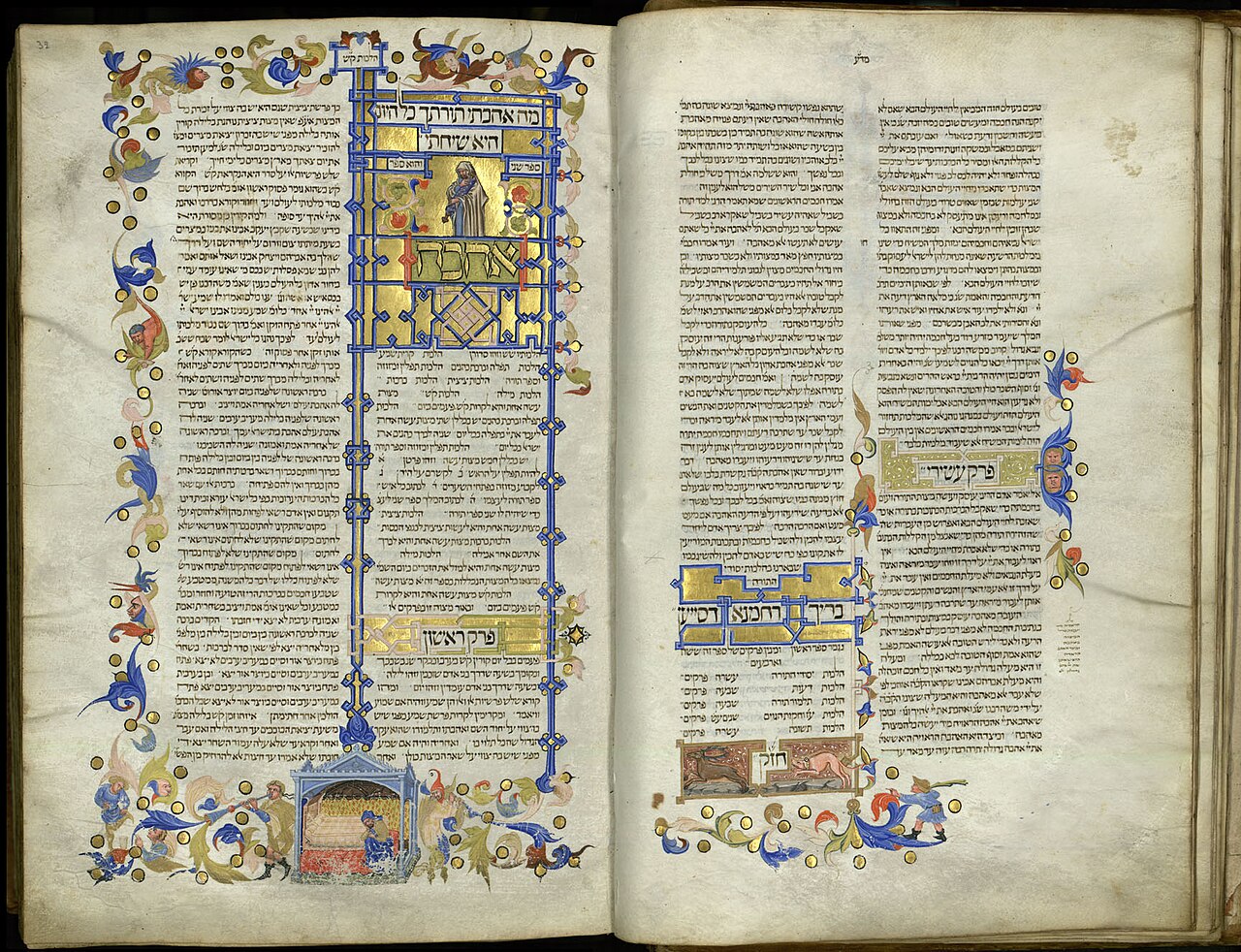
Moses ben Maimon (Maimonides, or Rambam) was born in Córdoba in 1138, or by an older reckoning 1135, into a family of judges. When the Almohads took the city in 1148 the family left, and after years in southern Spain and Morocco reached Fez around 1160. In 1165 they sailed to Acre, visited Jerusalem and Hebron, and settled in Egypt, at Fustat by about 1168–71. His brother David, a merchant who supported the family, drowned in the Indian Ocean on a trading voyage, around 1170 or, by other reckonings, about 1177; in a letter to Japheth ben Elijah, judge of Acre, written nearly eight years later, Maimonides said he had lain ill for about a year after the news.[35] He became physician to the court of Saladin’s vizier al-Qāḍī al-Fāḍil, served as head (raʾīs al-yahūd) of Egyptian Jewry, and died in 1204.[20][25] Consensus
He wrote three works that shaped Judaism for the next eight centuries.
The Commentary on the Mishnah (completed c. 1168), in Arabic, explains the whole Mishnah. Its introduction to the tenth chapter of tractate Sanhedrin, the chapter that begins “All Israel have a share in the world to come”, lists thirteen principles that, Maimonides says, every Jew must believe: that God exists; is one; is not a body; is eternal; alone may be worshipped; that prophecy exists; that Moses was the greatest prophet; that the whole Torah was given to Moses; that it will never be replaced; that God knows human deeds; rewards and punishes; that the Messiah will come; and that the dead will be resurrected.[21] Consensus
The Mishneh Torah (c. 1170–1180), in Hebrew, is a code of all Jewish law in fourteen books, including the laws of the Temple and the messianic king, which no Jew could then practise. It gives rulings without the arguments, sources or dissenting opinions of the Talmud. Maimonides intended it to make the Talmud unnecessary for practical purposes, and said so (see Primary source 4).[22][23] Consensus
The Guide of the Perplexed (c. 1185–1190), in Arabic, is addressed to a reader who knows both the Torah and Aristotelian philosophy and is troubled by the conflict between them. It reads the Bible’s descriptions of God’s body, emotions and actions as metaphors, argues that nothing positive can be said of God, only what he is not, and gives reasons for the commandments, explaining sacrifice, for example, as a concession to the religious habits of the ancient Israelites.[24][25] Consensus
The Maimonidean controversy
All three works provoked opposition. Rabbis in Provence objected that the Mishneh Torah gave rulings without sources and could replace Talmud study; Abraham ben David of Posquières wrote sharp glosses on it. The Guide was attacked for allegorising the Bible and for its view of the resurrection, which Maimonides had to defend in a separate treatise. In the 1230s the conflict divided the communities of Provence and Spain, and copies of his philosophical writings were burned in Montpellier in 1232 or 1233 by Christian church authorities, to whom, his supporters charged, anti-Maimonist rabbis had denounced them.[25][20] Majority
The Thirteen Principles fared better in the prayer book than among philosophers. In fourteenth-century Rome they were set as the hymn Yigdal, traditionally credited to Daniel ben Judah, and a later prose form, each line beginning Ani maʾamin, “I believe with perfect faith”, entered many prayer books in the sixteenth century (apparently first printed in an Ashkenazi prayer book at Mantua in 1558). But later thinkers disputed them: Ḥasdai Crescas and Joseph Albo, in fifteenth-century Spain, proposed different lists, Albo reducing the essentials to three, and Isaac Abravanel argued that Judaism has no dogmas in this sense because every commandment is equally binding. Marc Shapiro has shown that respected rabbis before and after Maimonides held views that contradict several of the principles.[36] Majority
The evidence ledger for Judaism under Islam
| Question | What the evidence supports | Key evidence | Confidence |
|---|---|---|---|
| Where Jews lived | Most of world Jewry under Muslim rule from the 8th to the 12th century | Demography of the conquests; Geniza correspondence networks[1][2] | Majority |
| Legal status | Dhimmī: protected, taxed, subordinate; rules enforced unevenly | Pact of Umar; Geniza; chronicles[10][11] | Majority |
| Authority of the Talmud | Made universal by the geonim through responsa, codes and prayer books | Responsa; Seder Rav Amram; Sherira’s Epistle[5][12][4] | Consensus |
| Karaism | A scripturalist movement formed in the 9th century from several groups; Anan made founder later | Anan’s fragments; Qirqisānī; Rabbanite polemic[8][27] | Majority |
| Language | Arabic, written in Hebrew letters, for prose; Hebrew for poetry, liturgy and law | Saadia, Halevi, Maimonides; the Geniza[15][2] | Consensus |
| Philosophy | Jewish theology built on Islamic kalām and Arabic Aristotelianism | Saadia; the Guide[15][24] | Consensus |
| Biblical text | The vocalised Masoretic text fixed in Tiberias by c. 930 | Aleppo Codex[13] | Consensus |
| Violence | Occasional, local and usually brief, with major exceptions (al-Ḥākim, Granada 1066, the Almohads) | Chronicles; Geniza letters[1][18] | Majority |
| A Jewish creed | First formulated as binding rabbinic dogma by Maimonides c. 1168, and disputed | Commentary on the Mishnah; Crescas, Albo[21][36] | Consensus |
Primary sources
1. The Pact of Umar
In the version preserved by the Andalusian jurist al-Ṭurṭūshī (d. 1126) in his Sirāj al-Mulūk, the Christians of a Syrian city write to the caliph. The Arabic below is the opening condition as Ibn Kathīr (d. 1373) quotes it in his commentary on Qurʾān 9:29, from a closely related version transmitted from ʿAbd al-Raḥmān ibn Ghanm.[37]
Arabic (opening condition, transliterated): allā nuḥditha fī madīnatinā wa-lā fīmā ḥawlahā dayran wa-lā kanīsatan wa-lā qillāyatan wa-lā ṣawmaʿata rāhib
“We shall not build, in our cities or in their neighborhood, new monasteries, Churches, convents, or monks’ cells … We shall not mount on saddles, nor shall we gird swords nor bear any kind of arms … We shall always dress in the same way wherever we may be, and we shall bind the zunar round our waists.” (Al-Ṭurṭūshī’s version, in the Internet Medieval Sourcebook translation.)[10]
What it proves. That medieval Islamic jurists had a model of dhimmī status combining protection with visible inferiority. It does not prove how any community actually lived: the Geniza shows Jews building and repairing synagogues, riding, and serving in government. The text is a legal ideal, invoked by some rulers and ignored by others.[2][1] Majority
2. “Search well in scripture”: the Karaite credo
Aramaic: ḥappîśû bĕʾôrayṯāʾ šappîr wĕʾal tiššāʿănû ʿal daʿtî
“Search well in the Torah, and do not rely on my opinion.”[38][29]
What it proves. The saying, attributed to Anan by later Karaite tradition, became the motto of Karaism: each believer must read scripture independently, and no teacher, not even the founder, is an authority. Daniel Lasker notes that doubts have been raised about the attribution to Anan, since Anan was neither a literalist nor a pluralist, but the saying partly reflects Karaite practice: Karaite scholars disagreed freely with each other and with Anan. Majority on the principle; Contested on the attribution.
3. A people only by its Torah: Saadia, Book of Beliefs and Opinions III.7
Hebrew (Judah ibn Tibbon’s translation, 1186): ki ʾummātēnû ʾênennâ ʾummâ ki ʾim bĕ-tôrôtêhā
“For our nation is a nation only by virtue of its laws.” (Our translation of Ibn Tibbon’s Hebrew; for a full English version from the Arabic, see Rosenblatt.)[15][16]
What it proves. Saadia uses the sentence to argue that the Torah cannot be abrogated, against Christian and Muslim claims that it had been superseded. But the sentence also defines the Jews of his time: a people without land, king or temple, held together by a law, the Oral as well as the Written, which is why the Karaite challenge mattered so much to him. Majority
4. “No other book between them”: the Mishneh Torah’s introduction
Hebrew: lefîkhakh qārāʾtî šēm ḥibbûr zeh Mišnēh Tôrâ, lefî še-ʾādām qôrēʾ Tôrâ še-biḵtāḇ teḥillâ, wĕ-ʾaḥar kāk qôrēʾ ba-zeh, wĕ-yôdēaʿ mimmennû Tôrâ še-bĕʿal peh kullāh, wĕ-ʾênô ṣārîk liqrôt sēfer ʾaḥēr bênêhem.
“Therefore I have called this work Mishneh Torah, because a person reads the Written Torah first and then reads this, and knows from it the whole Oral Torah, and does not need to read any other book between them.”[22]
What it proves. Maimonides meant his code to stand in for the Talmud as a guide to practice. Earlier in the introduction he says the purpose is that no one should need “any other work in the world” for any law of Israel. This claim, more than any single ruling, provoked the opposition of Talmudists who saw the debate of the sources as the heart of Torah study. The Mishneh Torah became authoritative, but as one code among several, studied with the Talmud rather than instead of it.[22][23] Consensus
5. The Thirteen Principles: Commentary on the Mishnah, Sanhedrin 10
Maimonides ends his list by stating its consequence: whoever holds all these principles is part of the community of Israel, must be loved and treated as a brother even if he sins, and has a share in the world to come; whoever denies one of them has excluded himself from the community.[21]
What it proves. That a Jewish creed, a list of beliefs defining membership of the people, was new to rabbinic Judaism in the twelfth century. The Mishnah’s chapter names only a few people who lose their share in the world to come, such as one who denies the resurrection or that the Torah is from heaven (m. Sanhedrin 10:1);[39] Maimonides turned this into a systematic statement of dogma, as Muslim theologians had done for Islam. Majority
6. “My heart is in the east”: Judah Halevi
Hebrew: libbî bĕ-mizraḥ wĕ-ʾānōkî bĕ-sôf maʿărāḇ; ʾêk ʾeṭʿămâ ʾēt ʾăšer ʾōkal wĕ-ʾêk yeʿĕrāḇ?
“My heart is in the east, and I am at the far end of the west. How can I taste what I eat, how can it please me?” (Our translation.)[40][17]
The poem goes on to ask how he can keep his vows while Zion is in the bonds of Edom and he is in the chains of Arabia: the Land of Israel under the Crusaders, he in Muslim Spain.[40]
What it proves. That longing for the Land of Israel could be more than liturgy. Halevi wrote this in the courtly Arabic-style forms he had mastered, and then acted on it. It also shows how Jews saw their position between the two great powers, “Edom” (Christendom) and “Ishmael” or “Arabia” (Islam). Majority
What is absent from the Jewish world under Islam
- A single centre or authority. Even at their height the geonim competed with the Palestinian academy, with local leaders in Kairouan and Córdoba, and with the exilarchs. By the eleventh century local scholars were deciding for themselves. Consensus
- Ashkenaz. The Jews of northern France and the Rhineland, whose traditions dominate later European Judaism, were a small outlying group until the eleventh century (§9). Consensus
- Kabbalah. The Zohar and the classical Kabbalah are thirteenth-century and later, and Christian Spain, not Muslim (§9). Consensus
- Hebrew as the language of thought. The philosophy, Bible commentary and much of the legal correspondence of this period were in Arabic. Consensus
- Ghettos and expulsions. Compulsory Jewish quarters and mass expulsions are features of later Christian Europe and, in the Islamic world, rare and late (the mellāḥ of Fez dates from the 15th century). Majority
- An agreed creed. Before Maimonides no rabbinic authority had set out a binding list of dogmas (Philo of Alexandria’s five tenets, a thousand years earlier, left no mark on the rabbis), and after him none was universally accepted. Consensus
Debates about Judaism under Islam
Was there a golden age of tolerance?
| View | Main argument | Main proponents |
|---|---|---|
| A golden age of tolerance | In al-Andalus Jews, Christians and Muslims lived together in convivencia: Jews rose to high office, shared Arabic learning and created a Hebrew literature unmatched in Latin Europe, under rulers far more accommodating than contemporary Christian ones; tolerance here means coexistence and cultural openness, not modern equality | Américo Castro, who made the term current; María Rosa Menocal[41][42] |
| A myth | Non-Muslims were second-class subjects under discriminatory, often humiliating Islamic law; the brilliance of a small elite says little about ordinary dhimmīs; and al-Andalus saw massacres (Granada 1066), forced conversions and expulsions (the Almohads) and the execution of Christians for blasphemy and apostasy (the martyrs of Córdoba, 850s), so the “paradise” is a modern construction | Darío Fernández-Morera[43] |
| Comparative middle | Jews were legally inferior under Islam but generally safer and more integrated than in Latin Christendom, because Islamic law gave them a recognised place and Muslim society was not organised against them | Mark R. Cohen, Bernard Lewis[1][18] |
Cohen identifies two opposite modern distortions: the “myth of the interfaith utopia”, promoted since the nineteenth century by Jewish historians who contrasted Islam favourably with Christian Europe, and a “neo-lachrymose” counter-myth, which since the mid-twentieth century has read the history backwards from the Arab–Israeli conflict as a story of unbroken persecution. His own conclusion is that Jews under Islam were, on the whole, better off than under Christendom between the seventh and the thirteenth centuries, with major exceptions.[1] Most historians accept a version of this comparative view. Majority on the comparison; Political on the modern uses of the history.
Who founded Karaism?
The traditional account, held by both later Karaites and their Rabbanite opponents, makes Anan ben David the founder, though they disagree on his motives: for Karaites he restored the true Torah; for Rabbanites he was a disappointed office-seeker.[9] Most modern historians see a process: several non-rabbinic groups in the early Islamic world merged into one movement in the ninth century, and Anan was adopted as a founder because he was the most prominent early dissenter.[27][29] Some have looked for continuity with the Sadducees or with the sectarians of Qumran (§6), whose writings may have been rediscovered in caves around 800; the evidence for a direct connection is thin. Majority for a process; Speculative on ancient roots.
Did Maimonides convert to Islam?
The Arabic biographers Ibn al-Qifṭī and Ibn Abī Uṣaybiʿa, writing in the thirteenth century, say that Maimonides professed Islam under the Almohads and returned to Judaism in Egypt, where a Muslim jurist accused him of apostasy and the vizier al-Qāḍī al-Fāḍil ruled that a forced conversion was not valid. Maimonides’ own Epistle on Forced Conversion told Jews in Almohad lands that outward profession under duress did not make them non-Jews, though they should leave as soon as possible. Some biographers, notably Joel Kraemer, think his family probably did make an outward conversion; others regard the Arabic reports as hostile gossip and note that Maimonides never mentions such a thing.[20][25] Contested
Was the Talmud’s victory inevitable?
The traditional view, expressed by Sherira himself, is that the Babylonian academies were the authentic continuation of the sages and their authority was natural. Robert Brody and others emphasise politics: the geonim’s success depended on Baghdad’s place as the Abbasid capital, on their energetic correspondence, and on defeating rivals in Palestine and among the Karaites. When Baghdad declined, so did they.[5][4] Majority that both factors mattered.
Further reading
- Mark R. Cohen, Under Crescent and Cross: The Jews in the Middle Ages (Princeton, 1994; new ed. 2008) — the best comparison of Jewish life under Islam and Christianity.
- Robert Brody, The Geonim of Babylonia and the Shaping of Medieval Jewish Culture (Yale, 1998).
- S. D. Goitein, A Mediterranean Society (6 vols., California, 1967–1993); the one-volume abridgement by Jacob Lassner (1999) is a good start.
- Adina Hoffman and Peter Cole, Sacred Trash: The Lost and Found World of the Cairo Geniza (Schocken, 2011).
- Meira Polliack, ed., Karaite Judaism: A Guide to its History and Literary Sources (Brill, 2003).
- Norman A. Stillman, The Jews of Arab Lands: A History and Source Book (Jewish Publication Society, 1979) — sources in translation, including the Pact of Umar.
- Raymond P. Scheindlin, The Gazelle: Medieval Hebrew Poems on God, Israel, and the Soul (Jewish Publication Society, 1991).
- Joel L. Kraemer, Maimonides: The Life and World of One of Civilization’s Greatest Minds (Doubleday, 2008), and Moshe Halbertal, Maimonides: Life and Thought (Princeton, 2014).
- Marc B. Shapiro, The Limits of Orthodox Theology: Maimonides’ Thirteen Principles Reappraised (Littman, 2004).
References
- ^ a b c d e f g h i j k l m n o p q Mark R. Cohen Under Crescent and Cross: The Jews in the Middle Ages. Princeton University Press, 1994. Compares Jewish life under Islam and Latin Christendom, between the myth of an interfaith utopia and its counter-myth.
- ^ a b c d e f g h i S. D. Goitein A Mediterranean Society: The Jewish Communities of the Arab World as Portrayed in the Documents of the Cairo Geniza. University of California Press, 6 vols. (1967–1993), 1967. Four decades of work on the Geniza's documentary fragments; the foundation of medieval Jewish social history.
- ^ a b Moshe Gil Jews in Islamic Countries in the Middle Ages. Brill, 2004. Detailed survey from pre-Islamic Arabia to the eleventh century, largely from Geniza sources.
- ^ a b c d e f Epistle of Sherira Gaon — Iggeret Rav Sherira Gaon. 987 CE. Aramaic and Hebrew. Reply to the community of Kairouan on how the Mishnah and Talmud were composed: the first history of the rabbinic tradition and the basis of the chronology of the sages and geonim. read the text
- ^ a b c d e f g h i j k l Robert Brody The Geonim of Babylonia and the Shaping of Medieval Jewish Culture. Yale University Press, 1998. The standard account of the geonim: academies, responsa, codes and their rivals.
- ^ a b c Ibn Isḥāq, Sīrat Rasūl Allāh — The Life of Muhammad (recension of Ibn Hishām). mid-8th c. CE (Ibn Hishām's recension, early 9th c.). Arabic. The earliest surviving Muslim biography of Muhammad; source for his alliance and conflicts with the Jewish tribes of Medina (Qaynuqāʿ, Naḍīr, Qurayẓa) and the conquest of Khaybar. about
- ^ a b Norman A. Stillman The Jews of Arab Lands: A History and Source Book. Jewish Publication Society, 1979. A history with translated sources, from Muhammad's Medina to the early modern period.
- ^ a b c Anan ben David, Sefer ha-Mitzvot — Book of Commandments (fragments). c. 760s–770s CE. Aramaic. Anan's legal handbook in Aramaic, surviving in fragments and quotations: a strict, ascetic law that rejects rabbinic authority but uses rabbinic methods of interpretation. about
- ^ a b c d e Leon Nemoy, trans. Karaite Anthology: Excerpts from the Early Literature. Yale University Press, 1952. Translations of Anan, Qirqisānī and other early Karaites, with a critical introduction to the founding story.
- ^ a b c d Pact of Umar (al-Ṭurṭūshī, Sirāj al-Mulūk) — Pact of Umar (Shurūṭ ʿUmar). 9th c. CE (form); attributed to Umar I, 634–644. Arabic. Conditions on non-Muslim subjects, framed as a letter from Christians to the caliph Umar: no new churches or synagogues, distinctive dress, no riding on saddles or bearing arms. Surviving versions are later than Umar; a legal ideal, enforced unevenly. about
- ^ a b c Milka Levy-Rubin Non-Muslims in the Early Islamic Empire: From Surrender to Coexistence. Cambridge University Press, 2011. Traces the Pact of Umar to conquest-era surrender treaties and Byzantine and Sasanian models.
- ^ a b c Seder Rav Amram Gaon — Order of prayer of Amram Gaon. c. 860–875 CE. Hebrew and Aramaic. The oldest surviving complete Jewish prayer book (its text later expanded and altered by copyists), sent by the gaon of Sura in reply to a request from Spain; the basis of later Sephardi and Ashkenazi rites. about
- ^ a b c Aleppo Codex — Israel Museum (Shrine of the Book). c. 930 CE. Hebrew. The most authoritative Masoretic manuscript, pointed by Aaron ben Asher in Tiberias and used by Maimonides; about 40% lost after 1947. about
- ^ a b c d Henry Malter Saadia Gaon: His Life and Works. Jewish Publication Society, 1921. Still the fullest biography, including the Ben Meir calendar dispute.
- ^ a b c d e f Saadia Gaon, Book of Beliefs and Opinions — Kitāb al-Amānāt wa-l-Iʿtiqādāt (Hebrew: Emunot ve-Deʿot). 933 CE. Judeo-Arabic. The first systematic Jewish theology, using the methods of Muslim kalām. III.7: "our nation is a nation only by virtue of its laws", against the claim that the Torah had been abrogated. read the text
- ^ a b c d Samuel Rosenblatt, trans. Saadia Gaon: The Book of Beliefs and Opinions. Yale University Press, 1948. The complete English translation, from the Arabic.
- ^ a b c d e Raymond P. Scheindlin The Gazelle: Medieval Hebrew Poems on God, Israel, and the Soul. Jewish Publication Society, 1991. Translations and essays on the religious poetry of al-Andalus, including Halevi's poems of Zion.
- ^ a b c d e Bernard Lewis The Jews of Islam. Princeton University Press, 1984. Classic survey; argues that persecution under Islam was real but rare compared with Christian Europe.
- ^ a b Raymond P. Scheindlin The Song of the Distant Dove: Judah Halevi's Pilgrimage. Oxford University Press, 2008. doi Reconstructs Halevi's last journey from his poems and the Geniza letters: Egypt from September 1140, sailing in May 1141, death that summer.
- ^ a b c d e f g Joel L. Kraemer Maimonides: The Life and World of One of Civilization's Greatest Minds. Doubleday, 2008. Biography drawing heavily on the Geniza; discusses the evidence that his family outwardly converted under the Almohads.
- ^ a b c d Maimonides, Commentary on Mishnah Sanhedrin 10 (Introduction to Perek Ḥeleq) — Commentary on the Mishnah. c. 1168 CE. Judeo-Arabic. The Thirteen Principles of faith; the eighth holds that the whole Torah now in our hands was given to Moses from heaven. about
- ^ a b c d Maimonides, Mishneh Torah, Introduction — Mishneh Torah. c. 1170–1180 CE. Hebrew. Maimonides explains the name of his code: a reader of the Written Torah and then of this book will know the whole Oral Torah "and does not need to read any other book between them". read the text
- ^ a b c Isadore Twersky Introduction to the Code of Maimonides (Mishneh Torah). Yale University Press, 1980. The standard study of the Mishneh Torah's aims, structure and reception.
- ^ a b c Maimonides, Guide of the Perplexed — Dalālat al-Ḥāʾirīn (Hebrew: Moreh Nevukhim). c. 1185–1190 CE. Judeo-Arabic. Maimonides' philosophical work for readers caught between Torah and Aristotle: biblical anthropomorphisms as metaphor, negative theology, and reasons for the commandments. read the text
- ^ a b c d e Moshe Halbertal Maimonides: Life and Thought. Princeton University Press, 2014. Clear introduction to the life, the Commentary, the Mishneh Torah and the Guide.
- ^ W. N. Arafat New Light on the Story of Banū Qurayẓa and the Jews of Medina. Journal of the Royal Asiatic Society of Great Britain & Ireland 108.2, pp. 100–107, 1976. doi Argues that the traditional account of the execution of the Qurayẓa men was inflated in later tradition.
- ^ a b c d e f Meira Polliack, ed. Karaite Judaism: A Guide to its History and Literary Sources. Brill, 2003. The reference work on Karaite history and literature.
- ^ Leon Nemoy ʿAnan ben David. Encyclopedia of Religion, ed. Mircea Eliade (Macmillan), 1987. open library Reference article noting that the Rabbanite story of Anan's rivalry for the exilarchate is first cited by the twelfth-century Karaite Elijah ben Abraham, and that its historicity is open to challenge.
- ^ a b c d Daniel J. Lasker Biblical Exegesis as a Source of Jewish Pluralism: The Case of the Karaites. TheTorah.com, 2017. open library Short account of Karaite origins and of doubts about Anan's credo.
- ^ Emanuel Tov Textual Criticism of the Hebrew Bible. Fortress Press, 3rd ed., 2012. The standard work on the Masoretic text, Septuagint, Samaritan Pentateuch and Scrolls.
- ^ Geoffrey Khan The Tiberian Pronunciation Tradition of Biblical Hebrew, Volume 1. Open Book Publishers, 2020. doi Open-access study of the Tiberian Masoretes; its introduction discusses the Karaite involvement with the tradition and argues against making the Ben Asher family Karaites.
- ^ a b c Adina Hoffman and Peter Cole Sacred Trash: The Lost and Found World of the Cairo Geniza. Schocken, 2011. The story of the Geniza and what it revealed.
- ^ Cairo Geniza (Taylor-Schechter Collection) — Cambridge University Library, Genizah Research Unit. c. 9th–19th c. CE. Hebrew, Judeo-Arabic, Aramaic. Several hundred thousand fragments from the storeroom of the Ben Ezra synagogue in Fustat, about 193,000 of them at Cambridge: letters, contracts, court records, lost texts and Maimonides autographs. about
- ^ Judah Halevi, Kuzari — Kitāb al-Radd wa-l-Dalīl fī l-Dīn al-Dhalīl. c. 1140 CE. Judeo-Arabic. A dialogue in which the king of the Khazars chooses Judaism after hearing a philosopher, a Christian, a Muslim and a rabbi; truth rests on the public revelation at Sinai and Israel's history rather than philosophical proof. read the text
- ^ Maimonides, Letter to Japheth ben Elijah — Letter to Japheth (Yefet) ben Elijah, dayyan of Acre. c. 1176–1184 CE (dating disputed). Hebrew. Maimonides recalls the drowning of his brother David in the Indian Ocean, with the family's capital, and says he lay ill for nearly a year after the news; 'close to eight years' later he still mourns. about
- ^ a b Marc B. Shapiro The Limits of Orthodox Theology: Maimonides' Thirteen Principles Reappraised. Littman Library of Jewish Civilization, 2004. Shows that respected rabbinic authorities held views contrary to several of the principles.
- ^ Ibn Kathīr, Tafsīr al-Qurʾān al-ʿAẓīm, on Q 9:29 — Tafsīr al-Qurʾān al-ʿAẓīm. 14th c. CE (Ibn Kathīr d. 1373). Arabic. Commenting on the jizya verse, Ibn Kathīr quotes the conditions of Umar as transmitted from ʿAbd al-Raḥmān ibn Ghanm, opening: 'that we shall not build in our city or around it a monastery, church, cell or monk's hermitage'. read the text
- ^ Saying attributed to Anan ben David — Karaite tradition. attributed to the 8th c. CE; recorded later. Aramaic. "Search well in the Torah and do not rely on my opinion": the motto of Karaite independent reading of scripture. Its attribution to Anan is doubtful.
- ^ m. Sanhedrin 10:1 — Mishnah. c. 200 CE. Hebrew. Abba Saul adds to those with no share in the world to come 'one who pronounces the name according to its letters'. read the text
- ^ a b Judah Halevi, "Libbi ba-mizraḥ" — "My heart is in the east" (poem). early 12th c. CE. Hebrew. Halevi's short poem of longing for Zion, "My heart is in the east, and I am at the far end of the west", with Zion in the bonds of Edom (Christendom) and the poet in the chains of Arabia (Islam). about
- ^ Américo Castro España en su historia: cristianos, moros y judíos. Losada, 1948. The book that introduced the idea of convivencia among the three faiths of medieval Spain.
- ^ María Rosa Menocal The Ornament of the World: How Muslims, Jews, and Christians Created a Culture of Tolerance in Medieval Spain. Little, Brown, 2002. The best-known modern statement of the convivencia view.
- ^ Darío Fernández-Morera The Myth of the Andalusian Paradise: Muslims, Christians, and Jews under Islamic Rule in Medieval Spain. ISI Books, 2016. A polemical rejection of the convivencia view, stressing discrimination and violence.