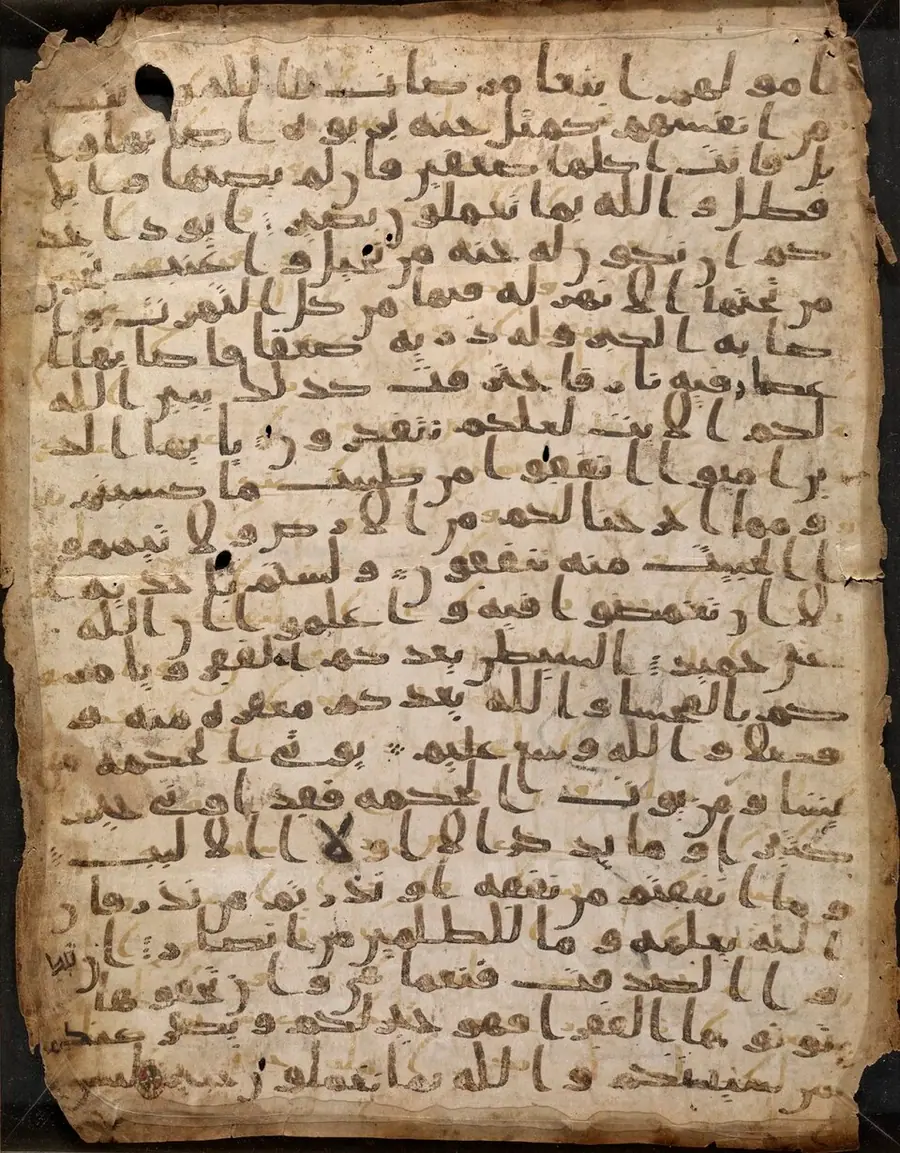
Between about 610 and 632, Muhammad recited to his followers in Mecca and Medina words that he and they understood as God’s speech, delivered through the angel Gabriel. The recitations were memorized, repeated in prayer and partly written down. Muslim tradition says that after his death they were gathered into one volume under Abū Bakr, and that around 650 the caliph ʿUthmān issued a standard text, sent copies to the main garrison cities and ordered the rest destroyed. Fragments of that text survive on parchment dated by radiocarbon to the seventh century, written in a script that recorded consonants but left the vowels, and often the dots that tell one letter from another, to the reader’s memory. Over the next three centuries scholars added the missing signs, sorted the permitted ways of reciting the text, and built the tools, such as the chronology of the suras and the theory of abrogation, through which it is still read. Majority
This chapter follows the Qur’an from recitation to standard book, and sets the tradition’s account beside the manuscripts. The general problem of the sources, and why the earliest biography of Muhammad is a century younger than him, is set out in §0; the life of the prophet is §2; the Dome of the Rock, the first great public display of Qur’anic text, belongs to §5. Whether the Qur’an is revealed is outside what historical method can test (§0). What a historian can date is when its words were written down, by whom the tradition says, and what the oldest copies contain.
Timeline
| Date | Event or evidence | Confidence |
|---|---|---|
| c. 610 | First revelation, traditionally the opening of sura 96, “Recite in the name of your Lord”[1] | Majority (as tradition) |
| 610–632 | The recitations are delivered over some twenty years in Mecca and, from 622, Medina[2] | Majority |
| 568–645 | Radiocarbon range for the parchment of the Birmingham leaves (suras 18–20)[3] | Consensus (parchment date) |
| 632 | Muhammad dies; tradition says the text was not yet in one volume[4] | Majority |
| c. 633 | After the battle of al-Yamāma, Abū Bakr has Zayd ibn Thābit collect the text, by tradition[4] | Contested |
| 643 | PERF 558, the oldest dated Arabic papyrus, already uses dots to distinguish letters[5] | Consensus |
| c. 650 (r. 644–656) | ʿUthmān’s standard codex, sent to the provinces[6][7] | Majority |
| 578–669 | Radiocarbon range for a leaf of the Ṣanʿāʾ palimpsest, whose erased text is not ʿUthmānic[8][9] | Consensus (date); Contested (meaning) |
| 649–675 | Radiocarbon range for the Tübingen fragment Ma VI 165[10][11] | Consensus |
| c. 650–700 | Codex Parisino-petropolitanus, about 45% of the text, copied by five scribes[12][13] | Majority |
| 691–692 | The Dome of the Rock’s mosaic inscriptions quote Qur’anic verses (§5)[14][15] | Consensus |
| c. 700 | al-Ḥajjāj, governor of Iraq, is reported to have had the text counted, divided and supplied with diacritics, and to have sent codices to the towns[7] | Majority (that the reports exist); Contested (what he changed) |
| 936 | Death of Ibn Mujāhid, whose Kitāb al-Sabʿa fixed seven authoritative readings[16] | Consensus |
| 1924 | The Cairo edition prints the reading of Ḥafṣ ʿan ʿĀṣim; it becomes the world standard[17] | Consensus |
A recitation before a book
“Recite!”
The word qurʾān means “recitation” or “reading aloud”. Nöldeke and many later scholars connect it with the Syriac qeryānā, the scripture reading of the Christian liturgy.[18] Majority Tradition places the first revelation in a cave on Mount Ḥirāʾ near Mecca, and takes it to be the opening of sura 96:
iqraʾ bi-smi rabbika lladhī khalaq; khalaqa l-insāna min ʿalaq; iqraʾ wa-rabbuka l-akram; alladhī ʿallama bi-l-qalam; ʿallama l-insāna mā lam yaʿlam
“Read! In the name of your Lord who created: He created man from a clinging form. Read! Your Lord is the Most Bountiful One who taught by [means of] the pen, who taught man what he did not know.” (Q 96:1–5, trans. Abdel Haleem)[1][19]
That this was the first revelation is the tradition’s account, not something the text itself says. Majority as tradition. Translations quoted in this chapter are M. A. S. Abdel Haleem’s (2004) unless stated; the Arabic follows the standard Cairo text.
The Qur’an talks about itself more than any other scripture of its time, and much of what it says concerns speech and memory. It tells the prophet not to hurry the words:
lā tuḥarrik bihi lisānaka li-taʿjala bih; inna ʿalaynā jamʿahu wa-qurʾānah; fa-idhā qaraʾnāhu fa-ttabiʿ qurʾānah; thumma inna ʿalaynā bayānah
“[Prophet], do not rush your tongue in an attempt to hasten [your memorization of] the Revelation: We shall make sure of its safe collection and recitation. When We have recited it, repeat the recitation and We shall make it clear.” (Q 75:16–19)[20]
It answers critics who asked why it did not come down all at once: it was sent “in this way to strengthen your heart”, “in gradual revelation” (Q 25:32).[2] And it promises that God will guard the “Reminder” he has sent down (Q 15:9).[21] Consensus on what the verses say.
A book in heaven, a text on earth
The same Qur’an also calls itself a kitāb, a book or scripture, and places its original in heaven: “This is truly a glorious Qur’an [written] on a preserved Tablet” (Q 85:21–22).[22] Angelika Neuwirth reads this double self-image, recitation on earth and book in heaven, as the mark of a text that grew in the liturgy of a community before it became a codex, and that claimed for itself the status Jews and Christians gave their written scriptures.[23] Majority
A text recited over twenty years also responds to events and revises itself. One verse concedes that some revelations are “superseded or forgotten” and replaced “with something better or similar” (Q 2:106), another that the prophet will not forget “unless God wishes” (Q 87:6–7).[24][25] Later scholars would build a theory of abrogation on these verses (below). For the historian, they show that the Qur’an itself knows its text was not static while it was being delivered. Majority
What was written in Muhammad’s lifetime?
Muslim tradition says that scribes, Zayd ibn Thābit prominent among them, wrote down revelations as they came, on whatever was to hand, while the main medium remained memory.[4] Majority that some writing happened. How much, and in what form, is unknown: no manuscript can be shown to come from Muhammad’s lifetime, and the earliest radiocarbon range, Birmingham’s, only reaches it at its early end. The Qur’an denies that Muhammad recited or wrote any scripture before it (Q 29:48), the basis of the later doctrine that he was unlettered.[26] What the verse means about his ability to write is debated. Contested
The tradition’s account: Abū Bakr, ʿUthmān and the companions’ codices
Abū Bakr and the battle of al-Yamāma
The best-known account of the collection is preserved by al-Bukhārī (d. 870) on the authority of Zayd ibn Thābit. After many of the men who knew the Qur’an by heart were killed at the battle of al-Yamāma (c. 633), ʿUmar urged the caliph Abū Bakr to have it collected, and Abū Bakr gave the task to Zayd:
fa-tatabbaʿtu l-qurʾāna ajmaʿuhu mina l-ʿusubi wa-l-likhāfi wa-ṣudūri l-rijāl
“So I started looking for the Qur’an and collecting it from (what was written on) palm stalks, thin white stones and also from the men who knew it by heart.” (al-Bukhārī 4986)[4]
Zayd says he found the last verses of sura 9 only with one man, Abū Khuzayma al-Anṣārī. The sheets passed from Abū Bakr to ʿUmar, and then to ʿUmar’s daughter Ḥafṣa, one of the prophet’s widows. Majority that this is the tradition’s account; Contested on its historicity.
ʿUthmān’s standard text
The second report, in the same collection, explains the standard text. During the campaigns in Armenia and Azerbaijan, the general Ḥudhayfa ibn al-Yamān was alarmed that soldiers from Syria and Iraq recited differently, and urged the caliph ʿUthmān (r. 644–656) to unite the community “before they differ about the Book as Jews and Christians did before”. ʿUthmān borrowed Ḥafṣa’s sheets and had Zayd and three men of Quraysh copy them, telling them that where they disagreed with Zayd they should write “in the dialect of Quraysh, the Qur’an was revealed in their tongue”. Then:
“ʿUthmān sent to every Muslim province one copy of what they had copied, and ordered that all the other Qur’anic materials, whether written in fragmentary manuscripts or whole copies, be burnt.” (al-Bukhārī 4987)[6]
Later sources disagree on how many copies there were (four, five or seven), but agree on Kufa, Basra, Damascus and Medina.[27] Majority The ʿUthmānic text is the one Muslims call the muṣḥaf ʿuthmānī, and its consonantal outline, the rasm, is the basis of every printed Qur’an today.[7] Majority
Two famous manuscripts are shown as ʿUthmān’s own copies, one in Tashkent (the Samarkand Qur’an, said to be stained with his blood) and one at the Topkapı Palace in Istanbul. Palaeography and radiocarbon (for the Samarkand copy) date both to the eighth or ninth century; they are early and important copies, but not his.[28] Majority
The companions’ codices
ʿUthmān’s order presupposes that other written versions existed, and the tradition names their owners. The most discussed are those of ʿAbd Allāh ibn Masʿūd, the leading Qur’an teacher of Kufa, and Ubayy ibn Kaʿb of Medina. The reports, gathered in works such as Ibn Abī Dāwūd’s Kitāb al-Maṣāḥif (“Book of the Codices”, tenth century) and collected by Arthur Jeffery in 1937, list hundreds of variant words and phrases.[29] They also report differences of extent: Ibn Masʿūd’s codex lacked the opening sura and the last two (113–114), and Ubayy’s had two short extra suras, known as al-Khalʿ and al-Ḥafd, which read like prayers.[29] Ibn Masʿūd is said to have resisted handing over his codex. Majority that the reports exist and are early; Contested on their detail. Muslim scholars have long explained the omissions as matters of what was written down, not of what was believed: the opening sura, for instance, was recited in every prayer. Consensus that this explanation exists.
The tradition also explains why variation was legitimate. In another report, ʿUmar hears a companion recite sura 25 differently from the way he learned it and drags him to the prophet, who approves both recitations and says: “This Qur’an has been revealed to be recited in seven different ways (sabʿat aḥruf), so recite of it whichever is easier for you.”[30] What the seven aḥruf were was already disputed by medieval scholars; they are not the same as the later seven readings. Consensus
How old are these reports?
The collection reports reach al-Bukhārī through the Medinan scholar Ibn Shihāb al-Zuhrī (d. 742). Harald Motzki, analysing their chains of transmission, argued that they can be traced at least to al-Zuhrī and so to the early eighth century, much earlier than earlier Western sceptics had assumed.[31] Majority Two older Western theses took the reports in opposite directions. John Burton (1977) argued that Muhammad himself had left a complete text, and that the stories of a later collection were invented by jurists who needed missing verses for their theory of abrogation.[32] John Wansbrough, in the same year, argued that the text was not fixed until around 800 (see Chapter 0: How We Know).[33] Neither view has survived the manuscript evidence below, which points to a fixed text well before 700. Majority
What the manuscripts show
A script that recorded consonants
Seventh-century Arabic was written in a script that distinguished fewer letter shapes than it had sounds. Several letters (b, t, th, n and y, for instance) shared one shape in the middle of a word, and short vowels were not written at all. Dots to tell the shapes apart already existed: PERF 558, a receipt for sheep written in Arabic and Greek in Egypt in April 643, is the oldest dated Arabic papyrus and uses them.[5] Consensus But the earliest Qur’an copies use such dots sparingly, and add no vowel signs.[13] Consensus
The consequence is that a written copy fixed the rasm, the consonantal skeleton, but not every reading of it: the same skeleton could be voiced as an active or a passive verb, a first or third person. The text lived in the combination of a written skeleton and a taught recitation. Consensus Muslim tradition credits the later signs to the Basran grammarian Abū l-Aswad al-Duʾalī (d. c. 688), who marked vowels with coloured dots; his students Naṣr ibn ʿĀṣim (d. 707–8) and Yaḥyā ibn Yaʿmar, said to have added the letter-dots at the request of the governor al-Ḥajjāj; and al-Khalīl ibn Aḥmad (d. c. 786–791), who replaced the coloured dots with the vowel signs still used.[7] Majority that the signs came in stages; Contested on the names.
The script of the earliest copies is called ḥijāzī, after the region of Mecca and Medina: an upright, slanting hand on parchment in vertical format. Within a few decades it gave way to the larger, horizontal “Kufic” hands of the Umayyad period.[34] Majority
The Birmingham leaves
In 2015 the University of Birmingham announced that two parchment leaves in its Mingana Collection (Mingana 1572a), written in ḥijāzī script and containing parts of suras 18 to 20, had been dated by the Oxford Radiocarbon Accelerator Unit to between 568 and 645 at 95.4% probability.[3] Consensus on the measurement. The leaves had been bound with leaves of a later manuscript; the researcher Alba Fedeli recognised that they belong to the same codex as sixteen leaves in Paris (BnF Arabe 328c).[3] Consensus
The result was widely reported as “the oldest Qur’an”. What it measures is the death of the animal whose skin became the parchment, so the writing is probably somewhat later, and the range, which begins before Muhammad’s prophecy, says nothing about which decade within it. François Déroche, the leading specialist in early Qur’anic manuscripts, expressed reservations about how much precision radiocarbon can give (Debates).[34] What the leaves do show is a text in ḥijāzī script whose wording agrees with the standard text, on parchment from the first half of the seventh century. Majority
Tübingen, Berlin and Leiden
Birmingham was not alone. In 2014 the Tübingen University Library announced that its fragment Ma VI 165 had been dated by the ETH Zürich to 649–675.[10] As part of the German–French project Coranica (2011–2014), Michael Marx and Tobias Jocham dated further fragments in Berlin and Leiden to the seventh century, including Berlin’s ms. or. fol. 4313 to 606–652, and compared the method against Arabic papyri and Syriac manuscripts of known date, which it dated correctly.[11] Majority They also found archaic spellings, of names such as Dāwūd (David) and of common words, that later copyists modernized: the spelling of the Qur’an was still developing in the seventh and eighth centuries even where its words were not.[11] Majority
The Codex Parisino-petropolitanus
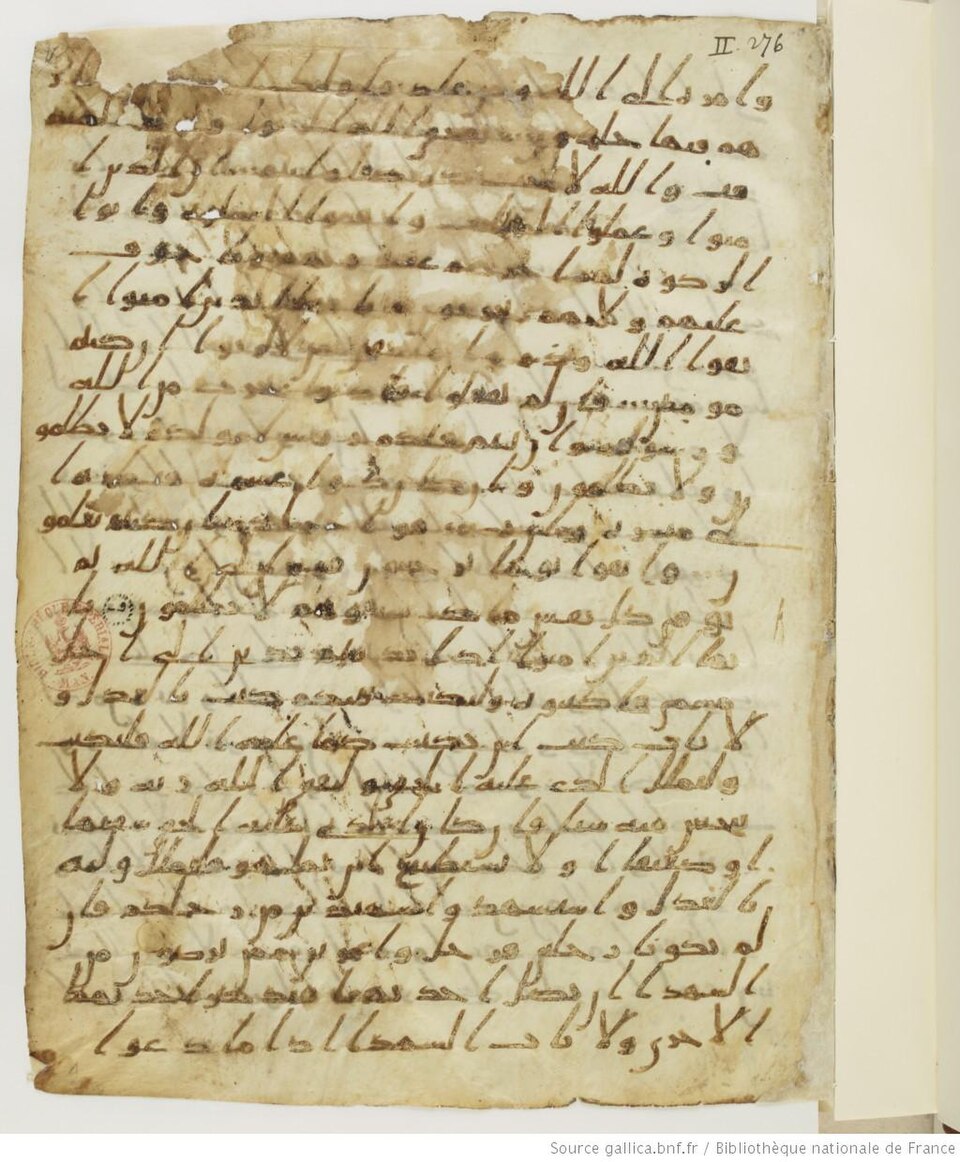
The largest early copy is not radiocarbon-dated but studied page by page. Its 118 surviving leaves are divided between Paris (70, BnF Arabe 328a–b), St Petersburg (46), the Vatican and the Khalili Collection in London (one each). They preserve about 45% of the text, from sura 2 to sura 72, and were written by five scribes working at once.[12] François Déroche, in a full study (2009), dated it on palaeographic grounds to the third quarter of the seventh century. Its wording is the standard rasm, with mainly orthographic differences from the Cairo text; its verse divisions and spellings vary between the scribes.[13] Majority
The Ṣanʿāʾ palimpsest
In 1972 workers repairing the roof of the Great Mosque of Ṣanʿāʾ in Yemen found a mass of discarded parchment: thousands of fragments of Qur’an manuscripts, later sorted into several hundred codices. A German conservation project directed by Albrecht Noth, with Gerd-R. Puin as its local director in the early 1980s, worked on them.[8] Consensus One codex, catalogued as DAM 01-27.1 and known as Ṣanʿāʾ 1, is a palimpsest: its parchment was scraped and rewritten. The upper text is the standard Qur’an. The lower text, readable under ultraviolet light and imaging, is not. Consensus
Behnam Sadeghi and Uwe Bergmann (2010) had a leaf of the codex that had been sold at auction in 1993 radiocarbon-dated: 578–669 at 95%, with a 75% probability of a date before 646.[9] Sadeghi and Mohsen Goudarzi (2012) then edited the lower text of the leaves in Ṣanʿāʾ.[35] They found that it agrees with the standard text in the great majority of its words, but differs in many small ways: words added or missing, different forms of a verb, transposed phrases, and suras in a different order. Its variants show little or no correspondence with those reported for the codices of Ibn Masʿūd or Ubayy. They concluded that it represents a companion codex of a type older than or independent of ʿUthmān’s, which they called C-1, and that the standard text is on the whole the better preserver of their common source.[35] Majority
Not everyone reads it as a codex. Asma Hilali (2017) argued that both layers show signs of teaching and exercise, practice copies rather than a book meant to be read.[36] Éléonore Cellard (2021), reconstructing many more leaves, concluded that they formed a complete codex produced by professional scribes.[37] Contested What is not disputed is that someone in the seventh century copied a version of the Qur’an that differed from ʿUthmān’s, and that someone later erased it and wrote the standard text over it. Consensus
One written archetype
The most important recent argument is about spelling. Marijn van Putten (2019) examined how fourteen early manuscripts spell a single phrase, niʿmat allāh, “the grace of God”, whose second word can be written in two ways. Across the manuscripts, each occurrence is spelled the same way in the same place, even though the choice between spellings is arbitrary.[38] Shared idiosyncrasies of this kind are what textual critics expect from copies of a single written exemplar, not from independent writings-down of a memorized text. Majority Together with the radiocarbon dates, this is the main reason most scholars now date the standard rasm to ʿUthmān’s reign, as the tradition says. Nicolai Sinai (2014), weighing the evidence for later editing, concluded that “the traditional dating of the standard rasm… to 650 or earlier ought to be our default view”, while conceding that rival versions were not displaced at once and that in the first decade after 632 the text may not yet have been fully fixed.[7] Majority
From one skeleton to many readings
Because the rasm did not fix vowels and dots, people who agreed on the written text still recited it differently, and each city followed its own famous teachers. By the late ninth century the variety was large. The Baghdad scholar Ibn Mujāhid (d. 936), in his Kitāb al-Sabʿa (“Book of the Seven”), chose seven readers as authoritative: Nāfiʿ of Medina, Ibn Kathīr of Mecca, Abū ʿAmr of Basra, Ibn ʿĀmir of Damascus, and ʿĀṣim, Ḥamza and al-Kisāʾī of Kufa. Later scholars accepted three more, to make ten. Each reading is transmitted through two principal students.[16][39] Consensus A reading had to fit the ʿUthmānic skeleton, accord with Arabic grammar and come through a sound chain of teachers; readings outside the canon, including the companions’ variants, became shādhdh, “irregular”, acceptable for study but not for prayer. Majority
The differences between the readings are real but small: a vowel that makes “king” (malik) into “owner” (mālik) in sura 1:4, a pronoun, a verb’s person. Consensus Which reading a Muslim hears today depends largely on a twentieth-century printing decision. The Cairo edition of 1924, prepared under King Fuʾād, printed the reading of ʿĀṣim in the transmission of his student Ḥafṣ, and its text, with its verse numbering and its headings marking each sura as Meccan or Medinan, became the model for most printed Qur’ans.[17] The transmission of Nāfiʿ by Warsh remains common in North and West Africa. Consensus
The Qur’an in its world
A text that assumes its hearers know the stories
The Qur’an names about two dozen prophets, most of them biblical, and refers to Adam, Noah, Abraham, Moses, David, Solomon, Jesus and Mary as figures its audience already knows. It rarely tells a story from beginning to end; it alludes, corrects and draws a lesson. Consensus Sidney Griffith has argued that there is no evidence of a written Arabic Bible before Islam, so that this knowledge must have circulated orally, in Arabic, among Arabs who had heard Jewish and Christian teaching.[40] Majority Scholars such as Gabriel Said Reynolds read the Qur’an alongside the Bible and its Jewish and Christian interpretations, its “subtext”.[41] Angelika Neuwirth reads it as a voice in the debates of late antiquity, answering the scriptures of others in its own terms.[23] Majority on the parallels; Contested on the channels and on how much the Qur’an is answering rather than borrowing.
The Qur’an is aware of the charge that someone was teaching Muhammad: “We know very well that they say, ‘It is a man who teaches him,’ but the language of the person they allude to is foreign, while this revelation is in clear Arabic” (Q 16:103).[42] It also challenges doubters to “produce a single sura like it” (Q 2:23).[43] Consensus on what the verses say.
Mary, the cross and the Sleepers
Sura 19 is named after Mary and tells of the annunciation and the birth of Jesus; Mary withdraws “to a place to the east” and God sends his Spirit “in the form of a perfected man” (Q 19:16–17).[44] Its narrative shares details with Christian texts outside the New Testament, such as the infant Jesus speaking in Mary’s defence (19:29–30).[41] Majority On the crucifixion, the Qur’an answers both Jews and Christians: “They did not kill him, nor did they crucify him, though it was made to appear like that to them” (Q 4:157).[45] What “made to appear like that to them” means has been debated by Muslim commentators since the first centuries; most held that another was crucified in his place. Consensus that the verse denies the crucifixion of Jesus as seen by his enemies; Contested on its exact sense.
Sura 18 tells of “the Companions in the Cave”, young believers who sleep in a cave for “three hundred years, … some added nine more” (Q 18:9–26).[46] This is the Christian legend of the Seven Sleepers of Ephesus, who hid from persecution under the emperor Decius and woke under a Christian emperor; its earliest surviving version is a Syriac poem by Jacob of Serugh (d. 521). The Qur’an tells it without names or place, and draws from it a lesson about resurrection and the limits of human knowledge: “[Some] say, ‘The sleepers were three, and their dog made four’… Say [Prophet], ‘My Lord knows best how many they were’” (18:22).[46] Consensus on the parallel.
Alexander, Gog and Magog
The same sura then tells of Dhū l-Qarnayn, “the two-horned one”, who travels to where the sun sets and where it rises, and builds a barrier of iron and molten metal against Gog and Magog (Q 18:83–98).[47] Most scholars identify him with Alexander the Great, who was shown with ram’s horns on coins. Majority Kevin van Bladel argued that the passage retells, point for point, a Syriac Christian text, the Alexander Legend (Neṣḥānā), which the Syriac scholar Gerrit Reinink dated to about 630 and read as propaganda for the Byzantine emperor Heraclius; the Qur’an removes the pro-Byzantine elements and keeps the story of a God-guided ruler.[48] Majority on the dependence. If the Syriac text is as late as 630, the Qur’anic passage cannot be early Meccan, as sura 18 is usually classed; either the sura grew later than tradition says, or the legend is older than its modern dating. Contested
The fringe: a Syriac Qur’an?
In 2000 a scholar writing as Christoph Luxenberg argued that the Qur’an was written in a mixed Syro-Aramaic and Arabic language, and that many obscure passages make sense when read as Syriac; on his reading, the “maidens of paradise” become white grapes.[49] Specialists rejected the method: the Syriac scholar François de Blois called it the work of someone who knew “enough Syriac so as to be able to consult a dictionary”.[50] Consensus among specialists that the thesis fails, though the Qur’an’s Syriac loanwords and Christian context are not in doubt.
Ordering the suras: Meccan, Medinan and their critics
The Qur’an’s 114 suras are not arranged by date: after the short opening prayer, they run roughly from longest to shortest. Consensus Muslim scholarship classed each sura as revealed in Mecca or Medina, using reports about the occasions of revelation, and the Cairo edition prints those labels. In 1860 Theodor Nöldeke’s Geschichte des Qorāns, drawing on that tradition and on style, divided the suras into three Meccan periods and a Medinan one: 48, 21, 21 and 24 suras. Short, rhymed, oath-filled suras came first; long, prosaic, legal ones last.[18] Majority His scheme still shapes the field.
It has critics. Gabriel Said Reynolds argued in 2011 that the scheme rests on the very biographies whose reliability is in question, and that reading the Qur’an through a reconstructed life of Muhammad is circular.[51] Defenders answer with internal evidence. Behnam Sadeghi showed that when passages are ordered by average verse length, other stylistic features change smoothly along the same sequence, which is what a real chronology would produce.[52] Sinai holds that a relative chronology of this kind, independent of the biographies, broadly confirms the early/late distinction.[53] Contested on precise dating; Majority that the short, highly rhymed suras are generally earlier.
Abrogation: a tool of later scholars
When one verse seemed to contradict another, early jurists asked which came later. The answer, naskh, “abrogation”, held that a later ruling could cancel an earlier one, building on Q 2:106: “Any revelation We cause to be superseded or forgotten, We replace with something better or similar.”[24] The classic example is wine: verses that tolerate it, then warn against it, then forbid it.[54] Majority The theory grew in stages. Scholars disagreed on how many verses were abrogated: some listed hundreds, the Egyptian polymath al-Suyūṭī (d. 1505) about twenty, and the Indian scholar Shāh Walī Allāh (d. 1762) only five.[54] Consensus on the range. Some theorists also held that verses could be withdrawn from the text while their rulings remained, such as a verse prescribing stoning, which they said had been in the Qur’an but was no longer recited; Burton argued that such claims served jurists’ needs, not textual history.[54] Contested For the history of the text, abrogation matters because it shows how much of the Qur’an’s later reading depended on a chronology that the text does not itself supply. Majority
The “Satanic verses”
Sura 53 names three goddesses of the Meccans and dismisses them: “Consider al-Lāt and al-ʿUzzā, and the third one, Manāt… these are nothing but names you have invented yourselves” (Q 53:19–23).[55] Several early biographies and commentaries report that at first, after naming them, Muhammad recited two further lines:
tilka l-gharānīqu l-ʿulā, wa-inna shafāʿatahunna la-turtajā
“These are the exalted cranes, whose intercession is to be hoped for.”
The Meccans prostrated with the Muslims in delight; then Gabriel told Muhammad that Satan had cast the words onto his tongue, and Q 22:52 was revealed, which says that Satan insinuated something into the wishes of every prophet before him, “but God removes what Satan insinuates”.[56][57][58] The story is in Ibn Saʿd (d. 845) and in al-Ṭabarī’s history and commentary (early tenth century), citing Ibn Isḥāq, but not in Ibn Hishām’s edition of Ibn Isḥāq’s biography. Consensus on where the reports appear.
Shahab Ahmed’s study of every early report found that in the first two centuries of Islam the story was near-universally accepted by those who transmitted it, as an episode in the prophet’s life that raised no special problem.[59] Objections were raised from the tenth century; Ibn Ḥazm (d. 1064) called it a fabrication and, most influentially, Qāḍī ʿIyāḍ (d. 1149) rejected it, on the grounds that its chains of transmission were weak and that it contradicted the prophet’s protection from error (ʿiṣma); by the thirteenth century rejection was general, and it remains the orthodox view.[59] Majority Modern historians are divided: W. Montgomery Watt argued that no Muslim would have invented so awkward a story, while more recent work leans towards reading it as a later narrative built around the Qur’anic verses.[59] Contested The name “Satanic verses” is a modern English one; Salman Rushdie’s novel of 1988 and the crisis it caused are the subject of §12.
The Qur’an in public
In 691–692 the caliph ʿAbd al-Malik completed the Dome of the Rock in Jerusalem. Its mosaic band quotes Qur’anic verses about Jesus and the oneness of God, including Q 4:171, addressed to the “People of the Book”: “the Messiah, Jesus, son of Mary, was nothing more than a messenger of God… do not speak of a ‘Trinity’”.[14] Some of its quotations differ from the standard text, and they were once taken as evidence that the text was still fluid. Estelle Whelan showed that the variations follow the conventions of inscriptions, which adapt quotations into a continuous statement, and argued that the inscription presupposes an already codified text.[15] Majority The building, its date and its message belong to §5.
Under ʿAbd al-Malik’s governor of Iraq, al-Ḥajjāj ibn Yūsuf (d. 714), the reports gathered by Sinai describe a programme for the written Qur’an: counting its letters, words and verses, dividing it into sections for recitation, adding diacritics, sending codices to the towns and, in Medina, instituting public reading from a codex in the mosque. One report lists eleven places where al-Ḥajjāj “changed” the ʿUthmānic skeleton, mostly by a single letter, and a Christian polemicist of the early ninth century, al-Kindī, accused him of wholesale rewriting.[7] Majority that he promoted and distributed the written text; Contested on whether he altered it. Sinai notes that if anyone had revised the text around 700, the passages that would most obviously have been corrected were left untouched.[7]
The evidence
| Question | What the evidence supports | Key evidence | Confidence |
|---|---|---|---|
| Oral first | Recited over about twenty years; partly written in Muhammad’s lifetime | The Qur’an on itself; the collection reports[20][2][4] | Majority |
| The standard text | A single written archetype, most likely ʿUthmān’s, c. 650 | Shared spelling idiosyncrasies; radiocarbon dates[38][7][11] | Majority |
| Rival versions | At least one non-ʿUthmānic text was copied and later erased | The Ṣanʿāʾ lower text; companion codex reports[35][29] | Consensus (existence); Contested (status) |
| The oldest copies | Parchment of the first half or middle of the seventh century | Birmingham, Ṣanʿāʾ, Berlin, Tübingen[3][9][10] | Consensus (measurements); Contested (precision) |
| Readings | One skeleton, many recitations; seven canonized c. 936 | Early unvocalized copies; Ibn Mujāhid[13][16] | Consensus |
| Chronology of suras | A relative order of early and late suras is defensible; exact dates are not | Nöldeke; stylometry; its critics[18][52][51] | Contested |
| Biblical stories | Known orally and retold in the Qur’an’s own argument | Mary, the Sleepers, Dhū l-Qarnayn[40][48] | Majority |
| Satanic verses | Early reports widely accepted; later rejected; historicity unresolved | Ibn Saʿd; al-Ṭabarī; Ahmed[56][57][59] | Contested |
Primary sources
Show the 10 primary sources
1. “Read! In the name of your Lord”: Q 96:1–5
Quoted above. What it proves. The text, which tradition places first, opens with a command to recite and speaks of God teaching “by the pen”. It shows the Qur’an presenting itself as recitation with a scriptural, written ideal from the start. That it was the first revelation is tradition. Majority
2. “Its collection and recitation”: Q 75:16–19
Quoted above. What it proves. The Qur’an describes its own delivery as recitation that the prophet repeats and God will “collect” (jamʿ), the same word later used for the collection of the text. It supports the picture of an oral text in the first instance. Consensus on what it says.
3. “Not sent down all at once”: Q 25:32
wa-qāla lladhīna kafarū law-lā nuzzila ʿalayhi l-qurʾānu jumlatan wāḥidah; kadhālika li-nuthabbita bihi fuʾādaka wa-rattalnāhu tartīlā
“The disbelievers also say, ‘Why was the Quran not sent down to him all at once?’ We sent it in this way to strengthen your heart [Prophet]; We gave it to you in gradual revelation.”[2]
What it proves. Contemporaries knew the Qur’an as a series of revelations over time, not a book delivered whole. Consensus
4. Zayd’s collection: al-Bukhārī 4986
Quoted above. What it proves. The classic account of the first collection, compiled in the ninth century from reports traceable to the early eighth. It is the tradition’s own evidence that the text was not in one volume at Muhammad’s death, and that memory and scattered writing were its sources. Majority on the age of the report; Contested on its detail.
5. ʿUthmān’s copies: al-Bukhārī 4987
Quoted above. What it proves. The tradition says that differences in recitation threatened unity within twenty years of Muhammad’s death, that the caliph imposed one written text, and that other copies were destroyed. The destruction order is itself evidence that rival written versions existed. Majority
6. “Seven different ways”: al-Bukhārī 4992
inna hādhā l-qurʾāna unzila ʿalā sabʿati aḥrufin fa-qraʾū mā tayassara minhu
“This Qur’an has been revealed to be recited in seven different ways, so recite of it whichever (way) is easier for you.”[30]
What it proves. Variation in recitation was remembered as approved by the prophet himself. The report gave later scholars a way to accept the variety that the manuscripts and the readings show. Majority
7. The Birmingham leaves: Mingana 1572a, parchment 568–645
What it proves. Two leaves of a ḥijāzī codex, whose parchment dates to the first half of the seventh century and whose wording is the standard text of suras 18–20. With the other early fragments it rules out a late fixing of the text, though not a precise decade. Consensus on the date of the parchment; Contested on how close the writing is to it.
8. Dhū l-Qarnayn and Gog and Magog: Q 18:83–98
wa-yasʾalūnaka ʿan dhī l-qarnayn; qul saʾatlū ʿalaykum minhu dhikrā
“[Prophet], they ask you about Dhu ‘l-Qarnayn. Say, ‘I will tell you something about him.’” (18:83)
“They said, ‘Dhu ‘l-Qarnayn, Gog and Magog are ruining this land. Will you build a barrier between them and us if we pay you a tribute?’” (18:94)[47]
What it proves. The Qur’an answers a question its audience asked about a figure they already knew, and tells his story in a form close to a Syriac Christian legend. It shows the Qur’an engaging with Christian literature of its own time. Majority
9. The goddesses and Satan’s insinuation: Q 53:19–23 and 22:52
a-fa-raʾaytumu l-lāta wa-l-ʿuzzā; wa-manāta l-thālithata l-ukhrā
“[Disbelievers], consider al-Lat and al-Uzza, and the third one, Manat.” (53:19–20)
“We have never sent any messenger or prophet before you [Muhammad] into whose wishes Satan did not insinuate something, but God removes what Satan insinuates and then God affirms His message.” (22:52)[55][58]
What it proves. The Qur’an names the Meccan goddesses and speaks of Satanic insinuation into prophecy; the early reports of the “Satanic verses” are built around these two passages. Whether the incident happened is a separate question. Consensus on the text; Contested on the story.
10. “Superseded or forgotten”: Q 2:106
mā nansakh min āyatin aw nunsihā naʾti bi-khayrin minhā aw mithlihā
“Any revelation We cause to be superseded or forgotten, We replace with something better or similar.”[24]
What it proves. The Qur’an acknowledges that revelations were replaced during its delivery. The verse became the foundation of the later theory of abrogation, but it does not itself list which verses were affected. Consensus on the text; Majority that the theory is later.
What is absent
- A manuscript from Muhammad’s lifetime. No surviving copy can be shown to have been written before 632; the earliest radiocarbon ranges reach his lifetime only at their early end. Consensus
- ʿUthmān’s own codices. None of the copies sent to the provinces is known to survive; the codices shown as his are later. Majority
- Vowels and full dotting. Seventh-century copies record the consonantal skeleton; the reading depended on teachers. Consensus
- A chronological arrangement. The suras were never put in the order of revelation; the Meccan and Medinan labels come from later scholarship. Consensus
- Commentary. No written commentary survives from the seventh century; the earliest extant full commentaries are of the eighth. Majority
- Seven canonical readings. Readers varied by city; the canon of seven dates from the tenth century. Consensus
- A printed standard. One reading became nearly universal only with the Cairo edition of 1924. Consensus
Debates
When was the text fixed?
| View | Position | Main proponents |
|---|---|---|
| Under ʿUthmān | The standard rasm goes back to c. 650, as the tradition says; spelling was later modernized | Déroche; Sinai; van Putten; Sadeghi[13][7][38][35] |
| Under ʿAbd al-Malik | The canonical text was produced around 700, under ʿAbd al-Malik and al-Ḥajjāj | Shoemaker[60] |
| By Muhammad himself | A complete text existed at his death; the collection stories are later fictions | Burton[32] |
| Late eighth or ninth century | The text emerged slowly with the community’s literature | Wansbrough (largely abandoned)[33] |
Majority for ʿUthmān; Contested overall.
How reliable are the radiocarbon dates?
Supporters point out that the Coranica project tested the method on manuscripts and papyri of known date and found it accurate, and that several independent fragments cluster in the seventh century.[11] Déroche cautioned that radiocarbon dates for some Umayyad manuscripts seem too early when set against their script and decoration, and that the method cannot give the precision the debates need.[34] Stephen Shoemaker went further, arguing that radiocarbon results for early manuscripts have varied too widely between tests and laboratories to settle a question that turns on a few decades.[60] Contested on precision; Consensus that the oldest fragments are seventh-century.
What is the Ṣanʿāʾ lower text?
A companion codex, independent of ʿUthmān’s and slightly inferior to it as a witness to their common source (Sadeghi and Goudarzi); a professional codex of a non-ʿUthmānic text (Cellard); or a school exercise (Hilali).[35][37][36] All agree that its variants are mostly small and that its existence confirms the tradition that non-ʿUthmānic texts circulated. Contested
How did the Qur’an know Jewish and Christian traditions?
Through oral contact in Arabic, in Mecca, Medina and on trade routes (Griffith); through a shared culture of late antiquity in which the Qur’an is a participant, not a borrower (Neuwirth); or, on the more radical view, because some of its material took shape in contact with Syriac Christianity later or further north than the tradition places it, the implication some draw from the Alexander passage.[40][23][48] Contested
Further reading
Show further reading (11 works)
- Nicolai Sinai, The Qur’an: A Historical-Critical Introduction (Edinburgh, 2017), and “When did the consonantal skeleton of the Quran reach closure?”, Bulletin of the School of Oriental and African Studies 77 (2014).
- Michael Cook, The Koran: A Very Short Introduction (Oxford, 2000).
- Angelika Neuwirth, The Qur’an and Late Antiquity: A Shared Heritage (Oxford, 2019).
- François Déroche, Qur’ans of the Umayyads: A First Overview (Brill, 2014), and La transmission écrite du Coran dans les débuts de l’islam: le codex Parisino-petropolitanus (Brill, 2009).
- Behnam Sadeghi and Mohsen Goudarzi, “Ṣanʿāʾ 1 and the Origins of the Qurʾān”, Der Islam 87 (2012).
- Marijn van Putten, “‘The Grace of God’ as Evidence for a Written Uthmanic Archetype”, Bulletin of the School of Oriental and African Studies 82 (2019).
- Gabriel Said Reynolds, The Qur’an and Its Biblical Subtext (Routledge, 2010), and ed., The Qur’an in Its Historical Context (Routledge, 2008).
- Sidney H. Griffith, The Bible in Arabic (Princeton, 2013).
- Shahab Ahmed, Before Orthodoxy: The Satanic Verses in Early Islam (Harvard, 2017).
- Stephen J. Shoemaker, Creating the Qur’an: A Historical-Critical Study (California, 2022), open access, for the case for a later canonization.
- M. A. S. Abdel Haleem, The Qur’an: A New Translation (Oxford, 2004).
References
- ^ a b Qurʾan 96:1–5 — The Qur'an. c. 610 CE (by tradition). Arabic. 'Read! In the name of your Lord who created': by tradition the first revelation; God teaches 'by the pen'. read the text
- ^ a b c d Qurʾan 25:32 — The Qur'an. c. 610–632 CE. Arabic. Critics ask why the Qur'an was not sent down all at once; it was given 'in gradual revelation'. read the text
- ^ a b c d Birmingham Qur'an manuscript (Cadbury Research Library, Mingana Islamic Arabic 1572a) — Two parchment leaves of the Qur'an, suras 18–20. parchment radiocarbon 568–645 CE. Arabic. Two ḥijāzī-script leaves radiocarbon dated by the Oxford Radiocarbon Accelerator Unit to 568–645 CE (95.4%); part of the same codex as Paris BnF Arabe 328(c). about
- ^ a b c d e al-Bukhārī, Ṣaḥīḥ 4986 — Ṣaḥīḥ al-Bukhārī, Faḍāʾil al-Qurʾān. compiled before 870 CE. Arabic. Zayd ibn Thābit's account of collecting the Qur'an for Abū Bakr after al-Yamāma, 'from palm stalks, thin white stones' and men's memories. read the text
- ^ a b PERF 558 (Austrian National Library, Papyrus Erzherzog Rainer) — Greek–Arabic receipt from Herakleopolis. Jumādā I 22 AH / 25 April 643 CE. Arabic and Greek. Receipt by the commander ʿAbd Allāh ibn Jābir for 65 sheep; the earliest dated Arabic papyrus, dated by the Hijri era, with dotted letters; the Greek calls the Arabs magaritai. about
- ^ a b al-Bukhārī, Ṣaḥīḥ 4987 — Ṣaḥīḥ al-Bukhārī, Faḍāʾil al-Qurʾān. compiled before 870 CE. Arabic. ʿUthmān has Zayd and three Qurashīs copy Ḥafṣa's sheets, sends a copy to every province and orders other copies burned. read the text
- ^ a b c d e f g h i Nicolai Sinai When Did the Consonantal Skeleton of the Quran Reach Closure? Parts I and II. Bulletin of the School of Oriental and African Studies 77, 2014. Weighs the evidence for later editing, including al-Ḥajjāj; concludes the standard rasm dates to 650 or earlier as the default view.
- ^ a b Ṣanʿāʾ 1 palimpsest (Dār al-Makhṭūṭāt, DAM 01-27.1) — Qur'an palimpsest from the Great Mosque of Ṣanʿāʾ. 7th c. CE (lower text). Arabic. Found in 1972; the erased lower text is a non-ʿUthmānic Qur'an with variant wording and sura order, overwritten with the standard text. about
- ^ a b c Behnam Sadeghi and Uwe Bergmann The Codex of a Companion of the Prophet and the Qurʾān of the Prophet. Arabica 57, 2010. Radiocarbon date and analysis of a leaf of the Ṣanʿāʾ palimpsest.
- ^ a b c Tübingen University Library, Ma VI 165 — Kufic Qur'an fragment. parchment radiocarbon 649–675 CE. Arabic. Fragment acquired from the Wetzstein collection in 1864, radiocarbon dated in Zürich to 649–675 CE (above 95%), announced 2014. about
- ^ a b c d e Michael Josef Marx and Tobias J. Jocham Radiocarbon (14C) Dating of Qurʾān Manuscripts. in A. Kaplony and M. Marx, eds., Qurʾān Quotations Preserved on Papyrus Documents, 7th–10th Centuries (Brill), 2019. Coranica dates for Tübingen, Berlin and Leiden fragments, tested against documents of known date.
- ^ a b Paris, BnF Arabe 328a–b; St Petersburg, NLR Marcel 18; Vatican, Vat. Ar. 1605/1; Khalili KFQ 60 — Codex Parisino-petropolitanus. c. 650–700 CE (palaeography). Arabic (ḥijāzī script). 118 surviving leaves, about 45% of the text, copied by five scribes; dated by Déroche to the third quarter of the seventh century. about
- ^ a b c d e François Déroche La transmission écrite du Coran dans les débuts de l'islam: le codex Parisino-petropolitanus. Brill, 2009. The largest early Qur'an codex, studied leaf by leaf.
- ^ a b Dome of the Rock, inner arcade inscription — Foundation inscription of ʿAbd al-Malik. 72 AH / 691–692 CE. Arabic. Monumental kufic band of Qur'anic passages on God's oneness and Jesus as messenger (4:171, 3:18–19, 19:33–36), dated 72; the founder's name was later replaced by al-Maʾmūn's. about
- ^ a b Estelle Whelan Forgotten Witness: Evidence for the Early Codification of the Qurʾān. Journal of the American Oriental Society 118, 1998. Reads the Dome of the Rock and Medina inscriptions as presupposing a codified text.
- ^ a b c Ibn Mujāhid, Kitāb al-Sabʿa fī l-qirāʾāt — Kitāb al-Sabʿa. before 936 CE. Arabic. Selects seven readers of Mecca, Medina, Damascus, Basra and Kufa as the authoritative readings of the Qur'an. about
- ^ a b al-Qurʾān al-karīm, Cairo (Būlāq): Amīriyya Press, 1924 (1342 AH) — The Cairo (King Fuʾād) edition. 1924 CE. Arabic. The standard printed Qur'an in the reading of Ḥafṣ ʿan ʿĀṣim, with verse numbers and Meccan/Medinan headings; the model for most modern printings. about
- ^ a b c Theodor Nöldeke, Friedrich Schwally, Gotthelf Bergsträsser and Otto Pretzl The History of the Qurʾān. Brill (trans. Wolfgang H. Behn; German 1860, 2nd ed. 1909–1938), 2013. The foundational Western history of the Qur'an and its four-period chronology.
- ^ M. A. S. Abdel Haleem The Qur'an: A New Translation. Oxford University Press (Oxford World's Classics), 2004. The translation quoted in the Islam series unless stated.
- ^ a b Qurʾan 75:16–19 — The Qur'an. c. 610–632 CE. Arabic. The prophet is told not to hurry his tongue: God will see to the text's 'collection and recitation'. read the text
- ^ Qurʾan 15:9 — The Qur'an. c. 610–632 CE. Arabic. God has sent down the 'Reminder' and will guard it: the basis of the doctrine of the text's preservation. read the text
- ^ Qurʾan 85:21–22 — The Qur'an. c. 610–632 CE. Arabic. 'A glorious Qur'an [written] on a preserved Tablet': the Qur'an's heavenly original. read the text
- ^ a b c Angelika Neuwirth The Qur'an and Late Antiquity: A Shared Heritage. Oxford University Press (trans. Samuel Wilder; German ed. 2010), 2019. Reads the Qur'an as a liturgical text in dialogue with the traditions of late antiquity.
- ^ a b c Qurʾan 2:106 — The Qur'an. c. 610–632 CE. Arabic. Revelations 'superseded or forgotten' are replaced with something better or similar: the basis of the theory of abrogation. read the text
- ^ Qurʾan 87:6–7 — The Qur'an. c. 610–632 CE. Arabic. The prophet will be taught and will not forget, 'unless God wishes'. read the text
- ^ Qurʾan 29:48 — The Qur'an. c. 610–632 CE. Arabic. The prophet never recited a scripture before this one nor wrote one with his hand. read the text
- ^ Michael Cook The Stemma of the Regional Codices of the Koran. Graeco-Arabica 9–10, 2004. Reconstructs the relationships of the codices ʿUthmān sent to the provinces from their reported variants.
- ^ Tashkent, Muslim Board of Uzbekistan: the Samarkand Kufic Qur'an — Samarkand Kufic Qur'an. 8th–9th c. CE. Arabic (Kufic script). Venerated as ʿUthmān's own copy; palaeography and radiocarbon place it in the eighth or ninth century. about
- ^ a b c Arthur Jeffery Materials for the History of the Text of the Qur'an: The Old Codices. Brill, 1937. Edition of Ibn Abī Dāwūd's Kitāb al-Maṣāḥif with the reported variants of the companions' codices.
- ^ a b al-Bukhārī, Ṣaḥīḥ 4992 — Ṣaḥīḥ al-Bukhārī, Faḍāʾil al-Qurʾān. compiled before 870 CE. Arabic. ʿUmar and Hishām ibn Ḥakīm recite sura 25 differently; the prophet approves both: the Qur'an was revealed in 'seven aḥruf'. read the text
- ^ Harald Motzki The Collection of the Qurʾān: A Reconsideration of Western Views in Light of Recent Methodological Developments. Der Islam 78, 2001. Traces the collection reports at least to al-Zuhrī (d. 742).
- ^ a b John Burton The Collection of the Qur'an. Cambridge University Press, 1977. Argues that Muhammad left a complete text and that the collection reports serve the theory of abrogation.
- ^ a b John Wansbrough Quranic Studies: Sources and Methods of Scriptural Interpretation. Oxford University Press, 1977. The form-critical case for a late, composite canon.
- ^ a b c François Déroche Qur'ans of the Umayyads: A First Overview. Brill, 2014. The early manuscripts and how they are dated.
- ^ a b c d e Behnam Sadeghi and Mohsen Goudarzi Ṣanʿāʾ 1 and the Origins of the Qurʾān. Der Islam 87, 2012. Transcription of the lower text and the case that it is a non-ʿUthmānic companion codex.
- ^ a b Asma Hilali The Sanaa Palimpsest: The Transmission of the Qur'an in the First Centuries AH. Oxford University Press, 2017. Edition of both layers, reading the lower text as a teaching copy.
- ^ a b Éléonore Cellard The Ṣanʿāʾ Palimpsest: Materializing the Codices. Journal of Near Eastern Studies 80, 2021. Reconstructs the lower text's leaves as a complete codex by professional scribes.
- ^ a b c Marijn van Putten 'The Grace of God' as Evidence for a Written Uthmanic Archetype: The Importance of Shared Orthographic Idiosyncrasies. Bulletin of the School of Oriental and African Studies 82, 2019. Shared spelling quirks show the early manuscripts descend from one written copy.
- ^ Michael Cook The Koran: A Very Short Introduction. Oxford University Press, 2000. Brief introduction, including the text's history and the readings.
- ^ a b c Sidney H. Griffith The Bible in Arabic: The Scriptures of the 'People of the Book' in the Language of Islam. Princeton University Press, 2013. The earliest Arabic translations of the Bible.
- ^ a b Gabriel Said Reynolds The Qur'an and Its Biblical Subtext. Routledge, 2010. Reads the Qur'an alongside the Bible and its Jewish and Christian interpretations.
- ^ Qurʾan 16:103 — The Qur'an. c. 610–632 CE. Arabic. Answering the charge that a man teaches Muhammad: that man's language is foreign, this revelation 'clear Arabic'. read the text
- ^ Qurʾan 2:23 — The Qur'an. c. 610–632 CE. Arabic. The challenge to doubters to produce a single sura like the Qur'an. read the text
- ^ Qurʾan 19:16–17 — The Qur'an. c. 610–632 CE. Arabic. Mary withdraws to a place to the east, and God's Spirit appears to her as a man: the annunciation. read the text
- ^ Qurʾan 4:157 — The Qur'an. c. 610–632 CE. Arabic. 'They did not kill him, nor did they crucify him, though it was made to appear like that to them.' read the text
- ^ a b Qurʾan 18:9–26 — The Qur'an. c. 610–632 CE. Arabic. The Companions of the Cave: the Christian legend of the Seven Sleepers of Ephesus, retold without names or place. read the text
- ^ a b Qurʾan 18:83–98 — The Qur'an. c. 610–632 CE. Arabic. Dhū l-Qarnayn travels to the setting and rising sun and builds a barrier against Gog and Magog; widely identified with Alexander. read the text
- ^ a b c Kevin van Bladel The Alexander Legend in the Qur'an 18:83–102. in G. S. Reynolds, ed., The Qur'an in Its Historical Context (Routledge), 2008. Argues the Dhū l-Qarnayn passage retells the Syriac Alexander Legend of c. 630.
- ^ Christoph Luxenberg Die syro-aramäische Lesart des Koran. Das Arabische Buch (English 2007), 2000. Argues the Qur'an is in a mixed Syro-Aramaic and Arabic language; rejected by specialists.
- ^ François de Blois Review of Christoph Luxenberg, Die syro-aramäische Lesart des Koran. Journal of Qur'anic Studies 5, 2003. A specialist's rejection of Luxenberg's method.
- ^ a b Gabriel Said Reynolds Le problème de la chronologie du Coran. Arabica 58, 2011. Critique of dating the suras by the traditional biography.
- ^ a b Behnam Sadeghi The Chronology of the Qurʾān: A Stylometric Research Program. Arabica 58, 2011. Shows that ordering passages by verse length yields smooth trends in other stylistic features.
- ^ Nicolai Sinai The Qur'an: A Historical-Critical Introduction. Edinburgh University Press, 2017. The Qur'an as a historical text, from the current mainstream.
- ^ a b c John Burton The Sources of Islamic Law: Islamic Theories of Abrogation. Edinburgh University Press, 1990. History of the theories of abrogation (naskh).
- ^ a b Qurʾan 53:19–23 — The Qur'an. c. 610–632 CE. Arabic. The goddesses al-Lāt, al-ʿUzzā and Manāt dismissed as 'names you have invented': the setting of the Satanic verses reports. read the text
- ^ a b Ibn Saʿd, al-Ṭabaqāt al-kabīr, vol. 1 (the gharānīq report) — al-Ṭabaqāt al-kabīr. before 845 CE. Arabic. Reports that Muhammad recited words praising the three goddesses before Gabriel corrected him. about
- ^ a b al-Ṭabarī, Taʾrīkh al-rusul wa-l-mulūk and Jāmiʿ al-bayān, on Q 22:52 (the gharānīq report) — History of the Prophets and Kings; Commentary. early 10th c. CE. Arabic. Al-Ṭabarī's versions of the Satanic verses story, citing Ibn Isḥāq and other early authorities. about
- ^ a b Qurʾan 22:52 — The Qur'an. c. 610–632 CE. Arabic. Satan insinuated into the wishes of every prophet, 'but God removes what Satan insinuates'. read the text
- ^ a b c d Shahab Ahmed Before Orthodoxy: The Satanic Verses in Early Islam. Harvard University Press, 2017. Shows the incident was widely accepted in the first two Islamic centuries and later rejected.
- ^ a b Stephen J. Shoemaker Creating the Qur'an: A Historical-Critical Study. University of California Press, 2022. Argues the canonical text was produced around 700, under ʿAbd al-Malik, and questions radiocarbon precision.