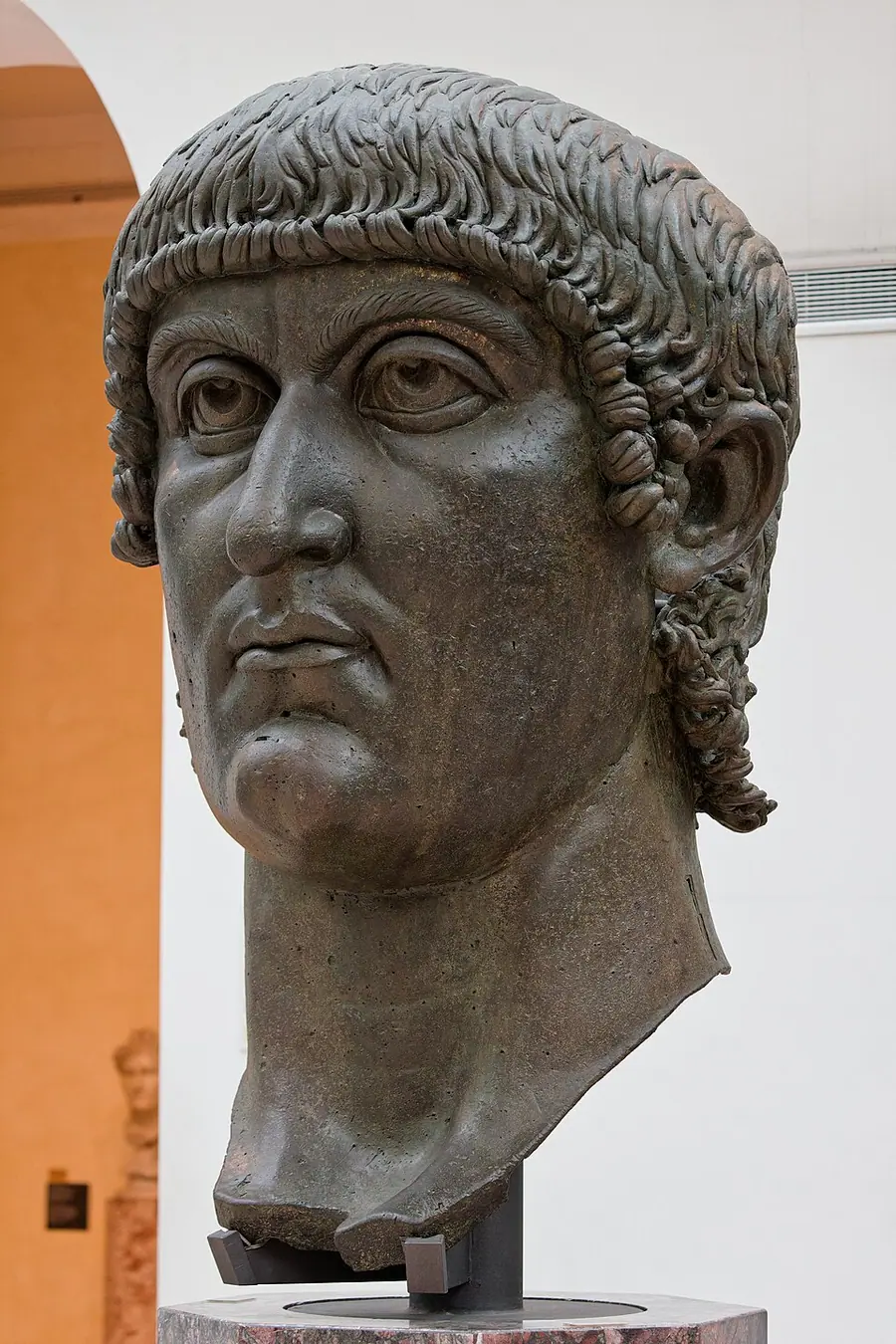
In 312 the emperor Constantine won a civil war under a Christian sign, and within a year Christianity went from persecuted to favoured. Constantine built churches, gave bishops privileges and summoned them to settle their quarrels, the largest of them at Nicaea in 325, where the bishops declared the Son “of one substance” with the Father against the priest Arius. The argument did not end there. It ran for another half-century under emperors who took different sides, until Theodosius I made Nicene Christianity the religion of the empire in 380, a council at Constantinople completed the doctrine of the Trinity in 381, and laws of 391–392 closed the temples. In the fifth century the question moved from the Trinity to Christ himself, and the councils of Ephesus (431) and Chalcedon (451) divided the churches of the East into families that are still separate. Majority
Three popular claims about this period are wrong, and this chapter returns to each: Constantine did not make Christianity the state religion, Nicaea did not choose the Bible, and no council invented the belief that Jesus was divine. What these councils did was decide, in technical Greek, how that belief was to be stated, and make the answer law. Consensus
Timeline
| Date | Event or evidence | Confidence |
|---|---|---|
| 303–311 | The Great Persecution under Diocletian and Galerius; Galerius’ edict of toleration (311) ends it in law, though Maximinus Daia renewed it in the East until 313[1] | Consensus |
| 28 October 312 | Constantine defeats Maxentius at the Milvian Bridge outside Rome, under a Christian sign[2][3] | Consensus (battle); Contested (vision) |
| 313 | Constantine and Licinius agree religious freedom; Licinius publishes the “Edict of Milan” at Nicomedia[4] | Consensus |
| 313–314 | Councils at Rome and Arles hear the Donatist dispute at Constantine’s request[5] | Consensus |
| 321 | Constantine makes Sunday, “the venerable day of the Sun”, a day of rest for courts and city workers[6] | Consensus |
| c. 318–324 | Arius and his bishop, Alexander of Alexandria, dispute whether the Son had a beginning[7] | Consensus |
| 325 | The Council of Nicaea: the creed with homoousios, a common Easter, twenty canons[8][9] | Consensus |
| 335 | Athanasius exiled to Trier, the first of five exiles; church of the Holy Sepulchre dedicated in Jerusalem[10] | Consensus |
| 336 | The earliest list giving 25 December as Christ’s birth, preserved in the Chronograph of 354[11] | Majority |
| 337 | Constantine baptised on his deathbed by Eusebius of Nicomedia; dies 22 May[12] | Consensus |
| 359–360 | Councils at Ariminum, Seleucia and Constantinople adopt a “homoian” creed: the Son is “like” the Father[13][14] | Consensus |
| 361–363 | The emperor Julian restores pagan cults and plans to rebuild the Jerusalem Temple[15] | Consensus |
| 380 | Theodosius I, Cunctos populos: the Nicene faith required; later read as binding the whole empire[16][17] | Majority (scope) |
| 381 | The Council of Constantinople; the creed later known as “Nicene”[18] | Majority |
| 391–392 | Laws ban sacrifice and temple worship; the Serapeum of Alexandria is destroyed[19][20][21] | Consensus |
| 410 | Visigoths sack Rome; Augustine begins The City of God (413)[22] | Consensus |
| 415 | Hypatia killed by a Christian crowd in Alexandria[23] | Consensus |
| 431 | The Council of Ephesus deposes Nestorius; Mary is Theotokos[24] | Consensus |
| 438 | The Theodosian Code gathers imperial laws since Constantine, ending with a book on religion[25] | Consensus |
| 451 | The Council of Chalcedon: Christ “in two natures”[26] | Consensus |
Where: an empire’s churches
The councils were imperial events. Bishops travelled to them by the state post, at the emperor’s expense, and they met in imperial cities: Nicaea, near the imperial residence at Nicomedia (Constantinople was not dedicated until 330); Constantinople itself; Ephesus and Chalcedon, both within reach of the court.[27][28] Consensus The great sees that fought over doctrine were the cities of the old empire. Rome, the only apostolic see in the West, was the most respected. Alexandria, the largest Greek city, was proud of its learning and its bishop’s power over the Egyptian churches. Antioch, in Syria, had its own school of biblical interpretation, more literal than Alexandria’s. Constantinople, founded by Constantine in 330, was a newcomer that claimed second place because it was “new Rome” (canon 3 of 381).[29] Consensus Much of the conflict that follows is the rivalry of these cities as well as of their theologies. Majority
Christians were still a minority when Constantine came to power, perhaps 5–10 per cent of the empire’s population in 300; most historians think they were a majority by about 400, though all such figures are estimates.[30][31] Contested
Constantine
The vision
On 28 October 312 Constantine, emperor in Gaul and Britain, defeated his rival Maxentius at the Milvian Bridge over the Tiber and took Rome. Two Christian writers who knew the emperor describe the sign under which he fought, and they do not agree.
Lactantius, a teacher of rhetoric who became tutor to Constantine’s son, wrote On the Deaths of the Persecutors around 314–315:
“Constantine was directed in a dream to cause the heavenly sign to be delineated on the shields of his soldiers, and so to proceed to battle. He did as he had been commanded, and he marked on their shields the letter X, with a perpendicular line drawn through it and turned round thus at the top, being the cipher of Christ.” (trans. William Fletcher)[2]
Eusebius, bishop of Caesarea, wrote his Life of Constantine after the emperor’s death in 337. He says Constantine told him, “long afterwards” and on oath, that before the campaign, around midday, he and his whole army saw “a cross-shaped trophy formed from light” (trans. Averil Cameron and Stuart Hall) above the sun, with the words “By this, conquer” (toutōi nika); that night Christ appeared to him in a dream and told him to make a copy of the sign, which became the labarum, a standard topped with the Chi-Rho.[3] Eusebius’ own Ecclesiastical History, written much nearer the battle, mentions no vision at all.[32]
The differences are telling: a dream in one, a daylight vision seen by thousands in the other; the second told decades later, by the emperor himself. A Latin panegyric of 310 had already praised Constantine for a vision of Apollo in a Gallic shrine, and Peter Weiss has argued that both stories grew from one real event, a solar halo seen by Constantine and his army in 310, which he later understood as Christian.[33][34] Speculative Historians cannot say what Constantine saw. They can say that from 312 he attributed his victory to the Christian God, and acted on it. Consensus
The letter of Milan
In early 313 Constantine and his eastern colleague Licinius met at Milan and agreed a religious policy. Licinius published it at Nicomedia in June, in a letter to his governors that Lactantius copies:
“…it was proper that the Christians and all others should have liberty to follow that mode of religion which to each of them appeared best; so that that God, who is seated in heaven, might be benign and propitious to us, and to every one under our government.” (trans. William Fletcher)[4]
The text is a rescript, not an edict, and the “Edict of Milan” is a modern name. It went further than Galerius’ toleration of 311: it ordered confiscated church property returned, and it made religious freedom a principle “for all”. Consensus What it did not do was make Christianity official. Constantine remained pontifex maximus, head of the traditional Roman priesthoods, all his life, and his coins carried the Unconquered Sun until the early 320s.[27][35] Consensus
A Christian emperor
What changed was patronage. Constantine gave clergy exemption from civic duties, allowed bishops to hear civil cases, gave churches the right to receive legacies, and built on a scale no Christian had imagined: the Lateran basilica and St Peter’s in Rome, and in Jerusalem the church of the Holy Sepulchre, dedicated in 335.[27][36] Consensus In 321 he made Sunday a day of rest, describing it as “the venerable day of the Sun”, a phrase that suited Christians and sun-worshippers alike.[6] Consensus
He also expected the church to be united, and treated division as a threat to the empire’s standing with God. His first experience of the problem came from Africa, where Christians had split over Caecilian, bishop of Carthage, whom one party accused of being consecrated by a bishop who had handed over scriptures in the persecution. The opposing party, later called Donatists after their bishop Donatus, appealed to the emperor. Councils at Rome (313) and Arles (314), and Constantine himself, ruled against them; a brief attempt at coercion failed, and the Donatist church remained the majority church in much of Africa for a century.[5] Majority The pattern was set: emperors called councils, councils decided, and the losers appealed or went into schism.
Constantine was baptised only on his deathbed, in May 337; Jerome’s Chronicle names the bishop as Eusebius of Nicomedia, who was sympathetic to Arius. Delaying baptism until death was common at the time.[12][37] Consensus Whether his conversion was sincere, and when it became complete, is a long debate: Jacob Burckhardt saw a calculating politician, Timothy Barnes a convinced Christian from 312, and others a gradual convert who saw his God as the giver of victory.[27][28] Contested
Arius and the Council of Nicaea
The question
Christians had worshipped Jesus as divine since the first generation (§3): Pliny’s Christians sang “to Christ as to a god”, and Ignatius of Antioch, around 110, calls him “our God”.[38][39] Consensus What they had not settled was how to say this while also saying, as Jews and as monotheists, that God is one. Second- and third-century writers such as Justin, Tertullian and Origen described the Son as God’s Word or Wisdom, divine but in some way derived from and subordinate to the Father.[40][41] Majority
Around 318, Arius, a respected priest in charge of a church in Alexandria, pressed one side of this inheritance. If the Father alone is unbegotten and without beginning, he argued, the Son, being begotten, must have a beginning: “the Son has a beginning, but God is without beginning”. His opponents summarised his position in a slogan he probably did use: “there was when he was not”.[7][42] Majority The Son was the first and greatest of God’s works, through whom all else was made, but a work nonetheless. His bishop, Alexander, excommunicated him; Arius found supporters among other bishops, notably Eusebius of Nicomedia; and the quarrel spread across the eastern churches.[14] Consensus
The council
Constantine, who had just defeated Licinius and become sole emperor in 324, summoned a council to Nicaea, in north-west Asia Minor, for the summer of 325. Eusebius of Caesarea, who attended, counted bishops that “exceeded two hundred and fifty” (trans. NPNF); Athanasius later said about three hundred. The famous number 318 appears only from about 360 onward, and matches the 318 servants of Abraham in Genesis 14:14.[43][41] Majority Almost all came from the Greek East; the bishop of Rome sent two priests. The emperor attended in person.
The council produced three things:
- A creed. Built on an existing baptismal creed, it declared the Son “begotten from the Father, only-begotten, that is, from the substance (ousia) of the Father… begotten, not made, of one substance (homoousios) with the Father”, and condemned anyone who said “there was when he was not” or that he was “of a different hypostasis or substance”, “created” or “subject to alteration or change”.[8] Consensus Homoousios was not a biblical word, and some bishops accepted it reluctantly; Eusebius of Caesarea wrote home to explain why he had signed.[44]
- Easter. The council agreed that all churches should keep Easter on the same Sunday, rather than some following the Jewish calendar’s date of Passover; Constantine’s letter to the churches presents the decision as freeing Christians from dependence on the Jews.[45] Consensus The exact method of calculation was not fixed at Nicaea, and East and West continued to differ.
- Twenty canons, on church discipline: the precedence of Alexandria, Rome and Antioch (canon 6), the readmission of those who had lapsed in persecution, a ban on clergy moving between cities, and a rule that Christians should pray standing, not kneeling, on Sundays (canon 20).[9] Consensus
Of the bishops present, only two refused to sign the creed, Secundus of Ptolemais and Theonas of Marmarica; they were exiled with Arius.[14] Consensus
What Nicaea did not do
- It did not choose the Bible. No document from the council mentions the canon of scripture. The story that the bishops sorted the true books from the false appears in a ninth-century Greek collection, the Synodicon Vetus, in which the books are placed on an altar and the false ones fall off; Voltaire repeated it to mock the church, and Dan Brown’s The Da Vinci Code (2003) revived the idea that Nicaea fixed the Bible.[46] The four Gospels were accepted by most churches by about 180, and the first list of the 27 New Testament books is Athanasius’ Easter letter of 367 (§5). Consensus
- It did not make Jesus divine by a close vote. The belief was two centuries older, and the vote was almost unanimous. The question was how the Son’s divinity related to the Father’s. Consensus
- It did not end the argument. It began a sixty-year controversy, described below. Consensus
After Nicaea: sixty years of argument
Nicaea’s creed did not command general support for long. Many eastern bishops who rejected Arius also distrusted homoousios, which seemed to blur the distinction between Father and Son, and Constantine himself readmitted Arius to communion before Arius’ death in 336.[14][41] Majority The chief defender of Nicaea was Athanasius, deacon at the council and bishop of Alexandria from 328 to 373. He was exiled five times, by four emperors, partly for theology and partly for his rough handling of opponents in Egypt.[10] Consensus
Historians now avoid the old picture of two parties, “Arians” and “Nicenes”, fighting for half a century. Lewis Ayres and R. P. C. Hanson describe a range of positions, most of them neither Arius’ nor Athanasius’, that hardened only gradually: those who said the Son was “of like substance” (homoiousios) with the Father, those who said he was simply “like” him (homoios), and those who said he was “unlike”.[14][41] Majority “Arianism” as a single movement is largely the creation of Athanasius’ polemic. Majority
Under Constantius II (337–361), the emperor favoured the “homoian” middle way. Councils at Ariminum in Italy and Seleucia in Asia Minor in 359, and at Constantinople in 360, adopted a creed that the Son was “like the Father” and banned the word ousia altogether. Jerome later wrote, ingemuit totus orbis et Arianum se esse miratus est: “the whole world groaned, and was astonished to find itself Arian”.[13] Consensus The Goths, converted in these decades by the homoian bishop Ulfilas, carried this form of Christianity into the western kingdoms, where it lasted into the sixth and seventh centuries (§8).[14] Consensus
Julian
Constantius’ cousin Julian (361–363), raised a Christian, became emperor and announced his return to the gods. He restored temples and sacrifices, forbade Christians to teach the classics, and ordered the Jerusalem Temple rebuilt, a project abandoned after fires broke out at the site.[15][47] Consensus He died on campaign in Persia after twenty months, and no later emperor was pagan.
The Cappadocians
The settlement came from three theologians from Cappadocia in central Asia Minor: Basil of Caesarea (d. 378 or 379), his brother Gregory of Nyssa and their friend Gregory of Nazianzus. Their formula distinguished two words that earlier writers had used interchangeably: God is one ousia, one substance or being, in three hypostaseis, three distinct realities or “persons”. It allowed the full equality of the Son that Nicaea had asserted without collapsing Father and Son into one, and it extended the same equality to the Holy Spirit.[41][40] Consensus Basil and Gregory of Nyssa credited much of their formation to their elder sister Macrina, whose life Gregory wrote.[48] Majority
Theodosius: one faith for the empire
Cunctos populos, 380
Theodosius I, a Spanish general made emperor in the East in 379, issued the edict Cunctos populos at Thessalonica with his co-emperors in February 380; later that year, seriously ill, he was baptised there by a Nicene bishop. The edict reads:
“It is Our will that all the peoples who are ruled by the administration of Our Clemency shall practise that religion which the divine Peter the Apostle transmitted to the Romans… We command that those persons who follow this rule shall embrace the name of Catholic Christians. The rest, however, whom we adjudge demented and insane, shall sustain the infamy of heretical dogmas.” (trans. Clyde Pharr)[16]
The edict names the faith of Damasus, bishop of Rome, and Peter, bishop of Alexandria, as the standard. Addressed to the people of Constantinople and aimed at rival Christians, it was later read, and codified, as establishing Nicene Christianity across the empire; it is usually taken as the moment Nicene Christianity became the religion of the Roman state. Majority
Constantinople, 381
Theodosius then called a council of eastern bishops to Constantinople in 381. It confirmed Nicaea, condemned the homoians and others, and declared the Holy Spirit fully divine. The creed associated with it, which expands the Nicene creed and adds that the Spirit is “the Lord and giver of life, who proceeds from the Father, who with the Father and the Son is worshipped and glorified”, is the creed most churches today recite as “the Nicene Creed”.[18][40] Consensus Its text, however, is first recorded in the acts of the Council of Chalcedon in 451, and how it relates to 381 has been debated; most scholars accept the link.[40] Majority The Western addition “and from the Son” (filioque) came later and belongs to §8.
The end of public paganism
A series of laws in 391–392 forbade sacrifice, entry to temples and, finally, any pagan worship, even in private.[19][20] Consensus Enforcement was uneven, and traditional cults survived for generations in the countryside and among the aristocracy.[49] Majority In Alexandria in 391 (or 392), a conflict between Christians and pagans ended with the destruction of the Serapeum, the great temple of Serapis, by soldiers and Christians under the bishop Theophilus.[21] Consensus The claim, often repeated, that this destroyed the Library of Alexandria rests on a confusion: the Serapeum had housed a daughter library, and no ancient account of 391 mentions books being burned.[50] Majority
The Christian empire also changed the position of Jews. Its laws forbade Jews to own Christian slaves, to marry Christians or to build new synagogues, and ended the office of the Jewish patriarch around 429; John Chrysostom’s sermons against Christians who attended synagogue date from 386–387. The Judaism series tells that story (Judaism §7).[51][52] Consensus
Hypatia
In March 415, Hypatia, a celebrated mathematician and Neoplatonist teacher in Alexandria, was dragged from her carriage by a crowd of Christians led by a church reader named Peter, killed in a church and her body burned. The near-contemporary church historian Socrates Scholasticus, himself a Christian, attributes the murder to the political rivalry between the bishop Cyril and the Roman prefect Orestes, whom Hypatia advised, and writes that “nothing can be farther from the spirit of Christianity than the allowance of massacres, fights, and transactions of that sort”.[23] Consensus Modern retellings that make her a young martyr of science killed for her paganism, and her death the end of ancient learning, are largely legend: she was probably in her sixties, her Christian students included bishops, and her death was the result of a city’s factional politics.[53][50] Majority
Christmas on 25 December
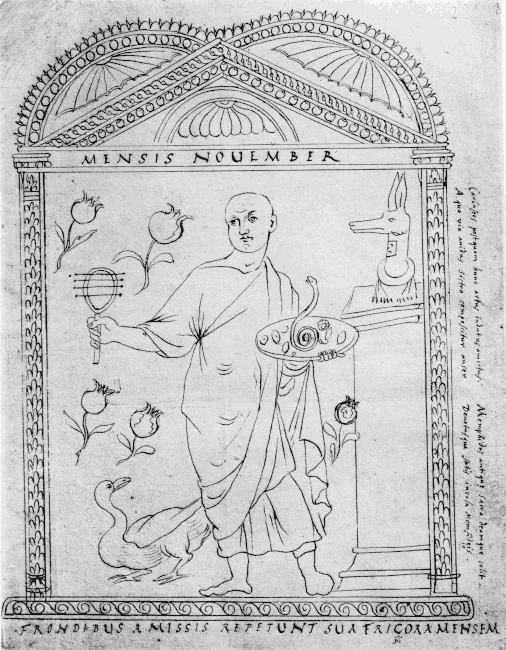
None of the Gospels gives a date or season for Jesus’ birth. The earliest secure evidence for a feast on 25 December is in a Roman almanac known as the Chronograph of 354, compiled for a wealthy Christian named Valentinus. Its list of the burial days of martyrs, which scholars date to 336, begins: VIII kal. Ian. natus Christus in Betleem Iudeae, “25 December: Christ born in Bethlehem of Judea”.[11] Majority An earlier statement of the date in Hippolytus’ Commentary on Daniel (c. 204) is widely suspected of being a later addition.[54] Contested
Why that day? There are two main theories.
| Theory | The argument | Main proponents |
|---|---|---|
| Replacement of a sun festival | The same almanac’s civic calendar marks 25 December as N(atalis) Invicti, the birthday of the Unconquered Sun, whose temple the emperor Aurelian had dedicated in 274. The church set Christ’s birth on the solstice festival to supplant it, and Christian writers compared Christ to “the sun of righteousness” | Usener; widely repeated[55][56] |
| Calculation | Christian writers dated the crucifixion to 25 March and believed that great prophets died on the anniversary of their conception; counting nine months from 25 March gives 25 December. The same reasoning from an Eastern date of 6 April gives 6 January | Duchesne, Talley[57][56] |
Neither theory is proved. The sun festival on 25 December is itself first attested in the same Chronograph of 354, so it may be no older than the Christian feast; the calculation theory rests on a few texts whose reasoning is explicit only later.[56][57] Contested Both may have contributed.
In much of the East the older feast was 6 January, the Epiphany, celebrating Jesus’ birth and baptism together. Constantinople adopted 25 December around 380, and John Chrysostom, preaching in Antioch in 386, said the feast had been known there for less than ten years.[58] Consensus The Armenian Apostolic Church still celebrates the Nativity on 6 January. Consensus
Augustine, original sin and the Western church
Augustine (354–430), bishop of Hippo in North Africa from 395, was the most influential theologian of the Latin West. His Confessions (c. 397–400) told the story of his conversion as a long drama of grace; his City of God (413–426), begun after the Visigoths sacked Rome in 410, answered pagans who blamed the disaster on the abandonment of the old gods.[22][59] Consensus
His dispute with Pelagius, a British ascetic teaching in Rome, shaped Western doctrine on sin and grace. Pelagius held that human beings could choose to obey God and were responsible for doing so; Augustine held that all humanity inherited from Adam both guilt and a will incapable of good without God’s grace. Councils in Africa (418) and the emperor condemned Pelagius.[59] Consensus Augustine’s reading leaned on the Latin text of Romans 5:12, which said that in Adam “all sinned”, in quo omnes peccaverunt, “in whom all sinned”; the Greek eph’ hō is usually translated “because all sinned”.[60][40] Consensus The Eastern churches never adopted Augustine’s doctrine of inherited guilt, one of the deepest differences between Latin and Greek Christianity. Majority
The monks
At the same moment that Christianity became the religion of power, thousands of Christians left the cities for the desert. Antony of Egypt (c. 251–356) gave away his property around 270, went into the desert proper around 285, and became the model of the solitary monk through the Life of Antony that Athanasius wrote around 360, one of the most widely read books of late antiquity.[61] Consensus Pachomius (c. 292–348) founded the first communal monastery at Tabennesi in Upper Egypt in the 320s, with a written rule.[62] Consensus
Women took part from the beginning. The sayings of the desert fathers include those of “desert mothers” such as Amma Syncletica; Macrina turned her family’s house into a community; the Roman aristocrats Melania the Elder and Melania the Younger founded monasteries in Jerusalem; and Egeria, a woman probably from Spain or Gaul, left an account of her pilgrimage to Sinai, Jerusalem and the monasteries of Egypt and Syria in about 381–384.[63][64] Consensus A common view, first argued by Edward Malone in 1950, holds that the ascetic movement was in part a reply to the church’s new comfort: the monk as successor of the martyr, living the costly discipleship that persecution had once demanded.[65] Majority
Ephesus and Chalcedon: the question of Christ
Nestorius and Cyril
Once the Trinity was settled, the argument turned to Christ himself: how can one person be fully God and fully human? The two great schools gave different answers. Antiochene theologians stressed the completeness of Jesus’ humanity and distinguished it sharply from the divine Word. Alexandrian theologians stressed the unity of the one Christ, the Word made flesh.[24] Consensus
In 428 Nestorius, an Antiochene monk, became bishop of Constantinople and objected to calling Mary Theotokos, “God-bearer”, a title already popular in devotion; he proposed Christotokos, “Christ-bearer”, since God could not be born. Cyril of Alexandria attacked him as dividing Christ into two. At the Council of Ephesus, called by Theodosius II in 431, Cyril opened proceedings before Nestorius’ Antiochene supporters had arrived and had Nestorius deposed; the Antiochenes held their own council and deposed Cyril. A compromise, the Formula of Reunion, followed in 433, and Nestorius died in exile.[24][66] Consensus
Chalcedon, 451
The peace broke down when Eutyches, a monk of Constantinople, taught that after the incarnation Christ had only one nature. A second council at Ephesus in 449, dominated by Cyril’s successor Dioscorus, upheld him; Pope Leo I called it a latrocinium, a “robber council”. The emperor Marcian called another council at Chalcedon, across the Bosporus from Constantinople, in October 451. With Leo’s Tome as a key text, it defined Christ as
“one and the same Christ, Son, Lord, Only-begotten, to be acknowledged in two natures, inconfusedly, unchangeably, indivisibly, inseparably.” (trans. Philip Schaff)[26]
Consensus Canon 28 of the same council gave Constantinople privileges equal to those of Rome, after Rome; Leo refused to accept it.[67] Consensus
Three families of churches
Chalcedon divided the East. Many Christians in Egypt, Syria and Armenia saw “two natures” as a betrayal of Cyril and of Ephesus, and kept Cyril’s formula “one incarnate nature of God the Word”. Over the following century they formed separate hierarchies: the Coptic Church in Egypt, the Syriac Orthodox Church, the Armenian Apostolic Church and the Ethiopian church, under Alexandria, now called the Oriental Orthodox churches.[68] Consensus Their critics called them “Monophysites”; they reject the label, and now describe their position as miaphysite, “one united nature”.
East of the Roman frontier, the church of the Persian Empire had already gone its own way, organising at a synod in 410 and adopting a strongly Antiochene theology in the 480s. Its opponents called it “Nestorian”, a name Sebastian Brock has called “a lamentable misnomer”; it is the Church of the East, which would carry Christianity to China (§7).[69] Majority
That gives three families that still exist: the churches that accept Chalcedon (the Eastern Orthodox and the Catholic Church, which later divided from each other, §8), the Oriental Orthodox, and the Church of the East. Joint declarations since the 1970s, including one between the Catholic Church and the Assyrian Church of the East in 1994, have concluded that much of the division was over words rather than faith.[70] Majority
The evidence
| Question | What the evidence supports | Key evidence | Confidence |
|---|---|---|---|
| Constantine’s conversion | From 312 he credited the Christian God with his victory; how and when his faith formed is debated | Lactantius; Eusebius; his letters and laws[2][3][27] | Consensus (patronage); Contested (inner faith) |
| The vision | Two incompatible accounts, one contemporary and one decades later from the emperor | Lactantius vs. Eusebius[2][3] | Contested |
| Milan, 313 | Religious freedom for all, property restored; not an establishment of Christianity | Lactantius’ text of the letter[4] | Consensus |
| Nicaea’s creed | The Son homoousios with the Father, against Arius | The creed and anathemas[8] | Consensus |
| Nicaea and the Bible | No evidence that the council discussed the canon | Absence from creed, canons and letters[9][46] | Consensus |
| “Arianism” | A range of positions, polarised gradually; “Arian” largely a polemical label | Hanson; Ayres[14][41] | Majority |
| State religion | Established by Theodosius in 380, enforced against paganism in 391–392 | Cunctos populos; Theodosian Code 16.10[16][20] | Majority |
| The “Nicene” Creed | The expanded creed linked to Constantinople 381; first recorded in 451 | Acts of Chalcedon[18][40] | Majority |
| Christmas | 25 December attested in Rome by 336; the reason disputed | Chronograph of 354[11][57] | Majority (date); Contested (reason) |
| Hypatia | Killed by a Christian crowd in a political conflict, not for her science | Socrates Scholasticus[23][53] | Majority |
| Chalcedon’s division | Created the lasting split between Chalcedonian and Oriental Orthodox churches | The Definition; later histories[26][68] | Consensus |
Primary sources
Show the 10 primary sources
1. The dream: Lactantius, On the Deaths of the Persecutors 44.5, c. 314–315
Quoted above. What it proves. Within two or three years of the battle, a Christian close to the court said Constantine fought under a Christian sign revealed in a dream. The sign Lactantius describes is probably the Chi-Rho or a cross-shaped staurogram. There is no vision in the sky. Majority
2. The vision: Eusebius, Life of Constantine 1.28–31, after 337
Quoted in part above. What it proves. By the end of his life Constantine told the story of a daylight vision seen by his whole army, with the words “By this, conquer”. It shows how the emperor wanted his conversion remembered, more than what happened in 312. Majority
3. Freedom “for all”: the letter of Milan, 313
Quoted above. What it proves. The first imperial text to grant Christians full legal standing did so on grounds of religious freedom for everyone. It was not yet a Christian empire. Consensus
4. Arius in his own words: letter to Eusebius of Nicomedia, c. 318
“We are persecuted, because we say that the Son has a beginning, but that God is without beginning. This is the cause of our persecution, and likewise, because we say that He is of the non-existent.” (trans. Blomfield Jackson, from the Greek preserved by Theodoret)[7]
What it proves. One of the few writings of Arius to survive, in his opponents’ collections. His concern was to protect the uniqueness of the Father, not to demote Jesus to a mere man. Majority
5. The Creed of Nicaea, 325
“We believe in one God, the Father almighty, maker of all things visible and invisible; and in one Lord Jesus Christ, the Son of God, begotten from the Father, only-begotten, that is, from the substance of the Father, God from God, light from light, true God from true God, begotten not made, of one substance with the Father… But as for those who say, ‘There was when He was not’… these the Catholic and apostolic Church anathematizes.” (trans. J. N. D. Kelly)[8]
What it proves. The original creed is shorter than the one churches now recite, ends abruptly with “and in the Holy Spirit”, and closes with condemnations. Homoousios is its new and contested word. Consensus
6. Cunctos populos: Theodosian Code 16.1.2, 380
Quoted above. What it proves. The legal basis, as later codified, for establishing Nicene Christianity, defined by communion with two named bishops, and the labelling of all others as heretics subject to imperial punishment. Consensus
7. The ban on sacrifice: Theodosian Code 16.10.12, 392
“No person at all, of any class or order whatsoever… shall sacrifice an innocent victim to senseless images in any place at all or in any city.” (trans. Clyde Pharr)[20]
What it proves. By 392 traditional sacrifice was a crime anywhere in the empire, even in private homes. The reversal of the age of persecution, eighty years earlier, was complete in law. Consensus
8. “Christ born in Bethlehem”: the Chronograph of 354
Quoted above. What it proves. The earliest secure evidence for 25 December as the date of Christ’s birth, in a Roman list of 336. It says nothing about why the date was chosen. Majority
9. Hypatia’s death: Socrates Scholasticus, Ecclesiastical History 7.15, c. 440
“For as she had frequent interviews with Orestes, it was calumniously reported among the Christian populace that it was she who prevented Orestes from being reconciled to the bishop… This affair brought not the least opprobrium, not only upon Cyril, but also upon the whole Alexandrian church.” (trans. A. C. Zenos)[23]
What it proves. A Christian historian writing a generation later blamed the killing on factional politics and condemned it. Consensus
10. The Definition of Chalcedon, 451
Quoted above. What it proves. The four negatives, “inconfusedly, unchangeably, indivisibly, inseparably” (in Greek, asynchytōs, atreptōs, adiairetōs, achōristōs), aimed at Eutyches on one side and Nestorius on the other. They became the standard of Christology for the Catholic, Orthodox and later Protestant churches, and the line that separated the Oriental Orthodox from them. Consensus
What is absent
- A council that chose the Bible. No ecumenical council of this period ruled on the canon; regional synods in Africa (393, 397) listed the books already in use (§5). Consensus
- A pope as head of the whole church. The bishop of Rome was honoured, and Leo I claimed authority as Peter’s successor, but councils were called by emperors and canon 28 of Chalcedon ranked Constantinople second. Papal supremacy was a later development and a later dispute (§8). Majority
- The filioque. The creed of 381 says the Spirit “proceeds from the Father”; “and from the Son” is a Western addition traditionally dated to the Council of Toledo in 589 (§8). Majority
- “Catholic” and “Orthodox” as separate churches. Both words were used by the same church, which divided only later (§8). Consensus
- Purgatory, transubstantiation and the immaculate conception as defined doctrines. All are medieval or modern (§8, §11). Consensus
- An end to pagans. Laws closed temples; they did not convert everyone. Traditional religion survived among aristocrats, philosophers and peasants into the sixth century and later. Majority
Debates
Was Constantine’s conversion sincere?
| View | Main argument | Main proponents |
|---|---|---|
| A convinced Christian from 312 | His letters, laws and church-building express real Christian commitment early on | Barnes[27] |
| A politician of consensus | He sought a broad monotheism that pagans and Christians could share, and turned against intolerance on both sides | Drake[28] |
| A sun-worshipper who became Christian gradually | Solar imagery on coins until the 320s; the God of victory understood in solar terms | Bardill and others[35] |
| A cynic | Christianity as a tool to unify the empire | Burckhardt (1853); few modern historians |
Contested
Did the church become what it opposed?
Some historians, and many later reformers, have seen Constantine as the point at which a persecuted church became a persecuting one, exchanging the cross for the sword. Others stress continuity: the church’s doctrines, structures and ascetic ideals were formed before 312, and Christians had argued for imperial support for decades. Peter Brown and others have described the fourth century as a negotiation, not a takeover, in which Christians adopted Roman forms and Roman elites adopted Christianity.[64][28][49] Contested
Was Nicaea a betrayal of the earliest faith?
| View | Main argument | Main proponents |
|---|---|---|
| Development | Nicaea stated in philosophical terms what the church had long believed about Christ | Kelly; most Catholic, Orthodox and Protestant theologians[40] |
| Hellenisation | Greek metaphysics replaced the Hebrew categories of the New Testament | Harnack (1880s–1890s); its modern descendants |
| Contingent outcome | The result was not inevitable; politics, personalities and imperial favour shaped it | Hanson; Ayres (in different ways)[14][41] |
Contested
Further reading
Show further reading (11 works)
- Timothy D. Barnes, Constantine and Eusebius (Harvard, 1981).
- H. A. Drake, Constantine and the Bishops: The Politics of Intolerance (Johns Hopkins, 2000).
- R. P. C. Hanson, The Search for the Christian Doctrine of God: The Arian Controversy 318–381 (T&T Clark, 1988).
- Lewis Ayres, Nicaea and Its Legacy (Oxford, 2004).
- J. N. D. Kelly, Early Christian Creeds (Longman, 3rd ed. 1972).
- Rowan Williams, Arius: Heresy and Tradition (SCM, 2nd ed. 2001).
- Peter Brown, Augustine of Hippo (Faber, revised ed. 2000) and The Body and Society (Columbia, 1988).
- Alan Cameron, The Last Pagans of Rome (Oxford, 2011).
- Edward J. Watts, Hypatia: The Life and Legend of an Ancient Philosopher (Oxford, 2017).
- Susan K. Roll, Toward the Origins of Christmas (Kok Pharos, 1995) and Thomas J. Talley, The Origins of the Liturgical Year (Pueblo, 1986).
- Richard Price and Michael Gaddis, The Acts of the Council of Chalcedon (Liverpool, 2005).
References
- ^ Lactantius, On the Deaths of the Persecutors 34 — On the Deaths of the Persecutors. c. 314–315 CE. Latin. Galerius' edict of toleration of 311, allowing Christians to exist and assemble again. read the text
- ^ a b c d Lactantius, On the Deaths of the Persecutors 44.5–6 — On the Deaths of the Persecutors. c. 314–315 CE. Latin. Constantine is told in a dream to mark the heavenly sign of God on his soldiers' shields before the battle of the Milvian Bridge. read the text
- ^ a b c d Eusebius, Life of Constantine 1.28–31 — Life of Constantine. c. 337–339 CE. Greek. Constantine's own account, told on oath, of a cross of light in the sky with the words 'By this, conquer', a dream of Christ, and the making of the labarum. read the text
- ^ a b c Lactantius, On the Deaths of the Persecutors 48 — On the Deaths of the Persecutors. 313 CE (letter); c. 315 (book). Latin. The text of the 'Edict of Milan', Licinius' letter granting Christians and all others freedom of religion and restoring church property. read the text
- ^ a b W. H. C. Frend The Donatist Church: A Movement of Protest in Roman North Africa. Clarendon Press, 1952. The classic study of the Donatist schism.
- ^ a b Codex Justinianus 3.12.2 — Codex Justinianus. 7 March 321 CE. Latin. Constantine orders courts and city people to rest 'on the venerable day of the Sun', while allowing farm work.
- ^ a b c Arius, Letter to Eusebius of Nicomedia (Theodoret, HE 1.5; 1.4 in NPNF) — Letter to Eusebius of Nicomedia. c. 318 CE. Greek. Arius complains that he is persecuted for saying that the Son has a beginning while God is without beginning. read the text
- ^ a b c d Creed of Nicaea (325) — Council of Nicaea. 325 CE. Greek. The original Nicene creed: the Son 'from the substance of the Father… of one substance (homoousios) with the Father', with anathemas against Arius' formulas. read the text
- ^ a b c Canons of the Council of Nicaea — Council of Nicaea. 325 CE. Greek. Twenty canons on church discipline, including the precedence of Alexandria, Rome and Antioch (canon 6) and standing for prayer on Sundays (canon 20). read the text
- ^ a b Timothy D. Barnes Athanasius and Constantius: Theology and Politics in the Constantinian Empire. Harvard University Press, 1993. Athanasius' career and exiles.
- ^ a b c Chronograph of 354, Depositio martyrum — Chronograph of 354 (Philocalian calendar). list of 336 CE; compiled 354. Latin. A Roman list of martyrs' feast days that begins 'VIII kal. Ian. natus Christus in Betleem Iudeae': 25 December, Christ born in Bethlehem. read the text
- ^ a b Eusebius, Life of Constantine 4.61–64 — Life of Constantine. c. 337–339 CE. Greek. Constantine's deathbed baptism near Nicomedia and his death in 337. read the text
- ^ a b Jerome, Dialogue against the Luciferians 19 — Dialogue against the Luciferians. c. 379 CE. Latin. After the councils of 359, 'the whole world groaned, and was astonished to find itself Arian'. read the text
- ^ a b c d e f g h R. P. C. Hanson The Search for the Christian Doctrine of God: The Arian Controversy 318–381. T&T Clark, 1988. The fullest history of the controversy.
- ^ a b Ammianus Marcellinus 23.1.2–3 — Res Gestae. c. 390 CE. Latin. Julian plans at vast cost to restore the Temple in Jerusalem, entrusts the work to Alypius of Antioch, and abandons it when 'terrifying balls of flame' burst from the foundations. read the text
- ^ a b c Codex Theodosianus 16.1.2 (Cunctos populos) — Codex Theodosianus. 27 February 380 CE. Latin. Theodosius orders all peoples to follow the faith of Damasus of Rome and Peter of Alexandria; only they are 'catholic Christians'. about
- ^ R. Malcolm Errington Christian Accounts of the Religious Legislation of Theodosius I. Klio 79: 398–443, 1997. doi Argues that Cunctos populos was addressed to Constantinople as a local measure and was generalised by later historians and the Theodosian Code.
- ^ a b c Creed of Constantinople (381) — Council of Constantinople. 381 CE (first recorded 451). Greek. The expanded creed, with the Holy Spirit 'the Lord and giver of life… worshipped and glorified' with Father and Son, now recited as the Nicene Creed. read the text
- ^ a b Codex Theodosianus 16.10.10 — Codex Theodosianus. 24 February 391 CE. Latin. No one to pollute himself with sacrifices, visit temples or revere images, at Rome. about
- ^ a b c d Codex Theodosianus 16.10.12 — Codex Theodosianus. 8 November 392 CE. Latin. A comprehensive ban on pagan sacrifice and worship, public or private, anywhere in the empire. about
- ^ a b Rufinus, Ecclesiastical History 11.22–30 — Ecclesiastical History. c. 402 CE. Latin. The conflict in Alexandria and the destruction of the Serapeum under bishop Theophilus. about
- ^ a b Augustine, City of God 1, preface — City of God. 413–426 CE. Latin. Augustine sets out to defend the City of God against those who blamed Christianity for the sack of Rome. read the text
- ^ a b c d Socrates Scholasticus, Ecclesiastical History 7.15 — Ecclesiastical History. c. 440 CE. Greek. The killing of Hypatia in 415 by a Christian crowd led by the reader Peter, attributed to the feud between Cyril and Orestes. read the text
- ^ a b c John A. McGuckin St Cyril of Alexandria: The Christological Controversy. Brill, 1994. Cyril, Nestorius and the Council of Ephesus.
- ^ Jill Harries and Ian Wood, eds. The Theodosian Code. Duckworth, 1993. How and why the code of 438 was compiled.
- ^ a b c Definition of Chalcedon — Council of Chalcedon. 451 CE. Greek. Christ 'acknowledged in two natures, inconfusedly, unchangeably, indivisibly, inseparably', one person. about
- ^ a b c d e f Timothy D. Barnes Constantine and Eusebius. Harvard University Press, 1981. Constantine as a committed Christian from 312.
- ^ a b c d H. A. Drake Constantine and the Bishops: The Politics of Intolerance. Johns Hopkins University Press, 2000. Constantine as a seeker of consensus between Christians and pagans.
- ^ Council of Constantinople, canon 3 — Council of Constantinople. 381 CE. Greek. The bishop of Constantinople to have the precedence of honour after the bishop of Rome, 'because Constantinople is New Rome'. read the text
- ^ Ramsay MacMullen Christianizing the Roman Empire, A.D. 100–400. Yale University Press, 1984. How, and how fast, the empire became Christian.
- ^ Rodney Stark The Rise of Christianity: A Sociologist Reconsiders History. Princeton University Press, 1996. The 40-percent-per-decade growth model.
- ^ Eusebius, Ecclesiastical History 9.9 — Ecclesiastical History. c. 315 CE. Greek. Eusebius' earlier account of the victory at the Milvian Bridge, with no vision. read the text
- ^ Panegyrici Latini 6(7).21 — Latin Panegyrics. 310 CE. Latin. An orator describes Constantine's vision of Apollo, with Victory, at a shrine in Gaul. about
- ^ Peter Weiss The Vision of Constantine. Journal of Roman Archaeology 16: 237–259, 2003. Argues that a solar halo seen in 310 underlies both vision stories.
- ^ a b Jonathan Bardill Constantine, Divine Emperor of the Christian Golden Age. Cambridge University Press, 2012. Constantine's solar imagery and how it was christianised.
- ^ Codex Theodosianus 16.2.2 — Codex Theodosianus. 319 CE. Latin. Constantine exempts Christian clergy from public obligations.
- ^ Jerome, Chronicle, year 337 — Chronicle. c. 380 CE. Latin. Constantine, at the end of his life, is baptised by Eusebius of Nicomedia.
- ^ Pliny the Younger, Letters 10.96 — Letters. c. 112 CE. Latin. The governor of Bithynia-Pontus reports that Christians met before dawn to sing 'a hymn to Christ as to a god', and that he tortured two enslaved women called ministrae. about
- ^ Ignatius, To the Ephesians 18.2 — Letters of Ignatius of Antioch. c. 110 CE. Greek. 'Our God, Jesus the Christ, was conceived by Mary', an early second-century statement of Jesus' divinity. read the text
- ^ a b c d e f g J. N. D. Kelly Early Christian Creeds. Longman, 3rd ed., 1972. The standard history of the creeds, including the link between the creed and the council of 381.
- ^ a b c d e f g Lewis Ayres Nicaea and Its Legacy: An Approach to Fourth-Century Trinitarian Theology. Oxford University Press, 2004. Replaces the two-party story with a range of trajectories that converged slowly.
- ^ Rowan Williams Arius: Heresy and Tradition. SCM Press, 2nd ed., 2001. Arius as a conservative theologian, not a rationalist.
- ^ Eusebius, Life of Constantine 3.6–14 — Life of Constantine. c. 337–339 CE. Greek. An eyewitness account of the Council of Nicaea, with bishops that 'exceeded two hundred and fifty' (NPNF) and the emperor presiding. read the text
- ^ Eusebius of Caesarea, Letter to his church (in Socrates, HE 1.8) — Letter to the Church of Caesarea. 325 CE. Greek. Eusebius explains to his congregation why he signed the Nicene creed and how he understood homoousios. read the text
- ^ Eusebius, Life of Constantine 3.18–19 — Life of Constantine. 325 CE (letter). Greek. Constantine's letter to the churches announcing a common date for Easter, independent of the Jewish reckoning. read the text
- ^ a b Bart D. Ehrman Truth and Fiction in The Da Vinci Code. Oxford University Press, 2004. Corrects the novel's claims about Constantine, Nicaea and the canon.
- ^ Julian, Letter 36 (rescript on Christian teachers) — Letters of Julian. 362 CE. Greek. Julian forbids Christians to teach the classical authors whose gods they reject.
- ^ Gregory of Nyssa, Life of Macrina — Life of Macrina. c. 380 CE. Greek. Gregory's life of his elder sister, who turned the family estate into an ascetic community and shaped her brothers' vocations. about
- ^ a b Alan Cameron The Last Pagans of Rome. Oxford University Press, 2011. Argues against a dramatic 'pagan revival' and shows the slow fading of the old cults.
- ^ a b Edward J. Watts Hypatia: The Life and Legend of an Ancient Philosopher. Oxford University Press, 2017. Hypatia's life, death and later legend.
- ^ Codex Theodosianus 16.8.29 (429 CE) — Codex Theodosianus. 30 May 429 CE. Latin. An imperial law ordering that the dues Jews had paid to their patriarchs be collected for the imperial treasury now that the patriarchs have passed away: the end of the patriarchate.
- ^ John Chrysostom, Adversus Judaeos, Homily 1 — Adversus Judaeos (Against the Judaizers). 386 CE. Greek. The first of eight sermons preached at Antioch against Christians who went to the synagogue and kept the Jewish festivals. read the text
- ^ a b Maria Dzielska Hypatia of Alexandria. Harvard University Press, 1995. Separates the historical Hypatia from her legend.
- ^ Hippolytus, Commentary on Daniel 4.23 — Commentary on Daniel. c. 204 CE (passage's authenticity disputed). Greek. Gives Jesus' birth as Wednesday 25 December, a reading many scholars think was interpolated.
- ^ Chronograph of 354, civic calendar (December) — Chronograph of 354 (Philocalian calendar). 354 CE. Latin. The Roman civic calendar marks 25 December as N(atalis) Invicti, the birthday of the Unconquered Sun. read the text
- ^ a b c Susan K. Roll Toward the Origins of Christmas. Kok Pharos, 1995. Weighs the history-of-religions and calculation theories.
- ^ a b c Thomas J. Talley The Origins of the Liturgical Year. Pueblo, 1986. The main modern statement of the calculation theory of Christmas.
- ^ John Chrysostom, Homily on the Birthday of Christ — Homily on 25 December (In diem natalem). 386 CE. Greek. Preaching in Antioch, Chrysostom says the feast of 25 December had been known there for less than ten years.
- ^ a b Peter Brown Augustine of Hippo: A Biography. Faber and Faber, revised ed., 2000. The standard life of Augustine.
- ^ Romans 5:12 — Paul, Letter to the Romans. c. 57 CE. Greek. Sin came into the world through one man, 'and so death spread to all because all have sinned' (Latin: in quo omnes peccaverunt). read the text
- ^ Athanasius, Life of Antony — Life of Antony. c. 360 CE. Greek. The life of the Egyptian hermit Antony, the model for Christian monasticism. read the text
- ^ Philip Rousseau Pachomius: The Making of a Community in Fourth-Century Egypt. University of California Press, 1985. The first communal monasteries.
- ^ Egeria, Itinerarium 1–5 — Itinerarium Egeriae (Latin). c. 381–384 CE. Latin. A pilgrim's account of climbing 'the holy mountain of God' in southern Sinai with the monks living there: the earliest detailed witness to the Christian identification of Sinai with the Jebel Musa massif. about
- ^ a b Peter Brown The Body and Society: Men, Women, and Sexual Renunciation in Early Christianity. Columbia University Press, 1988. Asceticism, virginity and the desert.
- ^ Edward E. Malone The Monk and the Martyr: The Monk as the Successor of the Martyr. Catholic University of America Press, 1950. The classic statement that monasticism took over the ideal of martyrdom.
- ^ Socrates Scholasticus, Ecclesiastical History 7.32–34 — Ecclesiastical History. c. 440 CE. Greek. Nestorius' objection to Theotokos and the Council of Ephesus. read the text
- ^ Richard Price and Michael Gaddis, trans. The Acts of the Council of Chalcedon. Liverpool University Press, 2005. The full proceedings, translated with commentary.
- ^ a b John Meyendorff Imperial Unity and Christian Divisions: The Church 450–680 A.D.. St Vladimir's Seminary Press, 1989. Chalcedon and the formation of the separated Eastern churches.
- ^ Sebastian P. Brock The 'Nestorian' Church: A Lamentable Misnomer. Bulletin of the John Rylands Library 78: 23–35, 1996. Why the Church of the East should not be called Nestorian.
- ^ Common Christological Declaration (1994) — Pope John Paul II and Patriarch Mar Dinkha IV. 11 November 1994. English. The Catholic Church and the Assyrian Church of the East affirm a common faith in Christ, setting aside the Ephesus-era divisions. read the text