The short version: nobody decided, in the sense of one meeting with a vote. The New Testament was assembled by use. Churches read some Christian writings aloud in worship, alongside the Jewish scriptures, and over about three centuries a core of those writings came to be treated as scripture everywhere, while others dropped out. Bishops and synods later wrote down the result. The first list that matches today’s 27 books exactly is a letter written by Athanasius, bishop of Alexandria, for Easter in 367.[1][2] Consensus
Before there was a canon
The first Christians already had a Bible: the Jewish scriptures, mostly read in Greek. The word kanōn, a measuring rule, came to mean a closed list of authoritative books only in the fourth century.[3] Consensus By the mid-second century, though, Gospels and collections of Paul’s letters were being copied and read in worship, together with other texts that did not make the final list: the Shepherd of Hermas, the Didache, the Epistle of Barnabas and 1 Clement.[2][4] Consensus
How a book was judged, when anyone explained it, came down to three questions: was it apostolic, written by an apostle or a companion of one? Was it read widely and from early on? Did it agree with the “rule of faith”, the short summary of belief taught at baptism?[2][4] Majority A case from Syria around 190 shows all three at work. Serapion, bishop of Antioch, allowed the church at Rhossus to read a Gospel of Peter, then read it himself, found additions that favoured the Docetists, who held that Christ only seemed to suffer, and withdrew his permission.[5] Majority
Marcion forces the question
The first known fixed list of Christian scriptures was made by Marcion, a shipowner from the Black Sea who was expelled from the church of Rome around 144. He taught that the God of the Jewish scriptures was not the Father of Jesus, so he dropped the Jewish scriptures altogether and kept one Gospel, a version of Luke without the birth stories, and ten letters of Paul.[6][3] Consensus Adolf von Harnack argued in 1921 that the church’s own New Testament was largely a reply to Marcion’s. Most scholars now think the Gospels and Paul’s letters were already in wide use, and that Marcion sped up a process rather than starting it.[7][3][4] Contested
Four Gospels, and no more
Around 180 Irenaeus, bishop of Lyon, argued that there could be neither more nor fewer than four Gospels, as there are four zones of the world and four principal winds.[8] At about the same time Tatian wove the same four into one continuous account, the Diatessaron, which suggests the four already stood apart from other Gospels.[9] Majority Gospels of Thomas, Peter, Mary and others circulated too, but none of them was read in worship across the churches.
The lists
Three kinds of evidence show where the edges still were:
- The Muratorian fragment, a Latin list copied in an eighth-century manuscript, accepts four Gospels, Acts, thirteen letters of Paul, Jude, two letters of John, the Wisdom of Solomon and the Revelations of John and of Peter. Whether it was written in Rome in the late second century, or in the East in the fourth, is disputed.[10][11][12][13] Contested
- Eusebius of Caesarea, around 325, sorted books into recognised, disputed and rejected, setting heretical works apart as a fourth group. James, Jude, 2 Peter and 2 and 3 John were still disputed though recognised by many; the Shepherd of Hermas, the Didache and the Epistle of Barnabas were rejected (nothoi); Revelation appeared in two categories at once.[14] Consensus
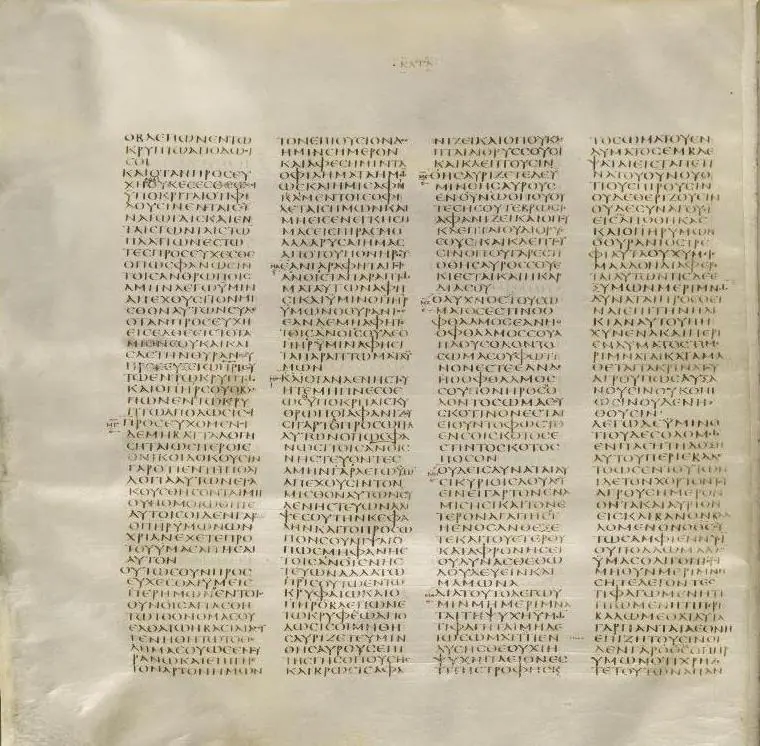
- Codex Sinaiticus, copied a little before Athanasius’ letter, contains the Epistle of Barnabas and the Shepherd of Hermas after Revelation.[15] Consensus
367: the first list of the 27
Athanasius’ 39th Festal Letter, sent to the churches of Egypt to announce the date of Easter in 367, listed the books of both Testaments. His New Testament has exactly today’s 27 books, in a slightly different order, and he added that the Didache and the Shepherd were useful for teaching new converts but not part of the canon.[1] Consensus Synods at Hippo in 393 and Carthage in 397 adopted the same New Testament for North Africa.[2] Consensus
That was not the end. The Syriac Peshitta, the Bible of the Syriac churches from the fifth century, lacked 2 Peter, 2 and 3 John, Jude and Revelation; Revelation stayed out of the Greek lectionaries; and the Ethiopian church kept a larger collection.[2][4] Consensus Hebrews had the opposite problem: accepted in the East as Paul’s, it was doubted in the West until the later fourth century.[2] Majority
The Old Testament, and the split at the Reformation
The New Testament has been the same 27 books for Catholics, Orthodox and Protestants in most churches since late antiquity. The Old Testament is where they divide. The Greek Bible the early church used included books that are not in the Hebrew Bible, among them Tobit, Judith, Wisdom, Sirach, Baruch and 1–2 Maccabees.[4] Consensus
In the Reformation, Protestants returned to the shorter Hebrew canon and printed those books as a separate “Apocrypha”. On 8 April 1546 the Council of Trent replied by listing the canonical books, including those, and declaring anyone who did not accept them “entire with all their parts” anathema (trans. Theodore A. Buckley). It was the first time a council made the list of the Bible’s books a dogma.[16] Consensus Today a Protestant Bible has 66 books, a Catholic one 73, and Orthodox Bibles include a few more.[4] Consensus
Luther’s own doubts went further. In his New Testament of 1522 he placed Hebrews, James, Jude and Revelation together at the end as disputed books, and in his preface he called James, compared with John’s Gospel, Paul’s letters and 1 Peter, a letter of straw.[17] Consensus He did not remove them from his Bible.
The case on each side
An early canon. On this view the core of the New Testament, the four Gospels and Paul’s letters, was recognised by the mid-second century, and later lists only tidied the edges. C. E. Hill argues that the four Gospels stood apart well before Irenaeus, and defenders of the early Muratorian date see a nearly complete list by around 200.[18][13] Contested
A late canon. On this view the idea of a closed list is a fourth-century development, and the second century had authoritative books but no boundary. Albert Sundberg and Geoffrey Hahneman date the Muratorian list to the fourth century, which removes the main evidence for an early list.[11][12] Contested
Both camps agree on what happened in the fourth century, and on the fact that no council of the whole church chose the books. They differ on how settled the core already was in the second.
Common misconceptions
- “The Council of Nicaea chose the Bible.” No record of the council in 325 mentions the canon. The story of bishops sorting books on an altar comes from a ninth-century Greek source, was repeated by Voltaire, and was revived by The Da Vinci Code (2003).[19] Consensus
- “Constantine decided which books went in.” He paid for fifty copies of the scriptures for his new capital, but there is no evidence that he chose their contents. The list of 367 came thirty years after his death.[20][2] Majority
- “The Gnostic gospels were voted out.” They were never read in worship across the churches, so there was nothing to vote on. They were rejected by bishops and teachers who judged their teaching, one by one, as Serapion did with the Gospel of Peter.[5][2] Majority
- “Every church has the same Bible.” The New Testament is nearly the same everywhere; the Old Testament differs between Protestants, Catholics, the Orthodox and the Ethiopian church.[4]
Why it matters
The Bible’s contents are sometimes presented as the decision of a powerful few. The evidence points the other way: a slow consensus of use, with bishops recording rather than creating it, and real disagreement at the edges that has never entirely gone away. The one formal decision, Trent’s in 1546, came fifteen centuries after the books were written.
For the full story of Marcion, the lists and the books that nearly made it, see Chapter 5: Many Christianities. For Nicaea, see Chapter 6: Constantine, the Creeds and the Councils. For Trent and the Reformation Bibles, see Chapter 9: Reformations.
References
- ^ a b Athanasius, Festal Letter 39 — Festal (Easter) Letters. 367 CE. Greek. The first list of exactly the 27 books of the New Testament: 'Let no man add to these, neither let him take ought from these.' read the text
- ^ a b c d e f g h Bruce M. Metzger The Canon of the New Testament: Its Origin, Development, and Significance. Clarendon Press, 1987. The standard account, with translations of the early lists.
- ^ a b c Harry Y. Gamble The New Testament Canon: Its Making and Meaning. Fortress Press, 1985. A short, clear account of canon formation.
- ^ a b c d e f g Lee Martin McDonald The Formation of the Biblical Canon. Bloomsbury T&T Clark, 2 vols., 2017. The fullest recent survey of both Testaments' canons.
- ^ a b Eusebius, Ecclesiastical History 6.12 — Ecclesiastical History. c. 325 CE (quoting Serapion, c. 190). Greek. Serapion of Antioch first allows, then forbids, the Gospel of Peter at Rhossus after finding docetic additions. read the text
- ^ Tertullian, Against Marcion 4.2 — Against Marcion. c. 207–208 CE. Latin. Marcion's Gospel carries no author's name; Tertullian identifies it as a mutilated Luke. read the text
- ^ Adolf von Harnack Marcion: Das Evangelium vom fremden Gott. J. C. Hinrichs, 1921. The classic study, arguing that Marcion prompted the church's canon.
- ^ Irenaeus, Against Heresies 3.11.8 — Against Heresies. c. 180 CE. Greek (Latin translation). There can be neither more nor fewer than four Gospels, as there are four zones of the world and four principal winds. read the text
- ^ William L. Petersen Tatian's Diatessaron: Its Creation, Dissemination, Significance, and History in Scholarship. Brill, 1994. The standard study of the Gospel harmony.
- ^ Muratorian fragment — Biblioteca Ambrosiana, Milan, Cod. J 101 sup.. 8th-c. copy of a list of the late 2nd or 4th c.. Latin. A list of New Testament books, incomplete at the start; rejects the Shepherd as written 'very recently, in our times'. about
- ^ a b Albert C. Sundberg Jr. Canon Muratori: A Fourth-Century List. Harvard Theological Review 66: 1–41, 1973. Argues the list is fourth-century and Eastern.
- ^ a b Geoffrey Mark Hahneman The Muratorian Fragment and the Development of the Canon. Clarendon Press, 1992. Argues for a fourth-century Eastern date.
- ^ a b Everett Ferguson Canon Muratori: Date and Provenance. Studia Patristica 17: 677–683, 1982. Defends a late-second-century Roman date against Sundberg.
- ^ Eusebius, Ecclesiastical History 3.25 — Ecclesiastical History. c. 325 CE. Greek. Eusebius sorts Christian books into recognised, disputed, spurious and heretical. read the text
- ^ Codex Sinaiticus — British Library (most leaves); Leipzig, St Catherine's Monastery and St Petersburg. c. 325–360 CE. Greek. About half of the Greek Old Testament survives, with the oldest complete copy of the New Testament. read the text
- ^ Council of Trent, Session 4, Decree concerning the Canonical Scriptures (8 April 1546) — Canons and Decrees of the Council of Trent. 1546. Latin. Receives Scripture and unwritten traditions with equal reverence and lists the canonical books, including the deuterocanonical ones, under anathema. read the text
- ^ Martin Luther, Preface to the New Testament (1522) — Das Newe Testament Deutzsch (the 'September Testament'). 1522. German. Luther ranks John, Romans, Galatians, Ephesians and 1 Peter highest, calls James a letter of straw by comparison, and places Hebrews, James, Jude and Revelation together at the end of his New Testament. about
- ^ Charles E. Hill Who Chose the Gospels? Probing the Great Gospel Conspiracy. Oxford University Press, 2010. Argues the fourfold Gospel was recognised before Irenaeus.
- ^ Bart D. Ehrman Truth and Fiction in The Da Vinci Code. Oxford University Press, 2004. Corrects the novel's claims about Constantine, Nicaea and the canon.
- ^ Eusebius, Life of Constantine 4.36 — Life of Constantine. c. 331 CE (letter); c. 337–339 (book). Greek. Constantine asks Eusebius to have fifty copies of the sacred Scriptures written on parchment for the churches of Constantinople, at the treasury's expense. read the text