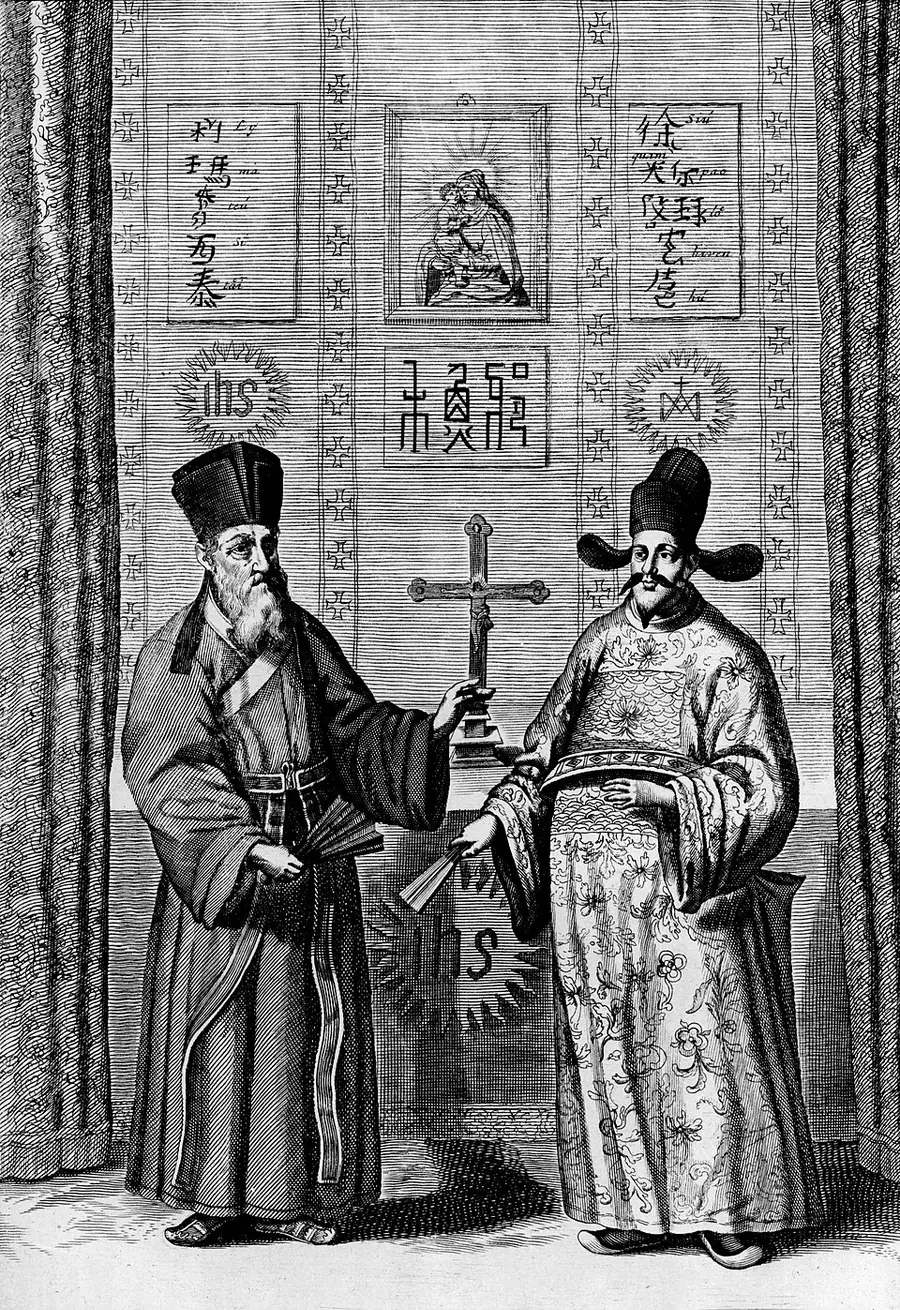
In 1492 Christianity was, outside Ethiopia, the Middle East and scattered communities in Asia (§7), the religion of Europe. By 1900 it was present on every inhabited continent. It travelled first with the Spanish and Portuguese empires, under arrangements by which the popes handed the kings control of the church in the lands they conquered, and from the 1790s with Protestant missionary societies that followed, accompanied and sometimes opposed British and other empires. Its expansion brought conquest, forced labour, the destruction of Indigenous religions and, in the Atlantic, the defence of slavery; it also produced the first sustained European critique of conquest, translations of the Bible into hundreds of languages, and churches that local converts made their own and often kept alive after the missionaries had gone. Majority
None of this makes the story one of simple imposition or simple liberation. Historians now stress how much of the spreading was done by Indigenous catechists, translators and prophets, and how differently it went in different places: by conquest in Mexico, by a king’s choice in Kongo, by persuasion and then persecution in Japan, by negotiation with Confucian scholars in China.[1][2] Majority By 1900, for all the expansion, about two-thirds of the world’s Christians still lived in Europe; the great shift to the global South came after this chapter ends (§12, §13).[3] Majority
Timeline
| Date | Event or evidence | Confidence |
|---|---|---|
| 1455 | Nicholas V’s bull Romanus Pontifex grants Portugal rights over lands and peoples it conquers in Africa, the basis of the Portuguese padroado[4] | Consensus |
| 1491 | The king of Kongo is baptised by Portuguese priests as João I[5] | Consensus |
| 1493 | Alexander VI’s bull Inter caetera assigns newly found lands west of a line in the Atlantic to Castile, charging it with converting their peoples[6] | Consensus |
| 1508 | Julius II’s Universalis ecclesiae gives the Spanish crown the right to found churches and present bishops in the Indies: the patronato real[7] | Consensus |
| 1511 | Antonio de Montesinos preaches against the treatment of the Taíno on Hispaniola[8] | Consensus |
| 1513 | The requerimiento is drafted, to be read to Indigenous peoples before war[9] | Consensus |
| 1526 | Afonso I of Kongo writes to the king of Portugal complaining of the slave trade in his kingdom[10] | Consensus |
| 1537 | Paul III’s Sublimis Deus declares that the Indigenous peoples of the Americas are rational and may not be enslaved[11] | Consensus |
| 1542 | The New Laws restrict the encomienda; Las Casas writes his Brief Account, printed 1552[12][13] | Consensus |
| 1549 | Francis Xavier lands in Japan[14] | Consensus |
| 1550–1551 | The Valladolid debate between Las Casas and Sepúlveda[15][16] | Consensus |
| 1556 | Archbishop Montúfar promotes the shrine of Guadalupe; the Franciscan Bustamante preaches against it[17][18] | Majority |
| 1560 | The Inquisition is established at Goa[19] | Consensus |
| 1597 | Twenty-six Christians are crucified at Nagasaki[20] | Consensus |
| 1599 | The Synod of Diamper brings the Thomas Christians of Kerala under Portuguese Latin control[21][22] | Consensus |
| 1601 | Matteo Ricci is allowed to reside in Beijing[23] | Consensus |
| 1614 | The Tokugawa shogunate bans Christianity throughout Japan[24] | Consensus |
| 1622–1633 | The Ethiopian emperor Susenyos professes Catholicism, provokes revolt and abdicates; his son expels the Jesuits[25][26] | Consensus |
| 1637–1638 | The Shimabara rebellion; afterwards Japanese Christianity survives only in secret[27][28] | Consensus |
| 1648–1649 | First written accounts of the Guadalupe apparition, in Spanish (Sánchez) and Nahuatl (Laso de la Vega)[29][30] | Consensus |
| 1688 | Quakers in Germantown, Pennsylvania, petition against slavery[31] | Consensus |
| 1706 | Kimpa Vita, prophet of the Antonian movement in Kongo, is burned as a heretic[32][33] | Consensus |
| 1715, 1742 | Papal bulls forbid the Chinese rites[34][35] | Consensus |
| 1732 | The first Moravian missionaries sail for the Danish West Indies[36] | Consensus |
| 1774 | John Wesley’s Thoughts upon Slavery[37] | Consensus |
| 1792–1793 | William Carey’s Enquiry; the Baptist Missionary Society; Carey sails for India[38] | Consensus |
| 1807 | Britain abolishes its slave trade; a selection of scripture for enslaved people is printed in London[39][40] | Consensus |
| 1816 | The African Methodist Episcopal Church is founded in Philadelphia under Richard Allen[41][42] | Consensus |
| 1850–1864 | The Taiping rebellion, led by a visionary who believed himself Jesus’ younger brother[43][44] | Consensus |
| 1864 | Samuel Ajayi Crowther is consecrated bishop in Canterbury Cathedral[45] | Consensus |
| 1865 | Hidden Christians reveal themselves to a French priest at Ōura in Nagasaki[46] | Consensus |
| 1892 | Mangena Mokone founds the Ethiopian Church in Pretoria[47][42] | Consensus |
| 1910 | The World Missionary Conference at Edinburgh (§12)[48][49] | Consensus |
Where: three oceans
The expansion followed sea routes. Spain’s Atlantic crossed to the Caribbean, Mexico and Peru, and from 1565 across the Pacific to the Philippines; Portugal’s ran down the African coast, round the Cape to Goa on India’s west coast, and on to Malacca, Macau and Nagasaki; the Protestant missions of the nineteenth century went out from Britain, Germany, Scandinavia and the United States to India, China, the Pacific islands and, after about 1840, the interior of Africa.[50][1] Consensus
The two Iberian empires had different shapes. Spain conquered large Indigenous populations in the Americas and ruled them directly, so Christianization was mass, rapid and enforced. Portugal’s Asian empire was mostly a chain of fortified ports; outside Goa its missionaries worked in kingdoms it did not rule, in Japan, China, Ethiopia and much of India, and depended on persuasion and royal favour.[51] Majority That difference explains much of what follows.
Popes, kings and the legal shape of mission
Two sets of papal grants made the colonial church a royal church. For Portugal, Dum diversas (1452) and Romanus Pontifex (1455) authorised the conquest of non-Christian lands in Africa and the enslavement of their inhabitants, and later bulls gave the Portuguese crown the padroado, the right to appoint clergy and fund missions throughout its sphere.[4][51] For Spain, Inter caetera (1493) assigned to Castile the lands west of a line in the Atlantic, on condition of converting their peoples, and Universalis ecclesiae (1508) gave the crown the patronato real: the right to found every church and present every bishop in the Indies.[6][7] Consensus
The effect was that bishops in Mexico, Lima, Goa or Macau were nominated by the king, the clergy were paid from royal revenues, and Rome itself had little direct reach. When the papacy tried to take back control of missions, it created the Congregation for the Propagation of the Faith (Propaganda Fide) in 1622, which for two centuries quarrelled with the Portuguese crown over who ruled the churches of Asia.[51] Consensus The Inter caetera bull has a modern afterlife: it is the centrepiece of the “Doctrine of Discovery” cited in Indigenous land claims, and in 2023 the Vatican issued a statement that the bulls “did not adequately reflect the equal dignity and rights of indigenous peoples” and that the papal documents in question “have never been considered expressions of the Catholic faith”.[52] Political on the modern use; Consensus on the text.
The Spanish Americas: conquest and its critics
Conversion by conquest
The Spanish conquest of the Caribbean, Mexico (1519–1521) and Peru (1532 onward) was accompanied by friars, and conversion was part of its official justification. The requerimiento, drafted in 1513 by the jurist Juan López de Palacios Rubios, was to be read to Indigenous peoples before war: it summarised the history of the world from Adam to the papal donation and demanded that they accept the pope and the Spanish king; if they did not, war, enslavement and seizure of property were declared lawful. It was often read in Spanish, to people who could not understand it, or out of earshot.[9][16] Consensus
In Mexico the first twelve Franciscans arrived in 1524, followed by Dominicans and Augustinians. Mass baptisms followed: the Franciscan Motolinía claimed that millions had been baptised within about fifteen years, sometimes thousands in a day.[53][54] Majority on the scale; the exact figures are the friars’ own. Temples were destroyed and churches built from their stones, sometimes on the same sites. All this happened amid a demographic catastrophe: epidemics of smallpox and other diseases, war and forced labour reduced the Indigenous population of central Mexico by most estimates by around 90 percent within a century.[55] Majority on the scale; Contested on the pre-conquest population and the share of disease.
Montesinos, Las Casas and Valladolid
The first public Christian challenge to the conquest came from its own clergy. In December 1511, on Hispaniola, the Dominican Antonio de Montesinos preached to the colonists that they were in mortal sin for their treatment of the Taíno: “Are these not men? Do they not have rational souls?” The sermon survives in the account of Bartolomé de las Casas.[8][56] Consensus that the sermon was preached; its wording is Las Casas’ report. It led to the Laws of Burgos (1512), which regulated rather than abolished the encomienda, the grant of Indigenous labour to colonists.[57][16] Consensus
Las Casas (1484–1566) had himself held an encomienda. In 1514 he gave it up and spent the next fifty years as priest, Dominican friar and, from 1544, bishop of Chiapas, campaigning against the conquest at the Spanish court.[16][13] His Brief Account of the Destruction of the Indies, written in 1542 and printed in 1552, describes massacres and torture island by island, province by province; translated across Protestant Europe, it fed the “Black Legend” of Spanish cruelty.[13] Consensus Early in his career Las Casas suggested that enslaved Africans be brought in to relieve the Indigenous; late in life he wrote that he had come to regret it, having realised that their enslavement was as unjust.[56][16] Majority
The campaign had results. Paul III’s bull Sublimis Deus (1537) declared that the peoples of the Indies “are truly men”, capable of receiving the faith, and must not be deprived of their liberty or property.[11] Charles V’s New Laws of 1542 forbade the enslavement of Indigenous people and limited new encomiendas, though colonists’ resistance forced their partial repeal.[12] Consensus In 1550–1551, at Valladolid, a junta of theologians and jurists heard Las Casas argue against the humanist Juan Ginés de Sepúlveda, who held, on Aristotle’s theory of natural slavery, that war against the Indigenous was just and their subjection natural. The junta reached no formal verdict, but Sepúlveda’s book was refused a licence to print.[15][16] Majority
Lewis Hanke called this “the Spanish struggle for justice”, and it is unusual among empires that the conquerors argued so publicly about whether conquest was lawful at all.[16] Critics answer that the argument changed little on the ground: the encomienda and the repartimiento draft labour continued, and the Potosí silver mines ran on forced Indigenous labour for two centuries.[55] Majority on both points.
How the Nahuas made Christianity their own
What did conversion mean to the converted? Studies of documents written in Nahuatl, the language of the Aztecs, show a Christianity reinterpreted in Indigenous terms. Louise Burkhart showed that friars translating sin, the devil and virtue into Nahuatl had to use words that carried Nahua ideas of disorder, filth and balance, so that what was preached was already a hybrid; James Lockhart traced how towns organised their saints’ cults through confraternities and treated the parish church as a symbol of the community, much as the old temple had been.[58][59] Majority Older accounts spoke of a “spiritual conquest”; most historians now describe a long, two-sided process in which Indigenous people took up Christianity selectively and on their own terms.[54][59] Majority
Guadalupe
Mexico’s most important religious symbol is the image of the Virgin of Guadalupe, kept in the basilica at Tepeyac, north of Mexico City. The tradition holds that in December 1531 the Virgin appeared four times to Juan Diego, an Indigenous convert, asked for a church on the hill, and left her image on his cloak as a sign for the bishop.[30] Consensus on what the tradition says.
The documentary record is later than the story it tells:
- 1556. A shrine of Our Lady of Guadalupe at Tepeyac is clearly established. Archbishop Alonso de Montúfar promoted it; in September the Franciscan provincial Francisco de Bustamante preached against the cult, calling the image a painting made recently by an Indigenous artist named Marcos and the devotion a danger to new converts. An inquiry followed.[17][18] Majority Neither side, in surviving records, mentions an apparition.
- 1648. The priest Miguel Sánchez publishes Imagen de la Virgen María, the first written account of the apparitions, in Spanish, interpreting the image through the woman of Revelation 12.[29] Consensus
- 1649. Luis Laso de la Vega, vicar of the shrine, publishes Huei tlamahuiçoltica in Nahuatl, including the narrative known by its opening words, Nican mopohua; some attribute that narrative to the sixteenth-century Nahua scholar Antonio Valeriano.[30][60] Contested on the attribution.
Stafford Poole argued that no sixteenth-century source mentions the apparitions and that the story was created or first committed to writing in the 1640s, in a creole culture seeking a Mexican sacred history.[18] Defenders of the tradition point to the 1556 cult, to testimonies collected in 1666, and to Indigenous oral memory that might not have reached Spanish documents.[60] Contested The Catholic Church canonised Juan Diego in 2002. The historical question and the religious one are separate: historians can date the documents, not adjudicate the apparition (§0). Whatever its origins, Guadalupe became, by the eighteenth century, the symbol of a Mexican identity, carried on the banner of Miguel Hidalgo’s revolt in 1810.[60] Consensus
The Portuguese East: Goa and the Thomas Christians
Portugal took Goa in 1510 and made it the capital of its Asian empire. Francis Xavier arrived in 1542 on behalf of the new Jesuit order and worked among the pearl-fishing Paravas of the south-east coast before moving on to Malacca and Japan.[22][51] Consensus In Goa the Portuguese destroyed temples, restricted Hindu worship and, from 1560, ran an Inquisition aimed above all at converts suspected of continuing Hindu or Jewish practice; it was suppressed in 1774, restored in 1778 and finally abolished in 1812.[19][22] Consensus on the dates; the number of its victims is uncertain because most of its archive was destroyed.
The Portuguese also found Christians already there: the Thomas Christians of Kerala, a community centuries older than their arrival, using Syriac liturgy and looking to bishops of the Church of the East (§7). At first they welcomed the Portuguese as fellow Christians. At the Synod of Diamper (Udayamperur) in 1599, Archbishop Aleixo de Menezes of Goa imposed Latin customs, condemned their bishops as Nestorian heretics, ordered Syriac books corrected or burned, and placed the community under Portuguese bishops.[21][22] Consensus Resentment boiled over in 1653, when a large crowd swore at the Coonan Cross at Mattancherry never to submit to the Jesuit prelates. The community split, into Catholic Syro-Malabar and several Syrian Orthodox and reformed churches that survive today (Hinduism §11).[61][22] Consensus
Japan: the Christian century and the hidden Christians
Xavier landed at Kagoshima in 1549. For half a century the Jesuit mission prospered, helped by the Portuguese silk trade that daimyo wished to attract, and by the conversion of several daimyo whose subjects followed them. By about 1600 there were perhaps 300,000 Christians in Japan, out of a population of perhaps 12–18 million.[14][28] Majority on the order of magnitude. The Jesuit Alessandro Valignano insisted that missionaries learn Japanese and adapt to Japanese manners, trained Japanese clergy, and in 1582 sent four young Japanese noblemen on an embassy to the pope.[14] Consensus
The tide turned with national unification. Toyotomi Hideyoshi issued an edict expelling missionaries in 1587, at first loosely enforced; in February 1597 twenty-six Christians, Japanese and European, were crucified at Nagasaki.[20] In 1614 the Tokugawa shogunate banned Christianity throughout Japan and expelled the missionaries; thousands were executed in the following decades, and families were required to register at Buddhist temples to prove they were not Christian.[24][28] Consensus After the Shimabara rebellion of 1637–1638, a peasant uprising with Christian banners crushed by the shogunate, Japan closed itself to Portuguese ships, and suspected Christians were made to tread on images of Christ or Mary, the fumi-e.[27][28] Consensus
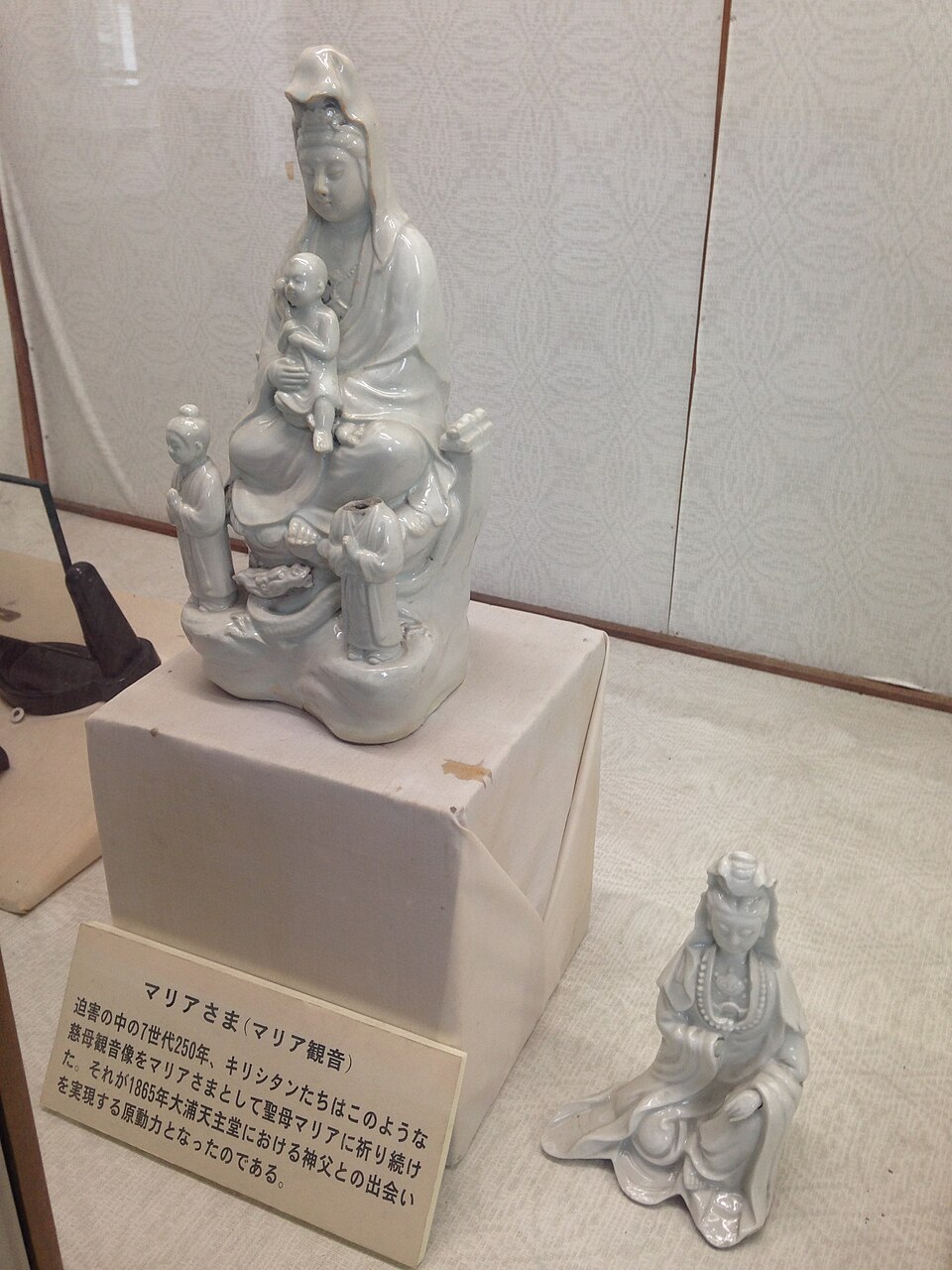
Christianity did not disappear. In villages around Nagasaki and on the Gotō islands, the Kakure Kirishitan, hidden Christians, kept a lay-led faith in secret for more than two centuries, without priests, baptising, keeping a church calendar and reciting prayers in a Latin and Portuguese that gradually became unintelligible, with images of Mary disguised as the Buddhist bodhisattva Kannon.[62][46] Consensus In March 1865 a group of villagers came to the newly built Ōura church in Nagasaki and told the French priest Bernard Petitjean that they shared his faith. Some rejoined the Catholic Church after the ban was lifted in 1873; others preferred to keep their ancestors’ tradition as it was, and a few communities still do.[62][46] Majority
China: Ricci and the rites
Matteo Ricci, an Italian Jesuit, reached Macau in 1582 and spent eighteen years working his way north, learning classical Chinese, adopting the dress first of a Buddhist monk and then of a Confucian scholar, and winning the friendship of officials with European mathematics, maps and clocks. In 1601 he was allowed to reside in Beijing, where he died in 1610.[23][63] Consensus His True Meaning of the Lord of Heaven (Tianzhu shiyi, 1603) presented Christianity as the fulfilment of ancient Confucian teaching, using the classical terms for Heaven and the Lord on High, and arguing against Buddhism and the Neo-Confucian philosophy of his day.[64] Consensus Converts included high officials such as Xu Guangqi, who translated Euclid with him. Christians in China numbered perhaps 200,000 by the end of the seventeenth century.[63] Majority
Ricci’s method raised the question that wrecked the mission: whether converts could continue the rites honouring Confucius and their ancestors. The Jesuits held that these were civil acts of respect, not worship; Dominican and Franciscan missionaries, arriving from the Philippines, considered them idolatry, and the dispute went to Rome.[65] Consensus In 1704 and again in the bull Ex illa die (1715) Clement XI forbade the rites and the classical names for God; the Kangxi emperor, who had issued an edict tolerating Christianity in 1692, replied that missionaries who did not accept Ricci’s practice could leave, and his successor banned Christianity in 1724. Benedict XIV’s Ex quo singulari (1742) closed the question; Pius XII reversed the ban in 1939.[34][35][65] Consensus
In the nineteenth century missions returned under the protection of treaties forced on China after the Opium Wars, which gave missionaries rights of residence and Christians legal protection, and tied the missions in Chinese eyes to foreign power.[66] Majority The most dramatic Chinese Christianity of the century was not missionary at all. Hong Xiuquan, a failed examination candidate, read a set of Christian tracts by the Chinese convert Liang Fa and came to believe that he was the younger brother of Jesus, sent to purge China of demons. His Taiping Heavenly Kingdom (1850–1864) conquered much of southern China and was destroyed in a war in which perhaps 20 million or more people died.[43][44] Consensus on the events; Contested on the death toll and on whether the Taiping should be called Christian.
Africa: Kongo, Ethiopia and the coasts
The Christian kingdom of Kongo
The kingdom of Kongo, in what is now northern Angola and the western Democratic Republic of the Congo, became Christian by its rulers’ choice. Portuguese ships arrived in 1483; in 1491 the king Nzinga a Nkuwu was baptised as João I. His son Afonso I (reigned c. 1509–1542) made Catholicism the state religion, built churches, sent young nobles to study in Portugal, and saw his own son Henrique made a bishop in 1518, the first known Black African bishop of the Latin church.[5][50] Consensus Kongo’s Christianity was run largely by Kongolese lay catechists and used Kikongo terms for God and spirits; John Thornton has argued that it should be seen as a genuinely African form of Catholicism rather than a veneer.[5] Majority
The same contact brought the Atlantic slave trade. In 1526 Afonso wrote to João III of Portugal complaining that Portuguese merchants were seizing free people, nobles and even members of his own family, and asking that only priests and teachers be sent, not merchants; the trade continued.[10] Consensus
In the civil wars of the later seventeenth century, a young Kongolese woman, Kimpa Vita, baptised Beatriz, claimed to be possessed by Saint Anthony and preached a Christianity in which Jesus and Mary were Kongolese and Kongo’s ruined capital was to be restored. Her Antonian movement drew thousands; in 1706 she was condemned as a heretic, with the agreement of Italian Capuchin missionaries, and burned.[32][33] Consensus She is often seen as a forerunner of the African prophetic churches of the twentieth century (§12).[33] Majority
Ethiopia and the Jesuits
Ethiopia had been Christian for more than a millennium (§7). Portuguese soldiers helped it against the Adal sultanate in the 1540s, and Jesuit missionaries followed. The Jesuit Pedro Páez won over the emperor Susenyos, who professed Catholicism in 1622 and in 1626 accepted a Portuguese patriarch, Afonso Mendes, who demanded the reordination of clergy, the rebaptism of the faithful, Latin practice and the abandonment of Ethiopian customs such as the Saturday sabbath. Revolts followed; in 1632 Susenyos restored the Orthodox faith and abdicated, and his son Fasilides expelled the Jesuits.[25][26] Consensus The episode left a lasting suspicion of Catholic missions in Ethiopia.[26] Majority
Christianity and Atlantic slavery
Political on the framing throughout this section; the facts below are Consensus unless marked.
About 12.5 million Africans were forced aboard slave ships between the sixteenth and nineteenth centuries, of whom about 10.7 million survived the crossing.[67] Majority Christian states ran it, Christian merchants profited from it, and church bodies, including Catholic religious orders and the Church of England’s Society for the Propagation of the Gospel, owned enslaved people on plantations.[68][69] Christianity also produced the first organised movements to abolish it. Both facts need to be held together.
Defending slavery
Defenders of slavery read the Bible as permitting it: the Hebrew Bible regulates slavery, Jesus does not condemn it, and the New Testament letters tell slaves to obey their masters (Eph 6:5; Col 3:22).[70][69] Consensus on the arguments made. In the British West Indies, missionary work among enslaved people was long resisted by planters who feared that baptism would make them free or rebellious; when it was permitted, it often came in forms designed to teach obedience. A selection of scripture printed in London in 1807, Select Parts of the Holy Bible, for the Use of the Negro Slaves, omitted most of the Bible, including the Exodus from Egypt, while keeping the passages on obedience.[40] Majority In the United States, the largest Protestant churches split along the line of slavery before the Civil War: the Methodists in 1844 and the Baptists in 1845, when the Southern Baptist Convention was formed.[69] Consensus (The Southern Baptist Convention formally apologised for its defence of slavery in 1995.)
Attacking slavery
The first protest against slavery in the English colonies is usually dated to 1688, when four Quakers in Germantown, Pennsylvania, argued that buying and selling people violated the rule of doing as one would be done by.[31] Over the following century Quakers excluded slaveholders from their meetings, and evangelicals took up the cause: John Wesley’s Thoughts upon Slavery (1774) called the trade a crime against humanity’s natural rights, and the parliamentary campaign led by William Wilberforce and the Clapham evangelicals, alongside Black abolitionists such as Olaudah Equiano, brought the abolition of Britain’s slave trade in 1807 and of slavery in its colonies in 1833–1834.[37][39][68] Consensus How far religion, rather than economic change or the resistance of the enslaved themselves, drove abolition is debated.[68] Contested
The Christianity of the enslaved
Enslaved Africans brought their own religions, Islam among them, and for long periods few were Christian. Mass conversion in the American South came mainly after the evangelical revivals of the late eighteenth century (§11).[71] Majority What developed, Albert Raboteau showed, was an “invisible institution”: worship held secretly in woods and cabins, with spirituals that read the Exodus as the story of their own deliverance and Jesus as a fellow sufferer.[71] Consensus Free Black Christians founded their own churches when white congregations excluded or segregated them. In Philadelphia, Richard Allen and Absalom Jones walked out of St George’s Methodist church after being pulled from their knees in prayer in the white section; Allen founded Bethel church in 1794, and in 1816 the African Methodist Episcopal Church became the first independent Black denomination in the United States.[41][42] Consensus Slave rebellions drew on Christianity too: Nat Turner, who led the Virginia rising of 1831, was a preacher who read his mission in biblical visions.[71] Consensus
The Protestant missionary century
Protestant churches were slow to send missions. The German Pietists of Halle sent the first Lutheran missionaries to the Danish colony of Tranquebar in India in 1706, and from 1732 the Moravians of Herrnhut sent artisans and labourers to the Caribbean, Greenland and South Africa.[36][1] Consensus The movement took off in Britain in the 1790s. William Carey, a Baptist shoemaker and schoolmaster, published An Enquiry into the Obligations of Christians to Use Means for the Conversion of the Heathens in 1792, helped found the Baptist Missionary Society, and sailed for India in 1793, where, at Serampore, he and his colleagues translated the Bible in whole or part into some forty languages.[38][1] Majority on the number. The London Missionary Society (1795), the Church Missionary Society (1799) and American and continental societies followed.[1] Consensus
Several features of the movement mattered for what came after:
- Translation. Protestant missions translated the Bible into hundreds of languages, often producing the first grammars and written forms of them. Lamin Sanneh argued that translation made Christianity a vernacular religion that local people could claim as their own, against the missionaries’ intentions as often as with them.[2] Majority
- Women. By the late nineteenth century women, single and married, made up the majority of the missionary workforce in many societies.[1] Majority
- “Three-self” churches. Henry Venn, secretary of the Church Missionary Society, argued that the aim was churches that were self-supporting, self-governing and self-propagating, with missionaries withdrawing.[72] Consensus
The test case was Samuel Ajayi Crowther. Born among the Yoruba, he was captured by slave raiders in 1821 and freed in 1822 when a British naval patrol intercepted the ship; educated in Sierra Leone, he became a missionary, a translator of the Bible into Yoruba and, in 1864, the first African bishop of the Anglican communion, consecrated in Canterbury Cathedral.[45][72] Consensus In the 1880s younger European missionaries, with the racial assumptions of high imperialism, attacked his administration of the Niger mission; after his death in 1891 a European was appointed in his place.[72][1] Majority The episode was remembered across West Africa as a betrayal, and fed the founding of African-led churches.[50] Majority
African churches of their own
From the 1880s African Christians began founding churches independent of the missions. In 1892 Mangena Mokone, a Methodist minister, left over racial discrimination and founded the Ethiopian Church in Pretoria, taking its name from Psalm 68:31, “Ethiopia shall soon stretch out her hands unto God”; it later joined the African Methodist Episcopal Church of the United States.[47][42] Consensus “Ethiopianism”, the movement for African-led churches, is the first stage of the African-initiated churches whose growth belongs to the twentieth century (§12).[73][50] Majority
Missions and empire: allies or rivals?
| Period and place | Relation of mission to empire | Key evidence |
|---|---|---|
| Spanish Americas, 1500s–1700s | Fused: the crown controlled the church, conversion justified conquest | Inter caetera; patronato real; requerimiento[6][7][9] |
| Portuguese Asia, 1500s–1600s | Fused in Goa; dependent on local rulers elsewhere | Goa Inquisition; Japan; China[19][51] |
| Kongo, 1490s–1700s | A sovereign African kingdom adopting Christianity, while suffering from the slave trade | Afonso’s letters[10] |
| British India, 1700s–1813 | The East India Company barred missionaries from its territories until Parliament forced it to admit them in 1813 | Charter Act 1813[22] |
| Africa, 1840s–1880s | Missions often preceded colonial rule; some missionaries called for it, others opposed it | Livingstone; the Scramble[74] |
| Africa and Asia, 1880s–1914 | Close cooperation under high imperialism, with frequent friction | Crowther; colonial education[75][74] |
Historians disagree about how to weigh this.
| View | Position | Main proponents |
|---|---|---|
| Missions as colonisers of consciousness | Missionaries reshaped colonised societies’ habits, ideas of time, work, dress and the self, preparing them for colonial rule whatever their intentions | Jean and John Comaroff[76] |
| Allies and rivals | Missions and empire were sometimes allies, often in conflict; missionaries criticised colonial abuses as well as benefiting from colonial order | Stanley, Porter[75][74] |
| Translation and local agency | What mattered most was what converts did with Christianity, especially once it was in their own languages | Sanneh, Walls[2][1] |
| Long-term effects | Protestant missions spread printing, schooling and voluntary associations with measurable effects on later democracy | Woodberry[77] |
Contested Woodberry’s statistical argument in particular has been widely debated.
The evidence
| Question | What the evidence supports | Key evidence | Confidence |
|---|---|---|---|
| Legal basis | Papal grants gave the Iberian crowns control of the church in their empires | Romanus Pontifex; Inter caetera; Universalis ecclesiae[4][6][7] | Consensus |
| Christian critique of conquest | Friars led a public debate on the justice of conquest from 1511 | Montesinos; Las Casas; Valladolid[8][13][15] | Consensus |
| Nature of conversion | Mass baptism under conquest; Indigenous reinterpretation over generations | Nahuatl sources[58][59] | Majority |
| Guadalupe | A cult at Tepeyac by 1556; the apparition narrative first written in 1648–1649 | Bustamante; Sánchez; Laso de la Vega[17][29][30] | Majority (dates); Contested (earlier tradition) |
| Thomas Christians | Latinised by force at Diamper; divided after 1653 | Synod acts; Coonan Cross[21][61] | Consensus |
| Japan | Rapid growth, then persecution; secret survival for over two centuries | The 1614 ban; Ōura 1865[24][46] | Consensus |
| China | Accommodation under Ricci; undone by the rites controversy | Ex illa die; Ex quo singulari[34][35] | Consensus |
| Kongo | A Christian African kingdom by royal choice | Afonso’s letters; Kimpa Vita[10][33] | Consensus |
| Slavery | Churches were deeply involved on both sides | Biblical defences; Quaker and evangelical abolition; Black churches[69][68][71] | Consensus |
| African leadership | African bishops and churches by the late 19th century, then pushed back under high imperialism | Crowther; Mokone[45][47] | Majority |
| Distribution in 1900 | Christianity on every continent, but still about two-thirds European | Atlas of Global Christianity[3] | Majority |
Primary sources
Show the 10 primary sources
1. Inter caetera, 4 May 1493
”…[we] give, grant, and assign to you and your heirs and successors, kings of Castile and Leon, forever… all islands and mainlands found and to be found, discovered and to be discovered towards the west and south… you should appoint to the aforesaid mainlands and islands worthy, God-fearing, learned, skilled, and experienced men, in order to instruct the aforesaid inhabitants and residents in the Catholic faith and train them in good morals.” (trans. Frances Gardiner Davenport)[6]
What it proves. The pope claimed the authority to assign newly found lands to a Christian king, on condition of converting their peoples. Conversion and possession were joined in the founding document of Spanish rule in the Americas. Consensus
2. The requerimiento, 1513
The text summarises the creation, the papacy and the papal donation, and asks its hearers to acknowledge the church and the kings of Castile. If they refuse, it declares that the Spaniards will make war on them, take their wives and children as slaves, seize their goods, and that the deaths and losses that followed would be their own fault, not the king’s.[9]
What it proves. The Spanish crown wanted its wars to be legally just under Christian theology, and built that justification into a ritual that its victims could rarely understand. Consensus
3. Montesinos’ sermon, 1511, as reported by Las Casas
Las Casas reports that Montesinos told the colonists that they lived in mortal sin for the cruelty with which they treated the Indigenous people, and asked whether these were not human beings with rational souls, whom the colonists were bound to love as themselves.[8][56]
What it proves. The first recorded public condemnation of the colonial system in the Americas came from a friar, from the pulpit, within twenty years of Columbus’ landing. Its wording is Las Casas’ reconstruction, written decades later. Consensus
4. Sublimis Deus, 1537
Paul III declared that the Indigenous peoples of the West and South, and all other peoples who might be discovered, were truly human and capable of receiving the faith, and that they must not be deprived of their liberty or the possession of their property, even if they were outside the faith.[11]
What it proves. The papacy formally rejected the claim that Indigenous Americans were natural slaves. The bull was partly undercut the next year by a brief, issued under Spanish pressure, that limited its legal force; its principle was reasserted by later popes. Majority
5. Afonso I of Kongo to João III of Portugal, 6 July 1526
Afonso complains that Portuguese merchants in his kingdom are seizing and selling free subjects, including nobles and his own relatives, and asks that the king send only priests and teachers and the goods needed for worship, not merchants.[10]
What it proves. A Christian African king protested against the slave trade in the language of a fellow Christian monarch, more than two centuries before European abolitionism. The trade went on. Consensus
6. Francisco de Bustamante’s sermon, September 1556
As recorded in the inquiry that followed, Bustamante told his congregation that the devotion to the image of Guadalupe had no foundation, that the image had been painted by an Indigenous artist named Marcos, and that encouraging the Indigenous to believe it worked miracles would undo the friars’ work against idolatry.[17][18]
What it proves. A shrine and an image at Tepeyac were well established and contested by 1556. The surviving records of the dispute do not mention the apparitions, the main ground for Poole’s argument. Whether the “Marcos” claim was accurate is itself debated. Majority
7. The decrees of the Synod of Diamper, 1599
The synod required the Thomas Christians to profess the faith of the Roman church, anathematised the Patriarch of the Church of the East as a heretic, ordered their Syriac books to be surrendered for correction or burning, and imposed Latin practices, including clerical celibacy.[21]
What it proves. The Portuguese treated an Asian church older than Portuguese Christianity as a heretical body to be reformed. The decrees explain the revolt of 1653 and the divided churches of Kerala today. Consensus
8. Ex illa die, 1715
Clement XI forbade Chinese Christians to take part in sacrifices to Confucius or the ancestors, to keep ancestral tablets inscribed as the dwelling of the spirit, and to use the terms Tian (Heaven) or Shangdi (Lord on High) for God, permitting only Tianzhu, “Lord of Heaven”.[34]
What it proves. Rome chose a strict boundary between Christianity and Chinese religious culture, reversing the Jesuit strategy of accommodation; the choice closed China to the mission for more than a century. Majority
9. Select Parts of the Holy Bible, for the Use of the Negro Slaves, London, 1807
A selection printed for the conversion of enslaved people in the British West Indies. It omits most of the Hebrew Bible, including the Exodus story of liberation from slavery, and much of the New Testament, while keeping passages such as “Servants, be obedient to them that are your masters according to the flesh, with fear and trembling” (Eph 6:5, in the King James Version it printed).[40][70]
What it proves. Scripture was edited for use in a slave society, to teach obedience rather than deliverance. Copies survive at Fisk University and elsewhere; it was exhibited by the Museum of the Bible in 2018. Majority
10. Crowther’s consecration, 29 June 1864
Samuel Ajayi Crowther was consecrated in Canterbury Cathedral as bishop of “the countries of Western Africa beyond the limits of the Queen’s dominions”, the formula that defined a missionary bishopric outside British territory.[45][72]
What it proves. The Church Missionary Society’s policy of African leadership was put into practice at the highest level, a generation before the racial thinking of high imperialism reversed it. Consensus
What is absent
- A world Christianity. For all the expansion, Christianity in 1900 was still overwhelmingly a European and settler religion; in 1910 about two-thirds of the world’s Christians lived in Europe, and Africa as a whole was perhaps 9 percent Christian.[3] Majority
- Indigenous clergy in Spanish America. The Mexican church barred Indigenous men from the priesthood for much of the sixteenth century, after early experiments such as the college of Santa Cruz de Tlatelolco; Indigenous priests remained rare for centuries.[54] Majority
- A Catholic Japan or China. Despite promising beginnings, persecution in Japan and the rites controversy in China kept both mission fields small until the twentieth century. Consensus
- Abolition by the churches as such. Abolition was led by Christian minorities, against Christian majorities in the slave-owning societies; the large churches came late. Majority
- Mission without translation. Nearly everywhere Protestant missions produced the first written forms of local languages; Catholic missions often did the same, though they kept Latin for the liturgy. Majority
Debates
Was conversion in the Americas real?
| View | Position | Main proponents |
|---|---|---|
| Spiritual conquest | The friars largely succeeded in replacing Indigenous religion within a few generations | Ricard[54] |
| Two-sided adaptation | Indigenous peoples adopted Christianity on their own terms, through their languages and communities | Lockhart, Burkhart[59][58] |
| Survival beneath the surface | Older religion persisted under a Christian surface | Many older accounts; now often criticised as too simple |
Majority for the second view.
Guadalupe
| View | Position | Main proponents |
|---|---|---|
| Created in the 1640s | No sixteenth-century source mentions the apparitions; the story belongs to creole Mexico | Poole[18] |
| A cult that grew a story | A 1550s shrine and image acquired its narrative over a century | Brading[60] |
| The tradition | An apparition in 1531, transmitted orally and in Nahuatl before 1648 | Catholic tradition; defenders of Juan Diego’s historicity |
Contested
Did the churches end slavery?
| View | Position | Main proponents |
|---|---|---|
| Religious conviction | Quaker and evangelical conscience created abolitionism and drove it through | Many older histories; Davis in part[68] |
| Economics and politics | Slavery ended when it ceased to pay or became politically untenable; religion supplied the rhetoric | Eric Williams and successors |
| The enslaved | Rebellion and resistance, from Haiti to Jamaica, made slavery untenable | Many recent historians |
Contested Most historians combine all three.
Further reading
Show further reading (10 works)
- Lewis Hanke, The Spanish Struggle for Justice in the Conquest of America (Pennsylvania, 1949).
- Louise M. Burkhart, The Slippery Earth: Nahua-Christian Moral Dialogue in Sixteenth-Century Mexico (Arizona, 1989).
- Stafford Poole, Our Lady of Guadalupe: The Origins and Sources of a Mexican National Symbol, 1531–1797 (Arizona, 1995), and D. A. Brading, Mexican Phoenix (Cambridge, 2001).
- C. R. Boxer, The Christian Century in Japan, 1549–1650 (California, 1951), and George Elison, Deus Destroyed (Harvard, 1973).
- Jonathan Spence, The Memory Palace of Matteo Ricci (Viking, 1984) and God’s Chinese Son (Norton, 1996).
- John K. Thornton, The Kongolese Saint Anthony: Dona Beatriz Kimpa Vita and the Antonian Movement, 1684–1706 (Cambridge, 1998).
- Albert J. Raboteau, Slave Religion: The “Invisible Institution” in the Antebellum South (Oxford, 1978).
- Robert Eric Frykenberg, Christianity in India (Oxford, 2008).
- Andrew F. Walls, The Missionary Movement in Christian History (Orbis, 1996), and Lamin Sanneh, Translating the Message (Orbis, 1989).
- Brian Stanley, The Bible and the Flag (Apollos, 1990), and Andrew Porter, Religion versus Empire? (Manchester, 2004).
References
- ^ a b c d e f g h Andrew F. Walls The Missionary Movement in Christian History: Studies in the Transmission of Faith. Orbis Books, 1996. Essays on mission, translation and the shift of Christianity's centre.
- ^ a b c Lamin Sanneh Translating the Message: The Missionary Impact on Culture. Orbis Books, 1989. Bible translation as vernacularisation of Christianity.
- ^ a b c Todd M. Johnson and Kenneth R. Ross, eds. Atlas of Global Christianity, 1910–2010. Edinburgh University Press, 2009. Estimates of Christian populations by region in 1910 and 2010.
- ^ a b c Nicholas V, Romanus Pontifex (8 January 1455) — Papal bull. 1455 CE. Latin. Grants the king of Portugal rights over lands, goods and peoples conquered in Africa, including their enslavement; a foundation of the Portuguese padroado. about
- ^ a b c John K. Thornton The Development of an African Catholic Church in the Kingdom of Kongo, 1491–1750. Journal of African History 25: 147–167, 1984. Kongo Christianity as a genuinely African Catholicism.
- ^ a b c d e Alexander VI, Inter caetera (4 May 1493) — Papal bull. 1493 CE. Latin. Assigns to the Castilian crown lands west and south of a line in the Atlantic, charging it to send men to instruct their inhabitants in the Catholic faith. read the text
- ^ a b c d Julius II, Universalis ecclesiae (28 July 1508) — Papal bull. 1508 CE. Latin. Grants the Spanish crown the right to found churches and present bishops throughout the Indies, the patronato real. about
- ^ a b c d Antonio de Montesinos, Advent sermon on Hispaniola (December 1511) — Sermon, as reported by Bartolomé de las Casas, Historia de las Indias. 1511 CE (reported c. 1550s). Spanish. A Dominican tells the colonists they are in mortal sin for their treatment of the Taíno and asks whether these are not human beings with rational souls. about
- ^ a b c d Requerimiento (1513) — Text drafted by Juan López de Palacios Rubios. 1513 CE. Spanish. A declaration to be read to Indigenous peoples before war, demanding submission to the pope and the Castilian crown and blaming them for the consequences of refusal. about
- ^ a b c d e Afonso I of Kongo to João III of Portugal (6 July 1526) — Letters of Afonso I (Mvemba a Nzinga). 1526 CE. Portuguese. The Christian king of Kongo complains that Portuguese merchants are seizing and selling free subjects and relatives, and asks for priests and teachers instead of merchants. about
- ^ a b c Paul III, Sublimis Deus (2 June 1537) — Papal bull. 1537 CE. Latin. Declares that the Indigenous peoples of the Americas are truly human and capable of the faith, and may not be deprived of liberty or property. read the text
- ^ a b New Laws of the Indies (1542) — Leyes Nuevas of Charles V. 1542 CE. Spanish. Forbid the enslavement of Indigenous people and restrict new encomiendas; partly repealed after colonists' resistance. about
- ^ a b c d Bartolomé de las Casas, Brevísima relación de la destrucción de las Indias — A Brief Account of the Destruction of the Indies. written 1542, printed 1552. Spanish. A region-by-region account of atrocities in the Spanish conquest, written for the emperor and widely translated. about
- ^ a b c C. R. Boxer The Christian Century in Japan, 1549–1650. University of California Press, 1951. The classic history of the Jesuit mission and its suppression.
- ^ a b c Valladolid debate (1550–1551) — Junta of theologians and jurists, Valladolid. 1550–1551 CE. Spanish and Latin. Las Casas against Juan Ginés de Sepúlveda on whether war and subjection of the Indigenous peoples were just. about
- ^ a b c d e f g Lewis Hanke The Spanish Struggle for Justice in the Conquest of America. University of Pennsylvania Press, 1949. Las Casas, the New Laws and the Valladolid debate.
- ^ a b c d Francisco de Bustamante, sermon against the Guadalupe cult (8 September 1556) — Recorded in the inquiry (Información) of 1556. 1556 CE. Spanish. The Franciscan provincial attacks the devotion at Tepeyac and says the image was painted by an Indigenous artist named Marcos. about
- ^ a b c d e Stafford Poole Our Lady of Guadalupe: The Origins and Sources of a Mexican National Symbol, 1531–1797. University of Arizona Press, 1995. Argues that the apparition narrative is not attested before 1648.
- ^ a b c Goa Inquisition (1560–1812) — Tribunal of the Holy Office at Goa. 1560–1812 CE. Portuguese. Established in 1560, suppressed 1774, restored 1778 and abolished 1812; aimed chiefly at converts suspected of Hindu or Jewish practice. about
- ^ a b The twenty-six martyrs of Japan (5 February 1597) — Execution at Nagasaki. 1597 CE. Twenty-six Christians, Japanese and European, crucified at Nagasaki on Hideyoshi's orders. about
- ^ a b c d Synod of Diamper (Udayamperur), June 1599 — Decrees of the synod under Aleixo de Menezes. 1599 CE. Portuguese and Malayalam. Imposes Latin practice and Portuguese authority on the Thomas Christians and orders Syriac books corrected or burned. about
- ^ a b c d e f Robert Eric Frykenberg Christianity in India: From Beginnings to the Present. Oxford University Press, 2008. The standard history, including the Thomas Christians.
- ^ a b Jonathan D. Spence The Memory Palace of Matteo Ricci. Viking, 1984. Ricci's life and method in late Ming China.
- ^ a b c Tokugawa ban on Christianity (1614) — Edict of the Tokugawa shogunate. 1614 CE. Japanese. Bans Christianity throughout Japan and expels the missionaries. about
- ^ a b Susenyos' profession of Catholicism (1622) and abdication (1632) — Ethiopian court and Jesuit sources. 1622–1632 CE. Ge'ez and Portuguese. The Ethiopian emperor accepts Catholicism and a Portuguese patriarch, provokes revolts, restores Orthodoxy and abdicates. about
- ^ a b c Leonardo Cohen The Missionary Strategies of the Jesuits in Ethiopia (1555–1632). Harrassowitz, 2009. The Jesuit mission, Susenyos' conversion and its collapse.
- ^ a b Shimabara Rebellion (1637–1638) — Uprising in Shimabara and Amakusa, Japan. 1637–1638 CE. A peasant uprising with Christian banners crushed by the shogunate, after which Japanese Christianity survived only in secret. about
- ^ a b c d George Elison Deus Destroyed: The Image of Christianity in Early Modern Japan. Harvard University Press, 1973. The Japanese suppression of Christianity and its anti-Christian literature.
- ^ a b c Miguel Sánchez, Imagen de la Virgen María, Madre de Dios de Guadalupe — Devotional history. 1648 CE. Spanish. The first written account of the Guadalupe apparitions to Juan Diego. about
- ^ a b c d Luis Laso de la Vega, Huei tlamahuiçoltica — Nahuatl account including the Nican mopohua. 1649 CE. Nahuatl. The Nahuatl narrative of the 1531 apparitions, published by the vicar of the Guadalupe shrine. about
- ^ a b Germantown Quaker Petition Against Slavery (1688) — Petition by four Quakers of Germantown, Pennsylvania. 1688 CE. English. Argues that buying and selling people breaks the rule of doing as one would be done by; usually counted as the first such protest in the English colonies. about
- ^ a b Kimpa Vita (Dona Beatriz) and the Antonian movement — Kongo, 1704–1706. 1704–1706 CE. Kikongo and Portuguese. A Kongolese prophet who claimed possession by Saint Anthony and was burned as a heretic in 1706. about
- ^ a b c d John K. Thornton The Kongolese Saint Anthony: Dona Beatriz Kimpa Vita and the Antonian Movement, 1684–1706. Cambridge University Press, 1998. The life and movement of Kimpa Vita.
- ^ a b c d Clement XI, Ex illa die (19 March 1715) — Papal bull. 1715 CE. Latin. Forbids Chinese Christians to take part in rites to Confucius and the ancestors and to call God Tian or Shangdi. about
- ^ a b c Benedict XIV, Ex quo singulari (11 July 1742) — Papal bull. 1742 CE. Latin. Confirms the ban on the Chinese rites and requires missionaries to swear to observe it. about
- ^ a b First Moravian mission (1732) — Leonard Dober and David Nitschmann to St Thomas. 1732 CE. The Moravian Church of Herrnhut sends its first missionaries to the Danish West Indies. about
- ^ a b John Wesley, Thoughts upon Slavery (1774) — Pamphlet. 1774 CE. English. Wesley condemns the slave trade and slavery as contrary to justice and natural rights. about
- ^ a b William Carey, An Enquiry into the Obligations of Christians to Use Means for the Conversion of the Heathens (1792) — Pamphlet. 1792 CE. English. The manifesto of the British Protestant missionary movement, with a survey of the world's religions and populations. about
- ^ a b Slave Trade Act 1807 — Act of the Parliament of the United Kingdom. 1807 CE. English. Abolishes the slave trade in the British Empire; slavery itself was abolished by the Act of 1833. about
- ^ a b c Select Parts of the Holy Bible, for the Use of the Negro Slaves, in the British West-India Islands (London, 1807) — Abridged Bible. 1807 CE. English. A selection omitting most of scripture, including the Exodus, while keeping passages on obedience; exhibited by the Museum of the Bible in 2018. about
- ^ a b African Methodist Episcopal Church (founded 1816) — Founding conference, Philadelphia. 1816 CE. English. Richard Allen and other Black Methodists form an independent denomination after discrimination in white churches. about
- ^ a b c d James T. Campbell Songs of Zion: The African Methodist Episcopal Church in the United States and South Africa. Oxford University Press, 1995. The AME Church and its union with South African Ethiopianism.
- ^ a b Taiping Heavenly Kingdom (1850–1864) — Movement led by Hong Xiuquan. 1850–1864 CE. Chinese. A rebellion led by a visionary who believed himself the younger brother of Jesus; one of the deadliest wars of the century. about
- ^ a b Jonathan D. Spence God's Chinese Son: The Taiping Heavenly Kingdom of Hong Xiuquan. W. W. Norton, 1996. Hong Xiuquan's visions and the Taiping war.
- ^ a b c d Consecration of Samuel Ajayi Crowther (29 June 1864) — Canterbury Cathedral. 1864 CE. English. Crowther consecrated bishop of 'the countries of Western Africa beyond the limits of the Queen's dominions', the first African Anglican bishop. about
- ^ a b c d Discovery of the hidden Christians at Ōura (17 March 1865) — Ōura Church, Nagasaki. 1865 CE. Japanese. Villagers from Urakami tell the French priest Bernard Petitjean that they share his faith, after two centuries in secret. about
- ^ a b c Ethiopian Church founded by Mangena Mokone (1892) — Pretoria, South African Republic. 1892 CE. English. A Methodist minister leaves over racial discrimination and founds an African-led church named from Psalm 68:31. about
- ^ World Missionary Conference, Edinburgh (1910) — Conference of Protestant missionary societies. 1910 CE. English. The high point of the Protestant missionary movement and a starting point of the ecumenical movement. about
- ^ Brian Stanley The World Missionary Conference, Edinburgh 1910. Eerdmans, 2009. The history and significance of the conference.
- ^ a b c d Adrian Hastings The Church in Africa, 1450–1950. Clarendon Press, 1994. The standard history from Kongo to the independent churches.
- ^ a b c d e C. R. Boxer The Portuguese Seaborne Empire, 1415–1825. Hutchinson, 1969. The empire's structure, including the padroado and its missions.
- ^ Joint Statement on the 'Doctrine of Discovery' (30 March 2023) — Dicasteries for Culture and Education and for Promoting Integral Human Development. 2023 CE. English. The bulls 'did not adequately reflect the equal dignity and rights of indigenous peoples' and have 'never been considered expressions of the Catholic faith'. read the text
- ^ Toribio de Benavente (Motolinía), Historia de los indios de la Nueva España — History of the Indians of New Spain. c. 1541. Spanish. A Franciscan's account of the early mission in Mexico, claiming millions of baptisms. about
- ^ a b c d Robert Ricard The Spiritual Conquest of Mexico. University of California Press, 1966. English translation of the 1933 classic on the mendicant missions.
- ^ a b Massimo Livi Bacci Conquest: The Destruction of the American Indios. Polity, 2008. The demographic collapse in the Americas and its causes.
- ^ a b c Bartolomé de las Casas, Historia de las Indias — History of the Indies. c. 1527–1561 (printed 1875). Spanish. Las Casas' history of the conquest, including Montesinos' sermon and his own regret at having proposed African slavery. about
- ^ Laws of Burgos (1512) — Royal ordinances of Castile for the Indies. 1512 CE. Spanish. Regulate the treatment of Indigenous labourers under the encomienda without abolishing it. about
- ^ a b c Louise M. Burkhart The Slippery Earth: Nahua-Christian Moral Dialogue in Sixteenth-Century Mexico. University of Arizona Press, 1989. How Christian teaching was translated into Nahua moral categories.
- ^ a b c d James Lockhart The Nahuas After the Conquest. Stanford University Press, 1992. Nahua society and religion from Nahuatl documents, 1520s–1760s.
- ^ a b c d D. A. Brading Mexican Phoenix: Our Lady of Guadalupe: Image and Tradition across Five Centuries. Cambridge University Press, 2001. The history of the Guadalupe tradition and its place in Mexican identity.
- ^ a b Coonan Cross Oath (January 1653) — Oath at Mattancherry, Kochi. 1653 CE. Malayalam. Thomas Christians swear not to submit to the Jesuit prelates, beginning the division of the community. about
- ^ a b Christal Whelan The Beginning of Heaven and Earth: The Sacred Book of Japan's Hidden Christians. University of Hawai'i Press, 1996. Translation and study of the hidden Christians' scripture.
- ^ a b Nicolas Standaert, ed. Handbook of Christianity in China, vol. 1: 635–1800. Brill, 2001. The reference work on Christianity in China to 1800.
- ^ Matteo Ricci, Tianzhu shiyi (The True Meaning of the Lord of Heaven) — Catechetical dialogue. 1603 CE. Classical Chinese. Presents Christianity as consistent with ancient Confucian teaching and argues against Buddhism and Neo-Confucianism. about
- ^ a b D. E. Mungello, ed. The Chinese Rites Controversy: Its History and Meaning. Steyler Verlag, 1994. Essays on the controversy from both Chinese and European sides.
- ^ Daniel H. Bays A New History of Christianity in China. Wiley-Blackwell, 2012. From the Nestorians to the present, with the treaty-port missions and Chinese-led churches.
- ^ David Eltis and David Richardson Atlas of the Transatlantic Slave Trade. Yale University Press, 2010. Based on the slave voyages database: about 12.5 million Africans embarked.
- ^ a b c d e David Brion Davis The Problem of Slavery in Western Culture. Cornell University Press, 1966. The religious and intellectual history of slavery and the origins of abolitionism.
- ^ a b c d Mark A. Noll The Civil War as a Theological Crisis. University of North Carolina Press, 2006. How American Protestants read the Bible on slavery, and the church splits of the 1840s.
- ^ a b Ephesians 6:5–8 — Letter to the Ephesians (New Testament). c. 80–100 CE. Greek. 'Slaves, obey your earthly masters with fear and trembling, in singleness of heart, as you obey Christ' (NRSVUE); cited in defence of slavery and kept, in the KJV, in the 1807 'Slave Bible'. read the text
- ^ a b c d Albert J. Raboteau Slave Religion: The 'Invisible Institution' in the Antebellum South. Oxford University Press, 1978. The religion of enslaved Africans in the United States.
- ^ a b c d Kevin Ward A History of Global Anglicanism. Cambridge University Press, 2006. Includes Venn's three-self policy and Crowther's episcopate.
- ^ Bengt Sundkler Bantu Prophets in South Africa. Lutterworth Press, 1948. The classic study of Ethiopian and Zionist churches.
- ^ a b c Andrew Porter Religion versus Empire? British Protestant Missionaries and Overseas Expansion, 1700–1914. Manchester University Press, 2004. Missions and empire as often in tension.
- ^ a b Brian Stanley The Bible and the Flag: Protestant Missions and British Imperialism in the Nineteenth and Twentieth Centuries. Apollos, 1990. Missions and empire as allies and rivals.
- ^ Jean Comaroff and John Comaroff Of Revelation and Revolution, vol. 1: Christianity, Colonialism, and Consciousness in South Africa. University of Chicago Press, 1991. Missions as a 'colonisation of consciousness' among the Tswana.
- ^ Robert D. Woodberry The Missionary Roots of Liberal Democracy. American Political Science Review 106: 244–274, 2012. Statistical argument that Protestant missions fostered later democracy; widely debated.