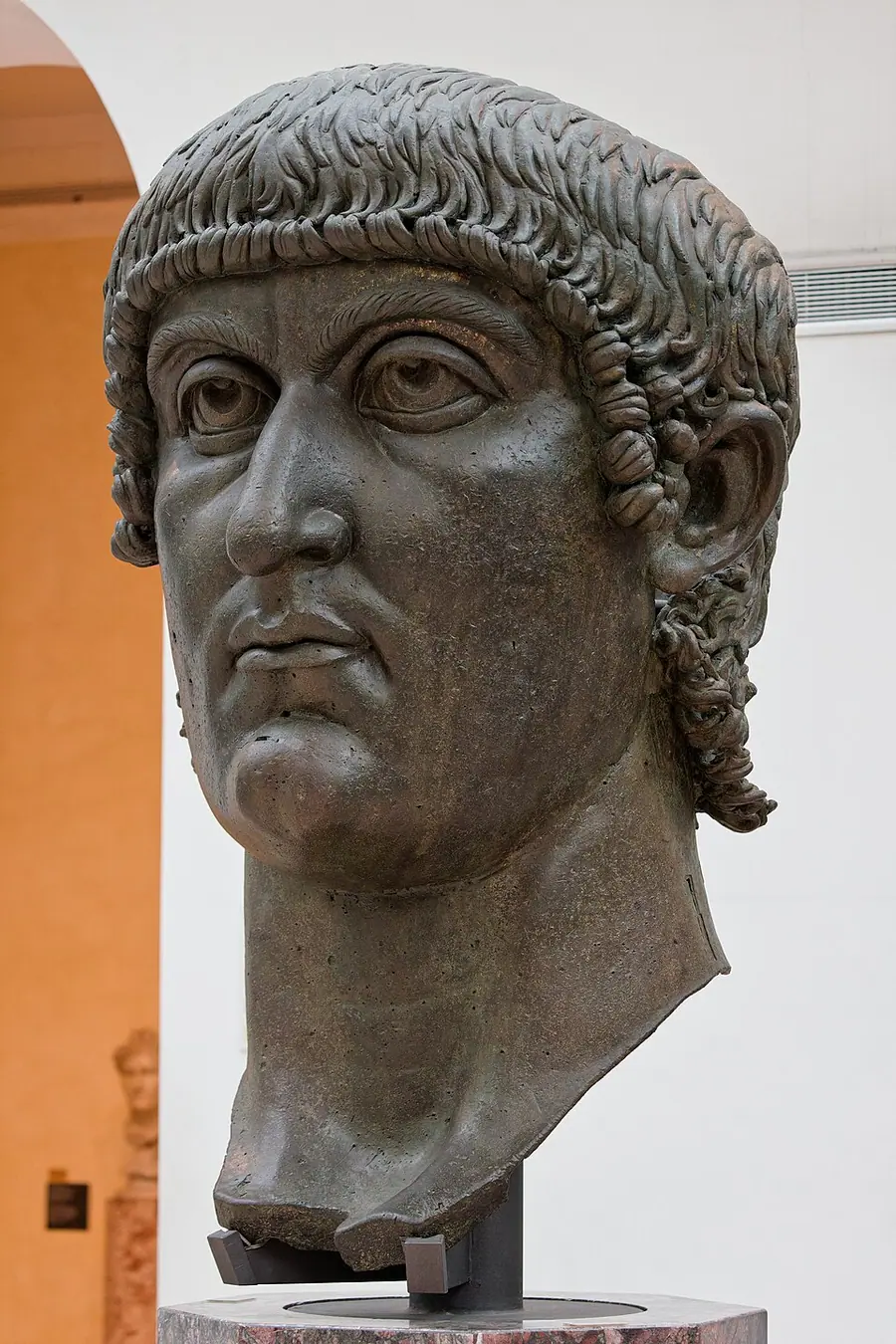
The short version: Nicaea was called to settle one argument, about how the Son of God is related to the Father, and it settled it on paper by a near-unanimous vote. It also fixed a rule for Easter and passed some rules of church discipline. Almost everything else popularly attributed to it, from choosing the Bible to inventing the divinity of Jesus, is legend. What makes it matter is not that it ended a debate, because it did not, but that it was the first time an emperor gathered bishops from across his empire and their decision became the standard others were measured against.[1][2] Consensus
The argument
Christians had worshipped Jesus as divine since the first generation: around 112 the governor Pliny reported that they sang a hymn “to Christ as to a god”, and Ignatius of Antioch, around 110, called him “our God”.[3][4] Consensus What they had not settled was how to say that while also saying, as monotheists, that God is one. Second- and third-century writers described the Son as God’s Word or Wisdom, divine but in some way derived from the Father.[5] Majority
Around 318 Arius, a priest in charge of a church in Alexandria, pressed one side of that inheritance. If the Father alone has no beginning, he argued, the Son, being begotten, must have one; in a letter to his ally Eusebius of Nicomedia he wrote that “the Son has a beginning, but God is without beginning”.[6] His opponents summed up his teaching as “there was when he was not”.[7] Majority His bishop, Alexander, excommunicated him, and the quarrel spread across the eastern churches.[1] Consensus
Why an emperor cared
Constantine treated division among Christians as a threat to the empire’s standing with God. He had already been drawn into a split in North Africa, where the party later called Donatists rejected a bishop of Carthage; councils at Rome in 313 and Arles in 314, called at his request, ruled against them, and the Donatist church survived for a century anyway.[8] Majority The pattern of Nicaea was set there: the emperor summoned bishops, the bishops decided, and the losers appealed or went their own way.
Who came
Constantine, sole emperor since defeating Licinius in 324, summoned the council for the summer of 325 and attended in person. The bishops travelled by the imperial post at state expense. Eusebius of Caesarea, who was there, counted bishops that “exceeded two hundred and fifty” (trans. NPNF); Athanasius later said about three hundred. The famous number 318 appears only from about 360, and matches the 318 servants of Abraham in Genesis 14:14, so it is probably symbolic.[9][2] Majority Almost all the bishops came from the Greek East; the bishop of Rome sent two priests.
The meeting place was Nicaea, near the imperial residence at Nicomedia. Constantinople, often imagined as the backdrop, was not dedicated until 330.[10] Consensus
What the council decided
A creed. Built on an existing baptismal creed, it said of the Son:
“…begotten from the Father, only-begotten, that is, from the substance of the Father, God from God, light from light, true God from true God, begotten not made, of one substance with the Father… But as for those who say, ‘There was when He was not’… these the Catholic and apostolic Church anathematizes.” (trans. J. N. D. Kelly)[11]
The key word was homoousios, “of one substance”. It is not a biblical word, and some bishops signed reluctantly; Eusebius of Caesarea wrote home to his church to explain why he had accepted it.[12] Consensus
Easter. All churches were to keep Easter on the same Sunday, rather than some following the Jewish calendar’s date of Passover. Constantine’s letter to the churches presents the decision as freeing Christians from dependence on the Jews. The exact method of calculation was not fixed, and East and West went on differing.[13] Consensus
Twenty canons on discipline: among them the precedence of the bishops of Alexandria, Rome and Antioch (canon 6), rules for readmitting those who had lapsed under persecution, a ban on clergy moving between cities, and a rule that Christians should pray standing, not kneeling, on Sundays (canon 20).[14] Consensus
Only two bishops refused to sign, Secundus of Ptolemais and Theonas of Marmarica; they were exiled with Arius.[1] Consensus
What happened next
The creed did not hold. Many eastern bishops who rejected Arius also distrusted homoousios, which seemed to blur Father and Son, and Constantine himself readmitted Arius to communion before Arius’ death in 336.[1][2] Majority Under Constantius II, councils in 359 and 360 adopted a creed saying only that the Son was “like” the Father, and banned the word ousia. Jerome later wrote that “the whole world groaned, and was astonished to find itself Arian”.[15] Consensus
The settlement came only in 381. After the Cappadocian theologians distinguished one divine ousia from three hypostaseis, the emperor Theodosius I called a council to Constantinople, which reaffirmed Nicaea and declared the Holy Spirit fully divine. The longer creed linked to that council is the one most churches now call “the Nicene Creed”.[16][5] Majority on the link to 381.
The case on each side
Historians still argue about what Nicaea represents.
| View | Argument | Main proponents |
|---|---|---|
| Development | Nicaea stated in philosophical terms what the church had long believed about Christ | Kelly; most Catholic, Orthodox and Protestant theologians[5] |
| Hellenisation | Greek metaphysics replaced the Hebrew categories of the New Testament | Harnack (1880s–1890s) and his modern successors |
| Contingent outcome | The result was not inevitable; politics, personalities and imperial favour shaped it | Hanson; Ayres, in different ways[1][2] |
Contested Older accounts described two parties, “Arians” and “Nicenes”, fighting for half a century. Hanson and Ayres show a range of positions that hardened only slowly, and treat “Arianism” as a single movement as largely the creation of Athanasius’ polemic.[1][2] Majority
Common misconceptions
- “Nicaea chose the Bible.” No document of the council mentions the canon. The tale of the bishops placing books on an altar and the false ones falling off comes from the ninth-century Synodicon Vetus; Voltaire repeated it, and The Da Vinci Code (2003) revived the idea.[17] Consensus The first list of exactly the 27 New Testament books is from 367.[18]
- “Jesus was voted divine by a narrow margin.” The vote was nearly unanimous, and the belief was nearly three centuries older. The question was how the Son’s divinity related to the Father’s. Consensus
- “Constantine wrote the creed.” He presided and pressed for unity; the creed was built on an existing baptismal creed and argued over by the bishops. How much he shaped the outcome is debated.[10][19] Contested
- “Nicaea created the Trinity.” It defined the Son’s relation to the Father. The Holy Spirit received one line, and the full doctrine came at Constantinople in 381.[5] Consensus
Why it matters
Nicaea set the pattern for the next thousand years: emperors called councils, councils defined doctrine in precise Greek, and the losers appealed or went into schism. Its creed, in the expanded form of 381, is still recited by Catholic, Orthodox, Anglican and many Protestant churches. In November 2025, for the council’s 1,700th anniversary, Pope Leo XIV and the Ecumenical Patriarch Bartholomew prayed together at Iznik, ancient Nicaea, and signed a joint declaration the next day.[20] Consensus
For Constantine, the council and the sixty years of argument that followed, see Chapter 6: Constantine, the Creeds and the Councils. For the second-century background, see Chapter 5: Many Christianities.
References
- ^ a b c d e f R. P. C. Hanson The Search for the Christian Doctrine of God: The Arian Controversy 318–381. T&T Clark, 1988. The fullest history of the controversy.
- ^ a b c d e Lewis Ayres Nicaea and Its Legacy: An Approach to Fourth-Century Trinitarian Theology. Oxford University Press, 2004. Replaces the two-party story with a range of trajectories that converged slowly.
- ^ Pliny the Younger, Letters 10.96 — Letters. c. 112 CE. Latin. The governor of Bithynia-Pontus reports that Christians met before dawn to sing 'a hymn to Christ as to a god', and that he tortured two enslaved women called ministrae. about
- ^ Ignatius, To the Ephesians 18.2 — Letters of Ignatius of Antioch. c. 110 CE. Greek. 'Our God, Jesus the Christ, was conceived by Mary', an early second-century statement of Jesus' divinity. read the text
- ^ a b c d J. N. D. Kelly Early Christian Creeds. Longman, 3rd ed., 1972. The standard history of the creeds, including the link between the creed and the council of 381.
- ^ Arius, Letter to Eusebius of Nicomedia (Theodoret, HE 1.5; 1.4 in NPNF) — Letter to Eusebius of Nicomedia. c. 318 CE. Greek. Arius complains that he is persecuted for saying that the Son has a beginning while God is without beginning. read the text
- ^ Rowan Williams Arius: Heresy and Tradition. SCM Press, 2nd ed., 2001. Arius as a conservative theologian, not a rationalist.
- ^ W. H. C. Frend The Donatist Church: A Movement of Protest in Roman North Africa. Clarendon Press, 1952. The classic study of the Donatist schism.
- ^ Eusebius, Life of Constantine 3.6–14 — Life of Constantine. c. 337–339 CE. Greek. An eyewitness account of the Council of Nicaea, with bishops that 'exceeded two hundred and fifty' (NPNF) and the emperor presiding. read the text
- ^ a b Timothy D. Barnes Constantine and Eusebius. Harvard University Press, 1981. Constantine as a committed Christian from 312.
- ^ Creed of Nicaea (325) — Council of Nicaea. 325 CE. Greek. The original Nicene creed: the Son 'from the substance of the Father… of one substance (homoousios) with the Father', with anathemas against Arius' formulas. read the text
- ^ Eusebius of Caesarea, Letter to his church (in Socrates, HE 1.8) — Letter to the Church of Caesarea. 325 CE. Greek. Eusebius explains to his congregation why he signed the Nicene creed and how he understood homoousios. read the text
- ^ Eusebius, Life of Constantine 3.18–19 — Life of Constantine. 325 CE (letter). Greek. Constantine's letter to the churches announcing a common date for Easter, independent of the Jewish reckoning. read the text
- ^ Canons of the Council of Nicaea — Council of Nicaea. 325 CE. Greek. Twenty canons on church discipline, including the precedence of Alexandria, Rome and Antioch (canon 6) and standing for prayer on Sundays (canon 20). read the text
- ^ Jerome, Dialogue against the Luciferians 19 — Dialogue against the Luciferians. c. 379 CE. Latin. After the councils of 359, 'the whole world groaned, and was astonished to find itself Arian'. read the text
- ^ Creed of Constantinople (381) — Council of Constantinople. 381 CE (first recorded 451). Greek. The expanded creed, with the Holy Spirit 'the Lord and giver of life… worshipped and glorified' with Father and Son, now recited as the Nicene Creed. read the text
- ^ Bart D. Ehrman Truth and Fiction in The Da Vinci Code. Oxford University Press, 2004. Corrects the novel's claims about Constantine, Nicaea and the canon.
- ^ Athanasius, Festal Letter 39 — Festal (Easter) Letters. 367 CE. Greek. The first list of exactly the 27 books of the New Testament: 'Let no man add to these, neither let him take ought from these.' read the text
- ^ H. A. Drake Constantine and the Bishops: The Politics of Intolerance. Johns Hopkins University Press, 2000. Constantine as a seeker of consensus between Christians and pagans.
- ^ Joint Declaration of Pope Leo XIV and Ecumenical Patriarch Bartholomew — Iznik (Nicaea) and Istanbul. 29 November 2025. English. Marks the 1,700th anniversary of the Council of Nicaea and the 60th of the lifting of the 1054 excommunications, and commits both churches to seek full communion. read the text