The story of Christianity is usually told as a story of Rome and its successors, but for most of its first thousand years much of the faith lay outside the empire. By the mid-fourth century three kingdoms beyond Rome’s borders, Armenia, Georgia and Aksum in Ethiopia, had Christian kings. The largest church outside the empire belonged to the Christians of Persia, who organised themselves in 410, worshipped in Syriac, took their own path after the councils of the fifth century (§6), and became the Church of the East. Its monks and merchants carried it along the trade routes to south India, Central Asia, Mongolia and China, where a Persian monk reached the capital in 635. After the Arab conquests of the 630s and 640s, the Christians of Egypt and Syria, and many in Iraq, lived for centuries as the largest communities under Muslim rule, and slowly became minorities. By 1400, war, plague, conversion and the collapse of the Mongol empires had reduced the Church of the East to the mountains of northern Iraq and its borders, and the coast of Kerala. Majority
This chapter does not tell these churches’ history as a footnote to the West’s. Several of them are older than the churches of northern Europe, and the Ethiopian, Armenian, Coptic and Syriac churches have been continuous for sixteen centuries or more, and the Indian church for nearly fifteen.[1][2] Islam’s own history is the subject of the Islam series; here it appears only as the setting in which most of these churches lived after the seventh century.
Timeline
| Date | Event or evidence | Confidence |
|---|---|---|
| c. 200 | A chronicle of Edessa records the “temple of the church of the Christians” damaged in a flood of 201[3] | Majority |
| 3rd c. | The Acts of Thomas, written in Syriac at Edessa, sends the apostle Thomas to India[4] | Consensus (date of text) |
| c. 314 | Gregory the Illuminator is consecrated bishop at Caesarea in Cappadocia; Armenia’s king Tiridates III is baptised (tradition: 301)[5][6] | Majority |
| c. 330s–340s | Ezana of Aksum adopts Christianity; Frumentius consecrated bishop by Athanasius[7][8] | Majority |
| c. 330s | Nino, a captive woman, converts the Georgian king Mirian and Queen Nana, according to Rufinus[9] | Majority (event); Contested (details) |
| c. 340–379 | Shapur II persecutes Christians in Persia[10][11] | Consensus |
| 337–345 | Aphrahat, “the Persian Sage”, writes his Demonstrations in Syriac[12] | Consensus |
| 356 | The emperor Constantius II writes to the Aksumite kings Aizanas and Sazanas about Frumentius[13] | Consensus |
| 363–373 | Ephrem leaves Nisibis for Edessa after the city is ceded to Persia; dies there in 373[14][15] | Consensus |
| c. 405 | Mesrop Mashtots creates the Armenian alphabet; the Bible is translated in the following decades[16] | Majority |
| 410 | Synod of Seleucia-Ctesiphon organises the Persian church under its own catholicos[17] | Consensus |
| 424 | Synod of Markabta: the Persian church rejects appeals to “the Western fathers”[18][19] | Majority |
| 489 | The emperor Zeno closes the “School of the Persians” at Edessa; its teachers move to Nisibis[20] | Majority |
| c. 525 | King Kaleb of Aksum invades Himyar in Yemen after the killing of Christians at Najran[21] | Majority |
| c. 550 | Cosmas Indicopleustes reports churches in Sri Lanka, on the Malabar coast and at Kalliana[22] | Consensus |
| 554 | A council at Dvin formally rejects Chalcedon for the Armenian church[6] | Majority |
| 635 | Alopen, a monk of the Church of the East, reaches Chang’an[23] | Consensus |
| 630s–640s | Arab conquest of Syria, Iraq, Egypt and Persia | Consensus |
| c. 740s | John of Damascus, a Christian of Umayyad Damascus, writes against “the heresy of the Ishmaelites”[24] | Majority |
| 781 | The Xi’an Stele is erected in Chang’an[23] | Consensus |
| c. 782 | The patriarch Timothy I debates the caliph al-Mahdi in Baghdad[25] | Majority |
| 845 | The Tang emperor Wuzong suppresses Buddhism and orders foreign monks, including those of the “Da Qin” religion, back to lay life[26] | Majority |
| 849 | The Tharisapalli copper plates grant land and privileges to a church at Quilon in Kerala[27] | Consensus |
| 987 | A monk returning from China tells Ibn al-Nadim in Baghdad that Christianity there has all but vanished[28] | Majority |
| c. 1007 | The Kerait, a Turkic-Mongol people, convert, according to later Syriac chroniclers[29] | Majority |
| c. 1181–1221 | Rock-hewn churches at Lalibela are associated with the Zagwe king Lalibela[30][31] | Majority (association); Contested (dates of some churches) |
| 1287–1288 | Rabban Sauma travels from Persia to Rome, Paris and Bordeaux[32] | Consensus |
| 1338–1339 | Gravestones of a Christian community near Lake Issyk-Kul record deaths from “pestilence”[33][34] | Majority |
| 1375 | The Mamluks end the Armenian kingdom of Cilicia | Consensus |
| c. 1370–1405 | Timur’s campaigns devastate the Christian communities of Iraq, Persia and Central Asia[2] | Majority |
Where: three worlds beyond the frontier
The churches of this chapter grew in three settings, each with its own language.
- The Caucasus and the Horn of Africa. Armenia, Georgia and Aksum were kingdoms on the edges of the Roman and Persian empires, whose kings chose Christianity. Each created its own alphabet or adapted an existing script for scripture: Armenian, Georgian and Ge’ez. Their churches became national institutions, identified with a people and a language. Majority
- Mesopotamia and Persia. Christianity spread east from Antioch and Edessa among Aramaic-speaking communities of the Fertile Crescent, inside the Persian Empire. The Syriac dialect of Edessa became the language of a literature second only to Greek and Latin in early Christianity.[15][20] Consensus
- The Silk Roads and the Indian Ocean. From Persian Mesopotamia, monks and merchants followed the land routes through Merv, Samarkand and Turfan to China, and the sea routes to India and Sri Lanka. The church’s language travelled with them: Syriac liturgies were sung in Kerala and Chang’an.[2][35] Consensus
The first Christian kingdoms
Armenia
Armenian tradition, written down in the fifth-century History attributed to Agathangelos, tells how King Tiridates III imprisoned Gregory, later called the Illuminator, in a pit for thirteen years, was cured by him of madness, and was baptised with his court; the traditional date is 301.[5] The History is a work of hagiography, compiled a century and a half after the events. Most historians date the conversion to about 314, after Gregory was consecrated bishop at Caesarea in Cappadocia, which tied the Armenian church to the Greek church of Asia Minor at its start.[6][36] Majority
Whether Armenia was “the first Christian state” depends on the date chosen and the meaning of “state”. A conversion around 314 is close in time to Constantine’s (§6), and Rome did not make Christianity its official religion until 380. Contested (see Debates)
The decisive step came a century later. Around 405, a monk named Mesrop Mashtots, with the support of the catholicos Sahak and King Vramshapuh, created an alphabet for Armenian. His pupil Koriun says the first sentence written in it was the opening of Proverbs, on knowing wisdom and instruction.[16] The Bible and the Greek and Syriac fathers were translated within a generation, and Armenian literature begins with them. Majority In 451 the Armenian nobility, led by Vardan Mamikonian, fought the Persian king at Avarayr to resist the reimposition of Zoroastrianism; the battle was lost, but the church remained, and Armenians commemorate Vardan as a saint.[6] Consensus Busy with that war, Armenia sent no bishops to Chalcedon, and a council at Dvin rejected its definition formally in 554.[6] Majority
Georgia
The Latin historian Rufinus, writing around 402, heard from a Georgian prince how a captive Christian woman had healed a sick child and the queen of Iberia (eastern Georgia), and how the king, lost in darkness while hunting, had prayed to her God and been delivered. The king and queen asked Constantine for clergy.[9] Georgian tradition names her Nino and the royal couple Mirian and Nana, and dates the conversion to the 330s. Majority on the period; Contested on the details. Georgian Christian inscriptions survive from the fifth century, and the Georgian church, which eventually accepted Chalcedon, stayed in communion with Constantinople.[37] Majority
Aksum
The kingdom of Aksum, in the highlands of what are now Ethiopia and Eritrea, controlled the Red Sea trade and minted its own gold, silver and bronze coins. Its conversion is recorded from three independent directions, which makes it one of the best-documented royal conversions of antiquity:
- The coins. Ezana’s early coins carry the disc and crescent of the old gods; his later coins replace them with the cross. Aksum was among the first states, perhaps the first, to make the cross the main type of its coinage.[38][39] Majority
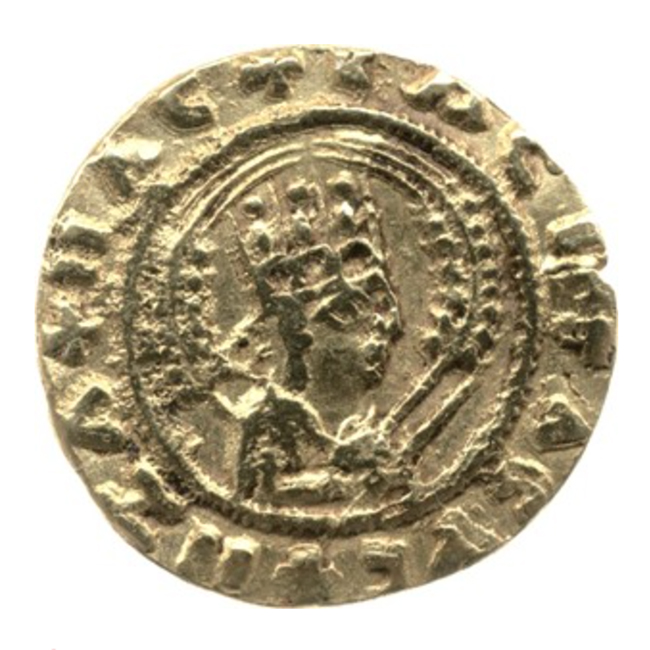
- The inscriptions. Ezana’s earlier inscriptions call him son of Mahrem, the Aksumite war god, who is never defeated. A later Greek inscription opens “In the faith of God and the power of the Father and Son and Holy Spirit”.[8][21] Consensus
- The texts. Rufinus tells how two Syrian boys from Tyre, Frumentius and Aedesius, survived the killing of a ship’s crew on the Red Sea, were raised at the Aksumite court, and helped Christian merchants found a community; Frumentius later went to Alexandria and was consecrated bishop for Aksum by Athanasius. Rufinus says he heard the story from Aedesius himself.[7] Athanasius preserves a letter of 356 in which the emperor Constantius II, an opponent of Nicaea, asks “Aizanas and Sazanas”, rulers of Aksum, to send Frumentius to Alexandria to be re-examined by the anti-Nicene bishop George.[13] Consensus
From then until 1951, the head of the Ethiopian church, the abuna, was an Egyptian monk consecrated by the Coptic patriarch of Alexandria, which tied Ethiopia to the Coptic, non-Chalcedonian side of the divisions of §6.[40] Consensus The Bible was translated into Ge’ez from Greek between the fifth and seventh centuries; Ethiopian tradition credits much of the work, and the spread of monasticism, to the Nine Saints, monks said to have come from the Roman East in the late fifth century.[21] Majority on the period; Contested on the Nine Saints’ origin. The Ethiopian Bible preserves books lost elsewhere, including the complete text of 1 Enoch and Jubilees, and its canon is the largest of any major church.[41] Consensus
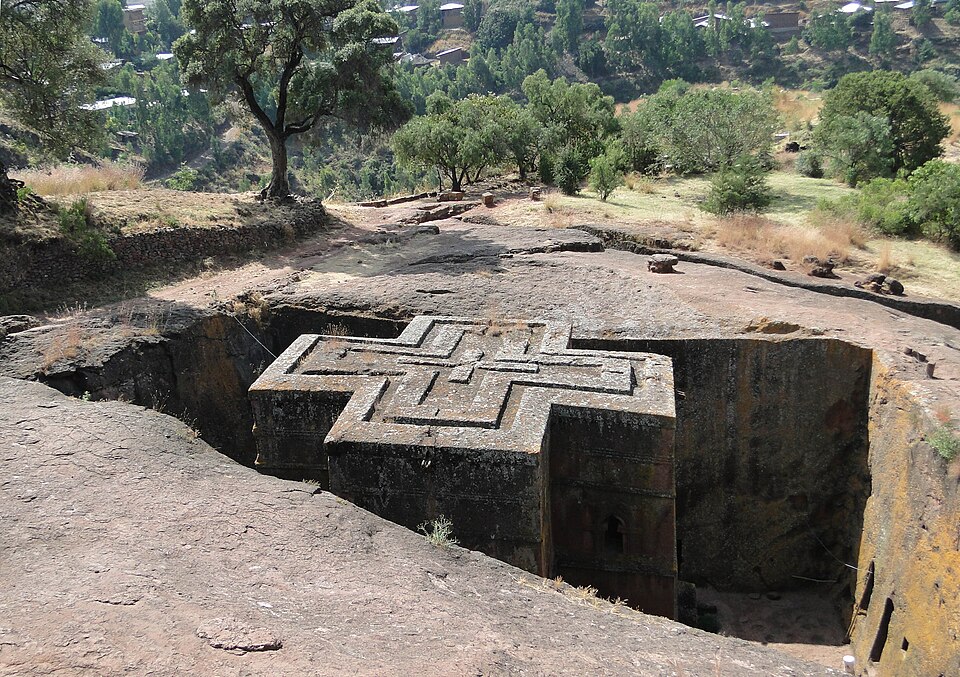
Around 525, King Kaleb crossed the Red Sea to Himyar in Yemen after a Jewish king there had killed the Christians of Najran, an episode recorded in Syriac, Greek and South Arabian sources.[21] Majority The rock-hewn churches of Lalibela, carved downwards into the volcanic rock, are traditionally the work of the Zagwe king Lalibela, around 1200, as a “new Jerusalem”; David Phillipson has argued that some of them began earlier, as palaces or fortifications.[30][31] Contested on the dating.
Nubia
South of Egypt, along the middle Nile, three Nubian kingdoms became Christian in the sixth century. John of Ephesus, a Syriac church historian who knew the people involved, describes rival missions: a priest named Julian, sent around 543 with the backing of the empress Theodora, reached the northern kingdom of Nobadia ahead of the emperor Justinian’s own envoys, which tied Nubia to the Egyptian, non-Chalcedonian church.[42][43] Majority The central kingdom, Makuria, absorbed Nobadia and in 652 made a treaty with the Arab rulers of Egypt, the baqt, that kept it independent for more than six centuries.[43] Majority The wall paintings of the cathedral at Faras, rescued by a Polish archaeological team in the 1960s before the waters of the Aswan High Dam covered the site, show bishops, saints and Nubian rulers from the eighth to the twelfth centuries; texts survive in Greek, Coptic and Old Nubian.[44][43] Consensus Makuria weakened under Mamluk pressure from the late thirteenth century and was ruled by Muslim kings by the early fourteenth; the southern kingdom, Alodia, lasted until about 1500.[43] Majority
The Church of the East
Syriac Christianity
East of Antioch, Christianity spread among people who spoke Aramaic, the language of Jesus himself in a later form. The city of Edessa (modern Şanlıurfa in Turkey) was its centre. A local legend, written down in the Doctrine of Addai around 400, claimed that its king Abgar had corresponded with Jesus; the letters are legendary, but a Christian building in Edessa is mentioned in a chronicle entry for a flood of 201.[3][15] Majority
Two fourth-century writers show what Syriac Christianity was like before the great councils:
- Aphrahat, “the Persian Sage”, wrote twenty-three Demonstrations between 337 and 345, inside the Persian Empire. His Christianity is biblical and ascetic, and argues with Jewish neighbours on Jewish terms; he shows no knowledge of the Council of Nicaea.[12] Consensus
- Ephrem (c. 306–373), a deacon of Nisibis who moved to Edessa when Nisibis was handed to Persia in 363, wrote hymns (madrāshē) that are among the masterpieces of early Christian poetry. He thought in symbols rather than definitions, and wrote hymns for choirs of women to sing.[14][15] Consensus
Persecution and organisation
When Constantine became a Christian, the Christians of Persia became suspect as the friends of Rome. Under Shapur II, from about 340, Christians were persecuted for decades; the catholicos Simeon bar Sabba’e was executed with many clergy, and Syriac Acts of the Persian Martyrs record hundreds more.[10][11] Consensus on the persecution; the numbers in the martyr acts are uncertain.
Peace came under Yazdegerd I. In 410 a synod at Seleucia-Ctesiphon, the Persian capital, held with the king’s permission and a Roman bishop’s help, accepted the creed of Nicaea and organised the Persian church under its own head, the bishop of Seleucia-Ctesiphon, the catholicos.[17] Consensus In 424 a further synod forbade appeals to “the Western fathers”, the bishops of the Roman Empire; the Church of the East was on its own.[18][19] Majority
The “Nestorian” label
After Ephesus (431), the teachers of the theological school at Edessa, known as the “School of the Persians”, followed Theodore of Mopsuestia, who distinguished sharply between Christ’s divine and human natures. When the emperor Zeno closed the school in 489, its teachers moved across the border to Nisibis, which became the intellectual centre of the Church of the East.[20] Majority A synod in 486 adopted this theology, and the church’s opponents called it “Nestorian”. The Church of the East never called itself that, did not treat Nestorius as its founder, and venerated Theodore far more; Sebastian Brock called the label “a lamentable misnomer”.[45] Majority (§6 explains the councils.)
A church of Asia
Under the Abbasid caliphs, the patriarch moved to Baghdad, and the Church of the East reached its greatest extent. Timothy I, patriarch from 780 to 823, wrote of having consecrated a metropolitan for the Turks and of preparing to consecrate one for the Tibetans, and the church had metropolitans for India and China.[46] Around 782 he debated the caliph al-Mahdi on the Trinity and the status of Muhammad, and wrote the exchange up as a model of courteous disputation.[25][47] Majority Christian physicians and translators served the caliphs, and Christian scholars such as Ḥunayn ibn Isḥāq (809–873) translated Greek medicine and philosophy into Syriac and Arabic, carrying Galen and Aristotle into the Islamic world.[47] Consensus
India: the Thomas Christians
The Christians of Kerala, who call themselves Nasrani or Saint Thomas Christians, hold that the apostle Thomas landed at Muziris (Kodungallur) in 52 CE, founded seven churches and was martyred near Mylapore, in modern Chennai, in 72. The tradition is old and central to their identity.[48] Consensus on the tradition.
The earliest written form of the story points somewhere else. The Acts of Thomas, composed in Syriac at Edessa in the third century, has the apostles cast lots for the world; Thomas draws India, refuses to go, and is sold by Jesus to a merchant of King Gudnaphar.[4] Gudnaphar is a historical figure: coins and an inscription name Gondophares, an Indo-Parthian king who ruled in the first century in what is now Pakistan and Afghanistan.[49][48] Consensus The match shows that the author knew a real king’s name; it does not show that Thomas met him, and it places the story in the north-west, not in Kerala. Majority
Other early evidence is ambiguous. Eusebius says the Alexandrian teacher Pantaenus, around 180, found in “India” Christians with a Gospel of Matthew in Hebrew, but “India” in Greek could mean southern Arabia or Ethiopia.[50] Contested Firm evidence begins with Cosmas Indicopleustes, a merchant turned monk, who around 550 reported a church with clergy in Sri Lanka, a church at “Malé, where the pepper grows” (the Malabar coast), and a bishop at Kalliana “appointed from Persia” (trans. J. W. McCrindle).[22] Consensus
The Tharisapalli copper plates, from around 849, record a grant by a local ruler at Quilon (Kollam) to the church of Tharisapalli, founded by a man named Mar Sapir Iso, with rights for the Christian community over trade guilds and land. They are signed by witnesses in Middle Persian (Pahlavi), Arabic in Kufic script, and Judeo-Persian in Hebrew characters, a picture of a multi-faith merchant world.[27][51] Consensus Stone crosses with Pahlavi inscriptions, found at Mylapore and Kottayam, date from about the seventh to ninth centuries.[48] Majority
By then the Thomas Christians belonged to the Church of the East, received their bishops from Mesopotamia and worshipped in Syriac, while living as a respected caste-like community within Kerala society. Their encounter with the Portuguese after 1498 belongs to §10; their place among India’s religions is touched on in the Hinduism series. Majority
China: the “Luminous Teaching”
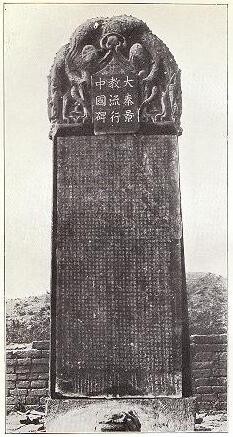
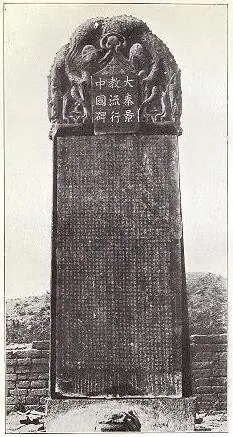
In 1623 or 1625, workers near Xi’an dug up a limestone tablet nearly three metres tall. Its heading announces a Memorial of the Propagation in China of the Luminous Teaching of Da Qin, Da Qin being the Chinese name for the Roman West.[23] Jesuit missionaries, who had arrived believing themselves the first Christians in China, published it in Europe, where some at first suspected a forgery; it is now universally accepted. Consensus
The stele, composed by a monk named Jingjing (in Syriac, Adam) and erected in 781, says that in 635 a monk named Alopen arrived at Chang’an, the Tang capital, with scriptures; that the emperor Taizong had them translated and in 638 permitted the teaching and paid for a monastery; and that the church had enjoyed imperial favour, with some setbacks, since. It explains Christian doctrine in a vocabulary drawn from Buddhism and Daoism, and lists the names of clergy in Syriac.[23][52] Consensus
Jingjing appears in another source. A Buddhist catalogue compiled in 800 records that he worked with Prajña, a monk from Kashmir, on translating a Buddhist sutra from a Central Asian language, and that the emperor judged the result unsatisfactory, ruling that the Buddhist teaching and the “Da Qin” teaching should be kept apart.[53][52] Majority The Buddhism series describes the Tang Buddhist world in which this happened (Buddhism §7).
Further evidence came from Dunhuang, where Chinese Christian texts were found in the cave library sealed around 1000; some of the texts attributed to Dunhuang that were bought on the antiquities market are modern forgeries, and scholars distinguish them carefully.[52] Majority In 2006 a stone pillar inscribed with a Christian text, dated to the early ninth century and set up at a family tomb, was found at Luoyang.[54] Majority
The church depended on court favour. In 845 the emperor Wuzong suppressed Buddhism and, with it, the foreign religions; an edict ordered more than three thousand monks of the Da Qin and Zoroastrian temples to return to lay life.[26] Majority In 987 a monk of the Church of the East, sent to China with five others seven years earlier, told the Baghdad bookseller Ibn al-Nadim that Christianity there had perished and its church had been ruined.[28] Majority
The Mongol revival
Christianity came back to China with the Mongols. Among the Turkic and Mongol peoples of the steppe, the Kerait, the Önggüt and the Naiman had become largely Christian; later Syriac chroniclers date the Kerait conversion to about 1007.[29][2] Majority Sorghaghtani Beki, a Kerait princess married to Genghis Khan’s son Tolui, was a Christian; she was the mother of four rulers, including the great khans Möngke and Kublai and the Ilkhan Hülegü.[2][55] Consensus
Under the Yuan dynasty (1271–1368), Christians, called Yelikewen, served in the Mongol administration, and a government office supervised them. Rabban Sauma, a monk born near Khanbaliq (Beijing) around 1220, set out on pilgrimage for Jerusalem with his pupil Markos. Markos became patriarch of the Church of the East as Yahballaha III in 1281, and in 1287–1288 Rabban Sauma travelled as the Ilkhan’s envoy to Constantinople, Rome, Paris and Bordeaux, meeting Philip IV of France, Edward I of England and Pope Nicholas IV, in search of an alliance against the Mamluks.[32][56] Consensus A Franciscan, John of Montecorvino, arrived in Khanbaliq in 1294 and became its first Latin archbishop; the two churches competed for converts. Consensus
The revival did not outlast the Mongols. When the Ming dynasty expelled them in 1368, the Christians, mostly of steppe origin, lost their protectors, and the church disappeared from China until the Jesuits arrived in the late sixteenth century (§10).[2] Majority
Central Asia
Merv, in modern Turkmenistan, had a bishop by the fifth century and a metropolitan by the sixth; there were metropolitans later at Samarkand and Kashgar. Sogdian merchants, the great traders of the Silk Road, included many Christians, and Christian manuscripts in Syriac, Sogdian, Middle Persian and Old Uyghur have been found at Bulayïq near Turfan, in the Chinese far west.[2][35] Consensus
In the Chu valley near Lake Issyk-Kul in Kyrgyzstan, hundreds of gravestones of a Christian community of the thirteenth and fourteenth centuries survive, inscribed in Syriac and Turkic. Several from 1338–1339 record that the dead died of “pestilence”. In 2022 a study of ancient DNA from burials there identified Yersinia pestis, the plague bacterium, making the community among the earliest identified victims of the outbreak that became the Black Death.[33][34] Majority
Christians under Islam
Between 634 and 651, Arab armies conquered Syria, Palestine, Egypt, Iraq and Persia. Most of the people of the first four were Christians, of every party in the disputes of §6: Chalcedonian “Melkites” loyal to the emperor’s church, Syriac Orthodox, Copts, and members of the Church of the East. For them the conquest often meant a change of masters rather than of religion. Consensus
Status
Christians and Jews became dhimmī, protected subjects who paid a poll tax, the jizya, and accepted restrictions. The rules later known as the Pact of Umar, attributed to the caliph Umar I (634–644), took their known form in the ninth century and were enforced unevenly; the Judaism series discusses them from the Jewish side (Judaism §8).[57][58] Majority
Majority to minority
How fast the Christians became minorities is one of the most argued questions of medieval history. Richard Bulliet, counting the generations in which Muslim names appear in family genealogies, proposed a slow S-shaped curve: conversion was slow for a century and a half, accelerated in the ninth and tenth, and in Iran produced a Muslim majority by about the late ninth or tenth century.[59] Applied to Egypt and Syria, where Christians were far more numerous, many historians think the Christian share fell more slowly, with Copts perhaps a majority of Egyptians into the tenth century or later, and the decisive losses in the Mamluk period of the thirteenth and fourteenth centuries.[60][47] Contested Bulliet’s method has been criticised for resting on elite genealogies, and no census survives. The revolt of the Bashmurite Copts in the Nile Delta between 829 and 832, crushed after the caliph al-Ma’mun came to Egypt in 832, shows that taxation, not only belief, drove conflict.[47] Majority
Christian Arabic
Christians began writing in Arabic within two centuries of the conquests. John of Damascus (c. 675–749), from a family of Christian officials in the Umayyad administration, still wrote in Greek; his book on heresies ends with a chapter on “the heresy of the Ishmaelites”, which he calls “a forerunner of the Antichrist” (trans. Frederic H. Chase), an early Christian polemic against Islam.[24][47] Majority A generation later, Theodore Abu Qurra (c. 750–c. 825), bishop of Harran, wrote theology in Arabic, and by the ninth century the monks of Mar Saba and Sinai were translating the Gospels and Paul into Arabic.[61] Consensus In Egypt, Coptic gave way to Arabic as the everyday language between the tenth and thirteenth centuries, and the Coptic church’s own history of its patriarchs was compiled in Arabic in the eleventh century.[47] Majority
These churches did not merely survive. The Syriac Orthodox church, organised in the sixth century by the itinerant bishop Jacob Baradaeus (hence its opponents’ name, “Jacobites”), produced its greatest scholar, Bar Hebraeus (1226–1286), under Mongol rule.[2] Consensus The Armenian kingdom of Cilicia, on the coast of south-eastern Turkey, allied with the Crusaders and the Mongols and lasted until the Mamluks took its capital in 1375. Consensus
The collapse of the fourteenth century
By 1300, the Church of the East had metropolitans from Cyprus to Beijing. By 1400, outside Kerala, it survived in the mountains of northern Iraq and south-eastern Turkey, and around Urmia in Persia. Four causes are usually given:[2][1] Majority
- The conversion of the Mongol khans. The Ilkhan Ghazan converted to Islam in 1295, and his reign brought attacks on churches and clergy; the Golden Horde and the Chagatai khans also became Muslim.
- The fall of the Yuan in 1368, which removed the church’s patrons in China.
- Plague, which struck the Central Asian communities from the 1330s.
- Timur (Tamerlane), whose campaigns from about 1370 to 1405 destroyed cities across Persia, Iraq and Central Asia, Christian and Muslim alike.
Philip Jenkins has called this “the lost history of Christianity”: a faith that in 1000 was as much Asian and African as European, reduced within a few centuries to a few mountain refuges and a coastal community in India.[1] Majority
The evidence
| Question | What the evidence supports | Key evidence | Confidence |
|---|---|---|---|
| Armenia’s conversion | Around 314; tradition says 301 | Agathangelos; Gregory’s consecration at Caesarea[5][6] | Majority |
| Aksum’s conversion | Under Ezana, c. 330s–340s, with a bishop from Alexandria | Coins; inscriptions; Rufinus; Constantius’ letter[38][8][7][13] | Consensus |
| Persian church organised | 410, under a catholicos at Seleucia-Ctesiphon | Synod of 410[17] | Consensus |
| “Nestorian” | A misnomer for a church following Theodore of Mopsuestia | Synod of 486; Brock[45] | Majority |
| Thomas in India | Possible, unprovable; the earliest text points to the north-west | Acts of Thomas; Gondophares coins[4][49] | Contested |
| Christians in Kerala | Established by c. 550; flourishing by 849 | Cosmas; Tharisapalli plates[22][27] | Consensus |
| China, first mission | Arrived 635; faded after 845 | Xi’an Stele; Tang edict; Ibn al-Nadim[23][26][28] | Consensus |
| China, second mission | Among Turks and Mongols under the Yuan; faded after 1368 | Rabban Sauma; Yuan records[32][56] | Consensus |
| Under Islam | Majorities for centuries; slow, uneven conversion | Bulliet; Coptic and Syriac sources[59][47] | Contested (pace) |
| Collapse | 14th-century combination of conversion, war and plague | Chronicles; Issyk-Kul[2][33] | Majority |
Primary sources
Show the 12 primary sources
1. Frumentius and Aedesius: Rufinus, Ecclesiastical History 10.9–10, c. 402
Rufinus tells the story of the two boys from Tyre, raised at the Aksumite court, of Frumentius’ consecration by Athanasius, and says that he heard it from Aedesius himself, later a priest at Tyre.[7]
What it proves. A Latin historian, writing within about seventy years, records Aksum’s conversion from an eyewitness’s account, with a named Alexandrian bishop. It is the main reason Ethiopian Christianity’s beginning is not a legend. Majority
2. “To Aizanas and Sazanas”: Athanasius, Apology to Constantius 31, 356
Athanasius quotes a letter of the emperor Constantius II to the rulers of Aksum, asking them to send Frumentius to Alexandria to be examined by Athanasius’ rival George.[13]
What it proves. The Roman emperor knew the Aksumite kings by name and saw their bishop as part of his own church’s quarrels. It independently confirms Rufinus, and the name Aizanas matches Ezana on the coins. Consensus
3. Ezana’s Christian inscription, Aksum, mid-fourth century
The Greek inscription opens by invoking the faith of God and the power of the Father, Son and Holy Spirit.[8]
What it proves. The same king who had called himself son of the war god Mahrem now ruled in the name of the Trinity. With the coins, it dates Aksum’s conversion to Ezana’s reign. Consensus
4. The Armenian alphabet: Koriun, Life of Mashtots, c. 440s
Koriun, Mashtots’ pupil, describes the creation of the alphabet and the first translation, beginning with the Book of Proverbs.[16]
What it proves. A near-contemporary account ties the Armenian script to a deliberate church project: Armenian literacy began with scripture. Majority
5. The synod of 410
The acts of the synod, preserved in the Synodicon Orientale, record the Persian bishops accepting the Nicene creed and the authority of the bishop of Seleucia-Ctesiphon, with thanks to King Yazdegerd.[17]
What it proves. The Church of the East began as an organised church under a Persian king, not as a breakaway from Rome. Consensus
6. Thomas sold into India: Acts of Thomas 1–2, third century
The apostles divide the world by lot; Thomas receives India and refuses; Jesus sells him as a slave to Habban, a merchant of King Gudnaphar.[4]
What it proves. By the third century, Syriac Christians at Edessa told of Thomas in India, and used the name of a real first-century king. It proves the tradition’s age, not its truth. Majority
7. “Where the pepper grows”: Cosmas Indicopleustes, Christian Topography 3.65, c. 550
Cosmas reports churches in Sri Lanka, Christians on the pepper coast of Malabar, and a bishop at Kalliana appointed from Persia.[22]
What it proves. The first secure evidence of Christians in south-west India, organised under the Persian church. Consensus
8. The Tharisapalli copper plates, Quilon, c. 849
A grant of land and privileges to a church at Quilon, witnessed in Pahlavi, Kufic Arabic and Judeo-Persian.[27]
What it proves. A well-established Christian community with legal privileges in a Kerala kingdom, among Muslim and Jewish merchants, three centuries after Cosmas. Consensus
9. The Xi’an Stele, 781
The Chinese inscription composed by Jingjing narrates Alopen’s arrival in 635, Taizong’s edict of 638 and the church’s history, with Syriac names.[23]
What it proves. A church of Persian origin existed in Tang China for nearly a century and a half, with imperial recognition, expressing its faith in Buddhist and Daoist terms. Consensus
10. “Perished”: Ibn al-Nadim, Fihrist, 987
A monk from Najran, sent to China seven years earlier, tells Ibn al-Nadim that the Christians there have perished and that their church has been destroyed.[28]
What it proves. The first Chinese church had disappeared by the late tenth century. Majority
11. The travels of Rabban Sauma, 1287–1288
A Syriac account, translated from a Persian original, describes Rabban Sauma’s embassy to Byzantium, Rome and France.[32]
What it proves. A Christian monk from China could stand before the pope and the kings of France and England as an envoy of a Mongol ruler; the Church of the East was a church of the whole of Asia. Consensus
12. The Issyk-Kul gravestones, 1338–1339
Syriac-Turkic gravestones record Christians who died of “pestilence”.[33][34]
What it proves. A Christian community in the heart of Central Asia, and among the earliest identified victims of the Black Death’s outbreak. Majority
What is absent
- The Western papacy. None of these churches recognised the bishop of Rome’s authority; their structures were synodal, national or patriarchal. Consensus
- Latin. Their scriptures and liturgies were in Syriac, Armenian, Georgian, Ge’ez, Coptic, Sogdian, Chinese and Arabic. Consensus
- The Crusades as a defining memory. For most eastern Christians, the Crusades (§8) were a late, brief and often unwelcome episode; the Fourth Crusade attacked Christians. Majority
- A Christian empire. Except in Aksum, Armenia, Georgia and Nubia, these Christians lived under rulers of other religions, Zoroastrian, Muslim, Buddhist, Hindu or shamanist, for most of their history. Consensus
- “Nestorians” who called themselves that. The name was given by opponents. Majority
Debates
Was Armenia the first Christian state?
| View | Argument | Main proponents |
|---|---|---|
| Yes, in 301 | The traditional date in Armenian sources precedes Constantine | Armenian church tradition[5] |
| Yes, but c. 314 | Gregory’s consecration fixes the date; still the first kingdom to adopt Christianity officially | Garsoïan, Thomson[6][36] |
| The question is anachronistic | “State religion” is a modern category; Edessa’s kings, Constantine’s patronage and Armenia’s conversion are different things | Many historians |
Contested
Did Thomas go to India?
| View | Argument | Main proponents |
|---|---|---|
| Yes | The Kerala tradition is ancient and uniform; Roman trade with Muziris made the journey possible | Thomas Christian tradition; some historians[48] |
| Possibly, unprovably | The trade routes existed and the Acts know a real king, but nothing before c. 550 places Christians in Kerala | Most historians |
| A later legend | The Acts are a romance; the Kerala church probably began with Persian merchants and clergy | Some historians |
Contested
Why did the Church of the East disappear from China?
The common explanation is dependence on the court and on foreign communities: the church flourished under rulers who favoured it and among people of Central Asian origin, and vanished when the dynasty fell. Others stress the general catastrophe of the fourteenth century, which also destroyed it in Central Asia and Persia. Some scholars once argued that it had become too Buddhist to survive as Christianity; most now see the Buddhist vocabulary as translation, not dissolution.[52][2] Contested
How fast did Christians become minorities under Islam?
| View | Argument | Main proponents |
|---|---|---|
| Early and fast in Iran | Muslim names in genealogies follow an S-curve, with a majority by c. 900 | Bulliet[59] |
| Slower in Egypt and Syria | Copts and Syriac Christians stayed majorities into the 10th century or later; Mamluk-era pressure was decisive | El-Leithy and others[60] |
| Unknowable precisely | No census exists; every method depends on elite or urban evidence | Many historians |
Contested
Further reading
Show further reading (10 works)
- Christoph Baumer, The Church of the East: An Illustrated History of Assyrian Christianity (I. B. Tauris, 2nd ed. 2016).
- Philip Jenkins, The Lost History of Christianity (HarperOne, 2008).
- Sebastian P. Brock, The Luminous Eye: The Spiritual World Vision of Saint Ephrem (Cistercian, 2nd ed. 1992).
- Ian Gillman and Hans-Joachim Klimkeit, Christians in Asia before 1500 (Curzon, 1999).
- Wilhelm Baum and Dietmar W. Winkler, The Church of the East: A Concise History (Routledge, 2003).
- David W. Phillipson, Foundations of an African Civilisation: Aksum and the Northern Horn (James Currey, 2012).
- Robert Eric Frykenberg, Christianity in India: From Beginnings to the Present (Oxford, 2008).
- Sidney H. Griffith, The Church in the Shadow of the Mosque (Princeton, 2008).
- Morris Rossabi, Voyager from Xanadu: Rabban Sauma and the First Journey from China to the West (Kodansha, 1992).
- Nina G. Garsoïan, “The Emergence of Armenia”, in R. G. Hovannisian, ed., The Armenian People from Ancient to Modern Times, vol. 1 (St. Martin’s, 1997).
References
- ^ a b c Philip Jenkins The Lost History of Christianity: The Thousand-Year Golden Age of the Church in the Middle East, Africa, and Asia. HarperOne, 2008. A popular account of the eastern churches and their decline.
- ^ a b c d e f g h i j k Christoph Baumer The Church of the East: An Illustrated History of Assyrian Christianity. I. B. Tauris, 2nd ed., 2016. The fullest general history, from Mesopotamia to China.
- ^ a b Chronicle of Edessa, entry for 201 CE — Chronicle of Edessa. 6th c. CE (compiled; using older archives). Syriac. An archival notice of the Edessa flood of 201 mentions damage to 'the temple of the church of the Christians'. about
- ^ a b c d Acts of Thomas 1–2 — Acts of Thomas. 3rd c. CE. Syriac (and Greek). The apostles divide the world by lot; Thomas receives India and is sold by Jesus to Habban, a merchant of King Gudnaphar. about
- ^ a b c d Agathangelos, History of the Armenians — History of the Armenians (attributed to Agathangelos). 5th c. CE. Armenian. The traditional account of Gregory the Illuminator's imprisonment and the baptism of King Tiridates III. about
- ^ a b c d e f g Nina G. Garsoïan The Emergence of Armenia; The Arsacid Period; The Aršakuni Dynasty. in R. G. Hovannisian, ed., The Armenian People from Ancient to Modern Times, vol. 1 (St. Martin's), 1997. The conversion of Armenia and its church to the sixth century.
- ^ a b c d Rufinus, Ecclesiastical History 10.9–10 — Ecclesiastical History. c. 402 CE. Latin. Frumentius and Aedesius, raised at the Aksumite court; Frumentius consecrated bishop for Aksum by Athanasius; Rufinus heard the story from Aedesius. about
- ^ a b c d Ezana's Christian inscription — Royal inscription of Ezana, Aksum. mid-4th c. CE. Greek (with Ge'ez versions). Ezana's later inscription opens 'In the faith of God and the power of the Father and Son and Holy Spirit', replacing invocations of Mahrem. about
- ^ a b Rufinus, Ecclesiastical History 10.11 — Ecclesiastical History. c. 402 CE. Latin. A captive Christian woman heals the queen of Iberia, and the king, saved while lost on a hunt, adopts Christianity. about
- ^ a b Martyrdom of Simeon bar Sabba'e — Acts of the Persian Martyrs. 4th–5th c. CE. Syriac. The execution of the catholicos Simeon and many clergy under Shapur II. about
- ^ a b Richard E. Payne A State of Mixture: Christians, Zoroastrians, and Iranian Political Culture in Late Antiquity. University of California Press, 2015. Christians within the Sasanian empire.
- ^ a b Aphrahat, Demonstrations — Demonstrations. 337–345 CE. Syriac. Twenty-three treatises by 'the Persian Sage' written inside the Persian Empire, with no reference to Nicaea. read the text
- ^ a b c d Athanasius, Apology to Constantius 31 — Apology to the Emperor Constantius. c. 357 CE (quoting a letter of 356). Greek. Constantius II writes to 'Aizanas and Sazanas', rulers of Aksum, asking that Frumentius be sent to Alexandria to be examined by Bishop George. read the text
- ^ a b Ephrem the Syrian, Hymns — Hymns (madrāshē). c. 350–373 CE. Syriac. The hymns of the deacon of Nisibis and Edessa, the major poet of early Syriac Christianity. about
- ^ a b c d Sebastian P. Brock The Luminous Eye: The Spiritual World Vision of Saint Ephrem. Cistercian Publications, 2nd ed., 1992. Ephrem's symbolic theology.
- ^ a b c Koriun, Life of Mashtots — Life of Mashtots. c. 440s CE. Armenian. Mashtots' pupil describes the creation of the Armenian alphabet and the first translations. about
- ^ a b c d Synod of Isaac (Seleucia-Ctesiphon, 410) — Synodicon Orientale. 410 CE. Syriac. The Persian bishops accept the creed of Nicaea and the authority of the bishop of Seleucia-Ctesiphon, with King Yazdegerd I's permission. about
- ^ a b Synod of Dadisho (Markabta, 424) — Synodicon Orientale. 424 CE. Syriac. The Persian church forbids appeals beyond its own catholicos to 'the Western fathers'. about
- ^ a b Wilhelm Baum and Dietmar W. Winkler The Church of the East: A Concise History. RoutledgeCurzon, 2003. A compact institutional history of the Church of the East.
- ^ a b c Adam H. Becker Fear of God and the Beginning of Wisdom: The School of Nisibis and Christian Scholastic Culture in Late Antique Mesopotamia. University of Pennsylvania Press, 2006. The schools of Edessa and Nisibis.
- ^ a b c d David W. Phillipson Foundations of an African Civilisation: Aksum and the Northern Horn, 1000 BC–AD 1300. James Currey, 2012. The archaeology and history of Aksum.
- ^ a b c d Cosmas Indicopleustes, Christian Topography 3.65 — Christian Topography. c. 550 CE. Greek. Churches in Sri Lanka, Christians at Malé 'where the pepper grows', and a bishop at Kalliana appointed from Persia. about
- ^ a b c d e f Xi'an Stele (Da Qin Jingjiao liuxing Zhongguo bei) — Stele erected in Chang'an (Beilin Museum, Xi'an). 781 CE. Chinese and Syriac. Jingjing's inscription records Alopen's arrival in 635, Taizong's edict of 638 and the church's history. about
- ^ a b John of Damascus, On Heresies 100 — Fount of Knowledge, part 2. c. 740s CE. Greek. The chapter on 'the heresy of the Ishmaelites', an early Christian polemic against Islam. about
- ^ a b Timothy I, Dialogue with the caliph al-Mahdi — Apology of Timothy the Patriarch before the caliph Mahdi. c. 782 CE. Syriac (and Arabic). The patriarch's written account of his debate with the caliph on the Trinity and on Muhammad. about
- ^ a b c Tang huiyao 47–49 (Huichang suppression, 845) — Tang huiyao (Institutional history of the Tang). 845 CE (compiled 961). Chinese. Wuzong's edict laicises Buddhist clergy and orders more than three thousand monks of the Da Qin and Zoroastrian temples to return to lay life. about
- ^ a b c d Tharisapalli copper plates — Copper-plate grant, Quilon (Kollam). c. 849 CE. Old Malayalam, with Pahlavi, Arabic and Judeo-Persian signatures. A local ruler grants land and privileges to the church of Tharisapalli founded by Mar Sapir Iso. about
- ^ a b c d Ibn al-Nadim, Fihrist (on China) — Kitāb al-Fihrist. 987 CE. Arabic. A Christian monk returned from China reports that the Christians there have perished. about
- ^ a b Bar Hebraeus, Ecclesiastical Chronicle (the Kerait conversion) — Chronicon Ecclesiasticum. 13th c. CE. Syriac. Reports the conversion of a Turkic people, identified with the Kerait, around 1007 through the metropolitan of Merv. about
- ^ a b Rock-hewn churches of Lalibela — Churches carved in rock, Lalibela, Ethiopia. c. 12th–13th c. CE (some debated). Ge'ez. Eleven monolithic churches associated with the Zagwe king Lalibela. about
- ^ a b David W. Phillipson Ancient Churches of Ethiopia: Fourth–Fourteenth Centuries. Yale University Press, 2009. Argues that some Lalibela churches predate King Lalibela.
- ^ a b c d History of Mar Yahballaha and Rabban Sauma — Syriac history (from a Persian original). early 14th c. CE. Syriac. Rabban Sauma's pilgrimage and his embassy of 1287–1288 to Constantinople, Rome, Paris and Bordeaux. about
- ^ a b c d Chu valley (Issyk-Kul) gravestones — Christian cemeteries at Kara-Djigach and Burana. 13th–14th c. CE. Syriac and Turkic. Gravestones of 1338–1339 record deaths from 'pestilence'.
- ^ a b c Maria A. Spyrou et al. The source of the Black Death in fourteenth-century central Eurasia. Nature 606: 718–724, 2022. Ancient DNA from the Chu valley cemeteries identifies Yersinia pestis in burials of 1338–1339.
- ^ a b Ian Gillman and Hans-Joachim Klimkeit Christians in Asia before 1500. Curzon Press, 1999. Survey of Asian Christianity before the Portuguese.
- ^ a b Robert W. Thomson, trans. Agathangelos: History of the Armenians. State University of New York Press, 1976. Translation and study of the Armenian conversion narrative.
- ^ Stephen H. Rapp Jr. The Sasanian World through Georgian Eyes. Ashgate, 2014. Early Georgian Christianity in its Iranian setting.
- ^ a b Coinage of Ezana — Aksumite gold, silver and bronze coins. mid-4th c. CE. Greek and Ge'ez. Ezana's coins change from the disc-and-crescent symbol to the cross. about
- ^ Stuart Munro-Hay Aksum: An African Civilisation of Late Antiquity. Edinburgh University Press, 1991. Aksum's history, coinage and conversion.
- ^ Taddesse Tamrat Church and State in Ethiopia, 1270–1527. Clarendon Press, 1972. The medieval Ethiopian church and its Egyptian metropolitans.
- ^ George W. E. Nickelsburg 1 Enoch 1: A Commentary on the Book of 1 Enoch, Chapters 1–36; 81–108. Fortress Press (Hermeneia), 2001. The standard commentary on the Book of the Watchers.
- ^ John of Ephesus, Ecclesiastical History 4.6–8 — Ecclesiastical History, part 3. c. 580s CE. Syriac. The rival missions to Nubia: Julian, backed by Theodora, reaches Nobadia before Justinian's envoys. about
- ^ a b c d Derek A. Welsby The Medieval Kingdoms of Nubia: Pagans, Christians and Muslims along the Middle Nile. British Museum Press, 2002. The Christian kingdoms of Nubia from their conversion to their end.
- ^ Faras cathedral paintings — Wall paintings from the cathedral of Faras (National Museum, Warsaw; Sudan National Museum). 8th–12th c. CE. Greek, Coptic and Old Nubian. Paintings of bishops, saints and rulers rescued in the 1960s before the Aswan flooding. about
- ^ a b Sebastian P. Brock The 'Nestorian' Church: A Lamentable Misnomer. Bulletin of the John Rylands Library 78: 23–35, 1996. Why the Church of the East should not be called Nestorian.
- ^ Timothy I, Letter 47 (to Rabban Sergius) — Letters of Timothy I, patriarch of the Church of the East. c. 792–793 CE. Syriac. Timothy reports that he has anointed a metropolitan for the Turks and is preparing to anoint another for the Tibetans. about
- ^ a b c d e f g Sidney H. Griffith The Church in the Shadow of the Mosque: Christians and Muslims in the World of Islam. Princeton University Press, 2008. Christian Arabic thought and life under the early caliphates.
- ^ a b c d Robert Eric Frykenberg Christianity in India: From Beginnings to the Present. Oxford University Press, 2008. The standard history, including the Thomas Christians.
- ^ a b Gondophares coins and the Takht-i-Bahi inscription — Indo-Parthian royal coinage and inscription. 1st c. CE. Greek and Kharoṣṭhī. Coins and an inscription name Gondophares, an Indo-Parthian king, the Gudnaphar of the Acts of Thomas. about
- ^ Eusebius, Ecclesiastical History 5.10 — Ecclesiastical History. early 4th c. CE. Greek. Pantaenus is said to have found in 'India' Christians with Matthew's Gospel in Hebrew, left by Bartholomew. read the text
- ^ M. G. S. Narayanan Perumāḷs of Kerala. CosmoBooks, 2013. Kerala's early medieval kingdom, including the Tharisapalli plates.
- ^ a b c d Li Tang A Study of the History of Nestorian Christianity in China and Its Literature in Chinese. Peter Lang, 2nd ed., 2004. The Tang church and its Chinese texts.
- ^ Zhenyuan xinding shijiao mulu (Yuanzhao's catalogue) — Buddhist scriptural catalogue of the Zhenyuan era. 800 CE. Chinese. Records Jingjing's work with the Kashmiri monk Prajña on a Buddhist translation and the emperor's ruling that the two teachings be kept apart. about
- ^ Luoyang Christian pillar — Inscribed stone pillar from Luoyang. early 9th c. CE. Chinese. A Christian text inscribed in Chinese on a funerary pillar erected c. 815, found in 2006. about
- ^ Peter Jackson The Mongols and the West, 1221–1410. Pearson Longman, 2005. Includes the Christians among the Mongols.
- ^ a b Morris Rossabi Voyager from Xanadu: Rabban Sauma and the First Journey from China to the West. Kodansha International, 1992. Rabban Sauma's life and embassy.
- ^ Pact of Umar (al-Ṭurṭūshī, Sirāj al-Mulūk) — Pact of Umar (Shurūṭ ʿUmar). 9th c. CE (form); attributed to Umar I, 634–644. Arabic. Conditions on non-Muslim subjects, framed as a letter from Christians to the caliph Umar: no new churches or synagogues, distinctive dress, no riding on saddles or bearing arms. Surviving versions are later than Umar; a legal ideal, enforced unevenly. about
- ^ Milka Levy-Rubin Non-Muslims in the Early Islamic Empire: From Surrender to Coexistence. Cambridge University Press, 2011. Traces the Pact of Umar to conquest-era surrender treaties and Byzantine and Sasanian models.
- ^ a b c Richard W. Bulliet Conversion to Islam in the Medieval Period: An Essay in Quantitative History. Harvard University Press, 1979. The onomastic S-curve of conversion.
- ^ a b Tamer el-Leithy Coptic Culture and Conversion in Medieval Cairo, 1293–1524 A.D.. PhD dissertation, Princeton University, 2005. Places the decisive Coptic conversions in the Mamluk period.
- ^ Sidney H. Griffith The Bible in Arabic: The Scriptures of the 'People of the Book' in the Language of Islam. Princeton University Press, 2013. The earliest Arabic translations of the Bible.