The short version: 25 December is not a date recorded in the Gospels, and nobody in the first three centuries is securely known to have celebrated Jesus’ birth on it. The date first appears in Rome in the fourth century, and historians still argue about why it was chosen. The two explanations on offer are not as far apart as they are sometimes made to sound, and the evidence for each is thinner than its advocates tend to admit.[1][2] Contested
What the Gospels say
Only Matthew and Luke tell the story of Jesus’ birth, and neither gives a day, a month or a season. Matthew places it “in the days of King Herod”, who died in 4 BCE; Luke at a census under Quirinius, which Josephus dates to 6 CE. The two cannot both be right, and most historians put the birth around 6–4 BCE.[3][4][5] Majority The year 1 CE itself comes from a calculation by the monk Dionysius Exiguus in 525, a few years too late (§2). Consensus
The first evidence for 25 December
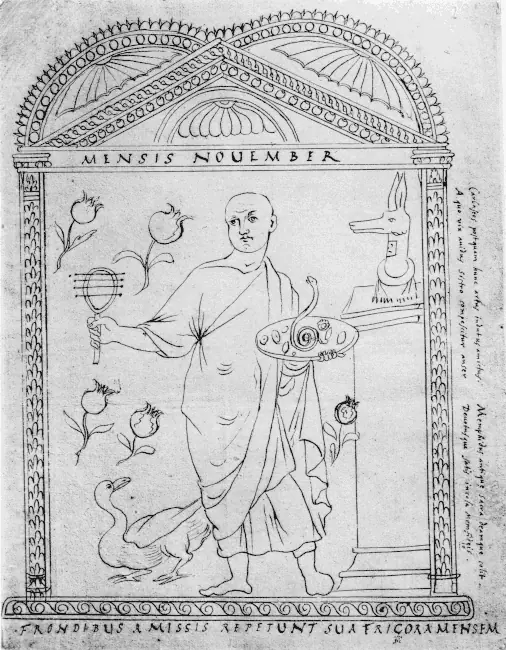
The earliest secure evidence is in a Roman almanac known as the Chronograph of 354, compiled for a wealthy Christian named Valentinus. Its list of the burial days of martyrs, which scholars date to 336, begins:
VIII kal. Ian. natus Christus in Betleem Iudeae: “25 December: Christ born in Bethlehem of Judea”.[6]
Majority on the date of the list. A statement of the same date in Hippolytus’ Commentary on Daniel, written around 204, would be older, but the passage is widely suspected of being a later addition to his text.[7] Contested
The same almanac’s civic calendar also marks 25 December as N(atalis) Invicti, the birthday of the Unconquered, the sun god whose temple the emperor Aurelian had dedicated in Rome in 274.[8] Consensus That coincidence is the starting point of the first theory.
Theory 1: replacing a sun festival
On this view, argued most influentially by Hermann Usener in 1889 and widely repeated since, the church placed Christ’s birth on the winter solstice feast of the Unconquered Sun in order to supplant it. Christian writers did compare Christ to “the sun of righteousness”, and Constantine’s coins carried the Unconquered Sun until the early 320s.[1][9] Contested
The weakness is chronological. The festival of the Unconquered on 25 December is itself first attested in the Chronograph of 354, the same document that records the Christian feast. It may be no older than Christmas.[1][10] Contested
Theory 2: a calculation
The second view, developed by Louis Duchesne and Thomas Talley, starts from Jesus’ death. Some early Christians dated the crucifixion to 25 March: around 200, Tertullian reports a calculation equating the day Jesus died with 25 March in the Roman calendar.[2][10] Majority There was also an idea that great prophets died on the anniversary of their conception, and McGowan points to rabbinic parallels for the notion that great events recur on the same day of the year.[10] If Jesus was conceived on 25 March, he was born nine months later, on 25 December. The same reasoning from an Eastern date for the crucifixion, 6 April, gives 6 January, the date many Eastern churches kept.[2][1] Contested
The weakness here is that the full chain of reasoning, from death to conception to birth, is spelled out only in texts later than the first evidence for the feast.[1] Contested Neither theory is proved, and they are not mutually exclusive: a date reached by calculation may have been welcomed because it also fell on a popular holiday.[1][2] Contested
So when was Jesus born?
Historians who work on the date of Jesus’ birth look at the year, not the day. Matthew’s link to Herod points to about 6–4 BCE; Luke’s census of Quirinius, which Josephus dates to 6 CE, is about ten years later, and attempts to reconcile the two have not persuaded most scholars. Matthew and Luke also explain Bethlehem in incompatible ways, and many historians think Jesus was born in Nazareth.[5][11] Majority No ancient source preserves the day or the season, and nothing in the Gospels can be turned into one without speculation. The feast commemorates the event; it does not record its date. Consensus
The Eastern date: 6 January
In much of the East the older feast was 6 January, the Epiphany, celebrating Jesus’ birth and baptism together. The Western date spread east in the late fourth century. Constantinople adopted it around 380, and John Chrysostom, preaching in Antioch in 386, said the feast of 25 December had been known there for less than ten years.[12] Consensus Many Eastern churches kept 6 January into the fifth century, and Jerusalem into the sixth. The Armenian Apostolic Church still celebrates the Nativity on 6 January.[2] Consensus
The date many people know as “Orthodox Christmas”, 7 January, is a different matter. It is still 25 December, counted in the old Julian calendar, which runs thirteen days behind the Gregorian from 1900 to 2099. The Russian, Serbian and Georgian churches and the Patriarchate of Jerusalem, among others, keep the Julian calendar for their feasts; several other Orthodox churches moved to a revised calendar in the twentieth century and keep Christmas on the Gregorian 25 December.[13] Consensus
One feast, two meanings
When the two dates met, churches kept both. In the West, 25 December became the feast of the birth, and 6 January, the Epiphany, was attached to the visit of the Magi; in much of the East, 6 January kept its association with Jesus’ baptism.[2] Majority The “twelve days of Christmas” are simply the days between the two feasts. Consensus
Common misconceptions
- “Jesus was born on 25 December.” No early source says so; the date first appears about three centuries after his death. Consensus
- “Christmas is simply a pagan festival renamed.” That is one theory, and its key evidence, the sun festival on 25 December, is no older in the record than Christmas itself.[1] Contested
- “Constantine moved Christmas to 25 December.” No source connects him to the date. The list of 336 comes from the church of Rome, a city he had left for Constantinople. Majority
- “Orthodox Christians celebrate a different day.” All Orthodox churches keep Christmas on 25 December. Those still on the Julian calendar (Russia, Serbia, Georgia, Jerusalem, Mount Athos and others) reach it on the Gregorian 7 January; the Armenian Apostolic Church, which is Oriental rather than Eastern Orthodox, alone keeps the older feast of 6 January. Consensus
Why it matters
Christmas shows how much of what feels ancient in Christianity was settled in the fourth century, when a newly favoured church organised its year. It also shows the limits of the evidence: a single line in a Roman almanac is the first firm sign of the most widely celebrated Christian feast, and the reason behind it is still an open question.
For the Chronograph of 354 and the councils of the fourth century, see Chapter 6: Constantine, the Creeds and the Councils. For the birth stories and the date of Jesus’ birth, see Chapter 2: The Historical Jesus.
References
- ^ a b c d e f g Susan K. Roll Toward the Origins of Christmas. Kok Pharos, 1995. Weighs the history-of-religions and calculation theories.
- ^ a b c d e f Thomas J. Talley The Origins of the Liturgical Year. Pueblo, 1986. The main modern statement of the calculation theory of Christmas.
- ^ Matthew 2:1 — Gospel of Matthew (New Testament). c. 80–90 CE. Greek. Jesus is born in Bethlehem 'in the time of King Herod'. read the text
- ^ Luke 2:1–5 — Gospel of Luke (New Testament). c. 80–90 CE. Greek. Augustus' decree of registration 'while Quirinius was governor of Syria' brings Joseph and Mary from Nazareth to Bethlehem. read the text
- ^ a b Raymond E. Brown The Birth of the Messiah: A Commentary on the Infancy Narratives in Matthew and Luke. Doubleday, updated ed., 1993. The standard study of the birth stories, by a Catholic priest-scholar.
- ^ Chronograph of 354, Depositio martyrum — Chronograph of 354 (Philocalian calendar). list of 336 CE; compiled 354. Latin. A Roman list of martyrs' feast days that begins 'VIII kal. Ian. natus Christus in Betleem Iudeae': 25 December, Christ born in Bethlehem. read the text
- ^ Hippolytus, Commentary on Daniel 4.23 — Commentary on Daniel. c. 204 CE (passage's authenticity disputed). Greek. Gives Jesus' birth as Wednesday 25 December, a reading many scholars think was interpolated.
- ^ Chronograph of 354, civic calendar (December) — Chronograph of 354 (Philocalian calendar). 354 CE. Latin. The Roman civic calendar marks 25 December as N(atalis) Invicti, the birthday of the Unconquered Sun. read the text
- ^ Jonathan Bardill Constantine, Divine Emperor of the Christian Golden Age. Cambridge University Press, 2012. Constantine's solar imagery and how it was christianised.
- ^ a b c Andrew McGowan How December 25 Became Christmas. Bible Review 18.6 (December 2002); republished by the Biblical Archaeology Society, 2002. open access A clear account of the calculation theory, including Tertullian's dating of the crucifixion to 25 March, and of why the two theories need not be alternatives.
- ^ Josephus, Antiquities 18.1–10 — Jewish Antiquities. c. 93 CE. Greek. Quirinius comes to Syria to assess property after Judea's annexation in 6 CE; Judas the Galilean leads resistance to the census. read the text
- ^ John Chrysostom, Homily on the Birthday of Christ — Homily on 25 December (In diem natalem). 386 CE. Greek. Preaching in Antioch, Chrysostom says the feast of 25 December had been known there for less than ten years.
- ^ Revised Julian calendar (1923) and the Orthodox churches — Pan-Orthodox congress, Constantinople, 1923, and later adoption. 1923–present. Several Orthodox churches keep fixed feasts, including Christmas, by a revised calendar matching the Gregorian; the Russian, Serbian, Georgian and Jerusalem churches, among others, keep the Julian calendar, thirteen days behind the Gregorian from 1900 to 2099, so their 25 December falls on 7 January. about