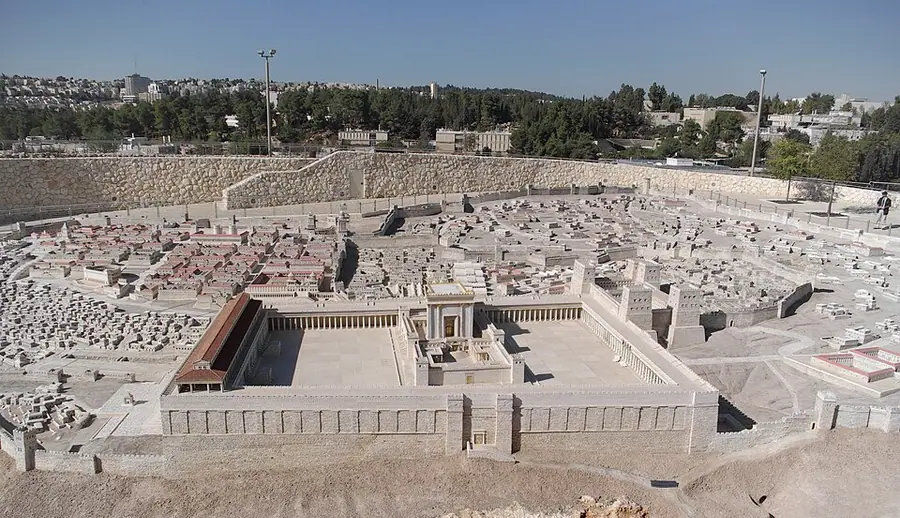
Jesus was born into a Jewish homeland under Roman power. Rome had taken Jerusalem in 63 BCE, and for most of the next century ruled through clients: Herod the Great, a king of Idumean descent who rebuilt the Temple on a vast scale, and after him his sons, of whom Herod Antipas ruled Galilee for the whole of Jesus’ life. Judea itself came under a Roman prefect in 6 CE. Galilee, where Jesus grew up, was a Jewish region of villages and two new cities, whose people fished the lake, farmed, paid taxes to Antipas and went up to the Temple in Jerusalem for the festivals. Many Jews hoped that God would soon act to restore Israel, some through a king from David’s line, and a series of prophets and would-be kings rose and were put down. The Jesus movement was one of these Jewish movements; its story makes sense only inside them. Majority
This chapter sets the scene for §2. The Jewish religious parties of the period (Pharisees, Sadducees, Essenes), the Maccabean revolt and the ideas of resurrection, angels and Satan that Second Temple Judaism developed are told in Judaism §6, and are linked rather than repeated here. Consensus
Timeline
Almost every date below comes from Josephus, a priest of Jerusalem writing in Rome in the 70s–90s CE, checked where possible against Roman sources, coins and inscriptions.
| Date | Event or evidence | Confidence |
|---|---|---|
| c. 104 BCE | The Hasmonean king Aristobulus I conquers Iturean territory (Josephus does not name Galilee, but many historians think it was taken then); Jewish settlement of Galilee grows sharply in the following decades[1][2] | Majority |
| 63 BCE | Pompey takes Jerusalem and enters the Holy of Holies; Judea becomes a dependency of Rome[3] | Consensus |
| c. 47–46 BCE | The young Herod, governor of Galilee, executes the bandit chief Hezekiah and his men[4] | Consensus |
| 40–37 BCE | The Roman Senate names Herod king of Judea (40); he takes Jerusalem with Roman help (37)[5] | Consensus |
| c. 22–10/9 BCE | Herod builds the harbour city of Caesarea Maritima, with a temple to Rome and Augustus[6] | Consensus |
| 20/19 BCE onward | Herod begins rebuilding the Jerusalem Temple; work continues until the 60s CE[7] | Consensus |
| 4 BCE | Herod dies; revolts break out across the country; the Syrian governor Varus burns Sepphoris and crucifies 2,000 rebels[8][9] | Majority |
| 4 BCE | Augustus divides the kingdom: Archelaus (Judea, Samaria, Idumea), Antipas (Galilee, Peraea), Philip (the north-east)[10] | Consensus |
| 6 CE | Archelaus deposed; Judea becomes a province under a prefect; Quirinius’ census provokes Judas the Galilean’s movement[11] | Consensus |
| after 4 BCE | Antipas rebuilds Sepphoris as “the ornament of all Galilee”; the date is not recorded[12] | Majority |
| c. 19 CE | Antipas founds Tiberias on the lake[13] | Majority |
| 18–36 CE | Caiaphas high priest[14][15] | Consensus |
| 26 CE | Pontius Pilate arrives and has military standards with the emperor’s image brought into Jerusalem by night[16] | Consensus |
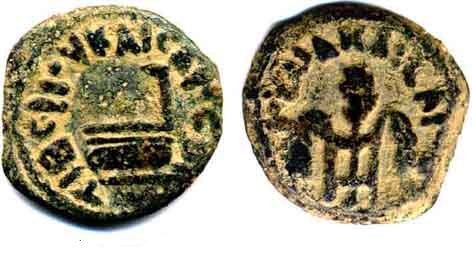
| 29–31 CE | Pilate’s bronze coins carry the Roman priestly ladle and augur’s staff[17] | Consensus |
| c. 28–29 CE | John the Baptist preaches in the Jordan valley (§2)[18][19] | Majority |
| 36 CE | Pilate’s troops attack a crowd following a Samaritan prophet to Mount Gerizim; Pilate is sent to Rome[20] | Consensus |
The story continues beyond Jesus’ death with more prophets and the great revolt of 66–70 CE, which ended with the destruction of the Temple (§4; Judaism §7).
Where: a small country of many jurisdictions
From Dan in the north to Beersheba in the south, the land is about 240 kilometres long; Nazareth is about 100 kilometres from Jerusalem, a journey of three or four days on foot. In Jesus’ adult life it was divided into several jurisdictions:[21] Consensus
- Galilee and Peraea (east of the Jordan), ruled by Herod Antipas as tetrarch from Sepphoris and then Tiberias.
- Judea, Samaria and Idumea, a Roman province since 6 CE, governed by an equestrian prefect from Caesarea on the coast; Jerusalem itself was run day to day by the high priest and the Temple aristocracy.
- Philip’s tetrarchy, north and north-east of the lake, with a largely gentile population; Philip rebuilt Bethsaida and Caesarea Philippi.
- The Decapolis, a league of Greek cities east and south-east of the lake (Scythopolis, Gadara, Hippos, Gerasa and others), and the Phoenician cities of Tyre and Sidon to the north-west.
The Jordan valley, the Dead Sea and the wilderness of Judea lay between. Samaria, between Galilee and Judea, was home to the Samaritans, who worshipped on Mount Gerizim; Josephus says Galileans customarily travelled through Samaria to the festivals, though the route could be dangerous: around 52 CE a Galilean pilgrim was killed there.[22] Consensus
Rome and the Herods
Herod the Great
Herod (r. 37–4 BCE) was the son of an Idumean official of the last Hasmonean kings, and a Jew by religion, though his enemies called him a “half-Jew”. He owed his throne entirely to Rome, and balanced loyalty to Augustus with patronage of his Jewish subjects.[23] Consensus He built on a scale unmatched in the region’s history: the Temple platform in Jerusalem, the harbour of Caesarea, the fortresses of Masada, Herodium and Machaerus, and temples to Augustus in gentile cities.[6][7] He executed his wife Mariamme and three of his own sons, and Josephus’ account of his last years is a record of paranoia and cruelty. Consensus The massacre of the infants in Matthew 2 is not in Josephus (§2).
The revolts of 4 BCE
When Herod died, the country rose. Josephus names three men who claimed to be king: Judas, son of the bandit chief Hezekiah, who seized the royal armoury at Sepphoris; Simon, a former royal slave in Peraea, who burned the palace at Jericho; and Athronges, a shepherd, who wore a diadem and fought with his four brothers.[9] The Roman governor of Syria, Varus, marched south, burned Sepphoris and enslaved its inhabitants, and crucified about two thousand rebels around Jerusalem.[9] Majority Nazareth is about six kilometres from Sepphoris. Whether Jesus’ family had any connection to these events is unknown; that his generation grew up in their shadow is not. Speculative for any connection.
Antipas in Galilee
Herod Antipas ruled Galilee and Peraea from 4 BCE to 39 CE, as tetrarch, not king.[10] He rebuilt Sepphoris, and around 19 CE founded a new capital, Tiberias, named for the emperor, on the western shore of the lake, partly on a cemetery, so that observant Jews were reluctant to settle there.[12][13] His coins carry no human images, in deference to Jewish sensibilities.[24] Consensus He married Herodias, his half-brother’s former wife, which John the Baptist condemned; he had John executed (§2). Caligula exiled him in 39 CE.
The prefects of Judea
From 6 CE, Judea was governed by a prefect of equestrian rank, answerable to the legate of Syria, who commanded the legions. The prefect had a few thousand auxiliary troops, mostly recruited from the gentile cities of Caesarea and Sebaste; no legion was stationed in Judea before the revolt of 66.[25][21] Majority The prefect appointed and removed high priests and kept the high priest’s vestments in the Antonia fortress beside the Temple, releasing them for festivals. He collected the tribute, heard capital cases, and came up to Jerusalem with troops at the great festivals.[26][25] Majority
Pontius Pilate
Pilate, prefect from 26 to 36 CE, is the best documented of them, and is named on a contemporary inscription (§0).[27] Josephus and Philo, writing within a few decades, record a series of clashes:
- The standards. Soon after arriving, Pilate had military standards bearing the emperor’s image brought into Jerusalem by night. Crowds went to Caesarea and lay on the ground for five days; when he threatened to kill them, they bared their necks, and he gave way.[16]
- The aqueduct. He spent money from the Temple treasury on an aqueduct for Jerusalem; when crowds protested, soldiers in plain clothes beat many to death.[16]
- The shields. He set up gilded shields inscribed with the emperor’s name in Herod’s palace in Jerusalem; Herod’s sons appealed to Tiberius, who ordered them removed to Caesarea.[28]
- The Galileans. Luke mentions “the Galileans whose blood Pilate had mingled with their sacrifices”, an incident known only from this verse.[29]
- Gerizim. In 36, his troops attacked Samaritans following a prophet who promised to show them vessels Moses had buried on the mountain. After Samaritan complaints, the legate Vitellius sent him to Rome to answer for it.[20] Consensus
Philo, in a letter he attributes to the Jewish king Agrippa I, calls Pilate “naturally inflexible, a blend of self-will and relentlessness” (trans. F. H. Colson).[28] Pilate’s own coins, struck in 29–31 CE, carry the simpulum, a ladle used in Roman sacrifice, and the lituus, an augur’s staff; no other prefect’s coins in Judea carry Roman cultic symbols.[17][30] Majority Whether Pilate set out to provoke, or was an ordinary Roman official portrayed through hostile sources, is debated below.
Galilee: a Jewish region of villages, a lake and two cities
How Jewish was Galilee?
Older scholarship often imagined Galilee as half-gentile, taking its cue from Isaiah’s “Galilee of the nations” (Isa 9:1, quoted in Matt 4:15). Excavation since the 1980s has overturned that picture.[31][32] Majority Survey work shows that many Galilean sites were founded or resettled after the Hasmonean annexation of about 104 BCE, apparently by Jewish settlers from the south.[2][32] Majority In first-century Galilean towns and villages, archaeologists find four markers of Jewish practice:
- Stone vessels. Cups, jugs and large jars carved from soft chalk, which in Jewish law could not contract ritual impurity as pottery could. They were made at quarries near Jerusalem and at Reina and Kefar Kana in Galilee, within walking distance of Nazareth.[33][34] Consensus
- Ritual baths. Stepped, plastered pools cut into the rock for immersion (miqva’ot), found at Sepphoris, Magdala and, just beyond Galilee, Gamla.[32] Consensus
- No pigs. Pig bones are almost absent from Jewish sites, and common in gentile ones nearby.[32] Consensus
- Burial. Rock-cut tombs with burial niches, like those of Judea.[32] Majority
The same markers appear at Sepphoris, Antipas’ capital, whose upper city has ritual baths and stone vessels of this period. Galilee was not a gentile land with a Jewish minority, nor a region “Hellenised” enough to make a Greek philosopher of Jesus (see below). Majority
Towns and villages
Galilee’s population lived mostly in villages. Nazareth was a hamlet of perhaps a few hundred people; Capernaum, Jesus’ base by the lake, a large village of perhaps 600–1,500; Sepphoris and Tiberias, the only cities, had perhaps 8,000–12,000 each.[32] Majority on the order of magnitude; the numbers are estimates.
Magdala, on the lake’s western shore, was a prosperous town known for salting fish; Josephus’ Taricheae, “fish-salting place”, is usually identified with it.[35] Majority In 2009, excavators found there a synagogue of the first century CE, with benches around the walls and, in its centre, a carved stone block decorated with a seven-branched menorah and other Temple motifs. It is one of a handful of synagogues securely dated before 70 CE, and the nearest in place and time to the “synagogues of Galilee” in which the Gospels have Jesus teach.[36][35][37] Majority
The lake economy
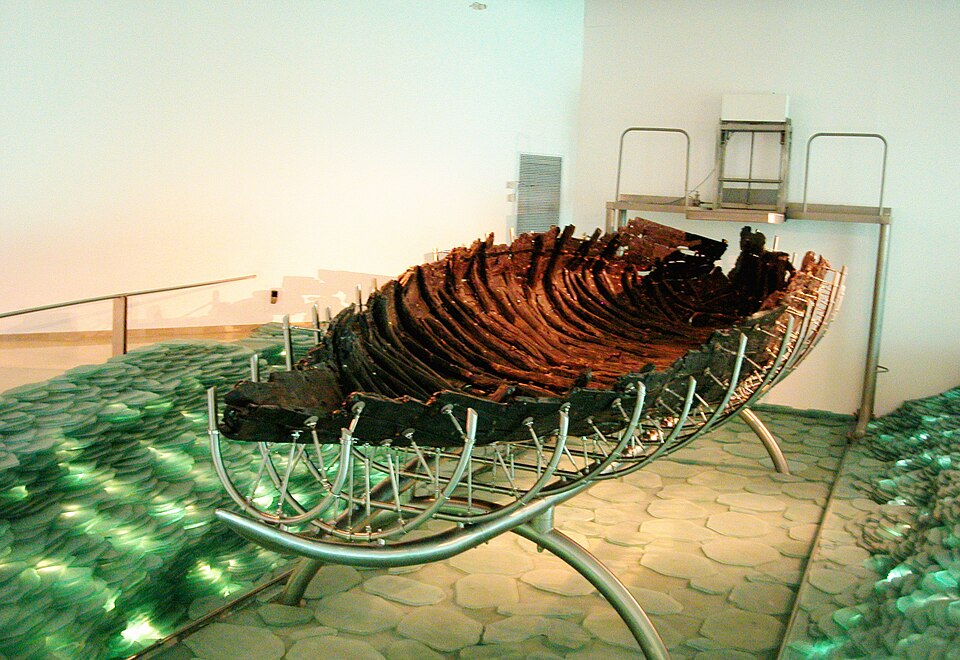
The lake supported a fishing industry, from boat-owning families to hired men, with fish salted and traded across the region.[38] In 1986, during a drought, two brothers from Kibbutz Ginosar found the remains of a wooden fishing boat in the exposed mud. About 8.2 metres long and 2.3 wide, it had been built and repaired many times with ten or more kinds of wood, and pottery and radiocarbon dates place it between about the first century BCE and the first century CE.[39][40] Majority It is the kind of boat the Gospels describe Simon, Andrew, James and John working from (Mark 1:16–20).[41]
Fishing was regulated and taxed. The telōnai of the Gospels, usually translated “tax collectors”, were local contractors who bought the right to collect tolls and dues for Antipas or for Rome, and were resented accordingly; Levi sits “at the tax booth” in Capernaum (Mark 2:14).[42][38] Majority
Was Galilee’s economy hard on its villages?
Antipas’ two cities had to be fed, and his building paid for. Richard Horsley and John Dominic Crossan argued that the urbanisation of Galilee under Antipas squeezed its peasants through taxes, debt and loss of land, and that Jesus’ sayings about debt, the poor and the rich reflect that pressure.[43][44] Morten Hørning Jensen, surveying the coins, building and settlement data, found Antipas’ reign modest in its impact and Galilee’s villages stable or growing.[24] Contested
Languages
The Jews of Galilee and Judea lived in at least three languages:[21] Majority
- Aramaic, the everyday language since the Persian period. Jesus’ words preserved in Mark are Aramaic (§2).
- Hebrew, the language of scripture and prayer, and spoken by some; the Mishnah, compiled about 200 CE, is in a living Hebrew.
- Greek, the language of the eastern Roman empire, of trade and government, and of the cities. Many Jewish ossuary inscriptions from Jerusalem are in Greek, as is the Temple warning inscription and the dedication of the synagogue of Theodotos.[45][46][47]
- Latin, the language of Roman officials and soldiers, as on the Pilate Stone.
About a century after Jesus, the private papers of a Jewish woman called Babatha, hidden in a cave by the Dead Sea during the Bar Kokhba revolt, include documents in Aramaic, Nabataean and Greek: a marriage contract, deeds of gift and the records of her lawsuits in Roman courts.[48] Consensus
Women’s lives
The sources for Jewish women of this period are thin and mostly written by men, but they are richer than once thought.[49]
- Names. Tal Ilan’s catalogue of the names of Jews in the land of Israel shows that almost half of the women whose names are recorded were called Mariam (Mary) or Salome. The many Marys of the Gospels are what the name lists would predict.[50] Majority
- Marriage and divorce. Women married young, often in their teens, by contract; in Jewish law divorce was the husband’s act. Josephus notes that when Herod’s sister Salome sent her husband a bill of divorce, she acted “not according to the Jewish laws”.[51][49] Majority
- Property and courts. Babatha’s papers show a woman owning date orchards, lending money and suing her late husband’s family before Roman judges.[48] Consensus
- Religious life. Women went up to the festivals and had their own court in the Temple; inscriptions from later centuries give some women synagogue titles, though what those meant is debated.[37] Contested for the titles.
Against this background, the women who travel with Jesus and support his group from their own resources (§2) are unusual but not impossible: Joanna, wife of Antipas’ steward, was a woman of means.[52] Majority
The Temple and the festivals
Herod’s Temple
Herod’s rebuilding, begun around 20/19 BCE, roughly doubled the Temple platform into one of the largest religious precincts of the Roman world, about 14 hectares, surrounded by colonnades.[7][53] Consensus Anyone could enter the vast outer court. A stone balustrade marked the limit beyond which gentiles could not go, with inscriptions in Greek and Latin warning of death (see the primary sources below).[46] Inside lay the court of the women, the court of Israel, the court of the priests with the altar, and the sanctuary itself, whose innermost room, the Holy of Holies, only the high priest entered, once a year. Consensus
The Temple was the centre of Jewish religious life and of the economy of Jerusalem. Jews everywhere paid an annual half-shekel tax for its upkeep, and the Gospels show it being collected in Galilee (Matt 17:24); offerings and the tax were paid in silver shekels of Tyre, the most reliable coinage available, which is why money-changers sat in the outer court.[54][26] Majority
Passover
Three festivals, Passover, Weeks and Tabernacles, brought pilgrims to Jerusalem from Galilee and the diaspora. Passover commemorated the escape from Egypt, and with it Israel’s liberation from a foreign power, a meaning not lost on Roman governors, who came up from Caesarea with troops for it.[26][55] Majority Josephus says that in one year of the 60s, 255,600 lambs were sacrificed and 2,700,000 people took part.[56] No historian accepts the figure; E. P. Sanders estimated several hundred thousand, at the upper end of modern estimates, in a city whose ordinary population was a few tens of thousands.[26] Contested on the numbers.
Hope for a coming kingdom
No single messiah
Messiah (Hebrew mashiaḥ, Greek christos) means “anointed”, a title of kings and priests. By the first century, some Jews hoped for an anointed figure who would restore Israel. What they expected varied widely:[57] Majority
- A king from David’s line, who would drive out the gentiles and rule in justice: the Psalms of Solomon, written soon after Pompey’s conquest (see below).[58]
- Two messiahs, one priestly (“of Aaron”) and one royal (“of Israel”), in the Community Rule from Qumran.[59]
- A heavenly judge, “that Son of Man”, who sits on God’s throne at the judgment, in the Parables of Enoch (1 Enoch 37–71), a work of disputed date, probably around the turn of the era.[60][61]
- God alone, with no human agent at all, as in much of the literature of the period.
Jacob Neusner and his colleagues argued that the messiah was a minor theme of Jewish texts of the period, made central only by Christian reading;[62] John J. Collins, while agreeing that there was no single idea, showed that the royal Davidic messiah was the most widely attested.[57] Contested Behind all of them lay older hopes for the end of foreign rule and the vindication of the righteous, expressed in Daniel’s vision of “one like a son of man” and the book’s promise of resurrection.[63][64] (Judaism §6 traces how resurrection, angels and Satan entered Jewish thought.)
Kings, prophets and bandits
Josephus, who despised them, records a succession of popular leaders between Herod’s death and the revolt of 66.[65] Consensus on the events.
- Would-be kings (4 BCE): Judas son of Hezekiah, Simon of Peraea and Athronges, described above.
- Judas the Galilean (6 CE), who led resistance to the census on the principle that God alone was Israel’s master; Josephus calls his teaching a “fourth philosophy” alongside the Pharisees, Sadducees and Essenes.[11][66]
- The Samaritan prophet (36 CE) who led a crowd up Gerizim, ending Pilate’s prefecture.[20]
- Theudas (c. 45 CE), who promised to part the Jordan.[67]
- The Egyptian (c. 52–60 CE), who promised that Jerusalem’s walls would fall at his command.[68][69]
- Jesus son of Ananias (62–70 CE), a peasant who cried woe on Jerusalem and the Temple for seven years; the Jerusalem leaders handed him to the Roman governor, who had him flogged to the bone and released him as a madman.[70]
Rome’s answer to crowds following a prophet into the wilderness was cavalry, and its answer to a man called king was a cross. Richard Horsley and John Hanson classed these figures as popular prophets, messiahs and “social bandits”, forms of peasant protest; others think the category of social banditry fits the evidence loosely.[65] Contested Jesus son of Ananias, arrested by the Jewish authorities, handed to the Roman governor and beaten, is the closest parallel in Josephus to what the Gospels describe of Jesus of Nazareth’s last days, though his ended differently.[70] Majority
John the Baptist’s setting
John preached and immersed people in the Jordan valley, partly in Antipas’ Peraea, announcing God’s coming judgment and calling Israel to repentance (§2).[19][71] His wilderness setting echoed Isaiah’s “voice crying in the wilderness” and Israel’s entry into the land across the Jordan; the community at Qumran, a few hours’ walk away, practised repeated immersions and saw itself as preparing the way of the Lord in the wilderness.[72][73] Whether John had any connection with Qumran is unknown. Speculative
The evidence
| Question | What the evidence supports | Key evidence | Confidence |
|---|---|---|---|
| Rulers | Herod (to 4 BCE), then Antipas in Galilee (4 BCE–39 CE) and Roman prefects in Judea (from 6 CE) | Josephus; coins; the Pilate Stone[10][27] | Consensus |
| Galilee’s population | Overwhelmingly Jewish, many sites settled after c. 104 BCE | Stone vessels, ritual baths, no pigs[32][31][2] | Majority |
| Galilee’s economy | Villages, two new cities, a fishing industry; how heavy the pressure on peasants was is disputed | Archaeology; the Galilee boat[24][43][39] | Contested |
| Synagogues | Existed in Galilee before 70; Magdala’s is the clearest example | Magdala; Gamla; Theodotos[36][47][37] | Majority |
| Languages | Aramaic, Hebrew, Greek, Latin | Mark’s Aramaic; ossuaries; Babatha[45][48] | Majority |
| Messianic hope | Varied: Davidic, priestly, heavenly, or none | Psalms of Solomon; Qumran; Enoch[58][59][60] | Majority (variety) |
| Popular movements | Prophets and would-be kings repeatedly suppressed by Rome | Josephus[67][68] | Consensus |
| Pilate | Provocative clashes, then removal in 36 | Josephus; Philo; coins[16][28][17] | Consensus (events); Contested (character) |
| The Temple | Rebuilt by Herod; centre of worship, pilgrimage and the economy | Josephus; warning inscription[53][46] | Consensus |
Primary sources
Show the 10 primary sources
1. A son of David: Psalms of Solomon 17:21, after 63 BCE
ide, kyrie, kai anastēson autois ton basilea autōn huion Dauid eis ton kairon hon oidas su, ho theos, tou basileusai epi Israēl paida sou.
“See, Lord, and raise up for them their king, the son of David, to rule over your servant Israel in the time known to you, O God.”[58]
What it proves. A Jewish poem written in the generation after Pompey’s capture of Jerusalem, which it treats as divine punishment, prays for a Davidic king who will purge Jerusalem of gentiles, gather the tribes and rule in righteousness; later in the psalm he is called christos, “anointed”. It is the fullest description of a royal messiah before the Gospels, and it shows that the hope could be political, national and this-worldly. Consensus
2. Healing and good news to the poor: 4Q521, 1st c. BCE
[ki ha-sha]mayim ve-ha-areṣ yishmeʿu li-meshiḥo… ki yerappeʾ ḥalalim u-metim yeḥayyeh ʿanawim yevasser.
“[For the hea]vens and the earth will listen to his anointed one… for he will heal the wounded, and revive the dead, and bring good news to the poor.”[74]
What it proves. A Hebrew text from Qumran Cave 4 links an anointed figure with healing, raising the dead and good news to the poor, the same sequence Jesus gives in his answer to John the Baptist in Q (Luke 7:22; Matt 11:5).[75] Whether the one who heals is God or his anointed is unclear from the grammar. It shows that this language was already associated with the messianic age before the Gospels used it. Majority
3. The fourth philosophy: Josephus, Antiquities 18.23
“Of the fourth sect of Jewish philosophy, Judas the Galilean was the author. These men agree in all other things with the Pharisaic notions; but they have an inviolable attachment to liberty, and say that God is to be their only Ruler and Lord.” (trans. William Whiston)[66]
What it proves. Resistance to Roman taxation could be framed as a religious principle: to pay tribute to Caesar was to accept a master other than God. That is the background to the question put to Jesus about tribute (Mark 12:13–17). Josephus blames the “fourth philosophy” for the revolt sixty years later, a view coloured by his own politics.[76] Majority
4. Theudas at the Jordan: Antiquities 20.97–98 and Acts 5:36
“While Fadus was procurator of Judea, a certain magician, whose name was Theudas, persuaded a great part of the people to take their effects with them, and follow him to the river Jordan; for he told them he was a prophet, and that he would, by his own command, divide the river.” (trans. Whiston)[67]
Fadus’ cavalry killed many and brought Theudas’ head to Jerusalem. In Acts, the Pharisee Gamaliel cites Theudas, and then Judas the Galilean, as failed movements, in a speech set in the mid-30s.[77]
What it proves. A prophet could promise a new Joshua’s crossing of the Jordan and draw a crowd; Rome would kill him. It also shows a chronological slip in Acts: Josephus dates Theudas to about 45 CE, around a decade after Gamaliel’s speech, and Judas to 6 CE, before him, not after. Either Luke’s Theudas is a different man, or Luke misplaced him. Majority that Acts is in error.
5. The Egyptian on the Mount of Olives: Antiquities 20.169–172, War 2.261–263, Acts 21:38
Josephus tells the story twice. In the Antiquities, a man from Egypt “said he was a prophet” and led a crowd to the Mount of Olives, promising that at his command the walls of Jerusalem would fall; the governor Felix attacked, killed four hundred and captured two hundred, and the Egyptian escaped.[68] In the Jewish War, his following is thirty thousand.[69] In Acts, a Roman tribune arresting Paul in the Temple asks: “Then you are not the Egyptian who recently stirred up a revolt and led the four thousand assassins out into the wilderness?”[78]
What it proves. Three accounts of the same man, with three very different numbers, are a lesson in how ancient writers handled crowds. They also show that a Roman officer in Jerusalem in the 50s could mistake a Jewish preacher for a messianic agitator. Consensus
6. Pilate in Philo: Embassy to Gaius 299–305
Philo, an Alexandrian Jew writing around 41 CE, presents a letter of Agrippa I to the emperor Caligula that recalls Pilate’s gilded shields. He describes Pilate’s fear that a Jewish embassy to Tiberius would expose “the briberies, the insults, the robberies, the outrages and wanton injuries, the executions without trial constantly repeated, the ceaseless and supremely grievous cruelty” of his rule (trans. F. H. Colson).[28]
What it proves. A near-contemporary Jewish witness regarded Pilate as cruel and corrupt. It also shows a rhetorical purpose: Philo is persuading an emperor not to place his statue in the Temple, and blackening a governor who had offended Tiberius served that end. Helen Bond reads it as polemic first and evidence second.[30] Contested
7. The Temple warning: the balustrade inscription
mēthena allogenē eisporeuesthai entos tou peri to hieron tryphaktou kai peribolou. hos d’ an lēphthē heautōi aitios estai dia to exakolouthein thanaton.
“No foreigner is to enter within the balustrade and enclosure around the Temple. Whoever is caught will have himself to blame for his death, which follows.”[46]
What it proves. The stone, found complete in 1871 and in a fragment in 1935, is one of the Greek notices Josephus says stood on the barrier around the inner courts. Gentiles were welcome in the outer court and barred from the inner ones on pain of death. Acts’ story of a riot over the claim that Paul had brought a gentile into the Temple (Acts 21:28) takes place at this line.[79] Consensus
8. A prophet of woe: Jesus son of Ananias, War 6.300–309
Four years before the war, at the festival of Tabernacles, a peasant named Jesus son of Ananias began to cry in the Temple “a voice against Jerusalem and the sanctuary”. The leading citizens had him beaten and brought before the Roman governor Albinus, who had him “flayed to the bone with scourges”; he answered nothing, and was released as a madman. He cried his woes for seven years and was killed by a Roman stone during the siege.[70]
What it proves. The pattern of a prophet against the Temple, arrested by the Jewish leaders, handed over to the Roman governor, scourged, and silent under questioning, was not unique to the Gospels. It gives historians a way to test the plausibility of the Gospel passion stories against a Jewish source with no Christian interest. Majority
9. A Galilean fishing boat, 1st c. BCE–1st c. CE
The boat found at Ginosar in 1986 (pictured above) was excavated from the mud in under two weeks, packed in polyurethane foam and floated to shore, then conserved for years in a chemical bath.[39][40]
What it proves. The ordinary craft of the lake’s fishermen was a small, much-repaired boat built of mixed and reused timber, the sign of a working economy, not a wealthy one. Nothing connects this boat with Jesus or his disciples, despite its nickname. Consensus
10. The Magdala synagogue and its stone, 1st c. CE
The synagogue found in 2009 is a small hall with stone benches and a mosaic floor. The carved block at its centre, perhaps a table for reading the Torah scroll, shows a seven-branched menorah flanked by jars and columns on one side, and on its top a rosette and other motifs that Mordechai Aviam reads as images of the Temple’s interior.[36][35]
What it proves. A Galilean town had a building for communal reading and teaching in Jesus’ lifetime, and its people pictured the Jerusalem Temple at its heart. The Gospels’ picture of Jesus teaching in Galilean synagogues fits the archaeology. Majority
What is absent
Much that later readers project back onto the first century was not yet there.
- Rabbinic Judaism. The Mishnah, the Talmud and the rabbis as Judaism’s authorities come after 70 CE (Judaism §7). The Pharisees of Jesus’ day were an influential movement, not the governing body of Jewish life. Consensus
- “The Zealots” as a party. Josephus uses “Zealots” for a faction that formed during the revolt of 66–70. There is no evidence of an organised Zealot party in Jesus’ time, although individuals were called “zealous”, like the disciple Simon “the Zealot”.[65][80] Majority
- A legion in Judea. Before 66 the prefect commanded auxiliary troops; the legions were in Syria. Majority
- The emperor’s image on local coins. The coins struck by Herod, Archelaus, Antipas and the prefects of Judea avoided human images (Philip, ruling a mostly gentile territory, put the emperor’s portrait and his own on his); the “image and inscription” in the question about tribute was on a Roman denarius (Mark 12:16).[76][24] Majority
- A Christian. The followers of Jesus did not call themselves Christians, and nothing in this world marked them off from other Jewish groups (§0, §4). Consensus
- A single “Judaism” of belief. Jews shared the Temple, the Torah, the Sabbath, circumcision and the festivals, what E. P. Sanders called “common Judaism”, but differed sharply on how to keep them and on the future.[26] Majority
Debates
How Jewish, and how Greek, was Galilee?
| View | Picture of Galilee | Main proponents |
|---|---|---|
| Jewish, resettled from the south | A predominantly Jewish population that arrived or expanded after the Hasmonean annexation; Greek culture mainly in the cities around it | Chancey, Reed, Leibner[31][32][2] |
| Old Israelite peasantry | Descendants of northern Israelites who shared Israel’s traditions but resented Jerusalem’s rule | Horsley[43] |
| Hellenised | Galilee was open to Greek culture and philosophy, and Jesus resembled a Cynic sage | Mack[81] |
Most scholars now accept the first view, which the archaeology supports, while recognising contact with the gentile cities that ringed Galilee.[31][82] Majority
Was there a widespread messianic expectation?
| View | Position | Main proponents |
|---|---|---|
| Messiahs were marginal | Most Jewish texts of the period have no messiah; Christian readers have exaggerated the theme | Neusner, Green, Frerichs[62] |
| Varied but real | There were several messianic types, of which the Davidic king was the most widely held; messianism was a minority hope that could catch fire | Collins[57] |
| Popular movements as messianic | Ordinary people expressed messianic hope in action, by following kings and prophets | Horsley and Hanson[65] |
Contested
Who was Pontius Pilate?
| View | Position | Main proponents |
|---|---|---|
| Harsh and provocative | Philo’s and Josephus’ clashes, and the cultic coins, show a governor careless of, or hostile to, Jewish sensibilities | Older scholarship; many Gospel readers |
| An ordinary Roman official | The sources are polemical; Pilate’s actions were normal for a Roman governor, his long tenure suggests competence, and the coins need not be provocative | Bond[30] |
Contested Both views explain how Pilate could condemn Jesus quickly, as the Gospels say. They differ on whether the Gospels’ hesitant Pilate is history or apologetic (§2).
Further reading
Show further reading (10 works)
- E. P. Sanders, Judaism: Practice and Belief, 63 BCE–66 CE (SCM, 1992): “common Judaism”, the Temple and the festivals.
- Mark A. Chancey, The Myth of a Gentile Galilee (Cambridge, 2002) and Jonathan L. Reed, Archaeology and the Galilean Jesus (Trinity, 2000).
- Martin Goodman, Rome and Jerusalem: The Clash of Ancient Civilizations (Allen Lane, 2007).
- Peter Richardson, Herod: King of the Jews and Friend of the Romans (South Carolina, 1996).
- Helen K. Bond, Pontius Pilate in History and Interpretation (Cambridge, 1998).
- Richard A. Horsley with John S. Hanson, Bandits, Prophets, and Messiahs: Popular Movements in the Time of Jesus (Winston, 1985).
- John J. Collins, The Scepter and the Star: Messianism in Light of the Dead Sea Scrolls (Eerdmans, 2nd ed. 2010).
- Tal Ilan, Jewish Women in Greco-Roman Palestine (Mohr Siebeck, 1995).
- Shelley Wachsmann, The Sea of Galilee Boat (Plenum, 1995).
- Emil Schürer, The History of the Jewish People in the Age of Jesus Christ, revised by Geza Vermes, Fergus Millar and others (T&T Clark, 1973–1987): the reference work.
References
- ^ Josephus, Antiquities 13.318–319 — Jewish Antiquities. c. 93 CE. Greek. Aristobulus I makes war on the Itureans, annexes much of their land and requires those who stay to be circumcised and live by Jewish law. read the text
- ^ a b c d Uzi Leibner Settlement and History in Hellenistic, Roman, and Byzantine Galilee. Mohr Siebeck, 2009. Survey archaeology of eastern Galilee showing settlement growth after the Hasmonean annexation.
- ^ Josephus, Antiquities 14.69–73 — Jewish Antiquities. c. 93 CE. Greek. Pompey takes the Temple in 63 BCE and enters the Holy of Holies with his men, but leaves its treasures untouched. read the text
- ^ Josephus, Antiquities 14.159–160 — Jewish Antiquities. c. 93 CE. Greek. The young Herod, governor of Galilee, captures and kills the bandit chief Hezekiah and many of his men. read the text
- ^ Josephus, Antiquities 14.381–389 — Jewish Antiquities. c. 93 CE. Greek. The Roman Senate, at Antony's and Octavian's urging, declares Herod king of Judea in 40 BCE. read the text
- ^ a b Josephus, Antiquities 15.331–341 — Jewish Antiquities. c. 93 CE. Greek. Herod builds Caesarea, with its harbour and a temple of Caesar, over about twelve years. read the text
- ^ a b c Josephus, Antiquities 15.380–425 — Jewish Antiquities. c. 93 CE. Greek. Herod, in his eighteenth year (20/19 BCE), undertakes to rebuild the Temple; Josephus describes the enlarged platform, porticoes, courts and the warning barrier for gentiles. read the text
- ^ Josephus, Antiquities 17.191 — Jewish Antiquities. c. 93 CE. Greek. Herod dies having reigned 34 years from Antigonus' death and 37 from his appointment by Rome. read the text
- ^ a b c Josephus, Antiquities 17.271–298 — Jewish Antiquities. c. 93 CE. Greek. Risings after Herod's death: Judas son of Hezekiah at Sepphoris, Simon in Peraea and Athronges; Varus burns Sepphoris and crucifies about two thousand. read the text
- ^ a b c Josephus, Antiquities 17.317–320 — Jewish Antiquities. c. 93 CE. Greek. Augustus divides Herod's kingdom between Archelaus, Antipas and Philip. read the text
- ^ a b Josephus, Antiquities 18.1–10 — Jewish Antiquities. c. 93 CE. Greek. Quirinius comes to Syria to assess property after Judea's annexation in 6 CE; Judas the Galilean leads resistance to the census. read the text
- ^ a b Josephus, Antiquities 18.27 — Jewish Antiquities. c. 93 CE. Greek. Antipas rebuilds Sepphoris as 'the ornament of all Galilee' and makes it his capital. read the text
- ^ a b Josephus, Antiquities 18.36–38 — Jewish Antiquities. c. 93 CE. Greek. Herod Antipas founds Tiberias on the Sea of Galilee and settles it with a mixed population. read the text
- ^ Josephus, Antiquities 18.35 — Jewish Antiquities. c. 93 CE. Greek. Valerius Gratus appoints 'Joseph, who was called Caiaphas' high priest. read the text
- ^ Josephus, Antiquities 18.95 — Jewish Antiquities. c. 93 CE. Greek. Vitellius removes Joseph Caiaphas from the high priesthood in 36/37 CE. read the text
- ^ a b c d Josephus, Antiquities 18.55–62 — Jewish Antiquities. c. 93 CE. Greek. Pilate's prefecture: the standards brought into Jerusalem and the riot over Temple funds used for an aqueduct. read the text
- ^ a b c Coins of Pontius Pilate — Bronze prutot struck in Judea, 29–31 CE. 29–31 CE. Greek. Small bronze coins naming Tiberius (and Julia), with the simpulum and the lituus, Roman cultic implements. about
- ^ Luke 3:1–2 — Gospel of Luke (New Testament). c. 80–90 CE. Greek. John begins preaching 'in the fifteenth year of the reign of Emperor Tiberius', when Pilate was governor and Annas and Caiaphas high priests. read the text
- ^ a b Josephus, Antiquities 18.116–119 — Jewish Antiquities. c. 93 CE. Greek. John 'surnamed the Baptist', a good man who urged righteousness and baptism, executed at Machaerus by Herod Antipas for fear of sedition. read the text
- ^ a b c Josephus, Antiquities 18.85–89 — Jewish Antiquities. c. 93 CE. Greek. Pilate's troops attack Samaritans gathering at Mount Gerizim behind a prophet; Vitellius sends Pilate to Rome to answer to the emperor. read the text
- ^ a b c Emil Schürer, rev. Geza Vermes, Fergus Millar et al. The History of the Jewish People in the Age of Jesus Christ (175 B.C.–A.D. 135). T&T Clark, 1973. The standard reference on politics, institutions and literature, in three volumes (1973–1987).
- ^ Josephus, Antiquities 20.118 — Jewish Antiquities. c. 93 CE. Greek. It was the custom of Galileans going up to Jerusalem for the festivals to travel through Samaria; around 52 CE a Galilean pilgrim was killed there. read the text
- ^ Peter Richardson Herod: King of the Jews and Friend of the Romans. University of South Carolina Press, 1996. A balanced life of Herod and his building.
- ^ a b c d Morten Hørning Jensen Herod Antipas in Galilee. Mohr Siebeck, 2006. Finds Antipas' rule modest in its economic impact.
- ^ a b Martin Goodman Rome and Jerusalem: The Clash of Ancient Civilizations. Allen Lane, 2007. Why Rome destroyed the Temple and refused to let it be rebuilt.
- ^ a b c d e E. P. Sanders Judaism: Practice and Belief, 63 BCE–66 CE. SCM Press / Trinity Press International, 1992. Introduces 'common Judaism': what most Jews shared, centred on Temple, Torah and festivals.
- ^ a b Pilate Stone — Dedicatory inscription, Caesarea Maritima (Israel Museum). 26–36 CE. Latin. '[Pon]tius Pilatus, [prae]fectus Iuda[ea]e' dedicates a building in honour of Tiberius; the only inscription securely naming Pontius Pilate, and the source of his title. about
- ^ a b c d Philo, Embassy to Gaius — Legatio ad Gaium. c. 41 CE. Greek. Philo's own account of the riots against Alexandria's Jews in 38 CE and of the embassy he led to the emperor Gaius (Caligula) in 40 CE.
- ^ Luke 13:1 — Gospel of Luke (New Testament). c. 80–90 CE. Greek. 'The Galileans whose blood Pilate had mingled with their sacrifices', an incident known only from this verse. read the text
- ^ a b c Helen K. Bond Pontius Pilate in History and Interpretation. Cambridge University Press, 1998. Reads the hostile sources as polemic and Pilate as an ordinary Roman governor.
- ^ a b c d Mark A. Chancey The Myth of a Gentile Galilee. Cambridge University Press, 2002. Shows that Galilee in Jesus' day was overwhelmingly Jewish.
- ^ a b c d e f g h Jonathan L. Reed Archaeology and the Galilean Jesus: A Re-examination of the Evidence. Trinity Press International, 2000. Nazareth, Capernaum and Sepphoris in the archaeology.
- ^ Yitzhak Magen The Stone Vessel Industry in the Second Temple Period. Israel Exploration Society, 2002. The chalk-vessel workshops near Jerusalem and their purity function.
- ^ Yonatan Adler The Origins of Judaism: An Archaeological-Historical Reappraisal. Yale University Press, 2022. Includes the chalk-vessel workshops, among them those excavated in lower Galilee.
- ^ a b c Mordechai Aviam The Decorated Stone from the Synagogue at Migdal: A Holistic Interpretation and a Glimpse into the Life of Galilean Jews at the Time of Jesus. Novum Testamentum 55, pp. 205–220, 2013. doi Publication and interpretation of the menorah stone found in the first-century synagogue at Magdala in 2009.
- ^ a b c Magdala synagogue and Magdala stone — Migdal, western shore of the Sea of Galilee. 1st c. CE (before 70). A first-century synagogue found in 2009, with benches, a mosaic floor and a carved stone block showing a menorah. about
- ^ a b c Lee I. Levine The Ancient Synagogue: The First Thousand Years. Yale University Press, 2nd ed., 2005. The standard history of the synagogue from its origins to late antiquity.
- ^ a b K. C. Hanson The Galilean Fishing Economy and the Jesus Tradition. Biblical Theology Bulletin 27: 99–111, 1997. How the lake's fishing was organised, taxed and traded.
- ^ a b c Sea of Galilee boat — Fishing boat from Ginosar (Yigal Allon Centre, Ginosar). 1st c. BCE–1st c. CE. A first-century-BCE-to-CE fishing boat about 8.2 by 2.3 metres, built and repaired with ten or more kinds of wood, found in 1986. about
- ^ a b Shelley Wachsmann The Sea of Galilee Boat: An Extraordinary 2000 Year Old Discovery. Plenum Press, 1995. The excavation, construction and dating of the Ginosar boat.
- ^ Mark 1:16–20 — Gospel of Mark (New Testament). c. 70 CE. Greek. Jesus calls the fishermen Simon, Andrew, James and John from their nets and their father's boat with hired men. read the text
- ^ Mark 2:13–17 — Gospel of Mark (New Testament). c. 70 CE. Greek. Jesus calls Levi from the tax booth at Capernaum and eats with tax collectors and sinners. read the text
- ^ a b c Richard A. Horsley Galilee: History, Politics, People. Trinity Press International, 1995. Galileans as Israelite peasants under pressure from Herodian and Jerusalem rulers.
- ^ John Dominic Crossan The Historical Jesus: The Life of a Mediterranean Jewish Peasant. HarperCollins, 1991. The most influential non-apocalyptic portrait of Jesus.
- ^ a b L. Y. Rahmani A Catalogue of Jewish Ossuaries in the Collections of the State of Israel. Israel Antiquities Authority, 1994. The ossuaries and their inscriptions, in Hebrew, Aramaic and Greek.
- ^ a b c d Temple Warning inscription — Balustrade inscription from Herod's Temple. c. 20 BCE–70 CE. Greek. Forbids any foreigner to pass the barrier around the inner Temple courts on pain of death; one complete copy found in 1871, a fragment in 1935. about
- ^ a b Theodotos inscription — Synagogue dedication from the City of David, Jerusalem. 1st c. BCE–70 CE (majority view). Greek. Theodotos son of Vettenos, priest and archisynagōgos, built the synagogue 'for the reading of the Law and the teaching of the commandments', with a guest house for visitors from abroad. Found 1913. about
- ^ a b c Babatha archive (P.Yadin 1–35) — Cave of Letters, Naḥal Ḥever. 94–132 CE. Greek, Aramaic and Nabataean. The legal papers of a Jewish woman of the Dead Sea region: marriage contract, property deeds and lawsuits in Roman courts. about
- ^ a b Tal Ilan Jewish Women in Greco-Roman Palestine. Mohr Siebeck, 1995. Marriage, divorce, property and religious life of Jewish women from the sources.
- ^ Tal Ilan Lexicon of Jewish Names in Late Antiquity, Part I: Palestine 330 BCE–200 CE. Mohr Siebeck, 2002. Every recorded name of a Jew in the land; Mariam and Salome dominate the women's names.
- ^ Josephus, Antiquities 15.259–260 — Jewish Antiquities. c. 93 CE. Greek. Herod's sister Salome sends her husband Costobarus a bill of divorce, 'not according to the Jewish laws', which allow only men to divorce. read the text
- ^ Luke 8:1–3 — Gospel of Luke (New Testament). c. 80–90 CE. Greek. Women travel with Jesus and the Twelve and provide for them: Mary Magdalene, Joanna wife of Herod's steward Chuza, Susanna and many others. read the text
- ^ a b Josephus, Jewish War 5.184–237 — Jewish War. c. 75–79 CE. Greek. Josephus' description of Herod's Temple, its courts, the warning notices in Greek and Latin, and the sanctuary. read the text
- ^ Matthew 17:24–27 — Gospel of Matthew (New Testament). c. 80–90 CE. Greek. Collectors of the Temple's half-shekel tax ask Peter in Capernaum whether his teacher pays it. read the text
- ^ Paula Fredriksen Jesus of Nazareth, King of the Jews: A Jewish Life and the Emergence of Christianity. Knopf, 1999. Jesus' execution read through Passover, Pilate and the Temple.
- ^ Josephus, Jewish War 6.422–425 — Jewish War. c. 75–79 CE. Greek. A Passover census under Cestius counts 255,600 lambs and, by Josephus' reckoning, 2,700,000 participants. read the text
- ^ a b c John J. Collins The Scepter and the Star: Messianism in Light of the Dead Sea Scrolls. Eerdmans, 2nd ed., 2010. open library The standard study of Jewish messianic expectations, including the two messiahs of the Qumran texts and the variety of messianic figures.
- ^ a b c Psalms of Solomon 17 — Psalms of Solomon. after 63 BCE. Greek (from Hebrew). A prayer for God to raise up 'the son of David' to purge Jerusalem, calling him christos kyrios, 'the Lord Messiah' (often emended to 'the Lord's anointed'): one of the earliest texts using Messiah as a title for the expected Davidic king. about
- ^ a b 1QS 9:9–11 (Community Rule) — Community Rule (Serekh ha-Yaḥad), Qumran Cave 1. c. 100–75 BCE (manuscript). Hebrew. The community is to keep its first ordinances 'until there shall come a prophet and the messiahs of Aaron and Israel': two expected anointed leaders, priestly and royal. about
- ^ a b 1 Enoch 37–71 (Parables or Similitudes of Enoch) — 1 Enoch (Ethiopic). c. 1st c. BCE–1st c. CE (disputed). Ge'ez (from Aramaic or Hebrew). A heavenly figure called 'that Son of Man', the Chosen One, sits on God's throne to judge the kings of the earth. about
- ^ George W. E. Nickelsburg and James C. VanderKam 1 Enoch 2: A Commentary on the Book of 1 Enoch, Chapters 37–82. Fortress Press (Hermeneia), 2012. The standard commentary on the Parables of Enoch.
- ^ a b Jacob Neusner, William Scott Green and Ernest S. Frerichs, eds. Judaisms and Their Messiahs at the Turn of the Christian Era. Cambridge University Press, 1987. Argues the messiah was a minor theme in Jewish texts of the period.
- ^ Daniel 7:13–14 — Daniel (Hebrew Bible). c. 165 BCE. Hebrew and Aramaic. 'One like a son of man' comes with the clouds of heaven and receives everlasting dominion, the source of the Gospels' 'Son of Man'. read the text
- ^ Daniel 12:1–3 — Book of Daniel (Hebrew Bible). c. 165 BCE. Hebrew. Michael the great prince arises; 'many of those who sleep in the dust of the earth shall awake, some to everlasting life, and some to shame and everlasting contempt': the first clear biblical statement of resurrection and judgment. read the text
- ^ a b c d Richard A. Horsley with John S. Hanson Bandits, Prophets, and Messiahs: Popular Movements in the Time of Jesus. Winston Press, 1985. Classifies the popular movements in Josephus as forms of peasant protest.
- ^ a b Josephus, Antiquities 18.11–25 — Jewish Antiquities. c. 93 CE. Greek. The Pharisees, Sadducees and Essenes (more than four thousand), and the 'fourth philosophy' of Judas the Galilean, founded in opposition to the Roman census of 6 CE. read the text
- ^ a b c Josephus, Antiquities 20.97–98 — Jewish Antiquities. c. 93 CE. Greek. Under Fadus, the prophet Theudas leads a crowd to the Jordan, promising to divide it; cavalry kill many and behead him. read the text
- ^ a b c Josephus, Antiquities 20.169–172 — Jewish Antiquities. c. 93 CE. Greek. A prophet from Egypt leads a crowd to the Mount of Olives, promising Jerusalem's walls will fall; Felix kills four hundred and the Egyptian escapes. read the text
- ^ a b Josephus, Jewish War 2.261–263 — Jewish War. c. 75–79 CE. Greek. The Egyptian false prophet gathers some thirty thousand followers and is routed by Felix. read the text
- ^ a b c Josephus, Jewish War 6.300–309 — Jewish War. c. 75–79 CE. Greek. Jesus son of Ananias cries woe against Jerusalem from 62 CE; he is beaten, handed to the governor Albinus, scourged and released as a madman. read the text
- ^ Mark 1:4–8 — Gospel of Mark (New Testament). c. 70 CE. Greek. John baptises in the wilderness, and people from Judea and Jerusalem come out to be immersed in the Jordan. read the text
- ^ 1QS 8:12–16 — Community Rule (Dead Sea Scrolls). c. 100 BCE (copy). Hebrew. The community separates to go into the wilderness 'to prepare there the way of the Lord', quoting Isaiah 40:3. about
- ^ John J. Collins Beyond the Qumran Community: The Sectarian Movement of the Dead Sea Scrolls. Eerdmans, 2010. open library Argues that the yaḥad was a movement with several settlements, of which Qumran was only one.
- ^ 4Q521 (Messianic Apocalypse), frag. 2 ii — Dead Sea Scrolls, Qumran Cave 4. c. 100–80 BCE (manuscript). Hebrew. Heaven and earth will obey God's anointed; the Lord will heal the wounded, revive the dead and bring good news to the poor. about
- ^ Luke 7:22 — Gospel of Luke (New Testament). c. 80–90 CE. Greek. Jesus answers John's disciples: the blind see, the lame walk, the dead are raised, the poor have good news brought to them (Q). read the text
- ^ a b Mark 12:13–17 — Gospel of Mark (New Testament). c. 70 CE. Greek. Asked whether it is lawful to pay tribute to Caesar, Jesus asks whose image is on a denarius: 'Give to the emperor the things that are the emperor's, and to God the things that are God's.' read the text
- ^ Acts 5:36–37 — Acts of the Apostles (New Testament). c. 80–90 CE. Greek. Gamaliel cites Theudas, and after him Judas the Galilean 'in the days of the census', as failed movements. read the text
- ^ Acts 21:38 — Acts of the Apostles (New Testament). c. 80–90 CE. Greek. A Roman tribune asks Paul whether he is 'the Egyptian who recently stirred up a revolt and led the four thousand assassins out into the wilderness'. read the text
- ^ Acts 21:27–30 — Acts of the Apostles (New Testament). c. 80–90 CE. Greek. A crowd seizes Paul in the Temple, claiming he brought a gentile, Trophimus, inside. read the text
- ^ Luke 6:15 — Gospel of Luke (New Testament). c. 80–90 CE. Greek. Among the Twelve, 'Simon, who was called the Zealot'. read the text
- ^ Burton L. Mack The Lost Gospel: The Book of Q and Christian Origins. HarperSanFrancisco, 1993. Q's earliest layer as Cynic-like wisdom from a Hellenised Galilee.
- ^ Seán Freyne Galilee from Alexander the Great to Hadrian, 323 B.C.E. to 135 C.E.. Michael Glazier / University of Notre Dame Press, 1980. The first modern regional history of Galilee.