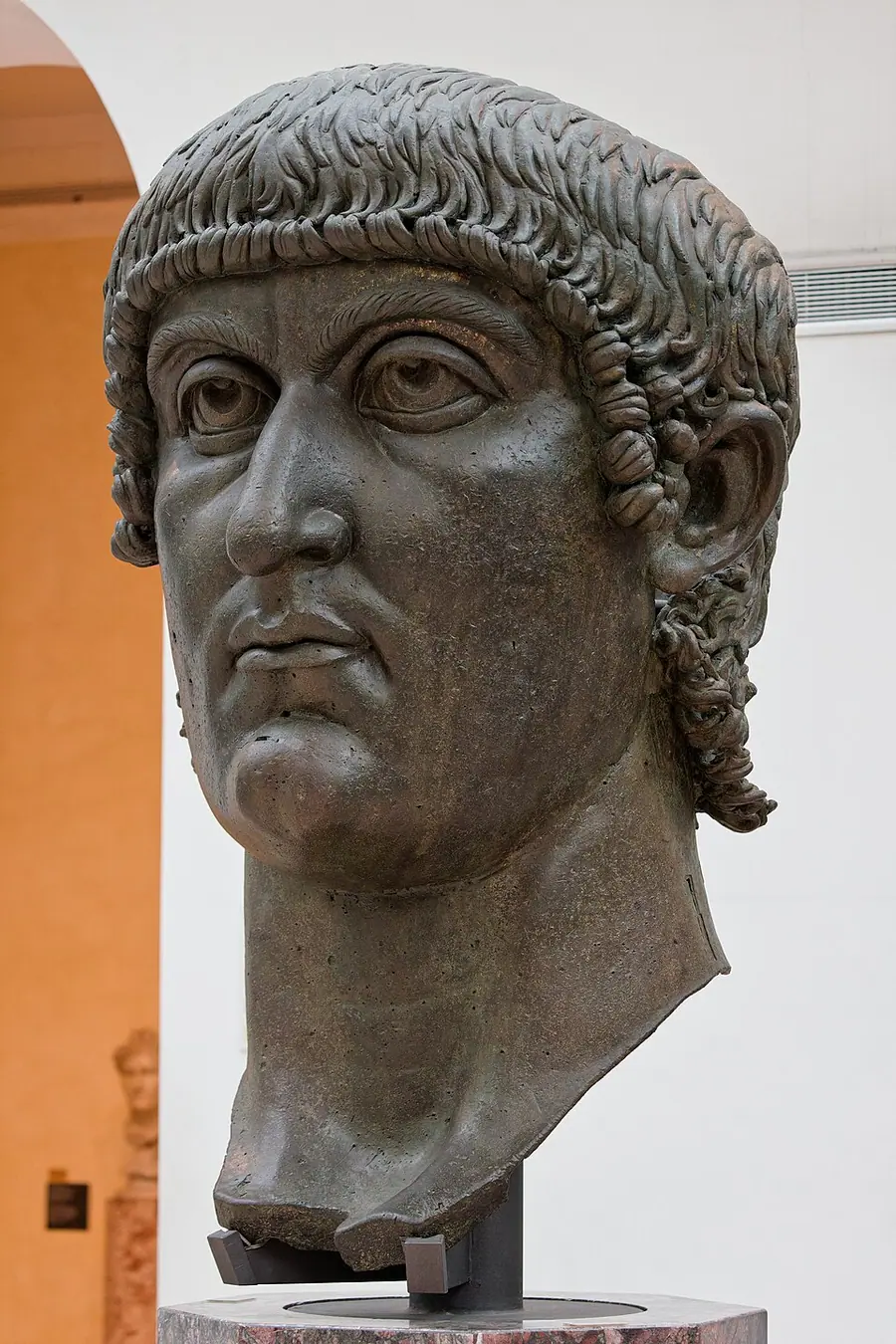
The short version: Constantine made Christianity protected, favoured and rich, but not compulsory or exclusive. The legal establishment of one form of Christianity came two generations later, under Theodosius I, and even then it began as a measure aimed at rival Christians in one city before it was read as law for the whole empire. Constantine gets the credit, and the blame, for a change that took most of the fourth century.[1][2] Majority
Before Constantine
Christianity was not legal when Constantine came to power. The Great Persecution, begun under Diocletian in 303, was ended in law in 311 by an edict of the dying emperor Galerius, which permitted them “again to be Christians” and to rebuild their meeting places, provided they did nothing against good order (trans. William Fletcher); Maximinus Daia renewed the persecution in the East until 313.[3] Consensus Toleration, then, came before Constantine’s victory and from a persecutor. What Constantine added was favour.
What Constantine did
On 28 October 312 Constantine defeated his rival Maxentius at the Milvian Bridge outside Rome and took the city. He attributed the victory to the Christian God. The two Christian writers who knew him describe the sign he fought under differently: Lactantius, writing within a few years, says he was told in a dream to mark the shields of his soldiers with the sign of Christ; Eusebius, writing after Constantine’s death in 337, reports the emperor’s own later story of a cross of light seen in the sky by his whole army.[4][5] Consensus that the accounts differ; what he saw is unknowable.
In 313 he and his eastern colleague Licinius agreed a policy that Licinius published at Nicomedia, the so-called Edict of Milan. It was a letter to governors, not an edict, and it gave “the Christians and all others” freedom to follow the religion they chose, and ordered confiscated church property returned.[6] Consensus Religious freedom “for all” is the point: it did not make Christianity official.
What changed after 312 was patronage. Constantine exempted clergy from civic duties, let bishops hear civil cases, allowed churches to receive legacies, and built on a scale no Christian had imagined: the Lateran basilica and St Peter’s in Rome, and the church of the Holy Sepulchre in Jerusalem, dedicated in 335.[1][7] Consensus He called the Council of Nicaea in 325 and expected the church to be united (§6). In 321 he made Sunday a day of rest for courts and city workers, calling it “the venerable day of the Sun”, a phrase that suited Christians and sun worshippers alike.[8] Consensus
What Constantine did not do
- He did not close the temples in general, though a few were demolished. Eusebius says that after 324 Constantine issued a law forbidding sacrifice, and Timothy Barnes takes the claim seriously; others doubt that any general ban was made or enforced. Either way, most temples stayed open and the traditional cults remained legal religions through his reign.[9][1][2] Contested on the ban.
- He did not give up the old titles. He remained pontifex maximus, head of the traditional Roman priesthoods, all his life, and his coins carried the Unconquered Sun until the early 320s.[1][10] Consensus
- He was not baptised until he was dying. He was baptised in May 337, shortly before his death, by Eusebius of Nicomedia, a bishop sympathetic to Arius; delaying baptism until death was common at the time.[11][12] Consensus
Christians were still a minority when he came to power, perhaps 5–10 per cent of the empire’s population around 300; most historians think they were a majority by about 400, though all such figures are estimates.[13][14] Contested
A pagan interlude: Julian
Constantine’s nephew Julian, raised a Christian, became sole emperor in 361 and announced his return to the gods. He restored temples and sacrifices, forbade Christians to teach the classics, and ordered the Jerusalem Temple rebuilt, a project abandoned after fires broke out at the site. He died on campaign in Persia in 363, and no later emperor was pagan.[15][16] Consensus The episode shows how far Christianity still was from being the empire’s established religion half a century after the Milvian Bridge.
What Theodosius did
Theodosius I, a Spanish general made emperor in the East in 379, who was baptised by a Nicene bishop during a serious illness later in 380, issued the edict Cunctos populos with his co-emperors in February 380:
“It is Our will that all the peoples who are ruled by the administration of Our Clemency shall practice that religion which the divine Peter the Apostle transmitted to the Romans… We command that those persons who follow this rule shall embrace the name of Catholic Christians. The rest, however, whom we adjudge demented and insane, shall sustain the infamy of heretical dogmas.” (trans. Clyde Pharr)[17]
It named the faith of Damasus, bishop of Rome, and Peter, bishop of Alexandria, as the standard. The edict was addressed to the people of Constantinople, and its target was rival Christians, above all those who rejected the creed of Nicaea, not pagans. R. M. Errington has argued that it began as a local measure and that later Christian historians and the compilers of the Theodosian Code made it a law for the whole empire.[18] Contested on its original scope. It is nonetheless usually taken as the moment Nicene Christianity became the religion of the Roman state. Majority
A council at Constantinople in 381 completed the doctrine of the Trinity, and a series of laws in 391 and 392 forbade sacrifice, entry to temples and finally any pagan worship, even in private.[19][20] Consensus Enforcement was uneven, and traditional cults survived for generations in the countryside and among the Roman aristocracy.[21] Majority
The case on each side
The real argument is not over the dates but over Constantine himself.
| View | Main argument | Main proponents |
|---|---|---|
| A convinced Christian from 312 | His letters, laws and church-building express real Christian commitment early on | Barnes[1] |
| A politician of consensus | He sought a broad monotheism that pagans and Christians could share, and turned against intolerance on both sides | Drake[2] |
| A sun-worshipper who became Christian gradually | Solar imagery on coins until the 320s; the God of victory understood in solar terms | Bardill and others[10] |
| A cynic | Christianity as a tool to unify the empire | Burckhardt (1853); few modern historians |
Contested All four agree on what he did. They disagree on why, and the evidence, much of it from Christian writers who admired him, makes the question hard to settle.
Common misconceptions
- “The Edict of Milan made Christianity the state religion.” It granted religious freedom to Christians and everyone else. It was not even an edict.[6] Consensus
- “Constantine chose the books of the Bible at Nicaea.” No record of Nicaea mentions the canon; the first list of the 27 New Testament books is from 367, thirty years after his death.[22][23] Consensus
- “Constantine founded the Catholic Church.” The churches had bishops, creeds and a growing canon long before 312 (§4, §5). What he gave them was legal security, money and an emperor’s support. Consensus
- “After 380 everyone in the empire was Christian.” Paganism survived in law until 391–392 and in practice for generations after.[21] Majority
Why it matters
The difference between Constantine and Theodosius is the difference between a favoured religion and an established one. Constantine made it possible to be a Christian and prosper; Theodosius made it dangerous, in law, to be anything else. The second change, more than the first, set the pattern of Christian states in Europe for more than a thousand years.
For Constantine, Nicaea and Theodosius, see Chapter 6: Constantine, the Creeds and the Councils. For the persecutions that came before, see Chapter 5: Many Christianities.
References
- ^ a b c d e Timothy D. Barnes Constantine and Eusebius. Harvard University Press, 1981. Constantine as a committed Christian from 312.
- ^ a b c H. A. Drake Constantine and the Bishops: The Politics of Intolerance. Johns Hopkins University Press, 2000. Constantine as a seeker of consensus between Christians and pagans.
- ^ Lactantius, On the Deaths of the Persecutors 34 — On the Deaths of the Persecutors. c. 314–315 CE. Latin. Galerius' edict of toleration of 311, allowing Christians to exist and assemble again. read the text
- ^ Lactantius, On the Deaths of the Persecutors 44.5–6 — On the Deaths of the Persecutors. c. 314–315 CE. Latin. Constantine is told in a dream to mark the heavenly sign of God on his soldiers' shields before the battle of the Milvian Bridge. read the text
- ^ Eusebius, Life of Constantine 1.28–31 — Life of Constantine. c. 337–339 CE. Greek. Constantine's own account, told on oath, of a cross of light in the sky with the words 'By this, conquer', a dream of Christ, and the making of the labarum. read the text
- ^ a b Lactantius, On the Deaths of the Persecutors 48 — On the Deaths of the Persecutors. 313 CE (letter); c. 315 (book). Latin. The text of the 'Edict of Milan', Licinius' letter granting Christians and all others freedom of religion and restoring church property. read the text
- ^ Codex Theodosianus 16.2.2 — Codex Theodosianus. 319 CE. Latin. Constantine exempts Christian clergy from public obligations.
- ^ Codex Justinianus 3.12.2 — Codex Justinianus. 7 March 321 CE. Latin. Constantine orders courts and city people to rest 'on the venerable day of the Sun', while allowing farm work.
- ^ Eusebius, Life of Constantine 2.45 — Life of Constantine. c. 337–339 CE. Greek. Eusebius reports two laws after 324, one forbidding the erection of images, divination and sacrifice, the other ordering churches enlarged; whether a general ban on sacrifice was made or enforced is debated. read the text
- ^ a b Jonathan Bardill Constantine, Divine Emperor of the Christian Golden Age. Cambridge University Press, 2012. Constantine's solar imagery and how it was christianised.
- ^ Eusebius, Life of Constantine 4.61–64 — Life of Constantine. c. 337–339 CE. Greek. Constantine's deathbed baptism near Nicomedia and his death in 337. read the text
- ^ Jerome, Chronicle, year 337 — Chronicle. c. 380 CE. Latin. Constantine, at the end of his life, is baptised by Eusebius of Nicomedia.
- ^ Ramsay MacMullen Christianizing the Roman Empire, A.D. 100–400. Yale University Press, 1984. How, and how fast, the empire became Christian.
- ^ Rodney Stark The Rise of Christianity: A Sociologist Reconsiders History. Princeton University Press, 1996. The 40-percent-per-decade growth model.
- ^ Ammianus Marcellinus 23.1.2–3 — Res Gestae. c. 390 CE. Latin. Julian plans at vast cost to restore the Temple in Jerusalem, entrusts the work to Alypius of Antioch, and abandons it when 'terrifying balls of flame' burst from the foundations. read the text
- ^ Julian, Letter 36 (rescript on Christian teachers) — Letters of Julian. 362 CE. Greek. Julian forbids Christians to teach the classical authors whose gods they reject.
- ^ Codex Theodosianus 16.1.2 (Cunctos populos) — Codex Theodosianus. 27 February 380 CE. Latin. Theodosius orders all peoples to follow the faith of Damasus of Rome and Peter of Alexandria; only they are 'catholic Christians'. about
- ^ R. Malcolm Errington Christian Accounts of the Religious Legislation of Theodosius I. Klio 79: 398–443, 1997. doi Argues that Cunctos populos was addressed to Constantinople as a local measure and was generalised by later historians and the Theodosian Code.
- ^ Codex Theodosianus 16.10.10 — Codex Theodosianus. 24 February 391 CE. Latin. No one to pollute himself with sacrifices, visit temples or revere images, at Rome. about
- ^ Codex Theodosianus 16.10.12 — Codex Theodosianus. 8 November 392 CE. Latin. A comprehensive ban on pagan sacrifice and worship, public or private, anywhere in the empire. about
- ^ a b Alan Cameron The Last Pagans of Rome. Oxford University Press, 2011. Argues against a dramatic 'pagan revival' and shows the slow fading of the old cults.
- ^ Bart D. Ehrman Truth and Fiction in The Da Vinci Code. Oxford University Press, 2004. Corrects the novel's claims about Constantine, Nicaea and the canon.
- ^ Athanasius, Festal Letter 39 — Festal (Easter) Letters. 367 CE. Greek. The first list of exactly the 27 books of the New Testament: 'Let no man add to these, neither let him take ought from these.' read the text