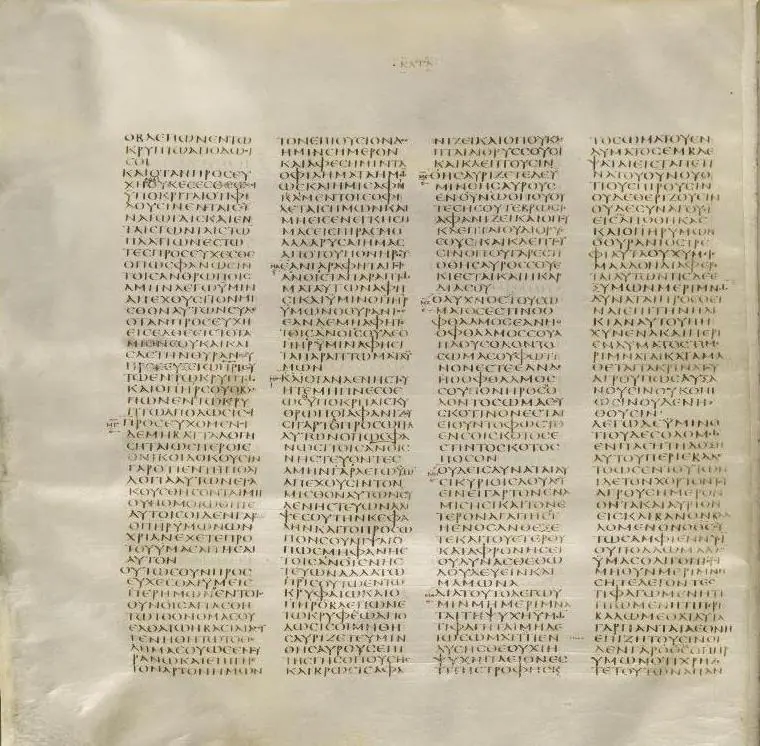
For most of its history Christianity read the New Testament as the record of what happened: the life of Jesus, the founding of the church, the first missionaries. Since the eighteenth century it has also been read as evidence, a set of documents written by particular people at particular times, which can be dated, compared with one another and set beside Jewish and Roman writings, inscriptions and excavations from the same world. Every later page of this series depends on that second kind of reading. This one explains how it works and where it stops.
The short answer: the earliest Christian texts are letters, not biographies; the Gospels came a generation later and depend on one another in ways that can be traced; a handful of non-Christian writers confirm the outline; manuscripts show how the texts were copied and changed; and archaeology supplies the setting, a few names and almost nothing about Jesus himself. No single method is decisive. Where they agree, this series says so; where they do not, it says that too.
The problem: twenty-seven books, none of them a history of their own time
The New Testament is a collection of twenty-seven Greek texts written between about 50 and 120 CE: four Gospels, one history of the early church (Acts), twenty-one letters and one apocalypse (Revelation).[1] Consensus They were not written as a set, they were not gathered into one book for another two centuries (§5), and most of them were written for a particular community with a particular problem, not for posterity.
Three things make the collection hard to use as history:
- The earliest texts say least about Jesus. Paul’s letters are the oldest Christian writings that survive, written in the 50s CE, about twenty to thirty years after the crucifixion. They quote a few sayings of Jesus and an early creed about his death and resurrection, but tell almost nothing of his life.[2][3] The Gospels, which tell the story, are later.
- The Gospels are anonymous. None of the four names its author in the text. The titles “according to Matthew”, “according to Mark” and so on are first attested in the second century (see below).[1][4] Consensus
- They were written to persuade. The Gospel of John says so directly: “these are written so that you may come to believe that Jesus is the Messiah, the Son of God” (John 20:31).[5] That does not make them unreliable, but it means each has to be read for its purpose as well as its information.
What does survive is unusually large. Few people of first-century Judea are documented by four biographical accounts written within a lifetime of their death, and by letters from a man who knew their brother. The question is not whether there is evidence, but how to read it.
Paul first: the oldest Christian writings
Thirteen letters in the New Testament carry Paul’s name. Nearly all critical scholars accept seven of them as his: 1 Thessalonians, Galatians, 1 and 2 Corinthians, Philippians, Philemon and Romans, written between about 50 and 60 CE.[1][6] Consensus The other six (Ephesians, Colossians, 2 Thessalonians, 1 and 2 Timothy and Titus) differ in vocabulary, style and church organisation, and most scholars think some or all of them were written in Paul’s name after his death (§4). Majority
The seven undisputed letters are the firmest ground in the study of early Christianity, for three reasons:
- They can be dated. Paul’s movements in his letters can be fixed against outside events. In Corinth he appears before the Roman proconsul Gallio (Acts 18:12), whose year of office, 51–52 CE, is fixed by an inscription found at Delphi, a letter of the emperor Claudius naming him.[7][8] That makes 1 Thessalonians, written from Corinth around then, the oldest surviving Christian text. Majority
- They are first-person. Paul says he persecuted the church, had a vision of the risen Jesus, met Peter and “James the Lord’s brother” in Jerusalem, and quarrelled with Peter at Antioch (Gal 1–2).[9] These are the only first-hand statements by someone who knew Jesus’ brother and his closest disciple.
- They contain older material. Paul quotes formulas he says he had “received”: the creed of 1 Corinthians 15:3–8 and the words over the bread and cup (1 Cor 11:23–26). The hymn of Philippians 2:6–11 is probably older than the letter too, and he keeps the Aramaic prayer maranatha, “Our Lord, come!” (1 Cor 16:22).[2][3][10][11] Most scholars date the creed of 1 Corinthians 15 to within a few years of the crucifixion. Majority
Acts, written a generation later by the author of Luke, tells Paul’s story at length but sometimes disagrees with Paul’s own account, notably about his visits to Jerusalem. Where they differ, historians generally prefer Paul.[6] Majority (§3)
The Gospels: who wrote them, and when
Dating
The Gospels are dated mainly from internal evidence: what they know, and what they seem to know has already happened.
| Gospel | Most common date | Key reasons | Confidence |
|---|---|---|---|
| Mark | c. 66–74 CE | Jesus’ prophecy of the Temple’s destruction (Mark 13) reads as written during or just after the Jewish revolt of 66–70[12][13] | Majority |
| Matthew | c. 80–90 CE | Uses Mark; parable of the wedding feast has the king “burn their city” (Matt 22:7)[14] | Majority |
| Luke (and Acts) | c. 80–90 CE; some say c. 110–120 | Uses Mark; describes Jerusalem “surrounded by armies” (Luke 21:20)[15] | Majority (range); Contested (late date) |
| John | c. 90–110 CE | Followers of Jesus “put out of the synagogue” (John 9:22); the John Rylands papyrus sets a latest date, if its early dating holds[16][17] | Majority |
A minority, following J. A. T. Robinson’s Redating the New Testament (1976), argues that every book of the New Testament was written before 70, because none clearly describes the Temple’s fall as past.[18] Most scholars find the prophecy passages too specific to have been written before the war. Majority The dates matter less than the order: Paul, then Mark, then Matthew and Luke, then John. That sequence is accepted by almost everyone outside the small Griesbach school (below). Majority
The names
The earliest testimony about the authors comes from Papias, bishop of Hierapolis in Asia Minor, writing around 110–130 CE. His work is lost, but the historian Eusebius quoted it two centuries later. Papias reports what “the Elder” told him:
“Mark became Peter’s interpreter and wrote accurately all that he remembered, not, indeed, in order, of the things said or done by the Lord… Matthew collected the oracles in the Hebrew language, and each interpreted them as best he could.” (trans. Kirsopp Lake)[19]
By about 180 CE, Irenaeus of Lyon names all four and argues that there can be only four Gospels, as there are four winds and four corners of the earth.[20][21] Consensus on the dates of these testimonies.
How much the second-century names can be trusted is debated. Most critical scholars think the authors were Greek-speaking Christians who did not know Jesus, and that the names were attached to anonymous texts as they gained authority: Papias’ “Matthew” wrote in Hebrew, but our Matthew was written in Greek and copies Greek Mark.[1][6] Majority Richard Bauckham has argued the opposite: that the Gospels rest closely on named eyewitnesses, and that Papias is a good witness to how they were made.[4] Contested
Reading the Gospels against one another: the Synoptic problem
Matthew, Mark and Luke are called the Synoptic Gospels because they can be laid side by side and “seen together”. They tell many of the same stories in the same order, often in the same Greek words. John goes its own way: a different order, a ministry of about three years rather than one, long speeches instead of parables, and the Temple incident at the beginning rather than the end.[6] Consensus
The overlap between the Synoptics is too close to be independent memory. Matthew reproduces about 90 percent of Mark’s content, and Luke about half; and where Matthew and Luke tell Mark’s stories, they almost never agree with each other against Mark’s order.[22][23] Most scholars conclude that Mark is the earliest and that Matthew and Luke each used it. This is called Markan priority, and it is the closest thing to a settled result in Gospel studies. Majority
Q, and the case against it
Matthew and Luke also share about 230 verses that are not in Mark, mostly sayings: the Beatitudes, the Lord’s Prayer, “love your enemies”. Most scholars think both drew on a lost collection of sayings, called Q (from German Quelle, “source”).[23] Q has never been found, and is reconstructed entirely from Matthew and Luke. The recovery of the complete Gospel of Thomas in 1945, a collection of sayings with almost no narrative, showed that such books did exist.[24]
The main alternative, the Farrer hypothesis, argues that Luke used Matthew as well as Mark, which explains the shared material without a hypothetical document. Its leading defender, Mark Goodacre, points to the places where Matthew and Luke agree in small changes to Mark, which are hard to explain if they never saw each other’s work.[25] Contested Both camps accept Markan priority.
| Model | Sources | Main proponents |
|---|---|---|
| Two-Source hypothesis | Matthew and Luke independently used Mark and Q | Most scholars; Kloppenborg[23] |
| Farrer hypothesis | Matthew used Mark; Luke used Mark and Matthew | Farrer, Goulder, Goodacre[25] |
| Griesbach (Two-Gospel) hypothesis | Matthew first; Luke used Matthew; Mark condensed both | Farmer; a small minority |
| Augustinian | Matthew, Mark, Luke in canonical order | Augustine; few modern scholars |
What this makes possible
Once the order is known, the changes become evidence. When Mark has Jesus say “Why do you call me good? No one is good but God alone” (Mark 10:18), Matthew rewrites the question as “Why do you ask me about what is good?” (Matt 19:17).[26][27] The later writer smoothed over a saying that had come to seem awkward. Such changes, repeated across hundreds of passages, let scholars watch beliefs about Jesus develop within the first century itself. Majority
Outside witnesses: Josephus, Tacitus, Pliny
Jesus left no writings, and no record of him survives from his own lifetime. Within a century of his death, though, he and his followers are mentioned by writers who were not Christians.
Josephus, c. 93 CE
Flavius Josephus, a Jewish priest and general who went over to the Romans in the war of 66–70, wrote his Jewish Antiquities in Rome around 93–94 CE. It mentions Jesus twice.
The shorter passage describes the execution of James in 62 CE:
“[Ananus] convened the judges of the Sanhedrin and brought before them a man named James, the brother of Jesus who was called the Christ, and certain others.”[28]
Almost all scholars accept it as genuine: it is incidental, it is about James rather than Jesus, and “who was called the Christ” is not how a Christian would put it. Consensus
The longer passage, the Testimonium Flavianum, is a different matter. In its received form it calls Jesus “the Messiah”, says he “appeared to them alive again on the third day”, and hesitates over whether “one ought to call him a man”.[29] A Jew who did not become a Christian would not have written that, and the early Christian writer Origen, around 248, says that Josephus “did not believe in Jesus as the Christ”.[30] Most scholars think Josephus wrote a shorter, neutral notice that Christian copyists later expanded. A tenth-century Arabic paraphrase by the bishop Agapius, published by Shlomo Pines in 1971, gives a more cautious version that some take as closer to the original.[31][32] Majority A minority think the whole passage is a Christian insertion; a smaller one that it is genuine as it stands. Contested
Tacitus, c. 116 CE
The Roman historian Tacitus, describing the fire of Rome in 64 CE, says Nero blamed a group “hated for their vices, whom the crowd called Christians”:
“Christus, from whom the name had its origin, suffered the extreme penalty during the reign of Tiberius at the hands of one of our procurators, Pontius Pilatus.”[33]
Tacitus was hostile to Christians and had no reason to invent their founder. Whether he checked Roman records or repeated what Christians said is unknown. His title for Pilate, “procurator”, is the one used in his own day; an inscription shows that Pilate’s title was in fact “prefect” (below). Consensus that the passage is genuine; Majority that it is independent of the Gospels.
Pliny the Younger, c. 112 CE
Pliny, governor of Bithynia and Pontus in northern Turkey, wrote to the emperor Trajan asking what to do about Christians brought before him. Under interrogation, including the torture of two enslaved women “who were called deaconesses” (ministrae), they told him that
“they were accustomed to meet on a fixed day before dawn and sing responsively a hymn to Christ as to a god.”[34]
Pliny says nothing about the historical Jesus. He shows something else: within about eighty years of the crucifixion, Christians had spread through the “cities, villages and farms” of a province, were numerous enough to worry a governor, met on a fixed day, worshipped Christ, and had women in recognised roles.[34][35] Consensus
Others
Suetonius, around 121, says Claudius “expelled the Jews from Rome, since they were constantly making disturbances at the instigation of Chrestus”, an event usually dated around 49 CE and often linked with Acts 18:2.[36][37] Whether “Chrestus” means Christ, garbled, or a local troublemaker of that name is debated. Contested Later Jewish traditions about a “Yeshu” in the Babylonian Talmud (b. Sanhedrin 43a) are centuries later and their relation to the historical Jesus is disputed.[38] Contested
What these sources together establish is modest and firm: a Jew called Jesus, regarded by his followers as the Messiah, was executed under Pontius Pilate, and a movement in his name spread to Rome within a generation. That outline is all historians need from outside sources; the details come from Christian ones. Consensus
Archaeology: the setting, and a few names
No object can be tied directly to Jesus. The Shroud of Turin is radiocarbon-dated to 1260–1390 CE;[39] the “James ossuary”, inscribed “James son of Joseph, brother of Jesus”, is genuine as an ossuary but its inscription’s final phrase is widely suspected of being a modern addition. A forgery trial in Israel ended in 2012 with its owner acquitted of forgery, the judge stressing that this did not show the inscription was authentic.[40] Contested What archaeology does supply is the world the texts describe, and a handful of names.
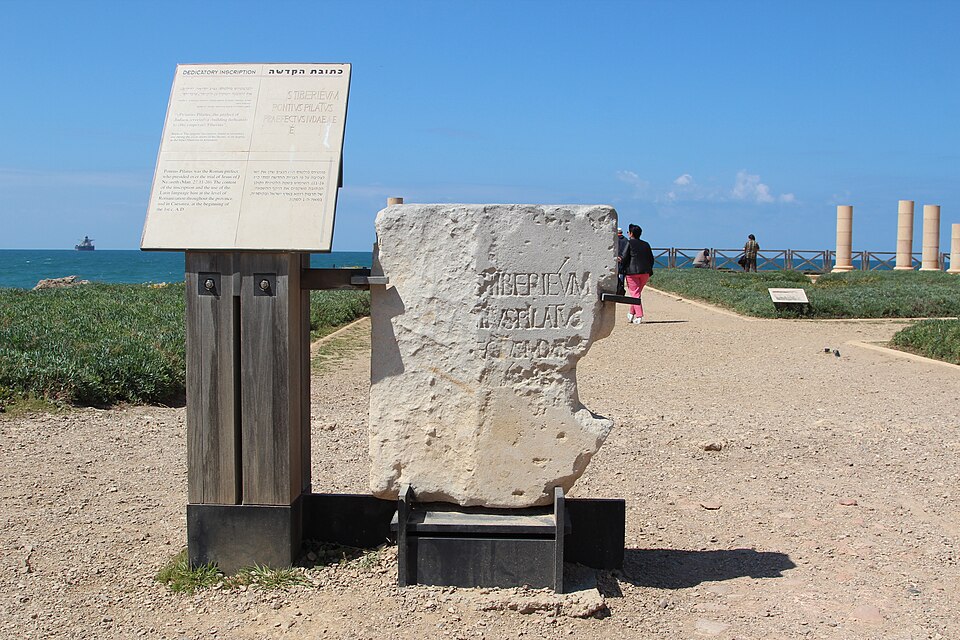
- Pontius Pilate. A limestone block found in 1961 in the theatre at Caesarea, reused in a later rebuilding, records that “[Pon]tius Pilatus, [prae]fectus of Juda[ea]” dedicated a building in honour of Tiberius.[41] It is the only inscription securely naming Pontius Pilate, and it fixes his title as prefect. Consensus
- Caiaphas. In 1990, construction workers in Jerusalem’s Peace Forest uncovered a burial cave with an ornate ossuary inscribed “Yehosef bar Qayafa”, Joseph son of Caiaphas. Josephus gives the high priest’s full name as “Joseph who was called Caiaphas”.[42][43] Most scholars accept the identification; some doubt it. Majority
- A crucified man. In 1968, a tomb at Giv’at ha-Mivtar in Jerusalem yielded the heel bone of a young man named Yehoḥanan, still pierced by an iron nail.[44][45] It is the clearest physical evidence of crucifixion from the period, and it shows that a crucified man could be buried in a family tomb, a point relevant to the burial stories (§2). Consensus
- Galilee. Excavations at Sepphoris, Magdala, Capernaum and Nazareth show Jewish villages and towns: stone vessels for ritual purity, immersion pools, no pig bones, a synagogue at Magdala and, just east of Galilee, another at Gamla.[46][47] The Galilee of Jesus was Jewish, not the mixed “Galilee of the Gentiles” once imagined. Majority (§1)
The earliest Christian buildings
For two centuries Christians met in houses. The earliest securely identified church is a house at Dura-Europos on the Euphrates, remodelled for worship around 240 and buried when the city’s defences were rebuilt before the Persian siege of 256. Its baptistery walls carry the oldest datable Christian paintings: a good shepherd, the healing of a paralysed man, and a procession of women, usually read as the women at Jesus’ tomb (Michael Peppard argues for the wise virgins of the parable).[48][49] Consensus A mosaic found in 2005 in a prison yard near Megiddo in Israel, in what was a Roman army camp, records that “the God-loving Akeptous has offered the table to God Jesus Christ as a memorial”. Its excavators dated it to about 230; others argue for the late third or early fourth century.[50] Contested on the date.
Manuscripts: how the text reached us
No original of any New Testament book survives. What survives are copies, and copies of copies, in Greek and in early translations into Latin, Syriac and Coptic.
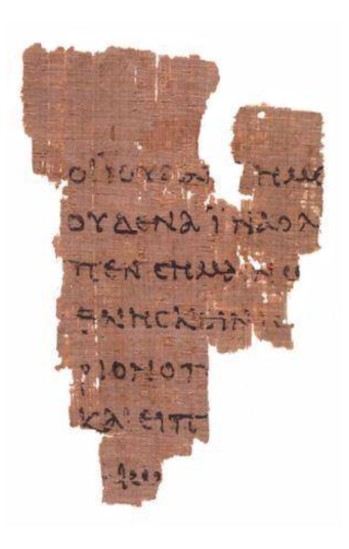
- How many. About 5,800 Greek manuscripts are catalogued, from scraps to complete Bibles, the great majority from the ninth century or later.[51] Consensus
- The earliest. About 140 papyri, mostly from the sands of Egypt. P52, a fragment of John 18 bought in 1920 and published in 1935, was dated by its editor to the first half of the second century and became famous as the oldest New Testament manuscript. Brent Nongbri has argued that the handwriting comparisons allow a range into the third century; others still favour c. 125–175.[17][52] Contested The oldest substantial manuscripts are papyri of about 200–250: P46, with most of Paul’s letters, and P66 and P75, with John and Luke.[53][54][51] Majority
- The first great codices. Codex Sinaiticus (c. 325–360), which Constantin von Tischendorf took from St Catherine’s Monastery in Sinai in 1844 and 1859, and Codex Vaticanus (c. 300–350), in the Vatican Library since at least the fifteenth century.[55][56] Sinaiticus is the oldest complete New Testament; Vaticanus breaks off in Hebrews and lacks the Pastoral letters, Philemon and Revelation; it also includes the Epistle of Barnabas and the Shepherd of Hermas, which did not make the final canon (§5). Consensus
What the copies change
Copyists made mistakes and, occasionally, deliberate changes. Estimates of the number of textual variants run to several hundred thousand, more than there are words in the New Testament, because every difference in every manuscript is counted.[57][58] The great majority are spelling, word order and slips of the eye that make no difference to meaning. Consensus A small number matter:
| Passage | What happened | Confidence |
|---|---|---|
| Mark 16:9–20 | The resurrection appearances after Mark 16:8 are absent from Sinaiticus and Vaticanus; the earliest manuscripts end with the women fleeing the empty tomb “for they were afraid”[59][60] | Consensus |
| John 7:53–8:11 | The woman taken in adultery (“let anyone among you who is without sin…”) is absent from P66, P75, Sinaiticus and Vaticanus, and moves around in later manuscripts[61][60] | Consensus |
| 1 John 5:7–8 | The “Johannine comma”, the clearest Trinitarian verse in the Bible, began as a Latin addition; it is found in only a handful of late Greek manuscripts, none before the fourteenth century except as later marginal notes, and Erasmus added it to his third edition in 1522 after a Greek manuscript containing it, made around 1520, was produced[60] | Consensus |
| Luke 22:43–44 | Jesus sweats “like great drops of blood” in Gethsemane; missing from early witnesses including P75 and Vaticanus[60] | Contested |
| Luke 23:34 | “Father, forgive them, for they do not know what they are doing” is missing from P75 and Vaticanus[60] | Contested |
Textual critics reconstruct the earliest recoverable text by comparing manuscripts. The standard critical edition, the Nestle–Aland Novum Testamentum Graece, now in its 28th edition (2012), is the base of most modern translations.[62] Consensus Bart Ehrman and Daniel Wallace, who disagree on most things, agree that no Christian doctrine depends on a disputed reading alone; they disagree on how much the early, less controlled period of copying may have altered.[57][58] Contested
The lost Christianities: Nag Hammadi and Oxyrhynchus
Until the twentieth century, the Christians whom later orthodox writers called heretics were known mainly from the books written against them. That changed with finds in Egypt.
- Oxyrhynchus. From 1896, Bernard Grenfell and Arthur Hunt dug the ancient rubbish mounds of a town on the Nile and recovered hundreds of thousands of papyrus fragments. Among them were Greek sayings of Jesus later identified as parts of the Gospel of Thomas (P.Oxy. 1, 654 and 655), copied about 200–250.[63] Consensus
- Nag Hammadi. In December 1945, farmers digging for fertiliser near Nag Hammadi in Upper Egypt found a sealed jar with twelve leather-bound papyrus books and leaves of a thirteenth. They contain 52 tractates in Coptic (about 46 distinct works), translated from Greek, including the only complete Gospel of Thomas, the Gospel of Philip, the Gospel of Truth and the Apocryphon of John.[64][65] Papyrus scraps used to stiffen the covers carry dates in the 340s, so the books were made after that.[64] Consensus
- The Berlin Codex and Codex Tchacos. The Gospel of Mary, in which Mary Magdalene teaches the disciples, survives in a Coptic book bought in Cairo in 1896 and published in 1955, and in two Greek fragments.[66][67] A Gospel of Judas, probably the work Irenaeus knew by that name around 180, survived in a codex found in the 1970s and published in 2006; it was radiocarbon-dated to about 220–340.[68][69] Consensus
How old the texts inside these books are is debated. Most scholars date the Gospel of Thomas in something like its present form to the second century; a minority argue that an early core goes back to the first.[70][71] Contested Whether the many texts called “Gnostic” belong to one movement at all is also debated (§5). What the finds establish beyond doubt is that second-century Christianity was more varied than later orthodox writers described. Consensus
How historians weigh a saying or a story
To decide which Gospel material goes back to Jesus, twentieth-century scholars developed criteria of authenticity:[32]
- Multiple attestation. A saying or deed found in independent sources (Mark, Q, Paul, John, material only in Matthew or only in Luke) is more likely early.
- Embarrassment. Material that the early church found awkward is unlikely to have been invented: that Jesus was baptised by John, who baptised “for the forgiveness of sins”; that his family thought he was “out of his mind” (Mark 3:21); that he said he did not know the day or hour of the end (Mark 13:32).[72][73]
- Dissimilarity. Material unlike both contemporary Judaism and the later church was once taken as distinctive of Jesus. It has fallen out of favour, because it produces a Jesus who was not Jewish.
- Coherence and context. Material that fits Galilee and Judea in the 20s CE, and the rest of what is established, gains weight.
Since about 2010, many scholars have argued that the criteria promise more than they deliver. Chris Keith, Anthony Le Donne and Dale Allison propose instead to work from memory: the Gospels preserve how Jesus was remembered, with the distortions that memory always introduces, and the historian looks for the general impressions repeated across many stories rather than verifying sayings one by one.[74][75] Contested The two approaches agree more in their results than in their method.
Faith and history: what historians can and cannot say
Historians can say when a text was written, by what kind of people, out of what earlier material and for what purpose. They can say what the first Christians believed and when they began to believe it. They cannot say whether Jesus was the Son of God or whether he rose from the dead. Those questions are outside the reach of historical method, in either direction.
The clearest case is the resurrection. That Jesus’ followers believed they had seen him alive after his death is among the best-attested facts about early Christianity: Paul lists the appearances in a creed he received early, and he claims to have had one himself.[2] Consensus What happened to produce that belief is a different kind of question. N. T. Wright has argued at length that a bodily resurrection is the best historical explanation;[76] Gerd Lüdemann argues that the appearances were visions with psychological causes;[77] Bart Ehrman holds that some disciples had visions but that historians cannot say whether they were veridical;[78] Dale Allison has examined both cases and concluded that history alone cannot settle it.[79] This series dates the belief and reports the arguments. It does not adjudicate the miracle.
Three further points of method:
- Believers and non-believers do the same history. John P. Meier imagined an “unpapal conclave” of a Catholic, a Protestant, a Jew and an agnostic, locked in a library until they agreed on what could be known about Jesus.[32] Their consensus is the “Majority” and “Consensus” of this series. Many of the scholars cited here are Christian, Jewish or agnostic, and their conclusions do not divide neatly along those lines.
- Tradition is evidence too. The church’s own memory, from Papias to Eusebius, is reported as what it says, with its date, and weighed like any other source. It is often right, and sometimes demonstrably wrong.
- Silence is weak evidence. Most ancient people left no trace at all. That a Galilean preacher appears in no record from his lifetime is what would be expected, not a sign he did not exist (§2).
What “Christianity” means in this series
The word Christianismos first appears around 110 CE, in the letters of Ignatius of Antioch (§4); the followers of Jesus were first called Christianoi, “Christ people”, at Antioch, according to Acts.[80][81] For the first decades the movement was a Jewish group, and the series calls it “the Jesus movement” until it becomes a separate religion, a process that took longer than once thought and is told from the Jewish side in the Judaism series. “The church” in the singular is a later ideal; until the fourth century there were churches, with different texts, leaders and beliefs (§5). Majority
Reading conventions used throughout
- Dates are BCE/CE, given as ranges where they are uncertain, with a confidence tag.
- Greek, Latin, Syriac and Coptic appear in italic transliteration, then translation, then what the passage is being used to prove.
- The Bible is cited by book, chapter and verse. Translations are this site’s own, close to the New Revised Standard Version. “Hebrew Bible” means the Jewish scriptures; “Old Testament” means the same books as part of the Christian Bible.
- Jesus and Christ. The historical chapters say “Jesus”. Christos, Greek for “anointed”, the Messiah, is treated as a title, used in quotations and in the names of beliefs.
- Abbreviations: Ant. = Josephus, Jewish Antiquities; HE = Eusebius, Ecclesiastical History; AH = Irenaeus, Against Heresies; P = papyrus, as in P52.
- Confidence tags: Consensus Majority Contested Speculative Political
Further reading
Show further reading (8 works)
- Bart D. Ehrman, The New Testament: A Historical Introduction to the Early Christian Writings (Oxford, 7th ed. 2020): the standard critical introduction.
- Raymond E. Brown, An Introduction to the New Testament (Doubleday, 1997), the Catholic standard, careful and fair to every position.
- Bruce M. Metzger and Bart D. Ehrman, The Text of the New Testament (Oxford, 4th ed. 2005): how the manuscripts were copied and how textual criticism works.
- Mark Goodacre, The Synoptic Problem: A Way Through the Maze (Sheffield, 2001) and John S. Kloppenborg, Q, the Earliest Gospel (Westminster John Knox, 2008): the Synoptic problem from both sides.
- John P. Meier, A Marginal Jew, vol. 1: The Roots of the Problem and the Person (Doubleday, 1991): the outside sources and the criteria, exhaustively.
- Richard Bauckham, Jesus and the Eyewitnesses (Eerdmans, 2nd ed. 2017): the strongest case for eyewitness Gospels.
- Elaine Pagels, The Gnostic Gospels (Random House, 1979) and James M. Robinson, ed., The Nag Hammadi Library in English (Harper & Row, 1977).
- Dale C. Allison Jr., Constructing Jesus: Memory, Imagination, and History (Baker, 2010).
References
- ^ a b c d Bart D. Ehrman The New Testament: A Historical Introduction to the Early Christian Writings. Oxford University Press, 7th ed., 2020. The standard critical introduction.
- ^ a b c 1 Corinthians 15:3–8 — Paul, First Letter to the Corinthians. c. 54 CE. Greek. A creed Paul 'received': Christ died, was buried, was raised on the third day, and appeared to Cephas, the Twelve, five hundred, James, all the apostles and Paul. read the text
- ^ a b 1 Corinthians 11:23–26 — Paul, First Letter to the Corinthians. c. 54 CE. Greek. Paul hands on the words over the bread and cup 'on the night when he was betrayed', the oldest account of the Last Supper. read the text
- ^ a b Richard Bauckham Jesus and the Eyewitnesses: The Gospels as Eyewitness Testimony. Eerdmans, 2nd ed., 2017. The strongest modern case that the Gospels rest on named eyewitnesses; widely debated.
- ^ John 20:30–31 — Gospel of John (New Testament). c. 90–110 CE. Greek. The Gospel states its purpose: 'these are written so that you may come to believe that Jesus is the Messiah, the Son of God'. read the text
- ^ a b c d Raymond E. Brown An Introduction to the New Testament. Doubleday, 1997. The Catholic standard introduction, fair to every position.
- ^ Gallio inscription — Letter of Claudius to Delphi (Delphi, Greece). c. 52 CE. Greek. A letter of the emperor Claudius naming Lucius Junius Gallio as proconsul of Achaia, which fixes Paul's stay in Corinth to about 50–52 CE. about
- ^ Acts 18:12–17 — Acts of the Apostles (New Testament). c. 80–90 CE. Greek. Paul is brought before Gallio, proconsul of Achaia, in Corinth; Gallio's year of office is fixed by the Delphi inscription. read the text
- ^ Galatians 1:13–2:14 — Paul, Letter to the Galatians. c. 50–55 CE. Greek. Paul's own account: he persecuted the church, received a revelation, stayed with Cephas and met 'James the Lord's brother', and later confronted Peter at Antioch. read the text
- ^ Philippians 2:6–11 — Paul, Letter to the Philippians. c. 50s CE. Greek. A hymn, probably pre-Pauline: Christ Jesus 'in the form of God' empties himself, is exalted, and every knee bows at his name. read the text
- ^ 1 Corinthians 16:22 — Paul, First Letter to the Corinthians. c. 54 CE. Greek. Paul closes with the Aramaic prayer maranatha, 'Our Lord, come!', preserved untranslated in a Greek letter. read the text
- ^ Mark 13:1–2 — Gospel of Mark (New Testament). c. 70 CE. Greek. Jesus predicts that not one stone of the Temple will be left upon another. read the text
- ^ Joel Marcus Mark 1–8 (Anchor Yale Bible 27). Doubleday, 2000. Dates Mark to the Jewish revolt, c. 69–70.
- ^ Matthew 22:7 — Gospel of Matthew (New Testament). c. 80–90 CE. Greek. In the parable of the wedding banquet the king sends troops who 'burned their city', often read as Jerusalem in 70. read the text
- ^ Luke 21:20 — Gospel of Luke (New Testament). c. 80–90 CE. Greek. 'When you see Jerusalem surrounded by armies, then know that its desolation has come near', often read as written after 70. read the text
- ^ John 9:22 — Gospel of John (New Testament). c. 90–110 CE. Greek. Anyone confessing Jesus as Messiah would be 'put out of the synagogue' (aposynagōgos), usually read as reflecting the late first century. read the text
- ^ a b Papyrus 52 (P. Rylands Gk. 457) — Fragment of the Gospel of John (John Rylands Library, Manchester). c. 125–175 CE, perhaps later. Greek. A scrap with John 18:31–33, 37–38, long called the oldest New Testament manuscript; its date range is now disputed. about
- ^ John A. T. Robinson Redating the New Testament. SCM Press, 1976. The case that every New Testament book predates 70 CE.
- ^ Eusebius, Ecclesiastical History 3.39 — Ecclesiastical History. early 4th c. CE (quoting Papias, c. 110–130). Greek. Papias' testimony that Mark wrote down Peter's recollections and Matthew collected the oracles 'in the Hebrew language'. read the text
- ^ Irenaeus, Against Heresies 3.1.1 — Against Heresies. c. 180 CE. Greek (Latin translation). The earliest list naming Matthew, Mark, Luke and John as authors of the four Gospels. read the text
- ^ Irenaeus, Against Heresies 3.11.8 — Against Heresies. c. 180 CE. Greek (Latin translation). There can be neither more nor fewer than four Gospels, as there are four zones of the world and four principal winds. read the text
- ^ Mark Goodacre The Synoptic Problem: A Way Through the Maze. Sheffield Academic Press, 2001. A clear introduction to the problem and its solutions.
- ^ a b c John S. Kloppenborg Q, the Earliest Gospel: An Introduction to the Original Stories and Sayings of Jesus. Westminster John Knox, 2008. The leading Q scholar's introduction for general readers.
- ^ Gospel of Thomas — Nag Hammadi Codex II,2. 2nd c. CE (composition; date disputed). Coptic (from Greek). One hundred and fourteen sayings of Jesus with almost no narrative. about
- ^ a b Mark Goodacre The Case Against Q: Studies in Markan Priority and the Synoptic Problem. Trinity Press International, 2002. The main modern defence of the Farrer hypothesis.
- ^ Mark 10:18 — Gospel of Mark (New Testament). c. 70 CE. Greek. 'Why do you call me good? No one is good but God alone', a saying Matthew rewords. read the text
- ^ Matthew 19:17 — Gospel of Matthew (New Testament). c. 80–90 CE. Greek. Matthew rewords Mark 10:18 as 'Why do you ask me about what is good?' read the text
- ^ Josephus, Antiquities 20.200 — Jewish Antiquities. c. 93 CE. Greek. The high priest Ananus has 'the brother of Jesus who was called Christ, whose name was James' stoned in 62 CE; the passage is generally accepted as authentic. read the text
- ^ Josephus, Antiquities 18.63–64 (Testimonium Flavianum) — Jewish Antiquities. c. 93 CE (received text later expanded). Greek. Jesus as 'a wise man', 'a doer of surprising deeds', condemned to the cross by Pilate; the received text's Christian phrases are generally thought to be interpolations. read the text
- ^ Origen, Against Celsus 1.47 — Against Celsus. c. 248 CE. Greek. Origen says Josephus 'did not believe in Jesus as the Christ', evidence that his text of Josephus lacked the Testimonium's Christian phrases. read the text
- ^ Shlomo Pines An Arabic Version of the Testimonium Flavianum and Its Implications. Israel Academy of Sciences and Humanities, 1971. Publishes Agapius' tenth-century paraphrase of Josephus.
- ^ a b c John P. Meier A Marginal Jew: Rethinking the Historical Jesus, vol. 1: The Roots of the Problem and the Person. Doubleday, 1991. The outside sources, the criteria, and the 'unpapal conclave'.
- ^ Tacitus, Annals 15.44 — Annals. c. 116 CE. Latin. Explaining the name of the Christians blamed for the fire of Rome, Tacitus says Christus was executed in the reign of Tiberius by the procurator Pontius Pilate.
- ^ a b Pliny the Younger, Letters 10.96 — Letters. c. 112 CE. Latin. The governor of Bithynia-Pontus reports that Christians met before dawn to sing 'a hymn to Christ as to a god', and that he tortured two enslaved women called ministrae. about
- ^ Robert Louis Wilken The Christians as the Romans Saw Them. Yale University Press, 2nd ed., 2003. Pliny, Celsus, Porphyry and Julian on the early Christians.
- ^ Suetonius, Claudius 25.4 — Lives of the Caesars. c. 121 CE. Latin. Claudius 'expelled the Jews from Rome, since they were constantly making disturbances at the instigation of Chrestus'. about
- ^ Acts 18:1–2 — Acts of the Apostles (New Testament). c. 80–90 CE. Greek. Paul meets Aquila and Priscilla in Corinth, who had left Italy 'because Claudius had ordered all Jews to leave Rome'. read the text
- ^ Peter Schäfer Jesus in the Talmud. Princeton University Press, 2007. The Talmud's Jesus passages as late counter-narratives to the Gospels.
- ^ P. E. Damon et al. Radiocarbon dating of the Shroud of Turin. Nature 337: 611–615, 1989. Three laboratories date the linen to 1260–1390 CE.
- ^ James ossuary — Limestone ossuary from the antiquities market. 1st c. CE (inscription disputed). Aramaic. Inscribed 'Yaakov bar Yosef akhui di Yeshua'; an Israel Antiquities Authority panel judged the inscription partly forged, and in 2012 its owner was acquitted of forgery, the judge saying this did not show the inscription was authentic. about
- ^ Pilate Stone — Dedicatory inscription, Caesarea Maritima (Israel Museum). 26–36 CE. Latin. '[Pon]tius Pilatus, [prae]fectus Iuda[ea]e' dedicates a building in honour of Tiberius; the only inscription securely naming Pontius Pilate, and the source of his title. about
- ^ Caiaphas ossuary — Ossuary from the Peace Forest tomb, Jerusalem (Israel Museum). 1st c. CE. Aramaic. An ornate ossuary inscribed 'Yehosef bar Qayafa', found in 1990 and widely identified with the high priest Caiaphas. about
- ^ Josephus, Antiquities 18.35 — Jewish Antiquities. c. 93 CE. Greek. Valerius Gratus appoints 'Joseph, who was called Caiaphas' high priest. read the text
- ^ Heel bone of Yehoḥanan — Tomb at Giv'at ha-Mivtar, Jerusalem. 1st c. CE. A right heel bone pierced by an iron nail, from a crucified man buried in a family tomb; found in 1968. about
- ^ Joseph Zias and Eliezer Sekeles The Crucified Man from Giv'at ha-Mivtar: A Reappraisal. Israel Exploration Journal 35: 22–27, 1985. Re-examines the heel bone and corrects the first reconstruction.
- ^ Jonathan L. Reed Archaeology and the Galilean Jesus: A Re-examination of the Evidence. Trinity Press International, 2000. Nazareth, Capernaum and Sepphoris in the archaeology.
- ^ Mark A. Chancey The Myth of a Gentile Galilee. Cambridge University Press, 2002. Shows that Galilee in Jesus' day was overwhelmingly Jewish.
- ^ Dura-Europos church — House church at Dura-Europos, Syria (paintings now at Yale University Art Gallery). c. 240–256 CE. Greek. The earliest securely identified Christian building, with a baptistery painted with a good shepherd, the healing of the paralytic and a procession of women, usually read as the women at the tomb. about
- ^ Michael Peppard The World's Oldest Church: Bible, Art, and Ritual at Dura-Europos, Syria. Yale University Press, 2016. The house church and its paintings.
- ^ Megiddo church mosaic — Prayer hall at Kefar ʿOthnay, near Megiddo. 3rd–early 4th c. CE (disputed). Greek. 'The God-loving Akeptous has offered the table to God Jesus Christ as a memorial', found in 2005. about
- ^ a b Bruce M. Metzger and Bart D. Ehrman The Text of the New Testament: Its Transmission, Corruption, and Restoration. Oxford University Press, 4th ed., 2005. The standard handbook of New Testament textual criticism.
- ^ Brent Nongbri The Use and Abuse of P52: Papyrological Pitfalls in the Dating of the Fourth Gospel. Harvard Theological Review 98: 23–48, 2005. Argues that P52's handwriting allows a date range into the third century; others still favour c. 125–175.
- ^ Papyrus 46 (Chester Beatty II) — Codex of Paul's letters (Chester Beatty Library, Dublin; University of Michigan). c. 200–250 CE. Greek. The oldest substantial manuscript of Paul's letters. about
- ^ Papyrus 75 (Bodmer XIV–XV) — Codex of Luke and John (Vatican Library). c. 200–250 CE (some argue later). Greek. The oldest substantial copy of Luke and one of the oldest of John; its text is very close to Codex Vaticanus. about
- ^ Codex Sinaiticus — British Library (most leaves); Leipzig, St Catherine's Monastery and St Petersburg. c. 325–360 CE. Greek. About half of the Greek Old Testament survives, with the oldest complete copy of the New Testament. read the text
- ^ Codex Vaticanus (Vat. gr. 1209) — Vatican Library, Rome. c. 300–350 CE. Greek. One of the two oldest near-complete Bibles: most of the Greek Old Testament and most of the New Testament in one book. about
- ^ a b Bart D. Ehrman Misquoting Jesus: The Story Behind Who Changed the Bible and Why. HarperSanFrancisco, 2005. Textual criticism for general readers, emphasising theologically motivated changes.
- ^ a b Daniel B. Wallace, ed. Revisiting the Corruption of the New Testament. Kregel, 2011. An evangelical textual critic's response to Ehrman.
- ^ Mark 16:8 — Gospel of Mark (New Testament). c. 70 CE. Greek. The earliest manuscripts of Mark end here: the women flee the tomb and 'said nothing to anyone, for they were afraid'. read the text
- ^ a b c d e Bruce M. Metzger A Textual Commentary on the Greek New Testament. Deutsche Bibelgesellschaft, 2nd ed., 1994. The committee's reasoning on every significant variant.
- ^ John 7:53–8:11 — Gospel of John (New Testament). c. 90–110 CE. Greek. The woman taken in adultery, absent from the earliest manuscripts and placed in different spots by later ones. read the text
- ^ Novum Testamentum Graece, 28th ed. — Nestle–Aland critical edition (Deutsche Bibelgesellschaft). 2012. Greek. The standard critical text of the Greek New Testament and the base of most modern translations. about
- ^ P.Oxy. 1, 654, 655 — Greek fragments of the Gospel of Thomas from Oxyrhynchus. c. 200–250 CE. Greek. Sayings of Jesus found from 1897, identified after 1945 as parts of the Gospel of Thomas. about
- ^ a b Nag Hammadi codices — Thirteen papyrus codices (Coptic Museum, Cairo). mid-4th c. CE (cartonnage dated 340s). Coptic. Fifty-two texts found buried in a jar in December 1945, including the Gospel of Thomas, the Gospel of Philip and the Apocryphon of John. about
- ^ James M. Robinson, ed. The Nag Hammadi Library in English. Harper & Row, 1977. The first complete English translation of the codices.
- ^ Gospel of Mary — Berlin Codex (P. Berol. 8502); P.Oxy. 3525; P.Ryl. 463. 2nd c. CE (composition). Coptic and Greek. Mary Magdalene comforts and teaches the disciples, and Peter questions whether the Saviour would speak to a woman privately. about
- ^ Karen L. King The Gospel of Mary of Magdala: Jesus and the First Woman Apostle. Polebridge Press, 2003. Translation and study of the Gospel of Mary.
- ^ Gospel of Judas — Codex Tchacos. codex c. 220–340 CE (radiocarbon); composition 2nd c.. Coptic. A dialogue in which Jesus singles out Judas; the codex was found in the 1970s and published in 2006. about
- ^ Irenaeus, Against Heresies 1.31.1 — Against Heresies. c. 180 CE. Greek (Latin translation). Irenaeus mentions 'a fictitious history' called the Gospel of Judas, used by a group later called Cainites. read the text
- ^ April D. DeConick Recovering the Original Gospel of Thomas: A History of the Gospel and Its Growth. T&T Clark, 2005. Argues for an early 'kernel' of Thomas from before 50 CE, expanded into the present text by about 120.
- ^ Mark Goodacre Thomas and the Gospels: The Case for Thomas's Familiarity with the Synoptics. Eerdmans, 2012. Argues that the Gospel of Thomas knew Matthew and Luke and is therefore second-century.
- ^ Mark 3:21 — Gospel of Mark (New Testament). c. 70 CE. Greek. Jesus' family go out to restrain him, 'for people were saying, He has gone out of his mind'. read the text
- ^ Mark 13:32 — Gospel of Mark (New Testament). c. 70 CE. Greek. 'About that day or hour no one knows, neither the angels in heaven, nor the Son, but only the Father.' read the text
- ^ Chris Keith and Anthony Le Donne, eds. Jesus, Criteria, and the Demise of Authenticity. T&T Clark, 2012. The critique of the criteria of authenticity.
- ^ Dale C. Allison Jr. Constructing Jesus: Memory, Imagination, and History. Baker Academic, 2010. Argues for working from recurring impressions in the tradition rather than verifying sayings one by one.
- ^ N. T. Wright The Resurrection of the Son of God. Fortress Press, 2003. The fullest historical case for a bodily resurrection.
- ^ Gerd Lüdemann The Resurrection of Jesus: History, Experience, Theology. Fortress Press, 1994. Argues that the appearances to Peter and Paul were visions with psychological causes.
- ^ Bart D. Ehrman How Jesus Became God: The Exaltation of a Jewish Preacher from Galilee. HarperOne, 2014. A developmental account of early Christology and the resurrection visions.
- ^ Dale C. Allison Jr. The Resurrection of Jesus: Apologetics, Polemics, History. T&T Clark, 2021. The most thorough recent examination of the resurrection evidence, concluding that history cannot settle the question.
- ^ Ignatius, To the Magnesians 10 — Letters of Ignatius of Antioch. c. 110 CE. Greek. The earliest known use of the word Christianismos, 'Christianity', set against Ioudaismos. read the text
- ^ Acts 11:26 — Acts of the Apostles (New Testament). c. 80–90 CE. Greek. At Antioch 'the disciples were first called Christians'. read the text