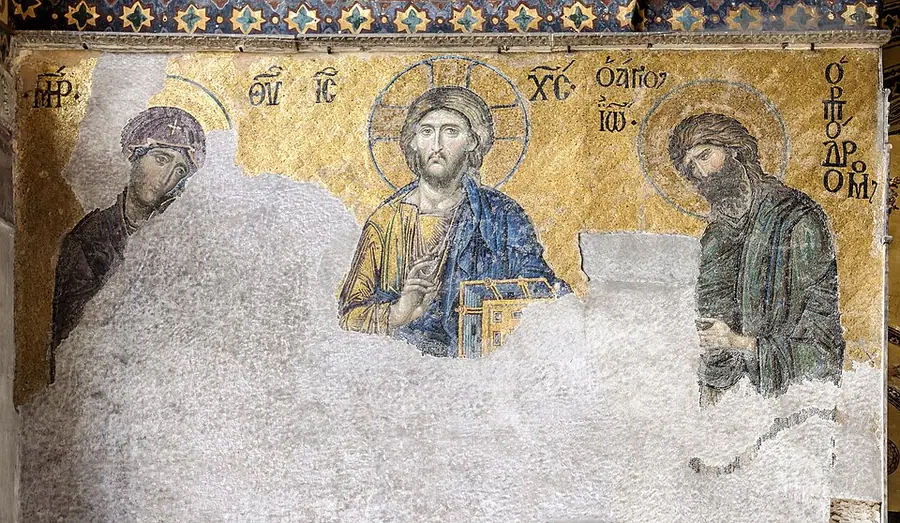
The usual answer is a date, 1054, and a cause, the pope. Both are half right. In July 1054 a papal legate laid a bull of excommunication on the altar of Hagia Sophia, and the claim of the bishop of Rome to authority over the whole church was the deepest issue between the two sides. But historians no longer treat 1054 as the moment the churches split, and they rarely reduce the split to one cause. It was a long estrangement, decided less by theologians than by a crusade.[1][2] Majority
Two churches in one empire
For their first thousand years the Greek-speaking and Latin-speaking churches belonged, at least in theory, to one church. They shared the creeds of Nicaea and Constantinople and the councils that defined them (§6). But they had always been different. The East had several ancient patriarchates, Constantinople, Alexandria, Antioch and Jerusalem; the West had one, Rome. By the sixth century few Greek bishops read Latin and fewer Latin bishops read Greek.[1] Consensus
They had quarrelled before. Rome and Constantinople were out of communion from 484 to 519, in the Acacian schism, over the aftermath of Chalcedon. That break was healed, as later ones were, but each left a memory of the other side as unreliable.[1] Consensus
What they disagreed about
Byzantine writers kept long lists of “errors of the Latins”. Tia Kolbaba has shown that many of the items were about ritual and custom, fasting on Saturdays, shaving, the bread of the Eucharist, and that for ordinary believers these could matter as much as doctrine.[3] Majority The issues that lasted were five.
Authority. The bishops of Rome came to claim jurisdiction over the whole church, culminating in the claims of Gregory VII in the 1070s (§8). Eastern bishops granted Rome a primacy of honour among the patriarchs, first among equals, but not the right to govern the other churches. This is the disagreement that has outlasted all the others.[2][1] Consensus
The creed. The creed of 381 says the Holy Spirit “proceeds from the Father”. Latin theology, following Augustine, taught that the Spirit proceeds from the Father and the Son, filioque. The word entered the creed in Spain at the Third Council of Toledo in 589, spread to the Frankish church under Charlemagne, and was sung in Rome only around 1014. Eastern theologians objected both to the doctrine and to the right of one part of the church to change a creed agreed by an ecumenical council.[4] Majority on the dates; Consensus that both objections are made.
Bread. The Latin church used unleavened bread in the Eucharist, the Greek church leavened bread. In the 1050s this became the presenting issue.[3] Consensus
Married priests. The Latin church made clerical celibacy binding in the twelfth century; the Eastern churches ordained married men as priests and still do (§8).[2] Consensus
Purgatory. Later, the Latin doctrine of purgatory, set out at Lyon in 1274, became a further point of difference.[5] Consensus
The quarrel of the ninth century
The first great open clash came in the 860s, when Pope Nicholas I refused to recognise Photius as patriarch of Constantinople, and Photius, in 867, denounced the filioque and the Latin missions in Bulgaria. Pope and patriarch condemned each other. The quarrel was patched up, but it joined the two issues, authority and the creed, that would recur.[4][1] Consensus
1054: what happened, and why it was not the end
In 1054 Pope Leo IX sent three legates to Constantinople, led by Cardinal Humbert of Silva Candida. The patriarch, Michael Cerularius, had closed the Latin churches in the city the year before; the legates came to negotiate an alliance against the Normans and to answer Greek attacks on Latin customs. The talks failed. On 16 July the legates laid a bull excommunicating Cerularius on the altar of Hagia Sophia, and days later a Greek synod excommunicated the legates.[6] Consensus
Three things make 1054 a poor date for the split. The sentences were personal: Humbert condemned the patriarch and his supporters, not the Greek church, and the synod condemned the legates, not the pope. Leo IX had died three months earlier, so the legates’ authority was doubtful. And contemporaries did not treat the event as a turning point; contacts, negotiations and even shared worship went on for generations.[1][3] Majority
1204: the real break
What made the separation popular and permanent was the Fourth Crusade. Diverted from Egypt by debts to Venice and the promises of a Byzantine pretender, the crusading army sacked Constantinople in April 1204, looted its churches, Hagia Sophia among them, and installed a Latin emperor and a Latin patriarch. Pope Innocent III condemned the violence but accepted the conquest.[7][8] Consensus For the Greek clergy and people, Latin Christians were now occupiers, and union with Rome came to mean submission to them.
Attempts at reunion
Twice the emperors in Constantinople, needing Western help, agreed to union. At the Second Council of Lyon in 1274, Greek envoys accepted the Latin positions for the sake of union; the Greek church rejected it.[5][1] Consensus At the Council of Florence in 1439, the Greek delegation, led by the emperor (the patriarch had died in June), signed a decree of union that accepted the filioque as legitimate and Rome’s primacy, while allowing leavened bread. Mark, metropolitan of Ephesus refused to sign, and on the delegates’ return the union was repudiated by most of the clergy and people; Constantinople fell to the Ottomans in 1453.[9][1] Consensus
Some historians put the final break later still: at the formal rejection of Florence, or in 1755, when the patriarchs of Constantinople, Alexandria and Jerusalem declared Latin baptism invalid and required Catholics joining them to be rebaptised.[2] Majority that these steps completed the separation.
The case for each explanation
| Explanation | What it stresses | Main proponents |
|---|---|---|
| Doctrine | The filioque and the theology of the Trinity | Many Orthodox theologians; Siecienski on its history[4] |
| Authority | Papal claims to jurisdiction over the whole church | Ware; most historians[2] |
| Estrangement | Language, liturgy, custom and politics drifting apart over centuries | Chadwick, Kolbaba[1][3] |
| Violence | The crusades and the Latin occupation after 1204 | Phillips, Runciman[7][8] |
These explanations are not exclusive, and most historians combine them. Majority What they reject is the idea that a single event in 1054 divided Christendom.
Since 1965
On 7 December 1965, Pope Paul VI and Patriarch Athenagoras I declared that they “commit these excommunications to oblivion”.[10] Popes and ecumenical patriarchs have met regularly since; in November 2025 Leo XIV and Patriarch Bartholomew prayed together at Iznik, ancient Nicaea, for the council’s 1,700th anniversary and signed a joint declaration the next day in Istanbul.[11] Consensus None of this has restored full communion. The question of the pope’s authority remains the central obstacle. Majority
Common misconceptions
- “The churches split in 1054.” The excommunications of 1054 were personal and contested; most historians see a process, with 1204 the decisive break. Majority
- “The Orthodox broke away from the Catholic Church.” Each side regards itself as continuing the one church and the other as having departed. The names “Catholic” and “Orthodox” are both claims each church made for itself. Consensus
- “It was only about the filioque.” The word mattered, but authority mattered more, and custom and violence did as much as theology. Majority
- “1965 ended the schism.” It removed the sentences of 1054; it did not restore communion. Consensus
Why it matters
The division of 1054–1204 is the second great fracture in Christian history, after the fifth-century divisions over Christ’s nature (§6) and before the Reformations (§9). It left the Catholic Church and the Eastern Orthodox churches as separate communions, and it shows a pattern the series traces throughout: splits that later generations date to one dramatic moment were usually slow, and were decided as much by politics and war as by doctrine.
References
- ^ a b c d e f g h i Henry Chadwick East and West: The Making of a Rift in the Church: From Apostolic Times until the Council of Florence. Oxford University Press, 2003. The schism as a long estrangement rather than an event.
- ^ a b c d e Timothy (Kallistos) Ware The Orthodox Church: An Introduction to Eastern Christianity. Penguin, new ed., 2015. The standard introduction, updated for the post-communist revival.
- ^ a b c d Tia M. Kolbaba The Byzantine Lists: Errors of the Latins. University of Illinois Press, 2000. Byzantine lists of Latin 'errors', mostly about ritual and custom.
- ^ a b c A. Edward Siecienski The Filioque: History of a Doctrinal Controversy. Oxford University Press, 2010. The standard history of the filioque from the fathers to the present.
- ^ a b Second Council of Lyon (1274), profession of faith — Acts of the Second Council of Lyon. 1274 CE. Latin. Souls who die in charity before completing penance are cleansed after death and helped by the prayers and masses of the living. about
- ^ Bull of excommunication against Michael Cerularius (16 July 1054) — Papal legates' bull, Hagia Sophia. 1054 CE. Latin. Cardinal Humbert's bull excommunicating the patriarch and his supporters, laid on the altar of Hagia Sophia after Leo IX's death. about
- ^ a b Jonathan Phillips The Fourth Crusade and the Sack of Constantinople. Jonathan Cape, 2004. The diversion of the crusade and the sack of 1204.
- ^ a b Steven Runciman A History of the Crusades. Cambridge University Press, 3 vols., 1951–1954, 1951. The classic narrative, sympathetic to Byzantium and hostile to the crusaders.
- ^ Council of Florence, Laetentur caeli (6 July 1439) — Decree of union with the Greeks. 1439 CE. Latin and Greek. Accepts the filioque as licitly added, allows leavened or unleavened bread, and says the souls of the penitent 'are cleansed after death by cleansing pains', without mentioning fire. read the text
- ^ Catholic–Orthodox Joint Declaration (7 December 1965) — Paul VI and Athenagoras I. 7 December 1965. Latin and Greek. The pope and the patriarch regret the events of 1054 and 'commit these excommunications to oblivion'. read the text
- ^ Joint Declaration of Pope Leo XIV and Ecumenical Patriarch Bartholomew — Iznik (Nicaea) and Istanbul. 29 November 2025. English. Marks the 1,700th anniversary of the Council of Nicaea and the 60th of the lifting of the 1054 excommunications, and commits both churches to seek full communion. read the text