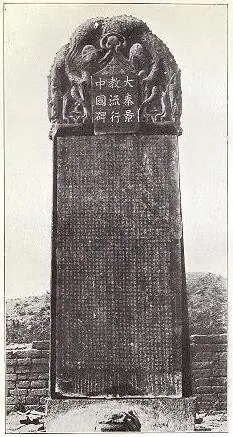
For most people the history of Christianity is a history of Rome and its successors. The Church of the East is the largest part of that history that the usual story leaves out. It began among Aramaic-speaking Christians beyond the Roman frontier, governed itself from the Persian capital, and at its height had bishops from the Mediterranean to the Pacific. Philip Jenkins called its story “the lost history of Christianity”.[1][2] Majority
A church beyond the frontier
Christianity spread east of Antioch among people who spoke Syriac, a form of Aramaic, with Edessa (modern Şanlıurfa) as its first centre. Beyond the Euphrates lay the Persian Empire of the Sasanian kings, whose official religion was Zoroastrianism. When Constantine made Christianity the favoured religion of Rome, Persia’s Christians became suspect as friends of the enemy, and under Shapur II, from about 340, they were persecuted for decades.[3][4] Consensus
Peace came under Yazdegerd I. In 410 a synod at Seleucia-Ctesiphon, the Persian capital, held with the king’s permission, accepted the creed of Nicaea and organised the church under its own head, the bishop of the capital, called the catholicos.[5] Consensus In 424 another synod forbade appeals to “the Western fathers”, the bishops of the Roman Empire. From then on the Church of the East governed itself.[6][7] Majority
Why it was called “Nestorian”
The fifth-century councils divided the churches over how Christ could be both God and human (§6). The theologians of the school of Edessa followed Theodore of Mopsuestia, who distinguished sharply between Christ’s divine and human natures. When the emperor Zeno closed the school in 489, its teachers crossed the border to Nisibis, which became the church’s intellectual centre; a synod in 486 had already adopted this Antiochene theology.[8] Majority
Their opponents in the Roman Empire called them “Nestorian”, after Nestorius, the bishop of Constantinople condemned at Ephesus in 431. The church never called itself that. It did not treat Nestorius as its founder, and it revered Theodore far more. Sebastian Brock called the label “a lamentable misnomer”.[9] Majority In 1994 the Catholic Church and the Assyrian Church of the East signed a Common Christological Declaration affirming a common faith in Christ and attributing the fifth-century divisions largely to misunderstandings over words.[10] Majority on that judgment.
A church across Asia
Under the Abbasid caliphs, the catholicos moved to Baghdad. Timothy I, catholicos from 780 to 823, wrote that he had consecrated a metropolitan for the Turks and was preparing to consecrate one for the Tibetans, and the church had metropolitans for India and China.[11] Majority Christian physicians and translators served the caliphs, and scholars such as Ḥunayn ibn Isḥāq (809–873) carried Greek medicine and philosophy into Syriac and Arabic.[12] Consensus
Its missions followed the trade routes:
- India. By about 550 there were Christians on the Malabar coast and a bishop “appointed from Persia” at Kalliana, on India’s west coast; the Thomas Christians of Kerala belonged to the Church of the East and worshipped in Syriac (see the question on when Christianity reached India).[13] Consensus
- China. In 635 a monk named Alopen reached the Tang capital, Chang’an. A stone tablet erected in 781, the Xi’an Stele, records the “Luminous Teaching” in a vocabulary drawn from Buddhism and Daoism, with clergy listed in Syriac.[14][15] Consensus The church faded after the emperor Wuzong suppressed foreign religions in 845, and returned with the Mongols. (§7)
- Central Asia and the steppe. Turkic and Mongol peoples such as the Kerait, the Önggüt and the Naiman became largely Christian; Christian gravestones in Syriac and Turkic survive in Kyrgyzstan.[2] Majority
In the Mongol period the church reached its greatest extent. Rabban Sauma, a monk born near modern Beijing around 1220, travelled in 1287–1288 as an envoy of the Mongol Ilkhan to Constantinople, Rome, Paris and Bordeaux, and met Pope Nicholas IV and the kings of France and England; his companion Markos had become catholicos as Yahballaha III.[16] Consensus By 1300 the church had metropolitans from Cyprus to Beijing.[2] Majority
The collapse
Within a century most of it was gone. Historians usually give four causes: the conversion of the Mongol khans to Islam, beginning with the Ilkhan Ghazan in 1295; the fall of the Mongol Yuan dynasty in China in 1368, which removed the church’s patrons; plague, which struck the Central Asian communities from the 1330s; and the campaigns of Timur, from about 1370 to 1405, which destroyed cities across Persia, Iraq and Central Asia, Christian and Muslim alike.[2][1] Majority By 1400 the church survived in the mountains of northern Iraq and south-eastern Turkey, around Urmia in Persia, and in Kerala.
Why it disappeared from China is debated. The common explanation is its dependence on the court and on communities of Central Asian origin; others stress the general catastrophe of the fourteenth century; an older view that it had become too Buddhist to survive is now usually rejected.[15][2] Contested
Divisions and survival
From the sixteenth century the surviving church divided. In 1553 a party opposed to the hereditary succession of the patriarchs sent Yohannan Sulaqa to Rome, where he entered communion with the Catholic Church and was recognised as patriarch. After long struggles between rival lines, the churches in communion with Rome became the Chaldean Catholic Church, today the largest church among Iraq’s Christians.[17] Consensus In India, the Portuguese placed the Thomas Christians under Latin bishops at the Synod of Diamper in 1599 (§10).[18] Consensus
The line of patriarchs that survived outside Catholic communion, descended from Sulaqa’s line, which had returned to the old faith by the 1670s and was based at Qodchanis in the Hakkari mountains, suffered catastrophically in the twentieth. Its people were massacred during the First World War, and after the massacre of Assyrians at Simele in Iraq in 1933 the patriarch was exiled; he settled in Chicago in 1940. The church adopted the name Assyrian Church of the East officially in 1976. A dispute over the adoption of the Gregorian calendar in 1964 led to the formation of the Ancient Church of the East, which elected its own patriarch in 1968.[19][20] Consensus on the events.
Today the Assyrian Church of the East is led from Erbil in northern Iraq, where its last two patriarchs were consecrated, in 2015 and 2021; the present head, Mar Awa III, was born in Chicago. It numbers a few hundred thousand members, in Iraq, Iran and Syria and in a large diaspora, chiefly in the United States.[19] Majority on the numbers.
The case on each side
| Question | Views | Main proponents |
|---|---|---|
| Was it heretical? | Nestorian heresy, as the councils held; or an Antiochene theology misnamed after Nestorius | Older Western histories; Brock and most modern scholars[9] |
| Why did it decline? | Mongol conversion to Islam, plague and Timur; or dependence on rulers and foreign communities | Baumer, Jenkins[2][1] |
| How Buddhist was it in China? | Thoroughly sinicised; or translating, not dissolving, Christian teaching | Older and newer scholarship[15] |
Contested
Common misconceptions
- “The Nestorians followed Nestorius.” The church took its theology from Theodore of Mopsuestia and the Antiochene school, not from Nestorius as a founder. Majority
- “Christianity reached China with the Jesuits.” It arrived in 635, a thousand years before them. Consensus
- “Christianity was a European religion until the colonial era.” In 1000 much of it was Asian and African; the Church of the East alone stretched across Asia. Majority
- “The Church of the East died out.” It survives in the Assyrian and Ancient Churches of the East, in the Chaldean Catholic Church, and among the churches of Kerala. Consensus
Why it matters
The Church of the East shows Christianity as an Asian religion that spread without an empire behind it, under Zoroastrian, Muslim, Buddhist and Mongol rulers. Its history runs through the councils (§6) and the eastern chapter of this series (§7), and its fate, near-destruction in the fourteenth century and again in the twentieth, is a reminder that churches, like empires, can rise and fall.
References
- ^ a b c Philip Jenkins The Lost History of Christianity: The Thousand-Year Golden Age of the Church in the Middle East, Africa, and Asia. HarperOne, 2008. A popular account of the eastern churches and their decline.
- ^ a b c d e f Christoph Baumer The Church of the East: An Illustrated History of Assyrian Christianity. I. B. Tauris, 2nd ed., 2016. The fullest general history, from Mesopotamia to China.
- ^ Martyrdom of Simeon bar Sabba'e — Acts of the Persian Martyrs. 4th–5th c. CE. Syriac. The execution of the catholicos Simeon and many clergy under Shapur II. about
- ^ Richard E. Payne A State of Mixture: Christians, Zoroastrians, and Iranian Political Culture in Late Antiquity. University of California Press, 2015. Christians within the Sasanian empire.
- ^ Synod of Isaac (Seleucia-Ctesiphon, 410) — Synodicon Orientale. 410 CE. Syriac. The Persian bishops accept the creed of Nicaea and the authority of the bishop of Seleucia-Ctesiphon, with King Yazdegerd I's permission. about
- ^ Synod of Dadisho (Markabta, 424) — Synodicon Orientale. 424 CE. Syriac. The Persian church forbids appeals beyond its own catholicos to 'the Western fathers'. about
- ^ Wilhelm Baum and Dietmar W. Winkler The Church of the East: A Concise History. RoutledgeCurzon, 2003. A compact institutional history of the Church of the East.
- ^ Adam H. Becker Fear of God and the Beginning of Wisdom: The School of Nisibis and Christian Scholastic Culture in Late Antique Mesopotamia. University of Pennsylvania Press, 2006. The schools of Edessa and Nisibis.
- ^ a b Sebastian P. Brock The 'Nestorian' Church: A Lamentable Misnomer. Bulletin of the John Rylands Library 78: 23–35, 1996. Why the Church of the East should not be called Nestorian.
- ^ Common Christological Declaration (1994) — Pope John Paul II and Patriarch Mar Dinkha IV. 11 November 1994. English. The Catholic Church and the Assyrian Church of the East affirm a common faith in Christ, setting aside the Ephesus-era divisions. read the text
- ^ Timothy I, Letter 47 (to Rabban Sergius) — Letters of Timothy I, patriarch of the Church of the East. c. 792–793 CE. Syriac. Timothy reports that he has anointed a metropolitan for the Turks and is preparing to anoint another for the Tibetans. about
- ^ Sidney H. Griffith The Church in the Shadow of the Mosque: Christians and Muslims in the World of Islam. Princeton University Press, 2008. Christian Arabic thought and life under the early caliphates.
- ^ Cosmas Indicopleustes, Christian Topography 3.65 — Christian Topography. c. 550 CE. Greek. Churches in Sri Lanka, Christians at Malé 'where the pepper grows', and a bishop at Kalliana appointed from Persia. about
- ^ Xi'an Stele (Da Qin Jingjiao liuxing Zhongguo bei) — Stele erected in Chang'an (Beilin Museum, Xi'an). 781 CE. Chinese and Syriac. Jingjing's inscription records Alopen's arrival in 635, Taizong's edict of 638 and the church's history. about
- ^ a b c Li Tang A Study of the History of Nestorian Christianity in China and Its Literature in Chinese. Peter Lang, 2nd ed., 2004. The Tang church and its Chinese texts.
- ^ History of Mar Yahballaha and Rabban Sauma — Syriac history (from a Persian original). early 14th c. CE. Syriac. Rabban Sauma's pilgrimage and his embassy of 1287–1288 to Constantinople, Rome, Paris and Bordeaux. about
- ^ Chaldean Catholic Church — Eastern Catholic church in communion with Rome. from 1553. Syriac and Arabic. Yohannan Sulaqa enters communion with Rome in 1553; the churches in communion with Rome become the Chaldean Catholic Church, today the largest church among Iraq's Christians. about
- ^ Synod of Diamper (Udayamperur), June 1599 — Decrees of the synod under Aleixo de Menezes. 1599 CE. Portuguese and Malayalam. Imposes Latin practice and Portuguese authority on the Thomas Christians and orders Syriac books corrected or burned. about
- ^ a b Assyrian Church of the East — East Syriac church, led from Erbil. modern. Syriac. Patriarch exiled after 1933 and settled in Chicago in 1940; the name Assyrian Church of the East official from 1976; patriarchs consecrated in Erbil in 2015 and 2021; a few hundred thousand members. about
- ^ Ancient Church of the East — East Syriac church based in Baghdad. from 1964/1968. Syriac. Separated from the Assyrian Church of the East after the 1964 calendar reform; elected its own patriarch in 1968. about