In 1606 Guru Arjan, the fifth Guru, the compiler of the Ādi Granth (§3), died in Mughal custody at Lahore; the emperor Jahāṅgīr records ordering his execution. His son Hargobind, eleven years old, became Guru. Within a generation the Sikhs who came to the Guru’s court found something new: horses, armed men, hunting dogs, a Guru who fought skirmishes against Mughal officers and held court like a minor prince. Sikh tradition sums up the change in an image: the young Guru put on two swords, one for pīrī, spiritual authority, and one for mīrī, worldly authority.[1][2] Majority
Seventy years later, in 1675, Guru Tegh Bahādur, the ninth Guru, was beheaded in Delhi, on Aurangzeb’s orders according to the earliest Persian notice (1710s); no order survives. Between these two deaths lie the years in which the Sikh community became armed, moved into the hills, and nearly broke apart in succession disputes. That is the argument of this chapter: the turn to arms began with Guru Hargobind and is attested in his own lifetime; the most familiar stories that explain it, from the two swords to the Kashmiri Brahmins, were written down later.[1][3][2] Majority
Timeline
The dates below follow J. S. Grewal and the Encyclopaedia of Sikhism’s reading of the Sikh sources, with the Persian witnesses where they exist.[1][4][5]
| Date | Event | Confidence |
|---|---|---|
| 1595 | Hargobind born, son of Guru Arjan[1] | Majority |
| 1606 | Guru Arjan dies in Mughal custody at Lahore, and Jahāṅgīr records ordering his execution; Hargobind becomes Guru; by tradition the Akāl Takht is raised at Amritsar[6][7] | Consensus (the death and Jahāṅgīr’s record); Majority (the Takht’s date is the tradition’s) |
| 1610s | The Guru held in Gwalior fort; length disputed[8][9] | Consensus (the imprisonment); Contested (dates) |
| 1621 | Tegh Bahādur (Tyāg Mal) born at Amritsar[1] | Majority |
| 1634–1635 | Fights with Mughal forces at Amritsar, Lahirā and Kartārpur; the Guru leaves Amritsar for good[9][1] | Majority |
| 1635 | The Guru settles at Kīratpur in the Śivālik foothills[9] | Consensus |
| 1636 | Death of Bhāī Gurdās[1] | Consensus |
| 1644 | Guru Hargobind dies at Kīratpur; his grandson Har Rāī becomes Guru[1] | Consensus |
| 1658 | Dārā Shukoh, defeated, passes through Punjab; the Guru’s help to him is remembered by Sikhs[1][10] | Majority |
| 1661 | Rām Rāī at Aurangzeb’s court; Guru Har Rāī dies; Har Krishan, aged five, becomes Guru[1] | Majority |
| 1664 | Guru Har Krishan dies of smallpox in Delhi; Tegh Bahādur recognised at Bakālā[1] | Majority |
| 1665 | Chakk Nānakī, later Anandpur, founded on land bought in the hill state of Kahlūr[1] | Majority |
| 1665–1670 | Travels east: Patna (where Gobind Rāi is born, 1666), Dhaka, Assam with Rājā Rām Singh[1] | Majority |
| 11 November 1675 | Guru Tegh Bahādur beheaded in Chāndnī Chowk, Delhi[1][11] | Majority (day); Consensus (year, Delhi) |
The sixth Guru: a court and a sword
What the tradition says
Sikh tradition remembers Guru Hargobind’s accession as a turning point. In the account found in later Sikh texts of the eighteenth and nineteenth centuries, such as Santokh Singh’s Sūraj Prakāsh (1843), Guru Arjan, before his death, told his son to take his seat fully armed and to keep as many armed men as he could. At the ceremony the Guru put on two swords, of mīrī and pīrī, and called for horses and weapons rather than money as offerings.[12][13] Consensus that this is the tradition’s account. The two swords were known to outsiders by the early nineteenth century: John Malcolm’s Sketch of the Sikhs (1812) already describes the Guru wearing two, though it glosses them differently.[14] Majority
The two words come from Persian. A mīr is a commander or lord; a pīr is a Sufi master. Together they say that the Guru is both a spiritual guide and a sovereign, and that the two cannot be separated.[1][15] Consensus on the meaning. Today the two swords flank the double-edged khaṇḍā in the Sikh emblem, and the two flagstaffs before the Akāl Takht are read the same way.[15] Consensus
What the earliest witness saw
The best evidence for the change comes from inside the Guru’s own circle. Bhāī Gurdās (§0), the scribe of the Ādi Granth, lived through it, and in one stanza (pauṛī) he sets out what people were saying about the new Guru: the earlier Gurus sat in the dharamsāl, but this one will not stay in one place; emperors came to their house, but this one the emperor put in a fort; they sat on their seat and taught contentment, but this one keeps dogs and goes hunting; they made hymns and sang them, but this one neither recites nor sings.[8] Consensus on the text. The stanza ends by answering the complaint, not denying it: the truth cannot be hidden, and the Guru “bears the unbearable” without showing himself (primary source 1, below).
Elsewhere Bhāī Gurdās praises the same Guru as dali bhañjan guru sūramā, a warrior Guru who breaks armies (Vār 1.48), and as dīn dunī dā pātasāh, king of faith and of the world (Vār 39.3).[16][17] Consensus on the text. Dīn and dunī are the pair that pīrī and mīrī name: the idea of the Guru as sovereign in both realms is attested in Guru Hargobind’s lifetime.[1][2] Majority
What Bhāī Gurdās does not mention is the pair of swords. Nor does the Dabistān-i Mazāhib, written by an author who knew Guru Hargobind (§0): it says that the Guru, “against the practice of his father”, girded a sword, kept servants and took to hunting.[9][5] Majority The two swords named mīrī and pīrī belong to the later tradition; the change they stand for is early.[1][2] Majority
Armed retainers
The Dabistān gives figures for the Guru’s establishment: seven or eight hundred horses in his stable (the translations differ), three hundred horsemen and sixty musketeers in his service.[9][5] Majority on the reading. These are not the numbers of an army. They are the retinue of a substantial landholder or a minor chief, the kind of armed household many religious establishments and local notables kept in Mughal India.[2] Majority Sikh tradition adds that the Guru recruited fighting men from among his followers and from Pathān mercenaries, among them Painde Khān, who later turned against him.[1] Majority
The Akāl Takht
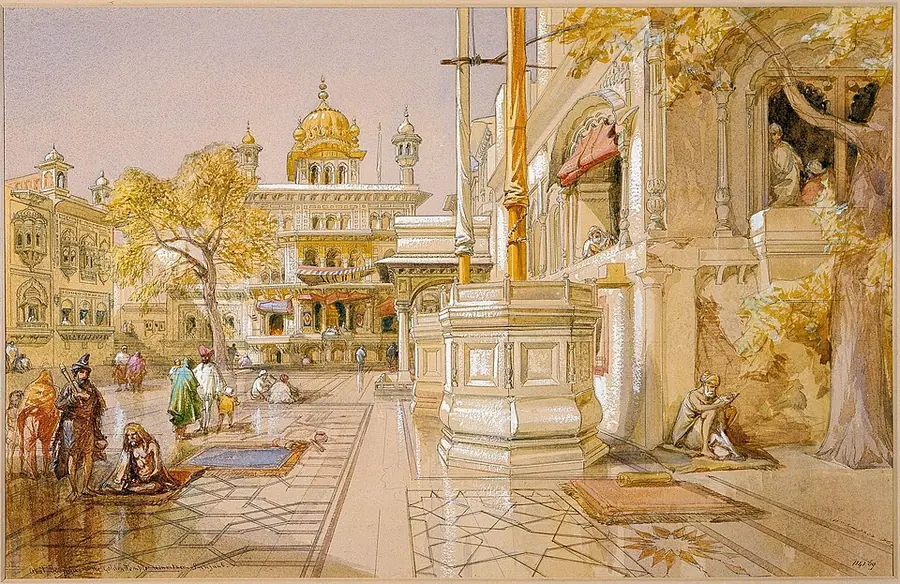
Opposite the Harmandir Sāhib (the Golden Temple) at Amritsar stands the Akāl Takht, the “throne of the Timeless One”. Sikh tradition says that Guru Hargobind raised a platform there in 1606, higher than a royal throne was permitted to be, and held court from it, while the Harmandir remained the place of worship; the building later raised over it was called the Akāl Buṅgā.[7][4] Consensus that this is the tradition’s account.
The date rests on later Sikh texts. The oldest life of the sixth Guru, the anonymous Gurbilās Pātshāhī 6, names 1606, but its own colophon date of 1718 is doubted because it refers to later events, and one modern scholar places it in the 1840s.[7] Majority Bhāī Gurdās and the Dabistān describe the Guru’s court but do not name the Takht.[8][9] Majority The building that stands today is much later: the lower storey was finished in the late eighteenth century and the upper storeys under Ranjit Singh (§7); it was wrecked in the army assault of June 1984 and rebuilt (§10).[4] Majority
The institution is clearer than the date. By the eighteenth century the Khālsā’s assemblies met at Amritsar before the Takht, and in the twentieth century it became the seat from which the community’s hukamnāmās (edicts) are issued and before which scholars have been summoned (§0).[18][19] Majority Its identification with Guru Hargobind’s mīrī is the tradition’s, and the reason it matters: the Takht stands for the claim that the community’s spiritual centre has a political voice. Political
Gwalior and Bandī Chhoṛ
The imprisonment
At some point in the 1610s Jahāṅgīr had the young Guru held in the fortress of Gwalior, the Mughal state prison. The fact is early. Bhāī Gurdās contrasts the Gurus whom emperors visited with the one whom the emperor “put in a fort” (gaṛi chaṛiā pātisāh chaṛāiā), and the Dabistān reports it too.[8][9] Consensus
Everything else is argued. The Dabistān gives two reasons for the detention, the money due for the Guru’s soldiers’ pay and the fine imposed on Guru Arjan, still unpaid, and gives its length as twelve years; Sikh accounts give anything from forty days to a few years; and historians, counting the births of the Guru’s children in the period, have held that it cannot have lasted more than two or three years, and was probably shorter.[9][1] Contested on the dates and the length. The Guru was released. The Dabistān says that before Gwalior he was always in attendance on Jahāṅgīr (“attached to the stirrup”), and that he later entered Shāh Jahān’s service; Sikh tradition remembers him hunting with Jahāṅgīr.[9][1] Majority on the release; Contested on the details.
The fifty-two princes
The best-known part of the story is later. Sikh tradition says the Guru refused to leave Gwalior unless the princes imprisoned with him were freed too; told that as many as could hold on to his robe might go, he had a cloak made with fifty-two tassels, and led out fifty-two rajas. Hence his title Bandī Chhoṛ, “liberator of prisoners”.[13][15] Consensus that this is the tradition’s account. It is not in Bhāī Gurdās or the Dabistān, and is first told in later Sikh texts.[1][4] Majority
Dīvālī
The tradition also says the Guru reached Amritsar on Dīvālī, and that the city was lit for his return. Sikhs had gathered at the Gurus’ seats at Dīvālī since the sixteenth century, and the festival is still the largest of the year at the Harmandir Sāhib. The name Bandī Chhoṛ Divas (“day of release”) for the Sikh Dīvālī is modern, and Nesbitt notes it as part of a wider effort to mark Sikh festivals off from Hindu ones (§11).[15] Majority; Political on the renaming.
The battles of the 1620s and 1630s
Under Jahāṅgīr the Guru’s retainers fought mostly local quarrels, though one of them drew in Mughal troops. Under Shāh Jahān (from 1628) there were open clashes with Mughal officers. Sikh sources, with dates the Encyclopaedia of Sikhism gives, some from the bards’ registers (bhaṭṭ vahīs), describe four:[4][1][2] Majority on the battles; Contested on the dates and numbers.
- Rohīlā, 1621: a local quarrel near the Beās that drew in troops of the Mughal faujdār of Jalandhar. Contested
- Amritsar, April 1634: a quarrel that Sikh accounts trace to a hawk of the emperor’s taken by the Guru’s men; a Mughal force under Mukhlis Khān attacked the Guru at Amritsar and was driven off. Majority on the fight; Contested on its cause.
- Lahirā, near Mehrāj, December 1634: over horses that Sikhs had taken back from the imperial stables. Contested
- Kartārpur, April 1635: a Mughal force led by Painde Khān, the Guru’s former retainer, was defeated near Kartārpur in the Doāb. Tradition says the Guru’s youngest son, Tyāg Mal, fought so well here that he was renamed Tegh Bahādur, “brave of the sword”. Majority on the battle; Contested on the renaming.
The outside witness confirms the outline. The Dabistān says that the Guru had to fight the forces that Shāh Jahān’s officers sent against him, that after the battle of Kartārpur he went to Phagwāṛā, and that because living near Lahore was dangerous he moved to Kīratpur.[9][5] Majority Kīratpur lay on the Sutlej at the edge of the Śivālik hills, in the territory of the raja of Kahlūr, beyond easy reach of the governor of Lahore. The Guru never returned to Amritsar, and for most of the rest of the century the Harmandir Sāhib was in the hands of the Mīṇās, as their opponents called them, the rival line descended from Prithī Chand (§3).[1] Majority
None of these clashes was a war with the empire. They were the kind of armed dispute between a Mughal officer and a powerful local household that the empire saw every year, and the Guru withdrew rather than escalate them.[2][11] Majority They mattered more in Sikh memory than in Mughal records, which do not mention them.[5] Majority
Why did the community arm?
The question is one of the longest-running in Sikh history, and the answers carry weight beyond the seventeenth century, because they bear on whether the Khālsā (§5) was the Guru’s design or the outcome of social forces.[20][1][2] Contested; Political
- The tradition’s answer: Guru Arjan’s death. The fifth Guru died in Mughal custody at Lahore, and Jahāṅgīr records ordering his execution; his son armed the community to defend it and the faith. Sikh texts make the link explicit through Guru Arjan’s last instruction to his son. On this reading the change was a principled response to persecution, and mīrī–pīrī a doctrine, not an improvisation.[21][12]
- McLeod’s answer: the Jaṭs. W. H. McLeod argued that the Jaṭ peasantry of central Punjab, who joined the community in large numbers from the late sixteenth century and brought a tradition of bearing arms, explain much of the change; the Gurus’ own response to Mughal hostility was the occasion rather than the whole cause. Bhāī Gurdās’s list of prominent Sikhs already includes many Jaṭ names.[20][22] Critics answered that this made the Khālsā a social accident and ignored the Gurus’ own words.[21]
- Grewal: a sovereign Guru. J. S. Grewal points out that royal language for the Guru (rāj, pātisāh, the canopy) was used before 1606, in Guru Arjan’s time (§0), and that his death in Mughal custody and the growth of a Panth with its own revenue (the masands’ collections) made a clash with the Mughal state likely. The arming expressed a claim already made.[1]
- Syan: the Mughal context. Hardip Singh Syan places Sikh militancy among the many armed religious groups and landholding households of seventeenth-century India, from Rajput lineages to warrior ascetics, and reads the Gurus’ retainers as normal in that world. What was unusual was the use made of them, and the theology of sovereignty around them.[2]
Contested These views are not exclusive, and most historians now combine them: the death of Guru Arjan as the occasion, a community with many armed peasants as the material, and a theology of the Guru’s sovereignty already present.[1][2][18] Majority
Guru Har Rāī and the prince
Guru Hargobind’s eldest son, Gurdittā, died before him, as did another son, Aṭal Rāī. Passing over his surviving sons, he named as Guru his grandson Har Rāī (b. 1630), son of Gurdittā, who held the office from 1644 to 1661, based at Kīratpur.[1] Consensus The Dabistān’s author knew him and calls him the seventh mahal (Guru); it also says that in 1645, when Najābat Khān’s army entered Kahlūr, the Guru withdrew to Thāpal in Sirmūr.[9][5] Majority Sikh tradition remembers a gentler Guru, who kept the armed retinue (some accounts put his armed followers at 2,200) but fought no battles, and who kept a herbal dispensary.[1] Majority that this is the tradition’s picture.
Dārā Shukoh
In 1658 Shāh Jahān’s sons fought for the throne. The eldest, Dārā Shukoh, the patron of the Persian Upaniṣads (Hinduism §10), was defeated at Sāmūgaṛh and fled through Punjab towards Lahore. Sikh tradition says he called on Guru Har Rāī at Goindvāl and that the Guru’s men delayed Aurangzeb’s pursuing army at the river crossing.[1][10] Majority on the meeting; Contested on the delaying action. Aurangzeb won, and had Dārā executed in 1659 (Islam §9).[10] Consensus
Rām Rāī passed over
The new emperor summoned the Guru to explain himself. Guru Har Rāī did not go, and sent his elder son, Rām Rāī. The Sikh account is that at court Rām Rāī was asked about a line of Guru Nānak’s in the Āsā dī Vār that seemed to insult Muslims: “the clay of the Muslim falls into the potter’s lump” (aṅg 466; primary source 4). To please the emperor, he said the text read beīmān, “faithless”, not musalamān. When the news reached Kīratpur the Guru refused to see his son again and passed him over for the Guruship.[23][1] Consensus that this is the tradition’s account. The story is known only from Sikh sources, and in its full form from eighteenth- and nineteenth-century texts; it cannot be checked against a Mughal record.[1][24] Majority What is secure is the outcome: Rām Rāī stayed in favour at court, received land from Aurangzeb in the Dūn valley below the Garhwāl hills, and founded the ḍerā (camp) from which Dehra Dun takes its name; his followers, the Rām Rāīyās, became a rival Sikh order.[1][22] Majority
The child Guru
Before he died at Kīratpur in October 1661, Guru Har Rāī named his younger son, Har Krishan, born in 1656, as Guru. He was five.[1] Consensus Rām Rāī contested the succession at court, and Aurangzeb summoned the boy to Delhi, where he stayed at the residence of Mīrzā Rājā Jai Singh of Āmber, on the site of the present Gurdwārā Baṅglā Sāhib. Smallpox was raging in the city; the Guru caught it, and died on 30 March 1664, aged about seven.[4][1] Majority on the date; Consensus on his death in Delhi as a child.
Asked who would succeed him, he is said to have answered Bābā Bakāle: “the Bābā [is] at Bakālā”, a village near the Beās where his great-uncle Tegh Bahādur, Guru Hargobind’s youngest son, had made his home since 1644.[1][13] Majority that this is the tradition’s account.
Twenty-two Gurus at Bakālā
The words were clear about the place and not about the person. Sikh tradition says that twenty-two members of the Sodhī family set themselves up at Bakālā as Guru, each with masands to collect offerings.[1][13] Majority that this is the tradition’s account; the number is conventional. By the 1660s the community had several established rival lines:[1][24][25] Majority
| Line | Founder | Base and claim |
|---|---|---|
| Mīṇās | Prithī Chand, Guru Arjan’s elder brother | Held the Harmandir Sāhib at Amritsar; their own scripture and the Miharbān janamsākhī (§0) |
| Dhīrmalīās | Dhīr Mal, Guru Hargobind’s grandson | Kartārpur, with the manuscript held to be Guru Arjan’s master copy of the Ādi Granth (§0) |
| Rām Rāīyās | Rām Rāī, Guru Har Rāī’s elder son | Dehra Dun, under Mughal patronage |
| Udāsīs | Srī Chand, Guru Nānak’s son | An ascetic order rather than a rival Guruship (§2, §6) |
Tradition tells how the true Guru was found. Makhan Shāh Lubāṇā, a merchant who had vowed five hundred gold coins to the Guru when his ship was saved in a storm, came to Bakālā and gave two coins to each claimant. Only Tegh Bahādur asked where the rest was, and Makhan Shāh climbed onto a roof and shouted that he had found the Guru.[12][13] Consensus that this is the tradition’s account. It is told in full in the nineteenth-century texts; how much earlier it goes is not settled.[24] Contested What the dated evidence shows is a recognition at Bakālā in August 1664, recorded in a bards’ register, and a contested one: tradition says Dhīr Mal’s men attacked Guru Tegh Bahādur and fired at him, and when he went to Amritsar the Mīṇā custodians shut the Harmandir against him.[4][1] Majority
Guru Tegh Bahādur
Anandpur and the east
Guru Tegh Bahādur (1621–1675) was the youngest son of Guru Hargobind. As Guru he moved to the hills, and in 1665 bought land from the dowager rani of Kahlūr near Kīratpur and founded a settlement named Chakk Nānakī after his mother; it grew into Anandpur, the town of the tenth Guru (§5).[1] Majority
He did not stay. From 1665 to 1670 he travelled east, through the Gangetic plain to Patna, where his son Gobind Rāī was born in 1666, and on to Dhaka, visiting the congregations that Sikh merchants had founded along the trade routes. In 1668–1669 he went with the army of Rājā Rām Singh of Āmber, a Mughal general, on its campaign against the Ahoms of Assam; a gurdwara at Dhubrī on the Brahmaputra marks the place.[1][2] Majority on the outline. Sikh tradition also tells of an earlier arrest in Delhi in 1665, on Rām Rāī’s complaint, from which Rām Singh secured his release.[1] Contested
The poet
Guru Tegh Bahādur is the only Guru after Guru Arjan whose hymns are in the scripture: fifty-nine hymns and fifty-seven saloks, added in the Damdamā recension (§0, §5).[26][25] Consensus on the count and their place in the text; manuscripts with them predate the tradition’s date for that recension.[25] Majority They speak of detachment, the transience of the world and the absence of fear: “One who frightens no one and fears no one else… call him wise” (aṅg 1427; primary source 5).[27] One salok near the end of the collection speaks of strength gone and bonds put on, with only God’s help left (aṅg 1429), and Sikhs have long read it as written in prison, though the text does not say so.[28][3] Contested on the reading.
Arrest and execution
In 1675 the Guru set out from Anandpur and was arrested in July near Ropar by the local Mughal officer; he was held at Sirhind and taken to Delhi, according to the Sikh sources in an iron cage, and beheaded in public in Chāndnī Chowk on 11 November 1675.[4][1][29] Majority on the route and dates; Consensus on the execution in Delhi in 1675.[11] Three Sikhs who had come with him were put to death before him, by Sikh tradition: Bhāī Matī Dās, sawn in two; Bhāī Satī Dās, wrapped in cotton and burned; and Bhāī Dayāl Dās, boiled in a cauldron.[3][13] Majority that this is the tradition’s account, which comes from Sikh sources. The Gurdwārā Sīs Gañj stands on the site of the execution, and the Gurdwārā Rakāb Gañj where the body was cremated, by tradition in the burning house of a Lubāṇā carrier, Lakhī Shāh. The head was carried to Anandpur, to the Guru’s nine-year-old son, Gobind Rāī (§5).[3][1] Majority
Why was Guru Tegh Bahādur executed?
No contemporary document gives a reason. The court’s official chronicle of Aurangzeb’s reign, the Maʾāsir-i ʿĀlamgīrī (1710), does not mention the execution.[5][30] Majority The earliest Persian notice, in Muḥammad Aḥsan Ijād’s Farrukhsiyar-nāma (1710s), known through William Irvine’s summary, says only that Aurangzeb secretly ordered the Guru’s arrest, that Dilāwar Khān, the faujdār of Sirhind, seized him near Ropar, and that he was executed after refusing to become a Muslim.[31][32] Majority Everything else is a reading of later evidence.[3][1] Contested
The tenth Guru’s account
The earliest Sikh account is the tenth Guru’s own, in the Bachitar Nāṭak of the Dasam Granth (late seventeenth century): his father protected “their tilak and sacred thread” and “gave his head, but not his resolve”. §5 quotes the verses.[33] Majority that the text is the Guru’s or his court’s. It does not say whose marks they were. Most readers take them to be the Brahmins’; Louis Fenech argues that they are Guru Tegh Bahādur’s own, the marks of the faith he would not give up.[34] Contested
The Kashmiri Brahmins
The story most Sikhs know is fuller. Brahmins from Kashmir, threatened with forced conversion by Aurangzeb’s governor, came to Anandpur in 1675 and asked the Guru for help; the boy Gobind Rāī said that no one was worthier to give his life than his father; the Guru told them to tell the emperor that if Guru Tegh Bahādur could be converted, they would follow, and went to Delhi to die.[13][3] Consensus that this is the tradition’s account. The delegation from Kashmir is told in eighteenth-century Sikh histories, the one usually cited being Kesar Singh Chhibbar’s Baṅsāvalīnāmā of 1769, written by a Chhibbar Brahmin whose family had served the Gurus as dīvāns, and is told at length in the nineteenth century.[29][3] Majority on the dates of the texts; Contested on the history behind them. The bards’ registers, as published in the twentieth century, date a deputation of Kashmiri Pandits under Kirpā Rām Datt to Anandpur on 25 May 1675; their entries cannot be checked against the originals.[4] Contested
The hostile Persian account
The first full Persian narrative of the execution, by Ghulām Ḥusain Khān Ṭabāṭabāʾī in his Siyar al-Mutaʾakhkhirīn (completed about 1781–1782), a century after the event, is hostile. It pairs the Guru with a Muslim holy man, Ḥāfiẓ Ādam, as leaders who gathered followers and levied money in Punjab; the shaikh was banished, and the Guru imprisoned and executed, at Lahore rather than Delhi.[35][5] Majority on what the text says. Sikh historians reject it, and most historians give it little weight: it was written in Bengal, long after the event, and if its Ḥāfiẓ Ādam is the Naqshbandī shaikh Ādam Banūrī, he had been sent away from Lahore on the hajj by Shāh Jahān in 1641–1642 and died at Medina in 1643, two decades before Tegh Bahādur became Guru.[36] Majority
How historians read it
| View | Main argument | Main proponents |
|---|---|---|
| Martyrdom for religious freedom | The Guru died for the right of others, Hindus included, to their own faith, as the tradition and the tenth Guru say | The Sikh tradition; Fundamental Issues[21] |
| Religious policy | The execution fits Aurangzeb’s harder line on non-Muslim religious leaders and conversions in the 1670s | Grewal, in part[1][11] |
| Reason of state | A Guru with a large following, armed retainers and long tours raised the suspicion of a state that had already put down several such movements | Syan; Truschke on Aurangzeb’s motives generally[2][37] |
| Martyrdom as a later reading | The language of shahīd and martyrdom was applied to the Gurus’ deaths mainly in the eighteenth and nineteenth centuries | Fenech[3] |
Contested; Political The second and third views are compatible, and most historians combine them; the fourth is about how the death was remembered rather than why it happened.[3][1] Majority Which answer is stressed is a modern political question in its own right, as it is for Guru Arjan’s death (§3): whether the Guru is remembered as a protector of Hindus, as a martyr for the freedom of conscience of people not of his faith, or as a victim of Mughal rule.[3][34] Political
The evidence ledger
| Date | Evidence | Confidence |
|---|---|---|
| 1606 | Jahāṅgīr records ordering Guru Arjan’s execution (§0, §3)[6] | Consensus |
| before 1636 | Bhāī Gurdās: the Guru hunts, keeps dogs, will not stay in one place, was put in a fort; “breaker of armies”; “king of faith and of the world”[8][16][17] | Consensus |
| c. 1645–1658 | The Dabistān: the Guru girds a sword, keeps horses and musketeers, fights Shāh Jahān’s officers, moves to Kīratpur; knows Guru Har Rāī[9] | Majority |
| 1660s–1670s | The scripture’s manuscripts with Guru Tegh Bahādur’s hymns[25] | Majority |
| late 17th c. | The Bachitar Nāṭak: the tenth Guru on his father’s death[33] | Majority (authorship) |
| 1769 | Kesar Singh Chhibbar’s Baṅsāvalīnāmā: the Gurus’ lives, the Kashmiri Brahmins[29] | Majority |
| 1710s | Muḥammad Aḥsan Ijād’s Farrukhsiyar-nāma: the arrest near Ropar on Aurangzeb’s orders, and the execution[31][32] | Majority |
| c. 1781–1782 | The Siyar al-Mutaʾakhkhirīn: the first full and hostile Persian account[35] | Majority |
| stated 1718; date disputed (as late as 1843 proposed) | Gurbilās Pātshāhī 6: the Akāl Takht in 1606[7] | Contested (date) |
| 1843 | Santokh Singh’s Sūraj Prakāsh: Guru Arjan’s last instruction, Makhan Shāh[12] | Consensus (date) |
Primary sources
Show the 6 primary sources
1. “This one keeps dogs and goes hunting”: Bhāī Gurdās, Vār 26, pauṛī 24
ਧਰਮਸਾਲ ਕਰਿ ਬਹੀਦਾ ਇਕਤ ਥਾਉਂ ਨ ਟਿਕੈ ਟਿਕਾਇਆ। ਪਾਤਿਸਾਹ ਘਰਿ ਆਵਦੇ ਗੜਿ ਚੜਿਆ ਪਾਤਿਸਾਹ ਚੜਾਇਆ। ਉਮਤਿ ਮਹਲੁ ਨ ਪਾਵਦੀ ਨਠਾ ਫਿਰੈ ਨ ਡਰੈ ਡਰਾਇਆ। ਮੰਜੀ ਬਹਿ ਸੰਤੋਖਦਾ ਕੁਤੇ ਰਖਿ ਸਿਕਾਰੁ ਖਿਲਾਇਆ। ਬਾਣੀ ਕਰਿ ਸੁਣਿ ਗਾਂਵਦਾ ਕਥੈ ਨ ਸੁਣੈ ਨ ਗਾਵਿ ਸੁਣਾਇਆ।
dharamasāl kari bahīdā ikat thāuṅ na ṭikai ṭikāiā | pātisāh ghari āvade gaṛi chaṛiā pātisāh chaṛāiā | umati mahalu na pāvadī naṭhā phirai na ḍarai ḍarāiā | mañjī bahi santokhadā kute rakhi sikāru khilāiā | bāṇī kari suṇi gāṅvadā kathai na suṇai na gāvi suṇāiā |
“[The earlier Gurus] sat in the dharamsāl; this one does not stay in one place. Emperors came to their house; this one the emperor put in a fort. The congregation cannot find him in his palace; he roams about, fearing no one and frightening no one. They sat on the seat and taught contentment; this one keeps dogs and goes hunting. They made hymns, heard them and sang them; this one neither recites, nor listens, nor sings.” (the site’s translation)[8]
What it proves. That the change in the Guruship was visible, and criticised, within Hargobind’s lifetime: the hunting, the travelling, the imprisonment in a fort and the break with the earlier Gurus’ manner are all recorded by a member of his own circle who died in 1636. Bhāī Gurdās gives the complaint in order to answer it; the stanza closes with the Guru bearing “the unbearable” without revealing himself. It does not mention two swords. Consensus on the text and its date.
2. “A warrior Guru, breaker of armies”: Bhāī Gurdās, Vār 1, pauṛī 48
ਪੰਜਿ ਪਿਆਲੇ ਪੰਜ ਪੀਰ ਛਠਮੁ ਪੀਰੁ ਬੈਠਾ ਗੁਰੁ ਭਾਰੀ। ਅਰਜਨੁ ਕਾਇਆ ਪਲਟਿ ਕੈ ਮੂਰਤਿ ਹਰਿਗੋਬਿੰਦ ਸਵਾਰੀ। ਚਲੀ ਪੀੜੀ ਸੋਢੀਆ ਰੂਪੁ ਦਿਖਾਵਣਿ ਵਾਰੋ ਵਾਰੀ। ਦਲਿ ਭੰਜਨ ਗੁਰੁ ਸੂਰਮਾ ਵਡ ਜੋਧਾ ਬਹੁ ਪਰਉਪਕਾਰੀ।
pañji piāle pañj pīr chhaṭhamu pīru baiṭhā guru bhārī | arajanu kāiā palaṭi kai mūrati harigobind savārī | chalī pīṛī soḍhīā rūpu dikhāvaṇi vāro vārī | dali bhañjan guru sūramā vaḍ jodhā bahu paraupakārī |
“Five pīrs drank from five cups; the sixth pīr, a mighty Guru, sits on the seat. Arjan changed his body and took the form of Hargobind. The line of the Sodhīs has begun, to show its form in turn. The Guru is a hero, a breaker of armies, a great warrior, and most benevolent.” (the site’s translation)[16]
What it proves. That the Gurus’ own circle praised the sixth Guru as a warrior while he lived, and that it presented him as the same Guru as his five predecessors in a new form, the doctrine of one light passing from Guru to Guru. The Persian word pīr for the Guru is already there. In Vār 39.3 the same poet calls Guru Hargobind dīn dunī dā pātasāh, “king of faith and of the world”, the idea that mīrī–pīrī names.[17] Consensus on the text.
3. A Persian visitor at Kīratpur: the Dabistān-i Mazāhib, c. 1645–1658
The author, now usually identified as Mobad (Mīr Zulfiqār Ardastānī), says that he knew Guru Hargobind and met him at Kīratpur. He reports that the Guru, unlike his father, girded a sword, kept servants and went hunting; that he kept seven or eight hundred horses (the translations differ), three hundred horsemen and sixty musketeers; that he fought the agents and servants of Shāh Jahān, went to Phagwāṛā after the battle of Kartārpur, and moved to Kīratpur because places near Lahore were unsafe; and that he had been detained at Gwalior.[9][5]
What it proves. That an outsider, writing within a few years of Hargobind’s death, confirms the Sikh tradition’s outline of the sixth Guru: the arms, the retinue, the battles and the retreat to the hills. It describes one sword, not two. Majority on the author and date.
4. The line Rām Rāī altered: Guru Nānak, Āsā dī Vār, aṅg 466
ਮਿਟੀ ਮੁਸਲਮਾਨ ਕੀ ਪੇੜੈ ਪਈ ਕੁਮਿੑਆਰ ॥ ਘੜਿ ਭਾਂਡੇ ਇਟਾ ਕੀਆ ਜਲਦੀ ਕਰੇ ਪੁਕਾਰ ॥
miṭī musalamān kī peṛai paī kumhiār | ghaṛi bhāṅḍe iṭā kīā jaladī kare pukār ||
“The clay of the Muslim [buried in his grave] falls into the potter’s lump. He shapes pots and bricks from it, and it cries out as it burns.” (the site’s translation)[23]
What it proves. The text itself is a salok of Guru Nānak (Mahalā 1) in Rāg Āsā: the Muslim who expects to rest in his grave becomes clay for the kiln, as the Hindu is burned on the pyre; only the Creator knows. It questions both communities’ confidence in their funeral rites, not Muslims alone. The Sikh tradition that Rām Rāī read beīmān for musalamān before Aurangzeb shows how much the seventeenth-century Panth cared that the Gurus’ words be kept unaltered, whatever the court thought.[26] Consensus on the text; Majority that the Rām Rāī story is the tradition’s.
5. “Fears no one”: Guru Tegh Bahādur, Salok Mahalā 9, aṅg 1427
ਭੈ ਕਾਹੂ ਕਉ ਦੇਤ ਨਹਿ ਨਹਿ ਭੈ ਮਾਨਤ ਆਨ ॥ ਕਹੁ ਨਾਨਕ ਸੁਨਿ ਰੇ ਮਨਾ ਗਿਆਨੀ ਤਾਹਿ ਬਖਾਨਿ ॥੧੬॥
bhai kāhū kau det nahi nahi bhai mānat ān | kahu nānak suni re manā giānī tāhi bakhāni ||16||
“One who frightens no one, and fears no one else: says Nānak, listen, my mind, call him wise.” (the site’s translation)[27]
What it proves. The ninth Guru’s voice, in the Braj-inflected verse of his saloks: detachment and fearlessness as the mark of the wise. Like his predecessors he signs as “Nānak”. It is the ethic that later Sikh writers read into his death, though the hymns themselves never mention it. Consensus on the text.
6. The hostile witness: the Siyar al-Mutaʾakhkhirīn, c. 1781–1782
Ghulām Ḥusain Khān’s history of the later Mughals, written in Bengal, says that Guru Tegh Bahādur, with a Muslim holy man named Ḥāfiẓ Ādam, gathered a large following in Punjab and levied money from it, the Guru from Hindus and the shaikh from Muslims, until reports reached the emperor; the shaikh was banished and the Guru executed.[35][5]
What it proves. That a century after the event, a Persian historian close to the Mughal nobility explained the execution as the suppression of unrest, not the punishment of a faith. It shows how the event was explained from the Mughal side a century later; it is not good evidence for 1675. Majority on its reliability.
What is absent
- The two swords in the earliest sources. Bhāī Gurdās calls Guru Hargobind king of faith and of the world; the Dabistān gives him one sword. The named pair of mīrī and pīrī swords is told in later texts. Majority
- A contemporary record of the Akāl Takht. The 1606 date is the tradition’s, from a text whose own date is in doubt. Majority
- The fifty-two princes. The imprisonment at Gwalior is early; the release of the princes, and the Dīvālī homecoming, are later. Majority
- A Mughal record of Guru Hargobind’s battles. They are known from the Sikh sources and the Dabistān. Majority
- A Mughal reason for Guru Tegh Bahādur’s execution. No court record of 1675 explains it; the official chronicle does not mention it. Majority
- The Kashmiri Brahmins in the earliest account. The Bachitar Nāṭak speaks of the tilak and sacred thread, without naming Kashmir; the delegation is told in later texts. Majority
Debates
Why did the community arm?
| View | Main argument | Main proponents |
|---|---|---|
| A response to Guru Arjan’s death | Guru Hargobind armed the community on his father’s instruction, to defend the faith against persecution | The Sikh tradition; Fundamental Issues[21] |
| The Jaṭ thesis | The Jaṭ peasants who joined in large numbers brought arms and martial custom | McLeod[20] |
| A sovereign Guru | Royal language for the Guru predates 1606; the clash with the Mughal state was built in | Grewal[1] |
| The Mughal context | Armed religious households were normal in seventeenth-century India; the Gurus’ was one of many | Syan[2] |
Contested; Political Most historians now combine several of these.[1][2] Majority
When were the two swords first described?
The idea of a Guru sovereign in faith and the world is in Bhāī Gurdās; the Dabistān gives the Guru a sword. The image of two named swords at the accession is found in later Sikh texts, and in English by 1812 (Malcolm); a verse credited to the bards Abdullā and Natthā names the pair, but its date has not been established. How far back the image goes is not settled.[17][9][14][1] Contested
The organised Panthic account is set out in the Sikh Research Institute’s report Miri-Piri: The Political-Spiritual Sikh Doctrine (2021): the Takht was built in 1606, and on 24 June 1606 Bhāī Buḍḍhā performed the investiture at which the Guru put on the two swords, with the bards Natthā and Abdullā describing it as witnesses. The report cites the bards’ verse from a 1996 Punjabi book by Piārā Siṅgh Padam and names no earlier source for the date.[38] Contested
Why was Guru Tegh Bahādur executed?
Martyrdom for others’ faith, Aurangzeb’s religious policy, or the suppression of a Guru the state saw as a threat. The tradition and the tenth Guru’s poem give the first answer; the earliest Persian notice, Ijād’s of the 1710s, says only that the Guru was executed after refusing to become a Muslim; the first full Persian narrative, the Siyar of c. 1781–1782, gives the third. Most historians combine the second and third.[3][1][2][31][35] Contested; Political
Further reading
Show further reading (7 works)
- J. S. Grewal, The Sikhs of the Punjab (Cambridge, 1990; revised 1998): the narrative.
- Hardip Singh Syan, Sikh Militancy in the Seventeenth Century: Religious Violence in Mughal and Early Modern India (I. B. Tauris, 2013): the sixth to ninth Gurus in their Mughal setting.
- W. H. McLeod, The Evolution of the Sikh Community (Clarendon, 1976): the Jaṭ thesis.
- Louis E. Fenech, Martyrdom in the Sikh Tradition: Playing the “Game of Love” (Oxford, 2000): Guru Arjan and Guru Tegh Bahādur, and how their deaths were remembered.
- J. S. Grewal and Irfan Habib, eds., Sikh History from Persian Sources (Tulika, 2001): the Dabistān and the later Persian accounts, translated.
- John F. Richards, The Mughal Empire (Cambridge, 1993), and Audrey Truschke, Aurangzeb: The Life and Legacy of India’s Most Controversial King (Stanford, 2017): the empire the Gurus lived in.
- Supriya Gandhi, The Emperor Who Never Was: Dara Shukoh in Mughal India (Harvard, 2020).
References
- ^ a b c d e f g h i j k l m n o p q r s t u v w x y z { | } ~ J. S. Grewal The Sikhs of the Punjab. The New Cambridge History of India II.3, Cambridge University Press, 1990. The standard narrative history; revised edition 1998.
- ^ a b c d e f g h i j k l m n o Hardip Singh Syan Sikh Militancy in the Seventeenth Century: Religious Violence in Mughal and Early Modern India. I. B. Tauris, 2013.
- ^ a b c d e f g h i j k Louis E. Fenech Martyrdom in the Sikh Tradition: Playing the "Game of Love". Oxford University Press, New Delhi, 2000.
- ^ a b c d e f g h i Harbans Singh, ed. The Encyclopaedia of Sikhism. Punjabi University, Patiala, 4 vols, 1992. open access Published 1992–1998; the standard reference, with signed entries reporting both tradition and sources.
- ^ a b c d e f g h i j J. S. Grewal and Irfan Habib, eds. Sikh History from Persian Sources: Translations of Major Texts. Tulika, New Delhi, 2001. Jahāṅgīr, the Dabistān, court newsletters and chronicles in English.
- ^ a b Jahāṅgīrnāmā, regnal year 1 (1606) — Memoirs of Jahāṅgīr. 1606 CE. Persian. The emperor's own account of ordering Guru Arjan's execution, which he links to the Guru's blessing of the rebel prince Khusrau.
- ^ a b c d Gurbilās Pātshāhī 6 — Anonymous life of Guru Hargobind. stated 1718 CE; date disputed (as late as 1843 proposed). Braj in Gurmukhi. The oldest life of the sixth Guru and the source of the tradition that the Akāl Takht was founded in 1606; anachronisms make its stated date of 1718 suspect, and one scholar proposes 1843.
- ^ a b c d e f Bhāī Gurdās, Vār 26.24 — Vārāṅ Bhāī Gurdās. before 1636 CE. Punjabi in Gurmukhi. What people said of Guru Hargobind: unlike the earlier Gurus he will not stay in one place, was put in a fort by the emperor, keeps dogs and goes hunting, and does not sing hymns; the stanza answers that the truth cannot be hidden. read the text
- ^ a b c d e f g h i j k l m n Dabistān-i Mazāhib, on the Nānakpanthīs — The School of Religions. c. 1645–1658 CE. Persian. A Persian survey of religions with a chapter on the followers of Nānak by an author who knew Guru Hargobind and Guru Har Rāī: the masands, the Gurus' court, and Sikhs who rejected idols and caste rules.
- ^ a b c Supriya Gandhi The Emperor Who Never Was: Dara Shukoh in Mughal India. Harvard University Press, 2020. The current biography.
- ^ a b c d John F. Richards The Mughal Empire. Cambridge University Press (New Cambridge History of India), 1993. The standard survey of the empire from Bābur to the eighteenth century.
- ^ a b c d Santokh Singh, Srī Gur Pratāp Sūraj Granth — Sūraj Prakāsh. 1843 CE. Braj in Gurmukhi. The vast nineteenth-century verse history of the Gurus: Arjan's instruction that Hargobind sit armed, the Makhan Shāh story and much of the tradition in its full form.
- ^ a b c d e f g Max Arthur Macauliffe The Sikh Religion: Its Gurus, Sacred Writings and Authors. Clarendon Press, Oxford, 6 vols., 1909. Written with Sikh scholars of the Singh Sabhā; the tradition's account in English.
- ^ a b John Malcolm Sketch of the Sikhs. John Murray, London, 1812. An early British account; p. 213 already gives Guru Hargobind two swords, glossed differently from the later tradition.
- ^ a b c d Eleanor Nesbitt Sikhism: A Very Short Introduction. Oxford University Press, 2nd ed., 2016.
- ^ a b c Bhāī Gurdās, Vār 1.48 — Vārāṅ Bhāī Gurdās. before 1636 CE. Punjabi in Gurmukhi. "The sixth pīr": Arjan takes the form of Hargobind, "a hero, a breaker of armies, a great warrior". read the text
- ^ a b c d Bhāī Gurdās, Vār 39.3 — Vārāṅ Bhāī Gurdās. before 1636 CE. Punjabi in Gurmukhi. Guru Hargobind as "dīn dunī dā pātasāh", king of faith and of the world: the idea that mīrī and pīrī name, in his lifetime. read the text
- ^ a b Purnima Dhavan When Sparrows Became Hawks: The Making of the Sikh Warrior Tradition, 1699–1799. Oxford University Press, New York, 2011.
- ^ Arvind-pal Singh Mandair Sikhism: A Guide for the Perplexed. Bloomsbury, 2013.
- ^ a b c W. H. McLeod The Evolution of the Sikh Community: Five Essays. Clarendon Press, Oxford, 1976. Includes the argument that the Jaṭ peasantry shaped the community's turn to arms.
- ^ a b c d Kharak Singh, G. S. Mansukhani and Jasbir Singh Mann, eds. Fundamental Issues in Sikh Studies. Institute of Sikh Studies, Chandigarh, 1992. Essays against McLeod's school, from its Sikh critics.
- ^ a b W. H. McLeod Who Is a Sikh? The Problem of Sikh Identity. Clarendon Press, Oxford, 1989.
- ^ a b Guru Granth Sāhib, ang 466 — Guru Nānak, Āsā kī Vār, salok. 1604 CE (compiled). Punjabi in Gurmukhi. "The clay of the Muslim falls into the potter's lump": the line Rām Rāī, by Sikh tradition, altered before Aurangzeb. read the text
- ^ a b c W. H. McLeod Early Sikh Tradition: A Study of the Janam-sākhīs. Clarendon Press, Oxford, 1980. The janamsākhī traditions, their manuscripts and how they grew.
- ^ a b c d Gurinder Singh Mann The Making of Sikh Scripture. Oxford University Press, New York, 2001. The manuscripts from the Goindvāl pothīs to the Damdamā recension.
- ^ a b Pashaura Singh The Guru Granth Sahib: Canon, Meaning and Authority. Oxford University Press, 2000. doi The formation of the Sikh canon, from the 1604 Ādi Granth to its installation as Guru.
- ^ a b Guru Granth Sāhib, ang 1427 — Guru Tegh Bahādur, Salok Mahalā 9. 1664–1675 CE (composed). Punjabi and Braj in Gurmukhi. "One who frightens no one, and fears no one else... call him wise": the ninth Guru's ethic of fearlessness. read the text
- ^ Guru Granth Sāhib, ang 1429, Salok Mahalā 9, 53 — Guru Tegh Bahādur, Salok Mahalā 9. 1664–1675 CE (composed). Punjabi and Braj in Gurmukhi. "My strength is gone and I am in bonds; nothing can be done": the ninth Guru turns to God's help alone, a salok Sikhs have long read as written in prison. read the text
- ^ a b c Kesar Singh Chhibbar, Baṅsāvalīnāmā — Genealogy of the Ten Gurus. 1769 CE. Punjabi in Gurmukhi. A Brahmin Sikh's history of the Gurus, with an early statement that the Granth is the Guru.
- ^ Maʾāsir-i ʿĀlamgīrī — Sāqī Mustaʿidd Khān, tr. Jadunath Sarkar (Calcutta: Royal Asiatic Society of Bengal, 1947), pp. 51–52, 55, 60, 108. 1710 CE. Persian. The official history of Aurangzeb's reign: the April 1669 order on the 'schools and temples of the infidels', the demolition of the Vishvanath temple at Banaras (1669) and the Keshava Deva temple at Mathura (1670), and the reimposition of jizya (1679), all framed in religious language. The 1669 order's wording is disputed (Sarkar: 'to demolish'; Eaton: 'be subject to demolition'). read the text
- ^ a b c Muḥammad Aḥsan Ijād, Farrukhsiyar-nāma — History of the emperor Farrukhsiyar. 1713–1719 CE. Persian. The earliest Persian notice of Tegh Bahādur's death, known through Irvine: Aurangzeb secretly orders the arrest, Dilāwar Khān of Sirhind seizes the Guru near Ropar, and he is executed after refusing to become a Muslim.
- ^ a b William Irvine Later Mughals, vol. 1: 1707–1720. M. C. Sarkar & Sons, Calcutta (ed. Jadunath Sarkar), 1922. full text The fullest account of Banda's rising from the Persian chronicles, from the Mughal side.
- ^ a b Bachitar Nāṭak 5.13–14 — Dasam Granth. late 17th c. CE. Braj in Gurmukhi. The tenth Guru's account of his father's death: Tegh Bahādur "protected their tilak and sacred thread" and "gave his head, but not his resolve".
- ^ a b Louis E. Fenech The Sikh Zafar-namah of Guru Gobind Singh: A Discursive Blade in the Heart of the Mughal Empire. Oxford University Press, New York, 2013.
- ^ a b c d Ghulām Ḥusain Khān, Siyar al-Mutaʾakhkhirīn — Review of Modern Times. c. 1781–1782 CE. Persian. The first full Persian narrative of Tegh Bahādur's execution, a century later and hostile: the Guru and a holy man, Ḥāfiẓ Ādam, gather followers and levy money in Punjab; the shaikh is banished and the Guru executed, placed at Lahore.
- ^ S. A. A. Rizvi Muslim Revivalist Movements in Northern India in the Sixteenth and Seventeenth Centuries. Agra University, 1965. Pp. 384–388 on Ādam Banūrī: sent from Lahore on the hajj in 1641–42, died at Medina in 1643.
- ^ Audrey Truschke Aurangzeb: The Life and Legacy of India's Most Controversial King. Stanford University Press, 2017. doi The revisionist short biography: temple destruction under Aurangzeb as limited and political; contested by critics who stress his discriminatory measures.
- ^ Harinder Singh, Jasleen Kaur and Parveen Kaur (Sikh Research Institute) Miri-Piri: The Political-Spiritual Sikh Doctrine. Sikh Research Institute, State of the Panth report 7 (July 2021), 2021. open library The organised Panthic statement of mīrī–pīrī: dates the Akāl Takht to 1606 and the investiture with two swords by Bhāī Buḍḍhā to 24 June 1606, witnessed by the bards Natthā and Abdullā (verse cited from Piārā Siṅgh Padam, 1996; pp. 25–26).