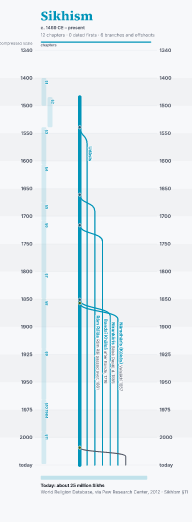
The short version: in 1699 the tenth Guru turned the Sikh congregations into his own initiated order, the Khālsā, and gave its members a rite, a name and a code. That a founding took place at Anandpur in 1699, at or about Vaisākhī, is accepted by historians.[1][2][3] Majority What is argued is how much of the story Sikhs tell about that day goes back to it. What follows separates the earliest account from what was written later, and says what the Khālsā was.
Before 1699: a Guru, the hills and the masands
Gobind Rāi became Guru at nine, in 1675, after his father Guru Tegh Bahādur was executed in Delhi (Why was Guru Tegh Bahādur executed?).[3][4] Consensus He grew up at Anandpur in the Śivālik foothills, where his court drew offerings and armed followers from the plains and troubled the neighbouring hill rajas (§5).[3][2] Consensus
The problem the Khālsā solved was institutional. Since the third Guru, the scattered congregations had been run through deputies, by the seventeenth century the masands, who collected offerings, taught in the Guru’s name and carried the money to his court (§3).[5][3] Consensus After the succession disputes of the seventeenth century (§4) some masands kept offerings and favoured rival lines of Gurus.[3][1] Majority A congregation that dealt with the Guru directly was called khālsā: from Persian, and the Arabic khāliṣ, “pure”; in Mughal administration khāliṣa land was held directly by the crown.[1][3] Majority Whatever else happened in 1699, the Guru took all the congregations into his own hands, and the masands lost their office.[6][1] Consensus
The account most Sikhs learn
At Vaisākhī 1699, before a great gathering at Anandpur, the Guru appeared with a drawn sword and asked for a Sikh willing to give his head. One man rose; the Guru took him into a tent and came out with the sword bloodied, and asked again, four more times. Then he brought out all five alive, dressed like himself: Dayā Rām, a Khatrī of Lahore; Dharam Dās, a Jaṭ of Hastinapur; Himmat Rāī, a water-carrier of Jagannāth Purī; Mohkam Chand, a calico-printer of Dvārkā; and Sāhib Chand, a barber of Bīdar. He stirred water in an iron bowl with a double-edged sword while reciting hymns, his wife added sugar sweets, and he gave the five this amrit and named them Singh, the Pañj Pyāre (“Five Beloveds”). Then he asked them to initiate him in turn.[7][8] Consensus that this is the tradition’s account.
The scene carries the order’s meaning: equality under the Guru across region and caste, readiness to die, and a community that could in turn initiate its own Guru.[9][2] Consensus that this is the tradition’s meaning.
What the earliest account says
Sainapati, a poet at the Guru’s court, wrote Srī Gur Sobhā within a few years of the Guru’s death; its date is read as 1701 or 1711, and since it describes events of 1708 the later date is usually preferred.[6][1] Majority It describes the Guru making the congregations his own khālsā, removing the masands, and the new initiation, and it already mentions the core of the code: uncut hair, the bearing of arms, avoidance of the hookah, and separation from the masands and the rival lines. It does not describe the call for five heads.[1][2] Majority
No Mughal or other outside record of Vaisākhī 1699 survives; the founding is known from Sikh sources only (§0).[1] Majority The call for heads appears in texts of the mid- to late eighteenth century, among them Koer Singh’s Gurbilās and Kesar Singh Chhibbar’s history of 1769; the names, origins and castes of the five later still.[10][11][1] Majority The scene may preserve memory, may dramatise it, or both; it cannot be checked.[1][2] Contested Koer Singh puts the founding in 1689; historians accept 1699 and set that aside.[10][2] Majority
What the Khālsā was
- An initiated order. Before 1699 Sikhs were initiated with charan pāhul, water touched by the Guru’s foot or a masand’s. The new rite, khaṇḍe dī pāhul, was given by five initiated Sikhs and made the initiate a member of the Guru’s own khālsā. It displaced the older rite over the eighteenth century.[1][12] Majority
- A name. Men took the name Singh, “lion”, already common among Rajputs, giving men of every caste the same warrior name; the Guru’s own name changed from Gobind Rāi to Gobind Singh.[1][3] Majority
- A code. The rahit began with uncut hair and arms; the fuller codes of the eighteenth century, dated by McLeod from 1718–19 onward, forbade tobacco, meat killed by the Muslim method and relations with Muslim women, and set penalties for lapses.[1][13] Majority on the dates; Contested on how much reaches back to 1699.
- A promise of rule. The Tankhāhnāmā, whose earliest manuscript is dated 1718–19, ends with a couplet Sikhs still sing, in slightly different wording, after the Ardās:[14][1]
ਰਾਜ ਕਰੇਗਾ ਖਾਲਸਾ ਆਕੀ ਰਹੇ ਨ ਕੋਇ ॥
rāj karegā khālsā ākī rahe na koi ||
“The Khālsā shall rule; none shall remain defiant.”[14] Majority on the date; Political in modern use.
What came later
Several things Sikhs associate with 1699 are attested only later, and the dates matter:
- The Five Ks as a list of five articles beginning with k is first clearly attested in the nineteenth century (McLeod: 1883); earlier claims are disputed. Uncut hair and arms are early, and the other items appear in eighteenth-century codes (What are the Five Ks?).[1][3] Contested
- The sweets in the amrit are told of two different wives, Mātā Jīto and Mātā Sāhib Kaur.[15] Contested
- Kaur for every woman. Doris Jakobsh argues that the name became the required name of all Sikh women only in the late nineteenth and twentieth centuries, and that the Rahit Maryādā’s provision for women’s initiation is a modern settlement; Nikky-Guninder Kaur Singh reads the founding as open to women from the start.[15][9] Contested
- A written code. The Sikh Rahit Maryādā of 1950 settled the Five Ks, the name Kaur and women’s initiation in a single text agreed by a representative body.[16] Consensus
- A single public date. The tercentenary at Anandpur in April 1999 fixed one founding date in public memory and told the story in the form the later sources give it (§11).[8] Majority
In this sense the Khālsā was founded in 1699 and took the shape Sikhs know over the following two centuries, in the wars of the eighteenth century above all (§6).[1][2] Majority
Why did the Guru found it?
The earliest sources tie it to the Guru’s mission for dharam (the Bachitar Nāṭak) and to the removal of the masands (Sainapati). Historians have added others, and most now combine several.[3][2] Majority
| View | Main argument | Main proponents |
|---|---|---|
| The Guru’s design | The Khālsā was the Guru’s deliberate creation, complete in 1699 | The Sikh tradition; Fundamental Issues[17] |
| The Jaṭ thesis | Jaṭ peasants who joined in large numbers brought arms and martial custom; the Khālsā gave them form | McLeod[18] |
| Institutional reform | The Khālsā solved the problem of the masands and the rival lines | Grewal[3] |
| Formed in war | The warrior identity and code were made over the eighteenth century | Dhavan[2] |
Contested
What followed
The Khālsā made the Guru stronger and his neighbours more afraid. From 1700 the hill rajas, then with Mughal support, besieged Anandpur; in December 1704 the Guru left it under a promise of safe passage, which, by the Sikh account and the Zafarnāmā, was broken when the besiegers attacked the departing column; he lost all four of his sons.[3][4] Majority He died at Nanded in 1708, and by Sikh belief the Guruship passed to the scripture and the Khālsā (Why is the Guru Granth Sāhib the Guru?).[19][1] Consensus on the belief.
Common misconceptions
- “Vaisākhī began in 1699.” Vaisākhī was already a Sikh gathering day, fixed by the third Guru in the sixteenth century; 1699 gave it its central Sikh meaning. Majority
- “The earliest account tells of the five heads.” It describes the founding without them. Majority
- “Every Sikh is a member of the Khālsā.” The Khālsā has always been part of the community rather than the whole of it, and most Sikhs today are not initiated. Majority
What the evidence cannot settle
Historians can date the founding, the earliest account and each later element of the story. Whether the scene of the five heads happened as told cannot be checked, and what the founding means is a question the tradition answers in its own terms. Consensus
References
- ^ a b c d e f g h i j k l m n o p W. H. McLeod Sikhs of the Khalsa: A History of the Khalsa Rahit. Oxford University Press, New Delhi, 2003. The code of conduct from the rahitnāmās to the Sikh Rahit Maryādā; the main source for dating the Five Ks.
- ^ a b c d e f g h i Purnima Dhavan When Sparrows Became Hawks: The Making of the Sikh Warrior Tradition, 1699–1799. Oxford University Press, New York, 2011.
- ^ a b c d e f g h i j k J. S. Grewal The Sikhs of the Punjab. The New Cambridge History of India II.3, Cambridge University Press, 1990. The standard narrative history; revised edition 1998.
- ^ a b Louis E. Fenech Martyrdom in the Sikh Tradition: Playing the "Game of Love". Oxford University Press, New Delhi, 2000.
- ^ Dabistān-i Mazāhib, on the Nānakpanthīs — The School of Religions. c. 1645–1658 CE. Persian. A Persian survey of religions with a chapter on the followers of Nānak by an author who knew Guru Hargobind and Guru Har Rāī: the masands, the Gurus' court, and Sikhs who rejected idols and caste rules.
- ^ a b Sainapati, Srī Gur Sobhā — Poem on Guru Gobind Singh by a poet of his court. early 18th c. CE. Braj in Gurmukhi. The earliest account of the Khālsā's creation, by a poet of Gobind Singh's court: the Guru makes the congregations his own khālsā and removes the masands.
- ^ Max Arthur Macauliffe The Sikh Religion: Its Gurus, Sacred Writings and Authors. Clarendon Press, Oxford, 6 vols., 1909. Written with Sikh scholars of the Singh Sabhā; the tradition's account in English.
- ^ a b Eleanor Nesbitt Sikhism: A Very Short Introduction. Oxford University Press, 2nd ed., 2016.
- ^ a b Nikky-Guninder Kaur Singh The Birth of the Khalsa: A Feminist Re-Memory of Sikh Identity. State University of New York Press, 2005.
- ^ a b Koer Singh, Gurbilās Pātshāhī 10 — Life of the Tenth Guru. dated 1751 CE in the text; possibly later. Braj in Gurmukhi. A full narrative of the Khālsā's founding, including the call for heads; its date is disputed.
- ^ Kesar Singh Chhibbar, Baṅsāvalīnāmā — Genealogy of the Ten Gurus. 1769 CE. Punjabi in Gurmukhi. A Brahmin Sikh's history of the Gurus, with an early statement that the Granth is the Guru.
- ^ Harjot Oberoi The Construction of Religious Boundaries: Culture, Identity, and Diversity in the Sikh Tradition. University of Chicago Press, 1994. The "Sanātan" Sikhism of the early nineteenth century and the Singh Sabhā's sharper boundaries.
- ^ Chaupā Singh Rahitnāmā — Code of conduct attributed to Chaupā Singh Chhibbar. mid-18th c. CE. Punjabi in Gurmukhi. The longest early rahitnāmā; McLeod dates its core to the 1740s–1760s.
- ^ a b Tankhāhnāmā — Code of penances attributed to Bhāī Nand Lāl. earliest manuscript 1718–1719 CE. Punjabi in Gurmukhi. A code of penances attributed to Bhāī Nand Lāl (an attribution McLeod discounts); its earliest manuscript is dated 1718–19, in the years of Banda's rising. It closes with the couplet "rāj karegā khālsā" (the Khālsā shall rule), sung after the daily Ardās.
- ^ a b Doris R. Jakobsh Relocating Gender in Sikh History: Transformation, Meaning and Identity. Oxford University Press, New Delhi, 2003.
- ^ Sikh Rahit Maryādā — Code of conduct of the Shiromaṇī Gurdwārā Prabandhak Committee. approved 1945 CE; published 1950 CE. Punjabi. The code most Sikh institutions follow: who is a Sikh, the amrit ceremony, the Five Ks and the four cardinal prohibitions. about
- ^ Kharak Singh, G. S. Mansukhani and Jasbir Singh Mann, eds. Fundamental Issues in Sikh Studies. Institute of Sikh Studies, Chandigarh, 1992. Essays against McLeod's school, from its Sikh critics.
- ^ W. H. McLeod The Evolution of the Sikh Community: Five Essays. Clarendon Press, Oxford, 1976. Includes the argument that the Jaṭ peasantry shaped the community's turn to arms.
- ^ Pashaura Singh The Guru Granth Sahib: Canon, Meaning and Authority. Oxford University Press, 2000. doi The formation of the Sikh canon, from the 1604 Ādi Granth to its installation as Guru.