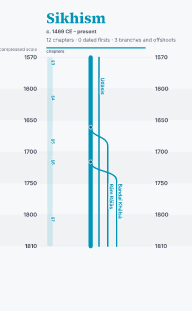
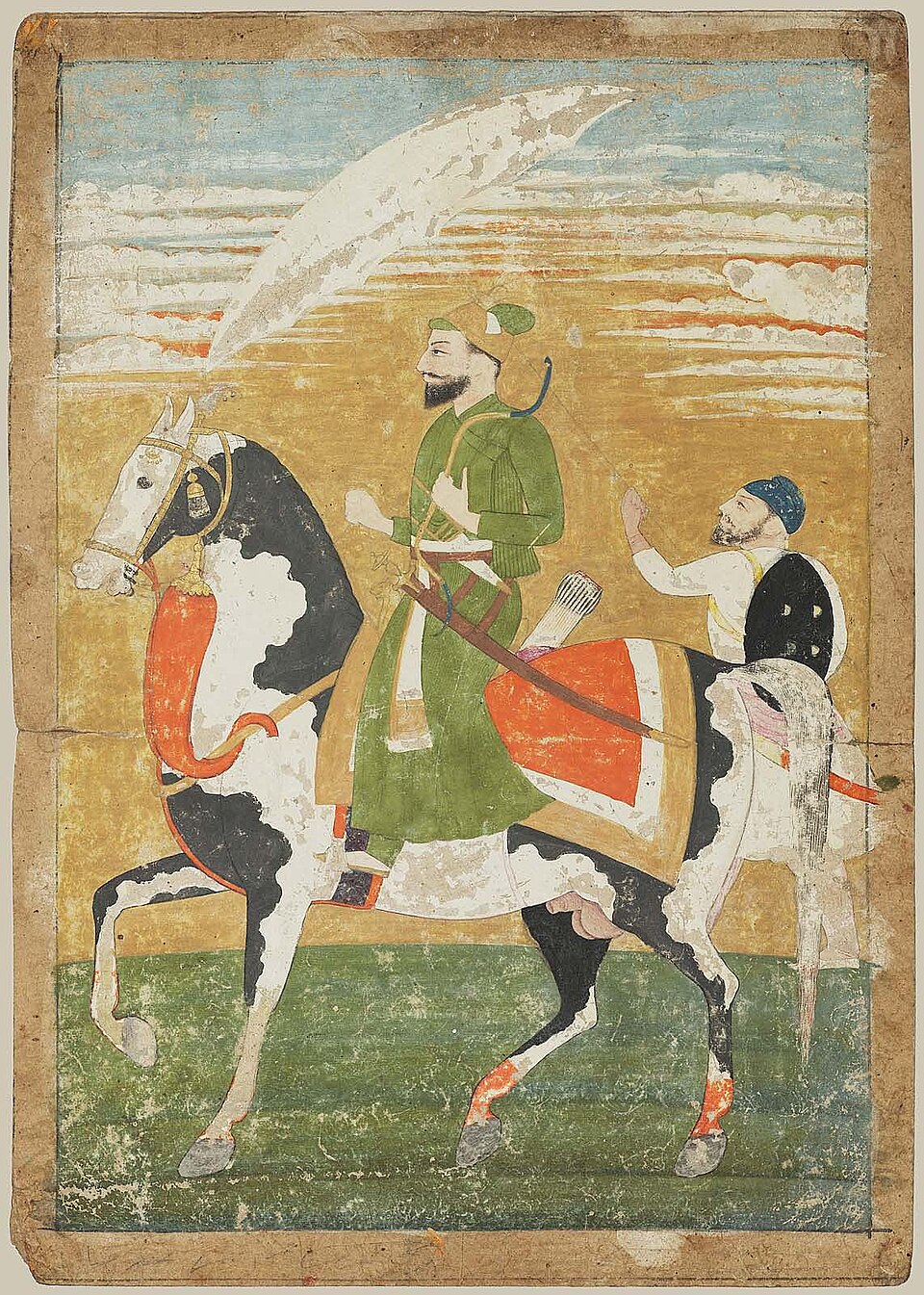
Guru Gobind Singh (1666–1708) is the Guru most Sikhs see in their mind’s eye: a young prince on horseback with a hawk on his wrist, the plume on his turban, the sword at his side. He was also a poet, in Braj, Punjabi and Persian, who kept dozens of poets at his court. In thirty-three years as Guru he fought the hill rajas of the Śivāliks and then the armies of the Mughal empire, lost his four sons and his town, and died far from Punjab. In 1699 he founded the Khālsā, the order of initiated Sikhs whose appearance (the uncut hair under a turban, the steel bracelet, the name Singh) defines a Sikh for most of the world today.[1][2] Consensus
The founding of the Khālsā is the best-known event in Sikh history and one of the hardest to reconstruct. The earliest account is short. The fuller one, with the Guru calling for heads and the Five Beloveds rising one by one, comes from texts written decades later. Much of what Khālsā Sikhs do today (the full list of the Five Ks, the name Kaur for every woman, the wording of the initiation) is attested only later still. That is the argument of this chapter: the Khālsā was founded in 1699, and took the shape Sikhs know over the following two centuries.[3][2] Majority
Timeline
| Date | Event | Confidence |
|---|---|---|
| 1666 | Gobind Rāi born at Patna, son of Guru Tegh Bahādur and Mātā Gujrī[1] | Majority (the year) |
| 1675 | Guru Tegh Bahādur executed in Delhi; Gobind Rāi becomes Guru at nine[1][4] | Consensus |
| c. 1685–1688 | At Pāoṇṭā on the Yamunā; the battle of Bhaṅgāṇī against hill rajas[5][1] | Majority |
| c. 1690 | The battle of Nādauṇ, against a Mughal commander, as the Bachitar Nāṭak describes it[5] | Majority |
| 1699 | The Khālsā founded at Anandpur at Vaisākhī; the masands removed[6][3] | Consensus (founding); Contested (details) |
| 1700–1704 | Anandpur besieged by the hill rajas, then with Mughal support[1] | Consensus |
| December 1704 | Anandpur evacuated; the two elder sons killed at Chamkaur; the two younger executed at Sirhind[1][4] | Majority (the dates) |
| 1705 | Battle at Khidrāṇā (Muktsar); the Guru at Talvaṇḍī Sābo (Damdamā Sāhib)[1] | Majority |
| c. 1705–1706 | The Zafarnāmā to Aurangzeb[7][8] | Majority |
| 1707 | Aurangzeb dies; the Guru meets Bahādur Shāh and accompanies him south[9] | Consensus |
| October 1708 | The Guru dies at Nanded after a knife attack; the line of human Gurus ends[1][9] | Consensus |
A Guru at nine
Gobind Rāi was born at Patna, in Bihar, while his father was travelling in the east; the year is usually given as 1666, and the tradition’s date is in December.[1] Majority He grew up at Anandpur, the town Guru Tegh Bahādur had founded in the Śivālik foothills above the Sutlej. In 1675 his father was executed in Delhi, on Aurangzeb’s orders according to the earliest Persian notice (1710s); no order survives (§4). Gobind Rāi became Guru at the age of nine.[1][4] Consensus
The tenth Guru’s own account of his father’s death, in the Bachitar Nāṭak, says that Guru Tegh Bahādur “protected their tilak and sacred thread”, the marks of the Hindu twice-born, and that he “gave his head, but not his resolve” (sirar, often rendered “faith”).[10][4] Majority that the text is the Guru’s or his court’s. Why he was executed, and whether he died defending the Brahmins of Kashmir as the later tradition tells it, is a question for §4. For this chapter what matters is that the second death of a Guru at Mughal hands, seventy years after Guru Arjan’s in Mughal custody at Lahore, framed the tenth Guru’s whole reign.[4][11] Majority
Anandpur: a court in the hills
The Śivālik hills were divided among small Rajput states (Kahlūr, also called Bilāspur, in which Anandpur lay; Nāhan; Kāṅgṛā; Guler and others), tributary to the Mughals and frequently at war with one another. The Guru’s establishment was one more power among them, and to the rajas a troubling one: it drew offerings and armed followers from the plains, and its Guru held court like a king.[1][2] Consensus
A ruler and a poet
From the time of Guru Hargobind (§4) the Gurus had kept horses, arms and retainers. Guru Gobind Singh’s court at Anandpur, and for a few years at Pāoṇṭā on the Yamunā in the state of Nāhan, was on another scale. Louis Fenech’s study of it describes a Persianate court like those of the Rajput and Mughal nobility, with poets writing in Braj and Persian, hunting and music.[12] Majority The tradition counts fifty-two poets at the court; the figure is the tradition’s, and the names of a smaller number are known from their works.[12] Majority
Bhaṅgāṇī and Nādauṇ
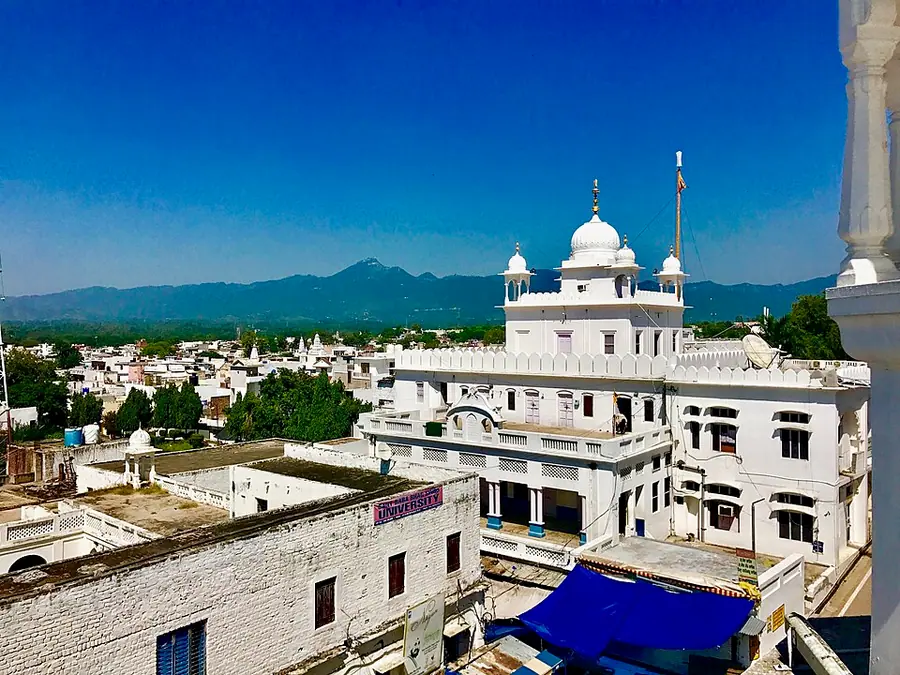
The Bachitar Nāṭak, a poem of the Dasam Granth that tells the Guru’s story in his own voice, describes, among other episodes, two early battles. At Bhaṅgāṇī, near Pāoṇṭā, in about 1688, the Guru’s men defeated a coalition of hill rajas led by Fateh Shāh of Garhwāl. At Nādauṇ, in about 1690, he fought for the hill rajas against a Mughal commander who had come to collect tribute.[5][1] Majority on the battles and their approximate dates. Bhaṅgāṇī is the subject of its eighth chapter, Nādauṇ of its ninth.
The text sets these wars inside a cosmic purpose. The Guru recounts a previous life as an ascetic in the Himalayas, and God’s command to go into the world and spread dharam:
ਹਮ ਇਹ ਕਾਜ ਜਗਤ ਮੋ ਆਏ ॥ ਧਰਮ ਹੇਤ ਗੁਰਦੇਵ ਪਠਾਏ ॥
ham ih kāj jagat mo āe | dharam het guradev paṭhāe ||
“For this purpose I came into the world: the divine Guru sent me for the sake of dharma.”[13]
The alliances matter as much as the theology. In the 1680s and 1690s the Guru fought hill rajas and Mughals in turn, as allies changed, in the ordinary politics of the hills. The later picture of a single war of the Sikhs against the Mughal empire is a simplification of these years.[2][11] Majority
The masand problem
From the time of Guru Amar Dās (§3), the congregations (saṅgats) scattered across northern India had been organised through deputies, the holders of mañjīs (“seats”). Under Guru Rām Dās and Guru Arjan these became the masands, and by the seventeenth century the masands collected the offerings of the faithful, taught in the Guru’s name and carried the money to the Guru’s court.[14][1] Consensus The Dabistān describes them in the 1640s or 1650s.
They were also a rival authority. The succession disputes of the seventeenth century (§4) had left several claimants to the Guruship, each with masands of their own, and the Sikh sources describe masands who kept offerings, ruled their congregations and favoured rival lines.[1][3] Majority A congregation that dealt with the Guru directly, without a masand, was called khālsā. The word is Persian, from Arabic khāliṣ, “pure”; in Mughal administration khāliṣa land was land held directly by the crown rather than assigned to a noble. Letters of the seventeenth-century Gurus already use it of congregations that belonged to the Guru directly.[3][1] Majority
That is the institutional problem the Khālsā solved. Whatever else happened in 1699, the Guru took all the congregations into his own hands, and the masands lost their office.[6][3] Consensus
Vaisākhī 1699: what the sources say
The tradition’s account
The account most Sikhs learn runs as follows. At the spring festival of Vaisākhī in 1699, before a great gathering at Anandpur, the Guru appeared with a drawn sword and asked for a Sikh willing to give his head. One man rose, and the Guru took him into a tent and came out with the sword bloodied; he asked again, four more times. Then he brought out all five alive, dressed like himself: Dayā Rām, a Khatrī of Lahore; Dharam Dās, a Jaṭ of Hastinapur; Himmat Rāī, a water-carrier of Jagannāth Purī; Mohkam Chand, a calico-printer of Dvārkā; and Sāhib Chand, a barber of Bīdar. He stirred water in an iron bowl with a double-edged sword (khaṇḍā) while reciting hymns, and his wife added sugar sweets; he gave the five this amrit to drink and sprinkled it on their hair and eyes; he named them Singh, the Pañj Pyāre (“Five Beloveds”); and then he asked them to initiate him in turn.[15][16] Consensus that this is the tradition’s account.
The five came from five regions and, by the tradition’s account, from five castes, one of them a Khatrī and the others from castes then ranked middling or low. The scene makes the order’s meaning visible: equality under the Guru, readiness to die, and a community that could in turn initiate its own Guru.[17][2] Consensus that this is the tradition’s meaning.
The earliest account
Sainapati, a poet at the Guru’s court, wrote Srī Gur Sobhā (“The Radiance of the Guru”) within a few years of the Guru’s death; the date in the text is read as 1701 or 1711, and since it describes events of 1708 the later date is usually preferred.[6][3] Majority It is the earliest account of the founding of the Khālsā. It describes the Guru making the congregations his own khālsā, removing the masands, and the new initiation; it does not describe the call for five heads.[3][2] Majority
How the story grew
| Element | Earliest clear attestation | Confidence |
|---|---|---|
| The Khālsā founded in 1699; the masands removed | Sainapati, early 18th c.[6] | Consensus |
| Initiation by khaṇḍe dī pāhul replacing initiation by the Guru’s foot-water | 18th-c. texts[3] | Majority |
| The name Singh for initiated men | 18th-c. texts; the Guru’s own name appears as Gobind Singh in this period[3][1] | Majority |
| The call for heads and the Five Beloveds | Mid- to late 18th-c. texts, among them Koer Singh’s Gurbilās and Kesar Singh Chhibbar (1769)[18][19] | Majority |
| The names, origins and castes of the five | Later 18th- and 19th-c. texts[3] | Majority |
| The Guru’s wife adding sweets to the amrit | Later tradition; it is told of Mātā Jīto and of Mātā Sāhib Kaur[20] | Contested |
Most historians accept that a founding event took place at Anandpur in 1699, at or about Vaisākhī, and that it created an initiated order owing direct allegiance to the Guru. The scene with the five heads is told in sources written decades later, and may preserve memory, may dramatise it, or both; it cannot be checked.[3][2][1] Majority on the founding; Contested on the details. Historians accept 1699; a few eighteenth-century texts give other years (Koer Singh’s Gurbilās puts it in 1689), and these are usually set aside.[18][2] Majority
What was the Khālsā?
An initiated order
Before 1699 Sikhs were initiated with charan pāhul: water touched by the Guru’s foot, or by a masand’s on the Guru’s behalf.[3] Majority The new rite, khaṇḍe dī pāhul (“initiation of the double-edged sword”), was given by five initiated Sikhs, not by the Guru alone, and it made the initiate a member of the Guru’s own khālsā, owing obedience to no intermediary. Majority Over the eighteenth century the Khālsā rite displaced the older one, though charan pāhul survived in some groups into the nineteenth century.[3][21] Majority
A name
Men initiated into the Khālsā took the name Singh, “lion”, already common among Rajputs. It gave men of every caste the same warrior name, and Sikh writers have long read it as an assault on caste names.[3][2] Majority The Guru’s own name changed with it: the sources of his early life call him Gobind Rāi.[1] Majority
A code
The Khālsā was given a rahit, a code of conduct. The earliest sources agree on its core: uncut hair, the bearing of arms, avoidance of the hookah, and separation from the masands and from the followers of the rival lines of Gurus; Sainapati already mentions all of these.[6][3] Majority The rahitnāmās (“codes of conduct”) of the eighteenth century, attributed to companions of the Guru (Nand Lāl, Chaupā Singh) or presented as records of his words (Prahlād Singh, Desā Singh), are fuller. They forbid tobacco, the cutting of hair, meat killed by the Muslim method, and relations with Muslim women, and they set penalties (tankhāh) for lapses. McLeod dated them from 1718–19 (the Tankhāhnāmā) and the 1730s (Sakhī Rahit kī) through the 1740s–1760s (Chaupā Singh) to the late eighteenth or early nineteenth century (Desā Singh): a century of war with Mughals and Afghans that shaped their rules.[3][22] Majority on the dates; Contested on how much reaches back to 1699.
A promise of rule
The Tankhāhnāmā, attributed to Nand Lāl (an attribution McLeod discounts), ends with a couplet that Sikhs still sing, in a slightly different wording, after the daily prayer, the Ardās:
ਰਾਜ ਕਰੇਗਾ ਖਾਲਸਾ ਆਕੀ ਰਹੇ ਨ ਕੋਇ ॥
rāj karegā khālsā ākī rahe na koi ||
“The Khālsā shall rule; none shall remain defiant.”[23][3]
Its earliest manuscript is dated 1718–19, a decade after the Guru’s death, in the years of Banda’s rising (§6).[3] Majority on the date; Political in modern use.
When did the Five Ks become five?
Today a Khālsā Sikh keeps five articles, each beginning with k in Punjabi: kes (uncut hair), kaṅghā (a wooden comb), kaṛā (a steel bracelet), kachhahirā (short breeches) and kirpān (a sword). The Sikh Rahit Maryādā of 1950 requires them, and Sikh tradition holds that the Guru prescribed them in 1699.[24][16] Consensus on current practice.
The early sources show the substance but not the formula. Uncut hair and the bearing of arms are in the earliest accounts; the comb, the breeches and the steel bracelet appear in eighteenth-century codes, among other rules about dress and weapons; but the earliest texts do not list five items beginning with k. Some codes speak instead of five weapons, or of other sets of five.[3][20] Majority on what the eighteenth-century codes contain.
W. H. McLeod concluded that the formula of the five kakkārs appears only with the Singh Sabhā reformers of the late nineteenth century (§8); the first full list he found is Sumer Singh’s, of 1883. He accepted that all five items may have been worn from early on; what he rejected was that the Guru decreed them as a set.[3][21] Others cite a Persian couplet attributed to Nand Lāl, a letter of the Guru dated 1699 and an undated text, the Srī Gur Kathā, all of disputed date and judged spurious or late by their critics; J. S. Grewal holds that the items were part of Khālsā dress from 1699 and only the formula is late; and many Sikhs hold that the list was always implicit in the Guru’s commands.[1][25] Contested; Political The difference between “the Guru prescribed the Five Ks” and “the Guru prescribed the practices that later became the Five Ks” is the whole of this argument.
Women and the Khālsā
Women appear in the history of the tenth Guru’s years in several roles. His mother, Mātā Gujrī, went with the younger sons into the plains when Anandpur fell and died in custody at Sirhind. His wife Mātā Sāhib Kaur (Sāhib Devāṅ) is honoured in Sikh tradition as “the mother of the Khālsā”, and Mātā Sundarī, another wife, guided the community for decades after his death. Māī Bhāgo, by the tradition’s account, led back to the Guru the forty men who had deserted him at Anandpur, and fought beside them at Khidrāṇā in 1705.[20][17] Majority on Mātā Sundarī’s role; Contested on the details of Māī Bhāgo’s story, which is first told in later sources.
Whether women were initiated into the Khālsā is less clear. The eighteenth-century codes are written for men, and some imply that women received the older charan pāhul or none.[20][3] Majority Doris Jakobsh has argued that the name Kaur, used by some women in the Gurus’ time as a title of rank, became the required name of all Sikh women only in the late nineteenth and twentieth centuries, and that the Sikh Rahit Maryādā’s provision for women’s initiation is itself a modern settlement.[20][24] Majority Nikky-Guninder Kaur Singh reads the founding in the opposite direction, as a rebirth from the Guru as mother as well as father, and the Khālsā as open to women from the start.[17] Contested
The fall of Anandpur
The sieges
The Khālsā made the Guru stronger, and his neighbours more afraid. From 1700 the hill rajas, led by the raja of Kahlūr, in whose territory Anandpur lay, tried to expel him; when they failed, they appealed to the Mughal governors of Sirhind and Lahore. Anandpur was besieged several times between 1700 and 1704.[1][2] Consensus on the sieges; Contested on their number and dates.
December 1704
In the last siege, with supplies exhausted, the Guru accepted an offer of safe passage, by the Sikh account sworn on the Qur’an by the Mughal commanders and on a cow by the hill rajas, and left Anandpur in December 1704. The besiegers attacked the column as it crossed the flooded Sarsā river, and the Guru’s household was scattered.[1][8] Majority; the year is given as 1705 in some accounts.
- At Chamkaur the Guru, with a few dozen men, held a mud fortress against a pursuing force. His two elder sons, Ajīt Singh and Jujhār Singh, were killed in the fighting; the Guru escaped by night.[1][4] Consensus
- At Sirhind the younger sons, Zorāwar Singh and Fateh Singh, aged about eight and six, were handed with their grandmother to the governor, Wazīr Khān, and executed. The tradition says they were bricked into a wall when they refused to convert, and then killed; Mātā Gujrī died in the tower where she was held.[4] Consensus on the executions; Majority on the details, which come from Sikh sources.
The deaths of the four sāhibzāde (the Guru’s sons) became one of the central memories of Sikh martyrdom, commemorated every December.[4] Consensus
Khidrāṇā and Talvaṇḍī Sābo
Moving south-west into the Mālvā country, the Guru fought a pursuing force at the pool of Khidrāṇā in 1705; the forty Sikhs who died there are the Chālī Mukte (“forty liberated ones”), and the town that grew there is Muktsar.[1] Majority He then stayed for some months at Talvaṇḍī Sābo, now Damdamā Sāhib, where tradition says the final recension of the scripture was prepared, with his father’s hymns added (§0).[26][27] Majority on the tradition.
The Zafarnāmā
From the Mālvā the Guru wrote to Aurangzeb, in Persian verse. The Zafarnāmā (“letter of victory”) accuses the emperor’s commanders of breaking the oaths they swore at Anandpur, praises God as the true sovereign, and defends the Guru’s resort to arms.[7][8] Majority that it is the Guru’s.
چو کار از همه حیلتی در گذشت حلال است بردن به شمشیر دست
chū kār az hama ḥīlate dar guzasht / ḥalāl ast burdan ba-shamshīr dast
“When every other means has failed, it is lawful to take the sword in hand.”[7]
Louis Fenech reads the letter as a courtly Persian composition, steeped in the Shāhnāma and the poetry of Saʿdī, addressed by one sovereign to another in the language of the Mughal elite; the Guru’s argument is made in his opponent’s own idiom.[8] Majority Whether Aurangzeb received it, and whether it is behind his reported invitation to the Guru to meet him, the sources do not settle. Contested
To the Deccan, and the end of the line
Aurangzeb died in March 1707, and his sons fought for the throne. The Guru met the victor, Bahādur Shāh, near Agra in the summer of 1707, was received with honour and given a robe, and travelled with the imperial camp south into the Deccan; the Mughal newsletters record the meetings.[9][1] Consensus What the two men discussed, and whether the Guru hoped for justice against Wazīr Khān of Sirhind, is not recorded. Contested
At Nanded on the Godāvarī, in the autumn of 1708, the Guru was stabbed by a Pathān, by the Sikh account an agent of Wazīr Khān; the wound was stitched, reopened, and he died in October.[1][9] Consensus on the death; Contested on who sent the assassin. At Nanded he had also met a Bairāgī ascetic, Mādho Dās, who became Banda Singh Bahādur and led the Khālsā’s rising in Punjab after his death (§6).[1][2] Consensus
Guru Granth, Guru Panth
Guru Gobind Singh named no human successor. His four sons were dead, and the Sikhs who followed him recognised no further personal Guru. In Sikh belief, authority passed to the scripture, the Guru Granth Sāhib, and to the Khālsā community, the Guru Panth.[28][3] Consensus on the belief and on the end of the line.
The command is remembered in a couplet recited after the Ardās:
ਆਗਿਆ ਭਈ ਅਕਾਲ ਕੀ ਤਬੈ ਚਲਾਇਓ ਪੰਥ ॥ ਸਭ ਸਿਖਨ ਕੋ ਹੁਕਮ ਹੈ ਗੁਰੂ ਮਾਨੀਅਹੁ ਗ੍ਰੰਥ ॥
āgiā bhaī akāl kī tabai chalāio panth | sabh sikhan ko hukam hai gurū mānīahu granth ||
“By the command of the Timeless One the Panth was established. Every Sikh is commanded to accept the Granth as Guru.”[29]
The couplet is attributed to the Guru, but is first found in later texts: in a variant (“by the word of the Timeless Being the Panth was established…”) in the rahitnāmā attributed to Prahlād Singh, and in its familiar form in Giānī Giān Singh’s Panth Prakāsh (1880).[29][3][28] Majority The earliest sources report the belief in other words: Sainapati speaks of the Guru’s presence in the Khālsā, and Kesar Singh Chhibbar in 1769 that the Granth is the Guru.[6][19][28] Majority In practice, through the eighteenth century, the Khālsā’s assemblies (the Sarbat Khālsā) took decisions in the presence of the scripture, as the Guru’s own (§6).[2] Consensus The doctrine of the Granth as Guru was settled, in other words, in the decades after 1708 as much as at the moment of the Guru’s death, and its rivals (Banda’s followers, and later lines that recognised living Gurus, such as the Nāmdhārīs) are part of the history too (§6, §8).[28][21] Majority
The Dasam Granth
The Dasam Granth, “the book of the tenth [Guru]”, is a collection of compositions attributed to Guru Gobind Singh, compiled after his death. Tradition credits its compilation to his companion Bhāī Manī Singh; the earliest manuscripts are from the early eighteenth century, and they differ in their contents.[5][30] Majority
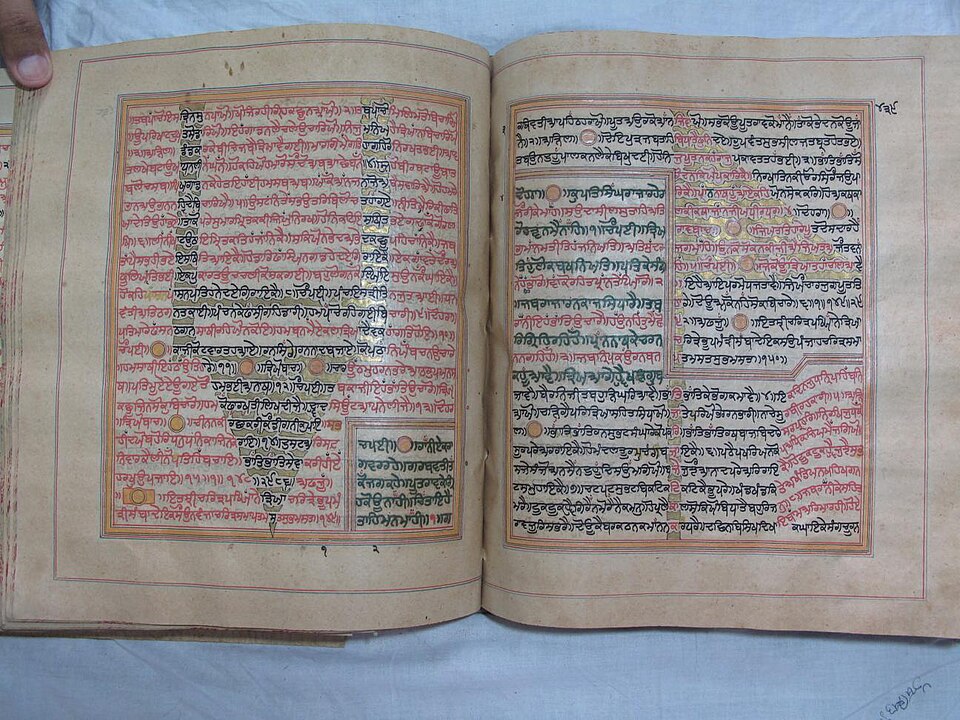
What is in it
The main compositions, in the order of the standard printed volume:[5][30] Consensus
| Composition | What it is | Recited today |
|---|---|---|
| Jāp | Praise of the formless God in many names and metres | Yes, in the morning prayers |
| Akāl Ustat | “Praise of the Timeless One”, against idol worship and empty ritual | In part: the Tav-Prasād Savaiyye of the morning prayers |
| Bachitar Nāṭak | The Guru’s previous life, his mission, and his early battles, in his own voice | No |
| Chaṇḍī Charitra, Vār Durgā kī | The goddess’s battles with demons, retold from Sanskrit | The opening of the Ardās is from the Vār |
| Chaubīs Avatār | The twenty-four avatars of Viṣṇu | No |
| Charitropākhyān | About four hundred stories of deceit, many sexual | One prayer, the Chaupaī, from its end |
| Zafarnāmā | The Persian letter to Aurangzeb | No |
Who wrote it
The question is part by part. Three positions are held:[30][3]
- All of it is the Guru’s. The traditional position of many Khālsā Sikhs and of the eighteenth-century tradition, which treated the whole collection as scripture beside the Granth.
- Some of it is the Guru’s, and the rest is by poets of his court. On this view the hymns, the Bachitar Nāṭak and the Zafarnāmā are his, and the long mythological retellings and the Charitropākhyān are court poetry he commissioned or kept. This is the most common view among historians.
- Little of it is the Guru’s. Some Sikh reformers and scholars argue that most of the book, especially the Charitropākhyān and its stories of women, cannot be his, and some that parts were added later.
Contested; Political The argument is fierce because the book is both a text and a liturgy. Prayers from it are recited every morning by Khālsā Sikhs and at the initiation, and the opening of the Ardās invokes the goddess as Bhagautī, the sword, in words from the Vār Durgā kī. To say the book contains court poetry about Hindu gods is to say something about the daily prayers.[30] Consensus on why it matters.
One line shows the problem in miniature. The prayer at the end of the Chaṇḍī Charitra, sung as a Khālsā anthem, begins:
ਦੇਹ ਸਿਵਾ ਬਰੁ ਮੋਹਿ ਇਹੈ ਸੁਭ ਕਰਮਨ ਤੇ ਕਬਹੂੰ ਨ ਟਰੋ ॥
deh sivā baru mohi ihai subh karaman te kabahūṅ na ṭaro ||
“Grant me this boon, O Śivā: that I never turn back from righteous deeds.”[31]
In the poem it comes from, near its end, Śivā is the goddess, Chaṇḍī; many Sikhs read the word as a name of God, “the auspicious one”. Both readings are argued.[30] Contested
Why did the Khālsā take this shape?
Why did the tenth Guru found an armed, initiated order? The sources give the Guru’s own reasons (the defence of dharma, the removal of the masands); historians have added others.[1][2]
| View | Main argument | Main proponents |
|---|---|---|
| The Guru’s design | The Khālsā was the Guru’s deliberate creation, complete in 1699, fulfilling Guru Nānak’s mission in a time of persecution | The Sikh tradition; Fundamental Issues[25] |
| The Jaṭ thesis | The Jaṭ peasantry, who joined in large numbers from the late sixteenth century, brought arms and martial customs; the Khālsā gave them form | McLeod[32] |
| Institutional reform | The Khālsā solved the problem of the masands and the rival lines; the militancy was already there from Guru Hargobind | Grewal[1] |
| Formed in war | The Khālsā’s warrior identity and code were made over the eighteenth century, in the wars with Mughals and Afghans | Dhavan[2] |
| Religious violence in context | Sikh militancy was one case of a wider seventeenth-century pattern of armed religious communities in Mughal India | Syan[11] |
Contested These views are not exclusive, and most historians now combine several of them. Majority
The evidence ledger
| Date | Evidence | Confidence |
|---|---|---|
| late 17th c. | Bachitar Nāṭak: the Guru’s mission and early battles in his own voice[13] | Majority (authorship) |
| early 18th c. | Sainapati, Srī Gur Sobhā: the Khālsā founded, the masands removed[6] | Majority (date) |
| c. 1705–1706 | The Zafarnāmā[7] | Majority (authorship) |
| 1707–1708 | Mughal newsletters on the Guru’s meetings with Bahādur Shāh and his death[9] | Consensus |
| early 18th c. | The Dasam Granth compiled[5] | Majority |
| 1718–1719 | Earliest manuscript of the Tankhāhnāmā: “the Khālsā shall rule”[23][3] | Majority |
| 1740s–1760s | The Chaupā Singh rahitnāmā[22] | Majority (date) |
| 1751 (stated) | Koer Singh’s Gurbilās Pātshāhī 10, with the call for heads[18] | Contested (date) |
| 1769 | Kesar Singh Chhibbar: the Granth as Guru[19] | Majority |
| 1880, 1883 | The couplet “accept the Granth as Guru” in its familiar form; the first full list of the Five Ks McLeod found[29][3] | Majority (the couplet’s date); Contested (the Five Ks list as the first, and earlier versions of both) |
| 1950 | The Sikh Rahit Maryādā: the Five Ks, Kaur, women’s initiation[24] | Consensus |
Primary sources
Show the 6 primary sources
1. “For this purpose I came into the world”: Bachitar Nāṭak 6.42
ਹਮ ਇਹ ਕਾਜ ਜਗਤ ਮੋ ਆਏ ॥ ਧਰਮ ਹੇਤ ਗੁਰਦੇਵ ਪਠਾਏ ॥ ਜਹਾਂ ਤਹਾਂ ਤੁਮ ਧਰਮ ਬਿਥਾਰੋ ॥ ਦੁਸਟ ਦੋਖੀਅਨਿ ਪਕਰਿ ਪਛਾਰੋ ॥
ham ih kāj jagat mo āe | dharam het guradev paṭhāe || jahāṅ tahāṅ tum dharam bithāro | dusaṭ dokhīani pakari pachhāro ||
“For this purpose I came into the world: the divine Guru sent me for the sake of dharma. [He said:] Spread dharma everywhere, and seize and destroy the wicked and the evil.”[13]
What it proves. How the tenth Guru, or the poets who spoke in his voice, understood his mission: as a divine commission to defend righteousness by force where necessary. It is the self-understanding behind the Khālsā. Majority that the text is the Guru’s or his court’s; Consensus on the text.
2. “Grant me this boon”: Chaṇḍī Charitra (Ukti Bilās) 231
ਦੇਹ ਸਿਵਾ ਬਰੁ ਮੋਹਿ ਇਹੈ ਸੁਭ ਕਰਮਨ ਤੇ ਕਬਹੂੰ ਨ ਟਰੋ ॥ ਨ ਡਰੋ ਅਰਿ ਸੋ ਜਬ ਜਾਇ ਲਰੋ ਨਿਸਚੈ ਕਰਿ ਅਪੁਨੀ ਜੀਤ ਕਰੋ ॥
deh sivā baru mohi ihai subh karaman te kabahūṅ na ṭaro | na ḍaro ari so jab jāi laro nisachai kari apunī jīt karo ||
“Grant me this boon, O Śivā: that I never turn back from righteous deeds; that I do not fear the enemy when I go to fight, and with resolve make victory mine.”[31]
What it proves. That the warrior devotion of the Khālsā was voiced in the idiom of the goddess literature of northern India, and that the same words could be heard, then and now, as a prayer to Chaṇḍī or to the one God. It is the clearest single example of why the Dasam Granth is argued over. Contested on the reading.
3. “Lawful to take the sword”: Zafarnāmā, couplet 22
چو کار از همه حیلتی در گذشت حلال است بردن به شمشیر دست
chū kār az hama ḥīlate dar guzasht / ḥalāl ast burdan ba-shamshīr dast
“When every other means has failed, it is lawful to take the sword in hand.”[7][8]
What it proves. The Guru’s own justification of armed resistance, addressed to the emperor in Persian: force as a last resort, after broken oaths and failed negotiation. The word he uses, ḥalāl, is the Islamic legal term for what is permitted. Majority that the letter is the Guru’s.
4. “The Khālsā shall rule”: the Tankhāhnāmā
ਰਾਜ ਕਰੇਗਾ ਖਾਲਸਾ ਆਕੀ ਰਹੇ ਨ ਕੋਇ ॥ ਖ਼ੁਆਰ ਹੋਏ ਸਭ ਮਿਲਹਿੰਗੇ ਬਚੇ ਸ਼ਰਨ ਜੋ ਹੋਇ ॥
rāj karegā khālsā ākī rahe na koi | ḳhuār hoe sabh milahiṅge bache sharan jo hoi ||
(Tankhāhnāmā 62, in the standard edition; the wording sung after the Ardās differs slightly.)
“The Khālsā shall rule; none shall remain defiant. All, humbled, will come to join; those who seek refuge will be saved.”[23]
What it proves. That within a decade of the Guru’s death the Khālsā understood itself as a sovereign community, destined to rule. The couplet closes a code attributed to Nand Lāl, a poet of the Guru’s court, whose earliest manuscript McLeod dates to 1718–19, and it is sung after the Ardās to this day.[3] Majority on the date; Political in modern use.
5. “Accept the Granth as Guru”: the couplet after the Ardās
ਆਗਿਆ ਭਈ ਅਕਾਲ ਕੀ ਤਬੈ ਚਲਾਇਓ ਪੰਥ ॥ ਸਭ ਸਿਖਨ ਕੋ ਹੁਕਮ ਹੈ ਗੁਰੂ ਮਾਨੀਅਹੁ ਗ੍ਰੰਥ ॥
āgiā bhaī akāl kī tabai chalāio panth | sabh sikhan ko hukam hai gurū mānīahu granth ||
“By the command of the Timeless One the Panth was established. Every Sikh is commanded to accept the Granth as Guru.”[29]
What it proves. The doctrine of the Granth as Guru as Sikhs recite it today. The couplet is attributed to Guru Gobind Singh but first found in later writing, its familiar form in 1880; the belief it states is attested in the eighteenth century in other words.[28][3] Majority
6. The Five Ks today: the Sikh Rahit Maryādā
The code approved by the Shiromaṇī Gurdwārā Prabandhak Committee in 1945 and published in 1950 requires an initiated Sikh to keep the five kakārs (kes, kirpān, kachhahirā, kaṅghā and kaṛā), and forbids four things (kurahits): “dishonouring the hair”, eating meat killed in the Muslim manner (kuṭhā), adultery, and the use of tobacco. It gives the initiated man the name Singh and the woman the name Kaur. On dress it says only that a Sikh “must wear Kachhehra … and turban. A Sikh woman may or may not tie turban.”[24]
What it proves. What the Khālsā rahit became: a written code, agreed by a representative body in the twentieth century, settling questions that the eighteenth-century codes had left open, among them the turban, which it requires of men and leaves to women’s choice. Its “Muslim manner” of slaughter and its single list of five articles each have a history in the earlier codes (above). Consensus on the text.
What is absent
- A Mughal or outside record of Vaisākhī 1699. The founding of the Khālsā is known from Sikh sources only. Majority
- The call for five heads in the earliest account. Sainapati describes the founding without it; it is first told in full decades later. Majority
- The Five Ks as a list in the earliest sources. The practices are early; the five are first clearly attested as a list in the nineteenth century (McLeod: 1883), and earlier claims are disputed. Contested
- A written succession. No document of 1708 survives naming the Granth as Guru; the belief is attested in the decades after. Majority
- A fixed Dasam Granth. The early manuscripts differ in contents and order; the printed volume of about 1,400 pages took its standard form in the nineteenth and twentieth centuries.[30] Majority
Debates
What happened at Vaisākhī 1699?
| View | Main argument | Main proponents |
|---|---|---|
| The tradition’s account is history | The Sikh memory of the five heads and the Five Beloveds is ancient and consistent; later texts record what was always told | Much Sikh scholarship[25] |
| A founding, dramatised later | The founding and the removal of the masands are early; the scene of the heads is a later telling | McLeod, Dhavan[3][2] |
| Memory as meaning | The question is what the story means for the community, not only whether it can be checked | Nikky-Guninder Kaur Singh, Murphy[17][33] |
Contested
When did the Five Ks become five?
The practices are early; the five are first clearly attested as a list in the nineteenth century (McLeod: 1883), and earlier claims, which depend on how the codes are dated and read, are disputed.[3][25] Contested; Political On the traditionalist side, Kamalroop Singh and Gurinder Singh Mann cite the Persian Nishān-i Sikhī, which names the five ks, as one of what they call the “so-called apocryphal” compositions of the Dasam Granth.[34] Contested
Who wrote the Dasam Granth?
All of it, part of it, or little of it beyond a few compositions; the middle view is the most common among historians.[30] Contested; Political The traditionalist case is made by Kamalroop Singh, whose Birmingham doctoral thesis (2012) on the text’s history concluded that it was compiled in the Guru’s lifetime. Writing with Gurinder Singh Mann of the UK’s Sikh Museum Initiative, he ties the book to the maryādā of the weapons, the Takhts and the Akālī Nihaṅgs, traces the authorship quarrel to the Singh Sabhā, and holds that it was under colonial rule that the book lost its ceremonial place.[34] Contested; Political
Further reading
Show further reading (8 works)
- J. S. Grewal, The Sikhs of the Punjab (Cambridge, 1990; revised 1998): the narrative.
- W. H. McLeod, Sikhs of the Khalsa: A History of the Khalsa Rahit (Oxford, 2003): the codes, and the dating of the Five Ks.
- Purnima Dhavan, When Sparrows Became Hawks: The Making of the Sikh Warrior Tradition, 1699–1799 (Oxford, 2011): how the Khālsā was made in the eighteenth century.
- Louis E. Fenech, The Darbar of the Sikh Gurus (Oxford, 2008), and The Sikh Zafar-namah of Guru Gobind Singh (Oxford, 2013): the court and the letter.
- Louis E. Fenech, Martyrdom in the Sikh Tradition (Oxford, 2000): Chamkaur, Sirhind and their memory.
- Robin Rinehart, Debating the Dasam Granth (Oxford, 2011): the book and the argument, fairly.
- Doris R. Jakobsh, Relocating Gender in Sikh History (Oxford, 2003), and Nikky-Guninder Kaur Singh, The Birth of the Khalsa (SUNY, 2005): two readings of women and the Khālsā.
- Hardip Singh Syan, Sikh Militancy in the Seventeenth Century (I. B. Tauris, 2013): the background to the Khālsā’s arms.
References
- ^ a b c d e f g h i j k l m n o p q r s t u v w x y z { | J. S. Grewal The Sikhs of the Punjab. The New Cambridge History of India II.3, Cambridge University Press, 1990. The standard narrative history; revised edition 1998.
- ^ a b c d e f g h i j k l m n o Purnima Dhavan When Sparrows Became Hawks: The Making of the Sikh Warrior Tradition, 1699–1799. Oxford University Press, New York, 2011.
- ^ a b c d e f g h i j k l m n o p q r s t u v w x y z { | } ~ W. H. McLeod Sikhs of the Khalsa: A History of the Khalsa Rahit. Oxford University Press, New Delhi, 2003. The code of conduct from the rahitnāmās to the Sikh Rahit Maryādā; the main source for dating the Five Ks.
- ^ a b c d e f g h Louis E. Fenech Martyrdom in the Sikh Tradition: Playing the "Game of Love". Oxford University Press, New Delhi, 2000.
- ^ a b c d e f Dasam Granth — The Book of the Tenth Guru. compiled early 18th c. CE. Braj, Punjabi and Persian in Gurmukhi. Compositions attributed to Gobind Singh and his court: the Jāp, Akāl Ustat, Bachitar Nāṭak, Chaṇḍī Charitra, Chaubīs Avatār, Charitropākhyān and the Zafarnāmā. Who wrote which parts is the field's most heated textual argument.
- ^ a b c d e f g Sainapati, Srī Gur Sobhā — Poem on Guru Gobind Singh by a poet of his court. early 18th c. CE. Braj in Gurmukhi. The earliest account of the Khālsā's creation, by a poet of Gobind Singh's court: the Guru makes the congregations his own khālsā and removes the masands.
- ^ a b c d e Zafarnāmā, couplet 22 — Letter of Guru Gobind Singh to Aurangzeb. c. 1705–1706 CE. Persian. "When every other means has failed, it is lawful to take the sword in hand."
- ^ a b c d e Louis E. Fenech The Sikh Zafar-namah of Guru Gobind Singh: A Discursive Blade in the Heart of the Mughal Empire. Oxford University Press, New York, 2013.
- ^ a b c d e J. S. Grewal and Irfan Habib, eds. Sikh History from Persian Sources: Translations of Major Texts. Tulika, New Delhi, 2001. Jahāṅgīr, the Dabistān, court newsletters and chronicles in English.
- ^ Bachitar Nāṭak 5.13–14 — Dasam Granth. late 17th c. CE. Braj in Gurmukhi. The tenth Guru's account of his father's death: Tegh Bahādur "protected their tilak and sacred thread" and "gave his head, but not his resolve".
- ^ a b c Hardip Singh Syan Sikh Militancy in the Seventeenth Century: Religious Violence in Mughal and Early Modern India. I. B. Tauris, 2013.
- ^ a b Louis E. Fenech The Darbar of the Sikh Gurus: The Court of God in the World of Men. Oxford University Press, New Delhi, 2008. Gobind Singh's court, its poets and its Persianate culture.
- ^ a b c Bachitar Nāṭak 6.42 — Dasam Granth. late 17th c. CE. Braj in Gurmukhi. Gobind Singh, in the work's autobiographical voice: "For this purpose I came into the world: the Guru sent me for the sake of dharma."
- ^ Dabistān-i Mazāhib, on the Nānakpanthīs — The School of Religions. c. 1645–1658 CE. Persian. A Persian survey of religions with a chapter on the followers of Nānak by an author who knew Guru Hargobind and Guru Har Rāī: the masands, the Gurus' court, and Sikhs who rejected idols and caste rules.
- ^ Max Arthur Macauliffe The Sikh Religion: Its Gurus, Sacred Writings and Authors. Clarendon Press, Oxford, 6 vols., 1909. Written with Sikh scholars of the Singh Sabhā; the tradition's account in English.
- ^ a b Eleanor Nesbitt Sikhism: A Very Short Introduction. Oxford University Press, 2nd ed., 2016.
- ^ a b c d Nikky-Guninder Kaur Singh The Birth of the Khalsa: A Feminist Re-Memory of Sikh Identity. State University of New York Press, 2005.
- ^ a b c Koer Singh, Gurbilās Pātshāhī 10 — Life of the Tenth Guru. dated 1751 CE in the text; possibly later. Braj in Gurmukhi. A full narrative of the Khālsā's founding, including the call for heads; its date is disputed.
- ^ a b c Kesar Singh Chhibbar, Baṅsāvalīnāmā — Genealogy of the Ten Gurus. 1769 CE. Punjabi in Gurmukhi. A Brahmin Sikh's history of the Gurus, with an early statement that the Granth is the Guru.
- ^ a b c d e Doris R. Jakobsh Relocating Gender in Sikh History: Transformation, Meaning and Identity. Oxford University Press, New Delhi, 2003.
- ^ a b c Harjot Oberoi The Construction of Religious Boundaries: Culture, Identity, and Diversity in the Sikh Tradition. University of Chicago Press, 1994. The "Sanātan" Sikhism of the early nineteenth century and the Singh Sabhā's sharper boundaries.
- ^ a b Chaupā Singh Rahitnāmā — Code of conduct attributed to Chaupā Singh Chhibbar. mid-18th c. CE. Punjabi in Gurmukhi. The longest early rahitnāmā; McLeod dates its core to the 1740s–1760s.
- ^ a b c Tankhāhnāmā — Code of penances attributed to Bhāī Nand Lāl. earliest manuscript 1718–1719 CE. Punjabi in Gurmukhi. A code of penances attributed to Bhāī Nand Lāl (an attribution McLeod discounts); its earliest manuscript is dated 1718–19, in the years of Banda's rising. It closes with the couplet "rāj karegā khālsā" (the Khālsā shall rule), sung after the daily Ardās.
- ^ a b c d Sikh Rahit Maryādā — Code of conduct of the Shiromaṇī Gurdwārā Prabandhak Committee. approved 1945 CE; published 1950 CE. Punjabi. The code most Sikh institutions follow: who is a Sikh, the amrit ceremony, the Five Ks and the four cardinal prohibitions. about
- ^ a b c d Kharak Singh, G. S. Mansukhani and Jasbir Singh Mann, eds. Fundamental Issues in Sikh Studies. Institute of Sikh Studies, Chandigarh, 1992. Essays against McLeod's school, from its Sikh critics.
- ^ Damdamā recension of the Ādi Granth — The text with Guru Tegh Bahādur's hymns added. c. 1706 CE (tradition). Punjabi in Gurmukhi. The form of the scripture installed as Guru; tradition says Gobind Singh had it prepared at Talvaṇḍī Sābo.
- ^ Gurinder Singh Mann The Making of Sikh Scripture. Oxford University Press, New York, 2001. The manuscripts from the Goindvāl pothīs to the Damdamā recension.
- ^ a b c d e Pashaura Singh The Guru Granth Sahib: Canon, Meaning and Authority. Oxford University Press, 2000. doi The formation of the Sikh canon, from the 1604 Ādi Granth to its installation as Guru.
- ^ a b c d Āgiā bhaī akāl kī — Couplet recited after the Ardās. 19th c. CE in writing. Punjabi in Gurmukhi. "Every Sikh is commanded to accept the Granth as Guru": attributed to Gobind Singh. A variant is in the Rahitnāmā attributed to Prahlād Singh; the familiar wording is first found in Giānī Giān Singh's Panth Prakāsh (1880).
- ^ a b c d e f g Robin Rinehart Debating the Dasam Granth. Oxford University Press, New York, 2011.
- ^ a b Chaṇḍī Charitra (Ukti Bilās) 231 — Dasam Granth. late 17th c. CE. Braj in Gurmukhi. "Deh sivā bar mohi ihai": a prayer for the courage never to turn from righteous deeds. Whether Śivā is the goddess or God is itself debated.
- ^ W. H. McLeod The Evolution of the Sikh Community: Five Essays. Clarendon Press, Oxford, 1976. Includes the argument that the Jaṭ peasantry shaped the community's turn to arms.
- ^ Anne Murphy The Materiality of the Past: History and Representation in Sikh Tradition. Oxford University Press, New York, 2012.
- ^ a b Kamalroop Singh and Gurinder Singh Mann "The Guru's warrior scripture". OUPblog (Oxford University Press), 24 January 2016, 2016. open library The authors of The Granth of Guru Gobind Singh: Essays, Lectures and Translations (OUP, New Delhi, 2015) on the Dasam Granth as a warrior scripture tied to the weapons, the Takhts and the Akālī Nihaṅgs; Kamalroop Singh's thesis (Birmingham, 2012) concluded it was compiled in the Guru's lifetime. Gurinder Singh Mann here is the director of the UK Sikh Museum Initiative, not the historian G. S. Mann.