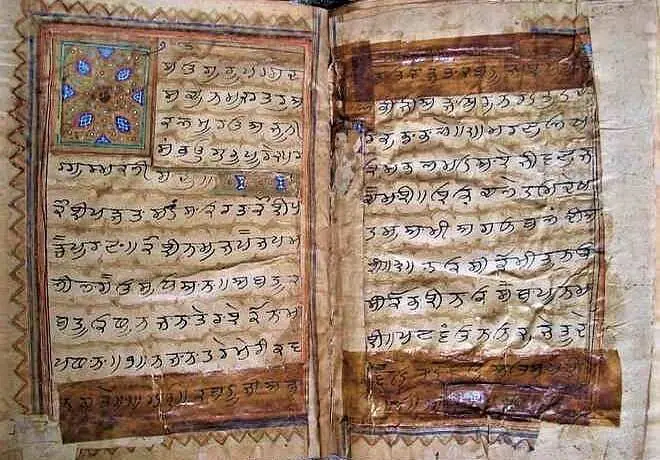
Sikh tradition gives a full account of its own beginnings: the birth of Guru Nānak in 1469, his childhood and calling, his travels to the holy places of Hindus and Muslims, the nine Gurus who followed him, and the founding of the Khālsā by the tenth, Guru Gobind Singh, in 1699. Much of that account comes from texts written in the seventeenth, eighteenth and nineteenth centuries: lives of Guru Nānak, poems on the later Gurus, codes of conduct and histories of the community. Since the twentieth century historians have also read those texts as evidence, dated them, compared them, and set them beside the hymns of the Gurus themselves, the earliest manuscripts, Persian records and the writings of outsiders. Every later chapter of this series depends on that kind of reading. This one explains how it works, and why it has caused more open conflict in Sikh studies than in almost any other field this site covers.
The short answer: the Gurus’ hymns are early and well preserved, and are the best evidence for what they taught; the stories of their lives are later and have to be weighed one by one; outside witnesses confirm the outline from 1606 onward. For Guru Gobind Singh and the Khālsā, the gap between event and written account is wider than for Guru Nānak’s teaching, and many familiar details first appear decades or a century later. Where the evidence agrees, this series says so; where it does not, it says that too. Majority
The problem: a scripture of hymns, and lives written later
The historian of the early Sikh community has two kinds of source, and the difference between them is the starting point of every argument in the field.[1][2] Consensus
- The hymns are early, but they are not narrative. The Gurus composed poetry to be sung, set to musical modes (rāgs). They speak of God, the divine Name, the human condition and the Guru; they name places and events only now and then. Most of the scripture was in writing within a lifetime of its authors (below).[3][4]
- The lives are later. No life of Guru Nānak was written in his own lifetime. The janamsākhīs (“birth stories”) were written down from the seventeenth century onward, and the narrative poems about the later Gurus (gurbilās, “the Guru’s splendour”) mostly from the eighteenth.[5][6]
- The outside evidence begins a century in. A Mughal emperor’s memoir of 1606, a Persian survey of religions from the mid-seventeenth century, and then Mughal court records and chronicles.[7]
The gap is not total. Some hymns refer to datable events, the scripture includes poems by Sikhs of the Gurus’ own time, and Bhāī Gurdās, writing in the early seventeenth century, knew Guru Amar Dās and his successors personally.[3][8] Consensus But most of the detailed narrative that Sikhs learn as their history was written down by people who lived after the events, often for communities with interests of their own in how the story was told.[5] Majority
The scripture’s manuscripts
The Guru Granth Sāhib, as printed today, runs to 1,430 pages (aṅgs, “limbs”) in the standard pagination. It contains about six thousand hymns by six of the Gurus (the first five and the ninth), by fifteen bhagats (devotees) from outside the line of Gurus, among them Kabīr, Nāmdev, Ravidās and the Sufi Shaikh Farīd, and by poets and minstrels of the Gurus’ courts.[4][3] Consensus How it reached that form is one of the best-documented histories of any scripture, because several of its stages survive as manuscripts.
The Goindvāl pothīs, c. 1570–1572
Under the third Guru, Amar Dās (Guru 1552–1574), the hymns of Guru Nānak and of Amar Dās himself, with those of several bhagats, were copied into a set of volumes at Goindvāl on the river Beās. Two of them survive, kept by descendants of the Guru’s family, and Gurinder Singh Mann’s study (1996) dates them to about 1570–1572.[9][10] Majority They show that a written collection of the Gurus’ hymns existed within about thirty years of Guru Nānak’s death in 1539, and that the bhagats’ hymns had already been gathered beside them.[10] Majority They are also the earliest dated witnesses to Kabīr and the other Sant poets (Hinduism §10).
The Kartārpur volume, 1604
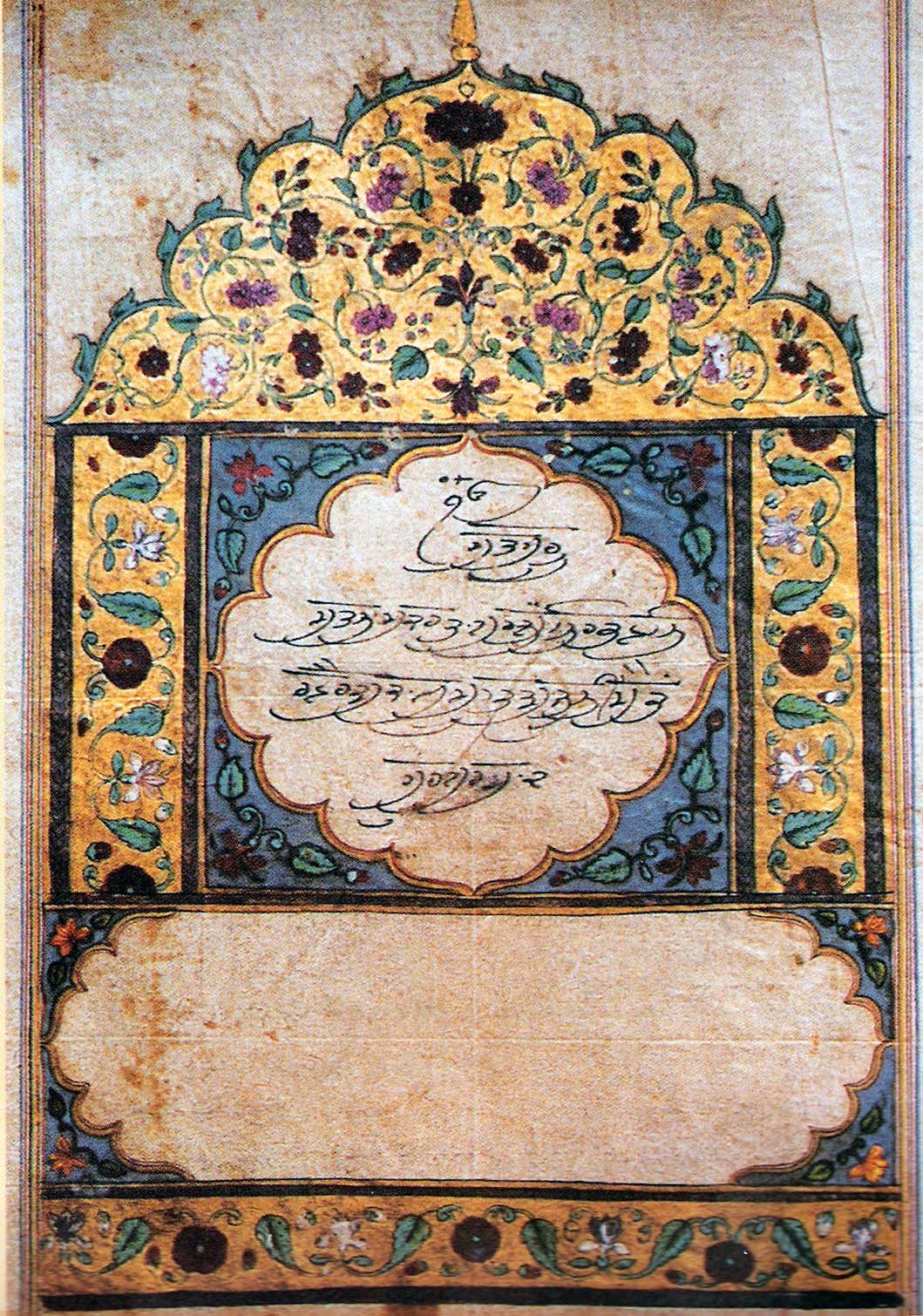
The fifth Guru, Arjan (Guru 1581–1606), compiled a larger collection, the Ādi Granth (“first book”), completed in 1604 with Bhāī Gurdās as scribe, and installed it in the Harmandir Sāhib at Amritsar.[4][11] Consensus A large manuscript kept by the Sodhī family at Kartārpur, near Jalandhar, is held by tradition and by its own dating to be that master copy.[12] Majority Its status has been argued over for a century, partly because access to it has been restricted, and partly because it contains erasures, blank pages and a few passages that the standard text does not have.[3][4] Contested on whether it is Guru Arjan’s own volume; most specialists accept it as either that copy or a very early one.
Other early copies
Several seventeenth-century manuscripts differ from the Kartārpur volume. The best known, the Bhāī Banno version, adds compositions that the standard text lacks, among them a hymn in Mīrābāī’s name and longer versions of some others.[13][3] Consensus on the differences. Mann reads the manuscripts as evidence that the text continued to settle through the seventeenth century, with competing lines of copies; Pashaura Singh puts more weight on Guru Arjan’s own editorial work in 1604.[3][4] Contested
The Damdamā recension and the printed text
The form of the scripture that became standard adds the hymns of the ninth Guru, Tegh Bahādur (d. 1675). Tradition says Guru Gobind Singh had this version prepared at Talvaṇḍī Sābo (Damdamā Sāhib) in about 1706, and installed it as the Guru before his death in 1708 (§5).[14][4] Majority on the tradition; manuscripts with Guru Tegh Bahādur’s hymns are older than that date.[3] Printed editions followed in the nineteenth century, and the standard 1,430-page layout in the twentieth, so that a citation by aṅg points to the same words in any modern copy.[4] Consensus
What the manuscripts show
The broad conclusion is secure: the hymns of the Gurus were written down early, in the Gurus’ own circle, and the text of the Guru Granth Sāhib has been stable in substance since the seventeenth century. Consensus What the manuscripts also show is that the scripture had a history: an order of collection, choices about what to include, and variant copies that the community later set aside.[3] Majority That second point is the one that, in the 1990s, brought scholars before the Akāl Takht (below).
The hymns as historical evidence
The Gurus rarely date anything, but their hymns are not timeless either. Three kinds of information can be drawn from them:
- Events. Four hymns of Guru Nānak, the Bābar-vāṇī, describe the Mughal invasions of Punjab in the 1520s: the slaughter, the women dishonoured, the Pathān rulers who failed to protect their people. They are the most securely datable lines in the scripture, and they show Guru Nānak alive and composing in the 1520s.[15][2] Consensus
- Institutions. A ballad by two minstrels of the Gurus’ court, Sattā and Balvaṇḍ, describes Guru Nānak setting the royal canopy over the head of his disciple Lahaṇā, whom he renamed Aṅgad, and so passing on the Guruship. It is the earliest account of the succession, in the scripture itself.[16] Majority on its date: the ballad names Guru Arjan, so it belongs to his time, 1581–1604.
- Teaching. What the Gurus said about God, caste, ritual, renunciation and the Name is in their own words. Here the hymns are not a source for the history; they are the history.[1][17] Consensus
What they do not give is a biography. Guru Nānak names himself in the last line of his hymns, as Indian devotional poets did; so do his successors, who all sign as “Nānak” and are distinguished in the scripture by number (mahalā 1, 2, 3…), not by name.[4] Consensus The scripture says nothing directly about where he travelled, whom he met, or when.
The janamsākhīs
The janamsākhīs are collections of stories (sākhīs, “testimonies”) about Guru Nānak, written in Punjabi prose from the seventeenth century onward. They tell of his birth at Talvaṇḍī, his childhood encounters with teachers, his call to preach after vanishing for three days in a river, and long journeys in the four directions, ending at Kartārpur, where he died. They were read aloud in Sikh congregations, and they are still the version of Guru Nānak’s life most Sikhs know.[5][18] Consensus
There are four main traditions:[5]
| Tradition | Earliest manuscripts | Character |
|---|---|---|
| Purātan (“ancient”) | 17th c.: the Colebrooke manuscript and the Hāfizābād manuscript, found in 1883[19] | Brief and relatively restrained; the basis of McLeod’s sorting |
| Miharbān | 17th c., from the circle of Prithī Chand’s descendants, rivals of the main line of Gurus[20] | Long discourses explaining the Guru’s hymns |
| Bālā | 17th c. onward; the most widely printed[21] | Claims to be narrated by Bhāī Bālā, an eyewitness companion not named in earlier sources |
| B40 | Dated 1733, with 57 paintings[22] | A compilation from several sources; among the earliest images of Guru Nānak |
McLeod’s sorting
In Guru Nanak and the Sikh Religion (1968) W. H. McLeod took 124 episodes from the janamsākhīs and sorted them into five classes, from the established through the probable and the possible to the improbable and the impossible. Only about three dozen were judged established or probable, and the life he could defend was short: birth in 1469, probably at Talvaṇḍī; a married life and employment at Sultānpur; travels whose details cannot be recovered; and the last years at Kartārpur, where he died in 1539.[1] Majority that this outline is what the evidence supports.
The method was not new to scholars of other religions, but it was new to Sikh history, and it landed on the stories that mattered most to devotion: the visit to Mecca, where the Kaʿba moved to follow Guru Nānak’s feet; the meeting with Bābur; the boulder stopped by his hand at Pañjā Sāhib.[1][5] The Mecca story is older than any surviving janamsākhī manuscript: Bhāī Gurdās already tells it in the early seventeenth century (below, and §2).[23] Consensus The others are first attested in the janamsākhīs. Majority
What the janamsākhīs are good for
McLeod’s later work, Early Sikh Tradition (1980), turned the question round: if the janamsākhīs are poor biography, they are good evidence for the communities that told them, for how Sikhs of the seventeenth and eighteenth centuries understood the Guru, and for the rivalries between lines of claimants.[5] Consensus Anne Murphy (2012) and others have since read them, with the relics and shrines associated with the Gurus, as a living tradition of memory rather than as failed history.[6] Majority
Bhāī Gurdās
Bhāī Gurdās (d. 1636), a kinsman of the third Guru and the scribe of the Ādi Granth, wrote forty long poems (vārs) in Punjabi, and verses in Braj. The first vār is a history of the world that leads to the mission of Guru Nānak, follows his travels, and ends with the succession down to Guru Hargobind; the eleventh lists the leading Sikhs of the first six Gurus by name and place.[8][2] Consensus on the author and his date.
He is the earliest Sikh writer outside the scripture whose work survives, and the Sikh tradition calls his poems “the key to the Guru Granth Sāhib”. For the historian he is a witness from inside the Gurus’ circle in the time of Guru Arjan and Guru Hargobind: he describes Guru Nānak’s journey to Mecca and Baghdad, which suggests that stories of the travels were already told in the early seventeenth century, but he wrote as a poet and theologian, not as a chronicler.[1][2] Majority
The series quotes the Vārāṅ in the text in common circulation, as given online by BaniDB, which is not a critical text. No copy in Bhāī Gurdās’s own hand survives. Gursharan Kaur Jaggi’s critical edition, Vārāṅ Bhāī Gurdās: sampādan ate pāṭh-nirdhāraṇ (Punjabi University, Patiala; second printing 1999), takes an old manuscript in the Central Public Library, Patiala, as its base, compares it with three other manuscripts and the SGPC’s printed text, and records the variant readings in footnotes.[24] Consensus on the edition. Most of the differences are of spelling and vowel signs, but some change a word: Santbir Singh, comparing a widely used online text with Jaggi’s, counted fifteen variants in the eight lines of Vār 1, pauṛī 35 alone.[25]
Persian and Mughal witnesses
The Sikh community grew up inside the Mughal empire, and from the early seventeenth century it appears in Persian writing.[7] Consensus
- Jahāṅgīr’s memoirs, 1606. The emperor recorded that at Goindvāl on the Beās there was “a Hindu named Arjan” who had drawn followers among Hindus and even Muslims, whose followers had been “peddling this same stuff” for “three or four generations”, and that after the Guru blessed the rebel prince Khusrau he ordered his property confiscated and his execution.[26][27] Consensus on the text. It is the earliest datable non-Sikh reference to a Guru, and it confirms the succession of Gurus and the community’s size. Why the Guru died, and how, is taken up in §3.
- The Dabistān-i Mazāhib, c. 1645–1658. A Persian survey of the religions of India and Iran, by an author who had met Guru Hargobind and Guru Har Rāī, gives a chapter to the followers of Guru Nānak: their Gurus, the masands who collected offerings, Sikhs who ignored caste and idol worship, and the Guru’s armed retinue.[28][7] Majority on the author and date; the work was long attributed to Muḥsin Fānī; most scholars now attribute it to Mīr Zulfiqār Ardastānī, who wrote as Mobad.
- Court records and chronicles. From the 1700s, Mughal newsletters (akhbārāt) and histories record Guru Gobind Singh’s dealings with the emperor Bahādur Shāh, the rising of Banda Singh Bahādur, and the campaigns against the Sikhs.[7] Consensus
The Persian writers were outsiders, and often hostile. Jahāṅgīr calls the Guru’s followers “fools” and “stupid”; later chroniclers call the Sikhs dogs and infidels. But like the Christian witnesses to early Islam, they did not depend on the Sikh tradition, and where they agree with it they confirm it.[7] Majority
The eighteenth-century texts
For Guru Gobind Singh and the Khālsā the sources change. There is a large body of writing attributed to the Guru himself, and a much larger body about him, most of it written decades or a century after his death.[29][30] Consensus
The Dasam Granth
The Dasam Granth (“the book of the tenth [Guru]”) is a collection of about 1,400 pages, usually thought to have been compiled after Guru Gobind Singh’s death in 1708; some manuscripts carry earlier dates.[31] Majority It contains devotional hymns (the Jāp, Akāl Ustat, the savaiyye), an account of the Guru’s previous life and early battles in his own voice (the Bachitar Nāṭak), long retellings of the goddess Chaṇḍī’s battles and of the avatars of Viṣṇu, hundreds of stories of the tricks of women and men (the Charitropākhyān), and, in Persian, the Zafarnāmā, a letter to Aurangzeb.[32][31] Consensus on the contents.
Several of these compositions are recited daily by Khālsā Sikhs. Who wrote which parts is the most heated textual argument in Sikh studies (§5).[31] Contested; Political
Poems, lives and codes
| Text | Date | What it is |
|---|---|---|
| Sainapati, Srī Gur Sobhā | early 18th c.[33] | A poem by a poet of Guru Gobind Singh’s court; the earliest account of the Khālsā’s founding |
| Rahitnāmās (codes of conduct) | 18th c., some later[34][35] | Rules for the Khālsā, attributed to the Guru’s companions; McLeod dates them from 1718–19 (the Tankhāhnāmā) to the late eighteenth century or later[29] |
| Koer Singh, Gurbilās Pātshāhī 10 | dated 1751 in the text[36] | A life of Guru Gobind Singh; its date is disputed |
| Kesar Singh Chhibbar, Baṅsāvalīnāmā | 1769 (some date it 1776)[37] | A genealogy and history of the ten Gurus |
| Ratan Singh Bhaṅgū, Prāchīn Panth Prakāsh | Usually dated 1841; G. S. Mann argues for c. 1810–1813[38][39][40] | The Khālsā’s eighteenth century, written in answer to a British officer |
The pattern matters for every chapter after §4: the fullest versions of the best-known stories (the Guru calling for five heads at Anandpur in 1699, the precise list of the Five Ks, the Guru’s last command that the Granth be the Guru) are found in the later texts, not the earliest ones.[29][30] Majority That does not make them false. It does mean that each has to be dated, and some will turn out to describe what Sikhs did in 1750 or 1850 rather than in 1699.
Even the dates in the table can move. Bhaṅgū’s chronicle is usually dated 1841 (Bikramī 1898), from Bhāī Vīr Singh’s reading of a coded verse near its end in his edition of 1914; Vīr Singh also gave the work the name Prāchīn (“old”) Panth Prakāsh, and the manuscripts call it Srī Gur Panth Prakāsh.[39][40] Majority on 1841. Gurinder Singh Mann (2016) points out that the closing section with that verse is missing from the manuscript he judges the earliest, that read literally the verse points to a year later than a copy dated early 1842, and argues from Bhaṅgū’s own account of telling the story to Captain Murray, whose chief, Colonel Ochterlony, oversaw the Punjab frontier from 1809 to 1814, and from his silence on Ranjit Singh after 1807, that the work was written in about 1810–1813.[40] Contested
Colonial scholarship
The British annexed Punjab in 1849, and the first histories of the Sikhs in English came with them. Joseph Davey Cunningham’s History of the Sikhs (1849), sympathetic to its subject, cost him his post for criticising British policy.[41] Consensus Ernest Trumpp, a German missionary scholar commissioned by the India Office, published the first English translation of the Ādi Granth in 1877; it was partial, and its preface, which called the scripture “incoherent and shallow”, gave lasting offence.[42] Consensus
The reply came from Max Arthur Macauliffe, a British civil servant who worked with Sikh scholars of the Singh Sabhā movement (§8) and published The Sikh Religion in six volumes in 1909: translations of the hymns and the tradition’s account of the Gurus, approved by Sikh scholars of his day.[43] Consensus For much of the twentieth century Macauliffe’s account, and the Singh Sabhā reading of Sikh history behind it, was what English readers and many Sikhs took Sikh history to be.[44][45] Majority
The McLeod controversy and after
The modern study of Sikh history begins with an argument, and the argument is part of the history.
McLeod, 1968
William Hewat McLeod (1932–2009), a New Zealander, went to Punjab in 1958 as a Presbyterian missionary teacher and wrote his doctorate at the University of London. Guru Nanak and the Sikh Religion (1968) did two things: it sorted the janamsākhī stories (above), and it set out Guru Nānak’s teaching from his own hymns, as part of the Sant tradition of northern India.[1] Consensus on the book’s argument. In later work McLeod argued that the community’s turn to arms owed much to the Jaṭ peasants who joined it in large numbers, and that the Khālsā’s code, including the Five Ks, took its fixed form in the eighteenth and nineteenth centuries.[46][29]
The replies
Many Sikh scholars read the work as an outsider dissolving the tradition into its Hindu surroundings, and its method as unfit for a revealed religion. In the 1980s and 1990s a group of scholars associated with the Institute of Sikh Studies in Chandigarh published a series of rebuttals, among them Fundamental Issues in Sikh Studies (1992).[47] Consensus that the debate took place. The sharpest points were three: that the Sant label made Guru Nānak a follower rather than the founder of a revelation; that the Jaṭ thesis made the Khālsā a social accident rather than the Guru’s design; and that the textual study of the scripture implied it had been edited by human hands.[47][48] Majority on what the critics argued.
Before the Akāl Takht
The argument reached the community’s highest seat of religious authority. In 1994 Pashaura Singh, a student of McLeod’s whose 1991 Toronto doctorate had studied the textual history of the Ādi Granth, was summoned before the Akāl Takht in Amritsar, and appeared. The same year Harjot Oberoi published The Construction of Religious Boundaries (1994), arguing that the clear line between Sikhs and Hindus was drawn in the late nineteenth century; it drew a campaign against the chair of Sikh studies he held at the University of British Columbia.[44][48] Majority on the events. This series reports these as events in the history of the field, and takes no side on the scholars’ standing.
Where the field stands
The field has moved since. Historians working in Punjab and abroad, many of them Sikhs (J. S. Grewal, Gurinder Singh Mann, Pashaura Singh, Louis Fenech, Purnima Dhavan, Anne Murphy, Doris Jakobsh), have kept McLeod’s method of dating each source while rejecting several of his conclusions. Few now describe Guru Nānak as merely a Sant; most think the Jaṭ thesis explains too little; and the textual history of the scripture is studied in Punjabi universities as well as abroad.[2][3][4][30][48] Majority
| View | Main argument | Representative scholars |
|---|---|---|
| Traditional | The janamsākhīs and gurbilās preserve the Gurus’ lives; the Khālsā and its code were created complete in 1699 | Singh Sabhā historians; Macauliffe; the authors of Fundamental Issues[43][47] |
| McLeod’s school | Date every source; Guru Nānak in his Sant setting; the Khālsā’s identity formed over two centuries | McLeod, Oberoi[1][29][44] |
| Current mainstream | Source criticism kept; more weight on the Gurus’ own institution-building and on the eighteenth century as formative | Grewal, Mann, Pashaura Singh, Dhavan, Fenech[2][3][4][30][49] |
| Postcolonial critique | Both the Singh Sabhā and the academic accounts were shaped by colonial categories of “religion” | Mandair[48] |
The evidence ledger
| Date | Evidence | Confidence |
|---|---|---|
| 1520s | Guru Nānak’s Bābar-vāṇī hymns on the Mughal invasions[15] | Consensus |
| c. 1570–1572 | The Goindvāl pothīs[9][10] | Majority |
| late 16th c. | Sattā and Balvaṇḍ’s ballad of the succession, in the scripture[16] | Majority |
| 1604 | The Ādi Granth compiled; the Kartārpur volume[12][4] | Consensus (compilation); Contested (the volume) |
| 1606 | Jahāṅgīr records ordering Guru Arjan’s execution[26] | Consensus |
| early 17th c. | Bhāī Gurdās’s Vārāṅ[8] | Consensus |
| 17th c. | The Purātan, Miharbān and Bālā janamsākhīs[19][20][21] | Majority |
| c. 1645–1658 | The Dabistān-i Mazāhib on the Nānakpanthīs[28] | Majority |
| early 18th c. | Sainapati’s Srī Gur Sobhā; the Dasam Granth compiled[33][32] | Majority |
| 1733 | The B40 janamsākhī, dated and illustrated[22] | Consensus |
| 1769 | Kesar Singh Chhibbar’s Baṅsāvalīnāmā[37] | Majority |
| 1841 | Ratan Singh Bhaṅgū’s Prāchīn Panth Prakāsh (some date it 1810–1813)[38][40] | Majority |
| 1877 | Trumpp’s partial English translation of the Ādi Granth[42] | Consensus |
| 1909 | Macauliffe’s The Sikh Religion[43] | Consensus |
| 1950 | The Sikh Rahit Maryādā published[50] | Consensus |
Faith and history: what historians can and cannot say
Historians can say when a hymn was first written down, in whose circle, beside what other texts, and how its wording varies between copies. They can say when a practice is first attested and what was said about it at the time. They cannot say whether the Gurus’ words are gurbāṇī, the word of the Guru revealed from God, or whether the ten Gurus shared one light, as Sikhs believe. Those questions are outside the reach of historical method, in either direction.
The clearest case is the scripture itself. That the hymns of the first Gurus were written down within a generation, in the Gurus’ own circle, is among the best-supported conclusions in the field.[10][3] Majority For Sikhs that agrees with the belief that the Gurus took care to preserve the revealed word; for others it shows only that the text is early. Both readings fit the evidence, and this series does not choose between them.
Three further points of method:
- Sikh and non-Sikh scholars do the same history. Most of the historians cited in this series are Sikhs, and their conclusions do not divide neatly from those of non-Sikhs. Where a view is held mainly by one group, the series says so.
- Tradition is evidence too. The janamsākhīs, the gurbilās poems and the community’s memory are reported as what they say, with their dates, and weighed like any other source. They are sometimes confirmed by earlier evidence, and sometimes not.
- Later is not the same as false. That a story is first written down a century after the event makes it harder to check, not wrong. The series says when a detail is first attested and leaves the reader to weigh it.
Images of the Gurus in this series
No portrait of any of the Gurus made from life is known. Painted images of Guru Nānak survive from the late seventeenth or early eighteenth century, the earliest dated being the illustrations of the B40 janamsākhī of 1733, and paintings of all ten Gurus became common in Punjab and the hill courts in the eighteenth and nineteenth centuries.[22][6] Majority Pictures of the Gurus hang in many Sikh homes, but they are not placed in gurdwaras as objects of worship, and the Akāl Takht has ruled against portraying the Gurus by actors on screen.[51] Majority
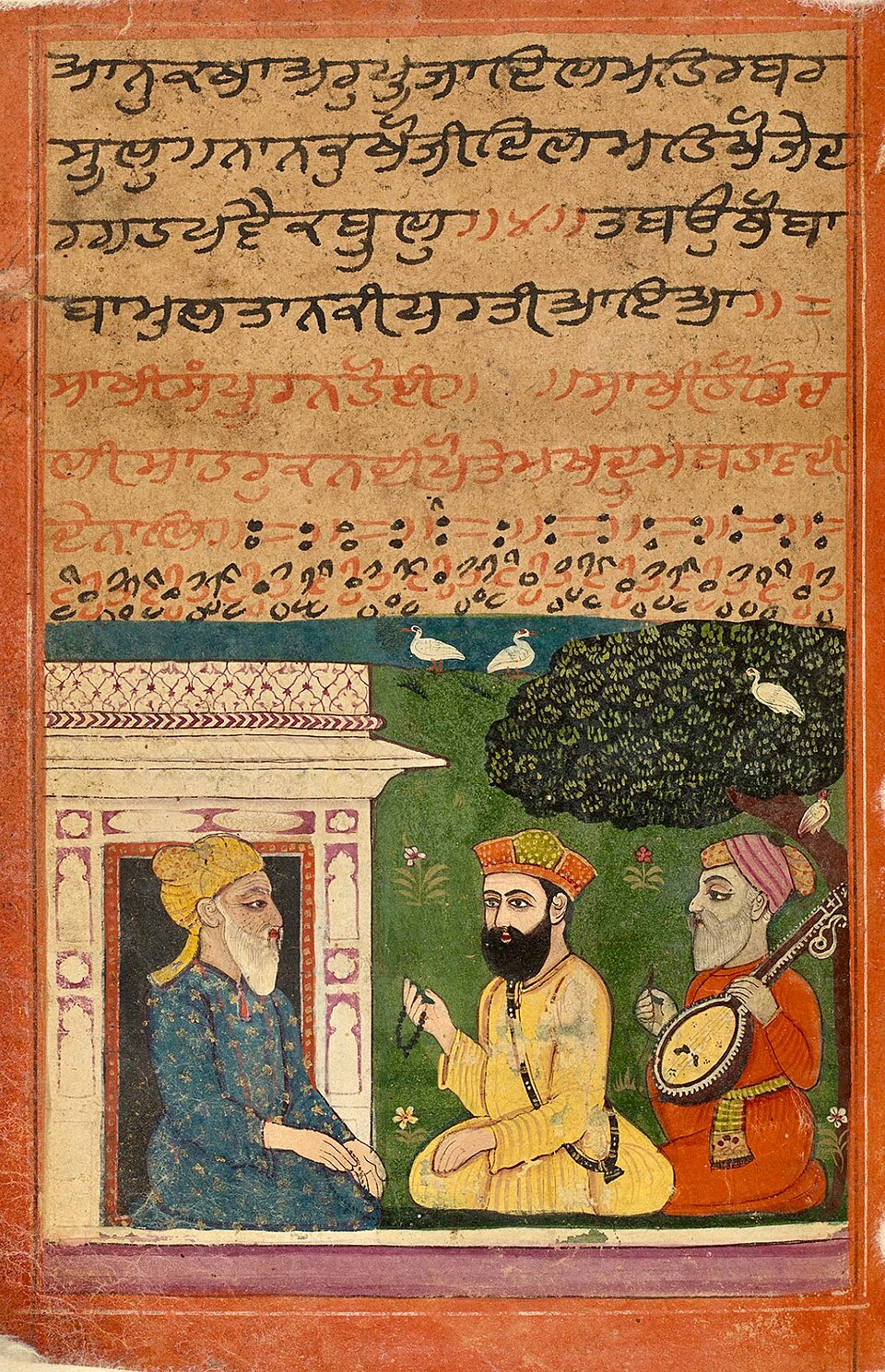
This series shows historical paintings of the Gurus only inside chapters, as works of art history, with their date, workshop and collection, and never as a page’s main image or social card. Its lead images are manuscripts, buildings and places.
What “Sikh” means in this series
Sikh is the Punjabi form of Sanskrit śiṣya, “disciple” or “learner”: a Sikh is a disciple of the Guru.[51] Consensus The early community also called itself the followers of Guru Nānak (Nānakpanthīs, as the Dabistān calls them) and the panth, “the path”.[28][2] Consensus The Khālsā, the order of initiated Sikhs founded by Guru Gobind Singh, has always been a part of the community rather than the whole of it.[45] Consensus
Who counts as a Sikh has been defined in several ways, and the definitions are part of the history: by the British army, by the Sikh Gurdwaras Act of 1925, and by the Sikh Rahit Maryādā (approved 1945, published 1950), which defines a Sikh as one who believes in the one God, the ten Gurus, the Guru Granth Sāhib and the teachings of the Gurus, and in the initiation of the tenth Guru, and owes allegiance to no other religion.[50][45] Consensus on the wording. The series says “Sikh” for the followers of the Gurus from Guru Nānak onward, as the sources do, and marks where the boundary itself is in question (§7–§9).
Reading conventions used throughout
- Dates are CE. The Sikh tradition, like most of northern India, dated events in the Vikram Samvat era (Bikramī), about 57 years ahead of the Common Era; conversions are given where a date depends on them. The Nanakshahi calendar is a subject of §11, not the series’ dating.
- Punjabi appears in Gurmukhi script, then in italic transliteration with macrons, then in translation, then with what the passage is used to prove. Familiar words keep their usual English spelling in running prose: Guru Nanak, Khalsa, gurdwara, Amritsar, Punjab.
- The Guru Granth Sāhib is cited by aṅg (page) in the standard 1,430-page pagination, with the Guru or poet and the rāg. No single English translation is standard; each passage names its translator, and where none is named the translation is the site’s own, close to the standard versions.
- Bhāī Gurdās’s Vārāṅ are quoted in the common text as given by BaniDB, cited by vār and pauṛī (1.23 is the first vār, twenty-third stanza). A critical edition by Gursharan Kaur Jaggi records manuscript variants. Not every quoted line has been checked against it; where one has and the wording differs, a note says so.[24]
- Names and titles. “Guru” is a title and is always kept. The honorifics Sāhib and Jī, which Sikhs add to the Gurus’ names and to the scripture, are left out of the narrative, as in academic writing, and kept in quotations and in the names of places (Harmandir Sāhib, Anandpur Sāhib). No disrespect is intended.
- The Golden Temple is called the Harmandir Sāhib, with “the Golden Temple” on first mention in each chapter; it is also known as the Darbār Sāhib.
- Confidence tags: Consensus Majority Contested Speculative Political
Primary sources
Show the 5 primary sources
1. The Mughal invasion: Guru Nānak, Āsā, aṅg 360
ਖੁਰਾਸਾਨ ਖਸਮਾਨਾ ਕੀਆ ਹਿੰਦੁਸਤਾਨੁ ਡਰਾਇਆ ॥ ਆਪੈ ਦੋਸੁ ਨ ਦੇਈ ਕਰਤਾ ਜਮੁ ਕਰਿ ਮੁਗਲੁ ਚੜਾਇਆ ॥ ਏਤੀ ਮਾਰ ਪਈ ਕਰਲਾਣੇ ਤੈਂ ਕੀ ਦਰਦੁ ਨ ਆਇਆ ॥੧॥
khurāsān khasamānā kīā hindusatānu ḍarāiā | āpai dosu na deī karatā jamu kari mugalu chaṛāiā | etī mār paī karalāṇe taiṅ kī daradu na āiā ||1||
“Having made Khurāsān his own, he has terrified Hindustan. The Creator takes no blame on himself: he sent the Mughal as Death. So much beating, and the people cried out; did you feel no pity?”[15]
What it proves. That Guru Nānak was alive and composing when Bābur’s armies came down into Punjab in the 1520s, and that he described the invasion as an eyewitness of its effects. The hymn is also a theological argument with God about suffering, which is how the scripture uses history: as an occasion, not as a record. Consensus
2. The first succession: Sattā and Balvaṇḍ, Rāmkalī, aṅg 966
ਨਾਨਕਿ ਰਾਜੁ ਚਲਾਇਆ ਸਚੁ ਕੋਟੁ ਸਤਾਣੀ ਨੀਵ ਦੈ ॥ ਲਹਣੇ ਧਰਿਓਨੁ ਛਤੁ ਸਿਰਿ ਕਰਿ ਸਿਫਤੀ ਅੰਮ੍ਰਿਤੁ ਪੀਵਦੈ ॥
nānaki rāju chalāiā sachu koṭu satāṇī nīv dai | lahaṇe dharionu chhatu siri kari siphatī aṁmritu pīvadai ||
“Nānak established the kingdom, building the fortress of truth on firm foundations. He set the royal canopy over Lahaṇā’s head, who drank the nectar of praise.”[16]
What it proves. That by the late sixteenth century the Gurus’ own circle described the Guruship as a sovereignty (rāj) passed from one Guru to the next, using the symbols of royalty, and that the succession from Guru Nānak to Lahaṇā (Aṅgad) was remembered in the scripture itself, not only in the later lives. The ballad names Guru Arjan, which places it in his time (1581–1604). Majority
3. Guru Nānak’s mission: Bhāī Gurdās, Vār 1, pauṛī 23
ਸੁਣੀ ਪੁਕਾਰਿ ਦਾਤਾਰ ਪ੍ਰਭੁ ਗੁਰੁ ਨਾਨਕ ਜਗ ਮਾਹਿ ਪਠਾਇਆ ।
suṇī pukāri dātār prabhu guru nānak jag māhi paṭhāiā |
“The bountiful Lord heard the cry, and sent Guru Nānak into the world.”[8] (Jaggi’s critical edition reads prabhū, gurū and jagi for prabhu, guru and jag, differences of vowel sign that leave the translation unchanged.)[24]
What it proves. How the Gurus’ own circle, in the early seventeenth century, understood Guru Nānak: not as a reformer within an existing tradition but as a teacher sent by God into an age of darkness. Bhāī Gurdās’s history of the world leads up to this line, and the rest of the vār follows Guru Nānak’s travels and the succession to Guru Hargobind. It is theology, and it is early. Consensus
4. Jahāṅgīr on Guru Arjan, 1606
“There was a Hindu named Arjan in Gobindwal on the banks of the Beas River. Pretending to be a spiritual guide, he had won over as devotees many simple-minded Indians and even some ignorant, stupid Muslims by broadcasting his claims to be a saint. They called him guru. Many fools from all around had recourse to him and believed in him implicitly. For three or four generations they had been peddling this same stuff. For a long time I had been thinking that either this false trade should be eliminated or that he should be brought into the embrace of Islam… When this was reported to me, I realized how perfectly false he was and ordered him brought to me. I awarded his houses and dwellings and those of his children to Murtaza Khan, and I ordered his possessions and goods confiscated and him executed.” (trans. Thackston)[26][27]
What it proves. That by 1606 the Gurus had a following large enough to concern the emperor, including some Muslims; that the Guruship had passed through several generations; and that Guru Arjan was put to death on Jahāṅgīr’s order. The emperor gives his reason as the Guru’s support for the rebel Khusrau; the Sikh tradition remembers a martyrdom for the faith. Both can be true (§3). Consensus on the text; Contested on the cause.
5. The Gurus in a survey of religions: the Dabistān-i Mazāhib, c. 1645–1658
The Dabistān’s author, writing in Persian, says that he knew Guru Hargobind and later Guru Har Rāī. He describes the Sikhs as followers of Guru Nānak who did not worship idols and paid little heed to caste; the masands, the Gurus’ agents, who gathered offerings from the congregations; and Guru Hargobind’s court, with its horses and armed men.[28][7]
What it proves. That by the mid-seventeenth century the community was organised, spread across northern India, and visibly different from its neighbours in practice, and that the sixth Guru kept the state of a ruler, as the Sikh tradition says (§4). It is the only extended description of the community by an outsider before 1700. Majority on the author and date.
What is absent
- A life of any Guru written in that Guru’s lifetime. The earliest narrative accounts of Guru Nānak are a century and more after him. Consensus
- An autograph. No manuscript in Guru Nānak’s own hand is known; the Kartārpur volume, if it is Guru Arjan’s master copy, was written by his scribe. Majority
- A contemporary account of Vaisākhī 1699 from outside the community. No Mughal record of the founding of the Khālsā survives; the earliest account is Sainapati’s, from within the Guru’s court (§5). Majority
- A fixed list of the Five Ks before the nineteenth century. Uncut hair and arms are early; the list of five things beginning with k is first clearly attested in the nineteenth century (McLeod: 1883); earlier claims are disputed (§5).[29] Contested
- A Sikh history written as history before the late eighteenth century. Bhāī Gurdās and the gurbilās poets wrote theology and praise; the first works that set out to narrate the community’s past, such as Chhibbar’s (1769) and Bhaṅgū’s (usually dated 1841), come later. Majority
Debates
How much of the janamsākhī Guru Nānak is history?
| View | Main argument | Main proponents |
|---|---|---|
| Largely reliable | The traditions preserve a living memory of the Guru’s companions; the travels are confirmed by Bhāī Gurdās and by local shrines | Many Sikh historians; the authors of Fundamental Issues[47] |
| A short outline only | The janamsākhīs are late, contradict one another and grow over time; only a few episodes can be accepted | McLeod[1][5] |
| Memory, not biography | The question of “fact” misses what the texts are for; they record how the community understood the Guru | Murphy, Mandair[6][48] |
Contested
Was the Ādi Granth text fixed in 1604?
Pashaura Singh puts weight on Guru Arjan’s editorial work and the Kartārpur volume; Mann on a longer process of collection from the Goindvāl pothīs to the Damdamā recension, with variant lines of copies through the seventeenth century.[4][3] Contested on the detail; both agree that the text was substantially fixed in the Gurus’ own circle. Majority
Is critical history compatible with Sikh faith?
The critics of McLeod argued that a revealed scripture and a Guru’s divine mission cannot be studied by methods that treat them as human products; his defenders, and most of the field since, that dating a manuscript or a practice says nothing either way about revelation.[47][48] This series follows the second view, and states it in Faith and history above. Contested
Further reading
Show further reading (9 works)
- W. H. McLeod, Guru Nanak and the Sikh Religion (Clarendon, 1968), and Early Sikh Tradition: A Study of the Janam-sākhīs (Clarendon, 1980): the method, applied.
- Gurinder Singh Mann, The Making of Sikh Scripture (Oxford, 2001): the manuscripts, briefly and clearly.
- Pashaura Singh, The Guru Granth Sahib: Canon, Meaning and Authority (Oxford, 2000).
- J. S. Grewal, The Sikhs of the Punjab (Cambridge, 1990; revised 1998): the standard narrative.
- J. S. Grewal and Irfan Habib, eds., Sikh History from Persian Sources (Tulika, 2001): the outside witnesses, translated.
- Anne Murphy, The Materiality of the Past (Oxford, 2012): relics, shrines and the janamsākhīs as memory.
- Arvind-pal Singh Mandair, Sikhism: A Guide for the Perplexed (Bloomsbury, 2013): the historiography and its critics.
- Kharak Singh and others, eds., Fundamental Issues in Sikh Studies (Institute of Sikh Studies, 1992): the case against McLeod, from his Sikh critics.
- Eleanor Nesbitt, Sikhism: A Very Short Introduction (Oxford, 2nd ed. 2016): the shortest reliable overview.
References
- ^ a b c d e f g h W. H. McLeod Guru Nanak and the Sikh Religion. Clarendon Press, Oxford, 1968. The critical study of Nānak's life and theology, separating the janamsākhī tradition from the hymns.
- ^ a b c d e f g J. S. Grewal The Sikhs of the Punjab. The New Cambridge History of India II.3, Cambridge University Press, 1990. The standard narrative history; revised edition 1998.
- ^ a b c d e f g h i j k l Gurinder Singh Mann The Making of Sikh Scripture. Oxford University Press, New York, 2001. The manuscripts from the Goindvāl pothīs to the Damdamā recension.
- ^ a b c d e f g h i j k l Pashaura Singh The Guru Granth Sahib: Canon, Meaning and Authority. Oxford University Press, 2000. doi The formation of the Sikh canon, from the 1604 Ādi Granth to its installation as Guru.
- ^ a b c d e f g W. H. McLeod Early Sikh Tradition: A Study of the Janam-sākhīs. Clarendon Press, Oxford, 1980. The janamsākhī traditions, their manuscripts and how they grew.
- ^ a b c d Anne Murphy The Materiality of the Past: History and Representation in Sikh Tradition. Oxford University Press, New York, 2012.
- ^ a b c d e f J. S. Grewal and Irfan Habib, eds. Sikh History from Persian Sources: Translations of Major Texts. Tulika, New Delhi, 2001. Jahāṅgīr, the Dabistān, court newsletters and chronicles in English.
- ^ a b c d Bhāī Gurdās, Vār 1.23 — Vārāṅ. early 17th c. CE. Punjabi in Gurmukhi. "The bountiful Lord heard the cry and sent Guru Nānak into the world": the first vār's history of the world reaches Nānak here, then follows his travels and the succession to Guru Hargobind. read the text
- ^ a b Goindval Pothīs — Early Sikh manuscript collections. c. 1570s. Punjabi in Gurmukhi. The earliest written Sikh collections, and the earliest datable manuscript witnesses to Kabīr, Nāmdev and Ravidās.
- ^ a b c d Gurinder Singh Mann The Goindval Pothis: The Earliest Extant Source of the Sikh Canon. Harvard Oriental Series 51, Harvard University Press, 1996.
- ^ Pashaura Singh Life and Work of Guru Arjan: History, Memory, and Biography in the Sikh Tradition. Oxford University Press, New Delhi, 2006.
- ^ a b Kartārpur bīṛ — The volume kept at Kartārpur (Jalandhar) by the Sodhī family. 1604 CE (by tradition and its own dating). Punjabi in Gurmukhi. Held by tradition to be Guru Arjan's master copy of the Ādi Granth; its status, and what its erasures and blank pages mean, are argued over.
- ^ Bhāī Banno bīṛ — A seventeenth-century copy of the Ādi Granth. 17th c. CE. Punjabi in Gurmukhi. A recension with compositions the standard text does not include, among them a hymn in Mīrābāī's name.
- ^ Damdamā recension of the Ādi Granth — The text with Guru Tegh Bahādur's hymns added. c. 1706 CE (tradition). Punjabi in Gurmukhi. The form of the scripture installed as Guru; tradition says Gobind Singh had it prepared at Talvaṇḍī Sābo.
- ^ a b c Guru Granth Sāhib, ang 360 — Guru Nānak, Āsā (Bābar-vāṇī). 1520s CE (the events); 1604 CE (compiled). Punjabi in Gurmukhi. Nānak on the Mughal invasion: "Having made Khurāsān his own, he has terrified Hindustan." The most securely datable lines in the scripture. read the text
- ^ a b c Guru Granth Sāhib, ang 966 — Sattā and Balvaṇḍ, Vār in Rāmkalī. late 16th c. CE. Punjabi in Gurmukhi. A minstrels' ballad, inside the scripture, on Nānak passing the Guruship to Lahaṇā (Aṅgad): the earliest account of the succession. read the text
- ^ Christopher Shackle and Arvind-pal Singh Mandair, trans. Teachings of the Sikh Gurus: Selections from the Sikh Scriptures. Routledge, 2005.
- ^ Janamsākhīs — Sikh hagiographies. 17th c. CE onward. Punjabi. Where "na koī hindū na koī musalmān" comes from — the traditional life of Nānak, not the Guru Granth Sāhib itself.
- ^ a b Purātan Janamsākhī — Lives of Nānak in the Colebrooke and Hāfizābād manuscripts. 17th c. CE. Punjabi in Gurmukhi. The tradition McLeod judged the least elaborated, and the basis of his sorting of the stories.
- ^ a b Miharbān Janamsākhī — Life of Nānak from the Mīṇā line. 17th c. CE. Punjabi in Gurmukhi. Discourses attributed to Nānak, from the circle of Prithī Chand's descendants, rivals of the main line of Gurus.
- ^ a b Bālā Janamsākhī — Life of Nānak claiming Bhāī Bālā as narrator. 17th c. CE onward. Punjabi in Gurmukhi. The most popular janamsākhī, which presents itself as an eyewitness account; Bālā is not named in earlier sources.
- ^ a b c B40 Janamsākhī — British Library, MSS Panjabi B 40. 1733 CE. Punjabi in Gurmukhi. A dated and illustrated janamsākhī with 57 paintings, among the earliest surviving images of Guru Nānak.
- ^ Bhāī Gurdās, Vār 1.32 — Vārāṅ. early 17th c. CE. Punjabi in Gurmukhi. Nānak at Mecca in blue, feet towards the miḥrāb; Jīvan drags him and Mecca turns. The earliest telling of the Mecca story. read the text
- ^ a b c Gursharan Kaur Jaggi, ed. Vārāṅ Bhāī Gurdās (sampādan ate pāṭh-nirdhāraṇ). Publication Bureau, Punjabi University, Patiala (Punjabi Bhasha Vikas Vibhag); second printing; ISBN 81-7380-506-7, 1999. open library Critical edition of the forty vārs: base text a manuscript in the Central Public Library, Patiala (no. 562), collated with manuscripts at Khalsa College Amritsar and the Languages Department, Patiala, a private manuscript, and the SGPC printed text; variants in footnotes. Year is the second printing (imprint 'dūjī vār 1999'); the first printing's date was not verified.
- ^ Santbir Singh "Getting Our Texts Right: The Need for Critical Editions of Sikh Writings". Inqlab (Substack), 9 October 2026, 2026. open library Compares a widely circulated online text of Bhāī Gurdās with Jaggi's critical edition: fifteen variants in Vār 1, pauṛī 35.
- ^ a b c Jahāṅgīrnāmā, regnal year 1 (1606) — Memoirs of Jahāṅgīr. 1606 CE. Persian. The emperor's own account of ordering Guru Arjan's execution, which he links to the Guru's blessing of the rebel prince Khusrau.
- ^ a b Wheeler M. Thackston, trans. The Jahangirnama: Memoirs of Jahangir, Emperor of India. Oxford University Press and Smithsonian Institution, 1999.
- ^ a b c d Dabistān-i Mazāhib, on the Nānakpanthīs — The School of Religions. c. 1645–1658 CE. Persian. A Persian survey of religions with a chapter on the followers of Nānak by an author who knew Guru Hargobind and Guru Har Rāī: the masands, the Gurus' court, and Sikhs who rejected idols and caste rules.
- ^ a b c d e f W. H. McLeod Sikhs of the Khalsa: A History of the Khalsa Rahit. Oxford University Press, New Delhi, 2003. The code of conduct from the rahitnāmās to the Sikh Rahit Maryādā; the main source for dating the Five Ks.
- ^ a b c d Purnima Dhavan When Sparrows Became Hawks: The Making of the Sikh Warrior Tradition, 1699–1799. Oxford University Press, New York, 2011.
- ^ a b c Robin Rinehart Debating the Dasam Granth. Oxford University Press, New York, 2011.
- ^ a b Dasam Granth — The Book of the Tenth Guru. compiled early 18th c. CE. Braj, Punjabi and Persian in Gurmukhi. Compositions attributed to Gobind Singh and his court: the Jāp, Akāl Ustat, Bachitar Nāṭak, Chaṇḍī Charitra, Chaubīs Avatār, Charitropākhyān and the Zafarnāmā. Who wrote which parts is the field's most heated textual argument.
- ^ a b Sainapati, Srī Gur Sobhā — Poem on Guru Gobind Singh by a poet of his court. early 18th c. CE. Braj in Gurmukhi. The earliest account of the Khālsā's creation, by a poet of Gobind Singh's court: the Guru makes the congregations his own khālsā and removes the masands.
- ^ Chaupā Singh Rahitnāmā — Code of conduct attributed to Chaupā Singh Chhibbar. mid-18th c. CE. Punjabi in Gurmukhi. The longest early rahitnāmā; McLeod dates its core to the 1740s–1760s.
- ^ Tankhāhnāmā — Code of penances attributed to Bhāī Nand Lāl. earliest manuscript 1718–1719 CE. Punjabi in Gurmukhi. A code of penances attributed to Bhāī Nand Lāl (an attribution McLeod discounts); its earliest manuscript is dated 1718–19, in the years of Banda's rising. It closes with the couplet "rāj karegā khālsā" (the Khālsā shall rule), sung after the daily Ardās.
- ^ Koer Singh, Gurbilās Pātshāhī 10 — Life of the Tenth Guru. dated 1751 CE in the text; possibly later. Braj in Gurmukhi. A full narrative of the Khālsā's founding, including the call for heads; its date is disputed.
- ^ a b Kesar Singh Chhibbar, Baṅsāvalīnāmā — Genealogy of the Ten Gurus. 1769 CE. Punjabi in Gurmukhi. A Brahmin Sikh's history of the Gurus, with an early statement that the Granth is the Guru.
- ^ a b Ratan Singh Bhaṅgū, Prāchīn Panth Prakāsh — History of the Khālsā. usually dated 1841 CE; c. 1810–1813 on G. S. Mann's reading. Punjabi in Gurmukhi. The Khālsā's eighteenth century told by a grandson of one of its fighters, written in answer to a British officer's questions.
- ^ a b Harbans Singh, ed. The Encyclopaedia of Sikhism. Punjabi University, Patiala, 4 vols, 1992. open access Published 1992–1998; the standard reference, with signed entries reporting both tradition and sources.
- ^ a b c d Gurinder Singh Mann "Sri Gur Panth Prakash: Its Text, Context, and Significance". Journal of Sikh & Punjabi Studies 23.1–2, 15–56, 2016. open library Rejects Vīr Singh's 1841 dating of Ratan Singh Bhaṅgū's chronicle and argues for 1810–1813; the manuscripts' title is Srī Gur Panth Prakāsh.
- ^ Joseph Davey Cunningham A History of the Sikhs, from the Origin of the Nation to the Battles of the Sutlej. John Murray, London, 1849.
- ^ a b Ernest Trumpp, trans. The Ādi Granth, or the Holy Scriptures of the Sikhs. W. H. Allen, London, 1877. The first English translation, partial, with a preface that offended Sikh readers.
- ^ a b c Max Arthur Macauliffe The Sikh Religion: Its Gurus, Sacred Writings and Authors. Clarendon Press, Oxford, 6 vols., 1909. Written with Sikh scholars of the Singh Sabhā; the tradition's account in English.
- ^ a b c Harjot Oberoi The Construction of Religious Boundaries: Culture, Identity, and Diversity in the Sikh Tradition. University of Chicago Press, 1994. The "Sanātan" Sikhism of the early nineteenth century and the Singh Sabhā's sharper boundaries.
- ^ a b c W. H. McLeod Who Is a Sikh? The Problem of Sikh Identity. Clarendon Press, Oxford, 1989.
- ^ W. H. McLeod The Evolution of the Sikh Community: Five Essays. Clarendon Press, Oxford, 1976. Includes the argument that the Jaṭ peasantry shaped the community's turn to arms.
- ^ a b c d e Kharak Singh, G. S. Mansukhani and Jasbir Singh Mann, eds. Fundamental Issues in Sikh Studies. Institute of Sikh Studies, Chandigarh, 1992. Essays against McLeod's school, from its Sikh critics.
- ^ a b c d e f Arvind-pal Singh Mandair Sikhism: A Guide for the Perplexed. Bloomsbury, 2013.
- ^ Louis E. Fenech Martyrdom in the Sikh Tradition: Playing the "Game of Love". Oxford University Press, New Delhi, 2000.
- ^ a b Sikh Rahit Maryādā — Code of conduct of the Shiromaṇī Gurdwārā Prabandhak Committee. approved 1945 CE; published 1950 CE. Punjabi. The code most Sikh institutions follow: who is a Sikh, the amrit ceremony, the Five Ks and the four cardinal prohibitions. about
- ^ a b Eleanor Nesbitt Sikhism: A Very Short Introduction. Oxford University Press, 2nd ed., 2016.

