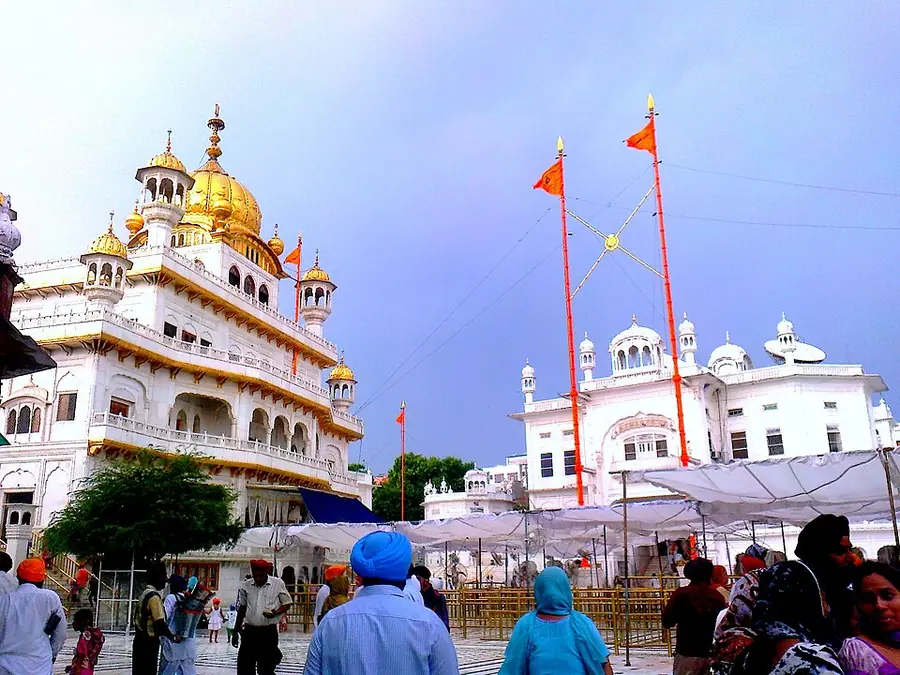
For most Sikhs alive today, 1984 is not one event but two, and then a decade. In June the Indian army stormed the Harmandir Sāhib (the Golden Temple) complex in Amritsar to remove Jarnail Singh Bhiṇḍrāṅwāle and his armed followers from the Akāl Takht, the seat of the Panth’s temporal authority that Guru Hargobind’s tradition had placed opposite the temple (§4). In October the prime minister who had ordered the assault, Indira Gandhi, was shot by two of her Sikh bodyguards, and over the next days thousands of Sikhs were killed in Delhi and other cities. An armed movement for a Sikh state, Khālistān, and the counter-insurgency against it followed, and lasted into the 1990s.[1][2][3] Consensus on the events.
Almost everything about these years is argued over: who was responsible for the violence of the early 1980s, whether the assault was necessary, how many died, what to call the killings of November, and what the Khālistān movement was. This chapter keeps to what the documents and the inquiries show, names its sources for every number, and reports who calls whom what. Its argument is narrower: 1984 changed Sikh religious life as much as any event since the eighteenth century, and much of that change, in memory, in the Akāl Takht itself, and in the diaspora, can be dated.[4][5][6] Majority; Political
Timeline
The dates below are from the government’s White Paper of July 1984, the inquiries, and the works named in each row.[7][1][3]
| Date | Event | Confidence |
|---|---|---|
| 1966 | Punjab reorganised; a Sikh-majority state (§9)[2] | Consensus |
| October 1973 | Anandpur Sāhib Resolution adopted by the Akālī Dal’s working committee[8] | Consensus |
| 13 April 1978 | Clash with the Nirankārīs in Amritsar; 13 Sikhs and two or three Nirankārīs killed[1][4] | Majority (the numbers) |
| June 1978 | Akāl Takht edict: Sikhs to have no connection with the Sant Nirankārīs[2] | Consensus |
| October 1978 | The resolution endorsed, in a revised form, at Ludhiana[8] | Consensus |
| 24 April 1980 | The Nirankārī leader Gurbachan Singh shot dead in Delhi[7] | Consensus |
| September–October 1981 | Lala Jagat Narain killed; Bhiṇḍrāṅwāle arrested and released[7][3] | Consensus |
| 4 August 1982 | Dharam Yudh Morcha launched at Amritsar[7][3] | Consensus |
| 25 April 1983 | Deputy Inspector-General A. S. Aṭwāl shot dead at the temple’s entrance[7] | Consensus |
| 6 October 1983 | President’s rule in Punjab after the killing of bus passengers at Dhilwāṅ[7][3] | Consensus |
| 15 December 1983 | Bhiṇḍrāṅwāle moves into the Akāl Takht[7] | Consensus |
| 1–8 June 1984 | Operation Blue Star; the Akāl Takht wrecked, the Sikh Reference Library burned[7][9] | Consensus (events); Contested (numbers) |
| 31 October 1984 | Indira Gandhi assassinated by her bodyguards Beant Singh and Satwant Singh[10] | Consensus |
| 31 October–early November 1984 | Killing of Sikhs in Delhi and other cities[11][10] | Consensus (events); Contested (numbers) |
| 23 June 1985 | Air India Flight 182 destroyed off Ireland; 329 killed[12] | Consensus |
| 24 July 1985 | Rajiv–Longowal Accord; Longowal shot dead on 20 August[13][3] | Consensus |
| 26 January 1986 | A Sarbat Khālsā at Amritsar orders the government-built Akāl Takht pulled down[14] | Consensus |
| 29–30 April 1986 | Khālistān declared in the Golden Temple complex; Operation Black Thunder I[15] | Consensus |
| May 1987–February 1992 | President’s rule in Punjab[3] | Consensus |
| May 1988 | Operation Black Thunder II[16][3] | Consensus (events); Contested (numbers) |
| 1992–1993 | The insurgency largely suppressed[6][17] | Majority |
| 31 August 1995 | Chief Minister Beant Singh killed by a bomb; Jaswant Singh Khalra abducted on 6 September[3][18] | Consensus |
| 1986–1999 | The Akāl Takht rebuilt by kār sevā[14] | Majority |
A rich state and an old quarrel
The Green Revolution
The Punjab created in 1966 (§9) was small, Sikh-majority and, within a few years, the most productive farming state in India. High-yielding wheat and rice, tube-wells, fertiliser and guaranteed government purchase made the Green Revolution of the late 1960s and 1970s, and Punjab’s farmers, most of them Jaṭ Sikhs, fed the national grain stock.[19][20] Consensus The prosperity was uneven. Smaller farmers fell into debt, educated young men from the villages found few jobs, and the state’s farmers and politicians quarrelled with Delhi over prices, the waters of the Rāvī and Beās, and the shared capital at Chandigarh.[19][6] Majority Historians differ on how much weight the economy carries in what followed; few leave it out.[6][3] Contested
The Anandpur Sāhib Resolution
The Shiromaṇī Akālī Dal, the party that had grown out of the gurdwara reform movement (§9), won only one of Punjab’s thirteen parliamentary seats in 1971 and lost the state to the Congress in 1972. A sub-committee was set up to restate the party’s aims, and its text was adopted by the working committee at Anandpur Sāhib, the town of the Khālsā’s founding (§5), in October 1973.[8] Consensus In the English version printed by the Encyclopaedia of Sikhism, it asks for the Punjabi-speaking areas left outside the state to be joined to it, and for the central government’s role there, as in all other states, to be restricted to “Defence, Foreign Relations, Currency and Communications”.[8] Its “political goal” is “the pre-eminence of the Khālsā”, to be sought “through the creation of a geographical entity and a constitutional set-up of its own” (primary source 1).[8] The version Longowāl authenticated in November 1982, printed as Annexure III of the government’s White Paper (pp. 69–83), reads instead “through creation of congenial environment and a political set up”, and lacks the “geographical entity”.[7] Consensus on the texts.
The resolution was endorsed, as a series of twelve resolutions that widened the call for autonomy to all states, at the Akālī conference at Ludhiana in October 1978.[8] Consensus By the early 1980s more than one text was in circulation, a more radical one was promoted by a rival Akālī faction in 1981, and the party president Harchand Singh Longowāl authenticated a version in November 1982; the White Paper itself quotes more than one version.[19][3][7] Majority How it was read depended on who read it, and on which text. Indira Gandhi’s government treated it as a separatist document; the Akālī Dal said it sought autonomy within India, and Longowāl repeated that the Sikhs had no wish to leave it.[6][3] Political It became, in any case, the charter the Akālīs took into the agitation of 1982.
Akālīs and Congress
Politics in the state turned on the rivalry of the Akālī Dal and the Congress. The Akālīs ruled in coalition from 1977 to 1980; Indira Gandhi’s return to power in 1980 brought a Congress government under Darbārā Singh, while Giānī Zail Singh, Punjab’s Congress chief minister in the 1970s, became Home Minister in 1980 and President of India in 1982.[1][2] Consensus Mark Tully and Satish Jacob, the BBC’s correspondents in Delhi, argued in 1985 that Congress leaders encouraged Bhiṇḍrāṅwāle in the late 1970s to divide the Akālīs, and lost control of him.[1] Contested; Political Others give more weight to the revival he led, or to the state’s handling of the agitation that followed.[21][4] (See Debates.)
Bhiṇḍrāṅwāle and the Akāl Takht
A preacher of the Damdamī Ṭaksāl
The Damdamī Ṭaksāl (“mint” of Damdamā) is a seminary of Sikh learning that traces its line to Guru Gobind Singh’s stay at Talvaṇḍī Sābo (§5), and is based at Mehtā Chowk near Amritsar. Jarnail Singh (1947–1984), a farmer’s son from Rode in Faridkot district, was chosen as its head in August 1977, and took the name Bhiṇḍrāṅwāle from his predecessors’ village of Bhiṇḍar.[3][4] Majority
He was a revivalist before he was a politician. He toured the villages calling Sikhs to take amrit, the Khālsā initiation, and to keep their hair uncut; he preached against alcohol, drugs, tobacco and pornography, against dowry, and against the Sikhs he judged to have fallen away. His following was strongest among young Jaṭ Sikhs in the villages.[21][4][1] Majority His speeches, recorded on cassette and widely circulated, also spoke of the Sikhs as a people discriminated against, and of the duty to resist.[4][3] Majority; Political
The Nirankārīs, 13 April 1978
The Sant Nirankārīs are a movement with a living Guru, distinct from the older Nirankārīs of the nineteenth century (§8). On Vaisākhī, 13 April 1978, they held a convention in Amritsar. A body of Sikhs from the Akhaṇḍ Kīrtanī Jathā and the Ṭaksāl, led by Fauja Singh, marched from the Golden Temple to stop it, and in the clash that followed thirteen Sikhs, Fauja Singh among them, and two or three Nirankārīs were killed.[1][4] Majority; the breakdown differs between sources. Bhiṇḍrāṅwāle’s own part on the day is told differently in different accounts.[1][4] Contested In June 1978 the Akāl Takht issued a hukamnāmā (edict) calling on Sikhs to have no connection with the Sant Nirankārīs, citing their Guru’s claim to be an avatār and his turning away from the Guru’s Word to the worship of a living man.[2][22] Consensus
The Nirankārī leader, Gurbachan Singh, and his followers were tried and acquitted in January 1980 on the ground of self-defence; in April 1980 he was shot dead in Delhi.[4][7] Majority The government’s White Paper of 1984 calls the clashes of April 1978 “the starting point of the tragic events in Punjab”.[7] Political that the story should start there.
The Dharam Yudh Morcha, 1982
In September 1981 Lala Jagat Narain, the owner of a Punjabi newspaper group and a critic of Bhiṇḍrāṅwāle, was murdered. Bhiṇḍrāṅwāle was arrested on 20 September and released on 15 October for want of evidence.[7][3] Consensus In July 1982, after the arrest of a follower, he moved into the Guru Nānak Nivās, a pilgrims’ hostel in the Golden Temple complex.[3] Consensus
On 4 August 1982 the Akālī Dal under Longowāl launched the Dharam Yudh Morcha (“righteous war campaign”) from the complex, for the demands of the Anandpur Sāhib Resolution, the river waters and Chandigarh, and Bhiṇḍrāṅwāle joined his own agitation to it.[3][7] Consensus Volunteers courted arrest in tens of thousands by October 1982; Akālī totals for the whole campaign are much larger.[3] Contested on the totals. Negotiations with the government broke down several times.[1][3] Consensus
Violence, 1981–1984
The years of the Morcha were also years of killing. The White Paper counts, from 4 August 1982 to 3 June 1984, “over 1200 violent incidents in which 410 persons were killed and more than 1180 injured”, in a chapter headed “Terror and Violence in Punjab”, which blames “terrorists” and “extremists”.[7] Contested on the figures; Political on the attribution. The killings included Hindus taken off buses, Nirankārīs, Sikh critics of Bhiṇḍrāṅwāle, and policemen; on 25 April 1983 a senior police officer, A. S. Aṭwāl, was shot dead at the temple’s entrance, and in October 1983 the state was put under President’s rule after the killing of six Hindu bus passengers at Dhilwāṅ.[7][1] Consensus on these events.
Civil liberties inquiries of the time, among them Citizens for Democracy’s Oppression in Punjab (1985), and Sikh organisations documented the other side: young Sikhs killed by the police in staged “encounters”, torture in custody, and arrests under special laws, which they held drove recruits to the militants.[23][21] Majority on the findings; Contested on their scale. Who was behind which killing, and how far Bhiṇḍrāṅwāle directed the violence from the complex, is disputed; the White Paper holds him responsible, his followers deny it, and historians divide.[7][3][4] Contested; Political
Into the Akāl Takht
On 15 December 1983, as a quarrel with the Akālī leadership grew, Bhiṇḍrāṅwāle moved into the Akāl Takht itself “with his armed entourage”, in the White Paper’s words.[7] Consensus Over the next months the building and others around the complex were fortified under the direction of Shabeg Singh, a former major-general dismissed from the army.[1][9] Consensus For Sikhs the choice of building mattered: the Akāl Takht is where the Panth’s collective decisions are pronounced, and to live in it was, for his followers, to speak from the Guru Panth’s own seat, and, for his critics, to make a shrine a fortress.[4][1] Political
June 1984: Operation Blue Star
The assault
On 2 June 1984 the government decided to send in the army. A curfew was imposed across Punjab from 9 p.m. on 3 June, the day of the annual commemoration of Guru Arjan’s martyrdom (§3), which had brought pilgrims into the complex; many were still inside when the fighting began.[7][9] Consensus Sikh accounts record firing on the complex from 1 June; the White Paper describes army action from 5 June.[23][7] Contested on the first days.
Troops under Major-General K. S. Brar entered the precincts on the night of 5–6 June and met heavy fire from fortified positions. By the White Paper’s account, a tank was brought in during the early hours of 6 June to blind and engage the positions in the Akāl Takht; India Today reported that tanks’ main guns were used on the building that evening. The Akāl Takht was cleared on 6 June except its ground floor and basement, where resistance ended in the night of 6–7 June. The bodies of Bhiṇḍrāṅwāle and Amrik Singh of the All India Sikh Students Federation were found on the ground floor; Shabeg Singh also died. Searches went on for several days.[7][9][1] Consensus on the outline; Contested on the details. The Harmandir Sāhib itself was hit by gunfire but stood; the Akāl Takht’s façade and upper floors were wrecked.[9][4] Consensus
The Sikh Reference Library
The Sikh Reference Library, in the complex, held printed books, manuscripts of the scripture, hukamnāmās (letters) of the Gurus and other records. It burned. The White Paper says the fire broke out during the fighting of 5–6 June, while, it says, “terrorists” were firing from machine-gun positions in the building, and that “by the time the terrorist positions could be overcome, the library had been gutted” (primary source 2).[7] Devinder Singh Duggal, the library’s in-charge, has said that it was intact when he last saw it on 6 June, after the army had control of the complex, and that it had been burned by the time he returned on 14 June.[24][23] Contested
What happened to its contents is still argued. The SGPC, the body that runs the gurdwaras (§9), and Ranjit Singh Nanda, a retired inspector of the Central Bureau of Investigation, have said that manuscripts, hukamnāmās and books were carried away in gunny bags and trunks after the operation.[25] The Defence Minister, George Fernandes, wrote to the SGPC in May 2000 that the army had removed items and handed them to the CBI;[26] in 2009 a later Defence Minister, A. K. Antony, told the Rajya Sabha that “various books/items” of the library “were handed over to SGPC representative by the Army”, which the SGPC denied.[25] Contested; Political No complete list of what was lost, or taken, has been published. Majority
The dead
The White Paper’s table of casualties “upto June 30, 1984” gives, for the Golden Temple complex, 493 people in its “civilian/terrorist” category killed and 86 injured, and 83 soldiers killed (4 officers, 4 junior commissioned officers and 75 other ranks) and 249 injured. For the whole operation in Punjab, including some forty other gurdwaras and searches during the curfew, it gives 554 “civilian/terrorist” dead and 92 soldiers killed, and 4,712 people apprehended.[7] Contested The table does not separate civilians from militants.
Other counts are higher. India Today reported at the end of June 1984 that more than 750 inquest reports had been prepared on dead “extremists” by 9 June, that close to 1,000 was a safe assumption, and that army sources put their own dead at perhaps 200 or more.[9] Sikh organisations and later writers give figures in the thousands, counting pilgrims trapped in the complex.[27][21] Contested No figure has been settled by an independent inquiry, and none was held. Majority
Woodrose, mutinies and returned honours
The army followed the assault with operations across the Punjab countryside, known as Operation Woodrose, in which large numbers of young Sikh men were detained.[3][21] Majority; the numbers were not published. Some Sikh soldiers mutinied when the news came. At the Sikh Regimental Centre at Ramgarh in Bihar about 1,400 recruits revolted and killed their commandant, Brigadier R. C. Puri, before they were stopped; according to Apurba Kundu, over 2,600 mutineers were captured in all, and 55 killed.[9][28] Majority; the figures differ by source.
Among civilians, the writer Khushwant Singh returned his Padma Bhushan, and Bhagat Pūraṇ Singh, founder of the Piṅgalvāṛā home for the destitute in Amritsar, returned his Padma Shrī; Amarinder Singh, then a Congress member of parliament, resigned from the party and the Lok Sabha.[27][3] Consensus For many Sikhs who had no sympathy with Bhiṇḍrāṅwāle, the assault on the Panth’s central shrine was the breaking point.[27][4] Majority
October–November 1984
The assassination
On the morning of 31 October 1984 Indira Gandhi was shot in the garden of her residence in New Delhi by two of her security guards, Beant Singh and Satwant Singh, both Sikhs. Beant Singh was shot dead by other guards soon afterwards; Satwant Singh was caught, and was hanged on 6 January 1989 with Kehar Singh, convicted of conspiracy.[10][29] Consensus
The killings
That evening, and over the following days, Sikhs were attacked in Delhi and in other cities of northern and eastern India. Men and boys were beaten and burned to death, homes, shops and gurdwaras were set alight, and women were assaulted; the worst of the killing in Delhi was on 1 and 2 November, in the resettlement colonies and outlying districts of the city.[11][30][10] Consensus
A fact-finding team of two civil liberties groups, the People’s Union for Democratic Rights (PUDR) and the People’s Union for Civil Liberties (PUCL), published Who Are the Guilty? on 17 November. It concluded that the attacks, “far from being a spontaneous expression of ‘madness’ and of popular ‘grief and anger’”, were “the outcome of a well organised plan”, and it named police officers and Congress(I) politicians (primary source 3).[11] The government of the day described the killings as a reaction to the assassination.[11][29] Political
On 19 November 1984, his mother’s birthday, the new prime minister, Rajiv Gandhi, spoke at a rally in Delhi, in Hindi, of the dange fasād (“riots”, in the usual translation) that had followed her death, and said that when a big tree falls, the earth shakes a little. Critics have cited the line ever since as condoning the killings.[31][32] Consensus that he said it; Political on what it meant.
How many died
Every count is disputed. The figures, with who gives them:[10][33][11][24]
| Count | Figure | Source |
|---|---|---|
| Early official figure, Delhi, to 7 November | 325 (including 46 Hindus) | As reported and rejected by PUDR–PUCL, November 1984 |
| PUDR–PUCL estimate, Delhi | more than 1,000 | Who Are the Guilty?, November 1984 |
| Home Minister to the Rajya Sabha | 2,146 in Delhi; 586 elsewhere | As recorded by the Nanavati Commission |
| Ahuja Committee, Delhi, 31 October–7 November | 2,733 | Reported 1988; accepted by Nanavati, 2005 |
| Home Minister Rajnath Singh, all India | 3,325, of which 2,733 in Delhi | Statement of 26 December 2014 |
| Kanpur; Bokaro | about 127; at least 72 | Ensaaf, 2006, from the Misra report and Sikh submissions |
Contested The Nanavati Commission noted that Sikh bodies disputed the Delhi figure and claimed more than 3,000, but accepted 2,733 “in absence of definite evidence”.[10] Sikh organisations and human rights groups have given higher totals still, and many Sikhs call the killings a genocide; Indian official usage has been “riots”.[24][18] Political
The inquiries
The killings were investigated, in whole or in part, by a long series of official bodies. A police inquiry under Ved Marwah (1984–85) was stopped before it finished, and a further committee sat in 1993.[24][32] The Nanavati Commission summarises the inquiries before it: the commission of Justice Ranganath Misra (1985–86), which found that some Congress members had taken part “on their own” but ruled out the party’s involvement; three committees set up in 1987 on its recommendation (on the conduct of the police, on the registration of cases, and the Ahuja Committee to count the dead); further committees in 1990; and the Nanavati Commission itself, appointed on 8 May 2000.[10] Consensus on the sequence. Its report, submitted in February 2005 and tabled in August, found that “what had initially started, as an angry outburst became an organized carnage” (primary source 4).[10] On 11 August 2005 the prime minister, Manmohan Singh, himself a Sikh, apologised in the Rajya Sabha “not only to the Sikh community but to the whole nation”.[34] Consensus
Prosecutions were few and slow. In December 2018 the Delhi High Court convicted Sajjan Kumar, a former Congress member of parliament, of conspiracy in the killing of five Sikhs in Delhi’s Palam Colony and sentenced him to imprisonment for life.[35] Consensus on the judgment. He died in custody in August 2026.[36] Other proceedings are still before the courts, and this site does not comment on open court cases.
The insurgency, 1984–1995
An accord and its failure
In July 1985 Rajiv Gandhi and Longowāl signed a memorandum of settlement, the Rajiv–Longowāl Accord. It promised Chandigarh to Punjab, a tribunal on the river waters, and that the Anandpur Sāhib Resolution, “in so far as it deals with Centre-State relations”, would go to the commission then reviewing the constitution’s federal arrangements (primary source 5).[13] Consensus On 20 August 1985 Longowāl was shot dead in a gurdwara at Sherpur near Sangrur. The Akālīs under Surjīt Singh Barnālā won the state election in September, but Chandigarh was never transferred and the accord’s main terms were not carried out.[3][6] Consensus
Air India Flight 182
On 23 June 1985 Air India Flight 182, from Montreal to London and Delhi, was destroyed by a bomb off the south-west coast of Ireland, and all 329 people aboard were killed, most of them Canadians; the same day a second bomb, in luggage from Vancouver, killed two baggage handlers at Narita airport in Tokyo.[12] Consensus Canadian investigators and the later inquiry traced the plot to members of the Babbar Khālsā in British Columbia led by Talwinder Singh Parmar; the only person convicted for it, Inderjit Singh Reyat, pleaded guilty to manslaughter in 2003, and Ripudaman Singh Malik and Ajaib Singh Bagri were acquitted in 2005.[12] Consensus A Canadian commission of inquiry under John C. Major reported in 2010, under the title Air India Flight 182: A Canadian Tragedy, on the failures of Canada’s security agencies, who had been watching the suspects (primary source 6).[12] Consensus
Sarbat Khālsā and Khālistān
On 26 January 1986 a gathering called as a Sarbat Khālsā, the assembly of the whole Panth that the eighteenth-century misls had convened at Amritsar (§6), met in the complex and ordered that the Akāl Takht repaired by the government be pulled down and rebuilt by the Panth, the kār sevā going to the Damdamī Ṭaksāl and others.[14] Consensus On 29 April 1986 five militant leaders in the complex declared an independent Khālistān. The next night commandos, backed by police and paramilitary troops, stormed the complex in a thirteen-hour operation, Operation Black Thunder.[15][3] Consensus
The movement for Khālistān had older roots, among them the campaign of Jagjit Singh Chauhān, who advertised for a Sikh state in the New York Times in 1971, and the Dal Khālsā founded in 1978, but after 1984 it had armed groups in Punjab and organisations in the diaspora behind it.[5][3] Majority It was not one organisation: the Babbar Khālsā, the Khālistān Commando Force, the Khālistān Liberation Force, the Bhiṇḍrāṅwāle Tiger Force and others fought the state and, at times, one another.[3][6] Majority The Indian government and much of the Indian press called them terrorists; their supporters called them khāṛkū (fighters, usually translated “militants”) and their dead shahīd (martyrs).[4][21] Political This chapter describes the movement and does not assess its claims.
In May 1987 Delhi dismissed Barnālā’s government and put Punjab under President’s rule, which lasted until February 1992.[3] Consensus In May 1988 militants again occupied the complex, and in Operation Black Thunder II police and National Security Guard commandos under the state’s police chief, K. P. S. Gill, besieged it: the siege began on 9 May and ended with a surrender on 18 May. The Christian Science Monitor reported almost fifty surrendering on the last day, and later accounts give about forty dead and some 200 surrendered in all.[16][3] Contested on the numbers.
Counter-insurgency, 1988–1993
The worst years were 1988 to 1992. Militant groups killed policemen, officials, journalists, Hindus, Sikhs who opposed them and members of each other’s groups; police and paramilitary forces, under Gill as director-general for most of 1988–1995, killed militants and suspects in large numbers.[6][17][37] Majority Asia Watch and Human Rights Watch documented killings by both sides, and, by the police, killings in custody and staged “encounters”.[37][17] Majority on the findings. The police and the government disputed them. Contested on the scale. In February 1992 elections were held under an Akālī boycott, with a turnout of about 22 per cent;[17] the Congress formed a government under Beant Singh, and by 1993 the armed groups had been largely broken.[3][6] Majority
Human Rights Watch and Physicians for Human Rights wrote in 1994 that Operation Rakshak II, “the counterinsurgency operation that ultimately crushed most of the militant groups by mid-1993, represented the most extreme example of a policy in which the end appeared to justify any and all means, including torture and murder”.[17] Political that it was policy. Asia Watch (1991), Amnesty International (2003) and Human Rights Watch with Ensaaf (2007) documented disappearances and killings in custody.[37][38][18] Majority that the abuses were documented.
The cremation grounds
In January 1995 Jaswant Singh Khalra, an official of the Akālī Dal’s human rights wing, made public his finding, from the records of municipal cremation grounds, that the police in Amritsar district had secretly cremated large numbers of bodies as “unidentified”. On 6 September 1995 he was abducted outside his home by police; he was killed in custody, and six police officers were convicted for his abduction and murder in 2005.[18][39] Consensus A Central Bureau of Investigation inquiry ordered by the Supreme Court found 2,097 illegal cremations at three crematoria in the district, and in December 1996 the court referred the case to the National Human Rights Commission.[18][39] Consensus on the CBI figure. Reduced to Ashes (2003), by Ram Narayan Kumar and others, gathered the families’ testimony of the disappeared.[39] Majority
On 31 August 1995 Beant Singh was killed with some sixteen others by a suicide bomber at the Punjab civil secretariat in Chandigarh; the Babbar Khālsā was held responsible.[3][6] Consensus By then the armed movement in Punjab had largely ended.[6] Majority
How many died
The figures for 1981 to 1993 have the same problem as those for 1984: those who counted had a stake in the count.[6][18]
| Estimate | Figure | Source |
|---|---|---|
| Official estimates, as given by Human Rights Watch and Ensaaf | 11,690 civilians, 1,714 police, 7,946 militants: over 20,000 | HRW–Ensaaf, 2007, which notes they are disputed |
| Higher estimates, including Blue Star and November 1984 | about 25,000 | Discussed by Gurharpal Singh, 2000[6] |
Contested Human rights groups have argued that many of the “militants” in the official figures were people killed in custody or in staged encounters, and that the disappeared are missing from every count.[18][39] Political
What 1984 changed in religious life
The Akāl Takht, built twice
In the summer of 1984 the government had the Akāl Takht repaired through a kār sevā (“voluntary service”, the traditional way of building and cleaning gurdwaras) led by Bābā Santā Singh, head of the Buḍḍhā Dal of the Nihaṅgs, with government contractors; he was later excommunicated from the Panth for it.[14] Consensus The SGPC’s president, Gurcharan Singh Ṭohṛā, announced that a building repaired by the government, against Sikh tradition, would be pulled down.[14] Consensus The Sarbat Khālsā of January 1986 ordered it pulled down, and a new kār sevā was entrusted to the Damdamī Ṭaksāl and others; the work was interrupted in 1988, resumed in 1991, and continued until October 1999.[14] Majority on the dates. The Akāl Takht Sikhs see today is the Panth’s rebuilding of the 1990s, not the government’s of 1984.[14] Majority
A new martyrology
Sikh memory already had its martyrs, from Guru Arjan and Guru Tegh Bahādur (§3, §4) to the sāhibzāde (§5) and the two great massacres of the eighteenth century, the Chhoṭā and Vaḍḍā Ghallūghārā (§6). The army’s entry into the Golden Temple was seen, as Darshan Singh Tatla puts it, as a third ghallūghārā.[5] Majority The dead of the complex, of November and of the insurgency joined the Panth’s martyrs in memory and in commemoration.[4] Majority Bhiṇḍrāṅwāle is remembered by many as a shahīd, a martyr; others remember him as the cause of the catastrophe.[4][1] Political
The diaspora
1984 politicised the diaspora. In Britain, Canada and the United States, Sikhs who had left Punjab in the 1950s and 1960s held protests, founded organisations such as the World Sikh Organisation (New York, July 1984) and the International Sikh Youth Federation (Britain, September 1984), and fought over the control of gurdwaras; some younger Sikhs took amrit and the turban for the first time.[5] Majority Darshan Singh Tatla subtitled his study The Search for Statehood; he and others note that most diaspora Sikhs never supported an armed movement.[5][4] Contested; Political What followed belongs to §11.
The evidence ledger
| Date | Evidence | Confidence |
|---|---|---|
| 1973, 1978 | The Anandpur Sāhib Resolution and the Ludhiana resolutions[8] | Consensus (text); Political (reading) |
| July 1984 | Government of India, White Paper on the Punjab Agitation: the official chronology and casualty table[7] | Consensus (text); Contested (figures) |
| June 1984 | India Today’s report on the assault and the dead[9] | Majority |
| November 1984 | PUDR–PUCL, Who Are the Guilty?[11] | Majority |
| 1985 | Tully and Jacob, Amritsar: Mrs Gandhi’s Last Battle; Citizens for Democracy, Oppression in Punjab[1][23] | Majority |
| 1985 | The Rajiv–Longowāl Accord[13] | Consensus |
| 1987 | Chakravarti and Haksar, The Delhi Riots: survivors’ testimony[30] | Majority |
| 1994 | Human Rights Watch and Physicians for Human Rights, Dead Silence[17] | Majority |
| 1995–1996 | Khalra’s findings; the CBI’s 2,097 cremations[18][39] | Consensus (CBI figure) |
| 2003 | Kumar et al., Reduced to Ashes[39] | Majority |
| 2005 | The Nanavati Commission report[10] | Consensus (text) |
| 2010 | Air India Flight 182: A Canadian Tragedy[12] | Consensus |
Primary sources
Show the 6 primary sources
1. “The pre-eminence of the Khālsā”: the Anandpur Sāhib Resolution (English version printed in the Encyclopaedia of Sikhism)
“The political goal of the Panth, without any doubt, is enshrined in the Commandments of the Tenth Lord, in the pages of Sikh history and in the very heart of the Khālsā Panth, the ultimate aim of which is the pre-eminence of the Khālsā (KHĀLSĀ JĪ KE BOL BĀLE). The fundamental policy of the Shiromaṇī Akālī Dal is to seek the realization of this birthright of the Khālsā through the creation of a geographical entity and a constitutional set-up of its own.”[8]
(The English version printed in the Encyclopaedia of Sikhism; the resolution was drafted in Punjabi, and other versions differ. The version Longowāl authenticated in November 1982, printed as Annexure III of the White Paper, pp. 69–83, reads instead “through creation of congenial environment and a political set up”, and the White Paper, paras 2–4, quotes other versions too.)[7]
What it proves. That the Akālī Dal stated a religious-political aim in the Panth’s own terms, Khālsā jī ke bol bāle, the cry for the Khālsā’s ascendancy; and why the text could be read two ways. The same document limits the centre to four subjects “in this new Punjab (as in all other states)”, which is a federal demand, and speaks of “a geographical entity and a constitutional set-up of its own”, which its critics read as separation. The two readings turn partly on which text is read: the 1982 version has no “geographical entity”. Consensus on the texts; Political on the reading.
2. “The library had been gutted”: the White Paper, July 1984
“Troops effected entry into the area around the Sarovar through the northern deori and the southern library building. In the latter area, the terrorists were firing from a number of machine gun positions in the library building and were hurling country-made grenades, lighting them with match-sticks. A fire was noticed at this stage in the library. Troop fire-fighting parties were repeatedly rushed to put out the fire, but these attempts were foiled by the heavy machine-gun fire from the terrorists. By the time the terrorist positions could be overcome, the library had been gutted.”[7]
(White Paper on the Punjab Agitation, para. 23. Its Annexure XI, “Details of civilian and army casualties … upto June 30, 1984”, gives the figures in this chapter.)
What it proves. The government’s account of the operation, published a month after it: the fighting, the fire, and who it blamed. It is the source of the official casualty figures. It is not evidence that the account is complete, and the library’s keeper contradicted its timing. Consensus on the text; Contested on the account.
3. “A well organised plan”: Who Are the Guilty?, November 1984
”… has come to the conclusion that the attacks on members of the Sikh Community in Delhi and its suburbs during the period, far from being a spontaneous expression of “madness” and of popular “grief and anger” at Mrs. Gandhi’s assassination as made out to be by the authorities, were the outcome of a well organised plan marked by acts of both deliberate commissions and omissions by important politicians of the Congress (I) at the top and by authorities in the administration.”[11]
(Section I, “Introduction”; the subject of the sentence is the PUDR–PUCL fact-finding team, which investigated from 1 to 10 November.)
What it proves. That within three weeks of the killings an independent investigation had concluded they were organised, and had said so in public, naming names. It is a contemporary witness, not a court’s finding. Majority; Political
4. “An organized carnage”: the Nanavati Commission, 2005
“Thus what had initially started, as an angry outburst became an organized carnage.”
“Large number of affidavits indicate that local Congress(I) leaders and workers had either incited or helped the mobs in attacking the Sikhs. But for the backing and help of influential and resourceful persons, killing of Sikhs so swiftly and in large numbers could not have happened.”[10]
(Report of the Justice Nanavati Commission of Inquiry, vol. I, pp. 179–180.)
What it proves. That an official commission, twenty years later, reached in substance the conclusion the civil liberties groups reached in 1984: that the killing of Sikhs in Delhi was organised, with local political backing. Consensus on the text.
5. The Rajiv–Longowāl Accord, 24 July 1985
“The Anandpur Sahib Resolution, in so far as it deals with Centre-State relations, stands referred to the Sarkaria Commission.”[13]
(Memorandum of Settlement, clause 8.2.)
What it proves. That the central government, a year after Blue Star, treated the resolution it had called separatist as, at least in part, a constitutional question for a commission on federal relations. Consensus on the text.
6. “Well known to Canadian authorities”: the Air India inquiry, 2010
“Parmar was assessed as the single most dangerous Sikh extremist at large, and had publicly pledged in the past that Air India planes would ‘…fall from the sky’. … There is no doubt that the leaders of the Sikh extremist movement in Canada were well known to Canadian authorities.”[12]
(Air India Flight 182: A Canadian Tragedy, vol. 2, part 1, p. 87; footnote markers omitted. Talwinder Singh Parmar was a leader of the Babbar Khālsā in Canada.)
What it proves. That a Canadian judicial inquiry found the threat known before the bombing, and that the conflict in Punjab had reached the diaspora by 1985. The words “extremist” and “extremist movement” are the commission’s. Consensus on the text.
What is absent
- An agreed death roll for Blue Star. The White Paper’s table does not separate pilgrims from militants, and no independent inquiry was held. Majority
- A catalogue of the Sikh Reference Library’s losses. What burned, what was taken and what was returned have never been settled in public. Majority
- A full list of the dead of November 1984. The official counts are of compensation claims and police records; the inquiries accepted them for want of better. Majority
- A count of the disappeared. The CBI’s 2,097 cremations cover three crematoria in one district. Majority
- A single Khālistān programme. The movement’s groups never agreed on borders, constitution or leadership. Majority
Debates
Who made Bhiṇḍrāṅwāle?
| View | Main argument | Main proponents |
|---|---|---|
| A Congress creation | Congress leaders promoted him to split the Akālīs, then lost control | Tully and Jacob[1] |
| A religious revival | He led a genuine revival of Khālsā observance among rural Sikhs; politics followed | Mahmood; much Sikh writing[4] |
| State and grievance | Police violence and the centre’s refusal to negotiate made the militants | Pettigrew; Gurharpal Singh[21][6] |
| Leadership failure | The Akālī and Congress leaderships’ rivalries let a militant leader take the initiative | Chima[3] |
| A Panthic reading | As co-leader of the Dharam Yudh Morcha he kept the custom, followed by morcha leaders since the 1920s, of staying inside the complex; he moved into the Akāl Takht when pushed out of his rooms in December 1983; and armed defence of the complex follows eighteenth-century precedent | Santbir Singh, Sikh Research Institute (2024)[40] |
Contested; Political
Was the assault necessary, and how many died?
The government held that the fortification of the complex left no alternative; critics, Sikh and not, argued that a siege or police action would have spared the shrine and the pilgrims, and that the timing on Guru Arjan’s anniversary multiplied the dead.[7][1][27] Contested; Political The figures run from the White Paper’s 493 in the complex to several thousand. Contested
Riot, pogrom or genocide?
Official usage was “riots”; the civil liberties groups and the Nanavati Commission found organisation; many Sikhs and some scholars and human rights groups call the killings a pogrom or a genocide.[11][10][24] Political The word chosen implies a judgement about intent; this chapter reports the findings. For June and November alike, writers at the Sikh Research Institute (SikhRI) prefer a Sikh word. SikhRI sets the government’s “Operation Bluestar” against Ghallūghārā, which Harinder Singh calls “the Sikh term for a large-scale massacre, carnage, or genocide” (2017); Santbir Singh argues that every English name falls short, “genocide” leaving out those who fought and “battle” the pilgrims killed beside them, and that Ghallūghārā, which he says Sikhs in Punjab have used all along, covers both (2024).[41][42] Political
What was the Khālistān movement?
A separatist insurgency, a national liberation struggle, or a movement made by repression: each view has its scholars and its partisans.[3][4][6] Political The chapter describes it and does not assess it.
Further reading
Show further reading (8 works)
- Mark Tully and Satish Jacob, Amritsar: Mrs Gandhi’s Last Battle (London, 1985): the journalists’ narrative to Blue Star.
- Jugdep S. Chima, The Sikh Separatist Insurgency in India: Political Leadership and Ethnonationalist Movements (Sage, 2010): the politics, year by year.
- Gurharpal Singh, Ethnic Conflict in India: A Case-Study of Punjab (Macmillan, 2000): the state, the insurgency and the numbers.
- Joyce Pettigrew, The Sikhs of the Punjab: Unheard Voices of State and Guerrilla Violence (Zed, 1995), and Cynthia Keppley Mahmood, Fighting for Faith and Nation: Dialogues with Sikh Militants (Pennsylvania, 1996): the villages and the militants in their own words.
- PUDR and PUCL, Who Are the Guilty? (1984); Uma Chakravarti and Nandita Haksar, The Delhi Riots: Three Days in the Life of a Nation (Lancer, 1987); Manoj Mitta and H. S. Phoolka, When a Tree Shook Delhi (Roli, 2007): November 1984.
- Ram Narayan Kumar et al., Reduced to Ashes: The Insurgency and Human Rights in Punjab (South Asia Forum for Human Rights, 2003): the disappeared.
- Darshan Singh Tatla, The Sikh Diaspora: The Search for Statehood (UCL Press, 1999): the diaspora after 1984.
- Government of India, White Paper on the Punjab Agitation (1984); Report of the Justice Nanavati Commission of Inquiry (2005): the official record.
References
- ^ a b c d e f g h i j k l m n o p q Mark Tully and Satish Jacob Amritsar: Mrs Gandhi's Last Battle. Jonathan Cape, 1985. The BBC correspondents' narrative from the Nirankārī clash to Blue Star; argues that Congress leaders encouraged Bhiṇḍrāṅwāle.
- ^ a b c d e J. S. Grewal The Sikhs of the Punjab. The New Cambridge History of India II.3, Cambridge University Press, 1990. The standard narrative history; revised edition 1998.
- ^ a b c d e f g h i j k l m n o p q r s t u v w x y z { | } ~ Jugdep S. Chima The Sikh Separatist Insurgency in India: Political Leadership and Ethnonationalist Movements. Sage, 2010. The politics of Punjab from the 1970s to the end of the insurgency, year by year.
- ^ a b c d e f g h i j k l m n o p q r s Cynthia Keppley Mahmood Fighting for Faith and Nation: Dialogues with Sikh Militants. University of Pennsylvania Press, 1996. Ethnography built on interviews with militants; martyrdom and the memory of 1984.
- ^ a b c d e Darshan Singh Tatla The Sikh Diaspora: The Search for Statehood. UCL Press, 1999. Migration from the 1860s, the first gurdwaras abroad, Ghadar.
- ^ a b c d e f g h i j k l m n o Gurharpal Singh Ethnic Conflict in India: A Case-Study of Punjab. Macmillan, 2000. The Indian state and Sikh ethno-nationalism; the counter-insurgency and the death toll (pp. 163–164).
- ^ a b c d e f g h i j k l m n o p q r s t u v w x y z { White Paper on the Punjab Agitation — Government of India, New Delhi, 10 July 1984. 1984 CE. English. The government's account of the agitation and of Operation Blue Star. Annexure XI: in the Golden Temple complex 493 civilians/terrorists and 83 soldiers killed; in all, 554 and 92 killed and 4,712 apprehended, up to 30 June 1984. Para. 23 on the burning of the library. Annexure III (pp. 69–83) prints the version of the Anandpur Sāhib Resolution authenticated by Longowāl in November 1982. read the text
- ^ a b c d e f g h Anandpur Sāhib Resolution — Resolution of the working committee of the Shiromaṇī Akālī Dal, Anandpur Sāhib, 16–17 October 1973; endorsed at Ludhiana, 28–29 October 1978 (English version in the Encyclopaedia of Sikhism). 1973 CE; 1978 CE. Punjabi; English version. Names 'the pre-eminence of the Khālsā' as the Panth's political goal and asks that the centre's role in Punjab, as in all states, be restricted to defence, foreign relations, currency and communications. Several versions circulated. about
- ^ a b c d e f g h Shekhar Gupta in Amritsar with bureau reports Crackdown in Punjab (cover story). India Today, 30 June 1984, 1984. open library Contemporary report on the assault, the dead (over 750 inquest reports by 9 June) and the Sikh soldiers' mutinies.
- ^ a b c d e f g h Who Are the Guilty? — People's Union for Democratic Rights and People's Union for Civil Liberties, report of a joint inquiry into the causes and impact of the riots in Delhi, 31 October–10 November 1984 (1st edn November 1984, released 17 November; 2nd edn December 1984, the edition of the PUDR PDF). 1984 CE. English. Concludes that the attacks on Sikhs in Delhi were 'the outcome of a well organised plan'; rejects the official figure of 325 dead and estimates more than a thousand; names police officers and Congress(I) politicians. read the text
- ^ a b c d e f Air India Flight 182: A Canadian Tragedy — Commission of Inquiry into the Investigation of the Bombing of Air India Flight 182 (Commissioner John C. Major), final report, 5 vols., tabled 17 June 2010. 2010 CE. English. The Canadian inquiry into the bombing of 23 June 1985 (329 killed) and the Narita bomb; finds the threat and the suspects were known to Canadian agencies before the bombing (vol. 2, part 1, p. 87). read the text
- ^ a b c d Rajiv–Longowal Accord — Memorandum of Settlement between the Government of India and the Shiromaṇī Akālī Dal, 24 July 1985. 1985 CE. English. Promises Chandigarh to Punjab and a tribunal on the river waters; clause 8.2 refers the Anandpur Sāhib Resolution, 'in so far as it deals with Centre-State relations', to the Sarkaria Commission. about
- ^ a b c d e f g Varinder Walia Roofs of Akal Takht leaking: Question mark on kar seva as gold turns black. The Tribune (Chandigarh), 29 July 2001, 2001. open access The government kar seva of Bābā Santā Singh (1984), the Panth's demolition and rebuilding (1986–1999).
- ^ a b T. S. K. Lingam Security forces going barefoot out of respect for the… (headline truncated). United Press International, Amritsar, 1 May 1986, 1986. open access The Khālistān declaration by five militant leaders (29 April 1986) and the thirteen-hour commando operation of 30 April (Operation Black Thunder).
- ^ a b Sheila Tefft Temple siege over, but no end in sight to Sikh unrest. Christian Science Monitor, 19 May 1988, 1988. open access Operation Black Thunder II: the surrender of the militants.
- ^ a b c d e f Human Rights Watch/Asia and Physicians for Human Rights Dead Silence: The Legacy of Human Rights Abuses in Punjab. Human Rights Watch, 1994. open access Report on torture, disappearances and killings in the counter-insurgency.
- ^ a b c d e f g h Human Rights Watch and Ensaaf Protecting the Killers: A Policy of Impunity in Punjab, India. Human Rights Watch, 2007. open access Khalra, the 2,097 cremations, the official death estimates and the failure to prosecute.
- ^ a b c Robin Jeffrey What's Happening to India? Punjab, Ethnic Conflict, Mrs Gandhi's Death and the Test for Federalism. Macmillan, 1986. The Green Revolution, Akālī–Congress politics and the Anandpur Sāhib Resolution.
- ^ Harnik Deol Religion and Nationalism in India: The Case of the Punjab. Routledge, 2000. Includes the social and economic effects of the Green Revolution in Punjab.
- ^ a b c d e f g Joyce Pettigrew The Sikhs of the Punjab: Unheard Voices of State and Guerrilla Violence. Zed Books, 1995. Anthropologist's account of the insurgency from the villages; police violence and the militants.
- ^ The Tribune, 'No Sikh-Nirankari tension in 3 decades', 20 November 2018 — The Tribune (Chandigarh). 20 November 2018. English. A few months after the clash of 13 April 1978 the Akāl Takht issued a hukamnāmā severing ties with the Nirankārīs; Gurbachan Singh's reply in pamphlets; mediation in the early 1990s. about
- ^ a b c d V. M. Tarkunde, Amiya Rao, Aurobindo Ghose et al. Oppression in Punjab: Report to the Nation. Citizens for Democracy, 1985. open library Civil liberties report on police abuses before and after Blue Star, with Sikh eyewitness accounts of the assault and the library.
- ^ a b c d e Jaskaran Kaur Twenty Years of Impunity: The November 1984 Pogroms of Sikhs in India. Ensaaf (2nd edn, October 2006; 1st edn June 2004), 2006. Human rights report on November 1984 and the inquiries; the counts outside Delhi (Kanpur, Bokaro); Devinder Singh Duggal on the Sikh Reference Library.
- ^ a b Varinder Walia No Sikh reference books with us: Antony. The Tribune (Chandigarh), 22 May 2009, 2009. open access A. K. Antony's Rajya Sabha reply on the Sikh Reference Library, the SGPC's denial, and retired CBI inspector Ranjit Singh Nanda's account of material removed after the operation.
- ^ George Fernandes, letter to the SGPC, 23 May 2000 — Letter of the Defence Minister to the Shiromaṇī Gurdwārā Prabandhak Committee, as reported in the Indian Express, 25 May 2000, 'George Fernandes admits Army removed items from Golden Temple during Operation Bluestar'. 2000 CE. English. The Defence Minister acknowledges that the army removed items from the Golden Temple complex during Operation Blue Star and handed them to the CBI. about
- ^ a b c d Khushwant Singh A History of the Sikhs, Volume 2: 1839–2004. Oxford University Press, 2004. Second edition; the 1980s by a participant who returned his Padma Bhushan after Blue Star.
- ^ Apurba Kundu The Indian Armed Forces' Sikh and Non-Sikh Officers' Opinions of Operation Blue Star. Pacific Affairs 67 (1), 1994. Includes the mutinies of Sikh soldiers in June 1984: over 2,600 captured, 55 killed.
- ^ a b Ramachandra Guha India After Gandhi. Picador, rev. ed., 2017. open library
- ^ a b Uma Chakravarti and Nandita Haksar The Delhi Riots: Three Days in the Life of a Nation. Lancer International, 1987. Survivors' testimony from Delhi, November 1984.
- ^ Jency Jacob BJP Revives Rajiv Gandhi's 1984 Speech Video Justifying Sikh Riots. BOOM, 22 May 2018, 2018. open access Fact check of the video of Rajiv Gandhi's speech of 19 November 1984; transcribes the Hindi of the 'big tree' remark.
- ^ a b Manoj Mitta and H. S. Phoolka When a Tree Shook Delhi: The 1984 Carnage and Its Aftermath. Roli Books, 2007. The November 1984 killings and the inquiries, by a journalist and a lawyer for the victims.
- ^ Home Minister's statement on the 1984 riots, 26 December 2014 — Statement of the Union Home Minister, Rajnath Singh, on additional compensation for victims of the 1984 riots (press release on his website). 2014 CE. English. 'As per records, 3,325 persons were killed in these riots across the country and out of these, 2,733 persons were killed in Delhi alone.' about
- ^ Manmohan Singh, Rajya Sabha, 11 August 2005 — Prime minister's reply in the debate on the Nanavati Commission report, as reported in The Tribune, 12 August 2005. 2005 CE. English. 'I apologise not only to the Sikh community but to the whole nation, because what took place in 1984 is a negation of the concept of nationhood enshrined in our Constitution.' about
- ^ State v. Sajjan Kumar (Delhi High Court, 2018) — Delhi High Court, judgment of 17 December 2018 (S. Muralidhar and Vinod Goel JJ.), 2018 SCC OnLine Del 12930. 2018 CE. English. Reverses a 2013 acquittal and convicts Sajjan Kumar of conspiracy in the killing of five Sikhs in Raj Nagar, Palam Colony, on 1–2 November 1984; life imprisonment. about
- ^ The Tribune, 'Obituary: Haunted by ghosts of 1984 anti-Sikh riots, ex-Congress MP Sajjan Kumar dies', 21 August 2026 — The Tribune (Chandigarh). 21 August 2026. English. Sajjan Kumar, serving two life sentences in Tihar Jail (convicted December 2018 and February 2025), dies on 21 August 2026 at Safdarjung Hospital after being taken there from the jail. about
- ^ a b c Asia Watch Punjab in Crisis: Human Rights in India. Human Rights Watch, 1991. open access Abuses by security forces and militants, 1984–1991.
- ^ Amnesty International India: Break the Cycle of Impunity and Torture in Punjab. Amnesty International (ASA 20/002/2003), 2003. open access Torture, disappearances and impunity in Punjab.
- ^ a b c d e f Ram Narayan Kumar, Amrik Singh, Ashok Agrwaal and Jaskaran Kaur Reduced to Ashes: The Insurgency and Human Rights in Punjab. South Asia Forum for Human Rights, Kathmandu, 2003. Report of the Committee for Coordination on Disappearances in Punjab; families' testimony and the cremation-ground cases.
- ^ Santbir Singh "Why Was Bhindranwale There?". Sikh Research Institute (sikhri.org), 4 June 2024, 2024. open library A Panthic defence of Bhiṇḍrāṅwāle's presence in the complex: the morcha tradition since 1920, his move to the Akāl Takht in December 1983, and eighteenth-century precedents for armed defence of the complex.
- ^ Harinder Singh "June 1984 Ghallughara: Lies, List, Light". Sikh Research Institute (sikhri.org), 16 June 2017, 2017. open library Sets "Operation Bluestar" against the Sikh term Ghallūghārā and disputes the White Paper's account and figures.
- ^ Santbir Singh "No More Blue Stars: Reclaiming the Narrative of 1984". Sikh Research Institute (sikhri.org), 26 March 2024, 2024. open library Traces Sikh usage from "riots" to "pogrom", "genocide" and "Battle of Amritsar", and argues for Ghallūghārā as the one term covering both combatants and non-combatants of June 1984.