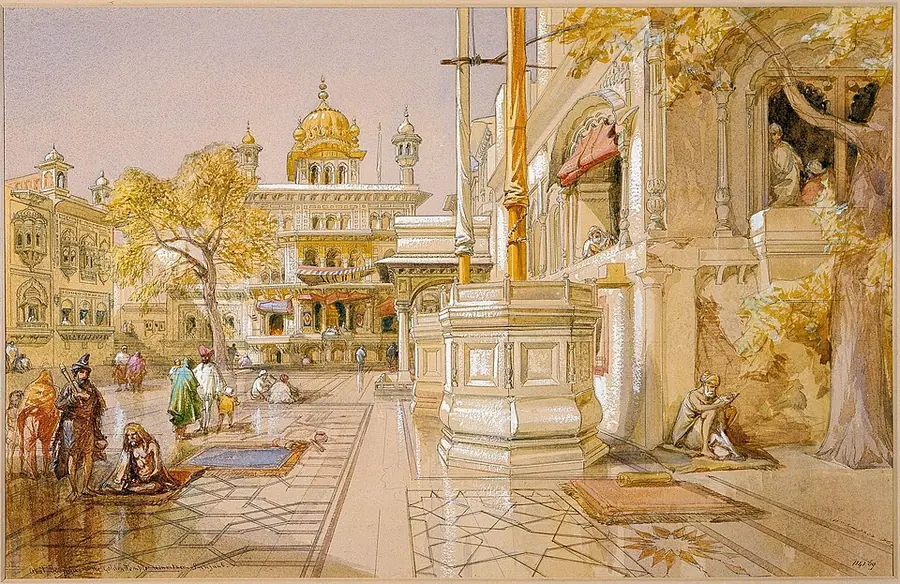
The short version: Sikhs keep a festival on the day of Dīvālī, and at Amritsar it is the largest gathering of the year at the Harmandir Sāhib (the Golden Temple). Its Sikh meaning is the release of Guru Hargobind from Gwalior fort; its Sikh name, Bandī Chhoṛ Divas, is modern.[1] Majority The answer to “is it Diwali?” is therefore yes and no: the day is the same, and the story told about it is the Sikhs’ own. What follows separates what the early sources say from what the later tradition adds, and shows that the Sikh gathering at Dīvālī is older than the story that now explains it.
A gathering older than the story
The Sikhs met at the Gurus’ seats on Dīvālī long before Guru Hargobind. Guru Amar Dās, the third Guru (1552–1574), fixed two occasions for the Sikhs to gather at Goindvāl: the spring festival of Vaisākhī and the autumn festival of Dīvālī, days of the Hindu calendar (§3).[2][3] Majority The choice made the Guru’s court, not the Hindu shrines, the place to be on the year’s great days.
Guru Hargobind was born in 1595, two decades after Guru Amar Dās died.[2] Majority So the Sikh Dīvālī did not begin with his release. The Gwalior story gave an existing Sikh gathering a Sikh story of its own. Majority That is the main thing the dates show, and it answers the common claim that Sikhs began to keep the day only because of Gwalior.
Gwalior: what the early sources say
At some point in the 1610s the emperor Jahāṅgīr had the young Guru held in the fortress of Gwalior, the Mughal state prison (§4). The fact is early. Bhāī Gurdās, a member of the Guru’s own circle who died in 1636, contrasts the earlier Gurus, whom emperors visited, with this one, whom the emperor “put in a fort”:[4] Consensus
ਪਾਤਿਸਾਹ ਘਰਿ ਆਵਦੇ ਗੜਿ ਚੜਿਆ ਪਾਤਿਸਾਹ ਚੜਾਇਆ।
pātisāh ghari āvade gaṛi chaṛiā pātisāh chaṛāiā
“Emperors came to their house; this one the emperor put in a fort.” (the site’s translation)[4]
The Persian Dabistān-i Mazāhib, written by an author who knew the Guru, reports the detention too, and gives two reasons: the money due for the Guru’s soldiers’ pay, and the fine imposed on his father, Guru Arjan, still unpaid.[5][6] Majority
How long he was held is argued. The Dabistān says twelve years; Sikh accounts give anything from forty days to a few years; historians, counting the births of the Guru’s children in the period, hold that it cannot have lasted more than two or three years, and was probably shorter.[5][2] Contested on the dates and the length. He was released, and the Dabistān says he later entered Shāh Jahān’s service.[5][2] Majority on the release.
The fifty-two princes
The best-known part of the story is later. Sikh tradition says the Guru refused to leave Gwalior unless the princes imprisoned with him were freed too; told that as many as could hold on to his robe might go, he had a cloak made with fifty-two tassels, and led out fifty-two rajas. Hence his title Bandī Chhoṛ, “liberator of prisoners”.[7][1] Consensus that this is the tradition’s account. It is not in Bhāī Gurdās or the Dabistān, and is first told in later Sikh texts.[2][3] Majority
The tradition also says the Guru reached Amritsar on Dīvālī, and that the city was lit for his return.[1] Consensus that this is the tradition’s account; like the princes, the homecoming is not in the early sources. Majority
Dīvālī in the Khālsā’s century
In the eighteenth century the day kept its place. By Ratan Singh Bhaṅgū’s account the Sarbat Khālsā, the assembly of the misls, met at Amritsar at Vaisākhī and Dīvālī, and took its decisions, the gurmatās, before the Akāl Takht (§6).[8][6] Majority The festival gathering also carried danger. Sikh tradition says that Bhāī Manī Singh, keeper of the Harmandir, was permitted to hold a festival gathering at Amritsar on payment of a levy, could not pay, and was executed at Lahore; the Encyclopaedia of Sikhism dates this to 1737, at Dīvālī, while much Sikh writing gives 1734.[3] Contested on the year.
A modern name
The name Bandī Chhoṛ Divas (“day of release”) for the Sikh Dīvālī is modern; Eleanor Nesbitt notes it as part of a wider effort to mark Sikh festivals off from Hindu ones.[1] Majority That effort has a long history: from the 1870s the Singh Sabhā reformers argued that Sikhs are not Hindus and set out to remove practices they judged un-Sikh (§8).[9][2] Majority
The calendar argument shows that the line is still being drawn. When the Nanakshahi calendar was adopted in 2003, it fixed most Sikh anniversaries to the solar year but left the festivals shared with Hindus, among them Bandī Chhoṛ (at Diwali) and Holā Mahallā, on their old lunar dates. Opponents of the calendar held that changing the old reckoning would divide Sikhs from Hindus who keep the same festivals (§11).[10][11] Consensus So Bandī Chhoṛ Divas falls on Dīvālī by design, even in the Sikh calendar that moved most other days.
Is it Diwali?
The honest answer has three parts, each with its own evidence:
- The day. It is the same day as Dīvālī, and the Sikh calendar keeps it there. Consensus
- The gathering. Sikhs have met at the Guru’s seat on Dīvālī since the third Guru, in the sixteenth century. Majority
- The meaning. The Sikh story of the day is Guru Hargobind’s release, attested early as an imprisonment and later as a deliverance of fifty-two princes; the name that says so is modern. Majority
Whether the renaming restores a distinct Sikh meaning or draws a new line through a shared festival is argued, and is part of the wider question of how Sikhs and Hindus relate. Political
Common misconceptions
- “Sikhs keep Dīvālī only because of Gwalior.” The Sikh Dīvālī gathering goes back to Guru Amar Dās, before Guru Hargobind was born. Majority
- “The fifty-two princes are in the earliest sources.” The imprisonment is; the princes and the homecoming are told in later texts. Majority
- “The name Bandī Chhoṛ Divas is centuries old.” The title Bandī Chhoṛ for the Guru is the tradition’s; the name for the day is modern. Majority
What the evidence cannot settle
Historians can date the imprisonment roughly, show that its length was shorter than the Persian survey says, and trace the princes and the homecoming to later texts. What the day means to those who keep it is not a question the sources can answer for them. Consensus
References
- ^ a b c d Eleanor Nesbitt Sikhism: A Very Short Introduction. Oxford University Press, 2nd ed., 2016.
- ^ a b c d e f J. S. Grewal The Sikhs of the Punjab. The New Cambridge History of India II.3, Cambridge University Press, 1990. The standard narrative history; revised edition 1998.
- ^ a b c Harbans Singh, ed. The Encyclopaedia of Sikhism. Punjabi University, Patiala, 4 vols, 1992. open access Published 1992–1998; the standard reference, with signed entries reporting both tradition and sources.
- ^ a b Bhāī Gurdās, Vār 26.24 — Vārāṅ Bhāī Gurdās. before 1636 CE. Punjabi in Gurmukhi. What people said of Guru Hargobind: unlike the earlier Gurus he will not stay in one place, was put in a fort by the emperor, keeps dogs and goes hunting, and does not sing hymns; the stanza answers that the truth cannot be hidden. read the text
- ^ a b c Dabistān-i Mazāhib, on the Nānakpanthīs — The School of Religions. c. 1645–1658 CE. Persian. A Persian survey of religions with a chapter on the followers of Nānak by an author who knew Guru Hargobind and Guru Har Rāī: the masands, the Gurus' court, and Sikhs who rejected idols and caste rules.
- ^ a b J. S. Grewal and Irfan Habib, eds. Sikh History from Persian Sources: Translations of Major Texts. Tulika, New Delhi, 2001. Jahāṅgīr, the Dabistān, court newsletters and chronicles in English.
- ^ Max Arthur Macauliffe The Sikh Religion: Its Gurus, Sacred Writings and Authors. Clarendon Press, Oxford, 6 vols., 1909. Written with Sikh scholars of the Singh Sabhā; the tradition's account in English.
- ^ Ratan Singh Bhaṅgū, Prāchīn Panth Prakāsh — History of the Khālsā. usually dated 1841 CE; c. 1810–1813 on G. S. Mann's reading. Punjabi in Gurmukhi. The Khālsā's eighteenth century told by a grandson of one of its fighters, written in answer to a British officer's questions.
- ^ Harjot Oberoi The Construction of Religious Boundaries: Culture, Identity, and Diversity in the Sikh Tradition. University of Chicago Press, 1994. The "Sanātan" Sikhism of the early nineteenth century and the Singh Sabhā's sharper boundaries.
- ^ The Tribune, 'Sikh clergy clears Nanakshahi calendar', 17 January 2003 — The Tribune (Chandigarh), Tribune News Service, Amritsar, 16 January 2003. 17 January 2003. English. The Sikh clergy approve Pal Singh Purewal's Nanakshahi calendar, with festivals shared with Hindus left on the old calendar for now; recalls the SGPC's attempt under Bibī Jagīr Kaur to bring it in against the Akāl Takht's direction, the hukamnāmā excommunicating her, which she did not accept, and the removal of the jathedār by SGPC members. about
- ^ The Tribune, 'Nanakshahi Calendar gets the nod', 29 March 2003 — The Tribune (Chandigarh), Amritsar, 28 March 2003. 29 March 2003. English. A meeting under the Akāl Takht's jathedār approves the final draft of the calendar; Guru Nānak's birthday will continue to be kept on the full moon of the Bikramī month of Kattak, not in Baisākh (April). about