The short version: the Harmandir Sāhib (the Golden Temple) was built by the Gurus, rebuilt by the Khālsā, and gilded by a king. Guru Arjan raised it in the late sixteenth century; the Sikh chiefs rebuilt it after the Afghans destroyed it in 1762; and the gold was laid on the rebuilt temple under Maharaja Ranjit Singh in the early nineteenth century.[1][2] Consensus What follows takes each stage in turn, with how well it is dated.
The pool and the town
The temple stands in a pool, and the pool came first. Guru Rām Dās (Guru 1574–1581) began a new centre in the Mājhā of central Punjab; the tradition dates the beginning of its pool to 1577. How he came by the land is told two ways: that it was bought from the villagers of Tuṅg, or that the emperor Akbar granted it to Bībī Bhānī, Guru Rām Dās’s wife and the daughter of the third Guru.[1][3] Majority on the date; Contested on the grant. The settlement was called Rāmdāspur, and took its later name, Amritsar, “pool of nectar”, from the pool (§3).[1] Consensus
Who built it
Guru Rām Dās’s son and successor, Guru Arjan (Guru 1581–1606), built the Harmandir Sāhib, the “temple of God”, at the centre of the pool. It stood on a platform in the water, reached by a causeway, with a door on each of its four sides, which Sikh writers read as openness to all four castes and all four directions.[1][4] Consensus on the plan. It was begun, by tradition, in 1588, and in 1604 Guru Arjan installed in it the Ādi Granth, the scripture he had just completed.[1][5] Majority on the dates. He praised the pool in a hymn:
ਰਾਮਦਾਸ ਸਰੋਵਰਿ ਨਾਤੇ ॥ ਸਭਿ ਉਤਰੇ ਪਾਪ ਕਮਾਤੇ ॥
rāmadās sarovari nāte | sabhi utare pāp kamāte |
Bathing in the pool of Rāmdās, all the sins they committed are washed away (the site’s translation).[6] Consensus on the text.
Did Mīāṅ Mīr lay the foundation stone?
Current tradition says the Qādirī Sufi Mīāṅ Mīr of Lahore (1550–1635) laid it, in December 1588, at Guru Arjan’s request.[1] Consensus that this is the tradition. The story is not in the early Sikh sources, nor in Dārā Shukoh’s life of Mīāṅ Mīr of 1642. It is first written down in the nineteenth century, and the nineteenth-century writers disagree:[7][8][1] Majority on when it is first attested
| Writer | Date | What he says |
|---|---|---|
| Santokh Singh, Gurpratāp Sūraj Granth | 1843 | The Guru laid the stone himself[1] |
| Ghulām Muḥyī al-Dīn (Būṭe Shāh), Tawārīkh-i Panjāb | c. 1848 | Mīāṅ Mīr laid four bricks, one on each side and one in the middle[7] |
| Sohan Lāl Sūrī, ʿUmdat ut-Tawārīkh | printed 1885 | The Guru sought Mīāṅ Mīr’s help with the tank and buildings[8] |
| Giānī Giān Singh | 1896 | Mīāṅ Mīr laid the foundation[1] |
That the Guru and the Sufi knew each other is likely; that the Sufi laid the stone cannot be shown. Contested
Who kept it
The Harmandir was not always in the hands of the line of Gurus Sikhs now follow. Guru Arjan’s elder brother Prithī Chand, passed over for the succession, set up a rival line, the Mīṇās, as their opponents called them, who held the Harmandir itself for much of the seventeenth century.[3][4][9] Majority Opposite it, by tradition from 1606, stands the Akāl Takht, the “throne of the Timeless One”, raised by Guru Hargobind as a seat of worldly authority beside the place of worship (§4).[10][1] Majority that the date is the tradition’s. After 1708 Bhāī Manī Singh kept the Harmandir for the tenth Guru’s widow, Mātā Sundarī.[1] Majority
Destroyed and rebuilt, 1757 to the 1770s
In the wars of the eighteenth century the temple was the Khālsā’s centre, and its enemies’ target (§6):
- 1757. Ahmad Shāh Abdālī’s commanders desecrated it; Sikh tradition remembers Bābā Dīp Singh dying in the attempt to retake it.[3][1] Majority
- April 1762. After the Vaḍḍā Ghallūghārā, Abdālī blew the building up with gunpowder and had the pool filled in. George Forster, two decades later, wrote that Amritsar “was rased to the ground, and the sacred waters choaked up with its ruins”.[11][1] Consensus
- 1763–1764. A news report from Delhi in October 1763 says that a large number of Sikhs had gathered at Amritsar and started building. The Sikh tradition dates the foundation of the new sanctum to April 1764, paid for out of the plunder of Sirhind and supervised by Bhāī Des Rāj, and its completion, with the causeway and gateway, to the 1770s.[12][2][1] Majority
“The Harmandar Sahib at Amritsar was destroyed and desecrated by Ahmad Shah Abdali on two or three occasions,” J. S. Grewal writes; “Everytime it was rebuilt through the collective effort of the Khalsa.”[2] It was this rebuilt temple that Ranjit Singh gilded. Consensus
The gold: Ranjit Singh, early 1800s to c. 1830
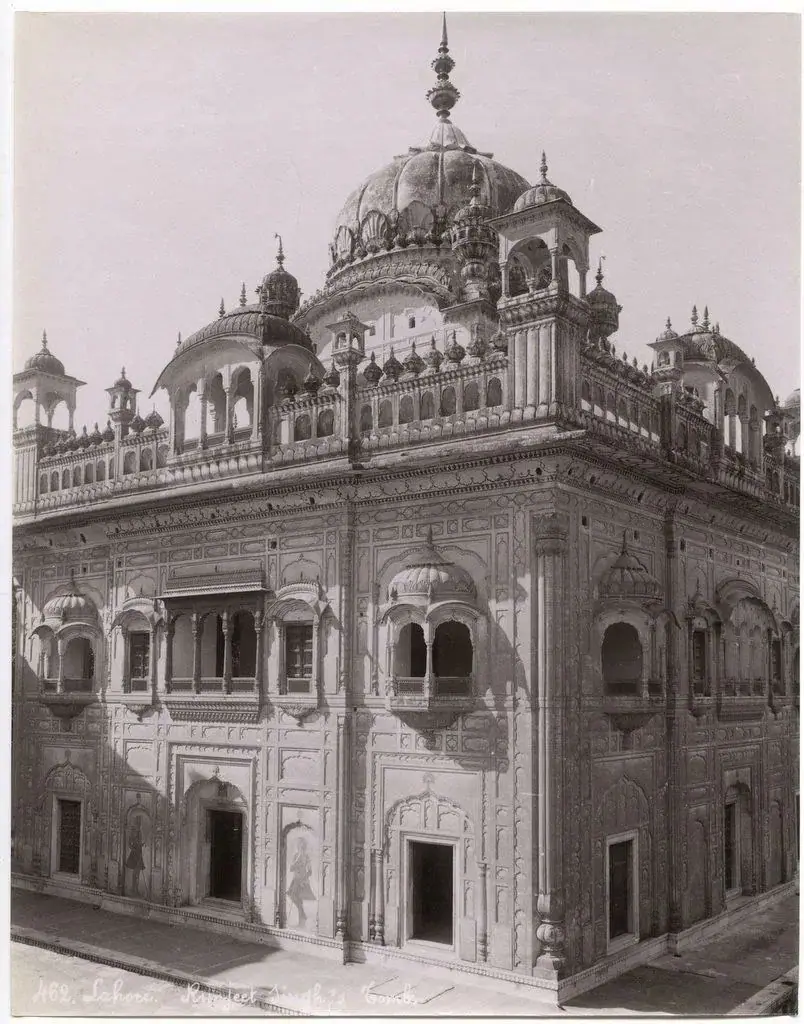
Ranjit Singh took Amritsar and its fort in 1802, took over the management of the shrines, appointing his own managers, and paid for the work that gave the temple its present look (§7):[1][3] Consensus
- the lower storey faced with white marble, inlaid with flowers and animals;
- the upper storeys and domes covered with copper plates overlaid with gold leaf;
- the doors sheathed in gilded copper.
The building, in the Encyclopaedia of Sikhism’s words, “assumed its present appearance” in his reign.[1] Consensus So the gold is gold leaf on copper, not solid gold.
The dates are less exact than the result. Popular accounts put the first gilt plate in 1803. An inscription in Gurmukhi on the entrance credits the Guru’s grace for the Maharaja’s service and is dated Sammat 1887 (1830–31 CE), as Sikh accounts report it; no published reading of the inscription is cited here. Majority on the inscription’s date. No surviving record gives the start of the work or the quantity of gold. Majority
By 1838 it was done. Emily Eden, the Governor-General’s sister, was taken round by the Maharaja in December of that year:
“The temple is of pure gold, really and truly covered completely with gold, most beautifully carved, till within eight feet from the ground, and then there are panels of marble inlaid with flowers and birds—very Solomonish altogether. There are four large folding-doors of gold.”[13]
Consensus Gold above, inlaid marble below, gilded doors: what a visitor sees today. The English name Golden Temple comes from this gilding; Sikhs call the building the Harmandir or the Darbār Sāhib.[1] Consensus
After the gold
Under the British the temple was run by custodians and a manager appointed by the government. Images of Hindu gods stood in its precincts until 1905, when the manager, under pressure from the Singh Sabhā reformers, had them removed; after Jallianwālā Bāgh in 1919 its manager presented General Dyer with a robe of honour, and in 1920 Sikhs took the temple over and formed the SGPC to run it (§8).[14][15] Consensus In the army’s assault on the complex in June 1984 the Harmandir was hit by gunfire but stood (§10).[16][17] Consensus
Common misconceptions
- “It was built golden.” The first Harmandir, and the rebuilt one of the 1760s and 1770s, were not gilded; the gold dates from Ranjit Singh’s reign. Consensus
- “It is made of gold.” The gold is leaf over copper plates, on the upper storeys and domes; the lower storey is marble. Consensus
- “Mīāṅ Mīr laid the foundation stone in 1588.” That is the current tradition, first written down about 260 years later; another nineteenth-century account has the Guru lay it himself. Contested
- “The building is Guru Arjan’s.” He built the first; it was blown up in 1762, and the temple Ranjit Singh gilded was the Khālsā’s rebuilding. Consensus
What the evidence cannot settle
Historians can date the pool by tradition, the rebuilding by a news report and the gilding by a reported inscription and an eyewitness. They cannot say who laid the first stone, or exactly when the first plate of gold went on. Majority
References
- ^ a b c d e f g h i j k l m n o p q Harbans Singh, ed. The Encyclopaedia of Sikhism. Punjabi University, Patiala, 4 vols, 1992. open access Published 1992–1998; the standard reference, with signed entries reporting both tradition and sources.
- ^ a b c J. S. Grewal and Irfan Habib, eds. Sikh History from Persian Sources: Translations of Major Texts. Tulika, New Delhi, 2001. Jahāṅgīr, the Dabistān, court newsletters and chronicles in English.
- ^ a b c d J. S. Grewal The Sikhs of the Punjab. The New Cambridge History of India II.3, Cambridge University Press, 1990. The standard narrative history; revised edition 1998.
- ^ a b Pashaura Singh Life and Work of Guru Arjan: History, Memory, and Biography in the Sikh Tradition. Oxford University Press, New Delhi, 2006.
- ^ Pashaura Singh The Guru Granth Sahib: Canon, Meaning and Authority. Oxford University Press, 2000. doi The formation of the Sikh canon, from the 1604 Ādi Granth to its installation as Guru.
- ^ Guru Granth Sāhib, ang 625 — Guru Arjan, Rāg Soraṭh. 1581–1606 CE. Punjabi in Gurmukhi. "Bathing in the pool of Rāmdās, all the sins they committed are washed away": the fifth Guru on the pool at Amritsar. read the text
- ^ a b Ghulām Muḥyī al-Dīn (Būṭe Shāh), Tawārīkh-i Panjāb — Persian history of Punjab. c. 1848 CE. Persian. The earliest written source for the story that the Sufi Mīāṅ Mīr laid the foundation of the Harmandir at Guru Arjan's request, placing four bricks on the sides and one in the middle.
- ^ a b Sohan Lāl Sūrī, ʿUmdat ut-Tawārīkh — Persian chronicle of the Lahore court (printed 1885). 19th c. CE; printed 1885. Persian. Says Guru Arjan went to Lahore and sought Mīāṅ Mīr's help in the construction of the tank and buildings at Amritsar.
- ^ Gurinder Singh Mann The Making of Sikh Scripture. Oxford University Press, New York, 2001. The manuscripts from the Goindvāl pothīs to the Damdamā recension.
- ^ Gurbilās Pātshāhī 6 — Anonymous life of Guru Hargobind. stated 1718 CE; date disputed (as late as 1843 proposed). Braj in Gurmukhi. The oldest life of the sixth Guru and the source of the tradition that the Akāl Takht was founded in 1606; anachronisms make its stated date of 1718 suspect, and one scholar proposes 1843.
- ^ George Forster, A Journey from Bengal to England, Letter XI — Travels of an East India Company servant through northern India, 1782–1784. travelled 1783; published 1798. English. On the Sikhs: Amritsar razed in 1762; the "grand convention" (gurmatā) "now rarely summoned"; the prediction that "some ambitious chief" would raise "the standard of monarchy". Vol. 1 (London, 1798), Letter XI, pp. 253–295; the passages quoted on pp. 277–278 and 295. read the text
- ^ Delhi news reports on the Sikhs, 1759–1765 — News-reports from Delhi to the Maratha courts, ed. G. H. Khare, Persian Sources of Indian History, vol. V. 1759–1765 CE. Persian. Contemporary reports of the Sikh chiefs' gurmatā at Amritsar, the rebuilding work at Amritsar in 1763, the fall of Sirhind in 1764 and Ālā Singh's answer that he was "a zamīndār"; no mention of the 1762 massacre. Translated by Irfan Habib in Grewal and Habib (2001), Text 17.
- ^ Emily Eden, 'Up the Country', letter of 10 December 1838 — 'Up the Country': Letters Written to Her Sister from the Upper Provinces of India (London: Richard Bentley, 1866; the linked Gutenberg text is the New Edition, Bentley, 1867). December 1838 CE (written); 1866 CE (published). English. The Governor-General's sister at the Harmandir with Ranjit Singh: "The temple is of pure gold, really and truly covered completely with gold... till within eight feet from the ground". read the text
- ^ Harjot Oberoi The Construction of Religious Boundaries: Culture, Identity, and Diversity in the Sikh Tradition. University of Chicago Press, 1994. The "Sanātan" Sikhism of the early nineteenth century and the Singh Sabhā's sharper boundaries.
- ^ Mohinder Singh The Akali Movement. Macmillan, 1978. Gurdwara reform from 1920, with its prelude in the Golden Temple's management.
- ^ Shekhar Gupta in Amritsar with bureau reports Crackdown in Punjab (cover story). India Today, 30 June 1984, 1984. open library Contemporary report on the assault, the dead (over 750 inquest reports by 9 June) and the Sikh soldiers' mutinies.
- ^ Cynthia Keppley Mahmood Fighting for Faith and Nation: Dialogues with Sikh Militants. University of Pennsylvania Press, 1996. Ethnography built on interviews with militants; martyrdom and the memory of 1984.