The short version: the Guru Granth Sāhib is a collection of about six thousand hymns by six Sikh Gurus, fifteen poets from outside the line of Gurus and several poets of the Gurus’ courts, gathered in stages from about 1570 and compiled as a book by Guru Arjan in 1604.[1][2] Consensus It is one of the best-documented histories of any scripture, because several of its stages survive as manuscripts (How We Know). What follows takes the authors first, then the making of the book.
For Sikhs the question has a further answer. The hymns are gurbāṇī, the word of the Guru revealed from God, and since 1708, in Sikh belief, the book itself is the Guru. Historians can say when a hymn was first written down, in whose circle and beside what other texts; whether the words are revealed is outside what their method can test.[1] Consensus that this is the limit of the method.
The Gurus: six of the ten, all signing “Nānak”
The hymns of the first five Gurus and of the ninth are in the scripture. Every one of them signs his hymns “Nānak”, as Indian devotional poets named themselves in their last line, and the scripture tells them apart by number: mahalā 1 is Guru Nānak himself (§2), mahalā 5 is Guru Arjan.[1] Consensus In Sikh belief that shared signature is a statement of doctrine: the same light passed from one Guru to the next. A ballad in the scripture already says “the light is the same, the way is the same; the king has only changed his body”.[3] Consensus on the doctrine.
The shares are uneven. Guru Nānak wrote nearly a thousand hymns, the Japjī that opens the book among them;[2][4] Guru Aṅgad about sixty couplets;[1][5] Guru Amar Dās some nine hundred compositions; Guru Rām Dās hymns that include the Lāvāṅ, now sung at Sikh weddings;[6] and Guru Arjan about two thousand, the largest part, among them the Sukhmanī.[1][7] Majority on the counts, which vary with how hymns are reckoned. Guru Tegh Bahādur, the ninth Guru (d. 1675), is the only Guru after Guru Arjan whose hymns are in it, fifty-nine hymns and fifty-seven saloks (§4).[1][2][8] Consensus
Guru Gobind Singh, the tenth Guru, is not among the authors. The writings attributed to him are gathered in a separate collection, the Dasam Granth, whose authorship is argued over part by part (§5).[9][10] Contested on the Dasam Granth’s authorship.
The bhagats: poets from outside, chosen and answered
The scripture includes hymns by fifteen bhagats, “devotees”, from outside the line of Gurus: Kabīr, a weaver of Banaras from a Muslim family; Ravidās, a leatherworker of Banaras; Nāmdev of Maharashtra; the Chishtī Sufi Shaikh Farīd of Pākpattan; and Trilochan, Beṇī, Dhannā, Sain, Pīpā, Rāmānand and others (§1).[11][12] Consensus Hymns of several of them had been gathered beside the Gurus’ since the Goindvāl pothīs of about 1570, and the Sikh scripture is the earliest dated witness to Kabīr, Nāmdev and Ravidās.[13][14] Majority Which Farīd wrote the couplets in his name, the thirteenth-century master or a later head of his shrine, is argued.[15][11][16] Contested
The Gurus did not simply collect these poets. Pashaura Singh showed that they selected the hymns, set them to the scripture’s own musical modes, and in places answered or corrected them in verses of their own: where Farīd would tear his silk robe and wear a blanket to find God, the third Guru replies that “the Lord is met sitting in your own home, if your intention is true”.[11][17] Majority What their presence means, a scripture that recognised kindred voices or a blend of traditions, is argued over (Is Sikhism a mix of Hinduism and Islam?).[1][18] Political
The court poets
The third group of authors were Sikhs of the Gurus’ own courts. The minstrels Sattā and Balvaṇḍ composed a ballad on the successions from Guru Nānak to Guru Arjan, the earliest account of how the Guruship passed; it names Arjan, so it belongs to his time. The bards called the Bhaṭṭs contributed poems in praise of the Gurus.[3][1] Majority on the ballad’s date.
Who compiled it, and when
The book was made in stages, and the stages can be dated. Majority
- The Goindvāl pothīs, c. 1570–1572. Under Guru Amar Dās, the third Guru, the hymns of Guru Nānak, of the Guru himself and of several bhagats were copied into volumes at Goindvāl on the Beās; two survive. They show a written collection within about thirty years of Guru Nānak’s death.[13][14]
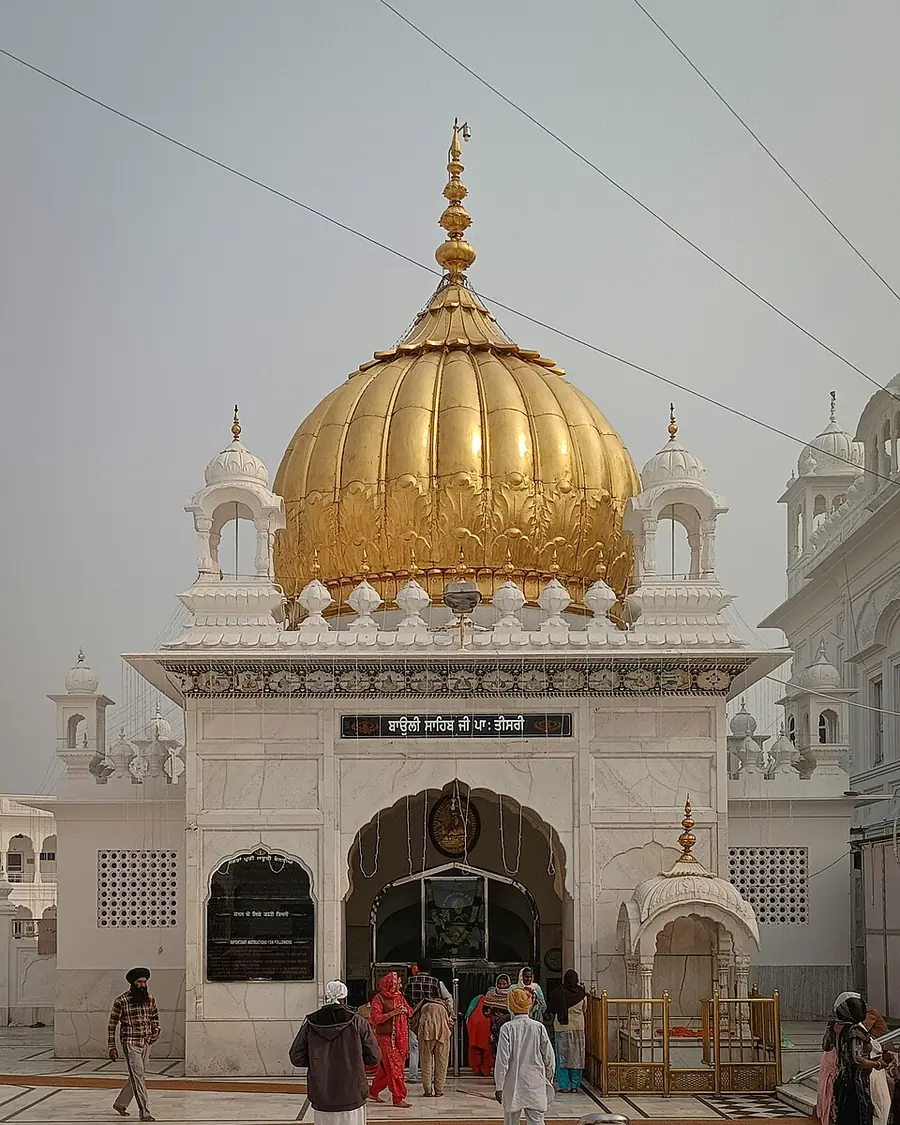
- The Ādi Granth, 1604. Guru Arjan, with Bhāī Gurdās as scribe, gathered the hymns of the first four Gurus and his own, the bhagats’ hymns and the court poets’, arranged them by rāg, and within each rāg by author and form, and installed the book in the Harmandir Sāhib (the Golden Temple) at Amritsar (§3).[1][2][7] Consensus It closes with a seal, the Mundāvaṇī: “on the platter three things have been placed: truth, contentment and reflection”.[19]
- The Damdamā recension, c. 1706. By tradition Guru Gobind Singh had the version with his father’s hymns prepared at Talvaṇḍī Sābo, Damdamā Sāhib, and installed it as the Guru before his death in 1708; manuscripts with Guru Tegh Bahādur’s hymns are older than that date.[20][1][2] Majority on the tradition.
- Print. Printed editions followed in the nineteenth century and the standard 1,430-page layout in the twentieth, so that a citation by aṅg points to the same words in any modern copy.[1] Consensus
Part of what Guru Arjan’s compilation did, Mann and Pashaura Singh argue, was to fix which hymns were the Gurus’. His elder brother Prithī Chand, passed over for the Guruship, set up a rival line whose members wrote hymns under the name “Nānak” too.[2][1][21] Majority
Was the text fixed in 1604?
In substance, yes, and in the Gurus’ own circle. Majority The details are argued. A large manuscript kept by the Sodhī family at Kartārpur, near Jalandhar, is held by tradition and by its own dating to be Guru Arjan’s master copy; it has erasures, blank pages and a few passages the standard text lacks, and access to it has been restricted.[22][2] Contested on whether it is Guru Arjan’s own volume. Other seventeenth-century copies differ: the Bhāī Banno version adds compositions the standard text lacks, among them a hymn in Mīrābāī’s name.[23][2] Consensus on the differences. Pashaura Singh puts the weight on Guru Arjan’s own editing in 1604; Gurinder Singh Mann on a longer process from Goindvāl to Damdamā, with competing lines of copies.[1][2] Contested
That argument has been more than academic. In 1994 Pashaura Singh, whose doctorate had studied the scripture’s textual history, was summoned before the Akāl Takht, the community’s highest seat of religious authority, and appeared (§0).[18] Majority on the event. This page reports it as an event in the history of the field.
Script and language
The scripture is written in Gurmukhī. Sikh tradition credits Guru Aṅgad, the second Guru, with creating the script; historians of Indian scripts hold that its letters are older, from the Laṇḍā and Śāradā family of Punjab, and that the early Gurus adopted and regularised them. Its earliest dated examples are the Goindvāl pothīs.[24][2][14] Contested on Guru Aṅgad’s part; Majority that the letters are older. The hymns are in Punjabi and in the mixed literary language of the north Indian devotional poets, built on the Hindi dialects.[25][2] Majority
A short timeline
| Date | Event | Confidence |
|---|---|---|
| 1520s–1539 | Guru Nānak’s hymns, among them the Bābar-vāṇī[26] | Consensus |
| c. 1570–1572 | The Goindvāl pothīs[13][14] | Majority |
| 1581–1604 | Sattā and Balvaṇḍ’s ballad[3] | Majority |
| 1604 | Guru Arjan completes the Ādi Granth and installs it at Amritsar[1][22] | Consensus (compilation); Contested (the Kartārpur volume) |
| 17th c. | Variant copies, among them the Bhāī Banno version[23] | Consensus |
| c. 1706 | The Damdamā recension, with Guru Tegh Bahādur’s hymns, by tradition[20] | Majority |
| 1708 | In Sikh belief the scripture becomes the Guru[1][27] | Consensus (belief) |
| 1877 | Trumpp’s partial English translation[28] | Consensus |
| 20th c. | The standard 1,430-page layout[1] | Consensus |
Common misconceptions
- “Guru Nānak wrote the Guru Granth Sāhib.” He wrote nearly a thousand of its roughly six thousand hymns; it was compiled by the fifth Guru, with hymns of five other Gurus, fifteen bhagats and the court poets.[1][2] Consensus
- “Guru Gobind Singh’s writings are in it.” They are not; the Dasam Granth is a separate book.[9] Consensus
- “Only Sikhs wrote it.” Fifteen of its poets were not Sikhs, among them a Muslim Sufi.[11] Consensus
- “The Gurus wrote it down in their own hands.” No hymn survives in Guru Nānak’s own hand; the Kartārpur volume, if it is Guru Arjan’s master copy, was written by his scribe.[2] Majority
Why it matters
The answer to “who wrote the Guru Granth Sāhib?” is unusual among scriptures: the authors are named in the text, the stages of collection survive, and the compiler was one of the authors. That is why historians can say so much, and agree so widely, about how it was made. It is also why the argument, when it comes, is about the edges, a volume, a variant, an erasure, rather than the core. For Sikhs the book is the living Guru; for the historian it is a scripture compiled in the sixteenth and seventeenth centuries, with an unusually clear history. Both descriptions fit the evidence (§0). Majority
References
- ^ a b c d e f g h i j k l m n o p q Pashaura Singh The Guru Granth Sahib: Canon, Meaning and Authority. Oxford University Press, 2000. doi The formation of the Sikh canon, from the 1604 Ādi Granth to its installation as Guru.
- ^ a b c d e f g h i j k l m Gurinder Singh Mann The Making of Sikh Scripture. Oxford University Press, New York, 2001. The manuscripts from the Goindvāl pothīs to the Damdamā recension.
- ^ a b c Guru Granth Sāhib, ang 966 — Sattā and Balvaṇḍ, Vār in Rāmkalī. late 16th c. CE. Punjabi in Gurmukhi. A minstrels' ballad, inside the scripture, on Nānak passing the Guruship to Lahaṇā (Aṅgad): the earliest account of the succession. read the text
- ^ Guru Granth Sāhib, ang 1 — Guru Nānak, Japu (Japjī). before 1539 CE (composed); 1604 CE (compiled). Punjabi in Gurmukhi. The first pauṛīs of the Japjī: cleansing, silence and cleverness do not make one true; the way is to walk in the hukam, outside which nothing stands. read the text
- ^ J. S. Grewal The Sikhs of the Punjab. The New Cambridge History of India II.3, Cambridge University Press, 1990. The standard narrative history; revised edition 1998.
- ^ Guru Granth Sāhib, ang 773–774 — Guru Rām Dās, Lāvāṅ (Chhant in Rāg Sūhī). 1574–1581 CE. Punjabi in Gurmukhi. The four rounds (lāvāṅ) of marriage as stages of the soul's union with God; sung today at the Anand Kāraj wedding. read the text
- ^ a b Pashaura Singh Life and Work of Guru Arjan: History, Memory, and Biography in the Sikh Tradition. Oxford University Press, New Delhi, 2006.
- ^ Guru Granth Sāhib, ang 1427 — Guru Tegh Bahādur, Salok Mahalā 9. 1664–1675 CE (composed). Punjabi and Braj in Gurmukhi. "One who frightens no one, and fears no one else... call him wise": the ninth Guru's ethic of fearlessness. read the text
- ^ a b Dasam Granth — The Book of the Tenth Guru. compiled early 18th c. CE. Braj, Punjabi and Persian in Gurmukhi. Compositions attributed to Gobind Singh and his court: the Jāp, Akāl Ustat, Bachitar Nāṭak, Chaṇḍī Charitra, Chaubīs Avatār, Charitropākhyān and the Zafarnāmā. Who wrote which parts is the field's most heated textual argument.
- ^ Robin Rinehart Debating the Dasam Granth. Oxford University Press, New York, 2011.
- ^ a b c d Pashaura Singh The Bhagats of the Guru Granth Sahib: Sikh Self-Definition and the Bhagat Bani. Oxford University Press, New Delhi, 2003. Farīd, Kabīr, the Sants and the Vaiṣṇava bhagats inside the scripture, and the Gurus' replies to them.
- ^ Karine Schomer & W. H. McLeod, eds. The Sants: Studies in a Devotional Tradition of India. Motilal Banarsidass, 1987. The foundational volume — and the source of the narrow Anglophone use of "Sant" that §10 flags as a convention.
- ^ a b c Goindval Pothīs — Early Sikh manuscript collections. c. 1570s. Punjabi in Gurmukhi. The earliest written Sikh collections, and the earliest datable manuscript witnesses to Kabīr, Nāmdev and Ravidās.
- ^ a b c d Gurinder Singh Mann The Goindval Pothis: The Earliest Extant Source of the Sikh Canon. Harvard Oriental Series 51, Harvard University Press, 1996.
- ^ Max Arthur Macauliffe The Sikh Religion: Its Gurus, Sacred Writings and Authors. Clarendon Press, Oxford, 6 vols., 1909. Written with Sikh scholars of the Singh Sabhā; the tradition's account in English.
- ^ Salok Shaikh Farīd — Guru Granth Sāhib, angs 1377–1384. 1604 CE. Punjabi in Gurmukhi. Dozens of saloks by a Sufi, canonized inside Sikh scripture. The cross-tradition claim is structural, not token. read the text
- ^ Guru Granth Sāhib, ang 1383 — Salok Shaikh Farīd 103–104, with Guru Amar Dās's reply. 1604 CE (compiled). Punjabi in Gurmukhi. Farīd will tear his silk robe and wear a rough blanket to meet his Lord; Guru Amar Dās answers that the Lord is met sitting at home, if the intention is true. The Gurus answering a Sufi inside their own scripture. read the text
- ^ a b Arvind-pal Singh Mandair Sikhism: A Guide for the Perplexed. Bloomsbury, 2013.
- ^ Guru Granth Sāhib, ang 1429 — Guru Arjan, Mundāvaṇī. c. 1604 CE. Punjabi in Gurmukhi. The "seal" of the Ādi Granth: "on the platter three things have been placed: truth, contentment and reflection". read the text
- ^ a b Damdamā recension of the Ādi Granth — The text with Guru Tegh Bahādur's hymns added. c. 1706 CE (tradition). Punjabi in Gurmukhi. The form of the scripture installed as Guru; tradition says Gobind Singh had it prepared at Talvaṇḍī Sābo.
- ^ Miharbān Janamsākhī — Life of Nānak from the Mīṇā line. 17th c. CE. Punjabi in Gurmukhi. Discourses attributed to Nānak, from the circle of Prithī Chand's descendants, rivals of the main line of Gurus.
- ^ a b Kartārpur bīṛ — The volume kept at Kartārpur (Jalandhar) by the Sodhī family. 1604 CE (by tradition and its own dating). Punjabi in Gurmukhi. Held by tradition to be Guru Arjan's master copy of the Ādi Granth; its status, and what its erasures and blank pages mean, are argued over.
- ^ a b Bhāī Banno bīṛ — A seventeenth-century copy of the Ādi Granth. 17th c. CE. Punjabi in Gurmukhi. A recension with compositions the standard text does not include, among them a hymn in Mīrābāī's name.
- ^ Richard Salomon Indian Epigraphy. Oxford University Press, 1998. open library The standard handbook for inscriptions and their dating.
- ^ Christopher Shackle and Arvind-pal Singh Mandair, trans. Teachings of the Sikh Gurus: Selections from the Sikh Scriptures. Routledge, 2005.
- ^ Guru Granth Sāhib, ang 360 — Guru Nānak, Āsā (Bābar-vāṇī). 1520s CE (the events); 1604 CE (compiled). Punjabi in Gurmukhi. Nānak on the Mughal invasion: "Having made Khurāsān his own, he has terrified Hindustan." The most securely datable lines in the scripture. read the text
- ^ W. H. McLeod Sikhs of the Khalsa: A History of the Khalsa Rahit. Oxford University Press, New Delhi, 2003. The code of conduct from the rahitnāmās to the Sikh Rahit Maryādā; the main source for dating the Five Ks.
- ^ Ernest Trumpp, trans. The Ādi Granth, or the Holy Scriptures of the Sikhs. W. H. Allen, London, 1877. The first English translation, partial, with a preface that offended Sikh readers.