Sikhism · Timeline · Free to reuse
A timeline of Sikhism, from Guru Nānak to today
Sikh history in 11 eras, from the Punjab of the fifteenth century and Guru Nānak to the Sikhs of today. Each era is one chapter of the series, shown with its date range, its key takeaways and the 0 dated firsts it argues, from the Goindvāl pothīs and the Ādi Granth to the Khālsā, the Singh Sabhā, the Sikh Gurdwaras Act and the Sikh Rahit Maryādā. Every date is the first datable attestation in the surviving record, and each era links to the chapter that cites the evidence.
Free to embed or reuse under CC BY 4.0. Get the embed code
The whole span
Time axis compressed: each labelled interval gets equal width
Bars overlap where periods do: §1 sets out the Punjab of the fifteenth century, into which Guru Nānak was born in 1469 (§2). After that the chapters follow one another, with the line of Gurus to 1708 and then the Panth's history to today.
Era by era
-
c. 1400 – 1500 CE Chapter 1 Majority view
Punjab Before Guru Nānak
The Lodī frontier, Sufi shrines, Nāth yogīs, Brahmins and the Sant poets: the world into which Guru Nānak was born
Punjab between the Indus and the Yamunā: Lahore, Multan, Pākpattan, Sultānpur and the Salt Range
- Fifteenth-century Punjab was a frontier province of the Delhi sultanate, ravaged by Timur in 1398, held by his governor's line (the Sayyids) and then by the Afghan Lodīs, whose governor at Lahore, Daulat Khān, would invite Bābur in the 1520s.
- Its religious life was crowded: Chishtī and Suhrawardī Sufi shrines (above all Bābā Farīd's at Pākpattan), Nāth yogīs with split ears and patched coats, Brahmin priests, pilgrimage to the Ganges and the goddess shrines of the hills, and the songs of devotional poets from far beyond Punjab.
- Almost everything known about that religious life comes from later sources, and the most important is the Sikh scripture itself, which preserves hymns of Farīd, Kabīr, Nāmdev, Ravidās and others in manuscripts from about 1570 onward.
- The Gurus answered these neighbours in their own hymns: Guru Nānak redefined the yogī's earrings and ashes, and Guru Amar Dās answered Farīd's call to renounce the world with a call to find God at home.
- Whether Guru Nānak belonged to a wider 'Sant tradition' of poets who worshipped a formless God, as Karine Schomer and W. H. McLeod argued, or began something new, is one of the field's oldest arguments; most historians now say both, and differ on the weight.
-
c. 1469 – 1539 CE Chapter 2 Majority view
Guru Nānak
Talvaṇḍī, Sultānpur and Kartārpur; the journeys and the stories told of them; the hymns on Bābur, the Japjī, and the first succession
Talvaṇḍī, Sultānpur Lodhī and Kartārpur in Punjab; journeys across India and, by tradition, to Mecca and Baghdad
- Guru Nānak was born in 1469 at Talvaṇḍī, now Nankāṇā Sāhib in Pakistan, into a Khatrī family; he worked for a time at Sultānpur Lodhī in the service of the Lodī governor Daulat Khān, travelled for many years, and spent his last years at Kartārpur on the Rāvī, where he died in 1539.
- Almost everything else people know about his life comes from Bhāī Gurdās's poems of some seventy years later and from the janamsākhīs, written down a century and more after him. The outline above is close to certain; the miracles, the meetings and the itineraries are the tradition's.
- Sikh tradition sends him on four great journeys, to Mecca, Baghdad, Sri Lanka and the Himalayas. Bhāī Gurdās already told of Mecca and Baghdad in the early seventeenth century, but no outside source confirms either visit, and the Baghdad inscription is disputed.
- His own words survive: nearly a thousand hymns, among them the Japjī and the Bābar-vāṇī on the Mughal invasions of the 1520s. They teach the divine Name (nām), the divine order (hukam), truth, and the life of a working householder over that of the ascetic.
- Before he died he passed over his own sons, Srī Chand and Lakhmī Dās, and installed his disciple Lahaṇā as Guru Aṅgad: the first succession, and the beginning of the line of ten Gurus.
-
c. 1539 – 1606 CE Chapter 3 Majority view
The Gurus Build a Community
Guru Aṅgad, Guru Amar Dās, Guru Rām Dās and Guru Arjan: Khaḍūr, Goindvāl and Amritsar, the laṅgar and the mañjīs, the Ādi Granth of 1604, and a death in Lahore
The Mājhā and the Doāba of central Punjab: Khaḍūr, Goindvāl on the Beās, Amritsar, Tarn Tāran and Kartārpur; Lahore
- Between 1539 and 1606 four Gurus turned Guru Nānak's following at Kartārpur into an organised community with its own centres (Khaḍūr, Goindvāl, Amritsar), its own script, a free communal kitchen, a network of deputies and a book of scripture.
- The laṅgar is attested inside the scripture itself: a ballad by the minstrels Sattā and Balvaṇḍ praises Mātā Khīvī, Guru Aṅgad's wife, for the rice pudding and ghee she served in it. The rule that visitors eat before they see the Guru is a later saying, attributed to Guru Amar Dās.
- Sikh tradition credits Guru Aṅgad with inventing Gurmukhī. Historians of the script hold that it grew out of the older Laṇḍā and Śāradā-family scripts of Punjab; what the early Gurus did was adopt it, regularise it and use it for the hymns.
- Guru Arjan built the Harmandir Sāhib at Amritsar and in 1604 completed the Ādi Granth, with Bhāī Gurdās as scribe, including hymns of Kabīr, Ravidās, Nāmdev, Farīd and other bhagats. The story that the Sufi Mīāṅ Mīr laid its foundation stone is first written down in the nineteenth century.
- Guru Arjan died in Mughal custody at Lahore in 1606. The emperor Jahāṅgīr wrote that he ordered the execution after the Guru blessed his rebel son Khusrau; Sikh tradition remembers a martyrdom. Heat and torment are in the early sources; Chandū Shāh by name appears in 1741, burning sand and the river as events in Kesar Singh Chhibbar's account (1769; some date it 1776), and the hot plate and boiling cauldron only in nineteenth-century and later tellings.
-
c. 1606 – 1675 CE Chapter 4 Majority view
Miri and Piri: The Sword Beside the Rosary
Guru Hargobind's court and battles, the Akāl Takht, Gwalior, the boy Gurus and their rivals, and the execution of Guru Tegh Bahādur
Amritsar and the Mājhā; Kīratpur, Bakālā and Anandpur at the edge of the Śivālik hills; Gwalior and Delhi; journeys to Patna, Dhaka and Assam
- Guru Hargobind succeeded as the sixth Guru in 1606, aged eleven, after his father, Guru Arjan, died in Mughal custody at Lahore; Jahāṅgīr records ordering his execution. The new Guru kept horses, armed retainers and a court, and Sikh tradition says he wore two swords, one for spiritual authority (pīrī) and one for worldly authority (mīrī).
- The change is attested within his lifetime: Bhāī Gurdās (d. 1636) records Sikhs complaining that this Guru hunted, kept dogs, would not stay in one place and had been put in a fort by the emperor, and calls him a breaker of armies. The pairing of two named swords is told in later texts.
- Between 1621 and 1635 the Guru's men fought several skirmishes with Mughal officers, and a Persian survey written c. 1645–1658, the Dabistān, confirms the battles and the move to Kīratpur in the Śivālik foothills, away from Lahore.
- The Guruship then passed through a grandson and a child: Guru Har Rāī (1644–1661) and Guru Har Krishan (1661–1664), who died of smallpox in Delhi at about seven. Rival claimants (Dhīr Mal, Rām Rāī, and the Mīṇās, as their opponents called them) held shrines, a scripture manuscript and followings of their own.
- Guru Tegh Bahādur (1664–1675) founded Anandpur, travelled as far as Assam, and was executed in Delhi in November 1675. Sikh tradition says he died defending the Kashmiri Brahmins' right to their faith; the earliest sources say less, and why Aurangzeb's officials put him to death is argued over.
-
c. 1675 – 1708 CE Chapter 5 Majority view
Guru Gobind Singh and the Khālsā
Anandpur, Vaisākhī 1699, the Five Ks, the wars with the hill rajas and the Mughals, and the scripture as Guru
Anandpur and the Śivālik hills; Chamkaur, Sirhind and Talvaṇḍī Sābo in the plains; Nanded in the Deccan
- Guru Gobind Singh, born Gobind Rāi, became Guru at nine, in 1675, after his father Guru Tegh Bahādur was executed in Delhi; he spent most of his life at Anandpur in the Śivālik hills, as a ruler, poet and patron of poets, at war first with neighbouring hill rajas and then with Mughal armies.
- In 1699, at Vaisākhī, he founded the Khālsā: an order of initiated Sikhs owing allegiance directly to the Guru rather than to his agents, the masands, given a new initiation with the double-edged sword (khaṇḍe dī pāhul) and the name Singh.
- The earliest account, by Sainapati, a poet of his court, is short. The famous call for five heads and the Five Beloveds appears in full only in later texts, and the five Ks are first clearly attested as a list in the nineteenth century (McLeod: 1883), though the practices are older; earlier claims are disputed.
- Between 1704 and 1705 the Guru lost Anandpur and all four of his sons; in 1708 he died at Nanded in the Deccan, and by Sikh tradition declared that the scripture and the community, not a human successor, would be the Guru after him.
- Much of the Dasam Granth, the book attributed to him, is argued over: whether he wrote it all, part of it, or little of it beyond a few compositions is the most heated textual question in Sikh studies.
-
c. 1708 – 1799 CE Chapter 6 Majority view
Banda, Persecution and the Misls
Banda Singh Bahādur, the Mughal and Afghan wars, the Ghallūghārās, the misls and the first Sikh rule at Lahore
The Punjab: Sirhind and the Sutlej–Yamunā country, Lahore and Amritsar, the Mālvā; Delhi
- Banda Singh Bahādur, a Bairāgī ascetic who met Guru Gobind Singh at Nanded in 1708, led a rising in Punjab that killed the governor of Sirhind in 1710, held the country between the Sutlej and the Yamunā for a time, and struck coins and a seal in the name of the Gurus, not his own.
- He was captured in December 1715 and executed in Delhi in June 1716, after hundreds of his followers. Chroniclers hostile to him, and two English envoys at the court, all recorded the prisoners' refusal to recant.
- For the next half-century the Khālsā survived Mughal governors, Nādir Shāh and the repeated invasions of Ahmad Shāh Abdālī. Sikh memory keeps two great killings, the Chhoṭā Ghallūghārā of 1746 and the Vaḍḍā Ghallūghārā of 1762, and Abdālī blew up the Harmandir in 1762; it was rebuilt from 1764.
- Out of the fighting bands came the misls, the confederacies of the Dal Khālsā (1748), who met at Amritsar as the Sarbat Khālsā and decided by gurmatā. By 1765 they held Lahore and struck coins in the Guru's name; by the 1780s they were a patchwork of rival chiefdoms.
- While the Khālsā fought, the shrines were often kept by Udāsī and Nirmalā holy men who did not keep the Khālsā form, and the rahitnāmās that define the Khālsā were written: the eighteenth century made the Khālsā as much as 1699 did.
-
c. 1799 – 1849 CE Chapter 7 Majority view
Ranjit Singh's Kingdom
Lahore, the Sutlej line, the Sarkār-i Khālsā, the gilding of the Harmandir, the argument over 'Sanātan' Sikhism, and the road to annexation
Lahore and Amritsar; the Punjab plains between the Sutlej and the Indus; Multān, Kashmir and Peshawar
- Ranjit Singh, the young chief of the Sukerchakia misl, took Lahore in 1799 and was proclaimed Maharaja in 1801; over thirty years he turned a confederacy of Sikh chiefs into a single kingdom stretching from the Sutlej to the Khyber and from Multān to Kashmir.
- The state called itself the Sarkār-i Khālsā and struck its coins in the Gurus' names, not the king's; but most of its subjects were Muslims and Hindus, and its ministers, governors and generals included Muslims, Hindu Dogrās and Brahmins, and French and Italian officers.
- The Harmandir Sāhib owes its gold to this reign: gilded copper was laid over the upper storeys in the early nineteenth century, an inscription at the entrance is dated Sammat 1887 (1830–31), and by 1838 a British visitor described the temple as covered in gold.
- Harjot Oberoi has argued that Sikh practice in this period was plural and loosely bounded, shared with Hindus and Muslims, and that the hard boundary was drawn only by the Singh Sabhā after 1873; J. S. Grewal and others reply that a distinct Khālsā identity was already clear.
- After Ranjit Singh's death in 1839 four of his wives and seven slave women died on his pyre; within four years three of his successors had died, two of them violently and the first, by rumour, of poison; the army governed itself through elected committees; and two wars with the British ended in annexation on 29 March 1849.
-
c. 1849 – 1920 CE Chapter 8 Majority view
Under the Raj: The Singh Sabhā and the Boundaries
The army and the 'martial race', the Kūkās, the Singh Sabhā and the Arya Samāj, 'We are not Hindus', emigration, and Amritsar in 1919
British Punjab (Lahore, Amritsar, Ludhiana, Malerkoṭlā) and the North-West Frontier; Hong Kong, Malaya, British Columbia and California
- After the annexation of 1849 the British recruited Sikhs heavily into their army, above all after Sikh troops fought on the British side in 1857. Recruits enlisted as Sikhs were expected to keep their hair, and regiments had those not yet initiated take the Khālsā pāhul, so the army became one of the forces that made the Khālsā form the standard one.
- The Nāmdhārīs (Kūkās), followers of Bābā Rām Singh, who held that the line of living Gurus had continued, were broken in January 1872, when some sixty-five of them were blown from guns at Malerkoṭlā without trial and their leader was exiled to Burma.
- The Singh Sabhā, founded at Amritsar in 1873 and at Lahore in 1879, set out to reform Sikh practice and defend it against Christian missions and the Arya Samāj. Its more thoroughgoing reformist wing, the Tat Khālsā, whose view prevailed, held that Sikhs are not Hindus, put most clearly in Kāhn Singh Nābhā's Ham Hindū Nahīṅ (1898).
- Between 1892 and 1909 the reformers founded the Khalsa College at Amritsar, had the Hindu images removed from the precincts of the Harmandir Sāhib (1905) and won the Anand Marriage Act (1909). Harjot Oberoi argues that this drew a hard line where the boundary had been loose; his critics reply that the Khālsā identity was much older.
- Sikhs went abroad as soldiers, police and labourers, to Hong Kong, Malaya, British Columbia and California. The Komagata Maru was turned away from Vancouver in 1914, and on 13 April 1919 troops under General Dyer fired on a crowd at Jallianwālā Bāgh in Amritsar: 379 dead by the official count, about 1,000 by the Congress inquiry's.
-
c. 1920 – 1966 CE Chapter 9 Majority view
Gurdwara Reform, Partition and Punjabi Suba
The Akālī morchās, the SGPC and the Gurdwaras Act, the Rahit Maryādā, the division of Punjab in 1947, Article 25, and the Punjabi-speaking state of 1966
Amritsar, Nankāṇā Sāhib, Guru kā Bāgh and Jaito; Lahore and Rawalpindi; the Radcliffe line; East Punjab, Haryana and Chandigarh
- In 1920 most historic gurdwaras were run by hereditary custodians, the mahants, many of them Udāsīs. Between 1920 and 1925 the Akālī movement took the shrines from them, through mass non-violent campaigns and some bloodshed, and the Sikh Gurdwaras Act of 1925 handed them to an elected Sikh body, the Shiromaṇī Gurdwārā Prabandhak Committee (SGPC).
- The Act also gave the first legal definition of a Sikh: a person who declares belief in the Guru Granth Sāhib and the ten Gurus, and, from 1930, that he has no other religion. Who counts as a Sikh became a question for courts and electoral rolls.
- The SGPC's code of conduct, the Sikh Rahit Maryādā, was drafted from the early 1930s, approved in 1945 and published in 1950: the first code to be agreed by a representative body for the whole community.
- Partition in 1947 divided Punjab along the Radcliffe line. Nankāṇā Sāhib, Guru Nānak's birthplace, and Kartārpur, where he died, went to Pakistan; almost every Sikh in western Punjab left or was killed. Estimates of the dead across the partition run from about 200,000 to two million.
- In independent India the Akālīs objected that Article 25 of the Constitution counts Sikhs as Hindus for some purposes, and campaigned for a Punjabi-speaking state. The Punjab Reorganisation Act of 1966 created it on 1 November 1966, with Haryana carved out and Chandigarh made a union territory.
-
c. 1966 – 1995 CE Chapter 10 Politically contested
1984
The Anandpur Sāhib Resolution, Bhiṇḍrāṅwāle and the Akāl Takht, Operation Blue Star, the killings of November 1984, and the insurgency to 1995
Amritsar and the Punjab plains; Delhi, Kanpur and Bokaro; the diaspora in Canada and Britain
- Between 1973 and 1984 the quarrel between the Akālī Dal and the Congress over Punjab's powers, water and capital became entangled with a religious revival led by Jarnail Singh Bhiṇḍrāṅwāle, who preached initiation and abstinence and from December 1983 lived in the Akāl Takht.
- In Operation Blue Star (1–8 June 1984) the Indian army stormed the Golden Temple complex. The Akāl Takht was wrecked and the Sikh Reference Library burned. The government's White Paper counted 493 people in its single 'civilian/terrorist' category, and 83 soldiers, killed there; other estimates run far higher.
- After Indira Gandhi was shot by two Sikh bodyguards on 31 October 1984, Sikhs were killed in Delhi and other cities over the next days. The official count is 2,733 in Delhi and 3,325 across India; the Nanavati Commission (2005) found the attacks organised.
- From 1984 to the early 1990s Punjab saw an armed movement for Khālistān, declared in the Golden Temple complex in 1986, whose groups killed police, officials and civilians, and a counter-insurgency in which, as the CBI and human rights groups documented, police killed suspects in custody and staged 'encounters', and bodies were secretly cremated. Official estimates put the dead at over 20,000.
- 1984 changed Sikh religious life: a new layer of martyrdom memory, an Akāl Takht demolished and rebuilt by the Panth itself, and a diaspora that organised around the events.
-
c. 1995 – 2026 CE Chapter 11 Majority view
Sikhs Today
Census counts, turbans and kirpans in court, who counts as a Sikh, caste and the ḍerās, the calendar quarrel, women and the Harmandir, and the corridor to Kartārpur
Indian Punjab, Haryana and Delhi; Kartārpur in Pakistani Punjab; the diaspora in Canada, Britain, the United States and beyond
- There are about 25 million Sikhs, and some estimates are higher. India's 2011 census counted 20.8 million (about 1.7 per cent of India), 57.7 per cent of the population of Punjab; Canada's 2021 census counted 771,790 and the census of England and Wales 524,140. The United States does not count religion, and estimates there run from about 200,000 to more than 500,000.
- Since the 1980s courts and governments have decided what Sikhs may wear: the House of Lords held in 1983 that Sikhs are an ethnic group under British race-relations law, the Supreme Court of Canada allowed a kirpan at school in 2006, and the US Army let brigade commanders approve turbans and beards in 2017.
- Who counts as a Sikh is written into Indian law. A 2003 notification took away the vote of sahajdhārī Sikhs, who do not keep uncut hair, in elections to the SGPC; the High Court quashed it in 2011, and Parliament restored the exclusion by amending the Sikh Gurdwaras Act in 2016, with effect from 2003.
- Caste persists among Sikhs despite the Gurus' teaching against it: separate caste gurdwaras exist in Punjab and Britain, many Dalit Sikhs follow ḍerās, and in 2010 the Ḍerā Sachkhaṇḍ Ballāṅ declared a separate Ravidāsīā religion with its own scripture.
- Some arguments are about ritual time and space: the Nanakshahi calendar adopted in 2003 was amended in 2010 and is still disputed, women are not among the rāgīs who sing in the Harmandir Sāhib's sanctum day to day, and the Kartārpur corridor to Guru Nānak's last home, opened in 2019, has been closed by India since May 2025.
How to read the dates
Era boundaries are the chapters' own ranges, and they are approximate; several overlap because the changes did. A date beside an idea is its first datable appearance, which is not the same as the date it began: the lives of Guru Nānak and most accounts of the Khālsā's founding were written down decades or a century and more after the events they report. The confidence tag on each era says how settled its evidence is. The dating methods are set out in How we know.
Embed or reuse this timeline
Teachers, students, writers and site owners may copy, adapt and republish this timeline, including commercially, under the Creative Commons Attribution 4.0 licence. The only condition is credit: name How It Evolved (howitevolved.com) and link back to this page. Photographs elsewhere on the site keep their own licences.
Embed code
<iframe src="https://howitevolved.com/embed/sikhism-timeline/" title="Timeline of Sikhism, c. 1400 to the present" width="100%" height="720" style="border:1px solid #dce1e8;border-radius:8px;max-width:760px" loading="lazy"></iframe>
<p style="font-size:13px">Timeline: <a href="https://howitevolved.com/sikhism/timeline/">A timeline of Sikhism</a> by <a href="https://howitevolved.com/">How It Evolved</a>, licensed <a href="https://creativecommons.org/licenses/by/4.0/">CC BY 4.0</a>.</p>The embedded version is a plain page with no ads and no tracking, and it updates when the chapters do. Preview it.
All six traditions
How religions evolved, on one chart: this series beside the other four, as a family tree with every dated first and branch, free to print.
Image version
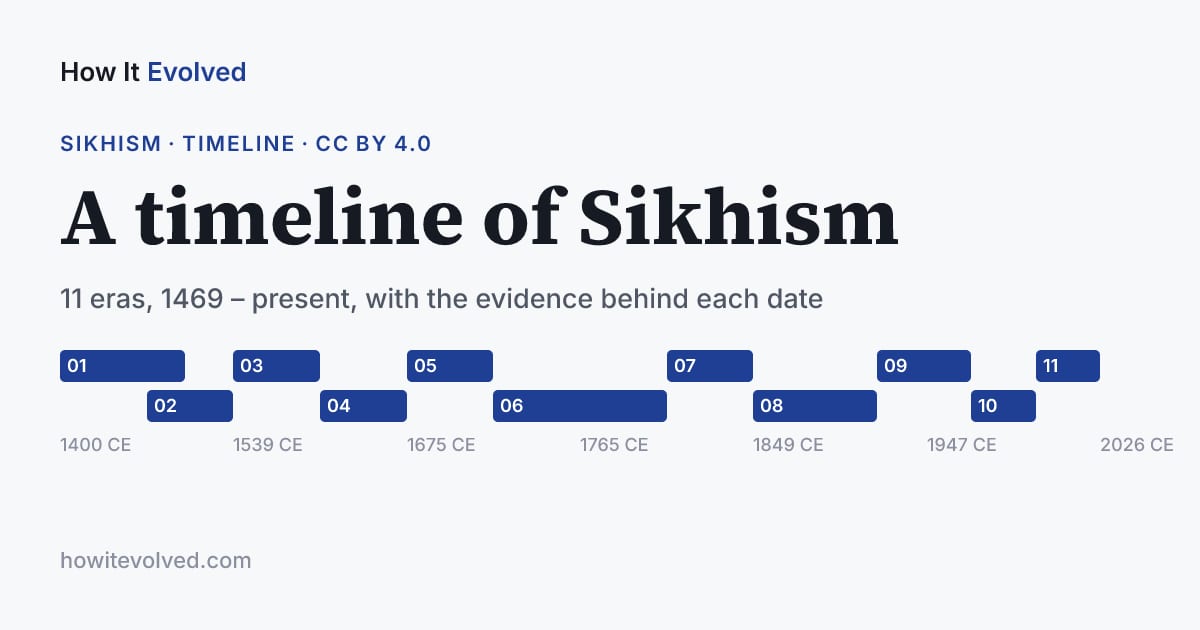
1200 × 630 JPEG. Credit: How It Evolved (howitevolved.com), CC BY 4.0.