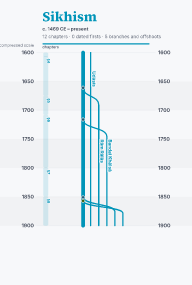
When Guru Gobind Singh died at Nanded in 1708 (§5), the Khālsā was nine years old, the Guru’s sons were dead, and his town of Anandpur was lost. Ninety years later, when the young Ranjit Singh rode into Lahore in 1799 (§7), Sikh chiefs ruled most of Punjab and had struck their own coins in the Guru’s name for a generation. In between lies the century Sikhs remember as the time of martyrs: a rising that briefly made a Sikh state, the execution of its leader in Delhi, decades that Sikh memory keeps as persecution by Mughal governors and Afghan invaders, two great massacres, the destruction of the Harmandir Sāhib (the Golden Temple), and the slow conquest of the land by bands of horsemen who decided their affairs together at Amritsar.[1][2] Consensus
It is also the century in which the Khālsā took the shape the earlier chapters could only point to. The rahitnāmās were written, the doctrine of the Guru Granth and the Guru Panth was settled in practice, the warrior identity was made in war, and the shrines passed to holy men who were not Khālsā at all. Much of what Sikhs now remember of it was first written down in the nineteenth century, above all by Ratan Singh Bhaṅgū, in a history usually dated 1841 (G. S. Mann argues for c. 1810–1813).[3][4] Majority on the date. That is the argument of this chapter: the eighteenth century made the Khālsā as much as 1699 did, and its outside witnesses, most of them hostile, confirm the outline the Sikh tradition remembers.[2][5][6] Majority
Timeline
The dates below follow Grewal and the Persian sources translated by Grewal and Habib; where Sikh and Persian dates differ, the cell says so.[1][5]
| Date | Event | Confidence |
|---|---|---|
| 1708 | Guru Gobind Singh meets the Bairāgī Mādho Dās at Nanded, who becomes Banda Singh[1] | Consensus |
| late 1709 | Banda’s followers sack Samāṇā[7] | Majority (the date) |
| 22 May 1710 (12 May Old Style) | Wazīr Khān of Sirhind killed in battle near Chappaṛ Chiṛī; Sirhind sacked[8][5] | Consensus |
| 1710–1712 | Banda’s coins and seal in the Gurus’ name, struck at Lohgaṛh[9][8] | Majority |
| late 1710 | Bahādur Shāh takes Lohgaṛh; Banda escapes to the hills[5] | Consensus |
| December 1710 | Bahādur Shāh orders the faujdārs around Delhi to kill the “worshippers of Nanak” wherever found[10][11] | Majority |
| April–December 1715 | Siege of Gurdās Nangal; Banda surrenders on 17 December (7 December Old Style)[8][12] | Consensus |
| March 1716 | Banda and some 740–780 prisoners paraded into Delhi; the followers executed, about a hundred a day[13][14] | Consensus (event); Contested (numbers) |
| June 1716 | Banda executed near the shrine of Quṭb al-Dīn Bakhtiyār Kākī at Delhi[5] | Consensus |
| 1717–1730 | Letters (hukamnāmās) of Mātā Sundarī to the Khālsā[15] | Majority |
| 1733 | Zakarīyā Khān offers a jāgīr and the title of Nawāb; Kapūr Siṅgh accepts it for the Khālsā[7] | Majority |
| 1734, 1737 or 1738 | Bhāī Manī Singh executed at Lahore[7] | Contested (the year) |
| 1739 | Nādir Shāh sacks Delhi; Sikh bands harry his return[1] | Consensus (invasion); Majority (the Sikh part) |
| March–May 1746 | The Chhoṭā Ghallūghārā[7] | Majority (event); Contested (numbers) |
| 29 March 1748 | The Dal Khālsā formed at Amritsar under Jassā Singh Āhlūvālīā, by Sikh tradition[7][2] | Majority |
| 1747–1769 | The nine invasions of Ahmad Shāh Abdālī[1] | Consensus |
| 1757 | The Harmandir desecrated by Abdālī’s commanders[1][7] | Majority |
| 5 February 1762 | The Vaḍḍā Ghallūghārā near Kup, north of Malerkotla[16][7] | Consensus (event); Contested (numbers) |
| April 1762 | Abdālī blows up the Harmandir and fills in the tank[17][7] | Consensus |
| January 1764 | Sirhind taken by the Sikhs; its Afghan governor, Zain Khān, killed[5] | Consensus |
| 1764 | Rebuilding of the Harmandir begins[18][7] | Majority |
| 1765 | Sikh chiefs hold Lahore and strike coins in the Guru’s name[19][5] | Consensus |
| 1783 | George Forster travels through the Sikh country; Sikh horsemen in Delhi[17] | Consensus |
| 1799 | Ranjit Singh takes Lahore (§7)[1] | Consensus |
Banda Singh Bahādur
Who he was
The man the Sikhs call Banda Singh Bahādur (“the brave slave [of the Guru]”) was born, by the usual account, in about 1670 in the hills of Rājaurī and became a Vaiṣṇava ascetic, a Bairāgī, under the name Mādho Dās; he had a hermitage at Nanded on the Godāvarī when Guru Gobind Singh came there in 1708.[7][1] Consensus on the meeting; Majority on his origins. The Sikh tradition says that the Guru made him a Sikh, gave him the name Banda, five arrows, a drum and a banner, and sent him to Punjab with five senior Sikhs and a small escort, with letters to the congregations to rally to him.[7][3] Majority that this is the tradition’s account; it is first told in full in later texts.
The Persian chroniclers tell another story. To them he was an impostor who resembled the dead Guru, put forward by the Guru’s followers so that the zamīndārs would believe their leader had come back to life; most of them never use the name Banda, and call him simply “the Guru”.[5][8] Consensus that this is what they say. The two accounts agree on the essential point: he came from Guru Gobind Singh, and the Sikhs of Punjab accepted him because of it. Majority
Sirhind
He reached the country north of Delhi in 1709. Sikh sources date the sack of Samāṇā to late that year; the Persian sources describe the rising gathering force around Sadhaura, at the foot of the Śivāliks.[7][8] Majority Khāfī Khān puts his following at first at 4,000–5,000 horse and 7,000–8,000 foot, growing to 40,000 armed men.[20][8] Contested on the numbers. Irvine, reading the Persian chroniclers, says the recruits came mostly from castes then called low, and the chroniclers single out sweepers, tanners and the nomad traders called Banjārās.[8][21] Majority
His target was Wazīr Khān, the governor (faujdār) of Sirhind, who had executed Guru Gobind Singh’s two younger sons in 1704 (§5). The armies met a few miles from Sirhind on 22 May 1710 by Irvine’s reckoning (12 May Old Style, the date in Sikh histories; a report from the emperor’s camp gives the 24th). Irvine’s text places the battle on the plain between Alwan Sarai and Banur; a Persian fragment he cites in a footnote puts it near Chappaṛ Chiṛī, the name the Sikh tradition uses. Wazīr Khān was killed, and Sirhind was taken and sacked.[8][5] Consensus The Mughal writers describe the sack in terms of horror: the city plundered, mosques pulled down, the tomb of a Sufi saint at Sadhaura dug up, and Wazīr Khān’s Hindu minister, remembered by the Sikhs for his part in the killing of the Guru’s sons, singled out for vengeance.[8][21] Majority on the events; the chroniclers were partisans of the other side, and say so.[5]
The first Sikh state
For a few years Banda ruled the old Mughal district (sarkār) of Sirhind, the country between the Sutlej and the Yamunā, from a fort in the hills near Sadhaura called Mukhlisgaṛh, which he renamed Lohgaṛh, “iron fort”.[5][8] Consensus He appointed a governor of Sirhind, Bāj Singh, and officers over the districts.[21][5] Consensus A report from Bahādur Shāh’s court says the Khālsā forbade the killing of animals in Sirhind, in keeping with Banda’s Vaiṣṇava past.[5] Majority The chronicler Wārid says he ordered Hindus and Muslims who joined the Sikhs to eat together, “to obviate the distinction of the lowly and the well-born”, as Grewal summarises him.[5] Majority The court newsletters (akhbārāt) tell a similar story from the other side. A news-sheet presented to Bahādur Shāh in the spring of 1711 (21 Rabīʿ I of his fifth regnal year), after the fall of Lohgaṛh, reported from Banda’s camp at Kalanaur that he had “promised and proclaimed, ‘I do not oppress the Muslims’”, that he fixed a daily allowance and wages for any Muslim who came to him, and that “He has permitted them to read khutba and namaz. As such, five thousand Muslims have gathered round him,” in Ganda Singh’s translation; a report a few weeks later says that “whosoever from amongst the Hindus and Muslims comes to him for service is looked after and fed.”[10][11] Majority that the news-writers reported this; the figure is theirs, and they were reporting on an enemy.
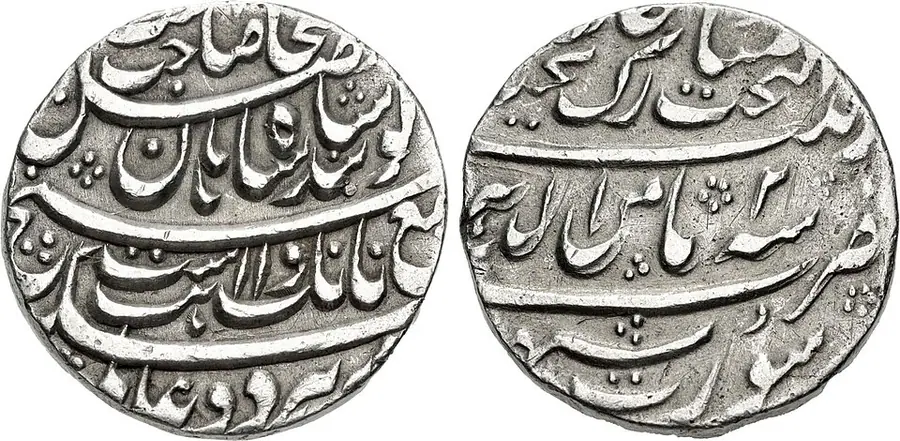
The coins and the seal. The clearest sign of what Banda claimed is the money. He struck coins at Lohgaṛh in 1710–1712, whose Persian couplet, as William Irvine read it from the Persian chroniclers, gives sovereignty to the Gurus:
Sikkah zad bar har do alam tegh-i-Nanak wahib ast, / Fath Govind Shah-i-shahan fazl-i-Sacha Sahib ast.
Irvine’s translation is: “Fath Govind, king of kings, struck coin in the two worlds, the sword of Nanak is the granter of desires, by grace he is the veritable Lord.”[9][8] Majority On his letters he used a seal with a second couplet, beginning with the cooking-pot (deg) and the sword (tegh), which said that Gobind Singh had received them, with victory and ready help, from Nānak.[22][5] Majority “Both these inscriptions reveal that Banda did claim sovereignty for the state he established, or tried to establish,” Grewal writes, “but not in his own name.”[5] Majority
Did he give the land to the tiller? Many Sikh and Indian historians, following Ganda Singh, have credited Banda with abolishing the zamīndārī system and giving the land to those who worked it; Ganda Singh wrote in 1935 that by this reform “the actual cultivators of the soil became the proprietors of their holdings”.[23][7] Contested The Persian sources show something narrower but still striking: men of castes the chroniclers called low appointed to rule places where they had been servants, and the well-born obliged to greet them. Irvine’s summary of the chroniclers is that “a low scavenger or leather-dresser, the lowest of the low in Indian estimation, had only to leave home and join the Guru, when in a short space of time he would return to his birth-place as its ruler, with his order of appointment in his hand.”[8] Majority that the chroniclers report this. No revenue document of Banda’s survives to show a redistribution of land, and Grewal and Dhavan describe a rising that drew in zamīndārs as well as peasants rather than a programme of land reform.[1][2] Contested The court newsletters, as their translator Bhagat Singh summarises them, have zamīndārs of the Bārī Doāb supplying Banda with arms and horses.[7] Majority; Political in modern Punjab, where the claim is part of Banda’s memory as a social revolutionary.
Lohgaṛh, Gurdās Nangal and Delhi
The emperor Bahādur Shāh came north in person. His army took Lohgaṛh late in 1710, but Banda escaped into the hills.[5][8] Consensus The contemporary chronicler Kāmwar Khān dates the assault to 19 Shawwal 1122, 11 December 1710.[24][5] Consensus From his camp near Lohgaṛh on 29 Shawwal, about 20 December 1710 by the modern calendar (10 December Old Style, the date usually quoted), the emperor told his paymaster-general, Mahābat Khān, to send orders to the faujdārs around Delhi “to kill the worshippers of Nanak (the Sikhs) wherever they were found”, as Ganda Singh translated the court newsletter in which it is recorded.[10][11] Majority Farrukh-Siyar repeated the order, the newsletters’ later translator Bhagat Singh writes, “in almost the same words”.[7] Majority The rising went on for five more years, in the hills, in the Bārī Doāb and around Batala, until the governor of Lahore, ʿAbd al-Ṣamad Khān, with troops sent from Delhi, shut Banda into a small fortified enclosure at Gurdās Nangal near Gurdaspur in April 1715. After eight months of siege and starvation he surrendered on 17 December 1715 (7 December Old Style, the date in most Sikh histories).[8][12] Consensus Muḥammad Qāsim, who watched the siege, says that many Sikhs deserted, cutting off their hair to escape notice.[21][5] Majority
The prisoners were brought into Delhi on 10 March 1716, in a procession copied from the one that had humiliated the Maratha king Sambhājī: the heads of the dead on poles, Banda in an iron cage on an elephant dressed in a gold-brocade robe and a red turban, and behind him the prisoners on camels in sheepskin caps.[13][12] Consensus Mīrzā Muḥammad, an imperial officer who went to watch, put them at “over seven hundred and forty”; the English envoys John Surman and Edward Stephenson, who were at the court on the East India Company’s business, wrote “about Seven hundred and eighty”, with “about two thousand heads stuck upon poles”.[13][14] Contested on the numbers. The followers were beheaded in batches, about a hundred a day, over a week or more, beginning on 15 March 1716 by Irvine’s reckoning (5 March Old Style); the other sources’ dates run to 21 March.[8][13][5] Majority
What struck every witness was that they would not recant. Mīrzā Muḥammad, who wrote of them with open hostility, records their answer to those who taunted them in the streets (Primary source 2); Khāfī Khān tells of a young prisoner whose mother won his release by swearing he was not a Sikh, and who denied her and asked to die with his companions; the English envoys wrote that “to the last it has not been found that one apostatized from this new formed Religion” (Primary source 3).[20][5][14] Consensus Banda himself was kept alive for three months while his captors tried to learn where his treasure was, and was executed in June 1716 (the 19th or 20th by the modern calendar), with his small son, near the shrine of the Sufi saint Quṭb al-Dīn Bakhtiyār Kākī at Mehraulī; the chroniclers describe a death by torture.[5][12] Consensus His followers’ deaths became one of the founding memories of Sikh martyrdom.[25] Consensus
Bandaī and Tat Khālsā
Who was Guru now?
Banda’s success raised the question that Guru Gobind Singh’s death had left open (§5). Kesar Singh Chhibbar, writing in 1769, says that many regarded Banda as the eleventh Guru, though Chhibbar himself did not; Ratan Singh Bhaṅgū, in a history usually dated 1841, says that he started a new panth of his own, with his own greeting (fateh daras, often written fateh darshan, “behold victory”, in place of the Khālsā’s), and that his claim to rule alienated the Sikhs who held that Guru Gobind Singh had given sovereignty to the Khālsā as a whole.[26][3][5] Majority The Persian writers confirm the greeting: Banda’s men went into battle shouting fateh daras and Sacha Padshah, “true king”, in Irvine’s spellings; Khāfī Khān reports the same cries.[8][20][5] Consensus
The tradition remembers the opponents as the Tat Khālsā (“the true Khālsā”), loyal to Guru Gobind Singh’s widow Mātā Sundarī in Delhi, and Banda’s followers as the Bandaī Khālsā. The later chronicles tell that after Banda’s death the two parties met at Amritsar and that Bhāī Manī Singh, keeper of the Harmandir, settled the dispute; the Tat Khālsā prevailed.[7][2] Majority that the tradition says so; the details are first told in the nineteenth century. The Bandaī Sikhs survived as a small following, and Banda’s line kept a shrine at Ḍerā Bābā Bandā near Riāsī in Jammu.[7] Majority
The Guru’s widows
Mātā Sundarī, who lived in Delhi until her death in 1747, and Mātā Sāhib Devī (Mātā Sāhib Kaur) were the focus of loyalty for many Sikhs after 1708. The Persian writer Chaturman, in 1759–60, thought each had held a “spiritual seat”, and that a youth adopted by Mātā Sundarī, Ajīt Singh, had been set up as Guru by some until his execution in Delhi, which Chaturman dates 1721–22 and the Encyclopaedia of Sikhism, with Irvine, to 1725.[5][7][8] Majority that he says so. Their own letters tell a different story. Mātā Sundarī’s surviving hukamnāmās, dated between 1717 and 1730, and Mātā Sāhib Devī’s, from 1726 to 1734, address the Sikhs as “the Khālsā of Akāl Purakh”, ask for offerings in the Guru’s name and claim no Guruship for their writers; Grewal reads them as speaking for “the house of the Guru”.[15][5] Majority By 1759 a hukamnāmā to the Sikhs of Patna, dated 12 April and printed in Ganda Singh’s edition of the hukamnāmās, was issued by “the Khalsa of Sat Sri Akal Purakh Ji”, in Grewal’s rendering: the community writing as the Guru.[27][5] Majority This is the doctrine of the Guru Panth becoming practice, a generation after 1708.
Persecution
The Mughal governors
The thirty years after Banda’s death were the hardest the Khālsā remembers. The governors of Lahore, ʿAbd al-Ṣamad Khān (to 1726) and his son Zakarīyā Khān (1726–1745), hunted the Sikh bands, and the Sikh chronicles tell of rewards for Sikh heads and of Sikhs living in the forests and the desert of the Lakkhī Jungle in the Mālvā.[1][3] Majority The non-Sikh sources are almost silent on these years: Grewal notes that they have “nothing about their activity” between Banda and the governorship of Muʿīn al-Mulk in 1748.[5] Majority Most of what is known comes from Bhaṅgū and later writers.
Persecution alternated with deals. In 1733 Zakarīyā Khān, unable to crush the bands, offered them a jāgīr and the title of Nawāb for their leader; they gave it to Kapūr Singh, who organised the fighters into an older and a younger army, the Buḍḍhā Dal and the Taruṇā Dal. The arrangement broke down within two years.[7][2] Majority Dhavan’s point is that this was the ordinary politics of the late Mughal Punjab: armed peasant bands bargained with governors as other zamīndārs did, and their leaders became sardārs by the same means.[2] Majority
Bhāī Manī Singh
Bhāī Manī Singh, the companion of Guru Gobind Singh who had kept the Harmandir for Mātā Sundarī and is credited by tradition with compiling the Dasam Granth (§5), was executed at Lahore. The tradition says he had been permitted to hold a festival gathering at Amritsar on payment of a levy, warned the Sikhs away when he learned that troops were to be sent against them, could not pay, and refusing to accept Islam was cut apart joint by joint.[7] Majority that this is the tradition’s account. The year is disputed: 1734 in much Sikh writing; 1737, at Dīvālī, in the Encyclopaedia of Sikhism; 1738 in some others.[7] Contested “Cut joint by joint” (band band kaṭāe) entered the Ardās, the daily prayer, as one of its marks of martyrdom (Primary source 6).[28][25] Consensus
Nādir Shāh, 1739
The Persian conqueror Nādir Shāh invaded India in 1738–39, defeated the Mughal army at Karnāl and sacked Delhi (see Islam §9 for the empire’s decline). The Sikh chronicles say that Sikh bands fell on his baggage as he returned through Punjab, and Bhaṅgū tells of his warning to Zakarīyā Khān that these people would one day rule the country.[1][3] Consensus on the invasion; Majority that Sikh bands raided his columns; Contested on the warning, which is the kind of prophecy written after the event.
The Chhoṭā Ghallūghārā, 1746
In 1746 Jaspat Rāi, a Mughal commander at Eminābād, was killed by a Sikh band, and his brother Lakhpat Rāi, a minister (dīwān) at Lahore, swore revenge. By the Sikh account he had the Sikhs of Lahore executed, then hunted the main body of the Khālsā through the marshes of Kāhnūvān and into the hills; Sikh chronicles put the losses at about 7,000 killed and 3,000 captured, the captives being beheaded at Lahore.[7][3] Majority on the campaign; Contested on the numbers, which come only from the Sikh side. The Sikhs called it the ghallūghārā, the ‘great massacre’ (often rendered ‘holocaust’); after 1762 it became the Chhoṭā, the lesser one.[7] Consensus
The Afghan wars
Ahmad Shāh Abdālī
Ahmad Shāh Abdālī (Durrānī), who had served Nādir Shāh and founded the Afghan kingdom after his death in 1747, invaded India nine times between 1747 and 1769; Punjab was ceded to him by the Mughals in 1752.[1][5] Consensus His wars, with the Marathas as well as the Mughals, broke what was left of Mughal government in Punjab, and the Sikhs fought both sides of them and gained from both.[5][2] Consensus Ṭahmās Khān, a servant of the Mughal governor who lived through these years, records how after 1757 “from every side tumult and rebellion began to be raised by the Sikhs”, until their bands, a thousand strong, sacked the suburbs of Lahore by night.[16][5] Consensus
The Vaḍḍā Ghallūghārā, 1762
After his victory over the Marathas at Pānīpat in January 1761, Abdālī returned in the winter of 1761–62 specifically to break the Sikhs. On 5 February 1762, after a forced march, he caught the Dal Khālsā near Kup, north of Malerkotla, with its baggage train of families, and fought it all day as it retreated towards Barnālā.[7][5] Consensus The estimates of the Sikh dead:
| Source | Date | Sikh dead |
|---|---|---|
| Ṭahmās Khān, a servant of the Mughal governor’s household, writing c. 1780[16][5] | 1780–1782 | about 25,000 |
| George Forster, from what he was told in 1783[17] | 1798 | “twenty-five thousand of their cavalry” |
| Ratan Singh Bhaṅgū, on the authority of his father and uncle, who fought there[3] | usually dated 1841 | 30,000 |
| Modern estimates, as surveyed by the Encyclopaedia of Sikhism[7] | 1990s | 20,000–50,000 |
Contested on every figure; the agreement of the non-Sikh contemporary and the Sikh chronicler on a number in the tens of thousands is the strongest evidence of the scale. The news reports from Delhi to the Maratha courts, which follow these years closely, do not mention the battle at all.[18][5] Majority Ṭahmās, who had watched the Sikhs for a decade, expected them to rise again within months, and they did.[5] Consensus
The Harmandir destroyed and rebuilt
Abdālī’s commanders had desecrated the Harmandir in 1757; the Sikh tradition remembers Bābā Dīp Singh, leader of the Shahīd misl, dying in the attempt to retake it.[1][7] Majority In April 1762, after the Ghallūghārā, Abdālī blew the building up with gunpowder and had the tank filled in. Forster, two decades later, wrote that Amritsar “was rased to the ground, and the sacred waters choaked up with its ruins”, and that pyramids of Sikh heads were built.[17][7] Consensus
The Sikhs began rebuilding almost at once. A news report from Delhi in October 1763 says that a large number of Sikhs had gathered at Amritsar and started building, employing some Durrānīs as labourers; the Sikh tradition dates the foundation of the new sanctum to April 1764, paid for out of the plunder of Sirhind and supervised by Bhāī Des Rāj, and its completion, with the causeway and gateway, to the 1770s.[18][5][7] Majority When Abdālī came back in December 1764, the Jangnāma says, he found only thirty Sikhs in the enclosure, who “did not at all show any fear of being killed nor the dread of death” and died fighting; Sikh sources name their leader as Gurbakhsh Singh.[29][5] Consensus “The Harmandar Sahib at Amritsar was destroyed and desecrated by Ahmad Shah Abdali on two or three occasions,” Grewal writes; “Everytime it was rebuilt through the collective effort of the Khalsa.”[5] The gold came later, under Ranjit Singh (§7). Consensus
The misls
From bands to confederacies
The fighting Khālsā of the 1730s and 1740s was a shifting set of armed bands (jathās, ḍerās), each following a leader. By Sikh tradition, at Vaisākhī on 29 March 1748, a few months after Abdālī’s first invasion, the bands gathered at Amritsar were united in the Dal Khālsā (“the army of the Khālsā”) under Jassā Singh Āhlūvālīā, in eleven groupings that came to be called misls.[7][2] Majority The word is Arabic-Persian, usually explained as “alike, equal” or “a file”; Sainapati already uses it of a troop of the Guru’s horsemen.[7] Majority
The list is conventional, and so is the number. The usual twelve are the Bhaṅgī, Āhlūvālīā, Rāmgaṛhīā, Kanhaiyā, Sukerchakia, Nakaī, Ḍallevālīā, Nishānāṅvālī, Karoṛsiṅghīā, Siṅghpurīā (or Faizullāpurīā) and Shahīd misls of the Dal Khālsā, and the Phūlkīāṅ chiefs of Patiala, Nābhā and Jīnd outside it.[7] Majority The neat dozen is a later convention; in the eighteenth century the groupings were more fluid, and followers could change allegiance.[2][7] Majority The Persian witnesses name the chiefs, not the misls: the Jangnāma of 1765 lists Jhaṇḍā Singh, Harī Singh and Lahiṇā Singh Bhaṅgī, Chaṛhat Singh Sukerchakia, Jai Singh Kanhaiyā, and “Jassa Kalal” and “Jassa Najjar”, Jassā Singh Āhlūvālīā and Jassā Singh Rāmgaṛhīā, named by the castes of distiller and carpenter.[29][5] Consensus Most of the chiefs were Jaṭs; those two were not.[1] Majority
The Sarbat Khālsā and the gurmatā
The misls met as the Sarbat Khālsā, “the whole Khālsā”, at Amritsar, by Bhaṅgū’s account at Vaisākhī and Dīvālī, and took decisions called gurmatās (“the Guru’s counsel”), passed before the Akāl Takht in the presence of the scripture: the Guru Granth and the Guru Panth acting together, as the doctrine Sikhs date to 1708 required (§5).[3][5][7] Majority The news reports from Delhi confirm the practice: in 1763 they describe the Sikh chiefs preparing to meet at Amritsar “for gurmata”, and Jassā Singh telling the emperor’s envoy that he would put the emperor’s orders before the chiefs there.[18][5] Consensus The non-Sikh sources, Grewal notes, mention the gurmatā but never the doctrine of the Guru Panth behind it.[5] Majority
How far this was government is another matter. Forster, travelling in 1783, described the “grand convention” in the past tense, and wrote that it was “now rarely summoned” (Primary source 5); the British historian J. D. Cunningham called the whole system “a theocratic confederate feudalism”.[17][30] Majority The picture of a Sikh commonwealth governed by its assemblies owes much to Forster, John Malcolm (1812) and Bhaṅgū; the reports of the 1760s show chiefs who met to coordinate, quarrelled over spoils and fought each other for Lahore.[5][2] Majority
Rākhī: protection
Before they ruled land directly, the misls took rākhī (“protection”): villages paid a share of the revenue, usually put at a fifth, twice a year at the harvests, in return for being left alone and defended against others.[7][1] Majority To the villagers it was another levy in a country where every armed power took one; to the Khālsā it was the step between raiding and government.[2] Majority In the country between Delhi and the Yamunā it was still collected at the end of the century.[7] Majority
The Phūlkīāṅ chiefs and their titles
The Phūlkīāṅ chiefs of the Mālvā, descendants of a Jaṭ chaudhrī named Phūl, took another road. Ālā Singh of Patiala dealt with Mughal and Afghan governors as a zamīndār: in 1763 his troops were collecting revenue for Zain Khān, the Afghan governor of Sirhind, and in 1765, when the other chiefs urged him not to accept Abdālī’s overlordship, he answered that he was “a zamīndār” and could not refuse.[18][5] Consensus Abdālī recognised him in 1761 and gave him the title of Raja in 1765; his grandson Amar Singh received from Abdālī in 1767 the title Rājā-i Rājgān, “raja of rajas”.[7] Majority The tradition also tells that after the Ghallūghārā of 1762 Ālā Singh paid Abdālī to be spared the order to shave his head.[7] Majority that the tradition says so. Patiala, Nābhā and Jīnd survived as princely states under the British until 1947.[1] Consensus
Sikh rule: Lahore, 1765
In January 1764 the Dal Khālsā took Sirhind and killed Zain Khān; in the following months the chiefs divided the Sutlej–Yamunā country and the Doābs among themselves, and demanded from the Afghan governors of Multan and Kashmir the tribute they had paid Abdālī.[5] Consensus Qāẓī Nūr Muḥammad, who rode with the Baluch chief Naṣīr Khān on Abdālī’s campaign of 1764–65, wrote that the Sikhs “have divided up Panjab among themselves, giving it to every man, old or young”.[29] Consensus In 1765 the Bhaṅgī chiefs Lahiṇā Singh and Gujjar Singh and Sobhā Singh Kanhaiyā held Lahore, and the Khālsā struck coins there bearing the couplet of Banda’s seal, deg tegh fateh.[19][8][5][7] Consensus Grewal treats the coin as the Sikhs’ declaration of sovereignty, coming after they were already the rulers in fact.[5] Majority
The coin had a rival. A rupee in Jassā Singh Āhlūvālīā’s own name, said to have been struck at Lahore in 1761, is reported by a contemporary Persian writer, but no specimen survives; a nineteenth-century chronicler, Ganesh Dās, says it was struck by Lahore’s qāzīs to provoke Abdālī. Grewal calls it “the controversial coin of Jassa Singh”.[5][7] Contested Either way, the coins struck in 1765 did what Banda’s had done: they named the Gurus, not the chiefs.[5] Majority The words deg tegh fateh, the pot that feeds and the sword that protects, are still in the Ardās.[28] Consensus
The last decades
After Abdālī’s last great campaign (1766–67) and his death (1772), the misls were the power in Punjab, and their horsemen raided far beyond it: in 1783 a Sikh army under Baghel Singh camped in Delhi, and by Sikh tradition he stayed to mark the sites of the Gurus’ presence there with gurdwaras.[7][1] Majority Unity did not survive success. The chiefs fought one another; Forster saw a land “divided into numerous states, which pursue an independent interest”, and predicted that “some ambitious chief” would absorb the rest and raise “the standard of monarchy”.[17] Consensus on the text. Women held power among them too: Sadā Kaur led the Kanhaiyā misl in the 1790s and helped her son-in-law Ranjit Singh of the Sukerchakia misl to take Lahore in 1799, which is where §7 begins.[1][7] Majority
Who kept the shrines
While, by the Sikh chronicles’ account, Khālsā Sikhs were hunted, the shrines of the Gurus were often in other hands. The Udāsīs, ascetics who traced their line to Guru Nānak’s son Srī Chand (§3), and the Nirmalās, a learned order whose members studied Sanskrit and read the Gurus’ hymns in the terms of Vedānta, kept many gurdwaras through the century and after it. They did not keep the Khālsā form, they could live where a turbaned Khālsā Sikh could not, and the misl chiefs, and later Ranjit Singh, endowed them with land.[31][1] Majority Forster in 1783 noted that “the administration of ecclesiastical affairs was entrusted to a certain society of religeuse [sic], composed chiefly of the descendants of their original priests”, the Bedīs and Sodhīs of the Gurus’ families.[17] Majority on whom he meant.
What that meant for practice is the subject of Oberoi’s argument (§7, §8). In the shrines kept by Udāsī and Nirmalā mahants, worship took forms shared with the Hindu traditions around them, images among them, which the Singh Sabhā reformers of the late nineteenth century would condemn and the gurdwara reform movement of the 1920s would expel (§9).[31][6] Majority on the custodianship; Contested on how far it represented a different Sikhism rather than a compromise of hard times.
The rahitnāmās take shape
The codes of conduct that define the Khālsā were written in these decades, and §5 sets out their dates: the Tankhāhnāmā from 1718–19, the Chaupā Singh rahitnāmā in the 1740s–1760s, the codes attributed to Prahlād Singh, and Desā Singh’s of the late eighteenth or early nineteenth century.[6][32][33] Majority on the dates. Their rules carry the century’s marks: uncut hair; no tobacco; no meat killed in the Muslim manner; no relations with Muslim women; distance from the “Turks”, the rulers; and the promise that “the Khālsā shall rule”.[6] Majority McLeod read them as the Khālsā’s answer to persecution and war; Dhavan as the record of an argument among Sikhs (Khālsā and non-Khālsā, Jaṭ and Khatrī, warriors and scholars) about who belonged and on what terms.[6][2] Contested on how much of each code reaches back to 1699.
The outsiders saw a separate people. Qāẓī Nūr Muḥammad, who wrote to celebrate a holy war against them and called them “miscreants”, nonetheless told his readers that the Sikhs “are not from amongst the Hindus” and had “a distinct religion of their own” (Primary source 4).[29] Consensus on the text; Political in modern use, where the line is quoted in the argument over whether Sikhs are Hindus (§8).
The evidence ledger
| Date | Evidence | Confidence |
|---|---|---|
| 1710–1712 | Banda’s coins and seal, as Irvine read them from the Persian chroniclers[9][22][8] | Majority |
| 1710–1716 | Mughal court reports and newsletters (akhbārāt) on the rising[5][10] | Consensus |
| March 1716 | Surman and Stephenson’s letter from Delhi[14] | Consensus |
| c. 1719 | Mīrzā Muḥammad’s ʿIbratnāma: an eyewitness of the Delhi procession[13] | Consensus |
| 1723 | Muḥammad Qāsim’s ʿIbratnāma, by a Lahore official who saw the siege[21] | Consensus |
| c. 1724 | Kāmwar Khān’s Tazkirat al-Salāṭīn Chaghtā, a court chronicle with dated entries drawn from the official news reports[24] | Consensus |
| 1731 | Khāfī Khān’s Muntakhab al-Lubāb, completed that year[20] | Consensus |
| 1717–1734 | Letters of Mātā Sundarī and Mātā Sāhib Devī[15] | Majority |
| 1759–1765 | News reports from Delhi to the Maratha courts[18] | Consensus |
| 1765 | Qāẓī Nūr Muḥammad’s Jangnāma, eyewitness of Abdālī’s seventh campaign[29] | Consensus |
| 1765 | Sikh coins of Lahore[19] | Consensus |
| 1769 | Kesar Singh Chhibbar on Banda and the Guruship[26] | Majority |
| 1780–1782 | Ṭahmās Khān’s memoir[16] | Consensus |
| 1783 (published 1798) | George Forster’s letter on the Sikhs[17] | Consensus |
| usually dated 1841 | Ratan Singh Bhaṅgū’s Prāchīn Panth Prakāsh: the century as the Khālsā remembered it[3][4] | Majority (date) |
Primary sources
Show the 6 primary sources
1. “Struck coin in the two worlds”: Banda’s coin and seal, 1710–1712
Sikkah zad bar har do alam tegh-i-Nanak wahib ast, / Fath Govind Shah-i-shahan fazl-i-Sacha Sahib ast.
Reverse: Zarb ba Aman-ud-dahr, Maswarat-shahr, Zinat-ut-takht-i-mubarak-bakht.
“Fath Govind, king of kings, struck coin in the two worlds, the sword of Nanak is the granter of desires, by grace he is the veritable Lord.” Reverse: “Coined at Refuge of the World, the Walled City, Ornament of the Fortunate Throne.” (Irvine’s transliteration and translation, as printed. He found the verse “halting, obscure”.)[9][8]
The seal, as Irvine prints it:
Teg, deg, o fath, nusrat-i-be-dirang, / Yaft az Nanak, Guru Govind Singh.
“Guru Govind Singh found in Nanak, sword, pot, and conquest, help without hindrance or delay.” Ganda Singh, and Grewal and Habib after him, put the pot (deg) first.[22][8][5]
What it proves. That the first Sikh state claimed sovereignty in the Mughal idiom, with Mughal coin formulas and an honorific name for its mint town, but placed it in the Gurus and in God rather than in Banda. The seal’s couplet passed to the coins of 1765 and its first words into the Ardās. The coin’s Persian is uncertain in places, and the readings vary. Majority on the text; Contested on its exact wording.
2. “We do not fear death”: Mīrzā Muḥammad watches the prisoners enter Delhi, 1716
“If any one in the lanes and bazar reminded them of the cruelties they had committed, which brought them to this condition, they gave immediate and manly retorts, and attributed their capture and humiliation to the doings of fate. If any one told them that they would now be executed, they replied, ‘Let them kill us! We do not fear death. Had we feared it, how could we have fought so many battles with you? We have fallen in your hands only because of hunger and lack of provisions; otherwise, you would have come to know of our bravery far more than has been witnessed till now.’”
(Mīrzā Muḥammad, ʿIbratnāma, written c. 1719; translated from the Persian by Iqbal Husain.)[13][5]
What it proves. That a Mughal officer who called the prisoners “ill-fated” and their leader a “wretch” saw them refuse to submit, and wrote it down within three years. He adds that he went the next day to see the executions and arrived as the bodies were falling. The hostility of the witness is what makes the testimony strong. Consensus
3. “Not one apostatized”: the English envoys’ letter, Delhi, March 1716
“The great Rebel Goroo who has been for these 20 years so troublesome in the Subaship of Lahore is at length taken with all his family and attendance by Abdell Summed Cawn the Suba of that province, some days ago they entered the City loaden with fetters, his whole attendance which were left alive being about Seven hundred and eighty all severally mounted on Camells … besides about two thousand heads stuck upon poles … for the rest there are 100 each day beheaded. It is not a little remarkable with what patience they undergo their fate, and to the last it has not been found that one apostatized from this new formed Religion.”
(John Surman and Edward Stephenson to Robert Hedges, President of Fort William, dated “Dilly, March the 10th 1715-16”, that is 10 March 1716 Old Style; printed by C. R. Wilson, 1911.)[14][12]
What it proves. An outside witness with no stake in the quarrel, writing within days, confirms the procession, the daily executions and the prisoners’ constancy, and calls the Sikhs’ faith a “new formed Religion”. Its numbers (“about”) are hearsay, and close to Mīrzā Muḥammad’s. Consensus
4. “A distinct religion of their own”: Qāẓī Nūr Muḥammad’s Jangnāma, 1765
“At no time do they kill one who is not a man (nāmard). Nor would they obstruct the passage of a fugitive. They do not plunder the wealth and ornaments of a woman, be she a well-to-do lady or a maid-servant. There is no adultery among the Sikhs, nor are these people given to thieving. … The ways and practices of these [people] are derived from Nanak who showed to the Sikhs a separate path. His [last] successor was Gobind Singh, from whom they received the title ‘Singh’. They are not from amongst the Hindus. These miscreants have a distinct religion of their own.”
(Persian verse, edited by Ganda Singh, 1939; translated by Iqtidar Alam Khan.)[29][5]
What it proves. How the Khālsā looked to an enemy who had fought it: disciplined in war, bound by rules of conduct, and a religion of its own, not a branch of Hinduism. The poem was written to celebrate a holy war against the Sikhs, and its author plays on Sikh and sag (“dog”) throughout; the translators render the pun as “Sikhs”. His praise is all the more telling for it. Consensus on the text; Political in modern use.
5. “The grand assembly is now rarely summoned”: George Forster, 1783
“The grand convention, called in their language Goorimotta, was that in which the army met to transact the more important affairs of the nation; as the declaration of war or peace, forming alliances, and detaching parties on the service of the year. … The dominions of the Sicques, now widely extended, have been since divided into numerous states, which pursue an independent interest, without a regard to general policy. The grand assembly is now rarely summoned, nor have the Sicques, since the Afghan war, been embarked in any united cause. … we may see some ambitious chief led on by his genius and success, and, absorbing the power of his associates, display, from the ruins of their commonwealth, the standard of monarchy.”
(George Forster, A Journey from Bengal to England, vol. 1, Letter XI, London, 1798, pp. 253–295, the passages quoted on pp. 277–278 and 295; spelling as printed, long s modernised.)[17]
What it proves. That the Sarbat Khālsā and the gurmatā were real institutions, known to an outsider as the Khālsā’s way of deciding war and peace, and that by the 1780s they had lapsed as the misls became rival states. Forster’s prophecy of a monarch was fulfilled by Ranjit Singh (§7). Consensus
6. “Those who were cut apart joint by joint”: the martyrs in the Ardās
ਜਿਨ੍ਹਾਂ ਸਿੰਘਾਂ ਸਿੰਘਣੀਆਂ ਨੇ ਧਰਮ ਹੇਤ ਸੀਸ ਦਿੱਤੇ ਬੰਦ ਬੰਦ ਕਟਾਏ ਖੋਪਰੀਆਂ ਲੁਹਾਈਆਂ ਚਰਖੀਆਂ ਤੇ ਚੜੇ ਆਰਿਆਂ ਨਾਲ ਚਿਰਾਏ ਗਏ ਗੁਰਦਵਾਰਿਆਂ ਦੀ ਸੇਵਾ ਲਈ ਕੁਰਬਾਨੀਆਂ ਕੀਤੀਆਂ ਧਰਮ ਨਹੀਂ ਹਾਰਿਆ ਸਿੱਖੀ ਕੇਸਾਂ ਸੁਆਸਾਂ ਨਾਲ ਨਿਬਾਹੀ ਤਿਨ੍ਹਾਂ ਦੀ ਕਮਾਈ ਦਾ ਧਿਆਨ ਧਰ ਕੇ ਖ਼ਾਲਸਾ ਜੀ ਬੋਲੋ ਜੀ ਵਾਹਿਗੁਰੂ ॥
jinhāṅ siṅghāṅ siṅghaṇīāṅ ne dharam het sīs ditte, band band kaṭāe, khoparīāṅ luhāīāṅ, charkhīāṅ te chaṛe, āriāṅ nāl chirāe gae, gurdavāriāṅ dī sevā laī kurbānīāṅ kītīāṅ, dharam nahīṅ hāriā, sikhī kesāṅ suāsāṅ nāl nibāhī, tinhāṅ dī kamāī dā dhiān dhar ke, khālsā jī, bolo jī vāhigurū.
The site’s translation: The Singhs and Singhṇīs who gave their heads for the faith, who were cut apart joint by joint, whose scalps were taken off, who were broken on the wheel, who were sawn apart, who gave their lives for the service of the gurdwaras, who did not give up their faith and kept their Sikhī with their hair to their last breath: think of their deeds, Khālsā, and say Vāhigurū.[28]
What it proves. How the eighteenth century entered daily worship. The tradition attaches each torment to a name: “joint by joint” to Bhāī Manī Singh, the scalping to Bhāī Tārū Singh (1745), the saw to Bhāī Matī Dās (1675).[25] The passage is layered: the “service of the gurdwaras” belongs to the reform struggle of the 1920s (§9), and the text is fixed in the Sikh Rahit Maryādā (§5). The Gurmukhi follows the SGPC’s printed text. It records memory, not events. Consensus on the text; Majority on the associations.
What is absent
- A record from Banda’s own government. No order, revenue paper or letter of his administration survives in the original beyond the seal’s wording and a few later-copied hukamnāmās; his state is known mostly from its enemies.[5] Majority
- A Persian witness to the persecution of the 1720s–1740s. Between Banda and 1748 the non-Sikh sources say almost nothing about the Sikhs; the stories of these years are Bhaṅgū’s and later.[5] Majority
- Outside numbers for the Chhoṭā Ghallūghārā. The figures for 1746 are the Sikh chroniclers’. Majority
- The Vaḍḍā Ghallūghārā in the Delhi reports. The news-writers who followed the Sikhs month by month do not mention it.[5] Majority
- A written constitution of the misls. There are no minutes of the Sarbat Khālsā; the twelve-misl scheme is a later convention, and the groupings were more fluid.[2][7] Majority
- A surviving specimen of Jassā Singh’s coin of 1761. Contested
Debates
Who was Banda?
| View | Main argument | Main proponents |
|---|---|---|
| The Guru’s general | Sent by Guru Gobind Singh to punish Sirhind; a loyal Sikh, wrongly accused of claiming the Guruship | Much Sikh historiography; Ganda Singh[7] |
| A rival Guru | Many followers treated him as the eleventh Guru; his innovations split the Khālsā | Chhibbar (1769), Bhaṅgū (usually dated 1841), read by Grewal[26][5] |
| A social revolutionary | Men of castes then called low made rulers; the land given to its tillers | Ganda Singh and Indian nationalist historians[7] |
| A Mughal-era rebel | One of the armed risings of the empire’s crisis, drawing zamīndārs as well as peasants, under a religious banner | Grewal, Dhavan[1][2] |
Contested; Political on the social-revolution reading.
How many died in the Ghallūghārās?
The numbers come from a Sikh chronicler writing decades later, a non-Sikh contemporary, and a British traveller’s hearsay; they agree on tens of thousands for 1762 and differ on everything else.[16][3][7] Contested
What were the misls?
| View | Main argument | Main proponents |
|---|---|---|
| A Sikh commonwealth | Equal Khālsā members, governed by the Sarbat Khālsā and the gurmatā under the Guru | The Sikh tradition; Bhaṅgū[3] |
| Theocratic confederate feudalism | A brotherhood in faith that resolved itself into rival lordships | Cunningham (1849)[30] |
| Sardārs in a military labour market | Peasant warriors and their chiefs bargaining with Mughals, Afghans and Marathas, the Khālsā identity made in that process | Dhavan[2] |
Contested The views differ more in emphasis than in fact, and most historians combine the last two. Majority
Further reading
Show further reading (8 works)
- Purnima Dhavan, When Sparrows Became Hawks: The Making of the Sikh Warrior Tradition, 1699–1799 (Oxford, 2011): the century as a whole, and the key modern study.
- J. S. Grewal and Irfan Habib, eds., Sikh History from Persian Sources (Tulika, 2001): the Mughal and Afghan witnesses in English, with Grewal’s long introduction.
- J. S. Grewal, The Sikhs of the Punjab (Cambridge, 1990; revised 1998): the narrative.
- William Irvine, Later Mughals, vol. 1 (1922): still the fullest account of Banda from the Persian sources, from the Mughal side.
- W. H. McLeod, Sikhs of the Khalsa: A History of the Khalsa Rahit (Oxford, 2003): the codes.
- Louis E. Fenech, Martyrdom in the Sikh Tradition (Oxford, 2000): how the deaths were remembered.
- Harjot Oberoi, The Construction of Religious Boundaries (Oxford, 1994): the Udāsīs, Nirmalās and the shrines.
- Ratan Singh Bhaṅgū, Prāchīn Panth Prakāsh (usually dated 1841; G. S. Mann argues for c. 1810–1813): the tradition’s own history of the century.
References
- ^ a b c d e f g h i j k l m n o p q r s t J. S. Grewal The Sikhs of the Punjab. The New Cambridge History of India II.3, Cambridge University Press, 1990. The standard narrative history; revised edition 1998.
- ^ a b c d e f g h i j k l m n o p Purnima Dhavan When Sparrows Became Hawks: The Making of the Sikh Warrior Tradition, 1699–1799. Oxford University Press, New York, 2011.
- ^ a b c d e f g h i j k Ratan Singh Bhaṅgū, Prāchīn Panth Prakāsh — History of the Khālsā. usually dated 1841 CE; c. 1810–1813 on G. S. Mann's reading. Punjabi in Gurmukhi. The Khālsā's eighteenth century told by a grandson of one of its fighters, written in answer to a British officer's questions.
- ^ a b Gurinder Singh Mann "Sri Gur Panth Prakash: Its Text, Context, and Significance". Journal of Sikh & Punjabi Studies 23.1–2, 15–56, 2016. open library Rejects Vīr Singh's 1841 dating of Ratan Singh Bhaṅgū's chronicle and argues for 1810–1813; the manuscripts' title is Srī Gur Panth Prakāsh.
- ^ a b c d e f g h i j k l m n o p q r s t u v w x y z { | } ~ J. S. Grewal and Irfan Habib, eds. Sikh History from Persian Sources: Translations of Major Texts. Tulika, New Delhi, 2001. Jahāṅgīr, the Dabistān, court newsletters and chronicles in English.
- ^ a b c d e W. H. McLeod Sikhs of the Khalsa: A History of the Khalsa Rahit. Oxford University Press, New Delhi, 2003. The code of conduct from the rahitnāmās to the Sikh Rahit Maryādā; the main source for dating the Five Ks.
- ^ a b c d e f g h i j k l m n o p q r s t u v w x y z { | } ~ Harbans Singh, ed. The Encyclopaedia of Sikhism. Punjabi University, Patiala, 4 vols, 1992. open access Published 1992–1998; the standard reference, with signed entries reporting both tradition and sources.
- ^ a b c d e f g h i j k l m n o p q r s t u William Irvine Later Mughals, vol. 1: 1707–1720. M. C. Sarkar & Sons, Calcutta (ed. Jadunath Sarkar), 1922. full text The fullest account of Banda's rising from the Persian chronicles, from the Mughal side.
- ^ a b c d Coin of Banda Singh Bahādur — Silver coins struck at Lohgaṛh, 1710–1712. 1710–1712 CE. Persian. The first coins struck in the name of the Sikh Gurus. Obverse couplet as William Irvine read it from the Persian chroniclers: "Sikkah zad bar har do alam tegh-i-Nanak wahib ast, / Fath Govind Shah-i-shahan fazl-i-Sacha Sahib ast"; reverse "Zarb ba Aman-ud-dahr, Maswarat-shahr, Zinat-ut-takht-i-mubarak-bakht" (Irvine, Later Mughals, I, p. 110).
- ^ a b c d Akhbārāt-i Darbār-i Muʿallā — Mughal court newsletters (Jaipur archives), Punjab extracts. 1708–1716 CE (the Banda entries). Persian. Summaries of news presented to the emperor, with his orders. On 29 Shawwal 1122 (10 December 1710 Old Style), from his camp near Lohgaṛh, Bahādur Shāh directed Mahābat Khān to order the faujdārs around Shāhjahānābād "to kill the worshippers of Nanak (the Sikhs) wherever they were found"; a news-sheet of 21 Rabīʿ I, regnal year 5 (spring 1711), reports from Kalanaur that Banda proclaimed "I do not oppress the Muslims", paid Muslims who joined him and "permitted them to read khutba and namaz", so that five thousand had gathered round him. Extracts copied by Ganda Singh in 1944–45 and translated in his 1948 paper; fuller translation by Bhagat Singh (Patiala, 1984). about
- ^ a b c Ganda Singh "The Punjab News in the Akhbar-i-Darbar-i-Mualla". Indian Historical Records Commission, Proceedings of Meetings, vol. XXIV (Jaipur, February 1948), pp. 61–66, 1948. full text The Jaipur court newsletters on Banda: the edict of December 1710, the Muslims in his camp in 1711, his seals and coin, and his execution; Persian text with translation.
- ^ a b c d e C. R. Wilson, ed. The Early Annals of the English in Bengal, vol. II, part II: The Surman Embassy. Bengal Secretariat Book Depot, Calcutta, 1911. full text Prints the embassy's diary and letters, including the report of Banda's capture and the Delhi executions.
- ^ a b c d e f Mīrzā Muḥammad, ʿIbratnāma — Memoir of an imperial officer, to 1719. c. 1719 CE. Persian. An eyewitness account of Banda and some 740 prisoners entering Delhi in March 1716 and of the daily executions; records the prisoners' reply, "Let them kill us! We do not fear death." Translated by Iqbal Husain in Grewal and Habib (2001), Text 11.
- ^ a b c d e John Surman and Edward Stephenson, letter from Delhi, 10 March 1716 — Letter of the East India Company's embassy to Farrukhsiyar, to the President of Fort William. 10 March 1715/16 (Old Style). English. "It is not a little remarkable with what patience they undergo their fate, and to the last it has not been found that one apostatized from this new formed Religion." Reports about 780 prisoners, 2,000 heads on poles and 100 beheaded a day. Printed in C. R. Wilson, The Early Annals of the English in Bengal, vol. II, part II (1911). read the text
- ^ a b c Hukamnāmās of Mātā Sundarī — Letters of Guru Gobind Singh's widows to the Sikh congregations. 1717–1730 CE (Mātā Sāhib Devī's to 1734). Punjabi in Gurmukhi. Letters addressing the Sikhs as "the Khālsā of Akāl Purakh" and asking for offerings in the Guru's name, with no claim to Guruship by their writers (Grewal, reading Ganda Singh's edition, Hukamnāme, 1967).
- ^ a b c d e Ṭahmās Khān, Ṭahmāsnāma — Memoirs of a slave and officer of Muʿīn al-Mulk's household. 1780–1782 CE. Persian. First-hand account of the Sikhs' rise around Lahore, 1748–1764, by a servant of Mughlānī Begam; estimates about 25,000 Sikhs killed in the battle of February 1762. Translated by Irfan Habib in Grewal and Habib (2001), Text 16.
- ^ a b c d e f g h i George Forster, A Journey from Bengal to England, Letter XI — Travels of an East India Company servant through northern India, 1782–1784. travelled 1783; published 1798. English. On the Sikhs: Amritsar razed in 1762; the "grand convention" (gurmatā) "now rarely summoned"; the prediction that "some ambitious chief" would raise "the standard of monarchy". Vol. 1 (London, 1798), Letter XI, pp. 253–295; the passages quoted on pp. 277–278 and 295. read the text
- ^ a b c d e f Delhi news reports on the Sikhs, 1759–1765 — News-reports from Delhi to the Maratha courts, ed. G. H. Khare, Persian Sources of Indian History, vol. V. 1759–1765 CE. Persian. Contemporary reports of the Sikh chiefs' gurmatā at Amritsar, the rebuilding work at Amritsar in 1763, the fall of Sirhind in 1764 and Ālā Singh's answer that he was "a zamīndār"; no mention of the 1762 massacre. Translated by Irfan Habib in Grewal and Habib (2001), Text 17.
- ^ a b c Sikh rupee of Lahore, 1765 — Coins struck by the Khālsā at Lahore, VS 1822. 1765 CE. Persian. Coins struck after the Bhaṅgī and Kanhaiyā chiefs took Lahore, bearing the deg tegh fateh couplet of Banda's seal (C. J. Rodgers, cited by Irvine); Grewal treats them as the Sikhs' declaration of sovereignty.
- ^ a b c d Khāfī Khān, Muntakhab al-Lubāb — History of the Mughal empire. c. 1731 CE. Persian. Describes Banda's following (4,000–5,000 horse and 7,000–8,000 foot at first, growing to 40,000), the war cries fateh daras (often written fateh darshan) and sachcha pādshāh, the Delhi procession and the young prisoner who denied his mother to die with his companions. Translated by Majida Bano in Grewal and Habib (2001), Text 13.
- ^ a b c d e Muḥammad Qāsim, ʿIbratnāma — History by a Lahore accountant, written 1723. 1723 CE. Persian. The earliest detailed account of Banda's rising, by a Lahore official who watched the siege of Gurdās Nangal; hostile to Banda, admiring of Guru Nānak. Translated by Irfan Habib in Grewal and Habib (2001), Text 10.
- ^ a b c Seal of Banda Singh Bahādur — Seal impressed on Banda's letters. 1710–1716 CE. Persian. A rhyming Persian couplet on the pot (deg) and the sword (tegh), saying that Guru Gobind Singh received them, with victory and ready help, from Nānak. Irvine prints "Teg, deg, o fath, nusrat-i-be-dirang, / Yaft az Nanak, Guru Govind Singh"; Ganda Singh and Grewal and Habib put deg first. The same couplet was used on the Sikh coins of Lahore in 1765.
- ^ Ganda Singh Life of Banda Singh Bahadur, Based on Contemporary and Original Records. Sikh History Research Department, Khalsa College, Amritsar, 1935. full text The founding modern biography from the Persian sources; the source of the claim that Banda abolished the zamīndārī system.
- ^ a b Kāmwar Khān, Tazkirat al-Salāṭīn Chaghtā — Chronicle of the Mughal emperors. c. 1724 CE. Persian. A court chronicle with dated entries on the campaigns against Banda, his capture and execution, and the source of the coin legend Irvine quotes. Translated by S. Ali Nadeem Rezavi in Grewal and Habib (2001), Text 12.
- ^ a b c Louis E. Fenech Martyrdom in the Sikh Tradition: Playing the "Game of Love". Oxford University Press, New Delhi, 2000.
- ^ a b c Kesar Singh Chhibbar, Baṅsāvalīnāmā — Genealogy of the Ten Gurus. 1769 CE. Punjabi in Gurmukhi. A Brahmin Sikh's history of the Gurus, with an early statement that the Granth is the Guru.
- ^ Hukamnāmā of the Khālsā to the Sikhs of Patna, 12 April 1759 — Letter issued in the name of the Khālsā, in Ganda Singh, ed., Hukamnāme (Punjabi University, Patiala, 1967), p. 233. 12 April 1759 CE. Punjabi in Gurmukhi. A hukamnāmā addressed to the Sikhs of Patna by "the Khalsa of Sat Sri Akal Purakh Ji" (Grewal's rendering), which, as Grewal notes in his introduction to Grewal and Habib (2001), equates the Khālsā with the Guru.
- ^ a b c Ardās — The Sikh congregational prayer, in the text of the Sikh Rahit Maryādā. fixed in the 20th c. CE. Punjabi in Gurmukhi. The daily prayer, in the SGPC's printed text, remembers the Singhs and Singhṇīs who "were cut apart joint by joint, whose scalps were taken off" and asks for deg tegh fateh; it opens with lines from the Vār Srī Bhagautī jī kī of the Dasam Granth.
- ^ a b c d e f Qāẓī Nūr Muḥammad, Jangnāma — Persian verse account of Ahmad Shāh Abdālī's seventh campaign, 1764–65. 1765 CE. Persian. An eyewitness hostile to the Sikhs praises their conduct in war (they do not kill one who is not a man, obstruct fugitives or plunder women) and says: "They are not from amongst the Hindus. These miscreants have a distinct religion of their own." Edited by Ganda Singh (1939); translated by Iqtidar Alam Khan in Grewal and Habib (2001), Text 18, pp. 208–209, who render the author's pun on sag ('dog') as 'Sikhs'.
- ^ a b Joseph Davey Cunningham A History of the Sikhs, from the Origin of the Nation to the Battles of the Sutlej. John Murray, London, 1849.
- ^ a b Harjot Oberoi The Construction of Religious Boundaries: Culture, Identity, and Diversity in the Sikh Tradition. University of Chicago Press, 1994. The "Sanātan" Sikhism of the early nineteenth century and the Singh Sabhā's sharper boundaries.
- ^ Tankhāhnāmā — Code of penances attributed to Bhāī Nand Lāl. earliest manuscript 1718–1719 CE. Punjabi in Gurmukhi. A code of penances attributed to Bhāī Nand Lāl (an attribution McLeod discounts); its earliest manuscript is dated 1718–19, in the years of Banda's rising. It closes with the couplet "rāj karegā khālsā" (the Khālsā shall rule), sung after the daily Ardās.
- ^ Chaupā Singh Rahitnāmā — Code of conduct attributed to Chaupā Singh Chhibbar. mid-18th c. CE. Punjabi in Gurmukhi. The longest early rahitnāmā; McLeod dates its core to the 1740s–1760s.