The short version: in June 1984 the Indian army fought its way into the Sikhs’ central shrine to remove Jarnail Singh Bhiṇḍrāṅwāle and his armed followers from the Akāl Takht, the seat of the Panth’s temporal authority. The shrine itself stood; the Akāl Takht was wrecked, a library of manuscripts burned, and several hundred people at the least were killed, by the government’s own count. Consensus on the events; Contested on the numbers. This page sets out the days of the operation, the figures with who gives each, and what the assault changed. Like §10, it keeps to the documents and the inquiries and reports who calls whom what.
Why the army went in
The quarrel of the 1970s between the Akālī Dal and the Congress, over Punjab’s powers, its river waters and Chandigarh, became entangled with a religious revival led by Jarnail Singh Bhiṇḍrāṅwāle, head of the Damdamī Ṭaksāl from 1977, who toured the villages calling Sikhs to take amrit and keep their hair uncut.[1][2][3] Majority In July 1982 he moved into a pilgrims’ hostel in the complex, and on 15 December 1983 into the Akāl Takht itself “with his armed entourage”, in the White Paper’s words; over the following months the buildings were fortified under the direction of Shabeg Singh, a former major-general dismissed from the army.[1][4][5] Consensus
The government’s White Paper counts 410 people killed in “violent incidents” in Punjab between August 1982 and June 1984, and holds Bhiṇḍrāṅwāle responsible; his followers deny it, and historians divide.[4][2][1] Contested; Political Who made him a power in the first place is argued too: the BBC’s Mark Tully and Satish Jacob blamed Congress leaders who encouraged him to divide the Akālīs; others give more weight to the revival he led, to police violence, or to the rival leaderships.[5][2][3][1] A Panthic reading, set out by Santbir Singh of the Sikh Research Institute (2024), holds that as co-leader of the Dharam Yudh Morcha he kept the custom, followed by morcha leaders since the 1920s, of staying inside the complex; that he moved into the Akāl Takht when pushed out of his rooms in December 1983; and that armed defence of the complex follows eighteenth-century precedent.[6] Contested; Political
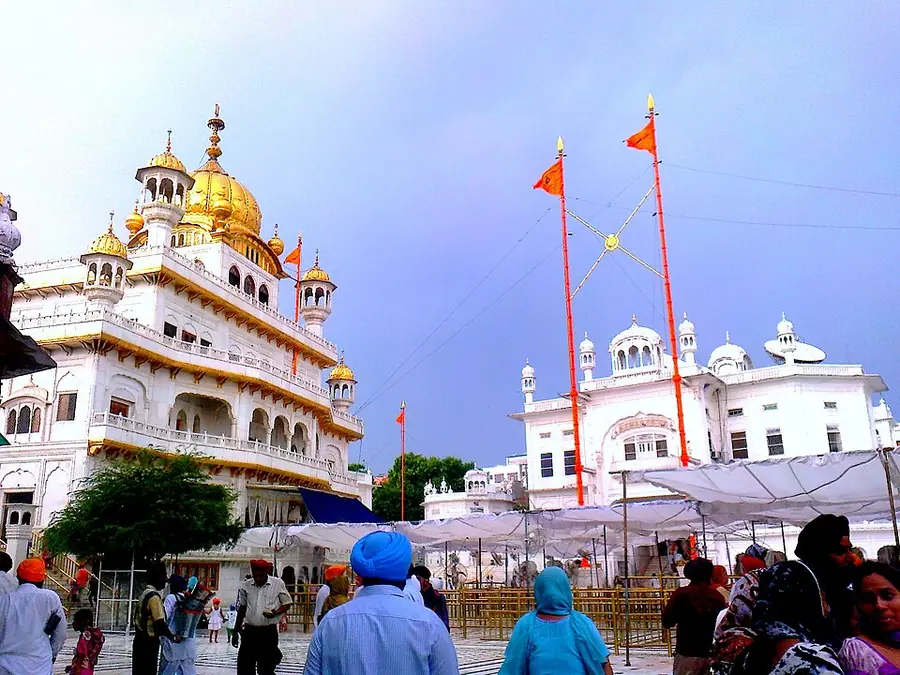
For Sikhs the building mattered. The Akāl Takht faces the Harmandir across the causeway, in the tradition Guru Hargobind began (§4); to his followers Bhiṇḍrāṅwāle spoke from the Guru Panth’s own seat, and to his critics he had made a shrine a fortress.[2][5] Political
The assault, day by day
The government decided on 2 June 1984 to send in the army. The curfew that fell across Punjab at 9 p.m. on 3 June came on the day of the annual commemoration of Guru Arjan’s martyrdom (§3), which had brought pilgrims into the complex, and many were still inside when the fighting began.[4][7] Consensus Sikh accounts record firing on the complex from 1 June; the White Paper describes army action from 5 June.[8][4] Contested
Troops under Major-General K. S. Brar entered the precincts on the night of 5–6 June and met heavy fire from fortified positions. By the White Paper’s account a tank was brought in during the early hours of 6 June to engage the positions in the Akāl Takht; India Today reported that tanks’ main guns were used on the building that evening. The Akāl Takht was cleared on 6 June except its ground floor and basement, where resistance ended in the night of 6–7 June. The bodies of Bhiṇḍrāṅwāle and of Amrik Singh, of the All India Sikh Students Federation, were found on the ground floor; Shabeg Singh also died. Searches went on for several days.[4][7][5] Consensus on the outline; Contested on the details.
The Harmandir Sāhib was hit by gunfire but stood. The Akāl Takht’s façade and upper floors were wrecked.[7][2] Consensus
The Sikh Reference Library
The library in the complex held printed books, manuscripts of the scripture and hukamnāmās, letters of the Gurus. The two accounts of its burning cannot both be right:
- The government’s. The White Paper says a fire broke out during the fighting of 5–6 June, while “terrorists” fired from machine-gun positions in the building, and that “by the time the terrorist positions could be overcome, the library had been gutted”.[4]
- The keeper’s. Devinder Singh Duggal, the library’s in-charge, has said it was intact when he last saw it on 6 June, after the army had control of the complex, and burned by the time he returned on 14 June.[9][8]
Contested What became of the contents is argued as well. The SGPC and a retired CBI inspector have said that manuscripts and books were carried away after the operation; the Defence Minister wrote to the SGPC in 2000 that the army had handed items to the CBI, and a later Defence Minister, A. K. Antony, told the Rajya Sabha in 2009 that items had been handed to an SGPC representative, which the SGPC denied.[10][11] Contested; Political No complete list of what was lost, or taken, has been published. Majority
How many died: every figure, and who gives it
- The White Paper, July 1984. For the Golden Temple complex, to 30 June: 493 civilians or “terrorists” killed and 86 injured; 83 soldiers killed (4 officers, 4 junior commissioned officers, 75 other ranks) and 249 injured. For the whole operation in Punjab, including some forty other gurdwaras: 554 “civilians/terrorists” and 92 soldiers killed.[4]
- India Today, end of June 1984. More than 750 inquest reports on dead “extremists” prepared by 9 June; close to 1,000 a safe assumption; army sources putting their own dead at perhaps 200 or more.[7]
- Sikh organisations and later writers. Figures in the thousands, counting the pilgrims trapped in the complex.[12][3]
Contested The official table puts civilians and those it calls terrorists in one category, so it cannot say how many of the dead were pilgrims. No independent inquiry was held, and no figure has been settled. Majority
After the assault
- Woodrose. Army operations across the Punjab countryside followed, in which large numbers of young Sikh men were detained; the numbers were not published.[1][3] Majority
- Mutinies. At the Sikh Regimental Centre at Ramgarh about 1,400 recruits revolted and killed their commandant; by Apurba Kundu’s count over 2,600 mutineers were captured in all, and 55 killed.[7][13] Majority; the figures differ by source.
- Returned honours. Khushwant Singh returned his Padma Bhushan and Bhagat Pūraṇ Singh his Padma Shrī; Amarinder Singh, then a Congress member of parliament, resigned from the party and the Lok Sabha. For many Sikhs with no sympathy for Bhiṇḍrāṅwāle, the assault on the central shrine was the breaking point.[12][1][2] Majority
- 31 October 1984. Indira Gandhi was shot by two of her Sikh bodyguards, and the killing of Sikhs in Delhi and other cities followed (What happened in 1984 in Delhi?).[14] Consensus
The Akāl Takht, built twice
In the summer of 1984 the government had the Akāl Takht repaired through a kār sevā led by Bābā Santā Singh of the Buḍḍhā Dal, with government contractors; he was later excommunicated for it. A Sarbat Khālsā in January 1986 ordered the building pulled down and rebuilt by the Panth, and the work went on, with interruptions, until October 1999.[15] Majority on the dates. The Akāl Takht that stands today is the Panth’s rebuilding, not the government’s. Majority
In memory the assault joined the two great massacres of the eighteenth century: it was seen, as Darshan Singh Tatla puts it, as a third ghallūghārā (§6).[16] Majority Bhiṇḍrāṅwāle is remembered by many as a shahīd, a martyr, and by others as the cause of the catastrophe.[2][5] Political The name is argued over too: writers at the Sikh Research Institute set the government’s “Operation Bluestar” against Ghallūghārā, which Harinder Singh calls “the Sikh term for a large-scale massacre, carnage, or genocide” (2017), and which Santbir Singh argues covers both those who fought and the pilgrims killed beside them (2024).[17][18] Political
Was it necessary?
The government held that the fortification of the complex left no alternative. Critics, Sikh and not, argued that a siege or a police action would have spared the shrine and the pilgrims, and that the timing on Guru Arjan’s anniversary multiplied the dead.[4][5][12] Contested; Political This page reports both positions and does not decide between them.
Common misconceptions
- “The Golden Temple was destroyed.” The Harmandir Sāhib was hit by gunfire but stood; it was the Akāl Takht that was wrecked. Consensus
- “The death toll is known.” The official figure does not separate pilgrims from fighters, and the higher figures are estimates or partial counts. Majority
- “It was over in a night.” The curfew began on 3 June, the main fighting ran from the night of 5–6 June to the night of 6–7 June, searches lasted days more, and the army’s operations in the countryside went on after that. Consensus
- “The Akāl Takht today is the one the army repaired.” That building was pulled down on the Panth’s orders; the present one was rebuilt by kār sevā between 1986 and 1999. Majority
What the evidence cannot settle
The outline of the operation is agreed, from the government’s own White Paper to the accounts of its critics. How many died, how the library burned, and what was taken from it are open because the only official account was written by one party and no independent inquiry followed. Whether the assault was necessary, and how Bhiṇḍrāṅwāle should be remembered, are judgements the evidence leaves to its readers. Majority
References
- ^ a b c d e f Jugdep S. Chima The Sikh Separatist Insurgency in India: Political Leadership and Ethnonationalist Movements. Sage, 2010. The politics of Punjab from the 1970s to the end of the insurgency, year by year.
- ^ a b c d e f g Cynthia Keppley Mahmood Fighting for Faith and Nation: Dialogues with Sikh Militants. University of Pennsylvania Press, 1996. Ethnography built on interviews with militants; martyrdom and the memory of 1984.
- ^ a b c d Joyce Pettigrew The Sikhs of the Punjab: Unheard Voices of State and Guerrilla Violence. Zed Books, 1995. Anthropologist's account of the insurgency from the villages; police violence and the militants.
- ^ a b c d e f g h White Paper on the Punjab Agitation — Government of India, New Delhi, 10 July 1984. 1984 CE. English. The government's account of the agitation and of Operation Blue Star. Annexure XI: in the Golden Temple complex 493 civilians/terrorists and 83 soldiers killed; in all, 554 and 92 killed and 4,712 apprehended, up to 30 June 1984. Para. 23 on the burning of the library. Annexure III (pp. 69–83) prints the version of the Anandpur Sāhib Resolution authenticated by Longowāl in November 1982. read the text
- ^ a b c d e f Mark Tully and Satish Jacob Amritsar: Mrs Gandhi's Last Battle. Jonathan Cape, 1985. The BBC correspondents' narrative from the Nirankārī clash to Blue Star; argues that Congress leaders encouraged Bhiṇḍrāṅwāle.
- ^ Santbir Singh "Why Was Bhindranwale There?". Sikh Research Institute (sikhri.org), 4 June 2024, 2024. open library A Panthic defence of Bhiṇḍrāṅwāle's presence in the complex: the morcha tradition since 1920, his move to the Akāl Takht in December 1983, and eighteenth-century precedents for armed defence of the complex.
- ^ a b c d e Shekhar Gupta in Amritsar with bureau reports Crackdown in Punjab (cover story). India Today, 30 June 1984, 1984. open library Contemporary report on the assault, the dead (over 750 inquest reports by 9 June) and the Sikh soldiers' mutinies.
- ^ a b V. M. Tarkunde, Amiya Rao, Aurobindo Ghose et al. Oppression in Punjab: Report to the Nation. Citizens for Democracy, 1985. open library Civil liberties report on police abuses before and after Blue Star, with Sikh eyewitness accounts of the assault and the library.
- ^ Jaskaran Kaur Twenty Years of Impunity: The November 1984 Pogroms of Sikhs in India. Ensaaf (2nd edn, October 2006; 1st edn June 2004), 2006. Human rights report on November 1984 and the inquiries; the counts outside Delhi (Kanpur, Bokaro); Devinder Singh Duggal on the Sikh Reference Library.
- ^ Varinder Walia No Sikh reference books with us: Antony. The Tribune (Chandigarh), 22 May 2009, 2009. open access A. K. Antony's Rajya Sabha reply on the Sikh Reference Library, the SGPC's denial, and retired CBI inspector Ranjit Singh Nanda's account of material removed after the operation.
- ^ George Fernandes, letter to the SGPC, 23 May 2000 — Letter of the Defence Minister to the Shiromaṇī Gurdwārā Prabandhak Committee, as reported in the Indian Express, 25 May 2000, 'George Fernandes admits Army removed items from Golden Temple during Operation Bluestar'. 2000 CE. English. The Defence Minister acknowledges that the army removed items from the Golden Temple complex during Operation Blue Star and handed them to the CBI. about
- ^ a b c Khushwant Singh A History of the Sikhs, Volume 2: 1839–2004. Oxford University Press, 2004. Second edition; the 1980s by a participant who returned his Padma Bhushan after Blue Star.
- ^ Apurba Kundu The Indian Armed Forces' Sikh and Non-Sikh Officers' Opinions of Operation Blue Star. Pacific Affairs 67 (1), 1994. Includes the mutinies of Sikh soldiers in June 1984: over 2,600 captured, 55 killed.
- ^ Varinder Walia Roofs of Akal Takht leaking: Question mark on kar seva as gold turns black. The Tribune (Chandigarh), 29 July 2001, 2001. open access The government kar seva of Bābā Santā Singh (1984), the Panth's demolition and rebuilding (1986–1999).
- ^ Darshan Singh Tatla The Sikh Diaspora: The Search for Statehood. UCL Press, 1999. Migration from the 1860s, the first gurdwaras abroad, Ghadar.
- ^ Harinder Singh "June 1984 Ghallughara: Lies, List, Light". Sikh Research Institute (sikhri.org), 16 June 2017, 2017. open library Sets "Operation Bluestar" against the Sikh term Ghallūghārā and disputes the White Paper's account and figures.
- ^ Santbir Singh "No More Blue Stars: Reclaiming the Narrative of 1984". Sikh Research Institute (sikhri.org), 26 March 2024, 2024. open library Traces Sikh usage from "riots" to "pogrom", "genocide" and "Battle of Amritsar", and argues for Ghallūghārā as the one term covering both combatants and non-combatants of June 1984.