For fifty years in the first half of the nineteenth century the Punjab was ruled from Lahore by a Sikh dynasty. Its founder, Ranjit Singh (1780–1839), took the city in 1799, was proclaimed Maharaja in 1801, and built from the quarrelling Sikh confederacies of the eighteenth century (§6) a kingdom that ran from the Sutlej to the Khyber Pass. Ten years after his death it was a British province.[1][2] Consensus
Sikhs remember the kingdom as the Khālsā rāj, the rule of the Khālsā that the eighteenth-century codes had promised (§5), and many still date the community’s golden age to it. Historians have found two things that complicate the memory. The first is that it was a Punjabi state as much as a Sikh one: most of its subjects were Muslims and Hindus, and so were many of its ministers. The second is that the religious life of its Sikhs looks, in the evidence, less sharply bounded than the reformers who came after it (§8) would have liked. That is the argument of this chapter: the kingdom gave the Sikhs a gilded temple and a memory of sovereignty, and was governed, worshipped in and lost by a society whose religious lines had not yet been drawn hard.[1][3][4] Majority; Contested on the second half.
Timeline
| Date | Event | Confidence |
|---|---|---|
| 1780 | Ranjit Singh born at Gujrāṅwālā, son of Mahāṅ Singh, chief of the Sukerchakia misl[5] | Majority (the date) |
| 7 July 1799 | He takes Lahore from the Bhaṅgī chiefs[5][1] | Consensus |
| 12 April 1801 | Proclaimed Maharaja at Lahore at Vaisākhī[5] | Majority (the day) |
| 1802 | Takes Amritsar and its fort; Akālī Phūlā Singh joins his service[5][1] | Consensus |
| 1805 | The last Sarbat Khālsā of the period, at the Akāl Takht[5] | Majority |
| 25 April 1809 | Treaty of Amritsar with the East India Company: the Sutlej as the line[6] | Consensus |
| 1813 | The Koh-i-Nūr diamond taken from the Afghan exile Shāh Shujāʿ[7] | Consensus |
| 1818, 1819 | Multān and Kashmir conquered[1][5] | Consensus |
| 1822 | Jean-François Allard and Jean-Baptiste Ventura enter his service[8] | Consensus |
| 1823 | Battle of Nowshera; Akālī Phūlā Singh killed[5] | Consensus |
| 1830–31 | Sammat 1887: the date of the inscription recording the Maharaja’s service at the Harmandir, as Sikh accounts report it; no published reading of the inscription is cited here | Majority |
| 1834 | Peshawar brought under direct rule[5][1] | Consensus |
| December 1838 | Lord Auckland and Emily Eden at Amritsar and Lahore[9] | Consensus |
| 27 June 1839 | Ranjit Singh dies at Lahore; four queens and seven slave women die on his pyre[10] | Consensus (Honigberger’s count) |
| 1839–1843 | Kharak Singh, Nau Nihāl Singh and Sher Singh die in turn; Duleep Singh, aged five, proclaimed[1][4] | Consensus |
| 1845–1846 | First Anglo-Sikh war; Treaty of Lahore, 9 March 1846[1][2] | Consensus |
| 1848–1849 | Second Anglo-Sikh war; annexation, 29 March 1849[11][1] | Consensus |
| 1853, 1886 | Duleep Singh baptised a Christian; re-initiated as a Sikh at Aden[5] | Consensus |
From misl chief to Maharaja
Lahore, 1799
By the 1790s the Sikh misls (§6) held most of the Punjab between the Sutlej and the Jhelum, but no single chief held all of it, and the Afghan king Shāh Zamān, Ahmad Shāh Abdālī’s grandson, still claimed it and marched in more than once. Ranjit Singh inherited the Sukerchakia lands around Gujrāṅwālā as a boy, when his father died, and his first alliances came through marriage: his mother-in-law, Sadā Kaur, the widowed head of the Kanhaiyā misl, backed him with her troops.[5][1] Consensus On 7 July 1799 he took Lahore from the three Bhaṅgī chiefs who shared it. Consensus Lahore had been the seat of Mughal and Afghan governors, and holding it made him the heir of their claims.[1][2] Majority
A king without a crown
At Vaisākhī, 12 April 1801, he was proclaimed Maharaja of the Punjab; by the Sikh account Sāhib Singh Bedī, a descendant of Guru Nānak, marked his forehead. He is said to have refused a crown and a throne, and to have preferred to be addressed as Singh Sāhib.[5][2] Majority on the details, which come from later and partisan accounts. The government did not bear his name. It was the Sarkār-i Khālsā (or Sarkār Khālsājī), “the government of the Khālsā”, and his court the Darbār.[5][1] Consensus
Amritsar, and the end of the Sarbat Khālsā
In 1802 he took Amritsar, the Sikhs’ holy city and the chief market of the Punjab, from the families who divided it, with the fort of Gobindgaṛh.[5][1] Consensus Over the next twenty years he swallowed the other misls one by one, his in-laws and allies among them, and turned their chiefs into his officers and pensioners.[1] Consensus
One institution did not survive the change. In the eighteenth century the Sikh chiefs had met at the Akāl Takht as the Sarbat Khālsā and resolved on common action by gurmatā, “the Guru’s counsel” (§6). A kingdom had no need of it. The Encyclopaedia of Sikhism records the last such assembly of the period in 1805.[5][12] Majority The authority that the Khālsā had exercised collectively passed to a monarch who ruled in its name. Majority
The Sutlej line: the Treaty of Amritsar, 1809
The East India Company had reached Delhi in 1803. In 1808, alarmed by Napoleon and by the thought of a French march on India through Persia and Afghanistan, it sent a young officer, Charles Metcalfe, to Ranjit Singh. The Maharaja wanted recognition of his claim to the Sikh states south of the Sutlej, in the Mālvā, and crossed the river with his army while Metcalfe followed him; the Company answered by taking the cis-Sutlej chiefs under its protection and posting troops at Ludhiana.[5][1] Consensus
The treaty signed at Amritsar on 25 April 1809 split the difference. The British would “have no concern” with his territories north of the Sutlej; he would keep the lands he already held south of it but station no more troops there than local duties required, and leave the chiefs around them alone.[6] Consensus The Sikhs of the Mālvā, Paṭiālā, Nābhā and Jīnd among them, stayed outside his kingdom, and the Sutlej became a frontier for forty years.[1] Consensus Shut out of the south-east, he turned north and west. Majority
The same year a party of Akālīs attacked Metcalfe’s Muslim escort in Amritsar; the incident is remembered as one of several in which the Akālīs acted on their own account (below).[5] Majority
Conquest: Multān, Kashmir, Peshawar
The kingdom’s great conquests came after the treaty. Multān, the old Afghan-held city of the south-west, fell in 1818 after several campaigns; Kashmir was taken from its Afghan governor in 1819; and the Derajāt and the districts beyond the Indus followed in the 1820s and 1830s.[1][5] Consensus Peshawar, at the foot of the Khyber, was first made tributary and then, in 1834, brought under direct rule; Hari Singh Nalvā, the general most associated with the frontier, was killed defending the fort at Jamrūd against the Afghans in 1837.[2][1] Consensus By his death Ranjit Singh ruled the four provinces (sūbās) of Lahore, Multān, Kashmir and Peshawar.[5] Consensus
The Koh-i-Nūr
In 1813 the deposed Afghan king Shāh Shujāʿ, a refugee at Lahore, gave up the Koh-i-Nūr, the great diamond that Nādir Shāh had carried off from Delhi in 1739 and that had passed to the Afghan kings. How freely he gave it is disputed; William Dalrymple and Anita Anand describe a long pressure on the exiled king and his household before the stone was surrendered.[7] Consensus on the transfer; Contested on the terms. Ranjit Singh wore it on his arm on state occasions.[5][7] Consensus It reappears at the end of this chapter.
The Sarkār-i Khālsā: whose state?
Coins in the Gurus’ names
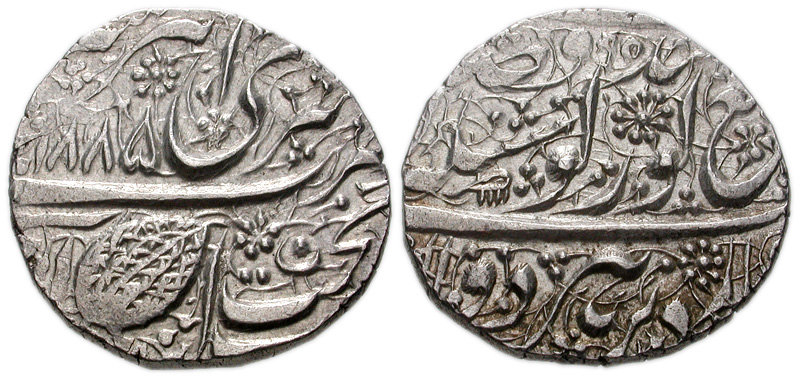
Ranjit Singh’s coins, the Nānakshāhī rupees, carried no portrait and no royal name. From 1801 they were struck at Lahore, and later at Amritsar, Multān, Kashmir and Peshawar, with the Persian couplet that the Sikh chiefs had used on their coins since 1765 and Banda Singh on his seal before that (§6): abundance, the sword and victory, obtained from Nānak by Guru Gobind Singh.[13][5] Consensus on the coins’ legend; Majority on the wording of Banda’s seal, which is known from Irvine’s reading (§6). By a custom the Encyclopaedia of Sikhism reports, coins from a new mint were first offered at the Akāl Takht. Coins of these years with a peacock-tail mark, popularly called Morāṅshāhī, are said to have been struck in honour of Morāṅ, a Muslim dancer whom he married; by the same tradition they were refused there.[5] Majority that this is the tradition; the episode is not documented in detail.
A court of three faiths
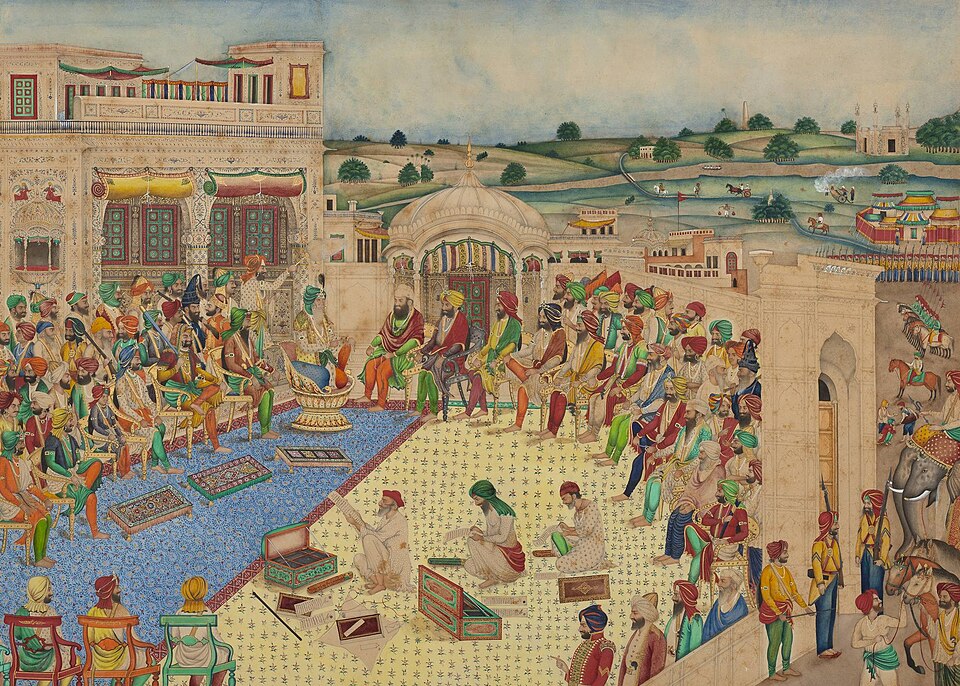
The men who ran the state were of every community. The Fakīr brothers of Lahore, Muslims of a Sufi family, served for decades: ʿAzīz al-Dīn as the Maharaja’s adviser on foreign affairs and his envoy to the British, Nūr al-Dīn and Imām al-Dīn in the household and the forts. The Dogrās of Jammu, Hindu Rajputs, rose through the bodyguard: Dhiān Singh became chief minister, his brother Gulāb Singh the lord of Jammu, and Dhiān’s son Hīrā Singh the Maharaja’s favourite. Brahmins and Khatrīs commanded armies and kept the treasury: Dīwān Mohkam Chand, Misr Dīwān Chand, the Misr family of the treasury, Dīwān Dīnā Nāth. Sikh sardārs held commands and great estates.[5][1][4] Consensus His wives included Hindus and Muslims who kept their own religion.[5] Majority
The army and the Europeans
The army was the state’s largest expense and its pride. From 1822 Ranjit Singh hired officers who had served Napoleon: Jean-François Allard to train cavalry and Jean-Baptiste Ventura infantry, then Claude-Auguste Court, who trained the artillery, and the Neapolitan Paolo Avitabile, who governed Wazīrābād and then Peshawar. Their corps, the Fauj-i Khās (“special force”), was the model for a regular army of infantry battalions and artillery on European lines, beside the older irregular cavalry of the sardārs; the artillery had earlier been organised under a Muslim, Ghaus Khān (d. 1814).[8][5] Consensus The Europeans’ contracts, the Encyclopaedia records, bound them not to shave their beards, smoke or eat beef, and to marry and settle in the Punjab.[5] Majority By the 1840s the regular army, mostly Sikh Jaṭs, had become the most coherent body in the kingdom.[1][14] Majority
Punjabi or Sikh?
How to describe such a state is argued. Older Sikh writing, and the Encyclopaedia of Sikhism, call it a state “in which all people, Muslims, Hindus and Sikhs, would enjoy equal rights and opportunities”.[5] Many historians describe it as a Punjabi or regional state, one of the successor states of the Mughal empire, which used Sikh symbols to legitimise a dynasty.[1][2] Priya Atwal’s study of the royal family shows a court building a monarchy from Sikh, Mughal and European models at once, in which the Khālsā’s name gave the throne legitimacy and the women of the household held real power.[4] Majority that the state was religiously mixed; Contested; Political on what to call it.
How the Golden Temple got its gold
The Harmandir Sāhib (the Golden Temple) at Amritsar was first built under Guru Arjan, in the 1580s and 1590s (§3). It was blown up by Ahmad Shāh Abdālī in 1762 and rebuilt by the misl chiefs from 1764 (§6).[5] Consensus The gold came later.
Ranjit Singh took over the management of the shrines when he took Amritsar, appointing his own managers, and paid for the work that gave the temple its present look. The lower storey was faced with white marble inlaid with flowers and animals; the upper storeys and domes were covered with copper plates overlaid with gold leaf; the doors were sheathed in gilded copper. The building, in the Encyclopaedia of Sikhism’s words, “assumed its present appearance” in his reign.[5] Consensus
The dates are less exact than the result. The gilding came under Ranjit Singh in the early nineteenth century; popular accounts put the first gilt plate in 1803. An inscription in Gurmukhi on the entrance credits the Guru’s grace for the Maharaja’s service and is dated Sammat 1887 (1830–31 CE), as Sikh accounts report it; no published reading of the inscription is cited here. Majority In December 1838 Emily Eden, the sister of the Governor-General, was taken round by the Maharaja and described a temple “covered completely with gold” down to eight feet from the ground (Primary sources, 3).[9] Consensus The English name Golden Temple comes from this gilding. Sikhs call the building the Harmandir or the Darbār Sāhib. Consensus
Patronage beyond the Sikhs
The Maharaja’s gifts did not stop at the Harmandir. He endowed Sikh shrines across the Punjab, and the Encyclopaedia of Sikhism records grants to dharamshālās, schools and mosques, and money for the repair of Muslim places of worship.[5] Majority His last days show the breadth of his piety. Emily Eden, writing from Simla on 1 July 1839, passed on the British despatch: that on his deathbed he had his jewels and horses sent to shrines “with directions that the Brahmins should pray for him”, and ordered the Koh-i-Nūr sent to the temple of Jagannāth at Purī, until his sardārs talked him out of it.[15] Majority that this was reported at the time; the despatch is second-hand. At his cremation, the physician Martin Honigberger saw Brahmins reciting from the Sanskrit books, Sikh priests from the Granth and Muslims crying “Ya Allah!” together (Primary sources, 4).[10] Consensus on the account.
The Akālīs and the Akāl Takht
Not every armed Sikh was the Maharaja’s. The Akālīs, or Nihaṅgs, were bands of Khālsā warriors in blue, devoted to the Akāl Takht at Amritsar, who claimed descent from the eighteenth-century fighting bands and answered to their own leaders.[5][3] Majority The most famous, Akālī Phūlā Singh (1761–1823), took charge of the shrines at Amritsar in the early 1800s and is remembered as the custodian of the Akāl Takht. Ranjit Singh took his band into service as an irregular corps, gave it barracks at Amritsar, and used it as shock troops: at Kasūr in 1807, at Multān in 1818 and in Kashmir in 1819. Phūlā Singh was killed leading a charge at Nowshera, against the Afghans, in 1823.[5][2] Consensus
Sikh tradition remembers that Phūlā Singh, as custodian of the Akāl Takht, once summoned the Maharaja for a breach of the Sikh code, usually said to be his marriage to Morāṅ, and that Ranjit Singh came and accepted the penalty, by some tellings a public flogging, commuted to a fine.[5] Majority that this is the tradition; the details are told in later sources, and the story’s point, that the Takht stood above the throne, is the one that mattered to the reformers who retold it. Contested on the details.
Sanātan Sikhism? Oberoi and his critics
The thesis
What did it mean to be a Sikh in Ranjit Singh’s Punjab? In The Construction of Religious Boundaries (1994), Harjot Oberoi argued that it could mean many things. Alongside the Khālsā Sikhs, who kept their hair and took the initiation of the sword, there were Sahajdhārī Sikhs who did not; Udāsī and Nirmalā ascetics who kept many shrines (§6); and a great many Sikhs who also venerated the Muslim saint Sakhī Sarvar, the goddess, village spirits and the miracle-working holy men of the countryside, and who used Brahmins at births, marriages and deaths. Oberoi called this plural, loosely bounded religious culture the “Sanātan” Sikh tradition, and argued that a single, exclusive Sikh identity, with a hard line against Hindu practice, was the work of the Tat Khālsā reformers of the Singh Sabhā after 1873 (§8).[3] Contested; Political
The evidence of the court fits parts of this picture. A Sikh king’s funeral was conducted by Brahmins and Sikh granthīs together, and four of his wives died as satīs on his pyre, a rite the Gurus had rejected (§3).[10][16] Consensus on the events. The book also drew a campaign against its author’s chair at the University of British Columbia, which §0 describes.
The replies
The replies came from two directions. Sikh scholars in India and North America answered in a volume of critiques, Invasion of Religious Boundaries (1995), which argued that Oberoi had mistaken folk practice and the lapses of some Sikhs for the norms of the tradition, and that the Gurus’ own teaching drew the boundary from the start.[17] Majority on what the critics argued. The historian J. S. Grewal answered on the evidence: read as a whole, the eighteenth- and early-nineteenth-century Sikh literature and chronicles, Ratan Singh Bhaṅgū’s history (usually dated 1841) among them, show the Khālsā Singhs as by far the most important Sikh identity; Oberoi’s “Sanātan” picture rested chiefly on Udāsī and Nirmalā texts and a selective reading of a few nineteenth-century authors. What was new in the Singh Sabhā, Grewal concluded, was “rational argument for a distinctive Sikh identity with its political implications, and not Sikh identity itself”, as Indu Banga summarises him.[18][19][20] Majority on Grewal’s argument. He had made the case also in Contesting Interpretations of the Sikh Tradition (1998).[21]
Where it stands
Most historians now accept two things at once. A self-conscious Khālsā, with its code, its initiation and its history, existed in the eighteenth century and ruled in the nineteenth; and many people counted as Sikhs, at court and in the villages, shared shrines, rites and holy men with their Hindu and Muslim neighbours, as W. H. McLeod’s Who Is a Sikh? had argued in 1989.[22][12][21] Majority What is argued is the weighting: whether the plural practice was the mainstream and the Khālsā a strand within it (Oberoi), or the Khālsā the norm and the plural practice a drift from it (Grewal and the Sikh critics). Arvind-pal Singh Mandair has argued that both sides use categories, “religion” and “boundary”, that themselves came with colonial rule.[23] Contested; Political
The death of Ranjit Singh, 1839
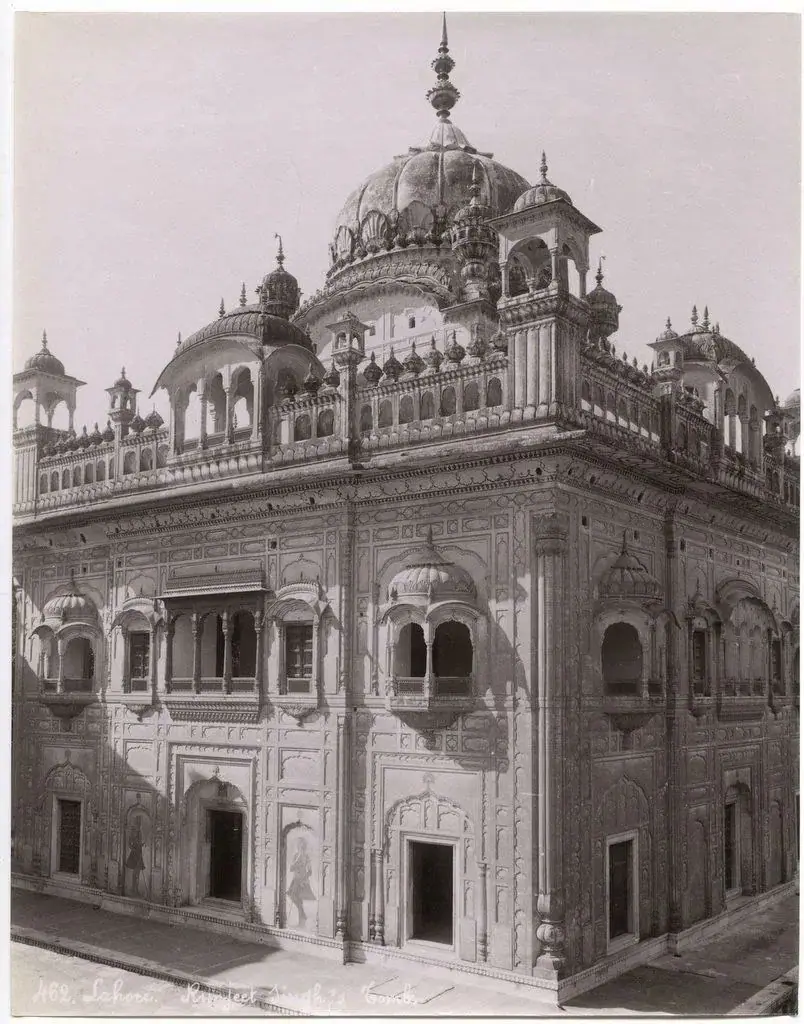
After years of failing health Ranjit Singh lost his speech, and died at Lahore, of paralysis, on 27 June 1839.[5][15] Consensus He was cremated the next morning beside the Lahore fort, where his samādhī now stands.
Four of his wives and seven slave women died on his pyre. The number is given by Honigberger, who watched the procession and the burning, and it is the usual one.[10][4] Consensus on the event and on Honigberger’s count. The chief minister, Dhiān Singh, by Honigberger’s account, offered to burn with them and was prevented.[10] Majority The rite was Rajput and Hindu, practised among the hill royalty from whom at least one of the queens came (Honigberger names her a daughter of Saṃsār Chand of Kāṅgṛā); it ran against the third Guru’s teaching that the true satī is the woman who dies of the pain of separation, not the one who burns on the pyre (§3).[16][4] Consensus on the hymn. That it happened at the funeral of the Khālsā’s king is one of the strongest single pieces of evidence for the mixed religious culture of the court. Majority
The succession wars, 1839–1845
Ranjit Singh left one legitimate heir and several sons whose legitimacy was questioned, and a court divided between the Dogrā brothers and the Sikh sardārs, among them the Sandhāṅvālīā family, his own kin.[4][1] Consensus What followed was six years of killing.
- Kharak Singh (r. 1839–1840), his eldest son, was set aside by his own son and the Dogrās within months, and died in November 1840, by rumour of poison.[1][4] Consensus on the death; Contested on the poison.
- Nau Nihāl Singh, Kharak Singh’s son, was struck by a falling gateway as he returned from his father’s cremation the same day, and died of his wounds.[1][2] Consensus on the death; Contested on whether it was an accident.
- Chand Kaur, Kharak Singh’s widow, claimed the regency for an unborn heir, until Sher Singh, a son of Ranjit Singh, took Lahore with the army’s help in January 1841.[4] Consensus
- Sher Singh (r. 1841–1843) was shot by the Sandhāṅvālīā sardārs in September 1843; Dhiān Singh was killed the same day.[1][5] Consensus
- Duleep Singh, the youngest son, was proclaimed Maharaja in September 1843, aged five, with his mother, Rānī Jind Kaur, as regent. The wazīrs, first Hīrā Singh Dogrā, Dhiān Singh’s son, and then her brother Jawāhar Singh, were both killed, the second by the army itself in 1845.[5][4] Consensus
The army’s panchayats
From 1841 the regiments of the regular army elected committees, pañchāyats, of their own men, which negotiated pay, chose sides in the succession and in practice became the power in Lahore. They spoke of themselves as the Khālsā, and their resolutions were taken in the name of the Panth.[14][1] Consensus on the panchayats. Joseph Davey Cunningham, a British officer who knew the Punjab, saw in them a revival of the Khālsā’s old assemblies; historians since have also seen a mutinous army of unpaid soldiers.[14][1] Contested
The Anglo-Sikh wars and annexation
The first war, 1845–1846
In December 1845 the Sikh army crossed the Sutlej into British territory. Who provoked the war is disputed: the British had been massing troops on the frontier, and many in Lahore believed that the regent and the ministers sent the army across to have it destroyed.[1][14] Consensus that both claims were made; Contested; Political on where the blame lies. The British won four hard battles, at Mudkī and Ferozeshah in December, at Aliwāl in January, and at Sobrāon on 10 February 1846. The Sikh commanders, Lāl Singh and Tej Singh, were accused then and since of betraying their own army; Cunningham said so in 1849, and lost his post for it (§0).[14][2] Contested; Political
The Treaty of Lahore, of 9 March 1846, left Duleep Singh on the throne but took the Jalandhar Doāb between the Beas and the Sutlej, demanded an indemnity, limited the army, and, by supplementary articles two days later, left a British force at Lahore until the end of the year; the hill country, Kashmir with it, was transferred within days to Gulāb Singh, the Dogrā, as his own state. In December 1846 a second treaty, at Bhairovāl, put the kingdom under a regency council controlled by a British Resident until the Maharaja came of age, and pensioned off the Rānī.[1][5] Consensus
The second war and the end, 1848–1849
In April 1848 two British officers were killed at Multān, where the governor, Dīwān Mūlrāj, had resigned under new demands from the Darbār; the local revolt became a general rising of the disbanded and remaining Sikh soldiery. After a costly drawn battle at Chilliānwālā (13 January 1849) and a decisive defeat at Gujrāt (21 February), the Sikh army surrendered.[1][2] Consensus
On 29 March 1849 the Governor-General, Lord Dalhousie, annexed the Punjab. In the Lahore fort the ten-year-old Duleep Singh signed the terms: he resigned all claim to sovereignty, the state’s property was confiscated to the East India Company, and he was to surrender the Koh-i-Nūr “to the Queen of England” (Primary sources, 5).[11][5] Consensus Whether the annexation was justified, given that the British were the boy’s guardians under the treaty of 1846, was argued in Britain at the time and is argued still.[5][1] Contested; Political
Duleep Singh
Duleep Singh was sent to Fatehgarh, in the North-Western Provinces, in the care of a Scottish surgeon, John Login. On 8 March 1853, aged fourteen, he was baptised a Christian there, and in 1854 he went to England, where he lived as a landed gentleman at Elveden in Suffolk and was a favourite of Queen Victoria.[5][4] Consensus His mother, who had escaped from British custody to Nepal, rejoined him in 1861 and died in England in 1863.[4] Consensus
In the 1880s, in debt and in dispute with the India Office over his estates, he turned back to the religion of his father, in touch with a Sikh cousin, Ṭhākur Singh Sandhāṅvālīā. In 1886 he set out for India, was stopped by the British at Aden, and there, on 25 May 1886, received the Khālsā initiation.[5] Consensus on the event. He died in Paris in 1893. His story, the last Maharaja who lost his kingdom as a child and found his faith again, became part of Sikh memory in the twentieth century. Majority
The evidence ledger
| Date | Evidence | Confidence |
|---|---|---|
| 1801 onward | Nānakshāhī rupees in the Gurus’ names[13] | Consensus |
| 1809 | The Treaty of Amritsar, in English and Persian[6] | Consensus |
| 1830–31 | The Gurmukhi inscription on the Harmandir, dated Sammat 1887, recording the Maharaja’s service, as Sikh accounts report it; no published reading of the inscription is cited here | Majority |
| 1838 | Emily Eden at the Harmandir: a temple covered with gold[9] | Consensus |
| 1839 | Eden on the deathbed gifts, from the British despatch[15] | Majority (second-hand) |
| 1839 | Honigberger on the cremation and the eleven satīs[10] | Consensus (Honigberger’s count) |
| usually dated 1841 | Ratan Singh Bhaṅgū’s history of the Khālsā (G. S. Mann argues for c. 1810–1813)[20][24] | Majority (date) |
| 1849 | Cunningham’s History of the Sikhs, by an officer on the frontier[14] | Consensus |
| 29 March 1849 | The terms of annexation, signed by Duleep Singh[11] | Consensus |
The court’s own Persian chronicle, Sohan Lāl Sūrī’s ʿUmdat al-Tawārīkh, a day-by-day record of the Darbār, underlies most modern narratives of the reign.[1][5] Consensus
Primary sources
Show the 5 primary sources
1. The Sutlej line: the Treaty of Amritsar, 1809, Article 1
“Perpetual friendship shall subsist between the British Government and the State of Lahore. The latter shall be considered, with respect to the former, to be on the footing of the most favoured powers; and the British Government will have no concern with the territories and subjects of the Rajah to the northward of the Sutlej.”[6]
(English text, as signed at Amritsar on 25 April 1809 by “Rajah Runjeet Sing” and Charles Theophilus Metcalfe; a Persian copy was exchanged with it.)
What it proves. That the British recognised Ranjit Singh as a sovereign, the “Rajah of Lahore”, and in the same sentence drew the line he could not cross. Article 2 bound him to keep no more troops south of the river than local duties required. The kingdom’s shape, a power that expanded north and west and never east, was set here. Consensus
2. The coin: the Nānakshāhī rupee
deg tegh fatah-o-nusrat bedraṅg, yāft az nānak gurū gobind siṅgh
Abundance (the cooking-pot, deg), the sword (tegh), victory and unfailing help: Guru Gobind Singh obtained them from Nānak. (A paraphrase of the Persian couplet, as the Encyclopaedia of Sikhism transliterates and explains it.)[13][5]
What it proves. That the kingdom presented its sovereignty as the Gurus’, not the king’s. The couplet had been used on Sikh coins since 1765 and on Banda Singh’s seal before that (§6); Ranjit Singh kept it and put no portrait or name of his own on his coinage. The deg and tegh, the community kitchen and the sword, are the two halves of the Khālsā ideal. Consensus on the legend; readings of the Persian vary slightly between catalogues.
3. “Covered completely with gold”: Emily Eden at Amritsar, December 1838
“The temple is of pure gold, really and truly covered completely with gold, most beautifully carved, till within eight feet from the ground, and then there are panels of marble inlaid with flowers and birds—very Solomonish altogether. There are four large folding-doors of gold.”[9]
What it proves. That the gilding of the Harmandir was complete, or nearly so, by December 1838, and what it looked like: gold above, inlaid marble below, gilded doors, as today. Eden also records that the Maharaja took off his shoes and touched the dust to his forehead at the shrine, and that the Governor-General was let in with stockings drawn over his boots. Consensus
4. A king’s funeral: Martin Honigberger, Thirty-Five Years in the East (1852)
“The first sad and cruel scene that I witnessed after the death of Runjeet Sing, was the Suttee, or burning of his eleven wives, along with the body of the deceased. There were four ranees (legal wives), and seven female slaves…”
“…the Brahmins performed their prayers from the Shaster, a book written in the Indian or Sanscrit language; the Gooroos, or priests of the Sikhs, did the same, from their holy scripture called Grunthsaheb, and the Musselmen accompanied them with their ‘Ya, Allah! Ya, Allah!’”[10]
What it proves. The number of the women who died, from a European physician of the court who watched the procession and the burning on 28 June 1839; and that the funeral of the Khālsā’s king joined Brahmin and Sikh rites, with Muslim mourners, beside a Rajput satī. It is the clearest single scene behind the “Sanātan” thesis. Honigberger’s tone (“abominable and fanatic ceremony”) is his own. Consensus on the account.
5. The end: the Terms of 29 March 1849, Article III
“The gem called the Koh-i-noor, which was taken from Shah Shooja ool-Moolk by Maharajah Runjeet Singh, shall be surrendered by the Maharajah of Lahore to the Queen of England.”[11]
What it proves. That the annexation was a document signed by the Maharaja, a child of ten under British guardianship, and not only a proclamation; and that the British treated the diamond as a trophy of state, singled out from the confiscated property of Article II. Article I resigned “all right, title, and claim to the Sovereignty of the Punjaub”; Articles IV and V granted a pension, his own share of it payable so long as he remained “obedient to the British Government”. The diamond was presented to Queen Victoria in 1850. Consensus on the text.
What is absent
- A constitution or a written law of the kingdom. The state ran on the Maharaja’s orders, the Darbār’s records and the customs it inherited from the Mughals and the misls. Majority
- A census. No count of the kingdom’s population by religion survives from before annexation; the first British counts of the Punjab are from the 1850s and after. Statements that Sikhs were a small minority of its subjects are estimates. Majority
- A contemporary record of the Akāl Takht summons. The story of the Maharaja’s penance is known from Sikh tradition, not from the court chronicle or the British observers. Majority
- A single date for the gilding. The inscription dates its completion; no surviving record gives the start of the work or the quantity of gold. Majority
- The women’s voices. The queens and the slave women who died in 1839 left no words; what is known of them comes from men who watched, and of Jind Kaur largely from her enemies’ reports.[4] Majority
Debates
A Sikh kingdom or a Punjabi state?
| View | Main argument | Main proponents |
|---|---|---|
| A Sikh sovereignty | The Khālsā’s promised rule realised: the Gurus’ coinage, the gilded Harmandir, a Sikh army | Much Sikh historiography; the Encyclopaedia of Sikhism[5] |
| A Punjabi successor state | A regional monarchy after the Mughals, governed by men of every faith, using Sikh symbols to legitimise a dynasty | Grewal; Khushwant Singh in part[1][2] |
| A dynasty in the making | Kingship built from Sikh, Mughal and European models, with the royal women at its centre | Atwal[4] |
Contested; Political
Was Sikh identity fluid before the Singh Sabhā?
Oberoi argued that before the 1870s Sikh practice was plural and its boundaries loose; his critics reply that a distinct Khālsā identity was clear from the eighteenth century. Most historians now accept both the Khālsā norm and the shared practice, and argue over the weight.[3][21][17] Contested; Political
Why was the kingdom lost?
The succession killings and the British appetite for the Punjab are agreed. Whether the Sikh army was betrayed by its own commanders in 1845–46, and whether the annexation of 1849 broke the British guardianship of 1846, are argued.[14][1][2] Contested; Political
Further reading
Show further reading (7 works)
- J. S. Grewal, The Sikhs of the Punjab (Cambridge, 1990; revised 1998): the reign and its end, in two chapters.
- Khushwant Singh, A History of the Sikhs (Princeton, 1963–1966; 2nd ed. Oxford, 2004): the readable classic narrative; volume 1 ends with Ranjit Singh’s death.
- Jean-Marie Lafont, Maharaja Ranjit Singh: Lord of the Five Rivers (Oxford, 2002): the Maharaja and his European officers.
- Priya Atwal, Royals and Rebels: The Rise and Fall of the Sikh Empire (Hurst, 2020): the royal family, its women and the succession.
- William Dalrymple and Anita Anand, Koh-i-Noor: The History of the World’s Most Infamous Diamond (Bloomsbury, 2017): the stone, Lahore and the terms of 1849.
- Harjot Oberoi, The Construction of Religious Boundaries (Chicago, 1994), and J. S. Grewal, Contesting Interpretations of the Sikh Tradition (Manohar, 1998): the “Sanātan” argument, from both sides.
- Emily Eden, ‘Up the Country’ (1866): letters from the Governor-General’s camp, 1837–1840, including the meetings with Ranjit Singh.
References
- ^ a b c d e f g h i j k l m n o p q r s t u v w x y z { | } ~ J. S. Grewal The Sikhs of the Punjab. The New Cambridge History of India II.3, Cambridge University Press, 1990. The standard narrative history; revised edition 1998.
- ^ a b c d e f g h i j k l Khushwant Singh A History of the Sikhs. Princeton University Press, 2 vols. (1963–1966); 2nd ed. Oxford University Press, New Delhi, 2004, 1963. The classic narrative; vol. 1 to 1839, vol. 2 from 1839.
- ^ a b c d Harjot Oberoi The Construction of Religious Boundaries: Culture, Identity, and Diversity in the Sikh Tradition. University of Chicago Press, 1994. The "Sanātan" Sikhism of the early nineteenth century and the Singh Sabhā's sharper boundaries.
- ^ a b c d e f g h i j k l m n Priya Atwal Royals and Rebels: The Rise and Fall of the Sikh Empire. Hurst, London, 2020. The royal family, its women and the succession struggles, 1799–1849.
- ^ a b c d e f g h i j k l m n o p q r s t u v w x y z { | } ~ Harbans Singh, ed. The Encyclopaedia of Sikhism. Punjabi University, Patiala, 4 vols, 1992. open access Published 1992–1998; the standard reference, with signed entries reporting both tradition and sources.
- ^ a b c d Treaty of Amritsar (1809), Article 1 — Treaty with the Rajah of Lahore, 25 April 1809. 25 April 1809 CE. English and Persian. "Perpetual friendship" between the British and the State of Lahore; the British "will have no concern" with the Rajah's territories north of the Sutlej. Article 2 limits his troops south of the river. about
- ^ a b c William Dalrymple and Anita Anand Koh-i-Noor: The History of the World's Most Infamous Diamond. Bloomsbury, London, 2017. The diamond from Nādir Shāh to Lahore and London, including Ranjit Singh's seizure of it in 1813 and the terms of 1849.
- ^ a b Jean-Marie Lafont Maharaja Ranjit Singh: Lord of the Five Rivers. Oxford University Press, New Delhi, 2002. The reign, and the French and other European officers of the Lahore army.
- ^ a b c d Emily Eden, 'Up the Country', letter of 10 December 1838 — 'Up the Country': Letters Written to Her Sister from the Upper Provinces of India (London: Richard Bentley, 1866; the linked Gutenberg text is the New Edition, Bentley, 1867). December 1838 CE (written); 1866 CE (published). English. The Governor-General's sister at the Harmandir with Ranjit Singh: "The temple is of pure gold, really and truly covered completely with gold... till within eight feet from the ground". read the text
- ^ a b c d e f g Honigberger, Thirty-Five Years in the East, vol. 1 — Johann Martin Honigberger, Thirty-Five Years in the East (London, 1852), vol. 1, pp. 96–100. 1839 CE (events); 1852 CE (published). English (from the German). The court physician's eyewitness account of Ranjit Singh's cremation: "four ranees (legal wives), and seven female slaves" burned; Brahmins, Sikh priests reading the Granth and Muslims all took part. about
- ^ a b c d Terms of 29 March 1849, Article III — Terms granted to the Maharajah Duleep Singh, Lahore, 29 March 1849 (Punjab Papers 1849, p. 653; Aitchison, Treaties, vol. 2, pp. 269–270). 29 March 1849 CE. English. The annexation terms signed by Duleep Singh: "The gem called the Koh-i-noor, which was taken from Shah Shooja ool-Moolk by Maharajah Runjeet Singh, shall be surrendered by the Maharajah of Lahore to the Queen of England." about
- ^ a b Purnima Dhavan When Sparrows Became Hawks: The Making of the Sikh Warrior Tradition, 1699–1799. Oxford University Press, New York, 2011.
- ^ a b c Nānakshāhī rupee of Ranjit Singh — Coinage of the Sarkār-i Khālsā, Lahore, Amritsar, Multān, Kashmir and other mints. 1801–1839 CE. Persian. The Persian couplet "deg tegh fatah-o-nusrat bedraṅg, yāft az nānak gurū gobind siṅgh": the kingdom's coins name the Gurus, not the king, and carry no portrait. about
- ^ a b c d e f g Joseph Davey Cunningham A History of the Sikhs, from the Origin of the Nation to the Battles of the Sutlej. John Murray, London, 1849.
- ^ a b c Emily Eden, 'Up the Country', letter of 1 July 1839 — 'Up the Country': Letters Written to Her Sister from the Upper Provinces of India (London: Richard Bentley, 1866; the linked Gutenberg text is the New Edition, Bentley, 1867). July 1839 CE (written); 1866 CE (published). English. Reports the British despatch on Ranjit Singh's death: jewels sent to shrines "with directions that the Brahmins should pray for him", and the Koh-i-Nūr ordered to Jagannāth until his sardārs objected. read the text
- ^ a b Guru Granth Sāhib, ang 787 — Guru Amar Dās, saloks in the Vār of Rāg Sūhī. 1552–1574 CE. Punjabi in Gurmukhi. "They are not called satīs who burn themselves on the pyres of the dead": the true satī dies of the pain of separation, or lives in modesty and contentment. read the text
- ^ a b Jasbir Singh Mann, Surinder Singh Sodhi and Gurbaksh Singh Gill, eds. Invasion of Religious Boundaries: A Critique of Harjot Oberoi's Work. Canadian Sikh Study and Teaching Society, Vancouver, 1995. Essays against Oberoi's Construction of Religious Boundaries, from his Sikh critics.
- ^ J. S. Grewal Recent Debates in Sikh Studies: An Assessment. Manohar, New Delhi, 2011. Assesses the McLeod and Oberoi debates; on the Sanātan thesis and the Singh Sabhā, pp. 124–31, 186.
- ^ Indu Banga "J. S. Grewal on Sikh History, Historiography and Recent Debates". Journal of Punjab Studies 20.1–2, 301–326, 2013. open library A survey of Grewal's positions, with his replies to McLeod and Oberoi.
- ^ a b Ratan Singh Bhaṅgū, Prāchīn Panth Prakāsh — History of the Khālsā. usually dated 1841 CE; c. 1810–1813 on G. S. Mann's reading. Punjabi in Gurmukhi. The Khālsā's eighteenth century told by a grandson of one of its fighters, written in answer to a British officer's questions.
- ^ a b c J. S. Grewal Contesting Interpretations of the Sikh Tradition. Manohar, New Delhi, 1998. Includes Grewal's critique of Oberoi's 'Sanātan' thesis.
- ^ W. H. McLeod Who Is a Sikh? The Problem of Sikh Identity. Clarendon Press, Oxford, 1989.
- ^ Arvind-pal Singh Mandair Sikhism: A Guide for the Perplexed. Bloomsbury, 2013.
- ^ Gurinder Singh Mann "Sri Gur Panth Prakash: Its Text, Context, and Significance". Journal of Sikh & Punjabi Studies 23.1–2, 15–56, 2016. open library Rejects Vīr Singh's 1841 dating of Ratan Singh Bhaṅgū's chronicle and argues for 1810–1813; the manuscripts' title is Srī Gur Panth Prakāsh.