In October 1920 the priests of the Akāl Takht in Amritsar walked away from their posts rather than pray for Sikhs of castes then called low, and a crowd of reformers took the building over. Forty-six years later, on 1 November 1966, a state of Punjab came into being in which Sikhs were the majority. In between lie the Akālī campaigns for the gurdwaras, a law that defined who is a Sikh, a written code of conduct, the partition of 1947, and two decades of agitation for a Punjabi-speaking state.[1][2] Consensus
These years gave the Sikh community most of the institutions that now speak for it: an elected body that runs its shrines, a statutory definition of a Sikh, a code agreed by that body, a political party, and a territory with a Sikh majority. Each was won in a campaign, and each drew a line around the shrines, around the person or around the land. That is the argument of this chapter: between 1920 and 1966 the boundaries the Singh Sabhā had drawn in print (§8) were written into law, into a code and onto the map.[3][4][5] Majority
Timeline
The dates below follow the Encyclopaedia of Sikhism and the standard histories.[6][1]
| Date | Event | Confidence |
|---|---|---|
| 12–13 October 1920 | Offerings of Dalit Sikhs accepted at the Harmandir; the Akāl Takht taken over by reformers[6][7] | Consensus |
| 15 November 1920 | A Sikh assembly at the Akāl Takht forms the Shiromaṇī Gurdwārā Prabandhak Committee (SGPC)[6] | Consensus |
| 14 December 1920 | The Shiromaṇī Akālī Dal formed[6][2] | Consensus |
| 20 February 1921 | Nankāṇā Sāhib: the mahant’s men kill a band of reformers[6][2] | Consensus (event); Contested (numbers) |
| November 1921 – January 1922 | The keys affair: the government takes the keys of the Golden Temple treasury, then returns them[6][8] | Consensus |
| August – November 1922 | Guru kā Bāgh: volunteers beaten daily by police[9][2] | Consensus |
| 1923–1925 | The Jaito morchā; firing on a band of volunteers on 21 February 1924[6] | Consensus (event); Contested (numbers) |
| July – November 1925 | The Sikh Gurdwaras Act passed; in force from 1 November[10][6] | Consensus |
| 1936; 1945; 1950 | The Sikh Rahit Maryādā accepted in draft, approved, and published[11][12] | Consensus |
| 23 March 1940 | The Muslim League’s Lahore Resolution[13] | Consensus |
| 1943 | The Akālī Dal’s Āzād Punjab scheme[6][5] | Consensus |
| March 1947 | Communal violence in Lahore, Amritsar and the Rawalpindi villages[14][15] | Consensus |
| 14–17 August 1947 | Independence; the Radcliffe award divides Punjab[14][16] | Consensus |
| 26 January 1950 | The Constitution of India in force, with Article 25 and its two Explanations[17] | Consensus |
| 4 July 1955 | Police enter the Golden Temple complex during the Punjabi Suba agitation[1][5] | Majority |
| 1960–1961 | Fasts of Sant Fateh Singh and Master Tārā Singh[6] | Consensus |
| 1 November 1966 | The Punjab Reorganisation Act takes effect: Punjab, Haryana, Chandigarh[18] | Consensus |
The shrines and their keepers
The mahants
By the early twentieth century most historic gurdwaras were in the hands of mahants, custodians who had held them since the eighteenth century and passed them on, often from teacher to disciple, as their own. Many were Udāsīs, an order of ascetics tracing itself to Guru Nānak’s son Srī Chand, who had kept the shrines through the decades of persecution (§6). Under Ranjit Singh and the British the larger shrines received land grants, and their revenues became the custodians’ income.[3][1] Consensus
The Harmandir Sāhib (the Golden Temple) itself was run by a manager (sarbarāh) appointed by the British deputy commissioner of Amritsar. In 1920 he was Arūṛ Singh, who had honoured General Dyer after the shooting at Jallianwālā Bāgh in 1919 (§8).[6][1] Majority
What the reformers objected to
To the reformers, trained in the Singh Sabhā’s idea of a Sikhism distinct from Hinduism (§8), the mahants’ shrines were a scandal. They pointed to images of Hindu gods in the precincts, Brahmin astrologers, the refusal of offerings from Dalit Sikhs, and custodians who lived on shrine income, some, the reformers said, with scandalous private lives.[6][2] Majority Harjot Oberoi reads the same scene differently: the practices the reformers called corruption were the older, plural Sikhism he calls Sanātan, and the campaign that cleared them was the Tat Khālsā’s victory in a long argument over what a Sikh is.[3] Contested; Political
1920: the Akāl Takht and the SGPC
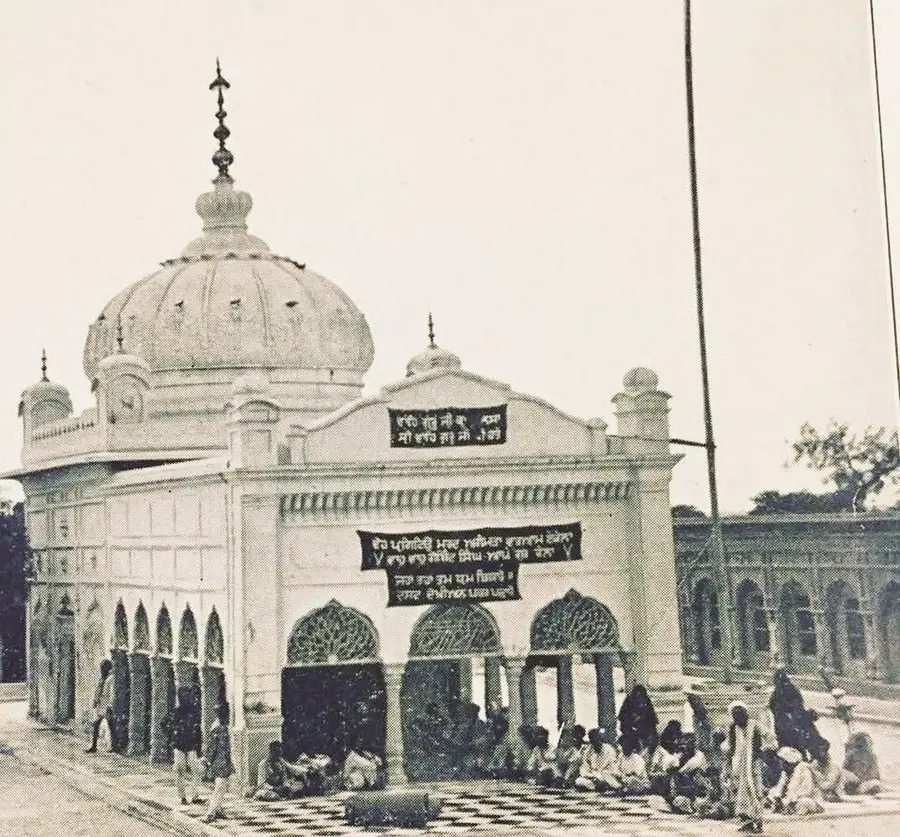
On 12 October 1920 a gathering of Dalit Sikhs, organised with teachers and students of Khālsā College, met at Jallianwālā Bāgh, and some newly initiated men were taken to the Harmandir with offerings of kaṛāh prasād. The priests refused to accept them. As a compromise the Guru Granth Sāhib was opened at random for a ruling, and the verse that came up, of Guru Amar Dās on aṅg 638, speaks of the Lord forgiving those without merit and setting them to the Guru’s service.[6][7] Consensus that this is the account in the Sikh sources. The offerings were accepted. The reformers then went to the Akāl Takht, whose priests left it; the crowd appointed its own jathedār and guards.[6] Consensus
The government nominated a committee of thirty-six Sikhs to manage the Golden Temple on 13 November. Two days later an assembly summoned in the name of the Akāl Takht met in front of it and elected a committee of 175, taking in the government’s thirty-six, and called it the Shiromaṇī Gurdwārā Prabandhak Committee (SGPC), the “supreme committee for gurdwara management”. It held its first meeting on 12 December 1920. On 14 December the Shiromaṇī Akālī Dal was formed to organise the volunteers, the Akālīs (“followers of the Timeless One”), who would take over shrines.[6][2][1] Consensus
The morchās, 1921–1925
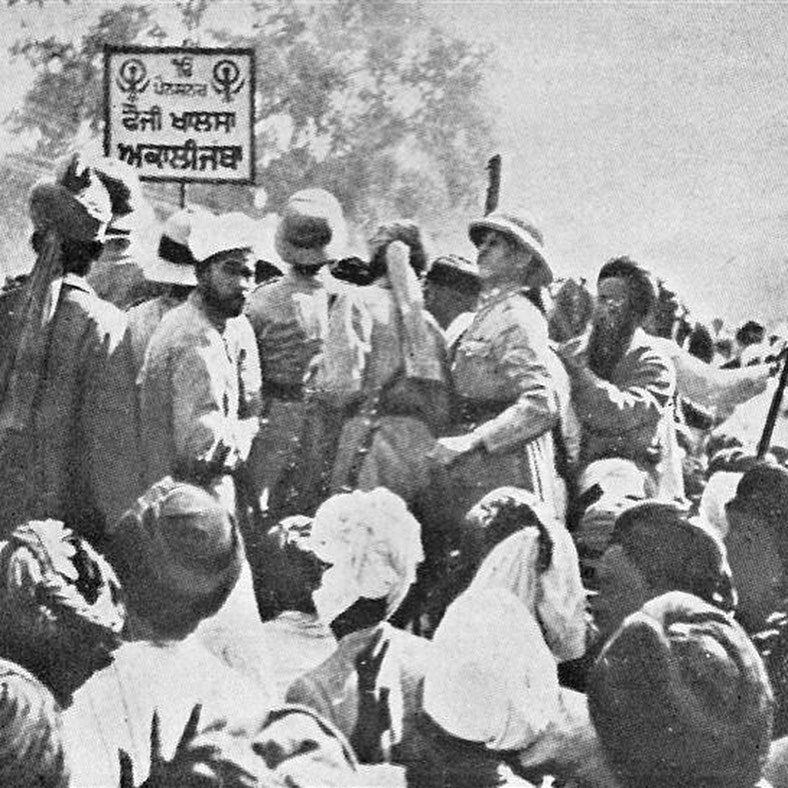
The movement worked by morchās (“fronts”): bands of volunteers (jathās), usually in black turbans, sent to a shrine to occupy it, or to court arrest when stopped. Many mahants gave way and became salaried readers under elected committees; others, with the courts and often the police on their side, did not.[2][1] Consensus
Nankāṇā Sāhib, 20 February 1921
The mahant of Nankāṇā Sāhib, the birthplace of Guru Nānak, was Naraiṇ Dās, the richest of the custodians. On the morning of 20 February 1921 a jathā of about 150 men led by Lachhmaṇ Singh of Dhārovālī entered the Janam Asthān gurdwara. The mahant’s hired men shut the gates and killed them with guns and blades, and piled the dead and wounded on a fire.[6][2] Consensus on the event. How many died is not settled: the Encyclopaedia of Sikhism puts the dead “between 82 and 156” in one article and at about 200 in another, and later commemorations give higher figures.[6] Contested
The Governor, Sir Edward Maclagan, came on 22 February, and Gandhi with the Muslim leaders Shaukat and Muhammad ʿAlī on 3 March. The shrine was handed to a Sikh committee. A sessions court sentenced Naraiṇ Dās to death in October 1921; the High Court commuted his sentence to life imprisonment on appeal.[6] Majority Nankāṇā turned a dispute over shrine management into a confrontation with the government, which the reformers accused of backing the mahants.[2][19] Majority
The keys, 1921–1922
On 7 November 1921 the Punjab government took the keys of the Golden Temple treasury (toshākhānā). The SGPC called protests, and volunteers went to jail in batches. On 19 January 1922 a court official handed the keys, wrapped in red cloth, to the SGPC’s president, Bābā Khaṛak Singh. Gandhi telegraphed to Khaṛak Singh, in the words the Sikh histories record: “First decisive battle for India’s freedom won.”[6][2][8] Majority on the wording, which is not in Gandhi’s collected works. The telegram set the Akālī movement inside the national movement, which is how Indian nationalist history has remembered it since.[2] Political
Guru kā Bāgh, 1922
Guru kā Bāgh, a shrine near Amritsar, was held by an Udāsī mahant, Sundar Dās, who had handed the gurdwara to the SGPC but claimed its garden land as his own. On 9 August 1922 police arrested five Sikhs for cutting firewood there for the laṅgar. The SGPC sent a jathā every day to cut wood and court arrest; from late August the police beat them with lāṭhīs until they fell.[6][2] Consensus The Christian missionary C. F. Andrews watched on 12 September and published what he saw (Primary source 2). The beatings were stopped after the Governor, Sir Edward Maclagan, visited on 13 September, and in November a retired engineer, Sir Gaṅgā Rām, leased the land from the mahant and let the Akālīs use it. By the SGPC’s records 5,605 volunteers went to jail.[9][6] Majority on the figure, which is the SGPC’s.
Jaito, 1923–1925
In July 1923 the British forced the abdication of Ripudaman Singh, the Mahārājā of Nābhā, a Sikh prince who had sympathised with the Akālīs. When Sikhs at Gurdwara Gaṅgsar at Jaito, in Nābhā, held continuous readings of the scripture (akhaṇḍ pāṭh) for his restoration, the state’s police interrupted one, in September 1923. The government declared the SGPC and the Akālī Dal unlawful in October and arrested their leaders. On 21 February 1924 troops under Nābhā’s British administrator fired on a jathā of about five hundred at Jaito. The official count was 19 dead and 29 wounded; the Akālīs gave higher figures.[6][2] Consensus on the event; Contested on the numbers.
The movement’s cost
The SGPC’s own reckoning, as the Encyclopaedia of Sikhism gives it, is that some forty thousand Sikhs went to jail during the movement and about four hundred lost their lives.[6] Contested A smaller group, the Babbar Akālīs, rejected non-violence after Nankāṇā and killed officials and informers; most were killed or caught by 1924, and six were sentenced to death.[6][1] Consensus
The Sikh Gurdwaras Act, 1925
The new Governor, Sir Malcolm Hailey, negotiated with the imprisoned leaders, and in July 1925 the Punjab Legislative Council passed the Sikh Gurdwaras Act. It came into force on 1 November 1925. It listed 241 historic shrines as Sikh gurdwaras, set up a tribunal to decide disputed claims, and vested their management in an elected Central Board, soon renamed the SGPC.[6][1] Consensus
Who counts as a Sikh in law
To decide who could vote for the Board and who could claim a shrine, the Act had to define a Sikh, and it did so by belief, not by birth or appearance. A Sikh is a person who professes the Sikh religion; if that is disputed, a living person is or is not a Sikh according as he makes or refuses to make a set declaration (Primary source 3).[10][4] Consensus on the text.
The definition changed with use. An amending Act of 1930 rewrote the clause and added the fourth affirmation, “I have no other religion”.[10] Majority Later amendments (1944, 1959) added definitions of the amritdhārī Sikh, initiated with the khaṇḍe dī pāhul, the sahajdhārī Sikh, and the patit, the lapsed Sikh who cuts his hair or breaks the four prohibitions. Voters for the SGPC had to keep their hair uncut, with an exemption for sahajdhārīs; the fight over that exemption belongs to §11.[10][4][6] Majority
What the Act did to the Udāsīs
The Act decided, in effect, that the Udāsīs who had kept the shrines for two centuries were not the people entitled to run them. The 241 shrines in Schedule I were declared Sikh gurdwaras outright; a second schedule listed akhāṛās and ḍerās, many of them Udāsī, that were not Sikh gurdwaras and could not be claimed. For any other shrine, Sikh worshippers could petition, a mahant could object, and a tribunal decided by tests of origin and use whether it was a Sikh gurdwara; Udāsīs filed most of the objections.[10][3][4] Majority W. H. McLeod saw in the Act the moment the Khālsā’s definition of a Sikh acquired the force of law; Oberoi, the moment the Udāsī and Sanātan forms of Sikhism lost their institutional home.[4][3] Contested
The Sikh Rahit Maryādā
With the shrines in its hands, the SGPC turned to the rules for worship in them and for the lives of Sikhs. A sub-committee began work on a code in the early 1930s. Its draft was accepted by the SGPC on 12 October 1936; the SGPC’s advisory committee on religious matters revised it on 7 January 1945, and the SGPC approved the revised text on 3 February 1945. It was published in 1950.[11][12] Consensus The code defines a Sikh, sets the forms of the Ardās and the services, the initiation and the Five Ks, and the four prohibitions; §5 sets its contents against the eighteenth-century codes.[11] Consensus
It was the first code of conduct agreed by a representative body for the whole community. McLeod called it the closing chapter of the long history of the rahit: a modern text that settled, by committee, what the old rahitnāmās had left open or disagreed about.[12] Majority Most gurdwaras and Sikh institutions follow it; some groups, among them the Nihaṅgs and some ḍerās and Sikh schools of practice, keep their own customs.[12][20] Majority
Sikhs in the world wars
Under the Raj, Punjab supplied a share of the Indian Army far beyond its share of India’s population, and Sikhs, recruited as a “martial race” (§8), a share far beyond theirs within Punjab. Sikh soldiers served in France, Gallipoli and Mesopotamia in the First World War and in North Africa, Italy and Burma in the Second.[21][1] Consensus Tan Tai Yong has called colonial Punjab a “garrison state”: recruitment, pensions and the land grants of the canal colonies bound the province’s rural elites, Sikh and Muslim, to the government.[21][22] Majority The army’s insistence on uncut hair and the turban for Sikh recruits did as much as any reformer to fix the Khālsā appearance as the Sikh norm.[3][21] Majority
The 1940s: a community between two claims
Numbers and seats
Sikhs were about 13 per cent of the population of British Punjab, where Muslims were a majority. The constitutional reforms of 1919 gave Sikhs about 18.5 per cent of the seats in the provincial council, and the Communal Award of 1932 about 19 per cent; neither satisfied any of the three communities.[6][5] Majority
Pakistan, Āzād Punjab and a Sikh state
On 23 March 1940 the Muslim League at Lahore called for the Muslim-majority areas of the north-west and east to be grouped into “independent States” (see Islam §11).[13][23] Consensus A Muslim Punjab would leave the Sikhs a minority in a state that was not theirs, with their community and shrines on both sides of any line. The Akālī Dal’s answer, from 1943, was Āzād Punjab (“free Punjab”), a scheme credited to Giānī Kartār Singh: detach the Muslim-majority west and leave a province in which no community had a majority. Master Tārā Singh, the Akālī leader, said it “shall comprise Ambala, Jullundur, Lahore divisions, and out of the Multan division, Lyallpur District, some portion of Montgomery and Multan districts.”[6][5] Majority
By 1946 some Akālī leaders were demanding a Sikh state, which no party at the negotiating table took up.[19][6] Majority; Political Rajiv Kapur traced a line from the gurdwara movement, in which religious control and political organisation were the same thing, to this demand.[19] Contested
March 1947
On 3 March 1947, after the coalition ministry resigned, Master Tārā Singh shouted “Pakistan murdābād” (“death to Pakistan”) outside the Assembly in Lahore; by the usual account he drew his kirpān, which his supporters later denied. Violence followed in Lahore, Amritsar and Multan.[14][16] Majority on the event; Contested on the gesture. In the villages of Rawalpindi district, in the Muslim-majority north-west, Muslim crowds attacked Sikh and Hindu villages in the second week of March; many Sikhs were killed or forcibly converted. At Thoa Khalsa, by survivors’ accounts that Urvashi Butalia recorded, about ninety Sikh women drowned themselves in a well rather than be taken.[15][14] Majority on the event; Contested on the numbers.
Partition
The line
Britain transferred power on 14 and 15 August 1947. The boundary commission chaired by Sir Cyril Radcliffe divided Punjab, and its award was published on 17 August, after independence. The line followed Muslim-majority areas, adjusted for “other factors”; the Sikhs, spread across the province, were cut in two.[14][16] Consensus Lahore, with the place where Guru Arjan died and the tomb of Ranjit Singh, went to Pakistan; so did the canal colonies of the west, where Sikh farmers had settled since the 1890s.[16][1] Consensus
The shrines left behind
Nankāṇā Sāhib, where Guru Nānak was born, and Kartārpur on the Rāvī, where he spent his last years and died, both fell on the Pakistani side, as did Pañjā Sāhib at Hasan Abdāl and the shrines of Lahore.[1][16] Consensus The SGPC’s control of gurdwaras in Pakistan lapsed on 15 August 1947.[6] Consensus The Ardās, the prayer recited at every Sikh service, as the SGPC’s code now prints it, asks God to grant the Khālsā “unobstructed visit to and free management of Nankana Sahib [Pakistan] and other shrines and places of the Guru from which the Panth has been separated”.[11] Consensus on the text.
The migrations and the killing
Through the late summer and autumn of 1947 almost all Sikhs and Hindus of western Punjab moved east, and almost all Muslims of eastern Punjab moved west, on foot, in bullock-cart columns many miles long, and by train. In the east, armed Sikh bands (jathās, the same word as the reformers’ bands of 1921, and tied like them to the gurdwaras and the Akālī Dal), supported by some of the Sikh princely states, led much of the killing that drove the Muslims out; Hindu gangs attacked Muslims too. In the west, Muslim gangs attacked Sikhs and Hindus in the same way. Brass’s verdict is that much of the larger-scale violence was mutual.[24][16] Consensus; Political on how each community remembers its part.
Nobody counted the dead. Across the partition of Punjab and Bengal, estimates run from about 200,000, the lowest contemporary figures, to two million; Yasmin Khan’s account speaks of at least a million killed and ten to fifteen million displaced, and Urvashi Butalia gives twelve million displaced and a million dead. Punjab saw most of the killing.[14][15][16] Contested on all the numbers.
Women
Women were abducted, raped and killed by men of the other communities, and some were killed by their own families, or killed themselves, to avoid that fate. The official estimates that Ritu Menon and Kamla Bhasin cite are 50,000 Muslim women abducted in India and 33,000 Hindu and Sikh women in Pakistan; social workers thought these figures too low, and Butalia cites 75,000.[25][15] Contested on the numbers. The two governments agreed in late 1947 to recover abducted women, and India legislated for it in 1949; Menon and Bhasin show that many women were returned against their will to families that did not want them.[25] Majority
How the deaths of women like those at Thoa Khalsa are remembered is itself argued over. Sikh memory and many families honour them as martyrs who chose death over dishonour. Butalia, Menon and Bhasin, listening to survivors, found that some women chose and others were given no choice, and that a language of honour and martyrdom made the difference hard to speak about.[15][25] Contested; Political
What Partition did to the Sikh community
Partition made the Sikhs, scattered across Punjab before 1947, a community concentrated in the eastern districts of the Indian Punjab and in the Sikh princely states, which became the Patiala and East Punjab States Union (PEPSU) in 1948. Refugees from the west, many of them Sikhs of the canal colonies and the towns, were resettled on land left by Muslims.[1][16] Consensus For the first time Sikhs were a large minority, and in some districts a majority, in a compact territory. That made the Punjabi Suba demand possible.[5][1] Majority
Article 25: “Hindu” in the Constitution
The Constitution of India, in force from 26 January 1950, guarantees freedom of religion in Article 25, subject to the state’s power to make laws for social welfare and reform and for “the throwing open of Hindu religious institutions of a public character to all classes and sections of Hindus”. Two Explanations follow. The first protects the Sikh kirpān; the second says that in that clause “Hindus” includes Sikhs, Jains and Buddhists (Primary source 5).[17] Consensus on the text.
The kirpān Explanation was in the draft of 1948. The Assembly rejected an amendment to widen clause (2)(b) in December 1948, and the Drafting Committee added the second Explanation in its revision of 1949, to let laws on temple entry and religious endowments reach Sikh, Jain and Buddhist institutions too.[26][17] Majority The Hindu Code Acts of 1955–56 then defined “Hindu” for marriage, divorce, adoption and inheritance to include Sikhs, Jains and Buddhists (see Hinduism §12).[27] Consensus
The Akālīs read Explanation II as a statement that Sikhs are Hindus. The two Sikh members of the Constituent Assembly who sat as Akālīs, Hukam Singh and Bhūpinder Singh Mān, spoke against the Constitution in November 1949, protesting that it did not protect the Sikhs as a minority, and refused to sign it when members signed on 24 January 1950.[1][19][6] Majority The objection never went away. In 2002 the National Commission to Review the Working of the Constitution recommended omitting Explanation II and naming Sikh, Jaina and Buddhist institutions in the clause itself; the recommendation has not been enacted.[28] Consensus on the recommendation; Political on what the Explanation means. Its defenders say it is a technical device about temple entry and endowments, and says nothing about whether Sikhism is a separate religion; its critics say that the state’s choice of words is itself the point.[4] Political
The Punjabi Suba
Language and religion
After 1947 the Indian Punjab had a Hindu majority and a large Sikh minority, and two languages in competition. Sikh institutions wrote Punjabi in the Gurmukhī script; the Arya Samāj and many Hindu organisations urged Punjabi Hindus to return Hindi, in the Devanāgarī script, as their mother tongue, and many did in 1951 (when the province’s Hindi and Punjabi returns were not tabulated separately) and in 1961.[5] Majority Paul Brass showed how language became the marker of religious community in Punjab: to claim a Punjabi-speaking state was, to both sides, to claim a state where Sikhs would be the majority.[5] Majority; Political
The agitation
When the States Reorganisation Commission, appointed in 1953 to redraw India’s states by language, reported in 1955 against a Punjabi-speaking state, Master Tārā Singh called a Sikh convention at Amritsar on 16 October 1955 that rejected the report.[6][5] Consensus Earlier that year the Punjab government had banned the slogan “Punjabi Suba zindabad” (“long live the Punjabi state”); thousands of volunteers courted arrest by shouting it, and on 4 July 1955, under the Chief Minister Bhīm Sen Sachar, police entered the Golden Temple complex, arrested Akālī leaders and used tear gas on volunteers there.[1][5] Majority on the details; the SGPC still marks the night as an assault on the shrine. Political
A compromise, the “regional formula” of 1956, divided the Punjab into Punjabi and Hindi regions with regional committees of the legislature, and the Akālī Dal accepted it on 11 March 1956. PEPSU was merged into Punjab that November.[6][5] Consensus The formula did not satisfy the Akālīs for long.
The fasts
The agitation was renewed in 1960. Master Tārā Singh was arrested in May; Sant Fateh Singh, who directed the campaign from the Golden Temple, began a fast unto death on 18 December 1960 and ended it on 9 January 1961, on Tārā Singh’s appeal and at the command of the Pañj Piāre, with no change in policy. Tārā Singh then fasted himself, from 15 August to 1 October 1961, and gave up after forty-eight days on the promise of a commission. A panel of five Sikhs appointed as Pañj Piāre found him guilty of breaking his vow and set him a penance (tankhāh): a continuous reading of the scripture, extra daily prayers and service.[6] Consensus The fast and its religious penalty show how far the Akālī Dal’s politics ran through the forms of the Panth: vows before the Akāl Takht, judgements by Pañj Piāre, and the tankhāh.[5][19] Majority
The penance broke Tārā Singh’s leadership. Fateh Singh’s faction took the SGPC in the elections of January 1965, by 90 seats to 45, and his demand for a Punjabi-speaking state was argued on language alone.[6][5] Majority
1966
After the war with Pakistan in September 1965, in which Sikh soldiers and Punjab’s border districts were in the front line, the government moved. A parliamentary committee under the Speaker, Hukam Singh, reported in March 1966; the Congress Working Committee had already resolved on 9 March to recommend a Punjabi-speaking state, and Indira Gandhi’s government accepted it in April.[6][5] Consensus The Punjab Reorganisation Act, enacted on 18 September 1966, took effect on 1 November 1966 (Primary source 6). The Hindi-speaking south-east became the state of Haryana; the hill districts went to Himachal Pradesh, then a union territory; Chandigarh, the new capital built for Punjab after Lahore was lost, became a union territory and the capital of both states.[18][5] Consensus Fateh Singh greeted the day, by the Encyclopaedia of Sikhism’s account, with the words “A handsome baby has been born into my household.”[6] Majority
The new Punjab was the first state with a clear Sikh majority (about 60 per cent at the 1971 census).[1] Consensus Chandigarh, the division of the river waters and the Punjabi-speaking villages left in Haryana remained unsettled, and they fed the Akālī demands of the 1970s (§10).[5][1] Consensus
The evidence ledger
| Date | Evidence | Confidence |
|---|---|---|
| 12 October 1920 | The verse of aṅg 638, read as the Guru’s ruling on the offerings of Dalit Sikhs[7][6] | Consensus (the account) |
| January 1922 | Gandhi’s telegram on the return of the keys, as the Sikh histories record it[8] | Majority |
| September 1922 | C. F. Andrews’s eyewitness report from Guru kā Bāgh[9] | Consensus |
| 1925; 1930 | The Sikh Gurdwaras Act and its definition of a Sikh, rewritten in 1930[10] | Consensus |
| 1936–1950 | The Sikh Rahit Maryādā: draft accepted 1936, approved 1945, published 1950[11] | Consensus |
| 23 March 1940 | The Lahore Resolution[13] | Consensus |
| 1947–1950s | Official estimates of abducted women; survivors’ testimony recorded from the 1980s[25][15] | Contested (numbers) |
| 1950 | Article 25 and its Explanations[17] | Consensus |
| 1951, 1961 | Census language returns in Punjab[5] | Majority |
| 1966 | The Punjab Reorganisation Act[18] | Consensus |
| 2002 | The review commission’s recommendation on Explanation II[28] | Consensus |
Primary sources
Show the 6 primary sources
1. The ruling of 12 October 1920: Guru Granth Sāhib, aṅg 638
ਨਿਗੁਣਿਆ ਨੋ ਆਪੇ ਬਖਸਿ ਲਏ ਭਾਈ ਸਤਿਗੁਰ ਕੀ ਸੇਵਾ ਲਾਇ ॥
niguṇiā no āpe bakhasi lae bhāī satigur kī sevā lāi ||
The site’s own translation: He Himself forgives the worthless, O brothers, and sets them to the service of the True Guru. (Guru Amar Dās, Rāg Soraṭh.)[7]
What it proves. That the reformers won their first victory inside the Harmandir by the Sikh practice of taking a hukam, the Guru’s command, from the scripture opened at random, and that the argument against caste in the shrine was settled in the Guru’s own words. The verse was written in the sixteenth century; its use in 1920 is reported in the Sikh accounts of the day.[6] Consensus on the text and on the account.
2. “A sight incredible to an Englishman”: C. F. Andrews at Guru kā Bāgh, 1922
It was a sight which I never wish to see again, a sight incredible to an Englishman. There were four Akali Sikhs with black turbans facing a band of about a dozen policemen, including two English officers… They were perfectly still and did not move further forward. Their hands were placed together in prayer and it was clear that they were praying. Then, without the slightest provocation on their part, an Englishman lunged forward the head of his lathi which was bound with brass… The vow they had made to God was kept. I saw no act, no look, of defiance.
(Report of 12 September 1922, as printed in the Encyclopaedia of Sikhism.)[9][6]
What it proves. That the non-violent discipline of the jathās was real and was seen by outsiders, and that the movement’s public power came from suffering witnessed and reported. Andrews, a friend of Gandhi, was a sympathetic witness, not a neutral one. Consensus on the text.
3. Who is a Sikh: the Sikh Gurdwaras Act, section 2(9)
“Sikh” means a person who professes the Sikh religion or, in the case of a deceased person, who professed the Sikh religion or was known to be a Sikh during his lifetime. If any question arises as to whether any living person is or is not a Sikh, he shall be deemed, respectively to be or not to be a Sikh according as he makes or refuses to make in such manner as the [State] Government may prescribe the following declaration:— I solemnly affirm that I am a Sikh, that I believe in the Guru Granth Sahib, that I believe in the Ten Gurus, and that I have no other religion.
(The clause as substituted by the amending Act of 1930.)[10]
What it proves. That Sikh identity became a legal category defined by belief: the scripture, the ten Gurus, and, from 1930, exclusive allegiance. It says nothing of hair, initiation or birth, which later amendments addressed. It is the text behind every later court case on who is a Sikh.[4] Consensus on the text.
4. The SGPC’s definition: Sikh Rahit Maryādā, Article 1
Any human being who faithfully believes in (i) One Immortal Being, (ii) Ten Gurus, from Guru Nanak Dev to Guru Gobind Singh, (iii) The Guru Granth Sahib, (iv) The utterances and teachings of the ten Gurus and (v) the baptism bequeathed by the tenth Guru, and who does not owe allegiance to any other religion, is a Sikh.
(The SGPC’s English version, translated by Kulraj Singh, 1994.)[11]
What it proves. That the community’s own definition, approved in 1945, follows the law’s of 1925 and 1930 and adds a fifth article: belief in the tenth Guru’s initiation. It names belief in the initiation, not initiation itself, and so leaves room for Sikhs who are not amritdhārī. The gap between the two definitions is where the later disputes over sahajdhārīs sit (§11). Consensus on the text.
5. Article 25 of the Constitution of India, Explanations I and II
Explanation I.—The wearing and carrying of kirpans shall be deemed to be included in the profession of the Sikh religion.
Explanation II.—In sub-clause (b) of clause (2), the reference to Hindus shall be construed as including a reference to persons professing the Sikh, Jaina or Buddhist religion, and the reference to Hindu religious institutions shall be construed accordingly.
What it proves. Both sides of the question. The first Explanation recognises a practice that belongs to the Sikh religion alone; the second folds Sikhs into “Hindus” for the purpose of reform laws. The same article can be read as recognition or as absorption, and the Akālīs read the second half. Consensus on the text; Political on its meaning.
6. The Punjab Reorganisation Act, 1966, sections 3 and 4
On and from the appointed day, there shall be formed a new State to be known as the State of Haryana comprising the following territories of the existing State of Punjab…
On and from the appointed day, there shall be formed a new Union territory to be known as the Union territory of Chandigarh…
(Act 31 of 1966; the “appointed day” is defined as 1 November 1966. Chapter 5 adds the hill districts to Himachal Pradesh.)[18]
What it proves. That the Punjabi-speaking state was made by subtraction: Punjab is what remained after Haryana, the hills and Chandigarh were taken out. The Act never mentions Sikhs or religion; the claim was made, and granted, as a matter of language. Consensus on the text.
What is absent
- A count of the dead. No government counted the dead of 1947, and every figure is an estimate. Consensus
- An agreed figure for Nankāṇā Sāhib. Even the sources closest to the SGPC give figures from about 80 to about 200. Contested
- The mahants’ side. The history of the Akālī movement is told largely from the reformers’ records and the government’s; the Udāsī mahants left few accounts of their own. Majority
- A date for the Ardās line on the lost shrines. The petition for Nankāṇā Sāhib stands in the Ardās as the SGPC prints it; when it was first added is not established in the sources used here.
- The words “Sikh” or “religion” in the 1966 Act. The state was created on language alone. Consensus
Debates
What was the Akālī movement?
| View | Main argument | Main proponents |
|---|---|---|
| Religious reform | Sikhs took back their own shrines from corrupt custodians; the politics followed from government support for the mahants | Mohinder Singh; much Sikh scholarship[2] |
| Anti-colonial nationalism | A mass non-violent campaign against the Raj, which Gandhi called the first decisive battle for freedom | Nationalist history[2] |
| Boundary-making | The Tat Khālsā’s victory over plural Sanātan Sikhism, enforced by law | Oberoi[3] |
| A peasant movement | Rural Jaṭ Sikhs, squeezed by colonial agrarian policy, found in the shrines a cause | Richard Fox[22] |
| Religious politics | Control of the shrines gave a religious body political power, and set the pattern for Sikh separatism | Rajiv Kapur[19] |
Contested Most historians combine several of these; the views differ on emphasis more than on facts.[1] Majority
Was the Punjabi Suba a linguistic or a religious demand?
The Akālīs argued it as a linguistic state like those granted elsewhere in India; the central government and many Punjabi Hindus saw it as a demand for a Sikh-majority state; Paul Brass argued that in Punjab language and religion had become the same boundary, so that the question has no clean answer.[5] Political
Are Sikhs “Hindus” in Indian law?
For temple-entry and endowment laws under Article 25(2)(b), and for the Hindu Code Acts, yes; for the Constitution’s guarantee of religious freedom and the kirpān, Sikhism is named as a religion of its own. Whether that is a technical convenience or a denial of identity is argued to this day.[17][28] Political
How many died in 1947?
From about 200,000 to two million across the partition, depending on the source and the method.[14][16] Contested
Further reading
Show further reading (10 works)
- J. S. Grewal, The Sikhs of the Punjab (Cambridge, 1990; revised 1998): the narrative.
- Mohinder Singh, The Akali Movement (Macmillan, 1978): the gurdwara campaigns, from the records.
- Harjot Oberoi, The Construction of Religious Boundaries (Oxford, 1994): the Singh Sabhā and the background to the Akālī movement.
- Richard G. Fox, Lions of the Punjab: Culture in the Making (California, 1985): the Akālīs as a rural movement.
- Rajiv A. Kapur, Sikh Separatism: The Politics of Faith (Allen & Unwin, 1986): from the shrines to the Sikh state.
- W. H. McLeod, Who Is a Sikh? (Oxford, 1989), and Sikhs of the Khalsa (Oxford, 2003): the law’s definitions and the Rahit Maryādā.
- Paul R. Brass, Language, Religion and Politics in North India (Cambridge, 1974): the Punjabi Suba.
- Yasmin Khan, The Great Partition (Yale, 2007), and Ian Talbot and Gurharpal Singh, The Partition of India (Cambridge, 2009): 1947.
- Urvashi Butalia, The Other Side of Silence (Penguin India, 1998), and Ritu Menon and Kamla Bhasin, Borders and Boundaries (Kali for Women, 1998): women and Partition, from survivors.
- Tan Tai Yong, The Garrison State (Sage, 2005): the army and colonial Punjab.
References
- ^ a b c d e f g h i j k l m n o p q r s J. S. Grewal The Sikhs of the Punjab. The New Cambridge History of India II.3, Cambridge University Press, 1990. The standard narrative history; revised edition 1998.
- ^ a b c d e f g h i j k l m n o Mohinder Singh The Akali Movement. Macmillan, 1978. Gurdwara reform from 1920, with its prelude in the Golden Temple's management.
- ^ a b c d e f g Harjot Oberoi The Construction of Religious Boundaries: Culture, Identity, and Diversity in the Sikh Tradition. University of Chicago Press, 1994. The "Sanātan" Sikhism of the early nineteenth century and the Singh Sabhā's sharper boundaries.
- ^ a b c d e f g W. H. McLeod Who Is a Sikh? The Problem of Sikh Identity. Clarendon Press, Oxford, 1989.
- ^ a b c d e f g h i j k l m n o p q r Paul R. Brass Language, Religion and Politics in North India. Cambridge University Press, 1974. The Punjabi Suba movement, census language returns, and how language became a marker of religious community.
- ^ a b c d e f g h i j k l m n o p q r s t u v w x y z { | } ~ Harbans Singh, ed. The Encyclopaedia of Sikhism. Punjabi University, Patiala, 4 vols, 1992. open access Published 1992–1998; the standard reference, with signed entries reporting both tradition and sources.
- ^ a b c d Guru Granth Sāhib, ang 638 — Guru Amar Dās, Rāg Soraṭh. 1604 CE (compiled). Punjabi in Gurmukhi. The Lord Himself forgives the worthless and sets them to the True Guru's service: the verse taken as the Guru's ruling at the Harmandir on 12 October 1920, when the offerings of low-caste Sikhs were accepted. read the text
- ^ a b c M. K. Gandhi, telegram to Kharak Singh, January 1922 — Telegram on the return of the Golden Temple keys. January 1922. English. "First decisive battle for India's freedom won": Gandhi on the return of the Golden Temple treasury keys to the SGPC president on 19 January 1922. Attested only secondarily (Mohinder Singh, The Akali Movement, 1978; Encyclopaedia of Sikhism); not found in the Collected Works of Mahatma Gandhi. about
- ^ a b c d C. F. Andrews, report on Guru kā Bāgh, September 1922 — Eyewitness report sent to the press. 12 September 1922. English. An English missionary describes police beating praying Akālī volunteers with brass-bound lathis: "I saw no act, no look, of defiance." about
- ^ a b c d e f g Sikh Gurdwaras Act, 1925, section 2(9) — Punjab Act VIII of 1925, as amended (clause 9 substituted by Punjab Act 3 of 1930). 1925 CE; clause substituted 1930. English. Defines a Sikh as one who professes the Sikh religion; a disputed living person is a Sikh if he declares belief in the Guru Granth Sahib and the Ten Gurus and that he has no other religion. Chapters 7, 8 and 16(2) set the petition, objection and tribunal procedure for shrines not in Schedule I. about
- ^ a b c d e f Sikh Rahit Maryādā — Code of conduct of the Shiromaṇī Gurdwārā Prabandhak Committee. approved 1945 CE; published 1950 CE. Punjabi. The code most Sikh institutions follow: who is a Sikh, the amrit ceremony, the Five Ks and the four cardinal prohibitions. about
- ^ a b c d W. H. McLeod Sikhs of the Khalsa: A History of the Khalsa Rahit. Oxford University Press, New Delhi, 2003. The code of conduct from the rahitnāmās to the Sikh Rahit Maryādā; the main source for dating the Five Ks.
- ^ a b c All-India Muslim League, Lahore Resolution, 23 March 1940 — Lahore Resolution. 23 March 1940. English. Calls for Muslim-majority areas to be grouped 'to constitute "independent States" in which the constituent units shall be autonomous and sovereign'. about
- ^ a b c d e f g Yasmin Khan The Great Partition: The Making of India and Pakistan. Yale University Press, 2007. The partition of 1947 from below; at least a million dead and ten to fifteen million displaced.
- ^ a b c d e f Urvashi Butalia The Other Side of Silence: Voices from the Partition of India. Penguin India, New Delhi, 1998. Oral history of Partition, with the Thoa Khalsa deaths and the recovery of abducted women.
- ^ a b c d e f g h i Ian Talbot and Gurharpal Singh The Partition of India. Cambridge University Press, 2009. Survey of the partition of Punjab and Bengal, the violence and the migrations.
- ^ a b c d e f Constitution of India, Arts. 17 & 25 — Republic of India. 1950 CE. English. Untouchability abolished; religious freedom guaranteed; temples opened to all classes of Hindus by constitutional mandate. about
- ^ a b c d Punjab Reorganisation Act, 1966, sections 3–5 — Act 31 of 1966, Parliament of India. 18 September 1966; in force 1 November 1966. English. Forms the State of Haryana and the Union territory of Chandigarh from Punjab and adds the hill districts to Himachal Pradesh, from the appointed day, 1 November 1966. about
- ^ a b c d e f Rajiv A. Kapur Sikh Separatism: The Politics of Faith. Allen & Unwin, London, 1986. Traces Sikh separatist politics from the gurdwara reform movement to 1947.
- ^ Eleanor Nesbitt Sikhism: A Very Short Introduction. Oxford University Press, 2nd ed., 2016.
- ^ a b c Tan Tai Yong The Garrison State: The Military, Government and Society in Colonial Punjab, 1849–1947. Sage, New Delhi, 2005. How army recruitment shaped colonial Punjab and its Sikh and Muslim rural elites.
- ^ a b Richard G. Fox Lions of the Punjab: Culture in the Making. University of California Press, 1985. Argues that the colonial army and state helped make the Singh the standard Sikh.
- ^ Ayesha Jalal The Sole Spokesman: Jinnah, the Muslim League and the Demand for Pakistan. Cambridge University Press, 1985. Argues the Pakistan demand began as a bargaining position for Muslim power within India.
- ^ Paul R. Brass The partition of India and retributive genocide in the Punjab, 1946–47: means, methods, and purposes. Journal of Genocide Research 5(1), 71–101, 2003. doi How the killing of 1947 was organised: Sikh jathās, Muslim and Hindu gangs, and the princely states; most of the large-scale violence mutual.
- ^ a b c d Ritu Menon and Kamla Bhasin Borders and Boundaries: Women in India's Partition. Kali for Women, New Delhi, 1998. Women's testimony; official estimates of 50,000 Muslim and 33,000 Hindu and Sikh women abducted; the recovery operation.
- ^ Constitution of India, Article 25, drafting history — Draft Constitution 1948 (draft Article 19) and Constituent Assembly debates. 1948–1950 CE. English. The 1948 draft had only the kirpān Explanation; an amendment to widen clause (2)(b) was rejected in December 1948, and the Drafting Committee later extended it to Sikhs, Jainas and Buddhists in Explanation II. about
- ^ Hindu Code Bills — Parliament of India. 1955–56 CE. English. A secular legislature imposes monogamy, permits divorce, and grants daughters inheritance — the largest single change in Hindu practice in this history. about
- ^ a b c National Commission to Review the Working of the Constitution, Report, 2002 — Report of the Venkatachaliah Commission. 31 March 2002. English. Recommends omitting Explanation II to Article 25 and naming Sikh, Jaina and Buddhist institutions directly in clause (2)(b). about