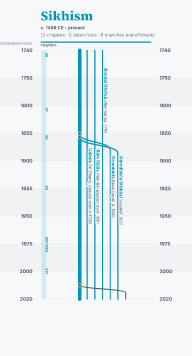
In March 1849 the British annexed the kingdom of Lahore (§7). For the next seventy years the Sikhs were a small minority in a British province: fewer than one Punjabi in ten at the early censuses, with Muslims in the majority and Hindus the next largest group.[1][2] Majority In those seventy years almost everything that defines a Sikh to an outsider today was settled and written down: that a Sikh keeps uncut hair under a turban, that a Sikh is married by circling the scripture, that the Harmandir Sāhib (the Golden Temple) houses no Hindu images, and that Sikhs are not Hindus. Much of it was settled by Sikhs arguing with other Sikhs.[2][1][3] Majority
Three forces did the work. The army recruited Sikhs as a “martial race” and insisted that its Sikh soldiers look like Khālsā Sikhs. Christian missions and then the Arya Samāj, a Hindu reform movement, competed for Punjabis’ allegiance and provoked a Sikh defence. And the Singh Sabhā, a reform movement of educated Sikhs, used printing presses, schools and the law to define what a Sikh was. That is the argument of this chapter: under British rule the line between Sikh and Hindu, long present but often loose, was drawn hard, and the Khālsā form became the standard of what a Sikh should be. How new that line was is the most argued question about the period.[2][4][5] Majority that the line hardened; Contested on how new it was; Political
Timeline
The dates below come from the standard histories and the Encyclopaedia of Sikhism, and the numbers from the sources named in each row.[1][2][6]
| Date | Event | Confidence |
|---|---|---|
| 1849 | Annexation of Punjab; the Khālsā army disbanded (§7) | Consensus |
| 1857 | Sikh and Punjabi troops and the Phulkīāṅ princes fight for the British in the uprising; Bābā Rām Singh begins the Nāmdhārī movement at Vaisākhī[1] | Consensus |
| 1872 | Malerkoṭlā: about 65 Kūkās blown from guns, 17–18 January; Rām Singh exiled to Burma[1][2] | Consensus (event); Contested (count) |
| 1873 | Four Sikh pupils at the Amritsar mission school announce they will convert; the Singh Sabhā founded at Amritsar[1] | Consensus |
| 1875 | Dayānanda’s Satyārth Prakāś; the Arya Samāj reaches Lahore in 1877[7][8] | Consensus |
| 1877 | Trumpp’s partial translation of the Ādi Granth (§0)[9] | Consensus |
| 1879 | The Lahore Singh Sabhā founded, 2 November[6] | Consensus |
| 1886–1887 | The Lahore and Amritsar Khālsā Dīwāns split; Gurmukh Singh targeted by an edict from the Akāl Takht[2][1] | Majority |
| 1892 | Foundation stone of the Khalsa College, Amritsar, 5 March[1] | Consensus |
| 1897 | Saragarhi, 12 September: 21 men of the 36th Sikhs killed holding a signal post[10] | Consensus |
| 1898 | Kāhn Singh Nābhā, Ham Hindū Nahīṅ[11] | Consensus |
| 1902 | The Chief Khālsā Dīwān founded at Amritsar, 30 October[6] | Consensus |
| 1904–1908 | Sikh migration to British Columbia; the first gurdwara in Vancouver (1908)[12][13] | Majority |
| 1905 | Hindu images removed from the precincts of the Harmandir Sāhib[2] | Consensus |
| 1909 | The Anand Marriage Act, 22 October; Macauliffe’s The Sikh Religion[14][15] | Consensus |
| 1912 | Gurdwara at Stockton, California[13] | Majority |
| 1913 | The Ghadar party founded on the Pacific coast[16] | Consensus |
| 1914 | The Komagata Maru turned back from Vancouver; shooting at Budge Budge, 29 September[12] | Consensus (event); Contested (deaths) |
| 1919 | Jallianwālā Bāgh, Amritsar, 13 April: 379 dead by the official count[17][18] | Consensus (event); Contested (count) |
| 1920 | The Golden Temple’s manager removed; the Shiromaṇī Gurdwārā Prabandhak Committee formed (§9)[19] | Consensus |
The army and the “martial race”
1857
The Khālsā army that had fought the British twice in the 1840s was disbanded in 1849, and many of its soldiers went home to their villages.[1] Consensus Eight years later, when the Bengal army rose against the East India Company in 1857, Punjab stayed quiet. The Sikh rulers of the Phulkīāṅ states (Paṭiālā, Nābhā, Jīnd) and of Kapūrthalā sent troops to the British, newly raised Punjabi regiments with many Sikhs in them helped retake Delhi in September, and few Sikhs joined the rising.[1][20] Consensus Why they did so is argued: memory of Mughal Delhi and of the Bengal sepoys who had fought against the Khālsā in the 1840s, pay, and the simple fact that the old Sikh state was gone and no other offered.[1] Majority
A preferred recruit
After 1857 the British reorganised their Indian army and turned to the north. By the end of the century, under commanders such as Frederick Roberts (commander-in-chief in India, 1885–1893), recruitment was governed by a doctrine of “martial races”: some peoples, mostly of the north and north-west, were held to be born soldiers, and others not.[20][21] Consensus Jaṭ Sikhs stood near the top of the list. Sikhs were enlisted in far greater numbers than their share of India’s population, in class regiments and companies of their own.[20][22] Consensus
How the army policed Sikh identity
The army did not take just any Punjabi who called himself a Sikh. The recruit it wanted was the Singh: the initiated Khālsā Sikh with uncut hair and beard, who did not smoke. Recruits enlisted as Sikhs had to keep the hair, and those not already initiated were given the pāhul (the Khālsā initiation) in the regiment; regiments kept the scripture and employed granthīs to read it.[2][22][23] Majority The recruiting handbooks that taught British officers about their men, such as Captain R. W. Falcon’s Handbook on Sikhs for the Use of Regimental Officers (1896), described the Khālsā code in detail and worried that Sikhism was slipping back into Hinduism.[24] Consensus on what the handbooks say (Primary source 2).
Historians agree on the policy and argue about its effect. Richard Fox argued that the colonial army and the colonial state helped to create the Singh as a social type, a “lion of the Punjab” made in part by the British demand for one.[23] Harjot Oberoi treats the army as one of several forces, with the census and the reformers, that favoured the Khālsā form over the other ways of being Sikh.[2] Others reply that the Khālsā identity the army recruited was already a century and a half old, and the army chose it because it existed.[4][25] Contested
Saragarhi, 1897
The best-remembered action of the Sikh regiments in this period was fought on the North-West Frontier. On 12 September 1897, during the frontier rising of 1897, shortly before the Tirah campaign, twenty-one men of the 36th Sikhs under Havildār Ishar Singh held the signal post of Saragarhi, between the forts of Lockhart and Gulistān, against a large Afridi and Orakzai force, and were all killed. Each was given the Indian Order of Merit after his death.[10] Consensus The 12th of September is kept as Saragarhi Day by the Sikh Regiment of the Indian army, which descends from the 36th Sikhs, and the battle has become one of the central memories of Sikh soldiering.[10] Majority The number of attackers is usually given as about ten thousand; that figure comes from the regiment’s and the tradition’s accounts and cannot be checked. Contested
Living Gurus: the Nirankārīs and the Nāmdhārīs
Not every Sikh reform of the nineteenth century came from the Singh Sabhā, and not every Sikh accepted that the line of personal Gurus had ended in 1708 (§5).
The Nirankārīs
Bābā Dayāl (1783–1855), a Sikh of Peshawar and Rawalpindi, preached worship of God as nirankār, “the formless”, and condemned images, Brahmanical rites and the worship of the dead. His followers, the Nirankārīs, married by walking round the scripture rather than the sacred fire, the rite that became the Anand marriage, and his successors kept the movement in the north-west. They are distinct from the Sant Nirankārī mission of the twentieth century (§10).[2][3] Majority
The Nāmdhārīs, or Kūkās
Bābā Rām Singh (1816–1885), a carpenter’s son of Bhainī in Ludhiana district who had served in Ranjit Singh’s army, began his movement at Vaisākhī 1857. His followers, the Nāmdhārīs (“bearers of the Name”), wore white, tied their turbans straight across the forehead, abstained from meat and alcohol and protected cows. They were called Kūkās, “shouters”, from the cries of their ecstatic worship.[1][2] Consensus They boycotted British schools, courts, posts and cloth.[1] Majority They held that Guru Gobind Singh had not died in 1708 but had passed on the Guruship, which came through Bābā Bālak Singh to Rām Singh; for this the other Sikhs of the Singh Sabhā generation treated them as outside the Khālsā.[3][2] Majority
In 1871 Kūkās killed butchers at Amritsar and Raikot over the slaughter of cows. In January 1872 a band of more than a hundred attacked the fort at Malauḍh and then the town of Malerkoṭlā, the seat of a small Muslim state, and were captured. On 17 January the Deputy Commissioner of Ludhiana, John Cowan, had 49 of the prisoners tied to the mouths of cannon and blown from guns without trial; the next day the Commissioner of Ambala, T. D. Forsyth, had 16 more executed in the same way. Cowan was dismissed and Forsyth moved for exceeding their powers.[1][2] Consensus on the event; Contested on the count, which the sources give as 65, 66 or 68. Rām Singh, who had disowned the violence, was deported, held at Rangoon under a Bengal regulation of 1818, and died in Burma in 1885; many Nāmdhārīs did not accept that he had died.[1] Majority
British officers saw a sect in revolt: Falcon’s handbook calls them “fanatical disciples” and notes that the army stopped enlisting them.[24] Indian nationalist history later honoured them as early fighters against British rule, and the Nāmdhārīs commemorate the dead of Malerkoṭlā every January.[1][2] Political The movement continues, with its own line of living Gurus and its seat at Bhainī.[3] Consensus
Missions and the scare of 1873
Christian missions came with British rule. The American Presbyterians had been at Ludhiana since 1834, and the Church Missionary Society opened a mission at Amritsar in 1852.[1][2] Consensus Their converts were few, but they included the last Maharaja, Duleep Singh, baptised in 1853 (he returned to Sikhism in 1886), and the missions ran schools that educated sons of the Sikh elite.[1] Majority
In February 1873 four Sikh pupils of the Amritsar mission school, Āyā Singh, Atar Singh, Sādhū Singh and Santokh Singh, announced that they would be baptised. About the same time Shardhā Rām Phillaurī, a Brahmin scholar who had written a history of the Sikhs for the British, gave public lectures in Amritsar that Sikhs heard as disparaging the Gurus.[1][2] Majority Sikh notables of the city persuaded the boys to change their minds, and that summer they formed a society to defend and reform their religion.[1] Majority
The Singh Sabhā
Amritsar, 1873
The Srī Gurū Singh Sabhā of Amritsar was formed at a meeting on 30 July 1873, and held its first formal session before the Akāl Takht on 1 October. Its leaders were landed and religious notables, with Ṭhākur Singh Sandhānwālīā as chairman and the historian Giānī Giān Singh as secretary; Bābā Khem Singh Bedī, a descendant of Guru Nānak, soon became the leading figure of the Amritsar side.[6][1] Majority on the names and dates. Its aims were modest: to restore Sikhism to the Gurus’ teaching, to publish religious and historical books, and to spread education in Punjabi, while staying loyal to the government.[6][2] Consensus
Lahore, 1879
On 2 November 1879 a second Singh Sabhā was founded at Lahore. Its moving spirit was Gurmukh Singh (1849–1898), a teacher at the Oriental College, who became its secretary under Dīwān Būṭā Singh as president. It was joined in the 1880s by Giānī Ditt Singh (1850s–1901), preacher and writer, and Jawāhir Singh, both of whom had been members of the Arya Samāj.[6][26] Majority Lahore was the more thoroughgoing in its reform. Its members were mostly men of the new professions (teachers, clerks, journalists) and more of them came from outside the old elite.[2] Majority A coordinating Khālsā Dīwān, set up in 1880, broke apart in 1886 into rival Dīwāns at Amritsar and Lahore; by 1888 the Lahore side counted about thirty Sabhās and the Amritsar side six or seven.[6] Majority In 1902 the factions were brought together in the Chief Khālsā Dīwān, with Sundar Singh Majīṭhīā as secretary.[6][1] Consensus
Tat Khālsā and Sanātan Sikhs
The split was about what a Sikh was. Historians call the two sides by the names Oberoi made standard.[2]
| Sanātan (“everlasting”) Sikhs | Tat Khālsā (“true Khālsā”) | |
|---|---|---|
| Leading figures | Khem Singh Bedī; the Amritsar Dīwān; many hereditary custodians of shrines[2] | Gurmukh Singh, Ditt Singh; the Lahore Dīwān; later Kāhn Singh Nābhā and Bhāī Vīr Singh[2][6] |
| Who is a Sikh | Anyone who reveres the Gurus, Khālsā or Sahajdhārī (uninitiated), within the wider Hindu world | The Khālsā is the norm; Sikhs are a separate religion |
| Hindu rites and images | Acceptable, in the home and at shrines | Un-Sikh, to be removed |
| Caste | Kept, with the authority of the Gurus’ descendants (Bedīs, Sodhīs, Bhallās) | Rejected in religion, though often kept in marriage |
| Authority | Lineages of holy men and shrine custodians | Scripture, the community, and its elected bodies |
The table simplifies a quarrel of personalities as well as principles.[6] Majority Khem Singh Bedī (1832–1905) held that Sikhs were part of the Hindu community, and was honoured as a Guru’s descendant; by Oberoi’s account he sat on a cushion in the Harmandir Sāhib, an honour the Tat Khālsā thought belonged to the scripture alone.[2] Contested Gurmukh Singh was the target of an edict from the Akāl Takht in 1887, issued by its custodians, among those who opposed the reformers; he answered in print.[2][1] Majority The Tat Khālsā’s view did not prevail at once. It prevailed over the next thirty years, through the press, the schools and the gurdwara reform movement that followed (§9).[2][1] Majority
The Arya Samāj and “We are not Hindus”
A broken alliance
Dayānanda Sarasvatī’s Arya Samāj, founded in Bombay in 1875, found its strongest following in Punjab, where he spent 1877–78 and where a Lahore Samāj was founded in 1877 (Hinduism §11).[8][27] Consensus At first some Sikh reformers joined it: it shared their hostility to images, Brahmin priests and caste ritual.[26][8] Consensus The alliance broke on what the Samāj said about the Gurus. Dayānanda’s Satyārth Prakāś praised Guru Nānak’s aim and dismissed his learning (Primary source 3), and in the 1880s Arya speakers at Lahore attacked the Gurus in public; Ditt Singh and Jawāhir Singh left the Samāj.[7][26] Majority on the date of the break, which sources put between 1885 and 1888.
From then until the First World War, Arya and Sikh newspapers and tract writers fought a long war of words.[8][6] Consensus Its sharpest point was śuddhi, “purification”, the rite by which the Arya Samāj received or reconverted people into Hinduism. In 1900 the Lahore Samāj purified a group of Rahtiā Sikhs, Dalits, in a ceremony at which their hair was cut. To Sikhs this was an assault on the Khālsā itself.[26][8] Majority
Kāhn Singh Nābhā
The answer to the question the quarrel posed came in book form. In 1897 Khem Singh Bedī argued in a public address that the Sikhs were not separate from the Hindus, and tracts arguing the same appeared, among them Sikh Hindū Hain (“Sikhs are Hindus”), which Britannica ascribes to Ṭhākur Dās and the Encyclopaedia of Sikhism to Bāvā Narain Singh in 1899.[2][26][10] Majority In 1898 Kāhn Singh (1861–1938), a scholar at the court of the Sikh state of Nābhā, published Ham Hindū Nahīṅ, “We are not Hindus” (Primary source 4); the first edition was signed with initials only, and his name appears on it from 1907.[10] Written as a dialogue, it argued from the Guru Granth Sāhib and the codes that Sikh doctrine on caste, incarnation, images and ritual differed from Hindu doctrine on every point that mattered.[11][2] Consensus on the book. The title became the Tat Khālsā’s slogan, and the question it answered, “are Sikhs Hindus?”, has been asked in law ever since (§9).[2][3] Majority; Political
Drawing the boundary
The quarrel was fought on paper. From the 1870s presses at Lahore and Amritsar printed tracts, newspapers and editions of Sikh texts in Gurmukhī. N. Gerald Barrier’s bibliography of the literature of 1849–1919 shows its growth.[6][28] Consensus Ditt Singh edited the Lahore Dīwān’s Punjabi weekly, the Khālsā Akhbār; Bhāī Vīr Singh (1872–1957), poet, novelist and editor, founded the Khālsā Tract Society in 1894 and the Khālsā Samāchār in 1899; the English-language Khalsa Advocate became the Chief Khālsā Dīwān’s voice.[6] Majority Print fixed things that had varied: the text of prayers, the order of rites, the dates of the Gurus’ lives as the reformers’ histories told them.[2][28] Majority
Scholars, foreign and Sikh
Ernest Trumpp’s translation of 1877, with a preface Sikhs read as contemptuous (§0), was an insult the reformers did not forget.[9][2] Consensus Max Arthur Macauliffe, a British official, resigned from the Indian Civil Service in 1893 to translate the scripture in its place, working with Sikh scholars of the Tat Khālsā, Kāhn Singh Nābhā among them; The Sikh Religion appeared in six volumes from Oxford in 1909 (§0).[15][1] Consensus Its account of the Gurus was the reformers’ account, and the book carried their reading of Sikh history to English readers for most of the twentieth century.[2][3] Majority
Schools
The Khalsa College at Amritsar, long planned and fought over between the Lahore and Amritsar factions, had its foundation stone laid by the Lieutenant-Governor of Punjab on 5 March 1892.[1][6] Consensus Many Khālsā schools followed, among them the Sikh Kanyā Mahāvidyālā for girls at Ferozepur, founded by Takht Singh in 1892.[29] Majority
The Harmandir without images
The Harmandir Sāhib had been run since the eighteenth century by custodians (pujārīs) and, under the British, by a manager (sarbarāh) appointed by the government. Images of Hindu gods stood in its precincts, and Brahmins sat on its parikrama.[2][19] Consensus In 1905 the manager, under pressure from the reformers, had the images removed. Hindu protests followed, and the reformers counted it a victory.[2][6] Consensus A Sikh shrine was now to look Sikh.
The Anand Marriage Act, 1909
The Tat Khālsā held that a Sikh should marry by the Anand rite: the couple circling the Guru Granth Sāhib four times while the Lāvāṅ, Guru Rām Dās’s wedding hymn, was sung, with no Brahmin and no fire. Many Sikh families still married by the Hindu rite.[2][29] Majority A bill to validate Anand marriages was introduced in the Imperial Legislative Council by Tikkā Ripudaman Singh of Nābhā in 1908 and carried by Sundar Singh Majīṭhīā; Sanātan Sikhs opposed it, and it became law on 22 October 1909.[14][6] Consensus The Act was careful (Primary source 5): it declared Anand marriages valid but left every other Sikh marriage custom valid too.[14] Consensus What the law permitted, the reformers then preached as the duty of every Sikh.[2] Majority
Women in the reform
The reformers spoke a great deal about women: their education, their dress, their names, and the “superstitions” (bharam) at local shrines and life-cycle rites that the Tat Khālsā attributed to them. Bhāī Vīr Singh’s first novel, Sundarī (1898), gave them a heroine: a pure Khālsā woman of the eighteenth century.[29] Consensus Doris Jakobsh argues that the reform gave women schools and a place in the Khālsā rites, and also a narrower, Victorian-coloured ideal of the Sikh wife and mother; that the name Kaur became the expected name of every Sikh woman in this period; and that the story of women’s equality in Sikh history was largely written now.[29] Majority; Contested on how much was new.
Abroad
Sikh soldiers and police went wherever the British needed them. Sikh constables served in Hong Kong from the 1860s and in Shanghai and the Malay states from the 1870s and 1880s, and Sikh veterans and their relatives followed as watchmen, labourers and traders.[13][28] Majority
British Columbia and California
From 1904 Sikh men, many of them former soldiers, began to cross from Hong Kong to British Columbia to work in sawmills and on the railways; by 1908 some five thousand South Asians, nearly all Sikhs, had arrived in the province.[12][13] Majority They opened a gurdwara in Vancouver in 1908, and further south, in California’s Central Valley, the Pacific Coast Khālsā Dīwān Society founded a gurdwara at Stockton in 1912, the first in the United States.[13][28] Majority Canada answered with a rule, in 1908, that immigrants must arrive by continuous journey from their country of birth, which no shipping line from India offered.[12] Consensus
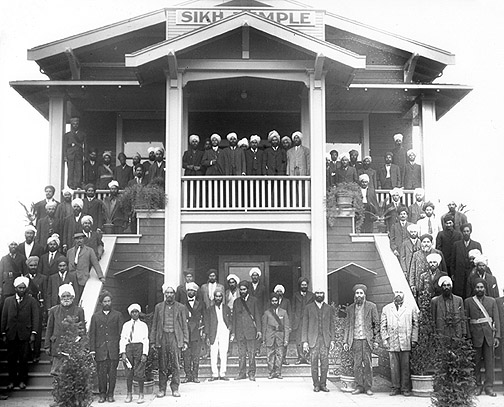
The Komagata Maru, 1914
Gurdit Singh, a Sikh businessman in Malaya, chartered a Japanese steamer, the Komagata Maru, to test the rule. It reached Vancouver on 23 May 1914 with 376 passengers from Punjab, by the usual count 340 Sikhs, 24 Muslims and 12 Hindus. The authorities let about twenty returning residents and a few others land, held the ship in the harbour for two months, and on 23 July forced it to sail.[12] Consensus on the event; Majority on the figures. When it reached Budge Budge, near Calcutta, on 29 September, police tried to put the passengers on a train to Punjab, a fight broke out and the police fired; about twenty people were killed, most of them passengers.[12] Consensus on the shooting; Contested on the count and on who fired first.
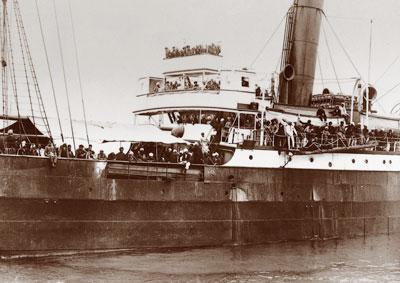
Ghadar
On the Pacific coast in 1913 Punjabi migrants, most of them Sikh farmers and labourers, founded the Hindi Association of the Pacific Coast (also called the Pacific Coast Hindustan Association), with Sohan Singh Bhakna as president and the Hindu intellectual Har Dayal as secretary. It took its popular name from its paper, Ghadar (“rebellion”), first issued at San Francisco in November 1913 in Urdu and then in Gurmukhī.[16][13] Consensus When war broke out in 1914 several thousand returned to India to raise a rising; it was betrayed in February 1915, and in the Lahore conspiracy trials that followed Kartār Singh Sarābhā and others were hanged.[16][1] Consensus The British called the Ghadarites seditionists and conspirators; the Indian state and Sikh memory honour them as martyrs of the freedom struggle.[16] Political The Chief Khālsā Dīwān, loyal to the government, disowned them.[1][13] Majority The movement was secular in its programme; it was Sikh in its membership, its gurdwaras and its language of martyrdom.[16][13] Majority
Amritsar, 1919
The war and the Rowlatt Acts
Punjab supplied more soldiers than any other province in the First World War, and Sikhs were a large part of them.[20] Consensus In March 1919 the government passed the Rowlatt Act, extending wartime powers of detention without trial; Gandhi called for protest strikes, and in Amritsar the arrest of two local leaders on 10 April led to violence in which Europeans were killed and banks burned. Brigadier-General Reginald Dyer took command of the city.[17][18] Consensus
13 April
The 13th of April 1919 was Vaisākhī, and the city was full of visitors from the villages for the festival and the horse fair. Dyer had proclaimed a ban on gatherings, which was not read in many parts of the city. That afternoon a crowd of thousands met in the Jallianwālā Bāgh, an enclosed ground a few hundred metres from the Harmandir Sāhib with few and narrow exits. Dyer marched in with fifty riflemen and, without warning, ordered them to fire. They fired 1,650 rounds for about ten minutes, until their ammunition was nearly gone, and then withdrew, leaving the wounded where they lay.[17][18] Consensus
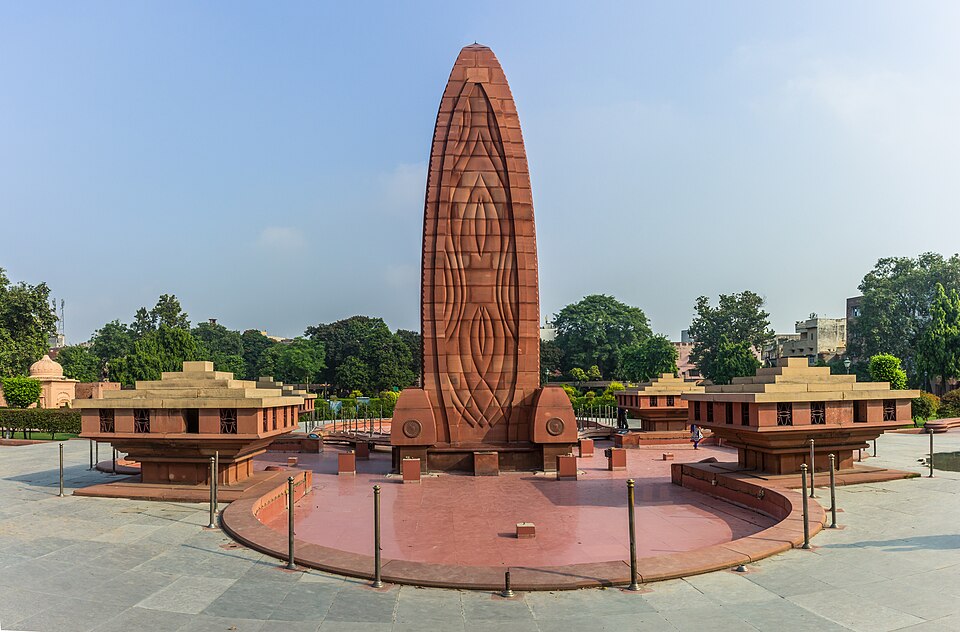
How many died
The number is a matter of record and dispute (Primary source 6).[17][30][18]
| Count | Source and date | Basis |
|---|---|---|
| About 200 | The first official impression, as the Hunter report recalls it[17] | No count made at the time |
| 379 dead; wounded “probably three times as great” | Government inquiry using the Sevā Samiti’s list, accepted by the Hunter Committee, report of 1920[17] | Names traced over the following months (291 by the end of August 1919, 379 by the end of the year) |
| 379 dead, 192 wounded | The Government of India’s later scrutiny, printed with the Hunter report, 1920[17] | The same list; serious wounds only |
| About 500 | The Sevā Samiti’s figure, as the Congress inquiry reported it, 1920[30] | “Actual tracing”, called a minimum |
| About 1,000 | The Congress inquiry, 1920, endorsing a local count by Girdhārī Lāl as “by no means an exaggerated calculation”[30] | Witnesses and estimate |
Contested The official 379 counted only the dead who could be traced and named months later, and historians generally treat it as a minimum.[18][30] Majority Kim Wagner, the most recent archival study, puts the dead at between 500 and 600.[18] Contested The dead were Hindus, Muslims and Sikhs; the place, the day and the nearness of the Harmandir made it, in Sikh memory, a Sikh wound as well as a national one.[18][1] Majority
A robe of honour
After the massacre, Dyer was received at the Golden Temple, and its government-appointed manager, Arūṛ Singh, with the custodians, presented him with a siropā, a robe of honour, at the Akāl Takht.[19] Majority on the event; the exact date and what was said are reported differently. To Sikh reformers it showed what the shrines had become in the hands of men who answered to the government. The demand for Arūṛ Singh’s removal grew until he gave way in 1920, and in the same year Sikhs took over the Golden Temple and formed the committee that would run the gurdwaras (§9).[19][1] Consensus
Debates: how new was the boundary?
Harjot Oberoi’s The Construction of Religious Boundaries (1994) is the central book on this period, and the most contested (§0).[2] Its argument, in brief:
- Before the 1870s most people who revered the Gurus belonged to what Oberoi calls a “Sanātan” tradition: plural, with many ways of being Sikh. Khālsā Sikhs, Sahajdhārīs, Udāsīs and Nirmalās shared shrines and festivals with Hindus and Muslims; they visited the shrine of the Muslim saint Sakhī Sarvar, revered goddesses and village spirits, and kept Brahmanical rites at birth, marriage and death. Identity was a matter of overlapping practices, not of a single line.[2]
- The Tat Khālsā were a new, educated elite who, under colonial conditions (the census, the army, print, competition with missions and the Arya Samāj), replaced this plural world with a single Khālsā identity and policed its edges.[2]
- The result was a Sikh religion with clear boundaries, and the Sikh past retold to fit it.[2]
The replies came from several directions.[4][31][5]
| View | Main argument | Main proponents |
|---|---|---|
| Boundaries constructed | A fluid Sanātan Sikhism was replaced by a Khālsā “episteme” in the Singh Sabhā period | Oberoi; broadly McLeod[2][3] |
| Restoration | The reformers restored the Gurus’ own teaching and the Khālsā’s eighteenth-century code; the Sanātan practices were the corruption | Much Sikh scholarship; Fundamental Issues[31] |
| An old norm, newly enforced | The Khālsā identity was dominant and self-conscious long before 1873; the reformers sharpened and enforced an existing boundary, and Oberoi took Sanātan practice for the norm | Grewal; Dhavan on the eighteenth century[4][25] |
| A many-sided movement | The Singh Sabhā was not one thing: its local Sabhās, factions and tracts varied, and the Tat Khālsā won slowly | Barrier[6] |
| Colonial categories | Both the reformers and their academic critics think in a colonial category of “religion” that requires sharp borders | Mandair[5] |
| Gender | The boundary was also drawn through women’s bodies, rites and names | Jakobsh[29] |
Contested; Political Most historians accept something from both sides: the Khālsā norm is far older than 1873, and the boundary with Hinduism was nonetheless drawn harder, written down and enforced in these years as never before.[4][3][5] Majority Whether that was invention or restoration is a question of judgement as much as evidence.
The evidence ledger
| Date | Evidence | Confidence |
|---|---|---|
| 1872 | Official correspondence on the Malerkoṭlā executions, as the histories report it[1] | Consensus |
| 1875; 1884 | Satyārth Prakāś, with its chapter on Guru Nānak and the Sikhs in the revised text[7][32] | Consensus |
| 1896 | Falcon’s Handbook on Sikhs for regimental officers[24] | Consensus |
| 1898 | Kāhn Singh Nābhā, Ham Hindū Nahīṅ[11] | Consensus |
| 1849–1919 | The Singh Sabhā tracts, newspapers and books, catalogued by Barrier[6] | Consensus |
| 1909 | The Anand Marriage Act[14] | Consensus |
| 1909 | Macauliffe, The Sikh Religion: the reformers’ reading of the Gurus in English[15] | Consensus |
| 1914 | The Komagata Maru: Canadian and Indian official records, as Johnston reads them[12] | Majority |
| 1920 | The Hunter Committee’s report and the Congress inquiry’s report on the Punjab disorders of 1919[17][30] | Consensus (texts); Contested (numbers) |
Primary sources
Show the 6 primary sources
1. “Neither Hindu nor Muslim”: Guru Arjan, Bhairau, aṅg 1136
ਨਾ ਹਮ ਹਿੰਦੂ ਨ ਮੁਸਲਮਾਨ ॥ ਅਲਹ ਰਾਮ ਕੇ ਪਿੰਡੁ ਪਰਾਨ ॥੪॥ ਕਹੁ ਕਬੀਰ ਇਹੁ ਕੀਆ ਵਖਾਨਾ ॥ ਗੁਰ ਪੀਰ ਮਿਲਿ ਖੁਦਿ ਖਸਮੁ ਪਛਾਨਾ ॥੫॥੩॥
nā ham hindū na musalamān | alah rām ke piṇḍu parān ||4|| kahu kabīr ihu kīā vakhānā | gur pīr mili khudi khasamu pachhānā ||5||3||
“I am neither Hindu nor Muslim; my body and breath belong to Allah and Rām. Says Kabīr, this is what I proclaim: meeting the Guru, the pīr, I have recognised my own Master.” (this series’ translation)[33]
What it proves. That the scripture itself contains a refusal of both labels. The hymn is Guru Arjan’s (headed Bhairau, mahalā 5), but it closes with Kabīr’s name, voicing a position Kabīr had made famous; earlier verses reject the fast of Ramaẓān and Hindu worship alike, and name God as both Gusāīṅ and Allah. Read one way, it says the Guru’s path is neither religion; read another, that the one God is the God of both. Each side of the 1890s argument could find itself here. Consensus on the text; Political on its bearing on the modern boundary.
2. The ideal recruit: Falcon’s Handbook on Sikhs, 1896
“…that splendid pattern of a native soldier, simple in his religion, worshipping the one God; broad in his views; free in not observing the prejudices of caste; manly in his warlike creed, in his love of sports and in being a true son of the soil; a buffalo, not quick of understanding, but brave, strong and true.” (preface)
“Hinduism has been ever hostile to Sikhism, for the latter faith attacked it in its most vital principles of caste… The influence of Hinduism on Sikhism is doubly felt both in preventing the children of Sikh fathers from taking the pahul and by indirectly withdrawing professed Sikhs from the faith.” (p. 21)[24]
What it proves. How the army saw the Sikh it recruited: the Singh as a type of soldier, defined against Hinduism, and in danger of sliding back into it unless initiated. Falcon, a recruiting officer, drew on Trumpp, the census reports and a book edited by Khem Singh Bedī; the handbook is evidence for British categories and for the army’s interest in Khālsā observance, not for how Sikhs saw themselves. Consensus on the text.
3. Dayānanda on Guru Nānak: Satyārth Prakāś, chapter 11
“The aim of Nanak was, no doubt, good; but he did not possess any learning and was merely acquainted with the dialect of the (Punjabi) villagers among whom he was born. He was quite ignorant of the Vedas and the Shastras and of Sanskrit…” (trans. Chiranjiva Bharadwaja, repr. 1984, pp. 443–445)[7][32]
What it proves. Why the alliance between the Arya Samāj and the Sikh reformers broke. The chapter, written in Hindi and included in the revised text published in 1884, credits Guru Nānak with opposing image worship and with saving Hindus from Islam, then treats his hymns as the work of an unlettered man seeking fame, and the later Gurus’ scripture and traditions as a decline. It also describes the Five Ks, in a garbled list, as a device of war of no use in the present: an outsider’s witness that by the early 1880s the five kakārs circulated as a formula (§5). Consensus on the text; Majority on its effect.
4. “We are not Hindus”: Kāhn Singh Nābhā, 1898
ਹਮ ਹਿੰਦੂ ਨਹੀਂ
ham hindū nahīṅ
“We are not Hindus.”[11]
What it proves. That by 1898 a leading Sikh scholar could set out, as a book-length argument from scripture, the claim that the Sikhs are a religion separate from Hinduism. The book was written to answer Sikhs who held the opposite view, Khem Singh Bedī among them. Consensus on the book; Political on the question.
5. The Anand Marriage Act, 1909 (Act VII of 1909), sections 2 and 4
“2. All marriages which may be or may have been duly solemnized according to the Sikh marriage ceremony called Anand shall be, and shall be deemed to have been with effect from the date of the solemnization of each respectively, good and valid in law.
- Nothing in this Act shall affect the validity of any marriage duly solemnized according to any other marriage ceremony customary among the Sikhs.”[14]
What it proves. That the reformers won legal recognition for a distinctly Sikh rite, and that the colonial state would not go further: the Act validated Anand marriages, past and future, but did not make the rite compulsory or invalidate Hindu-rite marriages among Sikhs. The boundary was recognised in law before it was universal in practice. (The words “commonly known as Anand Karaj” were added to section 2 in 2012.) Consensus on the text.
6. Dyer’s own reason: the Hunter Committee report, 1920
“I fired and continued to fire until the crowd dispersed, and I consider this is the least amount of firing which would produce the necessary moral and widespread effect it was my duty to produce if I was to justify my action. If more troops had been at hand the casualties would have been greater in proportion. It was no longer a question of merely dispersing the crowd, but one of producing a sufficient moral effect from a military point of view not only on those who were present, but more especially throughout the Punjab. There could be no question of undue severity.”
The committee’s comment: “In our view this was unfortunately a mistaken conception of his duty.” On the dead: “approximately 379 people were killed. Of these about 87 were strangers or villagers who had come into Amritsar from the neighbouring district.”[17]
What it proves. That Dyer fired, in his own words, to produce “a sufficient moral effect” not only on the crowd “but more especially throughout the Punjab”, and that the official inquiry called this “a mistaken conception of his duty”. Its count of 379 rests on names traced months later; the Congress inquiry of the same year held 1,000 to be no exaggeration.[30] Consensus on the text; Contested on the numbers.
What is absent
- A count of Sikhs that does not depend on a definition. The census asked Punjabis their religion, and the answer depended on what the enumerators and the people meant by “Sikh”: Sahajdhārīs were counted as Sikhs or Hindus in different years and places.[2] Majority
- A written army regulation in the sources this chapter could check. The army’s practice of initiating Sikh recruits and requiring uncut hair is described by its officers’ handbooks and by historians; the text of a general order setting it out is not quoted in them. Majority
- A single Singh Sabhā programme. The local Sabhās were many and disagreed with one another; there was no one manifesto.[6] Majority
- The voices of the Sanātan side in their own words. Much of what is known of them comes from their opponents’ tracts, the winners’ histories and British reports.[2] Majority
- An exact toll for Jallianwālā Bāgh. No count was made on the day; the Congress inquiry charged that the government did not begin counting until 20 August, four months later.[17][30] Consensus
Debates
How new was the boundary between Sikh and Hindu?
Constructed in the Singh Sabhā period, restored, or an old norm newly enforced: see above.[2][4][31] Contested; Political
Did the British make the Singh?
Fox and Oberoi give the army and the census a large part in making the Khālsā form the standard; others reply that the army recruited an identity that already existed.[23][2][4] Contested
Who were the Kūkās?
A religious reform with a living Guru, a revolt, or an early anti-colonial movement: each reading has its sources, and the third is the one modern India commemorates.[1][2] Political
Further reading
Show further reading (9 works)
- Harjot Oberoi, The Construction of Religious Boundaries: Culture, Identity, and Diversity in the Sikh Tradition (Chicago, 1994): the Sanātan thesis.
- J. S. Grewal, Contesting Interpretations of the Sikh Tradition (Manohar, 1998): the strongest historian’s reply; and The Sikhs of the Punjab (Cambridge, 1990; revised 1998): the narrative.
- N. Gerald Barrier, The Sikhs and Their Literature (Manohar, 1970): the tracts and the press.
- Kenneth W. Jones, Arya Dharm (California, 1976), and “Ham Hindū Nahīn: Arya–Sikh Relations, 1877–1905”, Journal of Asian Studies 32 (1973): the Arya Samāj side of the quarrel.
- Richard G. Fox, Lions of the Punjab: Culture in the Making (California, 1985), and David Omissi, The Sepoy and the Raj (Macmillan, 1994): the army.
- Doris R. Jakobsh, Relocating Gender in Sikh History (Oxford, 2003): women and the reform.
- Tony Ballantyne, Between Colonialism and Diaspora (Duke, 2006), and Darshan Singh Tatla, The Sikh Diaspora (UCL Press, 1999): print, empire and migration.
- Hugh J. M. Johnston, The Voyage of the Komagata Maru (UBC Press, 2014), and Maia Ramnath, Haj to Utopia (California, 2011): Vancouver and Ghadar.
- Kim A. Wagner, Amritsar 1919: An Empire of Fear and the Making of a Massacre (Yale, 2019).
References
- ^ a b c d e f g h i j k l m n o p q r s t u v w x y z { | } ~ J. S. Grewal The Sikhs of the Punjab. The New Cambridge History of India II.3, Cambridge University Press, 1990. The standard narrative history; revised edition 1998.
- ^ a b c d e f g h i j k l m n o p q r s t u v w x y z { | } ~ Harjot Oberoi The Construction of Religious Boundaries: Culture, Identity, and Diversity in the Sikh Tradition. University of Chicago Press, 1994. The "Sanātan" Sikhism of the early nineteenth century and the Singh Sabhā's sharper boundaries.
- ^ a b c d e f g h W. H. McLeod Who Is a Sikh? The Problem of Sikh Identity. Clarendon Press, Oxford, 1989.
- ^ a b c d e f g J. S. Grewal Contesting Interpretations of the Sikh Tradition. Manohar, New Delhi, 1998. Includes Grewal's critique of Oberoi's 'Sanātan' thesis.
- ^ a b c d Arvind-pal Singh Mandair Sikhism: A Guide for the Perplexed. Bloomsbury, 2013.
- ^ a b c d e f g h i j k l m n o p q r s N. Gerald Barrier The Sikhs and Their Literature: A Guide to Books, Tracts and Periodicals, 1849–1919. Manohar Book Service, Delhi, 1970. The Singh Sabhā press, with an introduction on the movement's factions.
- ^ a b c d Satyārth Prakāś — Dayānanda Sarasvatī. 1875 CE. Hindi. "Back to the Vedas" — reform by declaring image worship, the Purāṇas, avatāras and caste-by-birth all later corruption. about
- ^ a b c d e Kenneth W. Jones Arya Dharm: Hindu Consciousness in 19th-Century Punjab. University of California Press, 1976. full text The Arya Samaj in the region where it mattered most.
- ^ a b Ernest Trumpp, trans. The Ādi Granth, or the Holy Scriptures of the Sikhs. W. H. Allen, London, 1877. The first English translation, partial, with a preface that offended Sikh readers.
- ^ a b c d e Harbans Singh, ed. The Encyclopaedia of Sikhism. Punjabi University, Patiala, 4 vols, 1992. open access Published 1992–1998; the standard reference, with signed entries reporting both tradition and sources.
- ^ a b c d Ham Hindū Nahīṅ — Kāhn Singh Nābhā. 1898 CE. Punjabi in Gurmukhi. 'We are not Hindus': a dialogue between a Hindu and a Sikh arguing from scripture that Sikh doctrine on caste, incarnation, images and ritual makes the Sikhs a separate religion. The Tat Khālsā's manifesto. about
- ^ a b c d e f g Hugh J. M. Johnston The Voyage of the Komagata Maru: The Sikh Challenge to Canada's Colour Bar. UBC Press, 2014. Expanded edition of the 1979 study; the voyage, Vancouver and Budge Budge.
- ^ a b c d e f g h Darshan Singh Tatla The Sikh Diaspora: The Search for Statehood. UCL Press, 1999. Migration from the 1860s, the first gurdwaras abroad, Ghadar.
- ^ a b c d e Anand Marriage Act, 1909 — Act VII of 1909, Imperial Legislative Council, 22 October 1909. 22 October 1909. English. Declares marriages by the Sikh Anand rite valid in law, past and future, while saving 'any other marriage ceremony customary among the Sikhs' (s. 4). about
- ^ a b c Max Arthur Macauliffe The Sikh Religion: Its Gurus, Sacred Writings and Authors. Clarendon Press, Oxford, 6 vols., 1909. Written with Sikh scholars of the Singh Sabhā; the tradition's account in English.
- ^ a b c d e Maia Ramnath Haj to Utopia: How the Ghadar Movement Charted Global Radicalism and Attempted to Overthrow the British Empire. University of California Press, 2011. The Ghadar party, 1913–1918.
- ^ a b c d e f g h i j Disorders Inquiry Committee, Report — The Hunter Committee (Calcutta: Superintendent Government Printing, 1920), with the Government of India's and Secretary of State's despatches. 1920 CE. English. The official inquiry into the Punjab disorders of 1919: 1,650 rounds fired at Jallianwālā Bāgh, 'approximately 379 people were killed', and Dyer's statement that he fired to produce a 'moral effect … throughout the Punjab'. read the text
- ^ a b c d e f g Kim A. Wagner Amritsar 1919: An Empire of Fear and the Making of a Massacre. Yale University Press, 2019. The massacre at Jallianwālā Bāgh and its causes, from the archives.
- ^ a b c d Mohinder Singh The Akali Movement. Macmillan, 1978. Gurdwara reform from 1920, with its prelude in the Golden Temple's management.
- ^ a b c d David Omissi The Sepoy and the Raj: The Indian Army, 1860–1940. Macmillan, 1994. The 'martial races' doctrine, recruitment, and the Sikh regiments.
- ^ Heather Streets Martial Races: The Military, Race and Masculinity in British Imperial Culture, 1857–1914. Manchester University Press, 2004. The martial-race idea, with Sikhs, Gurkhas and Highlanders as its exemplars.
- ^ a b Stephen P. Cohen The Indian Army: Its Contribution to the Development of a Nation. University of California Press, 1971. Includes the army's handling of Sikh religious observance in its regiments.
- ^ a b c Richard G. Fox Lions of the Punjab: Culture in the Making. University of California Press, 1985. Argues that the colonial army and state helped make the Singh the standard Sikh.
- ^ a b c d Handbook on Sikhs for the Use of Regimental Officers — Captain R. W. Falcon (Allahabad: Pioneer Press, 1896). 1896 CE. English. A recruiting officer's guide to the Khālsā rahit and the Sikh districts; praises the Singh as 'that splendid pattern of a native soldier' and warns that Hinduism keeps Sikhs' sons from taking the pahul. read the text
- ^ a b Purnima Dhavan When Sparrows Became Hawks: The Making of the Sikh Warrior Tradition, 1699–1799. Oxford University Press, New York, 2011.
- ^ a b c d e Kenneth W. Jones "Ham Hindū Nahīn: Arya Sikh Relations, 1877–1905". Journal of Asian Studies 32, no. 3: 457–475, 1973. doi The alliance and the break between the Arya Samāj and the Sikh reformers.
- ^ Kenneth W. Jones Socio-Religious Reform Movements in British India. Cambridge University Press, 1989. doi The survey that maps Brahmo, Arya Samaj, Prarthana and the rest against each other.
- ^ a b c d Tony Ballantyne Between Colonialism and Diaspora: Sikh Cultural Formations in an Imperial World. Duke University Press, 2006. Print, colonial knowledge and Sikh migration across the empire.
- ^ a b c d e Doris R. Jakobsh Relocating Gender in Sikh History: Transformation, Meaning and Identity. Oxford University Press, New Delhi, 2003.
- ^ a b c d e f g Congress Punjab Inquiry Report — Report of the Commissioners appointed by the Punjab Sub-Committee of the Indian National Congress (1920). 1920 CE. English. The Congress inquiry into the Punjab disorders of 1919: calls the Sevā Samiti's 500 dead at Jallianwālā Bāgh a minimum and a local count of 1,000 'by no means an exaggerated calculation'. read the text
- ^ a b c Kharak Singh, G. S. Mansukhani and Jasbir Singh Mann, eds. Fundamental Issues in Sikh Studies. Institute of Sikh Studies, Chandigarh, 1992. Essays against McLeod's school, from its Sikh critics.
- ^ a b Chiranjiva Bharadwaja, trans. Light of Truth: English Translation of Swami Dayananda Saraswati's Satyarth Prakash. First published early 20th c.; repr. New Delhi: Sarvadeshik Arya Pratinidhi Sabha, 1984, 1984. full text English translation of Dayānanda's Satyārth Prakāś; chapter 11 (pp. 443–445 of the reprint) on Nānak and the Sikhs.
- ^ Guru Granth Sāhib, ang 1136 — Guru Arjan, Rāg Bhairau. 1581–1606 CE. Punjabi in Gurmukhi. "I am neither Hindu nor Muslim" (nā ham hindū na musalamān): a hymn of Guru Arjan on a theme of Kabīr's, quoted in the modern argument over whether Sikhs are Hindus. read the text