The short version: Sikhism began in Punjab in the early sixteenth century, with the teaching of Guru Nānak (1469–1539), the community he settled at Kartārpur in the 1520s, and the successor he named before his death in 1539.[1][2] Majority Sikhs understand that beginning as a revelation, not an invention: Guru Nānak was sent by God. Historians ask a different question, when a following became a community with its own institutions, and their answer runs from Kartārpur through the four Gurus after him to the scripture of 1604. What follows sets out each layer and how secure it is.
When was Sikhism founded?
Most historians place the beginning of a distinct community in the 1520s and 1530s, the years of Guru Nānak’s settled community at Kartārpur and of the first succession. The single most secure date is 1539, when Lahaṇā became Guru Aṅgad and Guru Nānak died. Majority
The tradition puts the start earlier. The janamsākhīs, the stories of Guru Nānak’s life written down from the seventeenth century onward, tell that at Sultānpur Lodhī, where he kept the stores of the Afghan governor Daulat Khān Lodī, he went to bathe in the river Veīṅ, vanished for three days, and came out to preach; the usual date is about 1500.[3][1] That he worked at Sultānpur is Majority; the date and the story are Contested, and the evidence for them is a century and more after the event (How We Know).[4]
One hymn describes the call from inside, in the language of a court minstrel: “I was a minstrel without work, and the Lord gave me work; from the first he commanded me to sing his praise, night and day.”[5] W. H. McLeod read lines like these as the Guru’s own testimony to an experience of calling, the one point in his life the hymns describe from within. What the experience was, historical method cannot say.[1] Majority
The hymns do supply one firm date. Four of them, the Bābar-vāṇī, describe the Mughal invasions of Punjab between 1519 and 1526 as recent and seen, so Guru Nānak was alive and composing in that decade (§2).[6][2] Consensus
Who founded Sikhism?
Historians name Guru Nānak, a Khatrī of the Bedī clan born at Talvaṇḍī, west of Lahore, as the teacher whose following became the Sikhs (Who was Guru Nanak?).[1][2] Sikhs agree, and add that the source was God. Consensus that both statements describe how each side sees it.
The Sikh view is stated early. Bhāī Gurdās, the scribe of the scripture, opened his first long poem, in the early seventeenth century, with a history of an age of darkness that ends: “The bountiful Lord heard the cry, and sent Guru Nānak into the world.”[7] In Sikh belief the same divine light then passed through ten Gurus, so that the line is one Guru in ten bodies; a ballad in the scripture, from the time of the fifth Guru, already says “the light is the same, the way is the same; the king has only changed his body”.[8][9] Consensus on the doctrine. Whether God spoke through Guru Nānak is outside what history can test.
What historians argue over is what kind of founder he was. McLeod placed him in the Sant tradition of north Indian poets of a formless God, as its greatest voice; many Sikh scholars replied that this reduced the founder of a revelation to one voice among many; most historians now say he shared the Sant idiom and founded what no Sant did, a settled community, a succession and the beginnings of a scripture (§1).[1][10][11][12] Contested; Political
Where did Sikhism originate?
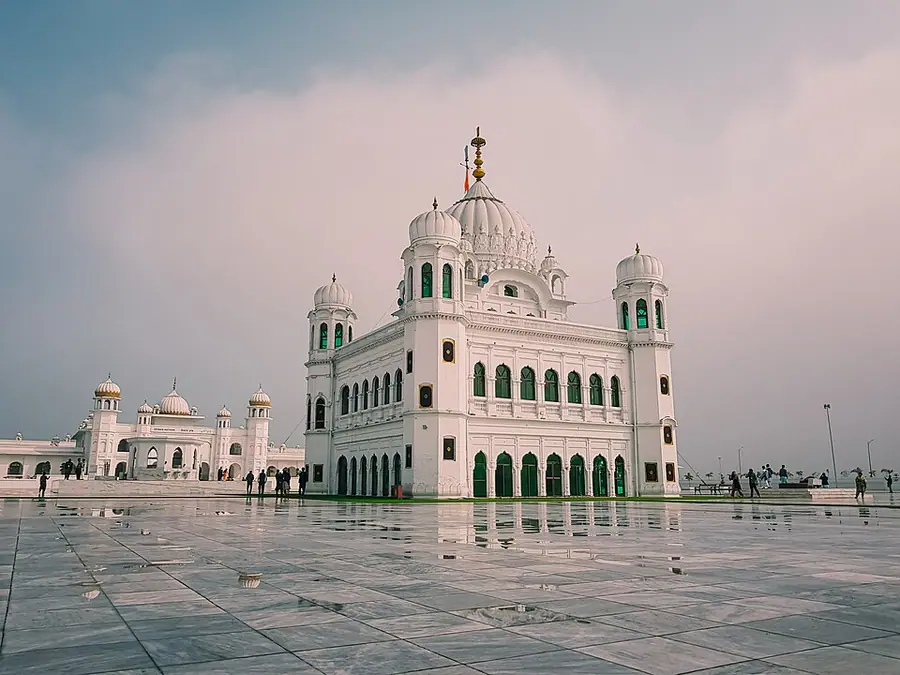
In Punjab, the plain of five rivers between Delhi and Kabul, then a frontier province of the Lodī sultans and from 1526 of the Mughals. Consensus Its first places are Talvaṇḍī, now Nankāṇā Sāhib, where Guru Nānak was born; Sultānpur Lodhī in the Jalandhar doāb, where he worked; and Kartārpur on the right bank of the Rāvī, where he lived his last years. Talvaṇḍī and Kartārpur are now in Pakistan.[1][2] Majority
It was a crowded religious world: Sufi shrines such as Bābā Farīd’s at Pākpattan, Nāth yogīs, Brahmin priests and pilgrimage, and the songs of devotional poets from Banaras and Maharashtra. Guru Nānak’s hymns argue with all of them by name, which is the best evidence for that world.[11][12] Majority
How did Sikhism start?
As a teacher’s following that became a settled community, then an organised one with its own centres and book. Majority
Kartārpur. After years on the road, by every account with the Muslim minstrel Mardānā, Guru Nānak settled at Kartārpur in the 1520s. Bhāī Gurdās says he took off the dress of the wandering ascetic, put on “worldly clothes” and sat as a teacher; the Japu was recited before dawn and the evening hymns sung at night.[13][2] Majority McLeod and Grewal drew from this a community of householders who worked their fields and worshipped together, and that it had a regular order of worship in the Guru’s own hymns is among the best-supported conclusions about it.[1][12] Majority
The first succession. Guru Nānak passed over his sons, the ascetic Srī Chand and Lakhmī Dās, and installed his disciple Lahaṇā as Guru Aṅgad. The ballad of Sattā and Balvaṇḍ in the scripture says he “set the royal canopy over Lahaṇā’s head”.[8][2] Majority on the ballad’s date. That act turned a teacher’s following into a line of Gurus, something no other poet of Guru Nānak’s milieu had done.[12][14] Majority
Four Gurus build a community. Between 1539 and 1606 Guru Aṅgad, Guru Amar Dās, Guru Rām Dās and Guru Arjan added the institutions: the Gurmukhī script for the hymns, the laṅgar as a rule, deputies across the country, the town of Amritsar with the Harmandir Sāhib (the Golden Temple), and in 1604 the Ādi Granth (§3).[2][9] Majority By 1606 the emperor Jahāṅgīr could complain that the Gurus had drawn followers among Hindus and “even some ignorant, stupid Muslims”, and had been doing so “for three or four generations”.[15][16] Consensus
When did Sikhism become a separate religion?
Here the question stops having one answer, and it is fought over. Political
- The early community saw itself as a distinct path. Its members called themselves Sikhs, “disciples”, and the panth, “the path”; a Persian survey of c. 1645–1658, the Dabistān-i Mazāhib, describes the Nānakpanthīs as followers of Guru Nānak who did not worship idols and paid little heed to caste.[17][18][19] Majority Bhāī Gurdās pictured Hindus and Muslims as two roads that had lost their way to one God.[20] Consensus on the text.
- The Khālsā, 1699. Guru Gobind Singh founded the order of initiated Sikhs at Anandpur, with its own initiation and name (§5). It has always been a part of the community rather than the whole of it.[21][22] Consensus that the Khālsā was founded around 1699.
- The boundary drawn hard, 1870s–1900s. Harjot Oberoi argues that many who revered the Gurus kept Hindu rites until the Singh Sabhā reformers drew a firm line, put most clearly in Kāhn Singh Nābhā’s Ham Hindū Nahīṅ, “We are not Hindus” (1898); J. S. Grewal and others reply that the Khālsā norm was old and the reformers enforced it (§8).[23][24][25] Contested
The Sikh tradition and most historians agree that what began with Guru Nānak was already a community of its own by the time of the fifth Guru; where they differ is how sharp its edges were, and when.[2][12][23] Majority
How do we know? The sources for the beginning of Sikhism
As with several religions, the founder’s words are early and the stories of his life are late. Consensus
- The hymns. Nearly a thousand of Guru Nānak’s hymns survive. Some are in the Goindvāl pothīs of about 1570–1572, within about thirty years of his death, of which only two volumes survive; all are in the Ādi Granth of 1604; no hymn survives in his own hand.[26][27][9] Majority They give his teaching and a few datable events, but no biography.
- Bhāī Gurdās. A kinsman of the third Guru who knew the later Gurus, writing in the early seventeenth century; a poet and theologian, not a chronicler.[7][2] Consensus
- The janamsākhīs. Lives of Guru Nānak written down from the seventeenth century, which disagree with one another; McLeod’s sorting of them in 1968 left a short outline as probable.[1][4] Majority
- Outside witnesses. None in Guru Nānak’s lifetime, apart from a disputed inscription at Baghdad. The first is Jahāṅgīr, in 1606 (How We Know).[15][28] Consensus
A short timeline
| Date | Event | Confidence |
|---|---|---|
| 1469 | Guru Nānak born at Talvaṇḍī[1][3] | Consensus (year); Contested (month) |
| c. 1500 | At Sultānpur Lodhī; his call, by tradition[1][3] | Majority (Sultānpur); Contested (date) |
| c. 1500–1520s | Years of travel with Mardānā[1][29] | Majority (travel); Contested (routes) |
| 1519–1526 | Bābur’s invasions; the Bābar-vāṇī hymns[6][2] | Consensus |
| 1520s | Guru Nānak settles at Kartārpur[2][13] | Majority |
| 1539 | Lahaṇā installed as Guru Aṅgad; Guru Nānak dies[8][2] | Consensus |
| c. 1570–1572 | The Goindvāl pothīs[26][27] | Majority |
| 1604 | The Ādi Granth completed and installed at Amritsar[9][30] | Consensus |
| 1606 | Jahāṅgīr records the execution of Guru Arjan[15] | Consensus |
| c. 1645–1658 | The Dabistān describes the Nānakpanthīs[18] | Majority |
| 1699 | The Khālsā founded at Anandpur[21] | Consensus (the founding) |
| 1708 | The line of human Gurus ends; in Sikh belief the scripture becomes the Guru[9][31] | Consensus (belief) |
| 1898 | Ham Hindū Nahīṅ[24] | Consensus |
Common misconceptions
- “Guru Gobind Singh founded Sikhism in 1699.” He founded the Khālsā, an order within a community that by then was a century and a half old; he was its tenth Guru.[22] Consensus
- “Sikhism was founded in 1469.” That is the year of Guru Nānak’s birth, not of anything he did. Consensus
- “Sikhism is a blend of Hinduism and Islam.” Guru Nānak used Hindu and Muslim names for God, but rejected the rituals and authorities of both; Sikhs reject the description, and most historians describe a new tradition (Is Sikhism a mix of Hinduism and Islam?).[1][11] Political
- “The Guru Granth Sāhib was the scripture from the start.” The hymns were sung at Kartārpur; they were written into collections from about 1570, compiled as a book in 1604, and in Sikh belief became the Guru in 1708 (Who wrote the Guru Granth Sahib?).[12][9] Majority
Why it matters
“When was Sikhism founded?” has a believer’s answer and a historian’s, and they do not contradict each other. For Sikhs the religion begins when God sent Guru Nānak; for historians it begins with a poet-teacher in early sixteenth-century Punjab whose hymns survive, a community of householders at Kartārpur, and the decision in 1539 to pass the Guruship to a disciple. Almost everything else people picture as Sikh, the scripture, the Golden Temple, the Khālsā and the Five Ks, came after him and can be dated, which is what the rest of this series does (§2). Majority
References
- ^ a b c d e f g h i j k l W. H. McLeod Guru Nanak and the Sikh Religion. Clarendon Press, Oxford, 1968. The critical study of Nānak's life and theology, separating the janamsākhī tradition from the hymns.
- ^ a b c d e f g h i j k l J. S. Grewal The Sikhs of the Punjab. The New Cambridge History of India II.3, Cambridge University Press, 1990. The standard narrative history; revised edition 1998.
- ^ a b c Purātan Janamsākhī — Lives of Nānak in the Colebrooke and Hāfizābād manuscripts. 17th c. CE. Punjabi in Gurmukhi. The tradition McLeod judged the least elaborated, and the basis of his sorting of the stories.
- ^ a b W. H. McLeod Early Sikh Tradition: A Study of the Janam-sākhīs. Clarendon Press, Oxford, 1980. The janamsākhī traditions, their manuscripts and how they grew.
- ^ Guru Granth Sāhib, ang 150 — Guru Nānak, Vār Mājh. before 1539 CE (composed); 1604 CE (compiled). Punjabi in Gurmukhi. "I was a minstrel without work, and the Lord gave me work": Nānak's call in the language of a court minstrel. read the text
- ^ a b Guru Granth Sāhib, ang 360 — Guru Nānak, Āsā (Bābar-vāṇī). 1520s CE (the events); 1604 CE (compiled). Punjabi in Gurmukhi. Nānak on the Mughal invasion: "Having made Khurāsān his own, he has terrified Hindustan." The most securely datable lines in the scripture. read the text
- ^ a b Bhāī Gurdās, Vār 1.23 — Vārāṅ. early 17th c. CE. Punjabi in Gurmukhi. "The bountiful Lord heard the cry and sent Guru Nānak into the world": the first vār's history of the world reaches Nānak here, then follows his travels and the succession to Guru Hargobind. read the text
- ^ a b c Guru Granth Sāhib, ang 966 — Sattā and Balvaṇḍ, Vār in Rāmkalī. late 16th c. CE. Punjabi in Gurmukhi. A minstrels' ballad, inside the scripture, on Nānak passing the Guruship to Lahaṇā (Aṅgad): the earliest account of the succession. read the text
- ^ a b c d e f Pashaura Singh The Guru Granth Sahib: Canon, Meaning and Authority. Oxford University Press, 2000. doi The formation of the Sikh canon, from the 1604 Ādi Granth to its installation as Guru.
- ^ Kharak Singh, G. S. Mansukhani and Jasbir Singh Mann, eds. Fundamental Issues in Sikh Studies. Institute of Sikh Studies, Chandigarh, 1992. Essays against McLeod's school, from its Sikh critics.
- ^ a b c J. S. Grewal Guru Nanak in History. Panjab University, Chandigarh, 1969. Nānak set against the politics and the religious groups of fifteenth- and early sixteenth-century Punjab.
- ^ a b c d e f Gurinder Singh Mann The Making of Sikh Scripture. Oxford University Press, New York, 2001. The manuscripts from the Goindvāl pothīs to the Damdamā recension.
- ^ a b Bhāī Gurdās, Vār 1.38 — Vārāṅ. early 17th c. CE. Punjabi in Gurmukhi. Back at Kartārpur the Guru puts off the udāsī's dress; Aṅgad set over the sons; the Japu recited at dawn and the Sodar and Āratī sung. read the text
- ^ Pashaura Singh The Bhagats of the Guru Granth Sahib: Sikh Self-Definition and the Bhagat Bani. Oxford University Press, New Delhi, 2003. Farīd, Kabīr, the Sants and the Vaiṣṇava bhagats inside the scripture, and the Gurus' replies to them.
- ^ a b c Jahāṅgīrnāmā, regnal year 1 (1606) — Memoirs of Jahāṅgīr. 1606 CE. Persian. The emperor's own account of ordering Guru Arjan's execution, which he links to the Guru's blessing of the rebel prince Khusrau.
- ^ Wheeler M. Thackston, trans. The Jahangirnama: Memoirs of Jahangir, Emperor of India. Oxford University Press and Smithsonian Institution, 1999.
- ^ Eleanor Nesbitt Sikhism: A Very Short Introduction. Oxford University Press, 2nd ed., 2016.
- ^ a b Dabistān-i Mazāhib, on the Nānakpanthīs — The School of Religions. c. 1645–1658 CE. Persian. A Persian survey of religions with a chapter on the followers of Nānak by an author who knew Guru Hargobind and Guru Har Rāī: the masands, the Gurus' court, and Sikhs who rejected idols and caste rules.
- ^ J. S. Grewal and Irfan Habib, eds. Sikh History from Persian Sources: Translations of Major Texts. Tulika, New Delhi, 2001. Jahāṅgīr, the Dabistān, court newsletters and chronicles in English.
- ^ Bhāī Gurdās, Vār 1.21 — Vārāṅ. early 17th c. CE. Punjabi in Gurmukhi. Hindus of four varṇas and Muslims of four schools of law quarrel over one God: "they call on Rām and Rahīm; the Name is one." The Gurus' circle's picture of the world before Nānak. read the text
- ^ a b Sainapati, Srī Gur Sobhā — Poem on Guru Gobind Singh by a poet of his court. early 18th c. CE. Braj in Gurmukhi. The earliest account of the Khālsā's creation, by a poet of Gobind Singh's court: the Guru makes the congregations his own khālsā and removes the masands.
- ^ a b W. H. McLeod Who Is a Sikh? The Problem of Sikh Identity. Clarendon Press, Oxford, 1989.
- ^ a b Harjot Oberoi The Construction of Religious Boundaries: Culture, Identity, and Diversity in the Sikh Tradition. University of Chicago Press, 1994. The "Sanātan" Sikhism of the early nineteenth century and the Singh Sabhā's sharper boundaries.
- ^ a b Ham Hindū Nahīṅ — Kāhn Singh Nābhā. 1898 CE. Punjabi in Gurmukhi. 'We are not Hindus': a dialogue between a Hindu and a Sikh arguing from scripture that Sikh doctrine on caste, incarnation, images and ritual makes the Sikhs a separate religion. The Tat Khālsā's manifesto. about
- ^ J. S. Grewal Contesting Interpretations of the Sikh Tradition. Manohar, New Delhi, 1998. Includes Grewal's critique of Oberoi's 'Sanātan' thesis.
- ^ a b Goindval Pothīs — Early Sikh manuscript collections. c. 1570s. Punjabi in Gurmukhi. The earliest written Sikh collections, and the earliest datable manuscript witnesses to Kabīr, Nāmdev and Ravidās.
- ^ a b Gurinder Singh Mann The Goindval Pothis: The Earliest Extant Source of the Sikh Canon. Harvard Oriental Series 51, Harvard University Press, 1996.
- ^ V. L. Ménage The "Gurū Nānak" Inscription at Baghdad. Journal of the Royal Asiatic Society of Great Britain and Ireland 111 (1): 16–21, 1979. doi Replies to critics (Harbans Singh among them) of his note printed in McLeod 1968: the words read as "Bābā Nānak" break the metre, the date was retouched, and the chronogram points to 1811–12; accepts the reading faqīr.
- ^ Bhāī Gurdās, Vār 1.35 — Vārāṅ. early 17th c. CE. Punjabi in Gurmukhi. At Baghdad with "Mardānā the rabāb player"; the call to prayer, and the pīr Dastgīr's questions. read the text
- ^ Kartārpur bīṛ — The volume kept at Kartārpur (Jalandhar) by the Sodhī family. 1604 CE (by tradition and its own dating). Punjabi in Gurmukhi. Held by tradition to be Guru Arjan's master copy of the Ādi Granth; its status, and what its erasures and blank pages mean, are argued over.
- ^ W. H. McLeod Sikhs of the Khalsa: A History of the Khalsa Rahit. Oxford University Press, New Delhi, 2003. The code of conduct from the rahitnāmās to the Sikh Rahit Maryādā; the main source for dating the Five Ks.