The short version: nobody who knew ʿAbd al-Malik wrote down why he built the Dome of the Rock. The answers historians give are inferences from the building, from its inscription, and from reports written two and three centuries later. The inscription points most clearly at Christians; a disputed later report points at Mecca; the place itself points at the Temple. The readings are not exclusive, and most historians combine more than one (Islam §5). Contested
What the building is
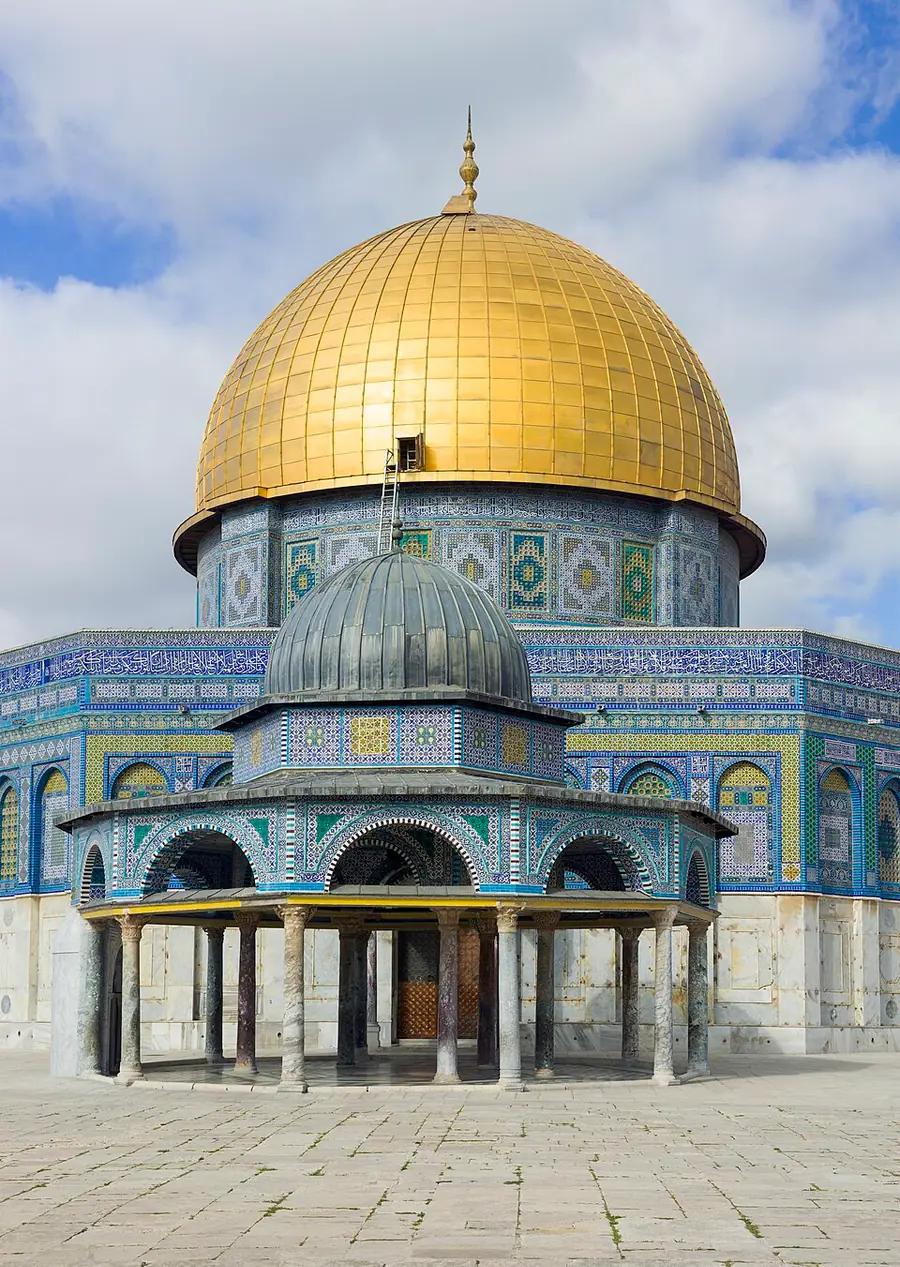
The Dome of the Rock stands on the platform in Jerusalem that Jews call the Temple Mount and Muslims the Ḥaram al-Sharīf, over an outcrop of bedrock. It is an octagon with a gilded dome, built in the manner of Byzantine churches and martyria, and decorated inside with mosaics of jewels, crowns and trees but no human or animal figures.[1] Consensus It is a shrine built over the Rock, not the congregational mosque of the compound: the al-Aqsa Mosque is a separate building at the southern end of the same platform. Consensus
A band of mosaic inscription in gold on blue, about 240 metres long, runs round both faces of the octagonal arcade inside, and gives the date of completion: the year 72, 691–692 CE. When building began is less certain; sources give 685–686 or 688.[2][3] Consensus on the date of completion. The builder’s name was later erased. Under the Abbasid caliph al-Maʾmūn (r. 813–833) it was replaced with his own, but the date was left as it was, which gives the substitution away (Islam §0).[2] Consensus
What the inscription says
The inscription is the longest Arabic text surviving from the first Islamic century, and the earliest dated public display of the Qur’an’s words. On the outer face it repeats the creed, “there is no god but God, alone, he has no partner” and “Muhammad is the messenger of God”, with sura 112, “He is God, One… He begets not, nor was he begotten”. On the inner face it turns to Christians. It quotes Qur’an 4:171–172:
“O People of the Book, do not go beyond the bounds in your religion, and say nothing but the truth about God. The Messiah, Jesus son of Mary, was only a messenger of God and His word… Do not say ‘Three’. Refrain; it is better for you. God is only one God.”[2][4]
It goes on with a version of 19:33–36 on Jesus as a mortal servant of God, and ends with 3:18–19, “the religion with God is islām”.[2][5] Consensus on the passages.
Estelle Whelan showed that its departures from the standard text of the Qur’an follow the conventions of inscriptions, which adapt quotations into a continuous statement, so the building presupposes an already codified Qur’an (Islam §3).[3] Majority
Two things are striking about this text. It is addressed to Christians, in a city whose skyline was dominated by Christian churches. And it is the first public monument to name the religion islām and to proclaim Muhammad as God’s messenger, in the decade when his name first appears on official coins (Islam §0). Consensus on both facts.
Explanation 1: an answer to Christianity
A tenth-century geographer from Jerusalem, al-Muqaddasī, reported his uncle’s view that ʿAbd al-Malik, “noting the greatness of the Dome” of the Church of the Holy Sepulchre, “was moved lest it should dazzle the minds of the Muslims”, and so built a dome over the Rock.[6] S. D. Goitein took this line in 1950, and Oleg Grabar, reading the inscription and the decoration together in 1959, argued that the building announced the arrival of Islam in a Christian city: its form borrowed from Christian architecture, its texts corrected Christian belief.[7][1] Majority
This explanation has the advantage of resting on the building’s own words. Its weakness is that al-Muqaddasī wrote three centuries after the event, and his uncle’s view was an interpretation, not a record.
Explanation 2: a substitute for Mecca
The historian al-Yaʿqūbī, writing in the late ninth century, says that because ʿAbd Allāh ibn al-Zubayr, the rival caliph who held Mecca, used the pilgrimage season to make Syrians swear allegiance to him, ʿAbd al-Malik forbade them to go to Mecca and told them the Rock “shall be unto you in the place of the Kaʿba”, and had people walk round it as pilgrims walked round the Kaʿba.[8]
- For: the building was under construction during the civil war in which Ibn al-Zubayr held Mecca, and its octagonal ambulatory suits walking round a sacred object. Ignaz Goldziher accepted the report in 1890, and Amikam Elad argued in 1992 that it is also found in sources without al-Yaʿqūbī’s bias and cannot simply be dismissed as propaganda.[9][10]
- Against: al-Yaʿqūbī was hostile to the Umayyads; other early historians do not mention so dramatic a step; a caliph could not have hoped to win Muslims by abolishing a duty laid down in the Qur’an; and the inscription, completed in the very year Ibn al-Zubayr fell, says nothing about Mecca or pilgrimage (Goitein).[7]
Most historians doubt the report, but it remains in play. Contested
Explanation 3: the Temple and the night journey
The Rock stands on the site of the Jewish Temple, and Jewish tradition already associated it with Abraham’s sacrifice of his son and with the creation of the world. Several historians read the building as claiming Jerusalem’s sacred history for the new faith, in a city the Qur’an’s community already revered.[1][11] Contested on what ʿAbd al-Malik intended.
Later Muslim tradition linked the Rock with Muhammad’s night journey and ascension. The Qur’an speaks of God taking “His servant” by night “from the sacred place of worship to the furthest place of worship (al-masjid al-aqṣā)” (Q 17:1), and tradition identified the “furthest place” with Jerusalem.[12] But the building’s inscription does not mention the night journey, and the association of the Rock with the ascension appears in the sources only after it was built. Majority that the association is later.
Explanation 4: an imperial programme
The Dome was one work among many. In the decade after 691 ʿAbd al-Malik replaced the images on the coinage with Qur’anic texts, put his name and the Prophet’s on milestones, and made Arabic the language of government (Islam §5).[11][13] Consensus Jeremy Johns, surveying the archaeological and documentary evidence, concluded that Islam becomes visible as a public, state religion in the 690s.[13] Majority On this reading, the Dome is the grandest statement of a new order: a Muslim empire announcing its faith in the most contested city it ruled.
How the explanations fit together
The building stood in a Christian city, was finished at the end of a civil war over the caliphate, and belongs to the decade when the dynasty first proclaimed the Prophet in public. Each of those contexts can be read in it, and Chase Robinson’s study of ʿAbd al-Malik treats them together.[11] Majority What divides historians is mainly the Mecca report: whether it records a real motive or a later accusation against the Umayyads.
Common misconceptions
- “The Dome of the Rock is the al-Aqsa Mosque.” They are separate buildings on the same platform; the Dome is a shrine over the Rock. Consensus
- “It was built to mark Muhammad’s ascension.” Its own inscription says nothing of the night journey, and the association appears in the sources later. Majority
- “It was built on the ruins of a church or the Temple building.” The Temple had been destroyed in 70 CE; the Dome was built over the bare rock of the platform. Consensus
References
- ^ a b c Oleg Grabar The Umayyad Dome of the Rock in Jerusalem. Ars Orientalis 3, 1959. Reads the building and its inscriptions as a statement of Islam's arrival in a Christian city.
- ^ a b c d Dome of the Rock, inner arcade inscription — Foundation inscription of ʿAbd al-Malik. 72 AH / 691–692 CE. Arabic. Monumental kufic band of Qur'anic passages on God's oneness and Jesus as messenger (4:171, 3:18–19, 19:33–36), dated 72; the founder's name was later replaced by al-Maʾmūn's. about
- ^ a b Estelle Whelan Forgotten Witness: Evidence for the Early Codification of the Qurʾān. Journal of the American Oriental Society 118, 1998. Reads the Dome of the Rock and Medina inscriptions as presupposing a codified text.
- ^ Qurʾan 4:171 — Qurʾan, Sūrat al-Nisāʾ. 7th c. CE. Arabic. 'Do not say "Three"… God is only one God': the verse on Jesus quoted on the Dome of the Rock. read the text
- ^ Qurʾan 3:18–19 — Qurʾan, Sūrat Āl ʿImrān. 7th c. CE. Arabic. 'The religion with God is islām': quoted on the Dome of the Rock in 691–692. read the text
- ^ al-Muqaddasī, Aḥsan al-taqāsīm, on the mosque of Damascus and the Dome of the Rock — al-Muqaddasī, The Best Divisions for Knowledge of the Regions (trans. Guy Le Strange, Palestine under the Moslems, 1890). 985 CE. Arabic. His uncle explains al-Walīd's mosque and ʿAbd al-Malik's Dome as answers to Syria's churches and the Holy Sepulchre, 'lest it should dazzle the minds of the Muslims'. about
- ^ a b S. D. Goitein The Historical Background of the Erection of the Dome of the Rock. Journal of the American Oriental Society 70, 1950. Rejects the report that the Dome was meant to replace the pilgrimage to Mecca.
- ^ al-Yaʿqūbī, Taʾrīkh, on the building of the Dome of the Rock — al-Yaʿqūbī, History (trans. Guy Le Strange, Palestine under the Moslems, 1890). late 9th c. CE. Arabic. ʿAbd al-Malik forbids Syrians the pilgrimage while Ibn al-Zubayr holds Mecca and declares the Rock 'in the place of the Kaʿba'. about
- ^ Ignaz Goldziher Muhammedanische Studien, vol. 2. Max Niemeyer, 1890. The founding critique of the hadith as evidence for the first century.
- ^ Amikam Elad Why Did ʿAbd al-Malik Build the Dome of the Rock? A Re-examination of the Muslim Sources. in J. Raby and J. Johns (eds), Bayt al-Maqdis: ʿAbd al-Malik's Jerusalem, Part One, Oxford University Press, 1992. Argues the pilgrimage-diversion report is not confined to al-Yaʿqūbī and cannot simply be dismissed.
- ^ a b c Chase F. Robinson ʿAbd al-Malik. Oneworld, 2005. The caliph's reign and the making of a public Islamic state in the 690s.
- ^ Qur'an 17:1 — The Qur'an. early 7th c. CE. Arabic. God takes his servant by night from the sacred place of worship to the furthest place of worship (al-masjid al-aqṣā). about
- ^ a b Jeremy Johns Archaeology and the History of Early Islam: The First Seventy Years. Journal of the Economic and Social History of the Orient 46, 2003. Islam as a public state religion becomes visible in the documents of the 690s.