The short version: Abū Bakr, ʿUmar, ʿUthmān and ʿAlī, who led the Muslim community in turn from Muhammad’s death in 632 until 661. All four were early followers of Muhammad from his own tribe of Quraysh, and all four were his relatives by marriage. Under them the community became an empire; three of them were killed, and the last two reigns ended in the first civil war. Consensus on the outline. What follows is who each was, how each was chosen, what “caliph” meant in their time, and why the two main branches of Islam remember them differently.
How they were chosen
The Qur’an names no successor to Muhammad and sets no procedure for choosing one, and no two of the four were chosen the same way (§4). Consensus
Abū Bakr (r. 632–634) was an early convert and the father of Muhammad’s wife ʿĀʾisha. According to the tradition, when Muhammad died the Medinan Helpers met to choose a leader of their own; ʿUmar and Abū Bakr hurried to the meeting and secured the leadership for Abū Bakr, while ʿAlī was preparing the body for burial.[1][2] Majority on the outline. The tradition gives him a short accession speech: he had been given authority although he was “not the best” of them, and they should obey him only while he obeyed God and his messenger.[1] Majority that the speech is early in the tradition; its words are the biographers’.
His two years were taken up by the wars the tradition calls the ridda, “apostasy”, against Arabian groups that stopped paying alms or followed rival prophets such as Musaylima. Historians point out that much of Arabia had never been under Medina’s control, so the “apostasy” was in large part a first conquest of the peninsula.[3][4] Majority The tradition also credits him with the first collection of the Qur’an, after many who knew it by heart were killed at al-Yamāma (§3).[5] Contested on its historicity.
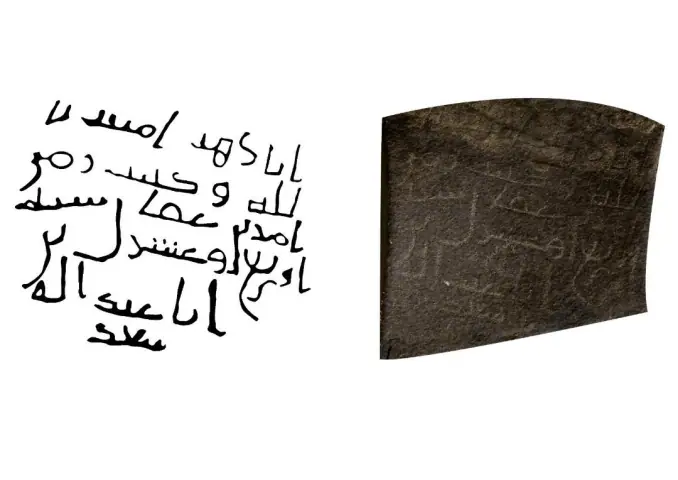
ʿUmar ibn al-Khaṭṭāb (r. 634–644) was named by Abū Bakr. His reign saw the great conquests: Syria after the Yarmūk in 636, Iraq after al-Qādisiyya, Jerusalem in 637 or 638, and Egypt from 639.[6][7] Consensus The tradition credits him with founding the state: the Hijri calendar counted from the emigration to Medina in 622, a register of the Arab fighters and their stipends, and garrison towns such as Basra, Kufa and Fusṭāṭ. A receipt from Egypt dated “year twenty-two” (643) shows the calendar in use within a few years.[8][9][10] Majority on the attributions; Consensus on the calendar’s early use. He was stabbed in the mosque at Medina in November 644 by Abū Luʾluʾa, a Persian slave. An inscription in north-west Arabia records “the time ʿUmar died” in the year 24 (How we know).[8][11] Consensus
ʿUthmān ibn ʿAffān (r. 644–656) was chosen by a council of six senior companions whom ʿUmar is said to have named as he died. He was an early convert from the Umayyad clan of Quraysh and twice Muhammad’s son-in-law.[8] Majority The tradition credits him with the standard text of the Qur’an, copied from the sheets of Abū Bakr’s collection and sent to the provinces, with other copies burned; the shared spelling of the oldest manuscripts points to a single written archetype that most scholars place in his reign.[12][13][14] Majority He also appointed kinsmen as governors, among them Muʿāwiya in Syria, and angered the men of the garrison towns. In June 656 rebels from Egypt and Iraq broke into his house in Medina and killed him: the first killing of a caliph by Muslims.[2][8] Consensus
ʿAlī ibn Abī Ṭālib (r. 656–661), Muhammad’s cousin and husband of his daughter Fāṭima, was acclaimed in Medina after the murder. He fought ʿĀʾisha, Ṭalḥa and al-Zubayr at the Battle of the Camel near Basra in 656, and Muʿāwiya at Ṣiffīn in 657, where an arbitration ended the fighting without restoring his position. Some of his own followers rejected the arbitration and became the Khārijites; one of them struck him in the mosque at Kufa in January 661.[2] Consensus His son al-Ḥasan came to terms with Muʿāwiya within months, and the Umayyad dynasty began (§5).[2][8] Consensus
What did “caliph” mean?
The tradition says Abū Bakr was called khalīfat rasūl Allāh, “successor of the messenger of God”, and that ʿUmar, finding “successor of the successor of the messenger of God” too long, took the title “commander of the believers”.[15] Majority as tradition. The documents agree on the second title: amīr al-muʾminīn is what Muʿāwiya is called on the dam he built at al-Ṭāʾif in 677–678.[16] Consensus
Patricia Crone and Martin Hinds pointed to Umayyad coins of the 690s and court poetry that call the ruler khalīfat Allāh, “God’s deputy”, and argued that this was the original sense: the early caliphs claimed religious as well as political authority, and the idea that religious authority belonged to the scholars won out only later, under the Abbasids (§6).[15] Contested Either way, the title was not a settled office handed down from 632 but part of the argument over who spoke for the community. Majority
“Rightly guided”: a later consensus
The phrase “rightly guided caliphs” (al-khulafāʾ al-rāshidūn) reflects a Sunni judgement formed after their time. In the ninth century the traditionists around Aḥmad ibn Ḥanbal came to accept all four, ʿAlī included, as rightly guided, the position that became the Sunni consensus.[17][18] Majority Shia Muslims hold that Muhammad had designated ʿAlī, above all at Ghadīr Khumm, and that the first three set that designation aside; for Twelver Shia, ʿAlī is the first imam rather than the fourth caliph.[19] Consensus that both views exist; historians cannot settle which reading of the first succession is right (Why did Sunni and Shia split?). Contested
Later historians also contrasted the four with what came after. When Muʿāwiya had the leading men swear allegiance to his son Yazīd, writers under the Abbasids made this the moment the caliphate became mulk, mere kingship.[20] Majority that the hereditary designation was new.
After the four
The office the four held lasted, in some form, for almost thirteen centuries. The Umayyads ruled from Damascus until 750, the Abbasids from Baghdad until the Mongols sacked the city in 1258 and executed the caliph; the Abbasid line survived only as figureheads in Mamluk Cairo (§8).[21][22] Consensus Ottoman sultans used the title, and their claim to be caliphs of all Muslims grew mostly later; the story that the last Abbasid caliph handed the office to Selim I in 1517 is not recorded by any contemporary source (§9).[23][24] Majority On 3 March 1924 the Turkish Grand National Assembly abolished the caliphate (§11).[25] Consensus When the “Islamic State” proclaimed a caliphate in 2014, more than 120 Muslim scholars rejected it in a public letter (§13).[26][27] Consensus
Common misconceptions
- “Muhammad appointed Abū Bakr.” In the Sunni account the community chose him; in the Shia account Muhammad had appointed ʿAlī. Neither account has Muhammad formally naming Abū Bakr as caliph. Majority
- “The four ruled a settled Islamic state.” The calendar, the stipend register and the garrison towns were created in these decades, and much the tradition credits to ʿUmar probably developed over a longer period.[8] Majority
- “It was a golden age of peace.” Three of the four were killed, and the last two reigns ended in a civil war among Muhammad’s own companions. Consensus
- “‘Caliph’ always meant a religious-and-political ruler of all Muslims.” What the title claimed was argued from the start, and from the tenth century rival caliphs ruled in Cairo and Córdoba. Majority
What the evidence cannot settle
The names, reigns and violent ends of the four are secure; much of the detail of their decisions comes from biographies and histories written a century and more later (How we know). Consensus Whether ʿAlī should have come first is a question of faith on which each tradition has its answer.
References
- ^ a b Ibn Isḥāq, Sīrat Rasūl Allāh — The Life of Muhammad (recension of Ibn Hishām). mid-8th c. CE (Ibn Hishām's recension, early 9th c.). Arabic. The earliest surviving Muslim biography of Muhammad; source for his alliance and conflicts with the Jewish tribes of Medina (Qaynuqāʿ, Naḍīr, Qurayẓa) and the conquest of Khaybar. about
- ^ a b c d Wilferd Madelung The Succession to Muhammad: A Study of the Early Caliphate. Cambridge University Press, 1997. Argues for the strength of ʿAlī's family claim and reads the first civil war from the early sources.
- ^ Elias S. Shoufani Al-Riddah and the Muslim Conquest of Arabia. University of Toronto Press, 1973. The 'apostasy' wars as largely a first conquest of Arabia.
- ^ Fred M. Donner The Early Islamic Conquests. Princeton University Press, 1981. The conquests as the work of a new state in Medina that united the tribes under one ideology.
- ^ al-Bukhārī, Ṣaḥīḥ 4986 — Ṣaḥīḥ al-Bukhārī, Faḍāʾil al-Qurʾān. compiled before 870 CE. Arabic. Zayd ibn Thābit's account of collecting the Qur'an for Abū Bakr after al-Yamāma, 'from palm stalks, thin white stones' and men's memories. read the text
- ^ Walter E. Kaegi Byzantium and the Early Islamic Conquests. Cambridge University Press, 1992. The Byzantine side of the loss of Syria, Palestine and Egypt.
- ^ Hugh Kennedy The Great Arab Conquests: How the Spread of Islam Changed the World We Live In. Weidenfeld & Nicolson, 2007. Narrative history of the conquests, region by region.
- ^ a b c d e f Hugh Kennedy The Prophet and the Age of the Caliphates. Longman, 1986. Standard political history of the Near East from Muhammad to the eleventh century.
- ^ PERF 558 (Austrian National Library, Papyrus Erzherzog Rainer) — Greek–Arabic receipt from Herakleopolis. Jumādā I 22 AH / 25 April 643 CE. Arabic and Greek. Receipt by the commander ʿAbd Allāh ibn Jābir for 65 sheep; the earliest dated Arabic papyrus, dated by the Hijri era, with dotted letters; the Greek calls the Arabs magaritai. about
- ^ Michael G. Morony Iraq after the Muslim Conquest. Princeton University Press, 1984. Continuity and change in Iraq's society, religions and administration after the conquest.
- ^ Inscription of Zuhayr, Qāʿ al-Muʿtadil near al-ʿUlā — Rock graffito. 24 AH / 644–645 CE. Arabic. 'I, Zuhayr, wrote [this] at the time ʿUmar died in the year four and twenty': the earliest dated Islamic inscription, with dotted letters. about
- ^ al-Bukhārī, Ṣaḥīḥ 4987 — Ṣaḥīḥ al-Bukhārī, Faḍāʾil al-Qurʾān. compiled before 870 CE. Arabic. ʿUthmān has Zayd and three Qurashīs copy Ḥafṣa's sheets, sends a copy to every province and orders other copies burned. read the text
- ^ Nicolai Sinai When Did the Consonantal Skeleton of the Quran Reach Closure? Parts I and II. Bulletin of the School of Oriental and African Studies 77, 2014. Weighs the evidence for later editing, including al-Ḥajjāj; concludes the standard rasm dates to 650 or earlier as the default view.
- ^ Marijn van Putten 'The Grace of God' as Evidence for a Written Uthmanic Archetype: The Importance of Shared Orthographic Idiosyncrasies. Bulletin of the School of Oriental and African Studies 82, 2019. Shared spelling quirks show the early manuscripts descend from one written copy.
- ^ a b Patricia Crone and Martin Hinds God's Caliph: Religious Authority in the First Centuries of Islam. Cambridge University Press, 1986. The caliph as 'God's deputy' with religious authority, later ceded to the scholars.
- ^ Dam inscription of Muʿāwiya near al-Ṭāʾif — Building inscription. 58 AH / 677–678 CE. Arabic. Records the dam built for 'the servant of God Muʿāwiya, commander of the believers' in the year fifty-eight; names God and the caliph, not Muhammad. about
- ^ Muhammad Qasim Zaman Religion and Politics under the Early ʿAbbāsids: The Emergence of the Proto-Sunnī Elite. Brill, 1997. The cooperation of early Abbasid caliphs with the scholars who became Sunni orthodoxy.
- ^ Christopher Melchert The Formation of the Sunni Schools of Law, 9th–10th Centuries C.E.. Brill, 1997. Dates the organized personal schools of law to c. 870–950.
- ^ Moojan Momen An Introduction to Shiʿi Islam: The History and Doctrines of Twelver Shiʿism. Yale University Press, 1985. The standard introduction to Twelver history and doctrine.
- ^ G. R. Hawting The First Dynasty of Islam: The Umayyad Caliphate AD 661–750. Routledge, 2nd ed., 2000. The standard short history of the Umayyads and of the sources' bias against them.
- ^ Peter Jackson The Mongols and the Islamic World: From Conquest to Conversion. Yale University Press, 2017. The Mongol conquests and the Ilkhans' conversion; calls Hülegü's Baghdad death toll 'obviously inflated' (p. 172).
- ^ Michal Biran Libraries, Books, and Transmission of Knowledge in Ilkhanid Baghdad. Journal of the Economic and Social History of the Orient 62 (2–3): 464–502, 2019. Shows that large libraries reopened within two years of the 1258 conquest.
- ^ Caroline Finkel Osman's Dream: The Story of the Ottoman Empire, 1300–1923. John Murray, 2005. The standard one-volume narrative history.
- ^ Treaty of Küçük Kaynarca, 21 July 1774 — Peace treaty between the Russian and Ottoman empires. 1774 CE. Ottoman Turkish, Russian and Italian. Declares the Crimean Tatars independent while recognising the sultan's religious authority over them as caliph, the first international recognition of the claim. about
- ^ Law No. 431 of 3 March 1924 (Hilafetin İlgasına ve Hanedan-ı Osmani'nin Türkiye Cumhuriyeti Memalik-i Haricine Çıkarılmasına Dair Kanun), art. 1 — Law abolishing the caliphate and expelling the Ottoman dynasty. 3 March 1924. Ottoman Turkish. Article 1 declares the caliph deposed and the caliphate abolished, as an office 'essentially contained in the meaning and concept of government and republic'. about
- ^ Islamic State proclamation of a caliphate (29 June 2014) and al-Baghdadi's sermon in Mosul (4 July 2014) — Islamic State statements. 29 June – 4 July 2014. Arabic. The group renames itself the Islamic State and names al-Baghdadi caliph; he preaches at the Great Mosque of al-Nuri in Mosul. about
- ^ Open Letter to Dr. Ibrahim Awwad Al-Badri, alias Abu Bakr Al-Baghdadi (19 September 2014) — Open Letter to al-Baghdadi. 19 September 2014. Arabic and English. More than 120 Muslim scholars refute the Islamic State in 24 points, including the killing of innocents, forced conversion, slavery and the declaration of a caliphate without consensus. about