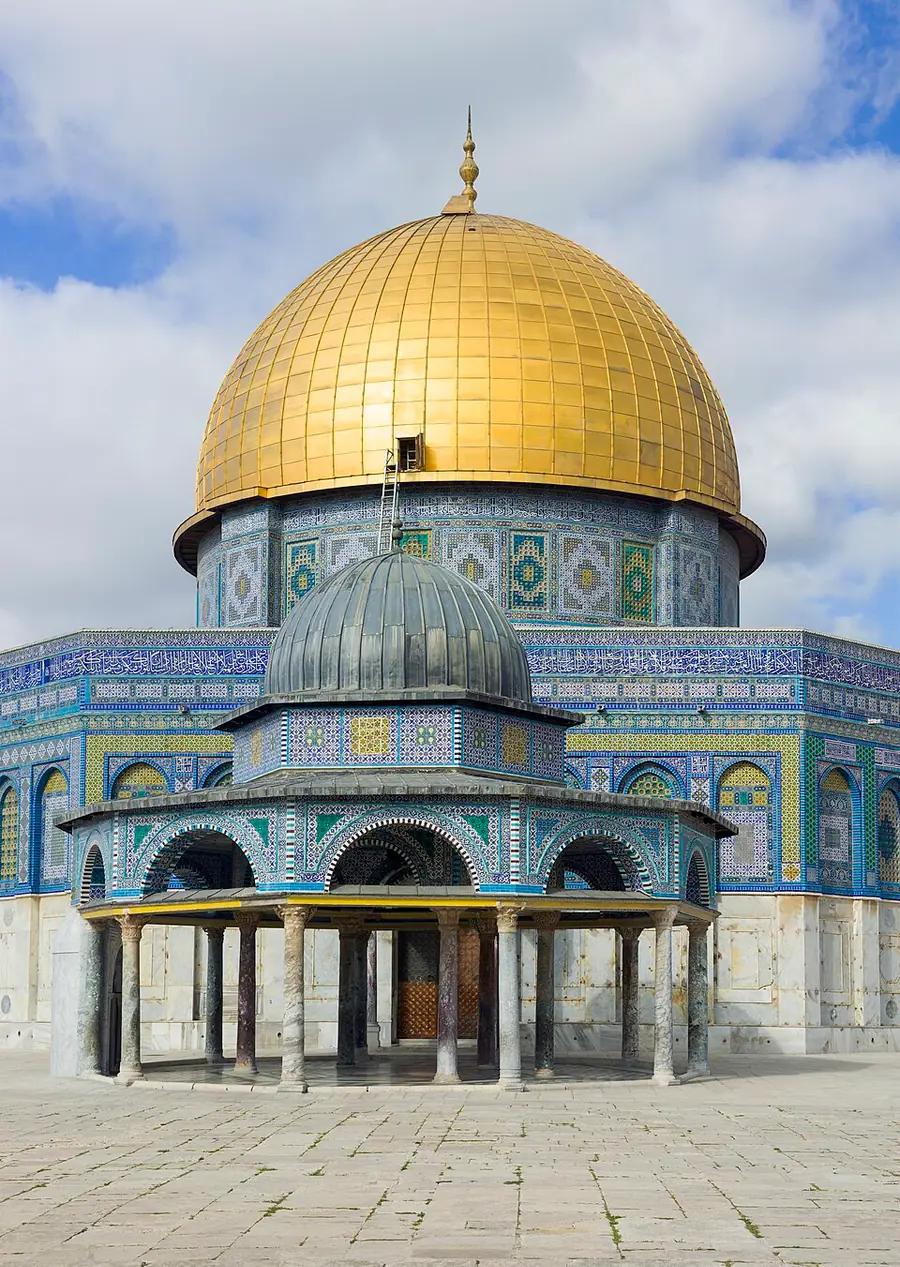
The short version: in October 680 a government army killed the Prophet’s grandson al-Ḥusayn and most of the men with him at Karbalāʾ in Iraq, after he refused to recognise the caliph Yazīd. As a battle it was small; as a memory it became the central story of Shia Islam, and its anniversary, ʿĀshūrāʾ, the most visible day in the Shia year. Consensus on the event. What follows is what the sources say happened, how secure each part is, and how the commemoration grew.
Who al-Ḥusayn was, and why he went
Al-Ḥusayn was the younger son of ʿAlī, Muhammad’s cousin and son-in-law, and of the Prophet’s daughter Fāṭima. His father had been the fourth caliph and was killed in 661; his elder brother al-Ḥasan had come to terms with Muʿāwiya, the first Umayyad caliph, and withdrawn to Medina (§4).[1][2] Consensus
Muʿāwiya broke with the practice of the first four caliphs by having the leading men swear allegiance to his son Yazīd as his successor; later Muslim historians made this the moment the caliphate became mere kingship.[3] Majority When Muʿāwiya died in April 680, al-Ḥusayn refused to swear allegiance to Yazīd. Men of Kufa, ʿAlī’s old capital, wrote inviting him to lead them, and he set out from Mecca with his family and a few dozen companions.[4][3] Consensus
The battle, 10 Muḥarram 61 AH
The governor of Iraq, ʿUbayd Allāh ibn Ziyād, cut off Kufa before al-Ḥusayn could reach it and sent an army to stop him. At Karbalāʾ, on the Euphrates, the small company was surrounded, denied water and, on 10 Muḥarram 61 AH, 10 October 680, killed almost to a man. Al-Ḥusayn’s head was sent to Kufa and then to Damascus; the women and his surviving son ʿAlī were taken as captives (§5).[4][3] Consensus on the event and its date.
How we know: a martyrdom narrative
No account written at the time survives. The detailed story is known mainly from the Kufan historian Abū Mikhnaf (d. 774), whose account al-Ṭabarī preserved in his history two centuries after the battle. It already has the shape of a martyrdom narrative, with dialogues, omens and the thirst of the children.[4][5] Majority that the outline is reliable and the detail shaped by later devotion.
That pattern is typical of the early Islamic sources: the events are confirmed, and the scenes are told by people for whom they already mattered (How we know). Historians accept the refusal, the invitation, the interception, the killing and the date; the speeches and the individual episodes are read as the work of a community remembering. Majority
Karbalāʾ in the second civil war
Karbalāʾ was the first act of a wider war over who should rule. Al-Ḥusayn was not the only man to refuse Yazīd. ʿAbd Allāh ibn al-Zubayr, son of one of Muhammad’s companions and nephew of ʿĀʾisha, made the sanctuary of Mecca his base; in 683 a Syrian army besieged the city and the Kaʿba caught fire. Yazīd’s death that November broke off the siege, and for about a decade Ibn al-Zubayr was recognised as caliph across most of the empire.[3] Consensus
The Umayyads survived in Syria by a narrow victory at Marj Rāhiṭ in 684, and under ʿAbd al-Malik, who succeeded in 685, they won the war back: his general al-Ḥajjāj retook Iraq and in 692 besieged Mecca, where Ibn al-Zubayr was killed.[3][6] Consensus In this light Karbalāʾ was a small engagement in a long struggle between the Umayyads and rival claimants. What set it apart was who died: the Prophet’s grandson, killed by a caliph’s army. That is why it, and not Marj Rāhiṭ, became a day of mourning. Majority
From loyalty to religion
Karbalāʾ turned a political loyalty into a religious one. In 684–685 several thousand Kufans who had failed to come to al-Ḥusayn’s aid called themselves the tawwābūn, “the penitents”, and marched out to die for their failure; most did, at ʿAyn al-Warda in January 685.[3] Consensus Later that year al-Mukhtār seized Kufa in the name of another son of ʿAlī, whom he called al-mahdī, “the rightly guided one”, and hunted down the killers of Karbalāʾ before he was killed in 687. Some of his followers held that their imam had not died but was hidden and would return, an early form of an idea later Shia communities developed.[3][2] Majority
Shīʿa means “party”: at first the party of ʿAlī and his descendants as rightful leaders. In the first Islamic century it was a set of loyalties and revolts, not yet a community with its own law and theology; that took shape over the next two centuries, and Karbalāʾ gave it its central story (Why did Sunni and Shia split?).[3][7] Majority
How ʿĀshūrāʾ grew
ʿĀshūrāʾ, the tenth of Muḥarram, was a fast day before Karbalāʾ. A report in al-Bukhārī’s collection says that when the Prophet came to Medina he found its Jews fasting on that day and fasted on it too; Sunni Muslims still keep it as a voluntary fast, while for Shia Muslims it is above all the day of al-Ḥusayn’s death.[8] Majority on the report.
The Shia commemoration grew over centuries:
- Public mourning, 963. Public processions of mourners in black are first recorded in Baghdad in 963, when the Shia Buyid ruler Muʿizz al-Dawla had the markets closed on ʿĀshūrāʾ; a festival of Ghadīr Khumm followed, and Sunni counter-commemorations and riots between quarters became part of the city’s life (§6).[9][10] Majority
- Iran’s rituals. Under the Safavids, who made Iran Shia from 1501, the rituals of Muḥarram were one of the means by which the population was won to Twelver Shiism; the passion plays, taʿziya, developed under the Safavids and Qajars (§9).[11][9] Majority
- A pilgrimage city. Karbalāʾ itself, the site of al-Ḥusayn’s tomb, became one of the great shrine cities of Shia Islam. In 1801–1802 forces of the first Saudi state attacked it, killed thousands of its people and plundered the shrine; Shia Muslims remember a massacre, while in the attackers’ terms it was a war on the veneration of tombs (§10).[12] Consensus on the event; Political on its memory.
- Modern politics. In the Iran–Iraq war of 1980–1988 Iran’s volunteer militia drew young men to the front with the imagery of Karbalāʾ and martyrdom (§12).[13] Consensus
Common misconceptions
- “Karbalāʾ was where Sunni and Shia split.” It gave the Shia their central story, but the dispute over leadership began in 632, and Sunni and Shia became separate communities only between the eighth and tenth centuries. Majority
- “It was a great battle.” Al-Ḥusayn had a few dozen companions; its importance lies in who died and how it was remembered, not in its size. Consensus
- “ʿĀshūrāʾ is only a Shia day.” It is a voluntary fast day for many Sunnis, with its own origin story in Medina. Majority
- “The rituals are as old as the battle.” Public processions are first recorded almost three centuries later, and the passion plays later still. Majority
What the evidence cannot settle
Historians can date the battle, trace the narrative to its eighth-century tellers and follow the commemoration through the centuries. Whether al-Ḥusayn was right to refuse Yazīd, and what his death means, are questions each tradition answers in its own terms. Consensus
References
- ^ Wilferd Madelung The Succession to Muhammad: A Study of the Early Caliphate. Cambridge University Press, 1997. Argues for the strength of ʿAlī's family claim and reads the first civil war from the early sources.
- ^ a b Hugh Kennedy The Prophet and the Age of the Caliphates. Longman, 1986. Standard political history of the Near East from Muhammad to the eleventh century.
- ^ a b c d e f g h G. R. Hawting The First Dynasty of Islam: The Umayyad Caliphate AD 661–750. Routledge, 2nd ed., 2000. The standard short history of the Umayyads and of the sources' bias against them.
- ^ a b c al-Ṭabarī, Taʾrīkh al-rusul wa-l-mulūk, on Karbalāʾ (after Abū Mikhnaf) — al-Ṭabarī, History of the Prophets and Kings. early 10th c. CE, from Abū Mikhnaf (d. 774). Arabic. The fullest account of al-Ḥusayn's journey and death at Karbalāʾ on 10 Muḥarram 61 AH, preserved from the Kufan historian Abū Mikhnaf. about
- ^ Chase F. Robinson Islamic Historiography. Cambridge University Press, 2003. A short guide to the Arabic historical tradition and how it was made.
- ^ Chase F. Robinson ʿAbd al-Malik. Oneworld, 2005. The caliph's reign and the making of a public Islamic state in the 690s.
- ^ Marshall G. S. Hodgson How Did the Early Shîʿa Become Sectarian?. Journal of the American Oriental Society 75:1, 1–13, 1955. Places the Shia's emergence as a sect in the doctrine of the imamate of Jaʿfar al-Ṣādiq's time.
- ^ al-Bukhārī 3942 — Ṣaḥīḥ al-Bukhārī, Book of the Merits of the Helpers. compiled before 870 CE. Arabic. On arriving in Medina the Prophet found the Jews fasting on the tenth of Muḥarram and fasted on it too; the origin of the Sunni fast of ʿĀshūrāʾ. read the text
- ^ a b Heinz Halm Shiʿa Islam: From Religion to Revolution. Markus Wiener, 1997. The commemoration of Karbalāʾ from the first mourners to the passion plays.
- ^ Moojan Momen An Introduction to Shiʿi Islam: The History and Doctrines of Twelver Shiʿism. Yale University Press, 1985. The standard introduction to Twelver history and doctrine.
- ^ Andrew J. Newman Safavid Iran: Rebirth of a Persian Empire. I.B. Tauris, 2006. A political and religious history of the dynasty; sceptical of the scale of the ʿĀmilī clerical migration.
- ^ David Commins The Wahhabi Mission and Saudi Arabia. I.B. Tauris, 2006. The history of the Najdi movement from Ibn ʿAbd al-Wahhāb to the modern kingdom.
- ^ Pierre Razoux The Iran–Iraq War. Harvard University Press, 2015. A full military and political history of the war of 1980–1988.