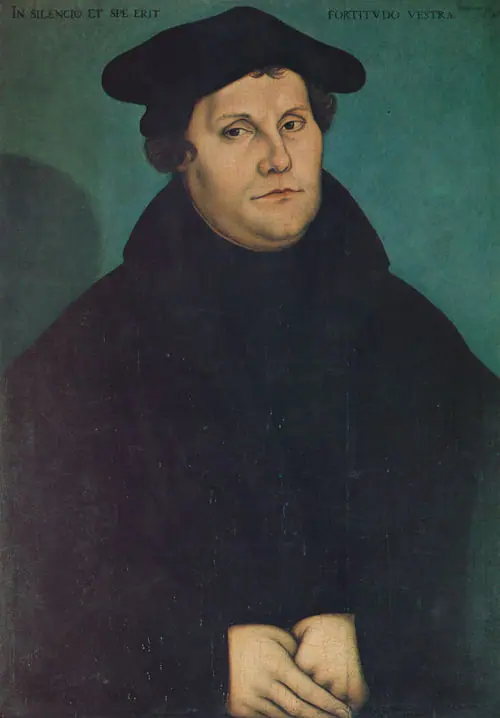
The image is one of the most familiar in European history: a monk with a hammer, a church door, a sheet of protest, and the Reformation begins. The facts behind it are both firmer and less dramatic. That Luther wrote ninety-five theses against the preaching of indulgences, and sent them to the archbishop responsible on 31 October 1517, is certain. Whether he also put them up on a church door is a real historical question, argued for sixty years, and the most important new evidence was found only in 2006.[1][2] Consensus on the letter; Contested on the door.
What the theses were
The Ninety-five Theses were written in Latin, for scholars, as propositions for an academic disputation, a formal debate of the kind universities held regularly. Their title was Disputation on the Power and Efficacy of Indulgences. They did not reject indulgences outright, nor the papacy, nor the sacrament of penance; the word “faith” does not appear in them. They attacked the way the indulgence for the rebuilding of St Peter’s was being preached by the Dominican Johann Tetzel near Wittenberg, and the promise that money could free souls from purgatory:[1][3] Consensus
“27. They preach man who say that so soon as the penny jingles into the money-box, the soul flies out [of purgatory].” (trans. Henry E. Jacobs and Adolph Spaeth)[1]
Thesis 86 put into a layman’s mouth the question why the pope, “whose wealth is to-day greater than the riches of the richest”, did not build St Peter’s with his own money (same translation).[1] Consensus
What is certain: the letter
On 31 October 1517, the eve of All Saints, Luther wrote to Albrecht of Brandenburg, archbishop of Mainz and Magdeburg, in whose lands the indulgence was being preached, and enclosed the theses. The letter survives, and its date is not in doubt. Albrecht, who was to receive half the proceeds of the indulgence to repay his debt to the Fugger bank, received the letter around the end of November, consulted his advisers and sent the matter on to Rome.[1][3] Consensus
Within weeks printers in Leipzig, Nuremberg and Basel had the theses out, and soon in German. Andrew Pettegree has argued that print, not the posting, is what made the theses an event: Luther became the best-selling author of his age, and Wittenberg a printing town.[4] Majority
The story of the door
The posting first appears in print in the preface Philip Melanchthon wrote for the second volume of Luther’s collected Latin works, published in 1546, a few months after Luther’s death. Melanchthon says Luther posted the theses on the church next to the castle in Wittenberg on 31 October 1517. Melanchthon only came to Wittenberg in 1518, so he was not an eyewitness.[5] Consensus on the facts about the source.
In 1961 the Catholic church historian Erwin Iserloh argued that the posting never happened. No source from 1517 mentions it; Luther himself, who wrote a great deal about the events of that autumn, says he sent the theses to the bishops and never describes nailing them up; and the story suited a later Protestant need for a public, heroic beginning. His book appeared in English in 1968 as The Theses Were Not Posted.[5] Contested The argument was fiercely debated, and for decades the honest answer was that nobody could know.
The note found in 2006
In 2006 a handwritten note by Georg Rörer, Luther’s secretary and editor, was identified in Rörer’s copy of the revised New Testament of around 1540. In Latin it records that on the eve of All Saints in 1517 Doctor Martin Luther posted theses about indulgences on the doors of Wittenberg’s churches (paraphrased here).[2] Consensus on the note.
The note matters for three reasons. It was written in Luther’s lifetime, by someone who worked with him every day. It speaks of church doors in the plural, which fits the way Wittenberg’s university actually announced disputations, by posting them on the doors of the town’s churches, rather than the single dramatic door of the legend. Treu argues that it is independent of Melanchthon’s account.[2] Majority that it strengthens the case. It is still not an eyewitness account, and Rörer too may have been repeating what was said in Wittenberg.
The case on each side
| View | Argument | Main proponents |
|---|---|---|
| Legend | No source from 1517 mentions a posting; Melanchthon was not there; Luther never describes it | Iserloh[5] |
| Likely posted | Posting on church doors was how the university announced disputations; Rörer’s note, written in Luther’s lifetime, says so | Treu and others[2] |
| It does not matter much | Print and the letter to Albrecht, not a notice on a door, turned an academic dispute into a public one | Pettegree[4] |
Contested Whatever happened at the door, 31 October 1517 is secure as the date of the letter; Iserloh allowed that a posting, if there was one, may have come in mid-November.[5]
How the door became a monument
The legend grew with the anniversaries. Protestant Germany celebrated the first centenary of the Reformation from 31 October to 2 November 1617, and annual observance of Reformation Day on 31 October followed later.[6] Majority The wooden doors of the Castle Church burned in 1760, when Wittenberg was bombarded in the Seven Years’ War. In 1858 King Frederick William IV of Prussia had bronze doors installed in their place, with the Latin text of the theses cast on them; those are the doors visitors photograph today.[7] Consensus Nineteenth-century paintings of a lone monk swinging a hammer before a crowd fixed the image that schoolbooks repeated. Majority
What happened next
The posting, real or not, was not the break. Luther still hoped the pope would act against the preachers. Over the next three years his position hardened: at Leipzig in 1519 he said councils could err; in 1520 he published his programme of reform; the bull Exsurge Domine condemned forty-one of his propositions, he burned it on 10 December 1520, and in January 1521 he was excommunicated.[8][9] Consensus (§9 tells the story.)
Common misconceptions
- “Luther nailed the theses to the door as an act of defiance.” Posting, if it happened, was the routine way to announce an academic debate. The theses were addressed to scholars, in Latin. Majority
- “The theses rejected the Catholic Church.” They criticised the preaching of indulgences and still assumed the pope would agree. Consensus
- “The Reformation began with a door.” It began with a letter, a set of propositions and the printing press; the door is the part that cannot be proved. Majority
- “The famous doors are the originals.” The originals burned in 1760; today’s bronze doors date from 1858. Consensus
Why it matters
The question is small, but it shows how historians work: a beloved story, a sceptic’s challenge, a new document, and a judgment that weighs both. It also shows how a movement makes its own founding moment. The Reformation needed a beginning, and a door in Wittenberg became one, whether or not a hammer was ever involved (§9).
References
- ^ a b c d e Martin Luther, Ninety-five Theses and letter to Albrecht of Mainz (31 October 1517) — Disputation on the Power and Efficacy of Indulgences. 1517. Latin. The theses against the preaching of indulgences, with Luther's covering letter to Archbishop Albrecht dated 31 October 1517; thesis 27 attacks the claim that the soul flies out of purgatory when the penny jingles. read the text
- ^ a b c d Joachim Ott and Martin Treu, eds. Luthers Thesenanschlag – Faktum oder Fiktion. Evangelische Verlagsanstalt, 2008. Includes Treu's publication of Georg Rörer's note on the posting of the theses.
- ^ a b Diarmaid MacCulloch Reformation: Europe's House Divided, 1490–1700. Allen Lane, 2003. The standard one-volume history, Catholic and Protestant together.
- ^ a b Andrew Pettegree Brand Luther: 1517, Printing, and the Making of the Reformation. Penguin Press, 2015. How Luther and Wittenberg's printers made each other.
- ^ a b c d Erwin Iserloh The Theses Were Not Posted: Luther between Reform and Reformation. Beacon Press, 1968. The case, first made in 1961, that the theses were sent, not nailed up.
- ^ Reformation centenary, 31 October–1 November 1617 — Protestant celebrations in Germany. 1617. German. The first centenary of the Reformation is celebrated across Protestant Germany from 31 October to 2 November 1617; annual Reformation Day observance comes later. about
- ^ Doors of the Castle Church (All Saints' Church), Wittenberg — All Saints' Church, Wittenberg. 1858 (bronze doors). Latin. The wooden doors burned in 1760; in 1858 Frederick William IV installed bronze doors with the Latin text of the theses. about
- ^ Leo X, Exsurge Domine (15 June 1520) — Papal bull. 1520. Latin. Condemns forty-one propositions from Luther's writings and gives him sixty days to recant; Luther burned it on 10 December 1520. about
- ^ Lyndal Roper Martin Luther: Renegade and Prophet. Bodley Head, 2016. Biography stressing Luther's body, emotions and relationships.