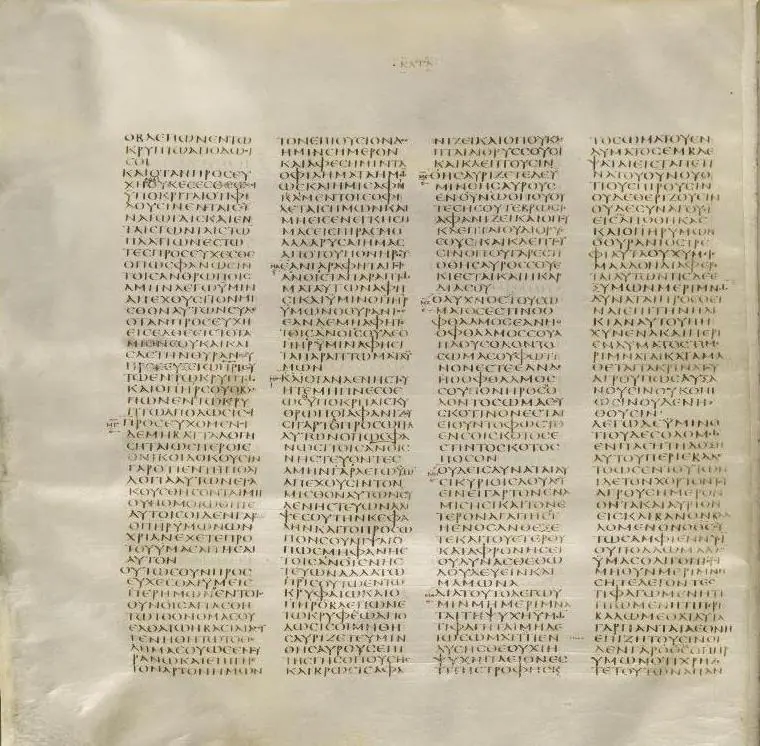
The short version: the “Gnostic gospels” are early Christian writings that did not make it into the New Testament, most of them recovered in the twentieth century from Egyptian sands. They are real ancient texts, and they show that second-century Christianity was more varied than its later historians described. But they are not a suppressed first-century alternative to the Bible: almost all were written after the four canonical Gospels, many are not “gospels” in the sense of a story of Jesus’ life, and several are not Gnostic in any precise sense. Majority
Where they come from
Until the twentieth century, the Christians whom the church fathers called heretics were known mainly from the books written against them, above all Irenaeus of Lyon’s Against Heresies of about 180. Then came a series of finds in Egypt (§0):
- Oxyrhynchus. From 1897, excavators of the rubbish mounds of a town on the Nile found Greek sayings of Jesus, later identified as parts of the Gospel of Thomas, copied about 200–250.[1] Consensus
- The Berlin Codex, bought in Cairo in 1896 and published in 1955, contains the Gospel of Mary and a version of the Secret Book of John.[2] Consensus
- Nag Hammadi. In December 1945, farmers digging near Nag Hammadi in Upper Egypt found a sealed jar with twelve leather-bound papyrus books and leaves of a thirteenth: 52 tractates in Coptic, about 46 distinct works, translated from Greek. Papyrus used to stiffen their covers carries dates in the 340s.[3][4] Consensus
- Codex Tchacos, found in the 1970s and published in 2006, contains the Gospel of Judas; the codex was radiocarbon-dated to about 220–340.[5] Consensus
The name “Gnostic gospels” became popular through Elaine Pagels’ book of that title in 1979.[6] Majority
What they say
They do not share one theology. The main kinds are these.
- Sayings collections. The Gospel of Thomas has 114 sayings and no account of Jesus’ death or resurrection; about half have parallels in Matthew, Mark and Luke. It stresses inner knowledge and the kingdom within, but it does not contain the creation myth of the Sethian texts, and is often called “Gnostic” only loosely.[7][8] Majority Its last saying has Peter say “women are not worthy of life” and Jesus promise to “make her male”, so that Mary too may become a living spirit (trans. Thomas O. Lambdin).[9]
- Revelation dialogues. The Secret Book of John and the Gospel of Mary set out teaching the risen Jesus gave privately to a disciple. In the Gospel of Mary, Mary Magdalene comforts the disciples and teaches them; Peter objects that the Saviour would not have spoken to a woman in preference to them, and Levi rebukes him.[2][10] Majority
- Sethian myth. Texts such as the Secret Book of John tell how the material world was made by an arrogant, ignorant lesser god, Yaldabaoth, and how a divine spark trapped in humanity can be freed by knowledge of the true, hidden God. Irenaeus summarised a version of this myth around 180, which shows it existed by then.[11][3] Majority
- Valentinian teaching. The Gospel of Truth and the Gospel of Philip come from the circle of Valentinus, who taught in Rome from about 136 to 160 and whose followers saw themselves as a spiritual elite within the ordinary churches.[12][13] Majority
- The Gospel of Judas, presented in 2006 as rehabilitating Judas, was soon argued by April DeConick and others to mock him instead, as a demon serving the creator god.[5][14] Contested It is probably the work Irenaeus knew by that name around 180.[15] Majority
Are they Gnostic?
Gnōsis is Greek for knowledge. The word Gnosticism is modern, first used by the English philosopher Henry More in 1669.[16] Majority In 1996 Michael Williams argued that the category should be dismantled, because the groups it lumped together shared no single set of beliefs and were described as a unity mainly by their opponents; Karen King traced how the category was built, first by the church fathers and then by modern scholars.[17][18] Bentley Layton and David Brakke keep a narrower sense: Irenaeus describes a group calling itself Gnostic whose myth matches the Sethian texts, which Brakke calls the “Gnostic school”, and the word can be reserved for it.[16][19] Contested On either view, calling the whole Nag Hammadi library “Gnostic” lumps together very different works. Majority
How old are they?
Most of these texts were composed in the second century, a generation or more after the canonical Gospels, which were written between about 70 and 110 (§0). The copies we have are later still: the Nag Hammadi books were made after the 340s. Majority
The main exception argued for is Thomas. Most scholars date it in something like its present form to the second century, and Mark Goodacre has argued that it knew Matthew and Luke. April DeConick has argued for an early core of sayings, perhaps from before 50 CE, expanded over the following decades.[8][20] Contested No scholar dates the Sethian or Valentinian gospels to the first century. Majority
Why are they not in the Bible?
No council voted them out. The New Testament grew by use: by about 180 Irenaeus insisted on exactly four Gospels, and the first list of exactly the 27 books is Athanasius’ Easter letter of 367 (§5).[21][22] Consensus The tests the churches applied were age, apostolic authorship, wide use, and agreement with the “rule of faith”, a summary of belief received at baptism whose first article, one God who made heaven and earth, excluded the teaching of a lesser creator.[23] Majority
Around 190 Serapion, bishop of Antioch, allowed the church at Rhossus to read a Gospel under Peter’s name, then withdrew permission after reading it himself and judging parts of it unsound: there was still no closed list, and bishops decided case by case.[24] Majority
The case on each side
| View | Argument | Main proponents |
|---|---|---|
| Lost Christianities | The finds show that early Christianity was very diverse, and that the winning side rewrote its history | Pagels; Ehrman; following Bauer[6][25][26] |
| Later developments | Most texts are second-century reworkings of an earlier tradition represented by the canonical Gospels and Paul | Köstenberger and Kruger; many scholars[27] |
| Middle view | Diversity was real from the start; what later counted as orthodox was one strand among several, but a strong and widespread one | Most current scholars (§5) |
Contested
Common misconceptions
- “They were banned at Nicaea.” The Council of Nicaea in 325 did not discuss the canon (§6). Consensus
- “They are older than the Gospels.” Almost all are later; Thomas is the only serious candidate for early material, and that is disputed. Majority
- “They show Jesus was married.” The Gospel of Philip calls Mary Magdalene Jesus’ companion, in a passage about spiritual union; no ancient text says he was married, and the “Gospel of Jesus’ Wife” fragment of 2012 is a modern forgery.[13][28] Majority
- “They were hidden by the church.” Why the Nag Hammadi books were buried is unknown; a monastic library disposing of disapproved books is one theory among several. Contested
Why it matters
The finds changed the history of early Christianity by letting the losing sides speak for themselves. They show a second century full of argument about the creator, the body, women’s authority and what Jesus had really taught. They do not replace the earlier evidence of Paul and the Gospels for the historical Jesus, but they do show how differently the first Christians could read him. Majority
References
- ^ P.Oxy. 1, 654, 655 — Greek fragments of the Gospel of Thomas from Oxyrhynchus. c. 200–250 CE. Greek. Sayings of Jesus found from 1897, identified after 1945 as parts of the Gospel of Thomas. about
- ^ a b Gospel of Mary — Berlin Codex (P. Berol. 8502); P.Oxy. 3525; P.Ryl. 463. 2nd c. CE (composition). Coptic and Greek. Mary Magdalene comforts and teaches the disciples, and Peter questions whether the Saviour would speak to a woman privately. about
- ^ a b Nag Hammadi codices — Thirteen papyrus codices (Coptic Museum, Cairo). mid-4th c. CE (cartonnage dated 340s). Coptic. Fifty-two texts found buried in a jar in December 1945, including the Gospel of Thomas, the Gospel of Philip and the Apocryphon of John. about
- ^ James M. Robinson, ed. The Nag Hammadi Library in English. Harper & Row, 1977. The first complete English translation of the codices.
- ^ a b Gospel of Judas — Codex Tchacos. codex c. 220–340 CE (radiocarbon); composition 2nd c.. Coptic. A dialogue in which Jesus singles out Judas; the codex was found in the 1970s and published in 2006. about
- ^ a b Elaine Pagels The Gnostic Gospels. Random House, 1979. The book that made the Nag Hammadi texts widely known and gave them their popular name.
- ^ Gospel of Thomas — Nag Hammadi Codex II,2. 2nd c. CE (composition; date disputed). Coptic (from Greek). One hundred and fourteen sayings of Jesus with almost no narrative. about
- ^ a b Mark Goodacre Thomas and the Gospels: The Case for Thomas's Familiarity with the Synoptics. Eerdmans, 2012. Argues that the Gospel of Thomas knew Matthew and Luke and is therefore second-century.
- ^ Gospel of Thomas, saying 114 — Nag Hammadi Codex II,2. 2nd c. CE (composition; date disputed). Coptic (from Greek). Peter: 'Let Mary leave us, for women are not worthy of life'; Jesus: 'I myself shall lead her in order to make her male'. read the text
- ^ Karen L. King The Gospel of Mary of Magdala: Jesus and the First Woman Apostle. Polebridge Press, 2003. Translation and study of the Gospel of Mary.
- ^ Irenaeus, Against Heresies 1.29.1 — Against Heresies. c. 180 CE. Greek (Latin translation). Irenaeus summarises the myth of Barbelo taught by a multitude of Gnostics, the account scholars connect with the Sethian Apocryphon of John. read the text
- ^ Einar Thomassen The Spiritual Seed: The Church of the 'Valentinians'. Brill, 2006. The fullest study of Valentinian thought.
- ^ a b Gospel of Philip — Nag Hammadi Codex II,3. 2nd–3rd c. CE (composition). Coptic (from Greek). A Valentinian anthology on sacraments; calls Mary Magdalene Jesus' companion (koinōnos) in a damaged passage. about
- ^ April D. DeConick The Thirteenth Apostle: What the Gospel of Judas Really Says. Continuum, 2007. Argues the first translation misread the text and that it portrays Judas as a demon.
- ^ Irenaeus, Against Heresies 1.31.1 — Against Heresies. c. 180 CE. Greek (Latin translation). Irenaeus mentions 'a fictitious history' called the Gospel of Judas, used by a group later called Cainites. read the text
- ^ a b Bentley Layton Prolegomena to the Study of Ancient Gnosticism. in L. Michael White and O. Larry Yarbrough, eds., The Social World of the First Christians (Fortress), 334–350, 1995. On the self-designation 'Gnostic' and the history of the term.
- ^ Michael A. Williams Rethinking "Gnosticism": An Argument for Dismantling a Dubious Category. Princeton University Press, 1996. The case for abandoning the category.
- ^ Karen L. King What Is Gnosticism?. Belknap Press of Harvard University Press, 2003. How the category was constructed by ancient polemicists and modern scholars.
- ^ David Brakke The Gnostics: Myth, Ritual, and Diversity in Early Christianity. Harvard University Press, 2010. Keeps 'Gnostic' for the self-named Sethian school.
- ^ April D. DeConick Recovering the Original Gospel of Thomas: A History of the Gospel and Its Growth. T&T Clark, 2005. Argues for an early 'kernel' of Thomas from before 50 CE, expanded into the present text by about 120.
- ^ Irenaeus, Against Heresies 3.11.8 — Against Heresies. c. 180 CE. Greek (Latin translation). There can be neither more nor fewer than four Gospels, as there are four zones of the world and four principal winds. read the text
- ^ Athanasius, Festal Letter 39 — Festal (Easter) Letters. 367 CE. Greek. The first list of exactly the 27 books of the New Testament: 'Let no man add to these, neither let him take ought from these.' read the text
- ^ Lee Martin McDonald The Formation of the Biblical Canon. Bloomsbury T&T Clark, 2 vols., 2017. The fullest recent survey of both Testaments' canons.
- ^ Eusebius, Ecclesiastical History 6.12 — Ecclesiastical History. c. 325 CE (quoting Serapion, c. 190). Greek. Serapion of Antioch first allows, then forbids, the Gospel of Peter at Rhossus after finding docetic additions. read the text
- ^ Bart D. Ehrman Lost Christianities: The Battles for Scripture and the Faiths We Never Knew. Oxford University Press, 2003. A modified Bauer thesis for general readers.
- ^ Walter Bauer Rechtgläubigkeit und Ketzerei im ältesten Christentum (Orthodoxy and Heresy in Earliest Christianity). Mohr Siebeck (English trans. Fortress, 1971), 1934. Argues that forms later called heretical were original in several regions and that orthodoxy was Rome's version.
- ^ Andreas J. Köstenberger and Michael J. Kruger The Heresy of Orthodoxy. Crossway, 2010. An evangelical critique of the Bauer thesis.
- ^ Ariel Sabar Veritas: A Harvard Professor, a Con Man and the Gospel of Jesus's Wife. Doubleday, 2020. The investigation that traced the 'Gospel of Jesus' Wife' fragment to its owner and showed it to be a modern forgery.