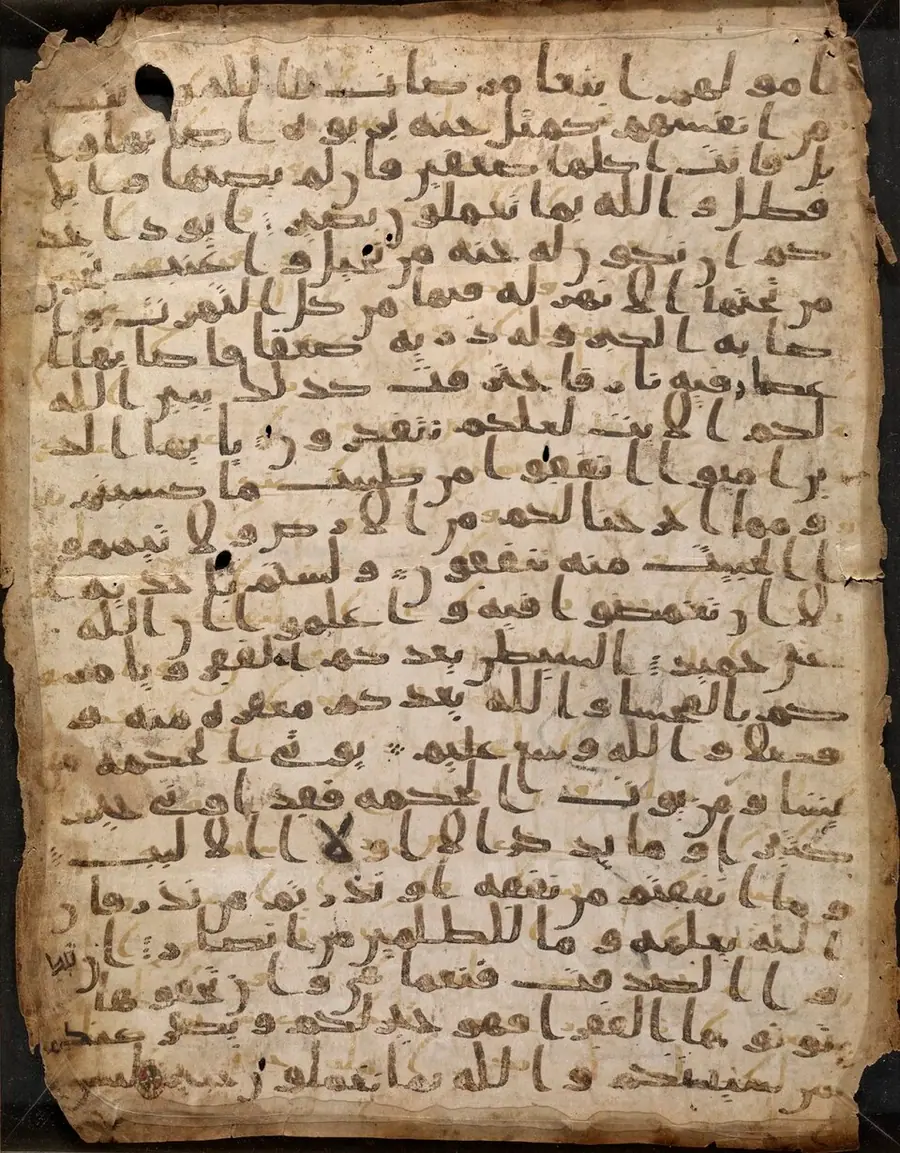
The short version: the “Satanic verses” are two lines that, according to reports in some of the earliest Muslim biographies and commentaries, Muhammad once recited in praise of three goddesses of Mecca, and then withdrew when told they had come from Satan. Whether the episode happened is debated. What can be dated is who reported it, who rejected it, and when.[1] Contested on the event; Consensus on where the reports appear. The full context is in the chapter on the Qur’an.
What the Qur’an says
Sura 53 names three goddesses whom the Meccans worshipped and dismisses them: “Consider al-Lāt and al-ʿUzzā, and the third one, Manāt… these are nothing but names you have invented yourselves” (Q 53:19–23).[2] The goddesses themselves are known from Arabian evidence outside the Qur’an (Late Antique Arabia).
Another verse speaks of Satan interfering with prophets in general: “We have never sent any messenger or prophet before you [Muhammad] into whose wishes Satan did not insinuate something, but God removes what Satan insinuates and then God affirms His message” (Q 22:52, trans. Abdel Haleem).[3] Consensus on the texts. The Qur’an itself does not quote any withdrawn verses about the goddesses.
Who were al-Lāt, al-ʿUzzā and Manāt?
The three goddesses were real objects of worship, attested long before Islam. Arabs across the north of the peninsula and the Syrian desert carved tens of thousands of short prayers in their own alphabets, and many name Allāt, al-Lāt.[4] The Greek historian Herodotus, in the fifth century BCE, already knew her as “Alilat”. She had a temple at Palmyra, and al-ʿUzzā and Manāt appear in Nabataean inscriptions as well.[5][6] Consensus
What is said about their shrines near Mecca comes almost entirely from later Muslim writers, above all the Book of Idols of Hishām ibn al-Kalbī (d. c. 820), which places al-Lāt at Ṭāʾif, al-ʿUzzā at Nakhla and Manāt on the coast between Mecca and Medina.[7] Historians use that book with care: it was written two centuries after Muhammad, long after the shrines had been destroyed (Late Antique Arabia).[8] Majority
Why “intercession”?
The withdrawn lines call the goddesses beings “whose intercession is to be hoped for”. That fits what the Qur’an itself says about Muhammad’s opponents. It assumes that they believed in God as creator: “If you ask the disbelievers who created the heavens and earth… they are sure to say, ‘God’” (Q 29:61).[9] Patricia Crone, analysing the Qur’an’s polemic, concluded that its opponents believed in God as the supreme deity and worshipped lesser beings, angels among them, as intercessors with him.[10] Majority on the reading of the Qur’an’s polemic. On that reading, the lines praise the goddesses not as rivals to God but as go-betweens, which is exactly what the Qur’an elsewhere rejects. That is why the story, if true, would mark a moment of compromise, and why later scholars found it so troubling. Majority
The reports
Several early biographies and commentaries tell a story that joins the two passages. At first, after naming the goddesses, Muhammad recited two further lines:
tilka l-gharānīqu l-ʿulā, wa-inna shafāʿatahunna la-turtajā
“These are the exalted cranes, whose intercession is to be hoped for.”
The Meccans, delighted, prostrated themselves with the Muslims. Then the angel Gabriel told Muhammad that Satan had cast the words onto his tongue, and Q 22:52 was revealed to console him.[11][12][3]
The story appears in the biographical dictionary of Ibn Saʿd (d. 845) and in al-Ṭabarī’s history and Qur’an commentary of the early tenth century, citing Ibn Isḥāq. It is not in Ibn Hishām’s edition of Ibn Isḥāq’s biography, the version through which that biography is mainly known.[11][12][13] Consensus on where the reports appear. Ibn Hishām says he left out material he thought unsuitable, which may explain the absence (How We Know). Majority
Accepted, then rejected
Shahab Ahmed’s study of every early report, Before Orthodoxy (2017), found that in the first two centuries of Islam the story was near-universally accepted by those who transmitted it, as an episode in the Prophet’s life that raised no special problem.[1] Majority
From the tenth century, scholars began to object. Ibn Ḥazm (d. 1064) called the report a fabrication, and Qāḍī ʿIyāḍ (d. 1149) set out the most influential case against it: its chains of transmission were weak, and it contradicted the Prophet’s protection from error in conveying revelation (ʿiṣma). By the thirteenth century rejection was general, and it is the view of most Muslims today.[1] Majority
The change is itself a piece of history. The same reports were read one way by the scholars of the eighth century and another way by those of the thirteenth, as the doctrine of the Prophet’s protection from error took its classical shape. Majority
Did it happen?
Modern historians are divided.
| View | Argument |
|---|---|
| It reflects a real event | No Muslim would have invented so awkward a story about the Prophet; W. Montgomery Watt argued this |
| It is a later story built from the verses | Commentators needed an occasion for Q 22:52 and 53:19–23, and joined them in a narrative; more recent work leans this way |
| The question cannot be settled | The reports are early but a century and more after the event, like most of the biography of Muhammad |
Ahmed’s study sets out the reports behind each view.[1] Contested The episode is a test case for the general problem of the sources: stories about Muhammad’s life were written down generations later, and some appear to have been built from the verses they explain (How We Know). Majority
The name, and the novel
“Satanic verses” is a modern English name, first used by the British historian William Muir in 1858, not an Arabic one; the Arabic sources speak of the story of the cranes (gharānīq). Consensus
On 26 September 1988 Salman Rushdie published a novel called The Satanic Verses. Its dream sequences include a prophet called Mahound and a scene drawing on the early reports about verses praising the goddesses of Mecca.[14] Consensus on the content. Many Muslims understood the book as an insult to the Prophet. On 14 February 1989 Ayatollah Khomeini called on Muslims to kill the author and all those involved in its publication who knew its contents; the novel’s Japanese translator was murdered in 1991. Muslim reactions were divided: many who condemned the novel rejected the death sentence (Revolution and Revival).[15][14] Political on the affair.
Common misconceptions
- “The Satanic verses are in the Qur’an.” They are not. The Qur’an names the goddesses only to dismiss them; the lines praising them are found in later reports, not in the text.[2] Consensus
- “The story was invented by Western critics.” It comes from Muslim sources of the ninth and tenth centuries, Ibn Saʿd and al-Ṭabarī, and early transmitters widely accepted it.[11][12][1] Consensus
- “The story proves Muhammad compromised with polytheism.” That is one reading of a disputed report. The Qur’an’s own text dismisses the goddesses, and whether the episode happened at all is unresolved; even on the story’s own terms, the lines were withdrawn.[2][1] Contested
- “Muslims have always rejected it.” Objections begin in the tenth century, and rejection became general only by the thirteenth.[1] Majority
- “Rushdie’s novel is about the episode.” It draws on it in dream sequences within a much larger novel about two Indian Muslim actors who migrate to London.[14] Consensus
References
- ^ a b c d e f g Shahab Ahmed Before Orthodoxy: The Satanic Verses in Early Islam. Harvard University Press, 2017. Shows the incident was widely accepted in the first two Islamic centuries and later rejected.
- ^ a b c Qurʾan 53:19–23 — The Qur'an. c. 610–632 CE. Arabic. The goddesses al-Lāt, al-ʿUzzā and Manāt dismissed as 'names you have invented': the setting of the Satanic verses reports. read the text
- ^ a b Qurʾan 22:52 — The Qur'an. c. 610–632 CE. Arabic. Satan insinuated into the wishes of every prophet, 'but God removes what Satan insinuates'. read the text
- ^ Ahmad Al-Jallad The Religion and Rituals of the Nomads of Pre-Islamic Arabia: A Reconstruction Based on the Safaitic Inscriptions. Brill, 2022. The gods and prayers of the Safaitic inscriptions.
- ^ Herodotus, Histories 3.8 — Herodotus, Histories. c. 430 BCE. Greek. The Arabs call Dionysus Orotalt and the heavenly Aphrodite (Urania) Alilat. about
- ^ Robert G. Hoyland Arabia and the Arabs: From the Bronze Age to the Coming of Islam. Routledge, 2001. The standard survey of pre-Islamic Arabia, its kingdoms, religions and languages.
- ^ Hishām ibn al-Kalbī, Kitāb al-Aṣnām — The Book of Idols. early 9th c. CE. Arabic. The fullest Muslim account of pre-Islamic Arabian gods: al-Lāt at Ṭāʾif, al-ʿUzzā at Nakhla, Manāt, Hubal in the Kaʿba, ʿAmr ibn Luḥayy. about
- ^ G. R. Hawting The Idea of Idolatry and the Emergence of Islam: From Polemic to History. Cambridge University Press, 1999. Argues that the Qur'an's 'associators' were monotheists judged deficient, not idolaters.
- ^ Qur'an 29:61 — The Qur'an. early 7th c. CE. Arabic. The disbelievers, asked who created the heavens and earth, 'are sure to say, God'. about
- ^ Patricia Crone The Religion of the Qurʾānic Pagans: God and the Lesser Deities. Arabica 57, 2010. The Qur'an's opponents believed in God and worshipped lesser beings as intercessors.
- ^ a b c Ibn Saʿd, al-Ṭabaqāt al-kabīr, vol. 1 (the gharānīq report) — al-Ṭabaqāt al-kabīr. before 845 CE. Arabic. Reports that Muhammad recited words praising the three goddesses before Gabriel corrected him. about
- ^ a b c al-Ṭabarī, Taʾrīkh al-rusul wa-l-mulūk and Jāmiʿ al-bayān, on Q 22:52 (the gharānīq report) — History of the Prophets and Kings; Commentary. early 10th c. CE. Arabic. Al-Ṭabarī's versions of the Satanic verses story, citing Ibn Isḥāq and other early authorities. about
- ^ Ibn Isḥāq, Sīrat Rasūl Allāh — The Life of Muhammad (recension of Ibn Hishām). mid-8th c. CE (Ibn Hishām's recension, early 9th c.). Arabic. The earliest surviving Muslim biography of Muhammad; source for his alliance and conflicts with the Jewish tribes of Medina (Qaynuqāʿ, Naḍīr, Qurayẓa) and the conquest of Khaybar. about
- ^ a b c Lisa Appignanesi and Sara Maitland (eds.) The Rushdie File. Fourth Estate, 1989. Documents and statements from the first year of the Rushdie affair.
- ^ Ruhollah Khomeini, statement on The Satanic Verses, 14 February 1989 — Radio Tehran broadcast. 14 February 1989. Persian. Khomeini calls on Muslims to kill the author and publishers of The Satanic Verses. about